Saturday, November 14, 2026


Rare Earths Americas doubles mineralized zone at Homer project in Brazil 


Drilling at the Homer project in Brazil. (Image: Rare Earth Americas )

Rare Earths Americas (NYSE American: REA) announced Thursday assay results from eight new drill holes at Homer-A, one of three 100%-owned exploration targets within the broader Homer project in Goiás, Brazil.

The latest results expand the known mineralized footprint by more than 60%, to approximately 3.5 km² (865 acres) from the 2.15 km² (531 acres) reported in September 2026. 

The mineralized zone now extends approximately 4.3 km along its longest dimension—roughly double the 2.1 km reported in September—and remains open for further expansion, the company said. 

Of the 20 holes within the primary geochemical anomaly with assays received to date, 19 have intersected mineralization above the reported cut-off, further supporting the scale and continuity of the system, REA said. 

Holes along the south-eastern margin of the complex returned the highest proportion of heavy rare earth oxides (HREO) found at Homer-A to date, with dysprosium and terbium oxides (DyTb) making up as much as 8.7% of total rare earth oxides plus scandium in individual samples. Multiple holes in this area returned elevated HREO and DyTb proportions, highlighting an emerging zone of heavy rare earth enrichment along the south-eastern margin that remains open to further drilling, the company said. 

Assays have been received for only 22 of approximately 180 holes planned for the 2026 program—roughly 12%—while approximately 11,800 meters, or nearly 80% of the planned 15,000-meter program, had already been drilled as of October 30, 2026. 

“What stands out in this second update on drilling is that Homer-A is becoming both larger and increasingly differentiated, REA CEO Donald Swartz said in a news release. 

“The known mineralized footprint has expanded by more than 60%, its longest dimension has roughly doubled, and drilling along the south-eastern margin has encountered the highest heavy rare earth and dysprosium-terbium proportions we have seen to date,” Swartz said.  “The heavy rare earth enrichment is occurring across multiple holes and intervals rather than in a single isolated sample, while the mineralized system remains open for further expansion.” 

The company said it expects to finish the program on schedule and continues to target a maiden mineral resource estimate in 2027. 

Rare Earth Americas controls four exploration projects, including ionic clay deposits in Brazil and a monazite-rich sands project in Georgia that management believes could represent the source rock for rare earth-bearing mineral sands already mined along the US coastal plain.  

REA stock closed Thursday down 10% in New York. The company has a $220 million market capitalization.   


Chile lithium output to reach 335,000 tonnes in 2027, Cochilco says


Evaporation ponds in Atacama’s Salt Flat, Chile. (Image courtesy of SQM.)

Chilean lithium production will grow 3.1% year-on-year in 2027 to reach 335,000 tonnes, according to a Thursday report by state copper commission Cochilco.

Production this year is expected to close at 325,000 tonnes, after totaling 311,000 in 2025.

Between January and July this year, 74% of Chilean exports were lithium carbonate, 21% sulfate and 5% hydroxide.

Sulfate exports grew from the 11% registered in 2025, becoming a strategic product for Chinese refineries, the report said.

The global market will close this year with a deficit of 79,000 tonnes, while 2027 will show a surplus of 42,000 tonnes, Cochilco added.

Chile holds 25% of the world’s available lithium reserves.

“Thanks to the unique evaporation and concentration conditions of the Atacama salt flat, our production maintains a stable and predictable growth trajectory,” said Paulina Avila, a mining market analyst.

(Reporting by Fabian Cambero; Editing by Aida Pelaez-Fernandez)


BHP plans overhaul of Australia iron ore business to cut costs


Jimblebar produced roughly a quarter of BHP’s iron ore in fiscal 2026,.(Image courtesy of BHP.)

BHP Group plans to restructure its Australian iron ore business as part of a wider cost-cutting effort aimed at helping the world’s largest miner cope with rising expenses and softer prices for the vital steelmaking ingredient.

BHP — where Brandon Craig took over as chief executive officer in July — has already cut 300 on-site workers from the division. It expects to reduce numbers further, primarily from its white-collar base, according to people familiar with the matter, who asked not to be named as the plans are not public. Currently, the Western Asutralia Iron Ore arm includes more than 16,000 employees and contractors.

While details are still being hammered out, the overhaul of the Perth-based division is expected to simplify management and put more of the support functions directly under the mining assets they serve, rather than in separate divisions, the people said. Some technology work, for example, will be moved out of the central structure, they added.

The changes, which build on efforts begun under former CEO Mike Henry, will ultimately extend beyond iron ore as BHP examines costs in other parts of the portfolio, the people said, adding other divisions could also face job cuts.

BHP declined to comment.

Virtually all the industry’s largest players have sought to streamline operations and boost productivity since last year as once-stellar margins begin to come under pressure. Rio Tinto Group CEO Simon Trott has also focused on simplifying the company, combining overlapping roles and stripping away layers of management, red tape and bureaucracy to create a slimmed-down operation centered on iron ore and copper.

China’s rapid industrialization more than two decades ago drove a dramatic acceleration in demand for steelmaking ingredients and transformed miners like BHP, with its vast, low-cost Australian mines, into a global powerhouse. Now that demand is cooling, costs are climbing and Beijing has also tightened its control over procurement.

BHP says it remains the Pilbara’s lowest-cost major iron ore producer, with mining expenses of about $16.40 a ton in its last financial year — compared to benchmark futures prices closer to $90. Rio’s Pilbara unit cash costs were about $25 a ton in the first half of 2026. 

(By Paul-Alain Hunt and Thomas Biesheuvel)

Indonesian tycoon said to weigh bid for Eramet’s nickel mine


Weda Bay Nickel site in Indonesia. (Image: Eramet.)

Indonesian tycoon Andi Syamsuddin Arsyad is considering buying Eramet SA’s stake in one of the world’s largest nickel mines, people familiar with the matter said, in what would be the second major deal by the coal magnate this year.

The billionaire known as Haji Isam may seek to buy part or all of Eramet’s 38.7% stake in PT Weda Bay Nickel, the people said, asking not to be identified because the deliberations are private.

Eramet may seek a valuation of as much as $4 billion for the entire mine, a person familiar with the matter said. Other sources gave a more conservative valuation.

Eramet shares climbed as much as 9.8% in Paris Wednesday, the biggest intraday gain since June 12. The stock has lost 33% this year, giving the French company a market value of €1.1 billion ($1.2 billion).

Other suitors for the holding include Indonesian sovereign wealth fund Danantara, people familiar with the matter have previously said.

Considerations are ongoing and no final decisions have been made, the people said. A representative for Paris-based Eramet declined to comment. Haji Isam didn’t immediately respond to a request seeking comment via his conglomerate PT Jhonlin Group.

Nickel has been performing weaker than most other base metals this year, declining around 3% year to date, as persistent oversupply outweighs concerns over potential production curbs in Indonesia.

A deal for WBN would follow another recent deal by Haji Isam, who in September agreed to acquire a stake in PT Bayan Resources, one of the country’s top coal miners. The billionaire, whose businesses include coal, palm oil, nickel and cryptocurrency, was among the biggest backers of Indonesian President Prabowo Subianto’s 2024 election campaign and now oversees major government projects.

Eramet has had a presence in Indonesia for about two decades. The government slashed WBN’s production quota earlier this year, forcing it to halt operations. The quota was later lifted in a mid-year revision. Prior to the cuts, WBN was the world’s largest nickel mine, producing 42 million tons of ore. Its other shareholders are Chinese stainless steel conglomerate Tsingshan Holding Group Co. and Indonesian state miner PT Antam Persero.

Eramet in February unveiled plans to raise funds through a capital increase and asset sales to curb its debt, which soared last year amid challenges at some of its overseas operations. Last month, France’s government announced it would become the Eramet’s top shareholder. 

Eramet earlier this week said that it has received expressions of interest from several investors for a significant portion of the group’s stake in WBN, and for a minority stake in its Centenario lithium plant in Argentina. Processes are underway, the company said, adding it agreed to sell undeveloped mining concessions in the Arizaro salar in Argentina for $71 million.


De Beers suitor aims to win customers back to real diamonds

De Beers used to be the prized possession of Anglo’s extensive business empire. 

The group in pole position to buy De Beers said it aims to bring customers back to real diamonds, and away from the synthetic gems that have deepened an industry crisis.

The Global Diamond Consortium, headed by former De Beers chief executive officer Gareth Penny, is in the closing stages of completing its purchase of the company after fending off rival bids. Crucially, the group won the support of Botswana, home of the diamond giant’s biggest mines.

Still, the GDC is poised to take over De Beers as the diamond industry slowly emerges from its deepest ever crisis. The gem market has been hammered by a slump in Chinese luxury spending, as well as the rising popularity of synthetic stones.

Synthetic — or lab-grown — diamonds are chemically identical to mined stones, yet an explosion in low-cost supply from China and India has seen prices plummet. That has put huge pressure on segments of the jewelry market where pinched consumers can buy synthetic gems for a fraction of the price. Now GDC wants to spur demand for natural diamonds.

“The market is still experiencing challenges and they are all about consumer demand and finding a way to address synthetics,” a GDC representative said, in some of the group’s first public comments on its plans.

Ever since De Beers monopoly collapsed at the start of this century, the industry has grappled with how to promote diamonds and fight off challenges like synthetic stones. Multiple attempts at industry-wide marketing have failed to deliver, while De Beers own foray into lab-grown gems was quickly aborted.

“This is about effective marketing because this is a demand side problem,” according to the GDC representative. “We want to find new, innovative ways to create demand for diamonds and we believe we have a lot of good strategies for that.”

The GDC has built a consortium of some of the industry’s biggest players. Botswana will double its De Beers stake to 30%, while other producing countries Namibia and Angola will also invest. Oman and some key customers are also in the group, while luxury house Richemont and retailer Signet Jewelers Ltd. are in talks to join, Bloomberg has previously reported.

“This is the time for everyone to work together and for the industry to unite,” the GDC representative said. “Each partner needs to bring its own competitive advantage and a common vision to lift natural diamonds to where they should be and that’s something that we are working towards.”

Anglo American Plc has been looking to sell De Beers since fending off an almost $50 billion approach from BHP Group in early 2024, but the process has been stymied by the diamond market crisis. Anglo has taken three impairments on the business in just three years, lowering its carrying value for De Beers to $2.3 billion in February.

Bloomberg reported earlier this year that Anglo is discussing a De Beers valuation of about $1 billion, with more payments based on the future performance of the business.

“It’s a process with Anglo American and we are trying to get things finalized as quickly as we can,” the GDC representative said.

(By Mbongeni Mguni and Thomas Biesheuvel)


Angola seeks 10% stake in De Beers under Anglo’s proposed exit


De Beers sources about 70% of its diamonds from Botswana.(Image courtesy of Anglo American | Flickr.)

Angola is seeking a 10% holding in De Beers as part of Anglo American’s (LON: AAL) proposed sale of its majority stake in the diamond producer, a mines ministry spokesperson told Reuters on Friday.

Anglo American put De Beers, which operates and explores for diamonds in Botswana, Namibia, Angola, South Africa and Canada, up for sale in 2024 as part of a broader restructuring amid falling diamond prices and growing competition from synthetic stones.

Botswana, which had the right of first refusal on Anglo American’s stake, on Monday backed the deal, saying it will double its holding to 30%.

President Duma Boko said that while Botswana would become De Beers’ single largest shareholder, the governments of Namibia and Angola would also participate in the transaction.

Angola’s mines ministry spokesperson was confirming a report in weekly newspaper Novo Jornal.

The report said Namibia was also seeking a 10% stake in De Beers. Namibian officials did not immediately respond to requests for comment.

Private buyers interested

Anglo American owns 85% of De Beers, the sale of which has also attracted interest from private buyers.

Swiss luxury group Richemont (SWX: CFR), owner of Cartier, is among firms in talks to join the Global Diamond Consortium, which Botswana said was the preferred bidder.

Richemont CEO Nicolas Bos said on Friday that the company sees the importance of natural precious stones for its collection, but declined to comment on potentially joining the group to buy De Beers.

In addition to Botswana, Angola and Namibia, the Global Diamond Consortium has said it is also working with Oman towards becoming co-owners of De Beers.

Anglo American said on Monday it would continue to work with the African nations and the consortium towards agreeing binding transaction documents.

(Reporting by Olivia Kumwenda-Mtambo;Additional reporting by Brian Benza in Botswana, Miguel Gomes in Luanda and Nyasha Nyaungwa in Windhoek;Writing by Sfundo Parakozov;Editing by Alexander Winning, Kirsten Donovan)


Copper shortage or surplus? Banks split on 2027 outlook


Copper may be heading for a surplus on paper, but a shortage where it counts. ( Reference image courtesy of Minera Centinela.)

Deutsche Bank says copper prices could surge to $10 a pound by mid-2027 as shrinking supplies of readily available metal threaten a liquidity crisis, challenging a more cautious outlook from Goldman Sachs.

The bullish forecast comes as Goldman Sachs warns its $15,400-per-tonne copper price projection for 2027 faces downside risks following the US midterm elections. The bank estimates prices could average $14,600 a tonne if investor positioning remains unchanged, or about $14,500 if reduced tariff expectations undermine US stockpiling.

“We are probably today in the scarcest copper environment since the 1980s,” Daniel Ghali, Deutsche Bank’s head of metals research, told MINING.COM host Devan Murugan in an interview this week. “The market still is not pricing in the kind of scarcity that we’re seeing.”

The competing forecasts expose a growing divide over whether copper’s next major price move will be driven by tightening physical supplies or weakening investor confidence. The outcome could have significant consequences for miners, manufacturers and investors as the market approaches 2027.

Mined copper

Ghali said global above-ground copper inventories have probably fallen to their lowest levels since 2006, with much of the remaining metal increasingly inaccessible to buyers outside China and the US.

Deutsche Bank estimates that by the end of 2026, only 30% of those inventories will be available for purchase, with the remainder effectively locked within the two countries. Continued stockpiling could push accessible supplies dangerously close to zero, Ghali warned.

The shortage is already evident in physical markets, even though benchmark prices have retreated. Copper cathode premiums in Shanghai have reached record levels, while pricing across commodity exchanges points to increasingly tight supplies.

Ghali said the disconnect reflects the difference between the amount of copper in existence and the metal actually available for immediate delivery.

“It’s not that demand is so strong at the moment,” he said. “We think demand is resilient, but it’s not a demand story per se. It’s actually a liquidity crisis that’s in the making.”

The International Copper Study Group (ICSG) offers a contrasting outlook, forecasting that the global refined copper surplus will more than triple by 2027 as smelter production rebounds faster than demand.

The projection highlights a distinction between overall supply and the metal available for immediate delivery. While the ICSG anticipates excess refined production, Deutsche Bank argues that inventories concentrated in China and the US could leave buyers elsewhere competing for an increasingly limited pool of accessible copper.

The pressure could intensify without any significant acceleration in consumption, Ghali said. He noted that manufacturers are largely buying copper as needed, leaving the market vulnerable if steady purchasing exhausts available inventories.

Ghali pointed to the October 2025 silver squeeze as an example of how restricted liquidity can magnify price movements. Once available supplies become sufficiently constrained, even relatively small purchases can produce outsized price increases.

Goldman Sachs sees a different set of risks. The bank argues that investor positioning, rather than physical demand, presents the biggest threat to its copper outlook.

Concerns that a Democrat-controlled Congress could slow artificial intelligence investment and data-centre construction have made investors more cautious about the sector’s future demand for copper.

“The main risk to our forecast stems from positioning rather than physical demand,” Goldman Sachs said in a research note.

Tariff uncertainty

US trade policy represents another potential catalyst for copper prices, particularly as markets assess the likelihood of tariffs on refined metal.

Ghali identified proposed duties on refined copper cathode as the most immediate policy issue facing the market. He cited a US Commerce Department recommendation for a 15% tariff beginning in January 2027, rising to 30% a year later.

Such measures could encourage additional stockpiling in the US, further restricting supplies available to consumers elsewhere.

Goldman Sachs, however, warned that diminished expectations for tariffs could undermine its assumptions about US inventory accumulation. A reversal of this year’s stockbuilding could release metal back into international markets and put additional pressure on prices.

The bank said copper could fall below its revised scenarios if most of the US inventories accumulated in 2026 were redistributed globally.

Ghali acknowledged that a recession poses the most serious threat to Deutsche Bank’s bullish forecast because weaker industrial consumption could eliminate the pressure created by scarce inventories.

“Scarcity is only relevant for as long as demand for that commodity is relevant,” he said.

Deutsche Bank does not expect a recession in 2027 and anticipates little disruption to AI infrastructure spending or global data-centre expansion.

Beyond copper, Ghali described a widening divergence between precious metals. He expects gold to benefit from persistent structural demand, including purchases by central banks and other official institutions, even as higher interest rates weigh on investment sentiment.


Chile mulls private-sector role in Codelco’s mines and infrastructure

Credit: Codelco via Flickr

Chile is considering ways to bring private companies into Codelco’s mining operations and infrastructure, potentially forming partnerships well beyond the exploration ventures currently used by the state copper giant.

Those companies could participate in the exploitation of some Codelco deposits or team up with the company on infrastructure and processing facilities, Mining and Economy Minister Daniel Mas said in an interview on Friday. The government is evaluating legal changes that could pave the way for private participation in deposits currently reserved for Codelco, he said.

Mas’s comments stand to further inflame a politically charged debate over private capital at Codelco, after leftist politicians and unions raised concerns that President José Antonio Kast’s government could be laying the groundwork for privatization. The company has struggled to reverse a production slump as operational setbacks, project delays and declining ore grades weigh on its aging mines. In an interview with Bloomberg News this week, Finance Minister Jorge Quiroz left the door open to private investment in the company itself. 

Mas stressed that Codelco will remain state-owned and said the government isn’t currently discussing the introduction of minority shareholders. Still, trying to bring private companies into some existing mining operations would push its partnership strategy into more sensitive territory than exploration ventures on undeveloped properties.

The alliances described by Mas could be key to Codelco’s chances of lifting output over the next several years. Exploration partnerships can help unlock the firm’s vast geological potential, but discoveries can take decades to reach production. 

The strategy also has implications for a global market struggling to bring on enough new supply to meet growing demand from power grids, electrification and data centers.

“We have to look for private partners,” Mas said from his office in downtown Santiago ahead of a state visit to Vietnam, China and Japan, where critical minerals will be a focus of meetings with potential investors. “The most obvious thing is for them to enter exploration. But the other is in exploitation.”

Mas said private participation in exploitation would be easier at some mines than others, with some cases potentially requiring legal changes.

More pressing

Codelco’s need for outside capital has become more pressing as declining production and record debt constrain its ability to finance projects. Mas said the government wants the company to operate safely and profitably without continuing to increase borrowing.

One option would be for Codelco and private miners to jointly develop facilities or share infrastructure to capture economies of scale, Mas said. Asked specifically whether private capital could participate in an existing operation such as the Gabriela Mistral mine, Mas didn’t rule it out.

“We are looking at private capital in all the areas where it is possible,” Mas said.

“If we are all convinced that Codelco has the potential to grow” — and that it faces capital constraints — “well, this is the formula,” he said. “I’d like there to be broad consensus in Congress to be able to approve it.”

The precise mechanisms haven’t been determined. Mas said Codelco should design the appropriate structures, while the government as shareholder sets parameters including debt limits, profitability and safety.

Codelco is also reviewing potential sales of non-core assets as it seeks to focus capital on its main operations. Among the assets that could be reviewed include company interests abroad, as well as its investments in ports, Mas said.

For now, the priority is to stabilize operations and to put finances in order before returning to growth, Mas said.

The overhaul has taken on greater urgency after Codelco disclosed irregularities that falsely boosted reported copper output in 2024 and 2025. The firm has dismissed managers, referred the matter to prosecutors and commissioned outside audits.

Despite its problems, Mas said Codelco remains attractive to potential partners because of its geological assets, workforce and technical expertise. Its potential remains “gigantic,” he said.

(By James Attwood and Carolina Gonzalez)


Op-Ed: Europe is stockpiling critical minerals. Wonderful. Can anyone actually use them?


Image credit: Pascal Ingelrest via Pexels.

There is something tremendously comforting about a warehouse. You can photograph it, measure it, put a ribbon across the entrance and invite a commissioner to cut it. If you fill it with enough material, you can even announce that Europe has become more secure. A functioning industrial supply chain is rather less obliging. It insists on factories, skills, equipment, investment and, most inconveniently, the ability to turn one thing into another.

Brussels is now moving to build strategic reserves of critical raw materials through RESourceEU. Given Europe’s exposure to export restrictions, geopolitical disruption and concentrated supply chains, this is a sensible development. Frankly, it’s overdue.

But before we start congratulating ourselves on the size of the pile, might I ask an awkward question? What, exactly, are we buying? Because securing a mineral and securing the ability to use that mineral are two entirely different achievements. Confusing them could leave Europe with a magnificent collection of strategically important rocks and precisely the same industrial dependencies it had before.

A warehouse full of the wrong stuff

Consider tungsten. It matters enormously to cutting tools, industrial machinery and defence. Excellent! Let’s stockpile tungsten, then.

Except tungsten concentrate is not ammonium paratungstate. Neither is tungsten powder, nor tungsten carbide. They occupy different stages of a processing chain and are not interchangeable simply because the word tungsten appears on the paperwork. Suppose Europe buys a splendid reserve of concentrate. The tonnage looks impressive. The procurement department has excelled itself. There may even be a commemorative photograph.

Then a crisis interrupts access to the overseas facilities needed to convert the concentrate into industrial products. European manufacturers ask for the material they can actually use, and we proudly direct them to a building full of something they cannot. That’s more storage arrangement than it is resilience. Rare earths are no different. Mixed concentrate, separated oxides, metals and magnet alloys are not four varieties of the same product. They serve different functions and require different processing capabilities. A magnet manufacturer cannot solve a shortage of suitable inputs by being handed a bag of mixed concentrate and encouraged to show initiative.

Of course, buying more advanced products presents a different problem. They may be immediately useful, but if they come from the same concentrated processing networks, the dependency has not disappeared. Europe has simply bought itself time. Whilst that time certainly has value, it would be a mistake to confuse it with a cure.

The trouble with buying things is that it’s easier than building them

The Critical Raw Materials Act sets a 2030 benchmark for EU processing capacity equivalent to at least 40% of annual strategic raw material consumption. RESourceEU’s December 2025 action plan brings stockpiling and joint purchasing together with investment support and supply diversification. On paper, splendid, but in practice, these ambitions could pull in rather different directions.

Imagine two proposals land on a procurement official’s desk. One offers refined material from an established overseas producer, available relatively soon. The other would help establish processing capacity in Europe, involving permits, financing, construction, commissioning and the usual succession of expensive surprises.

Now tell that official their performance will be judged by price, delivery speed and tonnes acquired. Which proposal do you suppose will win? I honestly wouldn’t blame the official. We’ve designed a system in which buying today’s material may look like success, while building tomorrow’s resilience looks suspiciously like a delay. This is why strategic stockpiling cannot be treated as a shopping list with a flag attached. Procurement is industrial policy, whether Brussels chooses to recognise it or not.

To be fair, overseas purchasing need not undermine domestic investment. Properly structured reserves could create reliable demand, underpin long-term offtake and help finance European processing facilities. But that requires design, not wishful thinking. Europe’s buying power should strengthen its building power, otherwise, we’ll have prepared beautifully for the next shortage and done remarkably little about the one after it.

Partners, not convenient places from which to extract things

There is also the small matter of the rest of the world. The EU has strategic raw materials partnership with countries including Zambia, Namibia and Chile. These are meant to support more secure supply chains and sustainable development. A very fine objective, provided we remember that the partner countries have objectives too.

Zambia wants more beneficiation and domestic value addition. Namibia has restricted exports of certain unprocessed minerals to encourage local processing. Neither country is especially eager to remain a picturesque source of raw material while someone else captures the industrial value. And why should they be?

Europe sometimes talks as though supply-chain security requires every useful processing facility to stand within the EU’s borders. It doesn’t. Security requires reliable, diversified capabilities across the chain, supported by stable relationships and realistic logistics.

Suppose European investment helps develop processing in Zambia, another refining route in a different partner country, and downstream manufacturing within Europe. That could provide substantially more resilience than buying raw materials from five countries and sending all five shipments to the same processing hub elsewhere.

We are very fond of diversifying where minerals are dug up. We ought to show a similar enthusiasm for diversifying where they become useful. And if Europe’s procurement commitments help partners build industries of their own, that is not an act of charity. It is a rather intelligent form of self-interest.

An old battery is not a new battery

Then we have recycling, another subject on which policy announcements can move considerably faster than physical materials. Europe already has critical metals in industrial scrap, electronic equipment, batteries and other end-of-life products. This is a resource worth recovering. But collecting an object containing a metal is not the same as recovering that metal to a specification with which somebody can manufacture.

A warehouse full of spent batteries is not a reserve of battery-grade lithium, nickel and cobalt. It is a warehouse full of spent batteries. It might seem semantic, but chemistry is notoriously indifferent to political enthusiasm.

Nor can these materials necessarily move wherever we please. Depending on their classification and composition, secondary streams may be subject to waste shipment controls, notifications and restrictions. Those rules serve legitimate environmental purposes, and are not inherently obstacles that should simply be removed. The answer is to understand how collection, legal movement, recovery, refining and industrial use fit together before counting a secondary material as strategically available.

So you see, ore and waste are governed through different policy pathways, yet both ultimately depend on the same practical question: can we get from the material we have to the product industry needs, when it needs it?

Weaponise the wallet

Europe has something more powerful than a warehouse, it has enormous collective purchasing power. Perhaps it ought to use it for something more imaginative than winning an international trolley dash.

Rather than judging contracts only by price, volume and delivery, the EU could ask what each purchase does for long-term resilience. Does it diversify processing? Support new refining capacity? Underpin recycling infrastructure? Create a commercially credible alternative when an existing route fails?

For some materials, procurement could be linked to European processing projects. For others, long-term offtake agreements, joint ventures or purchasing commitments could support facilities in partner countries. Where legally and commercially suitable, targeted value-addition conditions might make sense.

Not a splendid, one-size-fits-all bureaucratic rule demanding that every mineral be treated identically. A tungsten chain may need conversion capacity. A rare-earth chain may need separation or magnet manufacturing. Different bottlenecks require different solutions. This should not be controversial, although one never quite knows. Every major purchasing decision should therefore answer two questions:

what material are we securing now, and what capability are we helping create for later? If the answer to the second is ‘nothing whatsoever’, we should at least have the decency to admit we’re buying insurance, not independence.

A stockpile is not a strategy

To judge a strategic reserve by tonnage alone is rather like judging a hospital by the number of beds it owns, without checking whether it has doctors, electricity or a functioning operating theatre. An impressive inventory, certainly. A less impressive outcome when somebody actually needs help.

Buying time is perfectly sensible, if we use it to build something. The Critical Raw Materials Act and RESourceEU give Europe a framework for doing so. The challenge is making procurement, processing investment, recycling and international partnerships work as one system rather than four separate administrative triumphs. Because the nightmare is not that Europe’s strategic stockpile will be empty, but that it will be gloriously, expensively and impeccably full, whilst the factories sit in silence.

Dr. Nicholas Vafeas is the Founder and Director of BluMelt Mineral Consulting Limited, an independent consultancy specialising in critical mineral intelligence, resource assurance and investment de-risking.


Guinea gold mining crackdown leaves 10 dead, sparks exodus

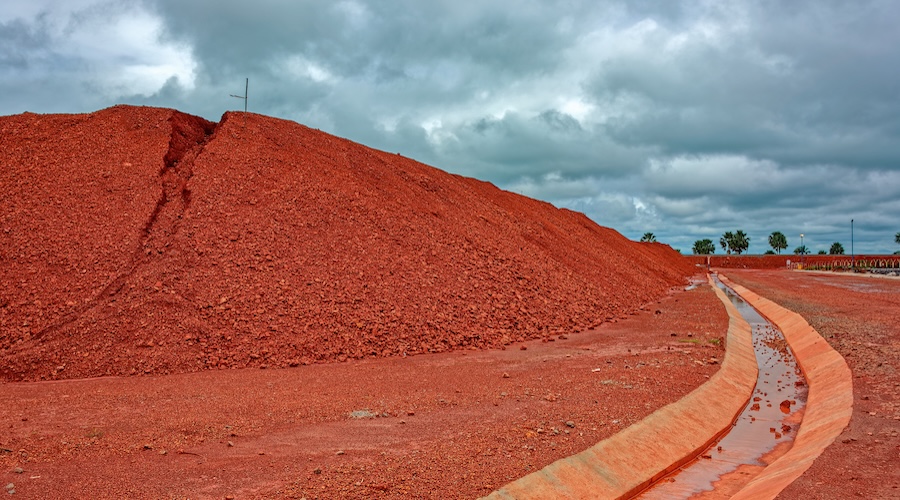
Large piles of bauxite ore sit at a treatment area storage in Guinea. (Stock image by Igor Groshev.)

Ten people have been killed in clashes between security forces and protesters in Guinea’s northeastern gold-producing region of Siguiri, as a government crackdown on illegal mining triggers mass expulsions and a growing humanitarian crisis in neighbouring countries.

The violence erupted Wednesday when defence and security forces attempted to enforce a Nov. 2 ban on unregulated artisanal gold mining, Reuters reported. Protesters erected barricades on public roads before the confrontation escalated into an exchange of gunfire, Guinea’s Ministry of Territorial Administration said in a statement.

Five foreign nationals were among those killed, while 13 people were injured, according to provisional government figures. Authorities did not disclose the nationalities of the foreign victims.

The unrest highlights the growing economic and humanitarian fallout from Guinea’s efforts to curb illegal gold production in a region where artisanal mining provides livelihoods for thousands of workers and their families. The crackdown has strained relations with neighbouring Mali and Burkina Faso, which are struggling to accommodate large numbers of expelled migrants.

Mass displacement

Guinea imposed the ban after authorities blamed unregulated mining operations for extensive environmental damage, including the contamination of agricultural land and rivers and the destruction of vegetation.

Security forces have arrested more than 1,200 suspected illegal miners in northeastern Guinea, with the first mass trials opening this week in the capital, Conakry.

The enforcement campaign has driven tens of thousands of miners and their families across the border into Mali, where authorities have warned of a potential humanitarian catastrophe.

About 100,000 displaced people have arrived in Mali’s capital, Bamako, while nearly 60,000 others have gathered in the border town of Kouremale, according to Malian authorities.

The Malian government has also recorded 11 deaths linked to the displacement crisis, separate from the fatalities reported in Guinea.

Burkina Faso, meanwhile, said Friday it had repatriated 45,406 citizens forced to leave Guinea following the ban. Officials in Ouagadougou have complained that their nationals were subjected to inhumane treatment during the expulsions.

Regional security fears

The influx of displaced miners has raised concerns that armed extremist groups operating across the Sahel could exploit the growing humanitarian emergency to recruit vulnerable migrants.

“These people are vulnerable. We are looking at ways to prevent them from being approached by terrorist networks,” a Malian security ministry official told Agence France-Presse.

Guinea, the world’s largest bauxite producer, also holds significant gold reserves exploited by industrial operators including Société Aurifère de Guinée, a subsidiary of AngloGold Ashanti, alongside two semi-industrial companies and hundreds of artisanal miners.

Artisanal mining remains a major source of employment across West Africa, where rising metal prices and growing demand for gold have encouraged informal operations, often beyond the reach of government oversight.