Sunday, November 15, 2026

‘Betrayal’: Ontario couple’s three-year wait to return to Stellantis may end in heartbreak

NATIONALIZE STELLANTIS UNDER WORKERS CONTROL


By Kamil Karamali
CTV NEWS
Published: November 15, 2026 


Two Stellantis employees that have spent around three years waiting for their jobs to return are speaking out about the potential plant sale.

As Joshua Taylor watches his seven-year-old daughter and three-year-old son play at a Brampton, Ont., playground not far from their home, he says a wave of emotion comes over him -- thinking about the sacrifices he’s made for his employer, Stellantis, over the years, and how that job might now be gone for good.

“I sacrificed, we sacrificed,” he said through tears, recalling working through the pandemic as an “essential” worker and having to keep his distance from his children. “I had to say hi to my kids through a door.”

His wife, Samantha Lafave, also a Stellantis employee, has been sitting idle alongside her husband – just like the plant where they worked for nearly three years.

But this week, news that Stellantis has agreed to sell the Brampton assembly plant to Canadian armoured vehicle manufacturer Roshel left the couple feeling betrayed and questioning their family’s future.How to set CTV News as your preferred source on Google

“It was just like everything came crashing down and you were filled with fear and loss and heartbreak,” Lafave told CTV News. She said the feelings stem from realizing they might lose “the future that we have (spent) the last eight years of our life building and looking forward to.”

The Brampton plant stopped production in December 2023 for what was supposed to be a temporary shutdown to retool the facility, but Stellantis ultimately moved its planned Jeep Compass production to Illinois amid a tariff dispute with the United States.

On Monday, the automaker announced it had signed an agreement to sell the facility to Roshel, leaving more than 2,000 laid-off workers in limbo.

“We feel (a sense of) betrayal. We feel sad, devastated and angry,” Taylor said of the past year. “Progressively more and more angry.”
A promise of priority, but no guarantee of a job

Both Stellantis and Roshel have told CTV News the sale would breathe new life into the idled facility, creating jobs for Canadian workers.

Roshel says it plans to establish a centre for advanced automotive and defence manufacturing, with the potential to create more than 2,000 jobs as production ramps up.

“Laid-off workers will receive first priority consideration as we hire,” the company said in a statement Friday.

But Vito Beato, president of Unifor Local 1285, which represents workers at the Brampton plant, isn’t reassured.

“There are no guarantees there,” Beato told CTV News. “Priority – what does that mean?

“We’re talking about our collective agreement that we already have here and that should be respected. All our workers should be following through with those successor rights and our collective agreements.”


Beato says the union isn’t giving up on its collective agreement with Stellantis – and neither, it appears, is the federal government.

In an interview with Vassy Kapelos on CTV’s Question Period airing Sunday, Industry Minister Mélanie Joly said Stellantis could be eligible for additional taxpayer funding if it agrees not to sell the plant.

“If it’s to save the plant, we would be actually doing what we’ve done with Ford, what we’ve done with Honda, and what we’ve done with Toyota,” Joly said, referring to government support for automakers affected by U.S. tariffs.

Her comments come after Ottawa threatened legal action against Stellantis over its contractual obligations.
Questions about Roshel’s plans and reputation

If the sale goes through, there are plenty of unknowns about the new jobs: whether they would offer comparable wages; whether workers would remain unionized; and what would happen to the protections they’ve had under their collective agreement.

“They should be taking our members, they should be taking our collective agreement,” Beato said.

“We have to sustain a life. We have kids, you know, we have obligations,” Lafave said, becoming emotional as she considered whether another job could provide comparable pay and hours.

For the couple, however, their concerns go beyond the size of a paycheque.

Roshel has drawn protests over a proposed sale of armoured vehicles to Israel, which the company said were intended for police use. Canada stopped approving new arms export permits for Israel that could be used in Gaza in January 2024.

The company also faced protests outside its existing Brampton facility after securing a roughly $10-million contract to supply 20 armoured vehicles to U.S. Immigration and Customs Enforcement, or ICE.

“I’m very anti-ICE -- it’s a very disgusting taste in my mouth” Taylor said, adding that he is uncomfortable with the company’s business dealings with Israel as well.

Lafave says working for Roshel would be difficult after years at a company she describes as family-oriented.

“It’s hard to see how you could support or be a part of a company that is taking that away from others,” she said.

Through all of the uncertainty, the couple is still holding on to hope that the sale won’t go through – and that they’ll someday return to the assembly line.

“Our hearts are with Stellantis. Our hearts are in that company,” Lafave said. “We’re going to go down fighting for it.”

Related Stories


Could everything be broken? Grounded jets, Microsoft outage, AI chaos make some wonder

By The Associated Press
Published: November 15, 2026 

Maybe the trouble started with the AI billionaire and the Silicon Valley chaos that followed talk of his infidelity, including with an alleged Chinese spy. Or maybe it was the Microsoft outage that, depending on how you looked at it, either cast millions of frustrated workers adrift or spared them from a daily, unrelenting electronic avalanche.

But by Friday afternoon, when U.S. authorities suddenly ordered every plane across the country to land immediately, it felt to many that something was up. Something was broken.

Just ask Chuck Amasio, a 68-year-old from Rahway, New Jersey, trying to fly out of Newark Liberty International Airport when his canceled flight led to a few beers with his brother in an airport bar and eventually a night in a hotel. Saturday morning, he was back at the airport to try again.

“There’s a lot of weird stuff going on,” Amasio said. “It makes one think.”

His first thought was dark: “We talk about how wars aren’t done with bombs anymore. They shut down airspace or a power grid. They can cripple an economy.”

An American Airlines flight takes off from Ronald Reagan Washington National Airport in Arlington, Va., after the Federal Aviation Administration grounded flights nationwide, Saturday, Nov. 14, 2026. (AP Photo/Tom Brenner)

Throw in a few more examples just from Friday – a cruise ship that overturned in New Orleans when a tanker slammed into it, suspicious drones over a U.S. air base in Britain, a bomb found near an ethanol plant in Ohio — and perhaps things seem even weirder, opening the door for a writer who has been picking at America’s fears for generations to offer his own explanation.

“The aliens have landed,” Stephen King wrote in a Friday afternoon tweet. “That’s the REAL reason for the ground stop. They don’t want to start a worldwide panic.”

The official explanations for the thousands of downed jetliners and hours of email and other computer troubles were far more prosaic.

A technology upgrade on the nation’s air traffic control system had overloaded antiquated equipment and caused “intermittent” communications and radar gaps, leading to the ground stop that lasted more than four hours, administration officials said.

By Saturday morning, air travel was already smoother and Bryan Bedford, administrator of the Federal Aviation Administration, said airline schedules should be back to normal by late Sunday.

Microsoft, for its part, said Saturday that its services had been fully restored, saying the problem “was introduced by an issue during an earlier network capacity upgrade that surfaced” following a recent network change.

The outage is believed to have affected many millions of people around the world.
‘Is this a cyberattack?’

Maxine Gustafson, a 34-year-old physician assistant from Minneapolis, was in line to pick up a hastily booked rental car at Chicago’s O’Hare airport on Friday afternoon so she and colleagues could get home from a work training.

Gustafson said the week’s mishaps made her feel afraid and helpless.


“It makes you think, like, is this a cyberattack?” she said. “We don’t have control over a lot of this stuff.”

A computer screen shows the Microsoft support page in London, Friday, Nov. 13, 2026. (AP Photo/Kirsty Wigglesworth)

Both the FAA and Microsoft said there were no signs that malicious activity had been behind the troubles.

Tori Perkins, 34, was hoping for a Saturday flight at Terminal 2 at San Diego International Airport, where 11 of the 62 flights already were listed as canceled that morning and the same number were delayed. Crowds were normal.

“It’s one of those things where I don’t necessarily believe what the government says,” said Perkins, who seemed to take the setback in stride. “I don’t know what’s true because there are so many people saying different things.”

Perkins, who lives in Hawaii, was in San Diego on a layover on her way to see family in Florida. She spent Friday night at the airport.

She was not surprised that Secretary of Transportation Sean Duffy had made a plea Friday for tens of billions in more funding to upgrade the country’s notoriously outdated air traffic system.

“It sounds like more of the same,” she said.

The FAA has already replaced thousands of copper wire connections with fiber optic lines and upgraded hundreds of radio systems as part of the overhaul that began last year after Congress approved $12.5 billion in funding. The White House has been pushing for $30 billion more to complete the work.
Bright spots ease concerns

Sometimes chaos brings out the best in people.

Corbyn Wascher was stuck on the tarmac at Charlotte Douglas International Airport for four hours while heading back to Moline, Illinois, from Miami, where he had been at an education conference.

He said everyone was cordial on the plane, talking to one another and stretching their legs. He was impressed with the American Airlines staff, who handed out water, pretzels and biscotti snacks, though they were clearly under stress.

Aircraft are seen at Hartsfield-Jackson Atlanta International airport, Friday, Nov. 13, 2026, in Atlanta. (AP Photo/Mike Stewart)

“The stewardesses were amazing,” said the 37-year-old high school teacher.

Back at the Newark airport, Caroline Ruiz had caught a few hours of sleep by a heating vent. She wasn’t sure what time it was as she waited for someone to bring her a meal she was promised after the cancellation of the first leg of her 24-hour trip to Australia. She hoped to get started later Saturday.

It was two days in a row, she noted, where she had been betrayed by technology.

Though maybe one of those days didn’t count as a betrayal.

“I kind of got a free day yesterday” because the Microsoft systems were down.

Associated Press journalists Elliot Spagat in San Diego, Ali Swenson in Chicago, Jessica Hill in Las Vegas and Aron Ranen in Newark contributed to this report.

Tim Sullivan, The Associated Press


Most Canadians would reject a trade deal that includes tariffs, Nanos survey suggests

By Michael Serapio
CTV NEWS
Published: November 15, 2026 

A new Nanos poll finds that a growing number of Canadians are feeling confident about doing trade with countries other than the U.S. Michael Serapio reports.

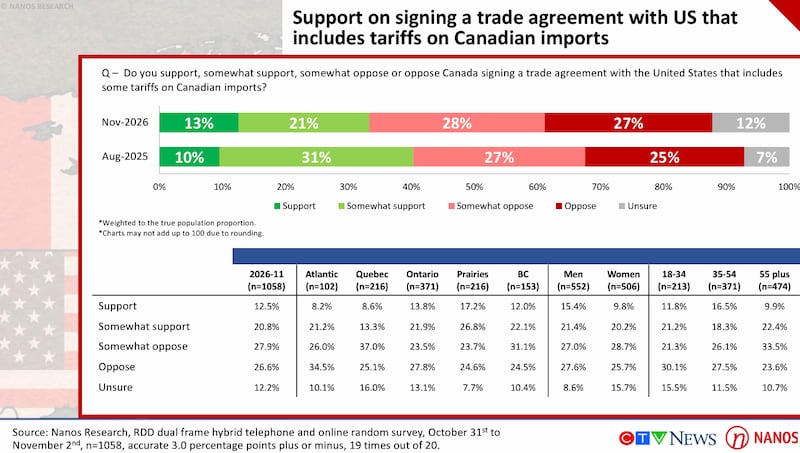
Canadians are increasingly opposed to any U.S. trade deal that would include tariffs on Canadian goods.

A new poll by Nanos Research and commissioned by CTV News finds just 33.3 per cent of Canadians would support such an agreement. That’s down from a similar survey in August of 2025 that found 41 per cent of Canadians willing to accept a deal that included import duties.

The results suggest growing resistance among Canadians to accepting a trade deal that leaves tariffs in place.

“Canadians feel more loved,” said Barry Appleton, international trade lawyer. “We’ve been courted by the Europeans. We’ve been courted out by the Philippines. We’ve been courted out in ASEAN. We’re talking to India for the first time. We don’t feel like we’re being rejected by our best friend. We’re feeling like we’re being loved at a party.”

That growing appreciation from other countries may explain why Canadians would prefer to find trading partners that don’t impose tariffs on Canadian products.


But that confidence can do little to alter North America’s geography, Canada’s proximity to the United States, and the natural trade flow those realities create.

“The problem is seven out of every $10 that we that we export still goes to the United States. So we still need to figure out how to make that relationship work,” said Appleton.

He added, “At the end of the day, the United States has made it clear with every single one of its trade partners -- the EU, for example, Great Britain is another good example -- they’re all paying. So, the price of getting to the United States is paying tariffs now. It’s pay-to-play. The question is going to be: Can we afford that, or can we not?”

That is the very question Canadian officials are mulling over right now.

In the past few weeks, trade talks between Canada and the United States have restarted, with the U.S. Ambassador to Canada, Pete Hoekstra, expressing confidence a trade deal can be reached before the end of the year.

Prime Minister Mark Carney addressed those talks on Saturday during a news conference in Manila, stating that, just before leaving for his current overseas trip, he had a substantive conversation with U.S. President Donald Trump.

“We are making progress,” said the prime minister. “There is a possibility of a deal, a bilateral deal, but we’re not yet there.”

It is impossible to know if any final agreement will include tariffs, but every signal from American officials suggest import duties will be a part of any deal the Trump administration signs.

And while the Nanos survey suggests most Canadians would reject a trade deal that includes tariffs, those closely involved in the Canada-U.S. trade file say tariffs are now part of the reality, and Canadians may have to learn to live with them.


Results of a survey conducted by Nanos Research and commissioned by CTV News are shown.

“I think it’s pretty unlikely we’ll get back to a world of zero tariffs,” said Maryscott Greenwood, a Canada-U.S. relations consultant and head of Ottawa Street Strategy.

Greenwood says most Canadian goods still enter the U.S. tariff-free under the Canada-U.S.-Mexico Agreement (CUSMA). And despite the tariffs imposed by Trump through executive orders, Canada’s overall effective tariff rate remains relatively low.

She understands why industries hit by tariffs want the issue addressed but says preserving Canada’s relatively favourable position could give the country an advantage over other global competitors in the U.S. market.

“Canada’s effective tariff rate right now is at about five per cent, and that’s not as good as zero, but it’s better than, you know, a lot of the rest of the world.”

Appleton says any agreement reached now would fall short of ideal, but failing to secure a deal could inflict even greater damage on Canada’s economy by prolonging the uncertainty of the past year and a half.

“Canada still has a benefit with a trade deal if we can get some certainty,” he said. “It’s the lack of certainty, it’s the lack of political clarity that’s costing Canadians jobs, costing us in-bound investments, costing us expansion for our plants. That’s what we need to address.”

That leaves the federal government with two challenges: negotiating a deal with the U.S. and convincing Canadians to accept it if the final agreement includes tariffs.
Methodology

The results come from an omnibus survey conducted by Nanos Research using a dual-frame hybrid telephone and online random survey.

Nanos surveyed 1,058 Canadian adults between Oct. 31 and Nov. 2. The results were statistically checked and weighted by age and gender using the latest census information, and the sample was geographically stratified to be representative of Canada.

The margin of error for this survey is plus or minus 3 percentage points, 19 times out of 20.


Michael Serapio

National Correspondent, CTV News


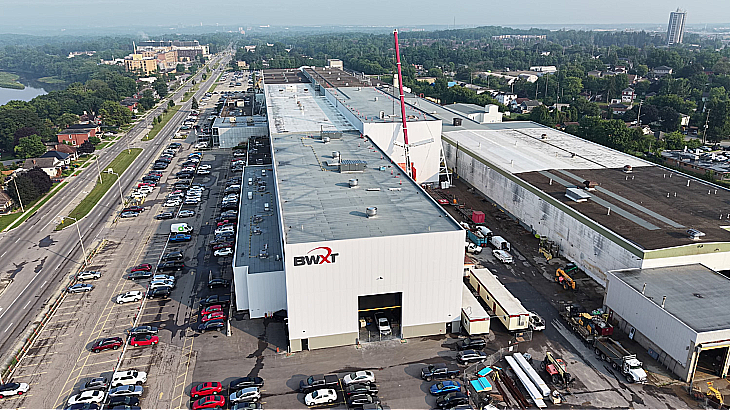
BWXT  nuclear manufacturing facility expansion complete


The CAD80 million (USD56 million) investment in the Cambridge, Ontario facility significantly expands BWX Technologies' capacity to manufacture large-scale nuclear components for both conventional and advanced reactors of all sizes.
 
BWXT's expanded facility in Cambridge, Ontario (Image: BWXT)

The project to expand BWXT's facility - already described as the largest manufacturing facility for commercial nuclear equipment in North America - was launched in 2024 and has seen the addition of 55,000 square feet (5,110 square metres). As well as adding more advanced manufacturing equipment, the work has also increased the size of the world's largest commercial nuclear clean room by 40%, the company said.

With major projects to extend the operating lives of 10 existing Candu reactors and the construction of a GE Vernova Hitachi Nuclear Energy BWRX-300 small modular reactor (SMR) at the Darlington New Nuclear Project, Ontario is leading the largest nuclear life-extension and active new-build programme "on the continent", according to BWXT.

The company is already building 48 new steam generators for the life extension and refurbishment of Ontario Power Generation's (OPG) Pickering Nuclear Generating Station while also fabricating the reactor pressure vessel for Darlington SMR. The additional manufacturing capacity and capabilities position it to support the existing fleet of reactors and the next generation of nuclear projects in Canada, including work for key customers OPG and Bruce Power, and aligns with the Nuclear Energy Strategy released by the Canadian government earlier this year, the company said.

John MacQuarrie, president, BWXT Commercial Operations, said the announcement represented "far more" than just an expansion of its capacity. "It is a major step to solidify our company’s place in the global nuclear resurgence," he said. "By increasing our manufacturing capacity in Cambridge, we are helping ensure we have the industrial capability needed to support major nuclear projects, strengthen energy security, advance climate goals and compete in a growing global market."

Tim Hodgson, Canada's Minister of Energy and Natural Resources, said the expansion of BWXT's facility "is exactly the kind of progress our Nuclear Energy Strategy is designed to catalyse: investments that create highly skilled Canadian jobs, strengthen our nuclear supply chain, and expand the domestic manufacturing capacity needed to support the next generation of nuclear projects in Ontario and beyond".

The Cambridge expansion has already created 200 new long-term, highly skilled jobs, supporting careers in engineering, advanced welding, metallurgy, robotics, precision machining and digital manufacturing, and BWXT said it is aiming to recruit 200 more workers in Cambridge over the next year. Ontario Minister of Energy and Mines Stephen Lecce said Ontario's nuclear buildout is helping to reindustrialise the province, driving manufacturing investment and employment. "The first mover advantage is positioning Ontario's supply chain at the centre of the global nuclear buildout - a key part of our plan to create 150,000 new good-paying Canadian jobs," he said.


Nuclear Industry urges nuclear recognition in COP31's 35-by-35 pledge


The role that nuclear can play in achieving the COP31 summit's pledge to increase electricity to 35% of energy demand by 2035 should be acknowledged, industry leaders have said, with nuclear construction at a 40-year high.
 
(Image: UN Climate Change/Kubilay Citfci)

According to World Nuclear Association’s World Nuclear Outlook Report - which was published in full ahead of the climate summit gathering in Turkey - there was 423 GWe of nuclear capacity at the end 2025 and there is currently 88 GWe of new capacity under construction.

There is a widespread goal of at least tripling nuclear energy capacity by 2050 - 39 countries have now signed the declaration which was launched with 22 signatories during COP28. Six have done so since COP30 - Belgium, Brazil, China, Italy, South Africa and Togo.

Director General of World Nuclear Association, Sama Bilbao y León, speaking at COP31, the United Nations Climate Conference, said: "The conversation has moved from whether we triple nuclear capacity to how fast we can deliver it. That depends on decisions made in the next few years: making the most of the existing fleet, completing projects under way, committing to the next ones, unlocking investment, and investing in people and supply chains.

"There is one more ask for COP31. The Presidency's pledge to raise electricity to 35% of final energy demand by 2035 is a welcome ambition, but it does not specifically acknowledge the role nuclear could play. Reactors already under construction will add around 88 GWe by then, including four reactors here in Türkiye, and more will come from reactors due to start construction over the next few years. Clean energy should be treated on equal terms."

At the moment electricity accounts for about 23% of global final energy consumption and to achieve the 35% goal would require a huge amount of new capacity - according to the International Energy Agency it would need an increase of more than 15,000 terawatt-hours in global electricity generation, equivalent to nearly half of today's output, requiring between 3,000 to 5,000 GWe of new generating capacity, depending on the mix of sources and capacity factor.

The draft of the COP31 35-by-35 Global Electrification Pledge, published in September, says that: "Recognising that achieving the goals of the Paris Agreement and keeping 1.5 degrees alive requires accelerated progress across a broad range of technologies and approaches, including in energy efficiency, renewable energy deployment, electrification, emissions abatement and removals, and other technologies and approaches of end uses across transport, buildings and industry … recognising that increasing electricity's share of final energy consumption can complement and reinforce existing efforts to expand renewable energy and improve energy efficiency by translating electricity supply into economy-wide emissions reductions…

"We declare our intent to work collaboratively and expeditiously to pursue the following objective: To increase electricity's share of total final energy consumption, to reach 35% globally by 2035 ('35 by 35'), in line with pathways consistent with keeping 1.5°C alive and complementary to efforts to expand renewable energy and improve energy efficiency."

A letter to COP31 President, and Turkey's Environment Minister, Murat Kurum, coordinated by Nuclear for Climate which was formed by more than 150 associations worldwide, says: "Climate action must serve both the countries reducing emissions from existing energy systems and communities gaining access to electricity for the first time. Nuclear energy can support meeting both needs, supplying reliable, low-emission electricity and heat at scale, while strengthening energy independence and supporting climate prosperity."

It urges: "In line with the Clean Energy Transition and Electrification Priority, and following the Global Stocktake decision calling for accelerating low-emission technologies, including, inter alia, renewables and nuclear, we urge the global community to advance nuclear energy in the implementation of the '35 by 35' Electrification target, as a low-carbon, firm, reliable and affordable source of electricity."

It also calls for the "Climate Implementation Bridge to expressly include nuclear" and calls for "integrating nuclear energy in green industrialisation strategies. It is an enabler of competitive, resilient and low-carbon industrial production, supporting the decarbonisation of hard-to-abate sectors through electricity, heat and hydrogen production."

French environment minister Monique Barbut, speaking at a COP31 event co-hosted by the French government, Comité Stratégique de la Filière Nucléaire and World Nuclear Association highlighting the momentum behind the declaration to triple nuclear capacity by 2050, said: "Here at COP31, the message is clear: the momentum behind the declaration continues to build. France will keep working with its partners to mobilise the finance, cooperation and international support needed to turn this commitment into reality."

Togo's Minister of Mines and Energy Resources, Robert Koffi Messan Eklo, said: "Africa's energy future will be built on ambition, innovation, and clean power. Togo's commitment to nuclear energy is a powerful signal of that future."

The World Nuclear Outlook Report also highlights the importance of extending the lifetimes of existing nuclear capacity, noting that about half of global nuclear capacity will have been operating for between 60 to 80 years by 2050. It says that life extensions of existing capacity are the most cost-effective form of additional low-carbon generation, and will be important, alongside new capacity, to hitting capacity expansion targets.


Pentagon Eyes Unprecedented 75-Year Deal to End China's Rare Earth Stranglehold

The U.S. Army wants first dibs on American-produced heavy rare earths, and REalloys (NASDAQ: ALOY) has just signed a landmark nonbinding term sheet that could put it at the top of the military's supply chain list.

And the terms are extraordinary. The term sheet proposes a potential 75-year operating lease on approximately 200 acres at Tooele Army Depot in Utah, where REalloys would build and operate a facility processing dysprosium and terbium, two metals China has spent decades monopolizing.

In return, one of the things that the Army wants is the right of first offer on production, giving it an opportunity to secure the materials for American weapons manufacturers before they are offered to other buyers, although it is not obligated to purchase any.

This is the latest development in a relationship that began taking shape in June, when the Army selected REalloys for exclusive negotiations.

Now, the two sides have signed a term sheet spelling out the proposed commercial terms: an initial 50-year lease, a possible 25-year extension, government ownership of the land and a privately financed industrial operation that could help supply the military for generations. The term sheet is non-binding, and the final lease still requires financing and regulatory approvals.

Consider what the Army is proposing here.

Rather than waiting for a domestic rare earth industry to develop on its own, it is making military land available to a private producer and negotiating priority access to the output. The company would carry the cost of construction and operations, while the Army would gain a source of American-processed heavy rare earths, particularly dysprosium and terbium, which at or near the top of Washington’s metals wishlist.

Dysprosium and terbium are used in the high-performance magnets that keep working when temperatures climb inside fighter aircraft, missile systems, and advanced electric motors. Radar, sonar and precision-guided munitions also depend on specialized magnetic materials. The problem is that China controls almost all global processing of dysprosium and terbium, leaving American defense manufacturers exposed to Chinese export licensing decisions.

That dependence became painfully obvious when Beijing introduced export restrictions on seven categories of medium and heavy rare earths in April 2025. Manufacturers suddenly faced delays, licensing requirements, and uncertainty over materials that had previously moved through established supply chains.

For the Pentagon, the stakes are unusually high.

Retired four-star General Jack Keane, who serves on REalloys' board, put the military consequences plainly in the company's announcement:. "For too long, the United States has depended on adversaries and others for the materials inside its most advanced defense technology and China has made clear it is prepared to use that dependence as leverage. Dysprosium and terbium sit at the center of that vulnerability. Our ability to deter conflict, and to prevail if deterrence fails, depends on producing munitions and weapons systems at scale, and that requires supply chains we control. This term sheet is an important step toward bringing heavy rare earth processing onto a U.S. defense installation. "

The Army's own Dr. Jeff Waksman was equally direct, describing rare earth processing as a national security vulnerability and pointing to China's near-total control of dysprosium and terbium.

The Pentagon has also imposed a deadline. Beginning January 1, 2027, expanded federal sourcing restrictions will apply to covered rare earth magnets and their supply chains. Defense contractors will need compliant sources of materials, processing, and manufacturing.

That creates an opening for companies capable of producing qualified rare earth metals outside China.

REalloys Has Been Assembling the Pieces

REalloys (NASDAQ: ALOY) has spent the past two years doing precisely that, securing feedstock, processing capacity, metallization technology, and financing across North America.

The company is already developing rare earth materials in Euclid, Ohio, and has partnered with Canada's Saskatchewan Research Council to expand non-Chinese rare earth processing.

Under that arrangement, REalloys secured rights to approximately 80% of SRC's expanded output, with the upgraded facility targeting annual production capacity of roughly 525 tonnes of NdPr metal, 30 tonnes of dysprosium oxide and 15 tonnes of terbium oxide

Those numbers are important because the rare earth business has a serious problem between the mine and the finished magnet.

Mining rare earths is one thing. Separating them, converting the oxides into metals and producing the alloys used in advanced magnets requires specialized equipment and technical expertise. China dominates those industrial processes, which is why simply opening new Western mines won't eliminate dependence on Chinese suppliers.

REalloys is developing what it says will become the largest heavy rare earth metallization facility outside China, with commissioning currently targeted for the first quarter of 2028.

The company has also secured a 15-year offtake agreement covering 15% of Phase 1 production from Critical Metals' Tanbreez project in Greenland, adding another potential source of rare earth feedstock outside China.

Other non-binding agreements involving Montana, Wyoming, and international partners expand the company's access to raw materials, while its strategic  LOI with JS Link aims to connect rare earth alloy production with permanent magnet manufacturing.

There's also a direct Pentagon relationship beyond Tooele.

In March, the Defense Logistics Agency awarded REalloys a contract to develop modular metallization technology for samarium and gadolinium, two additional metals used in specialized defense applications.

And the company has raised significant money to pursue its plans. REalloys completed an approximately $100 million institutional private placement in June and reported $122.4 million in cash at the end of that month.

Its Saskatchewan expansion and heavy rare earth metallization projects are funded through their planned commissioning stages, according to the company. Tooele remains a separate proposed development requiring its own financing and approvals.

Inside the Army's Unusual Rare Earth Deal

The Army's approach at Tooele deserves attention because it could change how Washington develops domestic sources of critical materials.

Under the proposed arrangement, the government keeps the land. REalloys pays fair-market rent, finances construction, and runs the processing operation. Once production begins, the Army receives a contractual opportunity to buy the materials it needs.

The military would also receive participation rent once commercial operations begin, with the exact methodology to be negotiated in the definitive lease.

That means the Army could help establish domestic production on its own property while leaving construction and operating costs with the private sector.

And this is no ordinary short-term industrial lease.

The proposed initial term is 50 years, with a possible 25-year extension. That's a potential three-quarters of a century for a facility dedicated to materials that American defense manufacturers currently struggle to source outside China.

The proposed right of first offer is equally important. It would give the Army an opportunity to secure production from the facility, although it would not require the military to purchase any material.

The implications extend across America's largest defense contractors, whose most sophisticated weapons programs rely on specialized materials that cannot always be sourced domestically. Lockheed Martin (NYSE: LMT) is a particularly important example. Its F-35 Lightning II fighter jets rely on rare earth permanent magnets, and the company recently unveiled a framework agreement with the Pentagon covering 850 U.S. aircraft over the next decade. Securing American-made magnet materials is becoming increasingly important as the military prepares to sustain production of these advanced aircraft for years to come.

The same supply-chain concerns extend to missile defense. RTX Corporation (NYSE: RTX), through its Raytheon business, produces Patriot air defense systems, advanced interceptors and military radars. In October, Raytheon was selected to modernize U.S. Space Force early-warning radar systems. For manufacturers operating at this level of technological complexity, dependence on foreign-controlled critical-material supply chains creates risks that Washington is increasingly determined to reduce.

Northrop Grumman (NYSE: NOC) faces similar strategic considerations as the manufacturer of the B-21 Raider stealth bomber, one of the Pentagon's most advanced aircraft programs. The company's portfolio also spans missile defense, space systems and advanced military electronics. With the Pentagon seeking to expand domestic production of rare earth permanent magnets, companies developing next-generation defense platforms have a direct interest in the availability of reliable, qualified American suppliers.

The issue also reaches beneath the ocean. General Dynamics (NYSE: GD), through its Electric Boat division, builds Virginia-class attack submarines and Columbia-class ballistic missile submarines for the U.S. Navy. The Pentagon has specifically identified both submarine classes among the military platforms that depend on rare earth permanent magnets. That makes the effort to establish secure domestic supplies relevant not only to combat aircraft and missiles, but also to the vessels underpinning America's naval deterrence.

There is still work to do. REalloys and the Army must negotiate a definitive lease, complete environmental reviews, agree on rent, secure financing and satisfy other regulatory and government requirements.

But the new term sheet provides something considerably more concrete than the June selection announcement: the proposed operating terms of a long-term industrial relationship with the U.S. Army.

For REalloys (NASDAQ: ALOY) the potential prize is a processing operation on military land, a strategically important customer with priority access to production and a business focused on two of the hardest rare earth materials to source outside China.

China spent decades cornering the market for the metals America needs to build its most advanced weapons. Now the U.S. Army is offering REalloys something few mining or metals companies could dream of: a potential 75-year home on military soil, with the Pentagon first in line for what comes out of it. The lease isn't final, and the Army hasn't committed to buying anything. But the fact that Washington is negotiating terms like these tells you just how far it's willing to go to get its hands on dysprosium and terbium.

By. Tom Kool for Oilprice.com

America’s Offshore Wind Industry Is Growing Despite Trump’s Crackdown

By Felicity Bradstock - Nov 14, 2026

Revolution Wind and Vineyard Wind have reached full commercial operations, delivering significant new offshore wind capacity despite federal opposition.

Federal courts have allowed five offshore wind projects to resume construction after Trump administration stop-work orders.

BloombergNEF slashed its U.S. offshore wind capacity forecast for 2035 from 39 GW to 5.9 GW amid worsening policy uncertainty.


The United States was slow to embrace offshore wind, with its first small-scale commercial wind farm coming online in 2016. It would take another eight years before the country launched its first utility-scale offshore wind project in 2024. While many other countries around the globe were rapidly developing offshore wind projects as part of energy diversification strategies, the United States mainly pursued solar photovoltaics and onshore wind projects.

The United States has significant potential to develop its offshore wind capacity, but it has only just begun to construct commercial offshore wind projects. According to the U.S. Department of Energy (DOE), the United States has over 4,000 GW of technical resource potential, or 13,500 terawatt-hours (TWh) of generation per year in federal waters and the Great Lakes. While it is not possible to fully realise the potential, tapping even a small share of offshore wind could help the U.S. reduce its dependence on fossil fuels and support a green transition.

In recent decades, the DOE has invested in offshore wind research and development to better understand the energy source’s potential and attract private investment in the sector. The DOE has earmarked over $300 million for offshore wind research, development, and demonstration projects. Nevertheless, the strict bureaucratic processes associated with offshore wind development have stalled permitting in the past, partially explaining why so many other countries raced ahead of the U.S. in capacity development.

The 30-MW Block Island Wind Farm, the first major offshore wind farm to be developed in the United States, came online in 2016. The $300-million, five-turbine wind farm was developed by Deepwater Wind. The Biden administration was highly supportive of offshore wind development, setting a target to deploy 30 GW of offshore wind by 2030.


Growing the country’s portfolio from 30 MW to 30 GW in around a decade would be no easy feat; however, under the Biden administration, several international wind energy companies announced major investment pledges in the sector. This was driven by the introduction of the Inflation Reduction Act (IRA) in August 2022, which provided a wide range of economic incentives for offshore wind development. The introduction of several subsequent state-level policies encouraged further investment.

The Biden-Harris administration approved a total of 11 commercial-scale offshore wind energy projects in federal waters during its term, which, if all developed, were expected to provide a total clean electricity output of 19 GW. In 2024, the first commercial-scale offshore wind farm (greater than 100 MW) came online. The 132-MW South Fork Wind began operations with 12 turbines in federal waters off New York.

Several international wind energy majors, such as Ørsted, Iberdrola, and Equinor, began developing projects under the Biden administration, committing billions of dollars of investment to rapidly expand the country’s clean energy production capacity. However, when President Trump came into office for his second term in January 2025, the outlook for offshore wind immediately looked bleaker.

Trump issued orders halting the development or operation of individual wind projects, resulting in numerous lawsuits. Several courts have since entered suspension orders against wind project operators. However, several judges have been thwarting Trump’s war on wind power by allowing operators to continue construction on various projects. Earlier this year, a U.S. federal judge ruled against the Trump administration and allowed companies developing five permitted East Coast wind farms to continue construction, after Trump tried to prevent them from being built.

Despite Trump’s ongoing attacks on wind power, several operators have successfully completed development or are nearing completion. Ørsted’s $6.2-billion Revolution Wind offshore project finally came online in November after months of uncertainty and legal action. The wind farm can produce up to 704 MW of clean power from 65 turbines at full capacity. Revolution Wind became the third utility-scale offshore wind farm to reach full commercial operations in the United States, after South Fork Wind and Vineyard Wind near Massachusetts.

Ørsted stated, “Revolution Wind will provide enough electricity to power the equivalent of more than 350,000 New England homes, strengthening the region’s supply of affordable, reliable energy.” The Danish firm has agreed to sell clean electricity to three utilities in the area: Rhode Island Energy, Eversource Energy, and United Illuminating.


Before Trump began his second term in office last year, BloombergNEF projected that the U.S. would build 39 gigawatts of offshore wind by 2035. It has since revised its forecast downward to just 5.9 GW, reflecting the projects that were already completed or under construction at the start of last year. Nevertheless, this figure marks extraordinary growth from the 30 MW of offshore capacity in 2016.

The United States has significant potential to expand its offshore wind capacity, having demonstrated that investors are interested in financing commercial projects under the right policy conditions. While progress has stalled under the Trump administration, and no new license approvals can be expected while Trump remains in power, the 5.9 GW offshore wind forecast demonstrates the determination of several companies to continue developing projects, as well as the support for clean energy from courts and consumers.

By Felicity Bradstock for Oilprice.com


Electrifying Ambitions Meet Tough Reality in Europe

By Irina Slav - Nov 14, 2026


The European Commission wants electricity to double from 23% to 46% of final energy use by 2040, and Irina Slav argues the plan rests heavily on wind and solar.

A wind lull pushed European power above €600 per MWh in peak evening periods on Monday, a reminder of what weak winter output costs.

Grid upgrades are estimated at over half a trillion euros by 2030, and the EU is heading into winter with thin gas stocks.

European Union leaders are among the most enthusiastic proponents of maximum electrification to reduce dependence on imported energy commodities. A lot of EU policy pursues precisely that. Yet EU electricity prices last week surged to over 600 euros per MWh on a wind drought, and the bloc still gets over 70% of its final energy consumption from hydrocarbons. Electrification is much easier said than done.

In July this year, the European Commission released a plan to turn Europe into the first “electro continent” by boosting the share of electricity in final energy consumption from 23% currently to 46%, and doing that by 2040. The target means that the share of electricity in final energy consumption needs to double—but that is not any electricity that the EC is after. In line with Brussels energy policies from the past decade, which have accelerated since 2022, the goal is to source as much of the bloc’s electricity from alternative sources such as solar and wind installations.

Theoretically, the plan is sound. It involves reducing dependence on energy imported from other countries that either the EU views as enemies or are in a state of war, which is affecting the price of that energy. Obviously, domestically sourced electricity would be a much better choice in this context. However, domestically sourced electricity generated from alternative sources with a view to reducing generation-related emissions is a bit harder.

We need look no further than the recent swing in European wholesale electricity prices. Last Monday evening, prices surged to top 600 per MWh, and the only reason for that was that the wind powering turbines in Northwestern Europe died down. The energy transition is frequently being advertised as a way to make energy cheaper without compromising reliability, but last week’s incident—which is far from a rarity—shows otherwise.


As Bloomberg put it, “Wind and solar generation are set to remain low across northwest and central Europe through Wednesday, as a slow-moving weather front brings still, cloudy conditions across some of the region’s biggest power markets.” This means that leaning into wind and solar during the winter is perhaps not the smartest thing to do. With a view to long-term electrification plans, these seasonal weather patterns are also worth considering before setting targets.

Yet instead of making these considerations, the EU is spreading the ambition, with this year’s COP host, Turkey, throwing its support behind faster electrification. The lead argument now is energy security, rather than emission reduction. The way to electrify, as noted by several attendees of COP31, is through more electric cars, switching from gas heating to heat pumps, and deploying more wind and solar to generate the electricity that a highly electrified economy would inevitably need.

This is where the question of seasonal variations in wind and solar output—and grid upgrades—needs to come into the conversation and it has, indeed, come into it. However, besides estimating that grid upgrades, for instance, would require investments of over half a trillion euros by 2030, little has been done in the practical aspect of it all. That’s probably because it is difficult to do anything practical about something that costs so much money and that would make electricity so much more expensive.

As for seasonal output variations for that twin Holy Grail of the EU’s energy transition plan, wind and solar, the dark doldrums, as media like to call the winter lull in wind and much lower solar irradiation, descend on Europe every single year. Every single year, they force those with the biggest wind capacities to lean more heavily on either hydrocarbon alternatives or imports from neighbors—which have nuclear, for example. This also comes at a cost, of course.

The European Union is this year entering winter with the lowest natural gas stockpile on record. Analyst John Kemp has warned that the EU could see this stockpile drop to a critical low before winter is over—and it probably will, even if the weather is milder than feared. Winter in the Northern Hemisphere, even if it is mild, is still the coldest season of the year.

In other words, theorizing about the electrification of final energy consumption is one thing, but actually applying it in real life is quite another. Some believe the financial aspect of the problem is “daunting but manageable”, as described by Reuters’ Ron Bousso. Those who would be paying for that aspect, however, may feel otherwise. They were, after all, promised cheap, clean, and reliable energy—for years. We are still nowhere near cheap and reliable, and clean in this combination may not be the top priority that politicians think it is.


Electrification to reduce dependence on imported energy makes sense. Electrification with a special clause for wind and solar, not so much. Developing domestic energy resources wherever these are available is something that is not being talked about a lot, yet even Germany signaled its readiness to develop its natural gas resources in the North Sea. Europeans could do with a little more of this kind of common sense when it comes to energy security.

By Irina Slav for Oilprice.com


Integrating farmer perceptions and scientific assessments: a study on soil acidity in the Upper Blue Nile Basin, Ethiopia


Higher Education Press


Soil acidity is a major land degradation issue in sub-Saharan Africa, severely constraining regional agricultural productivity and threatening food security. In Ethiopia, nearly half of the rainfed agricultural land is affected by soil acidity, with about 12% classified as strongly to extremely acidic (pH < 5.5). As an important agricultural region in Ethiopia, the Upper Blue Nile Basin faces a particularly prominent soil acidity problem. Current soil management strategies mostly adopt a top-down approach, prioritizing scientific interventions such as lime application to mitigate soil acidity, but these strategies have limited adaptability to local conditions. Although Ethiopian farmers possess generations of accumulated soil knowledge, this knowledge has long been excluded from mainstream agricultural policy and research, and academic research on farmers’ specific perceptions of soil acidity remains limited. Most related studies in Ethiopia have focused on the effectiveness of lime in mitigating soil acidity, often neglecting farmers’ traditional adaptive strategies and the similarities and differences between these strategies and scientific assessments.

Recently, the team led by Belstie LULIE at the College of Agriculture and Environmental Sciences, Bahir Dar University, Ethiopia, published a research paper titled “Integrating farmer perceptions and scientific assessments of soil acidity in the Upper Blue Nile Basin, Ethiopia” in ENGINEERING Agriculture (DOI: 10.15302/J-FASE-2026690), an ENGINEERING cluster journal of the Chinese Academy of Engineering. The study focused on three key objectives: assessing farmers’ perceptions of the causes and widespread impacts of soil acidity, documenting the adaptive measures farmers have taken to mitigate the effects of soil acidity, and linking farmer perceptions with scientific assessments of cultivated soil, aiming to provide scientific support for building more inclusive and effective soil management policies.

The research team used a cross-sectional household survey design, conducted in 2022 in three kebeles (the smallest local administrative units) in the Amhara Region, supplemented by field reconnaissance and soil sampling and testing. Before the formal survey, the team conducted a rapid rural appraisal during the pre-survey phase and a pilot survey of 50 people. A multistage sampling method was used to select the study areas and respondents: in the first stage, three districts—Machakel, Baso Liben, and Banja—were selected based on their soil acidity profiles; in the second stage, one kebele was randomly selected from each district, namely Debre Kelemua, Limichim, and Sankit Lidet; subsequently, a total of 292 households were randomly selected from the three kebeles (96 from Debre Kelemua, 96 from Limichim, and 100 from Sankit Lidet).

Soil samples were collected using a stratified random method. Based on questionnaire responses, farmers were grouped into three levels of soil acidity perception: high (n = 67), medium (n = 194), and low (n = 31). On this basis, a total of 146 composite soil samples were collected, this stratified sampling design ensured representative coverage across the gradient of farmer-perceived soil acidity and enabled precise comparison with laboratory-measured soil pH (H₂O) and Munsell soil color classification.

The results showed that farmers generally identified yield reduction (> 97%) and stunted crop growth (> 90%) as the most prominent indicators of soil acidity. Farmers considered the top three causes of soil acidity to be lack of crop rotation, poor field management (continuous cropping and soil compaction), and inadequate soil reclamation measures (insufficient lime application, complete removal of crop residues, and poor organic fertilizer management). For farmland judged by farmers as having high soil acidity, the main causes shifted to lack of crop rotation, absence of fallow periods, and poor field management. For farmland judged by farmers as having medium or low soil acidity, more than half of the respondents attributed it to heavy rainfall and continuous use of mineral fertilizers.

For soil acidity, farmers’ subjective classifications were significantly correlated with laboratory-measured soil pH. Laboratory results showed that many fields were classified as very strongly to extremely acidic, and there was a discrepancy between farmers’ subjective perceptions and measured pH values. The research team pointed out that the high, medium, and low categories assigned by farmers represent a relative severity gradient within an overall acidic soil environment, rather than a precise mapping to pH thresholds. This explains why laboratory measurements often showed that fields judged by farmers as “low acidity” were often more severely acidified.

Regarding soil management strategies, farmers widely adopted organic fertilizer application, planting bitter white lupin, and retaining crop residues. In addition to these main measures, crop rotation was implemented on more than 70% of farmland subjectively judged by farmers as having medium and high acidity. About two-thirds of the farmland had soil conservation structures established. Lime application was inconsistent: nearly half of the farmers did not apply lime, with a higher proportion of non-application in the low-acidity group. Among farmers who applied lime, 13% applied the full recommended rate once every 5 years, and 28% applied the full recommended rate once every 3 years; in the high-acidity group, about 45% of farmers followed a three-year cycle. Organic fertilizer was applied almost universally, with compost being the most common; animal manure was widely applied in medium-acidity areas, while green manure (mainly bitter white lupin) was used more frequently in medium- and high-acidity fields.

The study concluded that local farmers have a high level of awareness of soil acidity but rely on late-stage crop symptoms, which limits proactive management, highlighting an urgent need for rapid soil testing tools. Farmers’ attributions are consistent with scientific findings, and rotation with acid-tolerant crops and increased organic fertilizer application can mitigate acidity. Farmers’ soil acidity classifications represent a relative severity gradient; integrating empirical soil testing with farmer knowledge can improve the precision of management decisions. The study recommends promoting affordable and accessible soil testing tools, rotation with acid-tolerant species, organic amendments, optimized lime application guidance, integration of farmer perceptions with scientific assessments, introduction of alternative legume rotations, planting of nitrogen-fixing trees, and fostering participatory research.