Friday, November 20, 2026

The Nasser Hospital Attack and Israel’s Relentless Lies

The more atrocious Israel’s actions are, the more desperate their lies become.


by Andy Worthington | Nov 16, 2026 |


Reprinted with permission from Andy Worthington’s Substack.

As the world was reeling from the State of Israel’s latest atrocity in Gaza — an aerial attack that, without warning, tore through three floors of the surgical wing of Nasser Hospital in Khan Younis just before midnight on November 11, killing six people, including a doctor, and wounding 30 others — the IDF posted a chilling image on X, showing five hospitals in total — Nasser Hospital, the European Hospital, Al-Shifa Hospital, Al-Quds Hospital and Kamal Adwan Hospital — with thumbnail photos allegedly illustrating the presence of weapons “used by Hamas for terror purposes” at all five locations, hinting at further strikes to come on the other four hospitals.
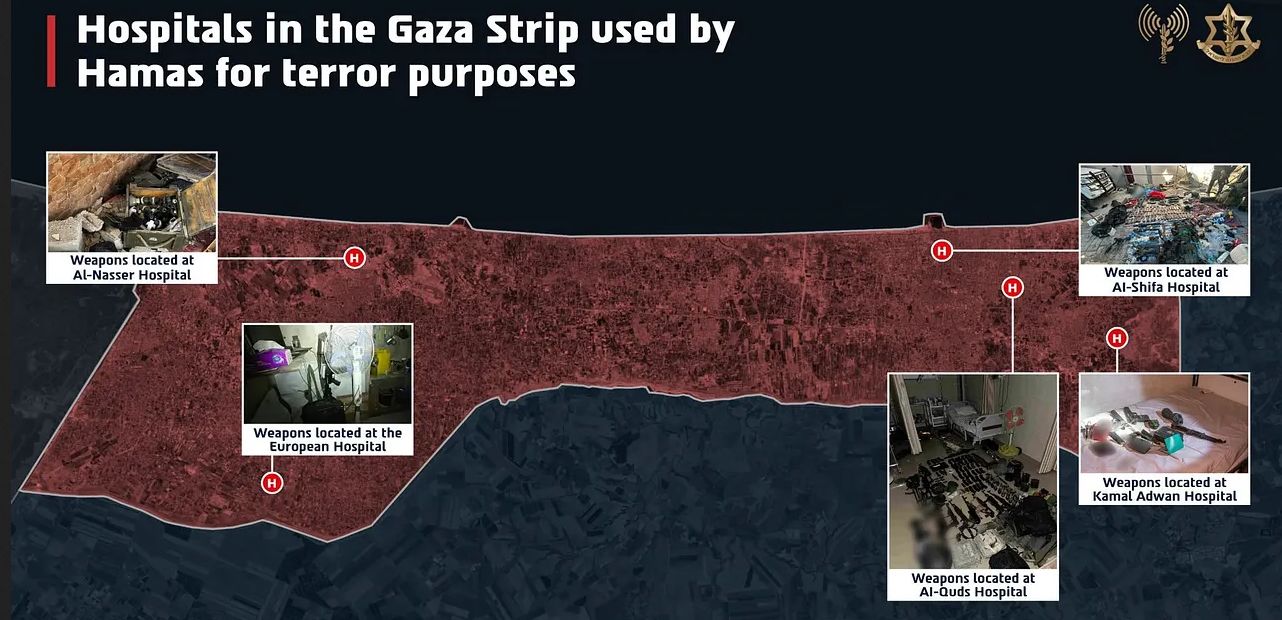


The IDF’s risible “illustration” of weapons at five hospitals in Gaza allegedly “used by Hamas for terror purposes.”


As the world was reeling from the State of Israel’s latest atrocity in Gaza — an aerial attack that, without warning, tore through three floors of the surgical wing of Nasser Hospital in Khan Younis just before midnight on November 11, killing six people, including a doctor, and wounding 30 others — the IDF posted a chilling image on X, showing five hospitals in total — Nasser Hospital, the European Hospital, Al-Shifa Hospital, Al-Quds Hospital and Kamal Adwan Hospital — with thumbnail photos allegedly illustrating the presence of weapons “used by Hamas for terror purposes” at all five locations, hinting at further strikes to come on the other four hospitals.

The IDF claimed in its post that the attack on Nasser Hospital struck “a senior Hamas terrorist and additional terrorists” operating within the hospital, “to eliminate the threat they posed”, alleging that “Hamas used the hospital complex as a hub for military and terrorist activities against IDF troops and Israel”, including “storing weapons, conducting interrogations and torture, operating command-and-control rooms [and] using hospital facilities as observation posts and shelters for terrorists.”

In a follow-up post, the IDF alleged that the Hamas commander who was “struck” was Khan Younis Brigade Commander Muhammad Abu Ismail — and “additional terrorists” — who were “hiding inside” the hospital, adding that Abu Ismail “was responsible for directing terrorist attacks against Israeli civilians & IDF troops and for holding numerous hostages captive throughout the war”, and that “Hamas turned the hospital complex into a headquarters to advance dozens of terrorist attacks and restore the brigade’s terror capabilities.”

The post also claimed that, “Prior to the strike, advance warnings were issued to the civilian population & precision-guided munitions and aerial surveillance assets were employed to minimize the risk of harm to civilians”, both of which seem to be outright lies, firstly because everyone in the hospital was completely unprepared, and, secondly, because the damage caused, and the civilian deaths, are very evidently the opposite of what could legitimately be regarded as “precision-guided.”

Later, the IDF cobbled together a claim that the hospital’s second floor “serves as a Hamas military HQ, where civilians are not permitted to enter, as it is used by Hamas commanders”, including Abu Ismail, and presented a feeble AI-generated film purporting to show this secret headquarters, as well as a map purporting to show three rooms used by three alleged Hamas commanders — Abu Hosna and Muhammad Tarim, about whom no information appears to be publicly available, as well as Abu Ismail.
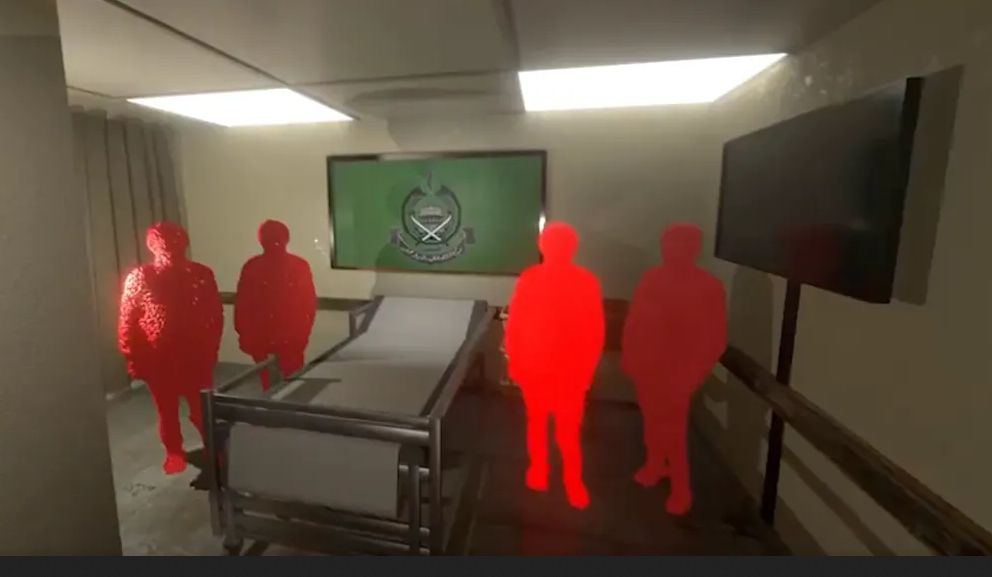


A screenshot from the IDF’s risible AI-generated video purporting to show the Hamas “military HQ” in Nasser Hospital.


In another follow-up post, the IDF then publicized a 2019 Hamas document, purportedly “found near [a] safe house”, which “outlines a protocol for handling suspects taken for interrogation”, and “identifies Nasser Hospital, the Red Crescent Hospital & the European Hospital as interrogation locations”, also claiming that “a 2020 document, found near Shifa Hospital, details Islamic Jihad’s exploitation of Shifa, Al-Rantisi & Kamal Adwan hospitals to position mortar shells, document rocket launches, take over offices & establish an operations room.”

The IDF then posted thumbnail profiles of eight alleged Hamas “terrorists” who were “eliminated” in Gaza over the last week, two who allegedly “infiltrated Israel during the October 7 Massacre”, and another “involved in manufacturing weapons at [a] dismantled workshop.”

Ramy Abdu, law professor and the chairman of the Geneva-based Euro-Med Human Rights Monitor, immediately responded by noting how, “Every week, the Israeli army publishes names of Palestinians it claims to have killed because they were Hamas members or participated in October 7. Yet every time, we identify civilians among them, including people opposed to Hamas with no political involvement.”

“Take Ali Abu Asi, whom I personally knew”, Abdu added, with reference to the IDF’s claim that he was the “terrorist who took part in manufacturing weapons for Hamas.” As Abdu stated, “He was a Fatah supporter, openly opposed to Hamas, and was growing potatoes when Israel killed him. Visit his mourning tent, and you’ll find it organized by Fatah, with Fatah members receiving condolences. This is how Israel falsely labels its victims to justify killing them.”

Just as significantly, none of the names provided by Israel include the alleged target of the attack on Nasser Hospital, Muhammad Abu Ismail, who seems to have evaded death if he — or any of his other spectral “terrorist” companions — were ever there in the first place. He may have been a target, but he was not “struck”, as the IDF claimed.

Instead, all we have are six dead civilians, including a 13-year old patient recovering from surgery, and Dr. Rezq Abu Sheera, 53, a hugely well-respected surgeon, remembered as a “super enthusiastic” individual, who was “always ready to do anything and everything to try to save lives” by the US doctor Feroze Sidhwa, who worked with him at Nasser Hospital, and pointed out that he was featured in the recently-released documentary film “American Doctor”, and that he appeared alongside him in a promotional poster for the film.



Dr. Rezq Abu Sheera, on the left, with Dr. Feroze Sidhwa, in the center, in a promotional poster for the documentary film “American Doctor.”


In an interview with Samira Mohyeddin for On The Line Media, Dr. Blayne Sayed, a visiting Canadian doctor who had just returned from Nasser Hospital last week, explained in detail how all three floors struck in Israel’s attack contained nothing but surgery wards, recovery rooms, surgeons’ offices and sleeping quarters. As he said, discussing how he had been checking in with colleagues, who described “near miss” situations where they too could have been killed, “All of these people are normal professional outstanding people, like I would work with here.”

He couldn’t stress enough how, even after three years of a sickeningly illegal “war” on Gaza’s hospitals, Israel’s poisonous lies about doctors, like journalists, not being doctors at all, but “terrorists” masquerading as doctors, has meant that all of these “normal professional outstanding people” — if they are Palestinian — are persistently regarded with suspicion.

In addition, as Drop Site News reported, two other senior surgeons on duty were badly wounded. One, Dr. Mohammed Aladaini, “lost a leg and is expected to have his other leg amputated as well”, while the other, Dr. Ayman Abu Obaid, is in intensive care, where he spoke about the terror of the attack to Al Arabiya.

It was also revealed that the US government was directly implicated in the attack, which had involved two GBU-39/B bombs, 250-pound bombs developed by Boeing for the US military. One of the bombs, sickeningly displaying its origins, had failed to explode, preventing further casualties, but also devastatingly implicating the US in the unjustifiable civilian slaughter.
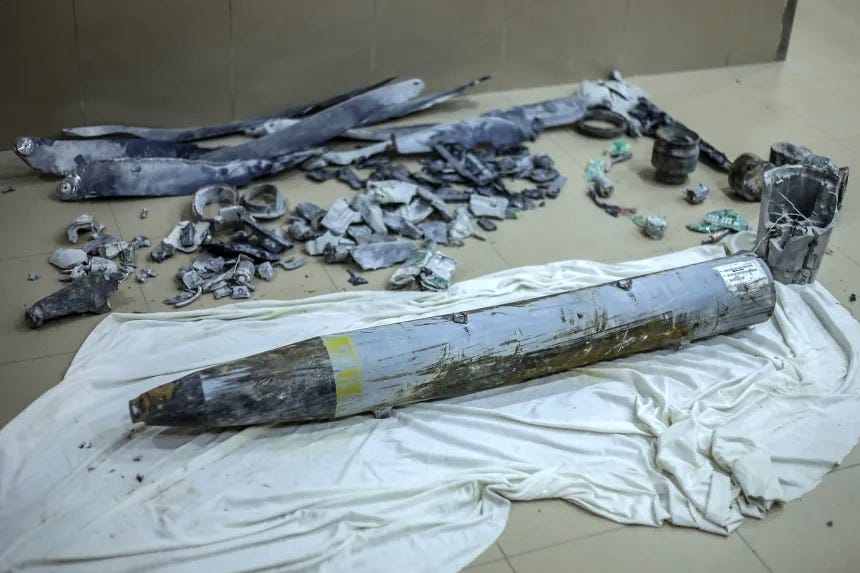


The unexploded US-manufactured and US-supplied GBU-39/B bomb that hit Nasser Hospital, and shrapnel from the bomb that did explode, killing six civilians.


As for Israel’s rationale for attacking Nasser Hospital, are we meant not to notice that the past is mixed up with the present in ways that make a mockery of the IDF’s claims? We’re meant to believe that, because it is suggested that hostages were held at Nasser Hospital in the past, and that some ill-defined and unverifiable torture took place, it is somehow morally or militarily acceptable to bomb the hospital over a year since the last hostages were released.

We’re also meant to endorse further attacks on four more hospitals in Gaza because of documents allegedly found by the IDF, and allegedly written by Hamas and Palestinian Islamic Jihad in 2019 and 2020, which identified them as locations for military activities, just as we’re also meant to forget that these hospitals have been repeatedly attacked over the last three years.

In the case of Nasser Hospital, this was the seventh attack since October 2023, the last and most notorious example involving the targeted murder of 22 journalists and medical staff in a “double-tap” strike in August 2025, which caused global condemnation, and led to a searingly critical report by Reuters.

In the IDF’s version of reality, it is as if some weird time loop of amnesia is in effect, which justifies attacking Nasser Hospital, the European Hospital, Al-Shifa Hospital, Al-Quds Hospital and Kamal Adwan Hospital over and over and over again, as though, every time they have been attacked, invaded and decommissioned, with often significant losses of life and the abduction of doctors and medical personnel, these facilities have miraculously reconstituted themselves as “terrorist” facilities, where the past permanently bleeds into the present, and all of Gaza’s hospitals are, perpetually, legitimate “terrorist” targets.

All of the above is, of course, not only an insult to our intelligence, but a constant and unforgivable demonstration of Israel’s contempt for all of the long-established and internationally agreed rules regarding the absolute protection given to hospitals, medical staff and patients during military conflicts.

Hospitals only lose their protected status if they are used “to commit, outside their humanitarian functions, an ‘act harmful to the enemy.’” That means specific actions that Israel has repeatedly alleged, but never verified, but it never means the right to drop bombs on medical facilities with no concern for the loss of civilian lives — whether of doctors, other medical staff, or patients.

Israel doesn’t care, however. As we now know — from the documentary film “NAZA”, in particular — and must never forget, the State of Israel believes that up to 20 civilian deaths as “collateral damage” are acceptable when pursuing any military target, with many times more deaths acceptable in pursuit of a high-profile target.

Israel also doesn’t care if the target wasn’t even there, as seems to have been the case in the latest attack on Nasser Hospital, because there is neither contrition nor punishment for Israel killing civilians, even if the alleged target of an attack was never even there in the first place.


Andy Worthington is a freelance investigative journalist, activist, author, photographer (of a photo-journalism project, ‘The State of London’, which ran from 2012 to 2023), film-maker and singer-songwriter (the lead singer and main songwriter for the London-based band The Four Fathers, whose music is available via Bandcamp). He is the co-founder of the Close Guantánamo campaign (see the ongoing photo campaign here) and the successful We Stand With Shaker campaign of 2014-15, and the author of The Guantánamo Files: The Stories of the 774 Detainees in America’s Illegal Prison and of two other books: Stonehenge: Celebration and Subversion and The Battle of the Beanfield. He is also the co-director (with Polly Nash) of the documentary film, “Outside the Law: Stories from Guantánamo”, which you can watch on YouTube here.

To receive new articles in your inbox, please subscribe to Andy’s new Substack account, set up in November 2024, where he’ll be sending out a weekly newsletter, or his RSS feed — and he can also be found on Facebook (and here), Twitter and YouTube. Also see the six-part definitive Guantánamo prisoner list, The Complete Guantánamo Files, the definitive Guantánamo habeas list, and the full military commissions list. Please also consider joining the Close Guantánamo campaign, and, if you appreciate Andy’s work, feel free to make a donation via PayPal or via Stripe.


Andy Worthington is a historian based in London. He is the author of The Guantánamo Files, the first book to tell the stories of all the detainees in Guantanámo. He writes regularly on issues related to Guantánamo and the "War on Terror" on his Web site.


The Beginning of the End: Israel at the Heart of America’s Political Civil War


by | Nov 16, 2026 | 

On the very morning of the critical US midterm elections, President Donald Trump made what seemed like a shocking announcement: no more aid to Israel.

“Bibi Netanyahu and I have made a deal that we give Israel $4 billion a year, and we made a deal months ago that we’re stopping,” Trump told Fox News’ Fox & Friends.

He goes on to make two seemingly contradictory assertions: “We won’t be paying Israel,” and “We’ll help Israel if they need it.”

In truth, there was little euphoria among those who have long campaigned against US funding of Israel. The lack of enthusiasm can be explained by two factors: few take Trump’s pledges seriously, and his remarks were widely understood as a desperate attempt to stave off what was shaping up to be a disastrous election outcome.

The election ultimately delivered one of the most humiliating defeats in Republican Party history, with Democrats capturing both the Senate and House of Representatives and making sweeping gains across the country.

Republicans quickly turned against Trump, who made the unusual admission that the war on Iran had contributed to their defeat.

Vice President JD Vance, widely considered a potential presidential contender in 2028, was more explicit. “The reason we lost is the war,” Vance tweeted on November 4, calling for Republicans to “change our relationship to Israel.”

Though Vance was criticized by some within his party for naming Israel, the clearest indication that unconditional US support for Israel had become a major political liability came from Trump himself.

First, his rushed Election Day announcement was an unmistakable attempt to influence voters before they cast their ballots. Trump failed, but in doing so, he revealed that he and his party understood Israel had become a major factor in their political predicament.

Indeed, Trump described the $4 billion payment as “a bad talking point,” complaining that critics were using it against Republicans.

Second, Trump’s acknowledgment that the Iran war had hurt Republicans exposed the very Israel connection that Vance was prepared to articulate more openly.

The war on Iran was not America’s war. It was Netanyahu’s war, pursued as part of his longstanding quest to dominate the Middle East, with Washington paying the military, economic and political price.

This is hardly hyperbole. Netanyahu has repeatedly presented Iran as an existential enemy, while his far-right allies have openly celebrated American military involvement.

Ironically, Washington’s own 2026 National Defense Strategy had identified defending the US homeland and asserting American interests throughout the Western Hemisphere as its foremost priorities. Yet the administration plunged into another devastating Middle Eastern war.

Thanks to independent journalists and analysts operating outside mainstream media, Americans have become increasingly aware of the damage this relationship has inflicted on their country’s economy, military standing and international reputation.

According to Quinnipiac University, 48 percent of registered American voters now believe the US is too supportive of Israel, compared with just 16 percent in January 2017.

This growing awareness, coupled with the seismic shift in Congress following the midterms, is still not enough to guarantee tangible and irreversible change.

The midterm results nevertheless offer a major ray of hope that America is not a lost cause after all, and that ordinary people possess enough knowledge and determination to challenge the powerful interests, mega-donors and shadowy agendas shaping their country’s foreign policy.

There is a fundamental lesson here: Americans can no longer be satisfied with empty promises. And this brings us back to Trump’s announcement.

Israel has been the largest cumulative recipient of US foreign assistance, with the Council on Foreign Relations estimating that American aid since 1948 has exceeded $300 billion, adjusted for inflation.

That staggering figure, however, hardly tells half the story. Washington has consistently found ways to finance Israel’s wars beyond the declared annual military assistance of $3.8 billion.

For example, in April 2024, President Joe Biden signed emergency legislation providing Israel with an additional $8.7 billion in direct military assistance, separate from the regular annual allocation. The money included $3.5 billion in additional Foreign Military Financing and $5.2 billion for missile defense programs.

These extraordinary funding mechanisms demonstrate how Washington can continue financing Israel’s military even when regular assistance becomes politically controversial.

And that is only part of the picture.

Congress has been considering proposals to expand US-Israeli defense technology cooperation, potentially shifting more spending into Pentagon research, development and procurement accounts.

In essence, Israel could continue benefiting from billions in American military spending without those expenditures being labeled conventional foreign aid.

What Trump appears to be offering, therefore, is a sleight of hand: remove the politically damaging label of aid while preserving, and potentially expanding, the military relationship itself.

A Democratic-controlled Congress could block some of these initiatives. But many Democrats remain committed supporters of Israel, and the American Israel Public Affairs Committee, AIPAC, will continue to spend heavily to influence congressional elections.

True, association with the lobby has become a political liability for some candidates. But AIPAC and its allies can be expected to seek alternative strategies, political vehicles and alliances to preserve their influence.

The election results are certainly a major step in the right direction, but America’s political civil war is only beginning: progressive Democrats against the party establishment, disillusioned Republicans against MAGA loyalists, independent media against mainstream institutions, and so on.

The good news, for now, is that the tireless work of generations of conscientious Americans are finally paying off. Thanks in no small part to their efforts, millions of Americans are beginning to recognize that Israel is not a friend of their country, and that this sinister relationship must end once and for all.

Dr. Ramzy Baroud is a journalist, author and the Editor of The Palestine Chronicle. He is the author of six books. His forthcoming book, ‘Before the Flood,’ will be published by Seven Stories Press. His other books include ‘Our Vision for Liberation’, ‘My Father was a Freedom Fighter’ and ‘The Last Earth’. Baroud is a Non-resident Senior Research Fellow at the Center for Islam and Global Affairs (CIGA). His website is www.ramzybaroud.net

Antiwar.com’s Fight To Keep the Scourge of AI-Generated Articles Off Our Site


by and | Nov 16, 2026 | 

Antiwar.com prides itself on being an online home to the Antiwar movement. Yes, many of our staff are libertarians, but we run articles from authors across the political spectrum, as we have since our founding in 1995.

We take submissions from anyone who meets our standards, such as word count, grammatically clean, and well written, and within our editorial position. However, we have recently encountered a new issue with submissions: AI-generated articles.

Starting in the spring of 2026, Antiwar.com began receiving submissions that we later linked to an operation involving AI-generated articles submitted under deceptive identities. Some were published before we identified the problem and were subsequently removed.

After initially being alerted to articles from two authors, Antiwar.com began running articles through AI-detection programs. But we found those programs to overestimate the use of AI, particularly for articles that were grammatically clean, logical, and well-written.

So we could not simply use those programs to check articles and simply reject anything that came back as AI-authorship; rather, we began contacting authors whose submissions came back as a high likelihood of AI-authorship.

Some of these authors refused to speak on the phone, which raised further concern that there may be something more nefarious afoot.

In July, we received a submission from one author from a different author’s email. We began to suspect that Antiwar.com was the target of a person or AI agent that was generating articles by multiple authors and sending submissions to Antiwar.com under multiple bylines.

Antiwar.com then used ChatGPT to run a scan of all articles published as viewpoints at Antiwar.com over the past year, checking for AI-authorship and confirming the identity of the authors. ChatGPT identified two clusters of authors whose articles and submission histories raised concerns about AI authorship and possible coordination.

The Antiwar.com team then uploaded the original .docx submissions into ChatGPT to analyze the metadata in the articles. ChatGPT identified similarities in writing styles and submission patterns among the suspicious authors.

Cluster A was the two authors who published at Antiwar.com and were previously identified earlier this year. Cluster B was made up of at least three authors, and possibly a fourth. The investigation did not uncover any evidence linking the two clusters.

An analysis of the original Word documents also revealed striking similarities in the metadata of articles attributed to three authors in Cluster B.

The ChatGPT review also uncovered that the authors appearing in the two clusters were published at a half dozen other outlets. Some of the authors had bylines dating back to 2021.

Antiwar.com now runs all submissions through an AI-authorship check at ChatGPT. The check reviews the metadata, writing style, and biography of the author. Not only does it look for abnormalities consistent with AI authorship, but it also compares those submissions to past articles to look for patterns.

Articles that get flagged are either rejected or require a phone or video conversation with the author before publication. We do not reject the articles automatically if flagged because ChatGPT regularly states that it can only make an assessment, not a conclusion. The goal of these conversations is not only to confirm the author’s identity, but also to confirm that the author actually wrote the article.

Earlier this month, Antiwar.com received an email from OpenAI’s investigations team alerting us to a coordinated operation involving AI-generated opinion articles submitted under deceptive identities. We shared our findings with each other.

“We identified a covert influence operation from Iran that was using AI to help pitch English-language editorials to different online publications,” Ben Nimmo, principal investigator on OpenAI’s investigations team, told Antiwar.com. “They seemed to have decided that just spraying content across social media wasn’t the most effective way of reaching their audience, so they were trying to hijack real publications to get in front of readers.”

Two of those authors were the two we identified in Cluster A; none of the other authors sent submissions to Antiwar.com. In response to the email, Antiwar.com reached out to OpenAI to offer the findings of our investigation that identified several other authors, including Cluster B, which appears to be a similar operation not previously identified.

“Influence operations from Iran are a tangled web, but this looked like a different operation, trying a similar kind of approach,” Nimmo said. “It’s important to watch out for operations like this, and it’s also important to share information about them. The more the defenders stay aware and share, the harder it is for attackers to get through.”

The submission of AI-generated articles has been a major headache for Antiwar.com. As with all independent outlets, we rely on many small donations from our readers to fund our journalism. We operate with minimal staff so we can ensure the money is put to good use.

Reviewing each article for potential AI authorship has placed a burden on us to ensure that not only are the articles published at Antiwar.com factual and well-written, but also authentic.

Kelley Vlahos, Editor-in-Chief at Responsible Statecraft, told Antiwar.com that RS is also dealing with an increased number of AI-generated submissions. “We were committed to laying down a marker after the number of AI-generated pitches and stories started flooding into our inbox last year,” she said.

Vlahos added that RS maintains a strict anti-AI content policy. She explained RS “came to the conclusion that our profession as journalists was at risk.” Vlahos added, “Such tools render content bloodless, bury nuance, and are devoid of personality. These are two standards for which we will not yield: the integrity of each and every story we publish, as well as providing writing that is fresh, independent, challenging, and overall — human.”

Some publications have started taking a similar policy. The American Conservative magazine recently published a new writing policy in an article explaining to their readers why it is important to have all articles written by humans:

A computer can never be held accountable. No matter how proficient AI tools become at generating aesthetically acceptable prose, they cannot supply authority and responsibility.

The problem of AI-generated articles will likely only get worse as AI advances, and we believe that fighting against it is worth the burden that it places on our small staff. We hope that editors at other outlets will also be vigilant and work against such content to preserve the integrity of independent media and the human written word in the age of AI.

Kyle Anzalone is the opinion editor of Antiwar.com and news editor of the Libertarian Institute. He hosts The Kyle Anzalone Show and is co-host of Conflicts of Interest with Connor Freeman.
Eric Garris is director and co-founder of Antiwar.com.

The Power at Your Fingertips: Congress, YOU Have To Show Up for Every Vote

These may be the most consequential weeks on the congressional calendar. Dennis and I call it Congress’ “Going Out of Business Sale.”

by | Nov 17, 2026 | 

Reprinted with permission from The Kucinich Report.

Dear House Democrats,

You swore an oath to support and defend the Constitution. When the House calls a vote on whether to hold a secretary of defense accountable for a war Congress has not authorized, your place is on the floor. A political reception can wait. Allow time for traffic. If you want to honor veterans, use your vote to hold the people who send them to war accountable. An entire congressional district is counting on you.

On November 10, Republican Rep. Thomas Massie brought articles of impeachment against Defense Secretary Pete Hegseth. All 203 Democrats who voted joined Massie in voting to keep the effort alive.

210 and 1 independent voted to refer the articles to the Republican-led Judiciary Committee. This was a motion to kill the impeachment effort, and it passed 211–204. Eleven House Democrats missed the vote.

Had eight of the absent Democrats voted that late afternoon with their colleagues, the motion would have failed and the House could have taken up the articles. You had a an obligation to do the job voters sent you there to do.

Most Americans never have occasion to see what a single vote can do on the House floor. You, as a Member of Congress, do. You swore an oath to uphold the Constitution, and honor that oath by voting. Every bill that comes to the floor deserves your attention. Your job is to be there and stay vigilant for our democracy. Your vote matters.

After the House blocked consideration of the articles, Hegseth stands emboldened. The attacks on Iran, and retaliation have continued, putting civilians and American service members in danger. Congress has a responsibility to act while it still has the chance.

This midterm was a referendum on Donald Trump and the war in Iran. You received majority power, beginning in January. Until then, Republican leaders still control what comes to the House floor. They have weeks to move bills and funding deals. If you use your vote, you may be able to change the outcome.

The House has had three votes to end the war in Iran, using war powers resolutions. Twice, in June and July of this year, four Republicans joined Democrats to pass those bills. A third vote, only two months ago, had seven Republicans joining Democrats to once again call for an end to the war.

While the President has veto power, you can let the American people know that you are not giving up. A post-election Reuters/Ipsos poll found that 71 percent of Americans want Congress to pass legislation ending the war. Reuters/Ipsos poll.

There is another, formidable opportunity with government funding expiring on December 11th, 2026.

Use your power to demand that money for the war against Iran be removed from the legislation which funds our government.

During my husband Dennis Kucinich’s years in Congress, I was known as one of the most active congressional spouses. I worked on projects of my own and, in the closing weeks of a session, supported Dennis directly.

The lame-duck session may be the most important stretch of the congressional calendar. Dennis and I call it Congress’ “Going Out of Business Sale.”

Dennis kept watch on the House floor and read cobbled-together legislation Republican leaders were trying to rush through. When we heard that something was coming up that warranted an objection, we hurried back so he could raise it.

The House could come back from recess hours after the last scheduled vote. If leadership sought unanimous consent, any one member on the floor could object and stop a bill from passing. So we stayed.

I often spent hours outside the Democratic entrance to the House chamber, waiting for him to finish on the floor, or watched from the Congressional Families’ Gallery. Late-night votes meant bringing food to the Capitol and picnicking on the back steps overlooking the Mall. Other times, we stayed through the early hours of the morning and slept in his office if we needed to.

In November 2006, voters turned against a Republican president’s corruption and war and gave Democrats the House. By May 2007, the Democratic Congress had approved another round of war funding without a timetable for withdrawal.

Twenty years later, the country is here are again.

Twenty years later, opposition to this Republican president’s war has helped return Democrats to power.

The vote on Secretary Hegseth was an early test of what you would do with the trust voters placed in you. The next test will come when the White House asks you to keep paying for the war. You have votes to cast between now and January. That is where you can break the cycle.

Before the Iraq invasion, Dennis challenged the Bush administration’s false claims about Iraqi weapons of mass destruction and its attempts to link Iraq to al-Qaeda and 9/11.

I was in the House Gallery in November 2007 when Dennis brought three articles of impeachment against Republican Vice President Dick Cheney to the floor. I watched, incredulous, as House Democratic leaders moved to send them to committee to die, rather than advance impeachment and accountability.

In June 2008, I sat alone in the House Gallery as Dennis read thirty-five articles of impeachment against Republican President George W. Bush. The moment was so serious, and yet so few people witnessed it.

House Democratic leaders had promised Dennis a hearing on the impeachment resolution. But, they insisted that Judiciary Committee Chairman John Conyers conduct it as an oversight hearing on executive power. Dennis testified, but the committee never considered the articles in a formal impeachment hearing, and so no recommendation went to the full House.

By refusing to let the articles advance, House Democratic leaders abdicated Congress’s responsibility as a coequal branch of government. The Constitution gives the House the sole power of impeachment so it can hold the executive to account. That power means little when the people entrusted with it refuse to use it.

I think about those years when I see the deals this administration is making and what it is prepared to give away.

Dock Cheney had run Halliburton before becoming vice president. As the United States invaded Iraq, Halliburton subsidiary KBR received a $2.5 billion no-bid contract to restore Iraq’s oil infrastructure. Under the cost-plus deal, taxpayers covered allowable costs, KBR received a fixed fee and the company could earn a bonus.

Washington found billions for well-connected contractors overseas while here at home, bridges deteriorated, water systems aged and families struggled to afford a place to live.

Innocent people in Iraq paid for the war, with their lives. By July 2006, a study published in The Lancet estimated about 655,000 excess Iraqi deaths since the invasion.

In 2006, voters who wanted the Iraq War to end gave Democrats the House. Bush vetoed a funding bill with a withdrawal timetable. Congress sent him another bill that kept the war funded without any timetable. Eighty-six House Democrats joined most Republicans to pass it. Voters had trusted Democrats to challenge the war but Congress kept paying for it.

Members of Congress:

Protect our country in these closing weeks. Be vigilant for us all, for our country. Be the conduit for democracy, for the upholding of the Constitution and end to illegal activities.

If you think your work can wait until January, think again. These may be the most consequential weeks on your congressional calendar.

Be present for every vote. Stay at the Capitol until the House adjourns.

Read what Republican leadership brings to the floor. Object when leadership tries to rush a bill through by unanimous consent.

Get your colleagues behind a demand for a roll call and put your own vote on the record. When the White House asks for more money to wage war in Iran, be there to vote no.

I know what it means to wait at the Capitol long after most people have gone home. I’ve seen what one member can do simply by being there. When there’s an opening to act, take it. If you’re waiting for someone else to stand up, remember who your constituents sent to Congress.

It is your job. The votes that can make a difference are coming now.

It’s time for Congress to lead. Show up, use your vote, and hold this administration accountable. That work begins now.

Elizabeth J. Kucinich

Readers: No matter your party affiliation, call your representative today through the Capitol Switchboard at 1(202) 224-3121. Ask them to pledge to stay at the Capitol through adjournment and show up for every vote. Ask them to call for roll-call votes and, when leadership seeks unanimous consent to rush a bill through, to rise and say, “I reserve the right to object.”

Kaliningrad May Be the World’s Most Dangerous Flashpoint

by | Nov 17, 2026 | 

When U.S. policymakers and members of the news media cite possible flashpoints around the world that could trigger a catastrophic war, places such as the Taiwan Strait, the Demilitarized Zone (DMZ) between North and South Korea, and multiple chronic hotspots in the Middle East immediately come to mind.  However, the souring of NATO’s relations with Russia over Ukraine and other issues has created dangerous potential sites of trouble in Europe.  Indeed, overall tensions in that region are at their worst point since the end of the Cold War and the dissolution of the Soviet Union in 1991.

The ongoing battle zone in Ukraine between NATO’s Ukrainian proxies and Russian forces understandably attracts the most notice from neighboring countries and the outside world. But the most dangerous potential flashpoint for a full-scale NATO-Russia war is Kaliningrad, the Kremlin’s heavily fortified enclave on the Baltic Sea. Although Kaliningrad has an outlet to that body of water, it is otherwise hemmed in between two NATO members, Poland to the south and Lithuania to the north and east.  Both Russia and NATO conduct frequent military exercises (war games) in the vicinity, and those actions invariably cause tensions to spike.

Deutsche Welle journalist Brent Goff correctly observes that Kaliningrad’s location “makes it strategically valuable to Russia, and potentially vulnerable in any direct confrontation with NATO.”  However, the strategic importance to Russia may outweigh Kremlin concerns about the enclave’s vulnerability.  Kaliningrad is the headquarters of the Russian Baltic Fleet and a base for Russian medium-range nuclear missiles and the country’s most modern combat aircraft.

The persistent game of strategic “chicken” reached a new level of severity at the end of September 2026.  Russian president Vladimir Putin warned that his country would use all weapons at his disposal if it considers Kaliningrad to have come under direct attack.  Putin insisted that Moscow was “not threatening anyone” but was merely responding to recent statements by Western leaders that NATO was preparing for war in 2029 or 2030.  It was especially significant that Russian leaders seemed to adopt a broad definition of what would constitute a direct attack.  Throughout the preceding week, Russian officials had accused NATO of preparing to blockade Kaliningrad, warning that Moscow would even be prepared to use nuclear weapons if the West tried to cut off the enclave from the rest of Russia.

NATO leaders typically adopt a public stance that the Russian military presence in Kaliningrad poses an ominous threat to neighboring countries.  But that theory seems far-fetched. The chance of a successful military offensive outward from the enclave is decidedly less credible than a multifront attack on the enclave from its surrounding NATO neighbors.  Indeed, Western officials and anti-Russia hawks in general openly tout the Alliance’s superiority of military power in the immediate region.

Anatol Lieven, director of the Eurasia Program at the Quincy Institute for Responsible Statecraft, cautions that U.S. and other NATO leaders must take Moscow’s warnings more seriously.  “President Vladimir Putin and the Russian government have stated recently that if NATO blockades Kaliningrad, Russia will respond with nuclear weapons if necessary; every member of the Russian establishment with whom I have spoken has said the same. NATO Secretary General Mark Rutte, displaying the smirking, strutting frivolity that he has made his trademark, responded that he does “’not take this seriously.’”

Rutte’s attitude is indeed frivolous and irresponsible.  It also is ironic in light of numerous statements by Rutte and other Western leaders that NATO will defend “every inch” of its territory from attack.  Why would those same leaders believe that Russia’s willingness to defend its territory is less intense?  Even a blockade of Kaliningrad, much less a military assault, would constitute an act of war by NATO against the Russian Federation.  U.S. and European policymakers need to seek opportunities to dampen existing flashpoints and ease tensions with Moscow, not find new ways to provoke Russia.

Lieven notes, “it may seem that NATO countries could not possibly be so crazy as to run the appalling risks involved in imposing a blockade on Kaliningrad; but in fact they have twice suggested moves in this direction.” Those incidents – in 2022 and 2025 – involved individual member countries, not the alliance as an entity, but the episodes still reflected a worrisome mentality.

U.S. and NATO leaders need to ponder some important recent history and ask themselves a crucial question: would Washington and its allies have used force to hold the West’s enclave in West Berlin during the Cold War? Most knowledgeable historians believe that they would have done so despite the danger of a wider, horribly destructive war.  The current crop of policy experts should assume that Putin’s government would do the same today to repel an attack on its Kaliningrad enclave that is even more central to Russia’s security and geostrategic interests.

Dr. Ted Galen Carpenter is a senior fellow at the Randolph Bourne Institute and the Libertarian Institute. He is also a contributing editor to National Security Journal and The American Conservative. He also served in various senior policy positions during a 37-year career at the Cato Institute. Dr. Carpenter is the author of 13 books and more than 1,600 articles on defense, foreign policy and civil liberties issues. His latest book is Unreliable Watchdog: The News Media and U.S. Foreign Policy (2022).