Behind Europe’s mega fires: Would France and Spain still be ablaze if it weren’t for climate change?
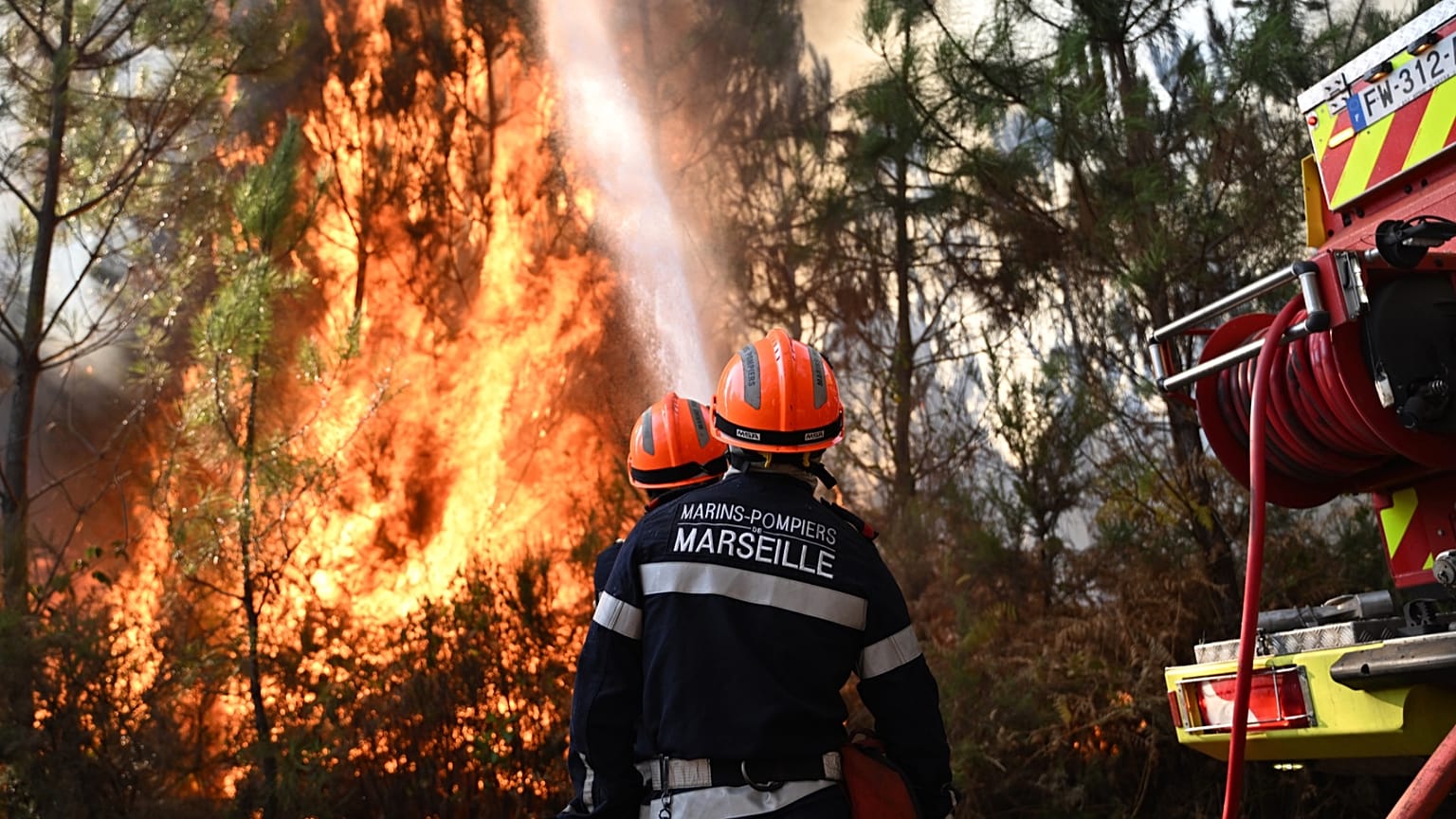
Climate change made recent fire-prone conditions at least twice as likely in southwestern France and at least 20 times as likely in central Spain, new analysis shows.
Human-induced climate change made the fire-prone conditions that have devastated large swathes of Europe up to 20 times more likely, scientists have warned.
Spain and France have been grappling with uncontained blazes that have scorched more than 120,000 hectares of land and forced around 300,000 people to evacuate their homes. The EU activated its emergency response system, sending firefighting aircraft and ground vehicles to tackle the blazes – but warned it was quickly running “out of capacity”.
Earlier this week, a wildfire in France grew so powerful that its own smoke column turned into a thunderstorm, generating lightning that struck the ground and ignited even more fires. It also produced heavy winds that pushed the flames in new directions.
More recently, wildfires have broken out in Greece – killing three firefighters on the island of Crete – while hundreds have been evacuated along Türkiye’s western and southern coasts.
While the blazes have garnered global media attention, many outlets have avoided linking Europe’s so-called ‘mega fires’ to climate change.
Has climate change increased the likelihood of Europe’s mega fires?
A new study from World Weather Attribution (WWA) analysed historical weather observations – but not climate models – to see how fire-prone weather conditions have changed over time.
To do this, they used a metric called the Daily Severity Rating (DSR), which incorporates hot, dry, and windy conditions and reflects how difficult a fire is to suppress once it has started. The researchers looked at the seven-day period with the highest DSR across southwestern France and central Spain, where the fires occurred.
They found that human-induced climate change made the fire-prone conditions at least twice as likely in southwestern France and at least 20 times as likely in central Spain. The scientists note that these are conservative estimates.
“When wildfires break out simultaneously across different regions, it becomes clear that human-induced climate change is not only increasing the likelihood of more extreme fires but also their synchronicity,” says Andreia Ribeiro, a climate scientist at the Helmholtz Centre for Environmental Research in Germany.
“That comes with a real cost, as overlapping fire extremes make it harder for countries to cooperate and share firefighting resources with each other when that support is needed most.”
The analysis found that in today’s climate, events of this intensity are expected to occur once every 20 years in southwestern France and once every six years in central Spain.
Dr Clair Barnes, a research associate in extreme weather and climate change at the Centre for Environmental Policy at Imperial College London, says the wildfires aren’t just a case of “bad luck” and are a “clear sign on the escalating impacts of anthropogenic warming”.
“A wet winter, followed by this intensely dry summer and a succession of heatwaves has left forests loaded with dry fuel, and relentless heat – fuelled by human-caused climate change – has created the conditions for sparks to take hold and become massive, dangerous wildfires,” she says.
Yesterday (30 July), a separate study published in the journal Scientific Reports analysed national wildfire records from Portugal, Spain, France, Italy and Greece alongside weather and climate data between 1981 and 2025.
Researchers found that in parts of France and Spain, the intensity of fire-promoting weather had increased by up to 50 per cent between 2016 and 2025 compared with 1981 to 2010.
The number of days with “highly fire-promoting conditions” also increased from fewer than 10 days per summer in 1981 to 2010 to around 25 days over the last decade in parts of each country studied.
UN urges Europe to move from fossil fuels ‘faster’
Following WWA’s attribution analysis, UN climate change Executive Secretary Simon Steill says Europe’s mega fires show how fast climate change-driven extreme heat and dry landscapes can turn wildfires into “devastating national disasters”.
“Humanity continuing to burn colossal amounts of coal, oil and gas is baking our planet, making these conditions more dangerous, and these mega fires more deadly and destructive,” he says.
“But the solutions are equally clear: all countries must move faster from fossil fuels to renewables and protect people from worsening climate impacts, from wildfires, to megastorms and floods, to droughts hitting food production.”
According to the European Commission, the number of people living near wildland and exposed to high-to-extreme fire danger levels for at least 10 days per year in the EU would grow by 15 million with just 3°C of warming. Human-caused climate change has already pushed the global surface temperature up by approximately 1.3-1.5℃ compared to pre-industrial levels.
As Bordeaux blaze eases, Ukraine sends
reinforcements to France
A total of 308 people have been detained across France as part of investigations into a recent wave of wildfires, Interior Minister Laurent Nunez said on Friday, with two-thirds of them suspected of "deliberate arson".
Issued on: 31/07/2026 - RFI

The announcement came as firefighters reported that the massive blaze near Bordeaux had stabilised, allowing some evacuees to begin returning home.
"That is obviously a very high figure, especially considering that two-thirds of the arrests are for criminal acts, namely intentional arson," Nunez told RTL radio on Friday.
Of those individuals, 33 have been incarcerated – "either in pre-trial detention awaiting judgment or already convicted," sometimes receiving "actual prison time," he added.
Nine out of ten fires are caused by human activity, with lightning accounting for a significant proportion of the remaining 10 percent.
According to preliminary investigation findings, the season's largest fires in France were accidental in origin.
The fire engulfing 42,000 hectares near Bordeaux, in southwestern France, may have been sparked by brush-clearing work beneath a power line, carried out by a contractor for Enedis.
The simultaneous fire in the Landes region, near Biscarrosse, was ignited by a vehicle fire on a departmental road.
As for the fire that ravaged part of the Fontainebleau forest, southeast of Paris, the Fontainebleau public prosecutor said that repair work on a motorway guardrail – specifically a spark from a petrol-powered angle grinder – reportedly ignited the vegetation and, subsequently, the forest bordering the A6 motorway.
Optimistic day
Early on Friday, authorities announced that the massive fire near Bordeaux had stabilised, thanks to "favourable" overnight conditions.
The improvement followed what Gironde prefect Sophie Brocas described as an "optimistic day" on Thursday, adding: "the feeling that we are beginning to return to normal life."
Firefighting chief Marc Vermeulen said hotspots in the wildfire zone had dropped from six to three since Thursday morning, but remained cautious.

"It will depend on how the terrain reacts, the number of remaining flare-ups that emerge, and also on the weather conditions we will face over the coming days," he told reporters.
With the spread now largely contained, more than half of the 224,000 people evacuated have been able to return to their homes in 12 municipalities to the northwest and south of Bordeaux.
The wildfires have destroyed more than 200 homes and killed at least three firefighters.
Ukraine sends reinforcements
Meanwhile, Ukraine said on Friday it had dispatched a team of 70 rescuers to help battle the blazes in France.
"This morning, Ukrainian rescuers set off for France to help combat forest fires," Ukraine's Interior Minister Ivan Vygivsky said in a social media post.
"A combined unit of 70 rescuers and 15 specialised vehicles has been dispatched," he added.
He said their "unique" experience dealing with the aftermath of Russian drone and missile strikes meant they were well equipped to work "in extremely challenging conditions."
How forests decimated by wildfires still have the power to heal
Scientists attribute the record-breaking heat to climate change and say Europe, the fastest-warming continent, could face a tenfold increase in extreme fires this century.
Southern Europe is "becoming more flammable," with the number of summer days primed for extreme fire conditions more than doubling since 1981, according to a new study released on Thursday.
The sharp rise in the frequency of fire weather – characterised by searing temperatures, low humidity, dryness and strong winds – "can only be attributed to global warming," said study co-author Raul Cordero, an atmospheric scientist at the University of Groningen in the Netherlands, in comments to the French news agency AFP.
(with AFP)

No comments:
Post a Comment