It’s possible that I shall make an ass of myself. But in that case one can always get out of it with a little dialectic. I have, of course, so worded my proposition as to be right either way (K.Marx, Letter to F.Engels on the Indian Mutiny)
Monday, August 03, 2026
Drought Makes Upper Rhine Unnavigable, Driving Barge Rates to New Record
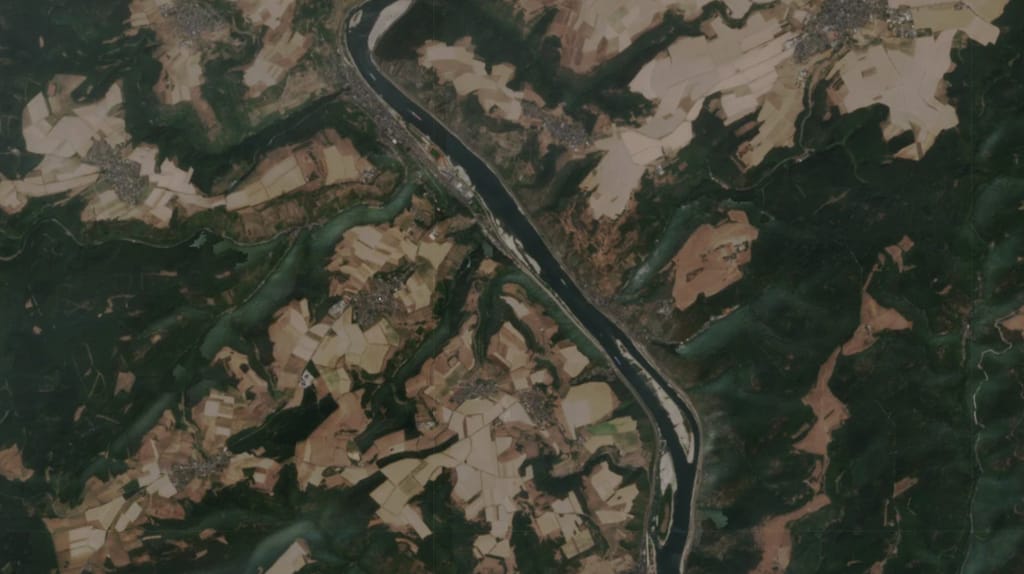
A handful of barges transit the Rhine near Kaub, Germany, July 30 (Copernicus / Sentinel-2)
Low summertime water levels are a routine problem for navigation on the River Rhine, especially in recent years, but the intense drought conditions affecting Western Europe have left the waterway all but unnavigable at a key chokepoint - sending freight rates to record highs.
The limiting factor is the gage depth at Kaub, downriver from Wiesbaden. At present it is less than 12 inches, the bare minimum for most barges to transit in laden condition. The shutdown closes off access above Kaub on the Upper Rhine, which serves customers from Mannheim to Strasbourg to Basel, Switzerland.
Even when passable, according to Reuters, barge loadings have been restricted to as little as 10 percent of capacity in order to minimize vessel draft and enable safe passage. This requires barge owners to charge more per tonne transported, since the vessel is still navigating the same route with reduced cargo. Since June, the price has roughly tripled.
"Industry is transferring cargo to rail and road transport, but this is also expensive because of the extra demand," one trader told Reuters.
A shutdown on parts of the Lower Rhine could begin as early as next week, according to Argus, with implications for inland refinery operators that rely on water transport to move products. Rail network capacity is already saturated, and commodity markets in the area are facing substantial disruption.
Drought is also affecting the Danube, where record-low water levels are disrupting traffic and exposing relics of bygone eras. Cruise and commodity traffic on the river has effectively come to a stop, and operators of two nuclear power plants in Romania and Hungary have had to shut down because of a lack of cooling water from the river.
The low water levels are driven not just by lack of rainfall, but by extreme heat events that increase evaporation - all made more likely by recent adjustments to average atmospheric temperature, according to a new study by researchers at Imperial College London and ETH Zurich.
Viking River Cruise Ship Evacuated After Grounding on the Danube
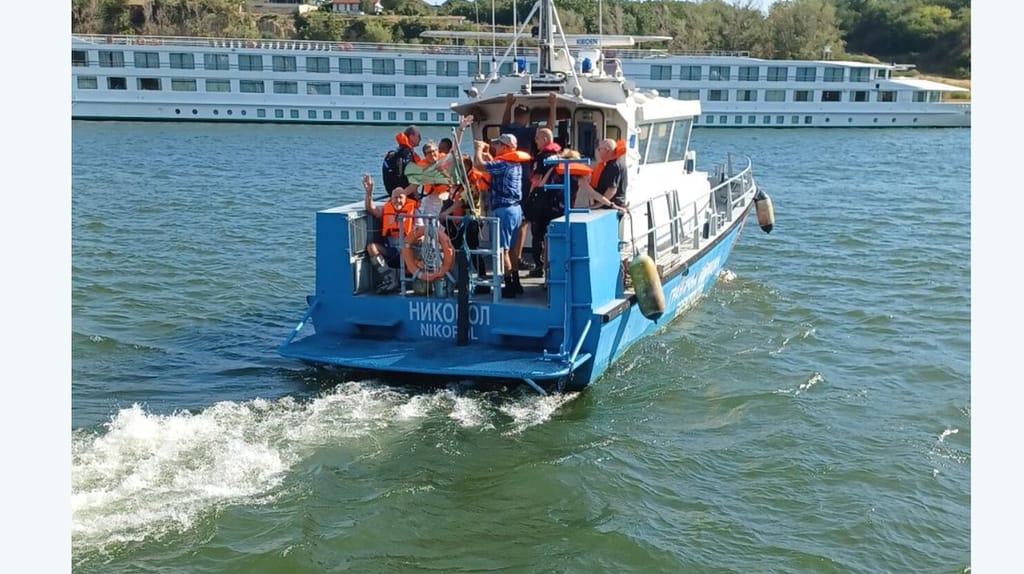
Passengers were evacuated from the grounded Viking Ullur (Bulgarian Ministry of the Interior)
Bulgaria’s Border Police were leading an orderly evacuation of the passenger from the Viking river cruise ship Viking Ullur after the vessel grounded early on July 28. The authorities cited low water levels and the dark of night as contributing factors but said the vessel had ultimately left the navigation channel before it grounded.
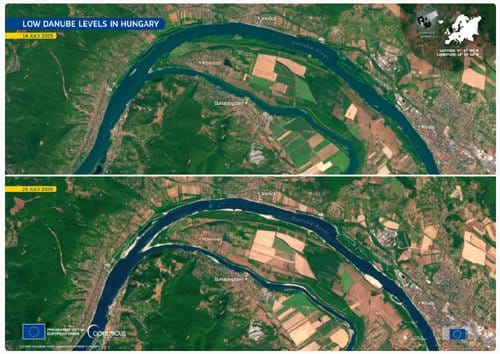
At various points along the Danube, which is the second longest river in Europe, authorities have warned of extreme low water levels due to a prolonged dry spell and intense summer heat, which has accelerated evaporation. The European Union used imagery from Copernicus Sentinel-2 to illustrate the rapid decline in water levels in sections of the Danube. It highlighted “exposed pale sediment bars along several bends” of the river in Hungary, saying the low water levels were affecting navigation and river tourism, warning that sightseeing services to northern Hungarian towns have been suspended since mid-July.
Images show the decline in water levels over 10 days in July on a section of the Danube in Hungary (European Union, Copernicus Sentinel-2 imagery)
Authorities in Serbia and Croatia reported the river is at record low levels. Serbia’s fuel imports are being impacted, as are fishing and tourism.
The Swiss-flagged cruise ship, built in 2019, departed the port of Drobeta-Turnu Severin, Romania, around 9:15 p.m. Monday night in a section of the river between Serbia and Romania. It was heading to Vidin in northwest Bulgaria. There were 186 passengers and 52 crew aboard the ship. It measures 443 feet (135 meters) in length as part of Viking’s unique Longship design.
The cruise ship went aground at approximately 02:20 on July 28, approximately 15 miles above Vidin as it was sailing downriver. The ship attempted to free itself, and local vessels were used in attempts to pull it free.
The authorities highlighted that there are draft restrictions on the river. They said the river’s flow in the area has fallen from a normal 4,700 cubic meters per second to a current 1,650 cubic meters per second, but the ship was in compliance with the restrictions and had moved outside the navigable channel. A passenger writing on social media said they were told it was a pilot error.
The Lower Danube River Administration sent its technical vessel Concordia to carry out water-depth measurements. Viking also sent a chartered cruise ship, the French-flagged Vivaldi, in an effort to transfer the passengers to another vessel. However, the second ship was unable to approach the stranded cruise ship.
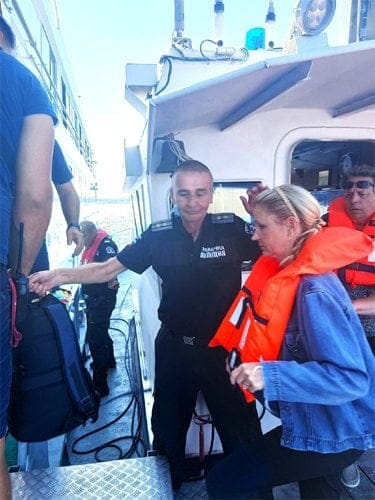
Passengers were being transferred between ships and later were bused to Bucharest (Border Police)
The authorities determined to conduct a daylight evacuation of the cruise ship after reports said the vessel was low on drinking water. It had been scheduled to replenish in Vidin. Pictures from the Border Police showed the passengers in life jackets boarding a small boat and being ferried to the second cruise ship. A passenger from Viking Ullur later reported they would be making a five-hour bus trip to Bucharest, where they would arrive around 2:00 a.m. local time.
The authorities reported the Viking cruise ship is in no immediate danger. Because it is outside the channel, it is not disrupting river traffic.
It is the second vessel that they are managing after having grounded in the Danube. In a similar area on the eastern side of the river in Romania, a cargo vessel has also stranded. It is aground near Calafat, Romania, stuck, the authorities said, on a sandbar exposed by the low water levels on the river.
All along the river, precautions are in place to address the low water levels. Cargo ships have been required to reduce their loads due to the draft restrictions. Some of the river cruise ships have been docked at key ports and are transferring passengers by bus between cities, while others have had to alter their scheduled itineraries.
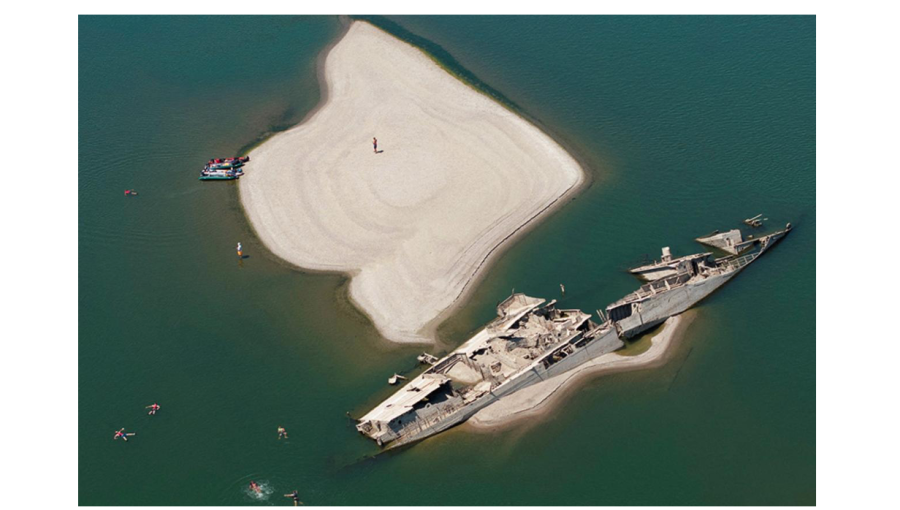
Sunken Nazi warships resurface on Danube as Serbia's drought deepens
Around 200 vessels scuttled in 1944 to keep them from the Red Army are re-emerging near Prahovo as the river hits some of its lowest levels on record. / bne IntelliNewsFacebook
Dozens of Nazi-era warships, deliberately sunk in the Danube in 1944 to stop them falling into Red Army hands, have resurfaced near Prahovo in eastern Serbia as a summer drought pushes the river to some of its lowest levels on record, Euronews reported.
Around 200 ships, barges and tugboats may still lie on the riverbed in a roughly five-kilometre bottleneck near Prahovo, obstructing navigation, and some of the wrecks may still contain live ammunition. With EU support, Serbia has begun raising the wrecks and clearing the waterway; salvage work led by the European Investment Bank started in 2024 and is expected to run until 2028.
It is not the first time low water has forced the issue. Persistent drought has repeatedly cut Danube water levels over the past several years, disrupting grain shipments and forcing Serbia and its neighbours into repeated dredging operations to keep the river navigable - a recurring seasonal stress on one of Central and Eastern Europe's most important trade corridors that this year's heatwave has made acute enough to expose seven-decade-old wreckage.

No comments:
Post a Comment