Von der Leyen’s Canada ‘associate membership’ spurs battle of words with EU capitals
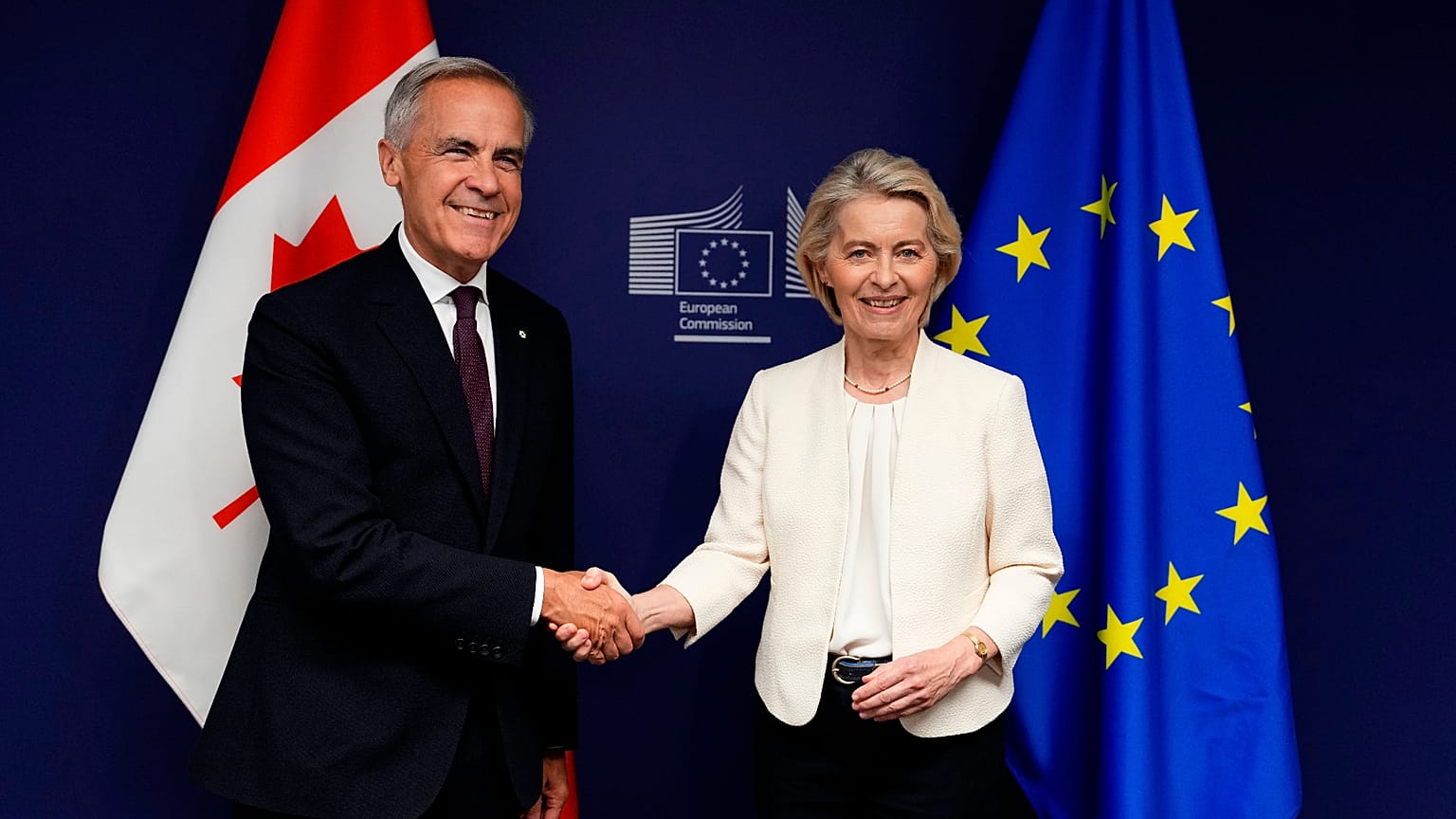 Copyright AP Photo/ Justin Tang
Germany, Italy, France and Greece objected to a draft EU-Canada declaration that cites von der Leyen’s ‘associate membership’ offer, as the member states fear legal uncertainty and a precedent for other third countries ahead of the Montreal summit on Thursday and Friday.
Last month, European Commission President Ursula von der Leyen made a bombshell offer to Canada: to become the first EU “associate member”. Now the term is proving hard to swallow for several member states, including her own Germany.
Ahead of the EU-Canada summit, meant to chart what many see as the closest partnership between the bloc and a non-member country, European capitals led by Berlin have pushed back against a term that has yet to be clearly defined, five EU diplomats told Euronews.
“The main concern is that this is unknown terminology, it might bring up legal uncertainty and expectations from other third countries,” one of the diplomats said. “This was not communicated previously from the Commission. We don’t know what we are talking about.”
Last week, a revised draft of the joint declaration explicitly mentioned the notion, vowing regular exchanges with Canadian authorities on major policy and regulatory initiatives and to define the full scope of the partnership at the 2027 summit.
Naming the term outright in what would be the first EU official document of major political significance to include it has drawn strong pushback from Germany, Italy and Greece, and scepticism from other countries, including France.
A new draft circulated on Monday evening added wording that distanced member states from the concept, specifying that it was “put forward by the European Commission," wording suggested by the Italian government.
The text was due to be adopted on Tuesday through the so-called silent procedure, under which a document passes unless a member state objects. Germany, Italy, France and Greece all raised objections before the deadline.
Italy's objection does not relate to associate membership, since its proposed wording was accepted, but it asked to change a paragraph related to competitiveness and technological sovereignty for a balanced decarbonisation transition.
The office of European Council President António Costa is now expected to circulate a new version, with another round of talks at ambassador level on Wednesday, before the summit opens in Montreal on Thursday.
Von der Leyen floated the idea of offering associate membership to Canada in her annual State of the Union speech to the European Parliament in September, with Prime Minister Mark Carney as guest of honour.
The idea had been put to the Canadians before, but it was never discussed with member states or within the Commission, catching capitals including Paris and Berlin off guard.
Even Carney did not seem fully sold on the nomenclature, preferring to call it an “alliance of the future”. “What matters is the substance,” he said when asked whether he was comfortable with the term.
With governments now finalising the joint declaration, to be adopted at the summit on Thursday and Friday, that initial lack of consultation is coming back to haunt the bid.
For Berlin, the main issue is that member states should first define what the cooperation package contains, and only then agree the terms for the declaration, not the other way around.
There is broad consensus on seeking closer cooperation with Canada in areas such as defence, critical raw materials, energy, trade and border security. It is the associate membership label that has drawn scrutiny.
Others took aim at its legal implications, arguing these must be carefully studied before the term enters a political declaration.
“It does not mean anything, it is not in the treaties,” a second EU diplomat said, adding that “we want to find a way to make the concept work.”
Von der Leyen is not new to launching new ideas and forging ahead with initiatives without consulting with the member states. In 2023, she announced a migration deal with Tunisia and was criticised for lacking a formal mandate to do so.
“In the case of Tunisia, member states fully agreed with the objective of reducing arrivals, but they had to say that they did not 100% agree with the way it was done. It is a bit the same case here,” a third diplomat told Euronews.
For this diplomat, the EU should not view the label as merely institutional, but as a way of packaging what would otherwise inevitably look like a sector-by-sector technical exercise in bringing Canada closer to the bloc.
For von der Leyen’s critics, she has a habit of making grand announcements before figuring out the implications. For her supporters, her strength is staying ahead of the curve, setting out a political vision and letting the bureaucratic machinery do the rest.
German Chancellor Friedrich Merz was the first to propose associate membership, but pitched it as a way to anchor Ukraine to the EU, with security guarantees, as Kyiv progressed through the accession process.
Applying it to Canada carries a very different connotation: it would offer a blueprint for the closest possible partnership with a non-European country that could never join the bloc.
“A lot of other countries want to come closer to the EU, but we don’t know what to offer them. Whatever deal we reach with Canada might be an important motivator for others,” an EU official told Euronews.
This story was updated with additional information.

October 28, 2026
By Rapporteur
Key Takeaways:
The undefined label, floated by Ursula von der Leyen, remains contentious ahead of the Montréal summit, with the text now only pledging to define it by 2027.
U.S. President Trump has already dismissed the idea as “laughable” and threatened heavy tariffs on the EU.
(Rapporteur) — Germany and three other countries have objected to a joint EU-Canada statement proposing to make the north American country the bloc’s first “associate member”.
The objection has put the brakes on a text that was due to be automatically adopted on Tuesday morning. The statement will now need to be redrafted.
Ursula von der Leyen, the European Commission president, first floated the concept of associate membership in September.
The label has since become one of the most contentious elements ahead of this week’s EU-Canada summit in Montréal, and has raised eyebrows in both Brussels and Ottawa amid a lack of clarity over what the status would mean in practice.Advertisement
Germany has been among the fiercest opponents of the term.
The objection came before the deadline for the EU’s so-called silence procedure, a diplomatic mechanism under which a text is approved automatically unless a member objects in time, several EU diplomats told Rapporteur.
Three other countries, Italy, France and Greece, also objected to the statement.
The draft objected to by the four members was circulated after member states discussed the text on Monday, in an attempt to bridge the different positions.
The latest version, dated 26 October and seen by Rapporteur, referred to work in order to define the concept of “Associate Member put forward by the European Commission,” effectively shifting ownership of the label back to the EU executive as national capitals sought to distance themselves from the internal dispute, said diplomats.
Monday’s draft still retained a commitment to define the concept ahead of the next EU-Canada summit in 2027.
The label had earlier triggered the ire of Donald Trump, the US president, who called the idea “laughable” in September, and threatened to impose “very heavy tariffs” on the EU for what he deemed a “hostile act.”
Germany did not immediately reply to a request to comment.
About Rapporteur
Rapporteur, formerly EurActiv, is Europe’s expert media organisation for policy and politics. Through deeply reported journalism, trusted expertise and a commitment to engagement with our audiences, we aim to help the people shaping Europe’s future make better decisions.
View all posts by Rapporte

No comments:
Post a Comment