Israel election: Netanyahu bloc leads with more than half of votes counted but short of majority
The partial results are likely to change, and several exit polls showed the camps neck-and-neck without a majority.
The camp of Prime Minister Benjamin Netanyahu was ahead of the opposition on Wednesday after 50% of votes were counted in Israel's pivotal general election, figures from the Central Elections Committee showed.
Netanyahu's bloc was projected to win 56 of the 120 seats in the parliament, compared with 49 for the opposition bloc and 15 for the Arab parties.
The partial results are likely to change, and several exit polls showed the camps neck-and-neck without a majority.
Initial exit polls suggested no clear victor, with both Prime Minister Benjamin Netanyahu and main rival Gadi Eisenkot falling short of a majority.
Israel's Channel 13 news initially projected the opposition bloc would have the edge with 53 seats in the 120-seat Knesset, with Netanyahu's bloc set to win around 50.
The three mainstream Israeli television networks later gave the two blocs each around 51 seats.
Netanyahu's Likud party would be the largest single party, with 27 seats.
Arab parties make gains
Israeli Arab lists were projected to win 15 seats, a sharp gain, with some Israeli Arab communities reporting near-universal turnout driven by outrage to often derogatory rhetoric against them by Netanyahu's far-right allies.
Key Israeli Arab leader Mansour Abbas said he believed the right had "suffered a major loss" and was open to working with Eisenkot.
But Eisenkot said during the campaign he would not govern with Israeli Arab lawmakers -- and Netanyahu again suggested that a government relying on Arab votes would lack legitimacy.
Arab lawmakers could give Eisenkot support in parliamentary votes to maintain a minority government without joining a coalition. If not, Israel could head to new elections.
Itamar Ben Gvir, a far-right firebrand who according to exit polls did not gain as much as many expected, warned Netanyahu against another option -- a unity government with Eisenkot.
"It would be a terrible mistake," said Ben Gvir, who champions the expulsion of Palestinians and would likely be excluded from any unity government.
In a post on X, Eisenkot said the exit poll results showed a "complete lack of confidence in Netanyahu and the October 7 government."
Yair Golan, the leader of Israel's left-wing Democrats party, added that the public had "spoken" and "ousted the Netanyahu government."
But Israeli Foreign Minister Gideon Sa'ar warned that celebrations from the left were "premature."
"One thing seems quite clear: The Likud is the largest party in Israel," he wrote on social media.
Netanyahu and Eisenkot each claim mandate
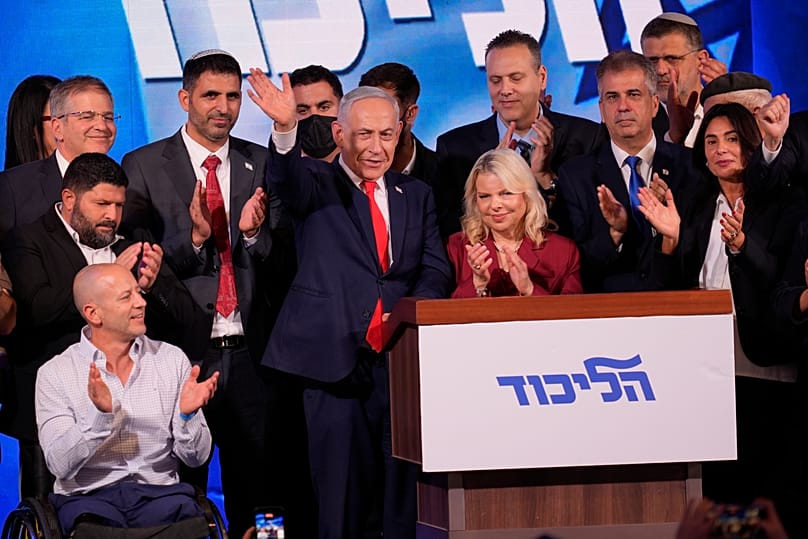
At an appearance early Wednesday, Netanyahu was upbeat and already trying to position himself to remain prime minister, listing off military achievements of the past three years.
He called on his opponents to line up behind him and dismissed the idea of a partnership with Arab parties — whose constituents make up 20% of Israel's population — as treasonous.
“We must establish a strong, right-wing, nationalist government,” said Netanyahu, who was facing off in the vote against his former military chief, centrist Gadi Eisenkot. “We must not endanger Israel and establish a government that relies on anti-Zionist Arab parties.”
"Israel has a unique opportunity with our partner President Trump to forever eliminate the existential threat of Iran," Netanyahu said.
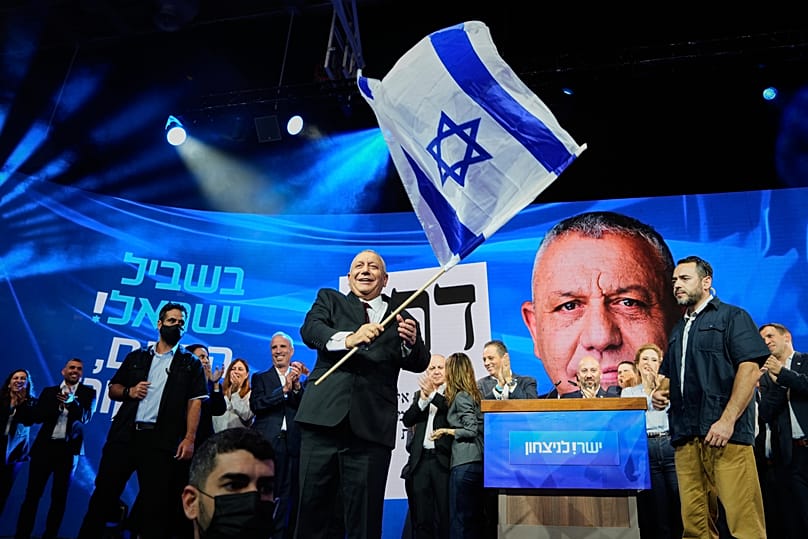
Eisenkot, speaking to his own supporters in Tel Aviv, issued a veiled warning to Netanyahu, who observers say could use a war to push for a unity government.
"Netanyahu, don't you dare use Israel's security for your political needs," Eisenkot said.
Addressing Israel's security establishment, Eisenkot said that they served the state and not Netanyahu, calling him "a caretaker prime minister, without a mandate or the people’s trust".
Turnout for the election - Israel's first since Hamas' 7 October 2023 attacks - hit over 77%, according to Israel's Central Elections Committee.
Netanyahu had spent much of the day calling on supporters to get out and vote, painting the election as a "matter of life and death."
The vote is widely seen as a referendum on Netanyahu's leadership.
Ex-Israel government spokesperson: 'Extraordinary comeback' by Netanyahu
Despite the fallout from the 7 October attacks, three years of war and widespread public dissatisfaction, Benjamin Netanyahu emerged from Israel's election with his political position strengthened, even as neither political bloc is assured of a parliamentary majority.
Israel faces three possible outcomes following an inconclusive parliamentary election: a unity government, a minority administration or fresh elections, according to former Israeli government spokesman Eylon Levy.
The political deadlock comes as Prime Minister Benjamin Netanyahu stages what Levy described to Euronews as an "extraordinary comeback".
"All of those are going to require someone to surrender on some very serious coalition promises," Levy said.
Netanyahu's political survival
For Netanyahu the election represents a remarkable political recovery after years of mounting pressure over the security failures surrounding the Hamas-led attacks of 7 October 2023, the subsequent war and domestic divisions.
"This is an extraordinary comeback for Netanyahu, despite the October 7th massacre that happened on his watch, despite three years of war since then, despite huge public unrest and dissatisfaction over his alliance with the ultra-orthodox parties and their demand for an exemption from military service," Levy told Euronews.
Yet his electoral gains do not necessarily translate into a governing majority.
"Netanyahu has lost his majority. It seems it's unlikely that he will hold on to a majority. But unless someone else manages to form a government, he remains the caretaker prime minister," Levy said.
That leaves Netanyahu in a potentially advantageous position: his rivals must assemble an alternative coalition, while failure to do so could extend his tenure as caretaker prime minister.
Could Arab parties decide who governs Israel?
Arab parties have made substantial gains in Israel's parliamentary election, with early projections pointing to potentially record representation in the Knesset.
Their performance has brought the politically sensitive question of their role in forming the next government back into focus.
Their support could prove decisive in determining whether Gadi Eisenkot, Netanyahu's main opposition challenger, can assemble an alternative government, although several opposition figures have ruled out governing with them.
Levy said the possibility of an Eisenkot-led minority government supported by some Arab parties had been discussed, but warned that such an arrangement could provoke a political backlash.
"Leaders within the change block are warning that would be extremely unpopular and would backlash and end up giving Netanyahu an even bigger majority in the next election," he said.
Levy pointed to deep ideological divisions between mainstream Israeli parties and Arab political factions, particularly over Hamas.
He singled out Mansour Abbas, leader of the Arab Ra'am party, which participated in Israel's 2021–2022 governing coalition.
Although Abbas has condemned the Hamas-led attacks of 7 October, he has repeatedly declined to explicitly describe Hamas as a terrorist organisation, a position Levy cited as an obstacle to political cooperation.
"So they are still kryptonite for most of the mainstream parties," Levy said.
"Either we go back to elections or someone folds and sues for peace and joins his coalition," Levy said.
October 28, 2026
Al Bawaba News
By Mansour Al-Maswari
(Albawaba) — Initial Israeli election exit polls indicate that Prime Minister Benjamin Netanyahu’s right-wing bloc is falling short of the 61 seats needed for a Knesset majority, with opposition leader Gadi Eisenkot emerging as a potential candidate to form the next government, Israel’s Channel 12 reported.
Preliminary projections put Netanyahu’s bloc at 50 seats, compared with 53 for the opposition and 17 for Arab parties. Across six exit-poll projections, Netanyahu’s coalition was estimated to win between 50 and 60 seats, with none reaching the 61-seat threshold required for a parliamentary majority. The results remain projections, not official election results.
Voter turnout reached 74.3% by 8 p.m., according to Israel’s Central Elections Committee, marking exceptionally high participation. Earlier, turnout had reached 55.7% by 4 p.m., amid reports that Arab voter participation was surging and threatening the electoral prospects of smaller right-wing parties.
Netanyahu intensified his campaign in the final hours of voting, using a TikTok livestream to urge supporters to vote for Likud. He warned that low turnout could result in a left-wing government backed by the Muslim Brotherhood. National Security Minister Itamar Ben Gvir also canvassed voters, knocking on doors and using a loudspeaker to encourage participation.
Finance Minister Bezalel Smotrich reportedly cut short visits to polling stations and called an emergency meeting amid concerns over Arab voter turnout. Meanwhile, Israeli media reported that Likud had requested an extension of voting hours, but the Central Elections Committee rejected the request.
Tensions were also reported at a polling station amid allegations of deliberate delays in Arab communities. Ahmad Tibi, head of the Joint List bloc, accused election staff of slowing the process and demanded that people waiting outside, including patients and journalists, be allowed to vote. The allegations had not been independently verified.
The election has become a critical test for Netanyahu’s right-wing coalition, with the final distribution of seats and the role of Arab parties likely to shape negotiations over the formation of the next government. Official results are awaited.
About Al Bawaba News
Al Bawaba provides top stories and breaking news about the Middle East and the world. The Al Bawaba network consists of several web portals and media platforms.
View all posts by Al Bawaba News →

No comments:
Post a Comment