
Russia’s winter campaign is just getting underway with a barrage of missiles and drones shattering what is left of Ukraine’s power sector and relations with the Trump administration hit a new low, but the Armed Forces of Ukraine (AFU) highly successful Operation Vivaldi has reached the end of the fourth part of the concerto and pushed Russia’s forces back from the three key Fortress Belt cities in a victory for Bankova.
Ukrainian forces have driven Russian troops back to the Zherebets river and ended their Vivaldi offensive in the Donbas, Third Army Corps commander Andriy Biletskyi told hromadske on October 20.
The operation ran north of the town of Lyman and was fought in four phases that the corps named after Vivaldi's four concertos and called seasons. It began in the summer and was first made public on September 15. Biletskyi put the ground retaken at 277 sq km and 16 settlements, and said Russia's 144th Division of the 20th Army had been smashed and no longer existed as an organised force.
Russian troops entered Kostiantynivka in the summer, the southern anchor of the Donbas fortress belt, and closed on Sloviansk and Kramatorsk, the two cities whose loss would have given Moscow the whole of Donetsk region and its central war aim. Vivaldi has pushed the line back east instead, and it has done so while the throttling of American military help leaves Ukraine's cities steadily more exposed to Russian missiles.
Pushback
Despite being outgunned and outmanned, Ukrainian assaults killed more than 8,000 Russian troops across the four phases, Biletskyi said, and 270 Russians surrendered, among them more than 20 officers. Two Russian battalion commanders died in the final phase.
"In Operation Vivaldi we attacked a stronger enemy and lost seven times fewer troops than Russia," he said. "Count only the dead and the gap is tenfold. Most Russian losses are killed, most of ours wounded. We can attack, and we can be effective."
Measured on Ukraine's map the operation freed 277 sq km, he said; measured on the maps Russia publishes, which he called fake, the same ground would come to 1,260 sq km.
The corps attacked with the troops already holding about 160 km of front, the longest sector in the war, and many of them had been retreating six months earlier, Biletskyi said. Russia had more men, more drones and far more artillery, but ended up retreating in disorder.
Ukrainian used its new mid-range drones, introduced this year, to cause havoc to Russian logistic supply lines up to 150 km behind the line, he said. Russian troops once unloaded 10 to 15 km from the front and now get off 40 to 50 km back and walk in, with shells passed hand to hand over the last 20 to 30 km by what he called mules. On some days the corps destroys up to 50 Russian vehicles.
Disputed claims
Every one of those figures is the corps' own, given by the commander of the force and there is no independent count of Russian dead on the Lyman axis.
While it is clear t4he AFU has made extraordinary progress, the details remain cloaked in the fog of war and disinformation. The headline totals have grown as the operation went on. The area officially retaken stood at 176 sq km after three phases in late September, with more than 2,000 Russian losses claimed in the third phase alone.
President Volodymyr Zelenskiy said in early October that more than 5,000 Russian troops had been killed and 250 captured, figures that could not be independently verified, The New York Times reported on October 7. When the corps announced the end of the operation on October 15 it put Russian losses for the whole of Vivaldi at 8,000 killed or wounded, United24 Media reported. Biletskyi's October 20 account has 8,000 killed.
The US-funded Institute for the Study of War put the ground Ukraine retook around Lyman at 147 sq km or more in its September mapping, and calculated that Russian forces had lost control of a net 293.59 sq km across the whole front since March, United24 Media reported on October 2. Russia lost dozens of square miles during the Ukrainian campaign and September was its worst month for net territorial gains since June 2023, The New York Times reported.
The 1,260 sq km figure is a claim about Russian cartography rather than a second measurement of the same ground, and no independent test of it is available.
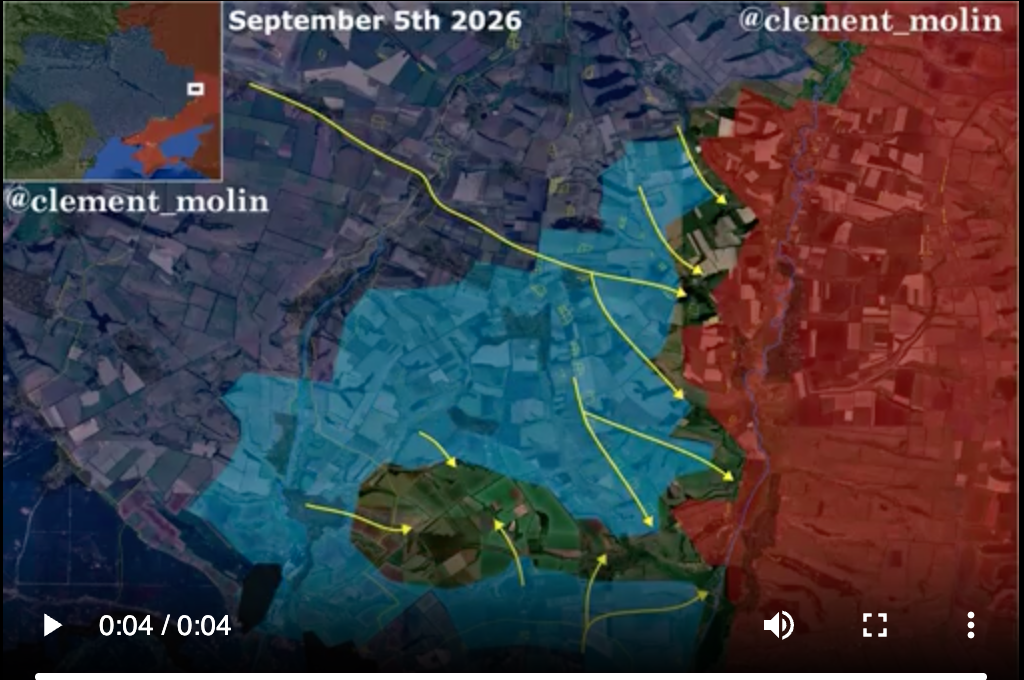
French milblogger Clement Molin reports on the basis of confirmed strikes that the Ukrainian advances were wider than the Russian side were willing to admit. @clement_molin
The French milblogger Clement Molin said the operation's scope was broader than had been reported in September. Ukrainian troops had pushed on towards the Zherebets and reached it at several points, he said, and Russian forces no longer controlled any territory west of the river, with the exception of the forest east of Lyman.
Parts of that forest, the village of Zarichne and some nearby settlements remain in what Molin designates the grey zone. "Despite various rumors, I have not been able to confirm that the Ukrainians have actually crossed the river," he said.
South of the Siverskyi Donets, where Ukrainian units moved to clear Russian infiltrators, those operations recaptured territory and cleared some infiltrated areas, Molin said, but he prefers to keep a broad grey-zone marking because many Russian positions still remain.
Putin said on October 16 that Russian forces controlled the whole of Luhansk region. Biletskyi called that "absolute nonsense" and said Vivaldi had extended Ukrainian control in the region from about 40 km at its most vulnerable point to more than 100 km, Interfax-Ukraine reported on October 19.
Ukraine's General Staff disputed Russian claims of control over Kostiantynivka, Kramatorsk, the outskirts of Sloviansk and Mykolaivka, with Major Andriy Kovaliov saying Ukrainian troops still held positions in Kostiantynivka as of October 17.
The line on the ground
Clearing the forests east of Lyman has fully secured the city, Molin said, which now lies well behind the front line and can be resupplied. Ukrainian artillery can sit in those forests to defend Sloviansk, and Ukrainian units can cross the Siverskyi Donets without constant threat from FPV drones, particularly around Izium.
The Third Army Corps, now under the Centre army group, has secured the northern flank of the Donbas and is working to stabilise the situation east of Sloviansk as winter sets in, Molin said. He ties the operations south of the river to General Mykhailo Drapatyi taking command of Ukraine's forces.
Molin does not expect Ukrainian troops to cross the Zherebets. They hold strong defensive positions on the western bank, he said, and a Russian crossing would be extremely difficult because it would mean negotiating a chain of about 10 dams along the river and its lakes.
Russia's broken plan
Russia's plan for 2026 was to break out of its bridgehead on the Chornyi Zherebets towards Sviatohirsk, cut Ukrainian forces east of the Oskil river in two and push on to Barvinkove, Biletskyi said. A second strike through the hard contested town of Dobropillia was to close the ring, and the objective was the whole of Donetsk region.
For now Russia has dropped both the encirclement of Donetsk region and a frontal assault on the remaining Fortress cities of Sloviansk and Kramatorsk, which he said would have been costly and bloody. Its main push is Dobropillia - a gateway to attacking the Fortress cities.
"We disrupted the offensive of Russia's Zapad Group of Forces," Biletskyi said when the corps closed the operation, which it said had degraded the 20th and 25th Combined Arms Armies and the 1st Guards Tank Army.
Small groups and drones
Both sides have changed tactics this summer. Russian attacks shifted to small "infiltration" infantry formations over the summer, using dense vegetation to infiltrate Ukrainian positions, find weak points and establish forward footholds before heavier weapons were brought up. The method cut the visibility of an advance, under pressure from constant FPV drone attacks, and kept armoured vehicles out of reach of Ukrainian drones. It has displaced the costly massed mechanised assault as Russia's main way of taking ground previously.
At Pokrovsk that fell to Russia in December Russian troops infiltrated in small groups and the city stayed a contested grey zone for weeks, with Ukrainian military intelligence running counter-sabotage sweeps through streets that had no front line. Ukraine now uses the method itself: Vivaldi began as an operation to eliminate Russian infiltrators north of Lyman and grew into an offensive.
Supply roads behind the front are now a kill zone, crossed under anti-drone netting, with fibre-optic cables from Russian FPV drones strewn across the fields and ground robots carrying food and ammunition in place of vehicles. Ukrainian ground robots went further during Vivaldi, fitted with grenade launchers, driven up to Russian positions to fire at close range and then blown up inside them.
Ukrainian officers described gaps of up to a kilometre between defensive positions last autumn, with drone operators and mortar crews several kilometres behind the line fighting as improvised infantry because there were not enough men to hold it, and those are the gaps assault groups of four and five men are sent through.
Casualties stay high
Both armies are thought to be losing 20,000 to 35,000 men a month in periods of heavy fighting, and neither publishes a figure. Russia's volunteer recruitment has fallen to about 20,000 a month, roughly 70% of what it loses from the fighting, while Ukraine mobilises 15,000 to 30,000 reluctant conscripts and has opened at least 100,000 desertion cases.
Smaller assault groups have not brought those rates down. The reconnaissance drones that find a mechanised column find four men in a treeline as well, and the zone they make lethal reaches tens of kilometres behind the line of contact, covering rotations, supply runs and casualty evacuation as much as the assault itself. Russian infantry dismounting 40 to 50 km back, on Biletskyi's account, is a measure of how deep it now goes.
Frontal assaults on fortified towns have largely stopped without the casualty totals following them down. Zelenskiy put Russian dead in Vivaldi at more than 5,000 in early October and the corps put them at 8,000 two weeks later, on an operation whose entire territorial result is a strip of farmland and forest 277 sq km in size.
Open skies over the cities
Zelenskiy said the US was sending 12 Patriot interceptors a month, about a quarter of the rate under former president Joe Biden, in an interview with Bloomberg on October 18, and accused Washington of holding back deliveries Kyiv had already paid for.
"I believe steps have been taken to convince Ukraine to capitulate," he said, adding that he was not saying this was the goal his partners were pursuing.
Ukraine's interceptor missiles ran dry over the summer and the hunt for air-defence ammunition has not closed the gap. Russia has spent the autumn working the grid again, the campaign it ran last winter to freeze Ukraine into submission, and hourly power cuts were in force across Ukraine on October 21.
Holding the line through winter
Molin expects Ukrainian forces to consolidate and take up a defensive posture, securing the gains around Lyman, finishing the clearance of the forest to the east and covering the eastern approach to Sloviansk near Mykolaivka, before organising a coherent defensive line between Sloviansk, Lyman and Borova.
Consolidating the front around Kramatorsk and Sloviansk is Biletskyi's priority, Molin said, and Ukrainian troops should hold the new line far more effectively than when they lost this ground suddenly a year and a half ago. A further offensive could come in winter or spring, in his view pushing north from Borova towards Kupiansk to move the front away from the Borova sector.
With the northern flank of the Donbas secured, at least for a time, the focus moves to the southern flank, Zaporizhzhia and Kharkiv, Molin said. Russia's main effort is already there.

No comments:
Post a Comment