Navy Secretary Hung Cao Gets Frosty Reception in Confirmation Hearing
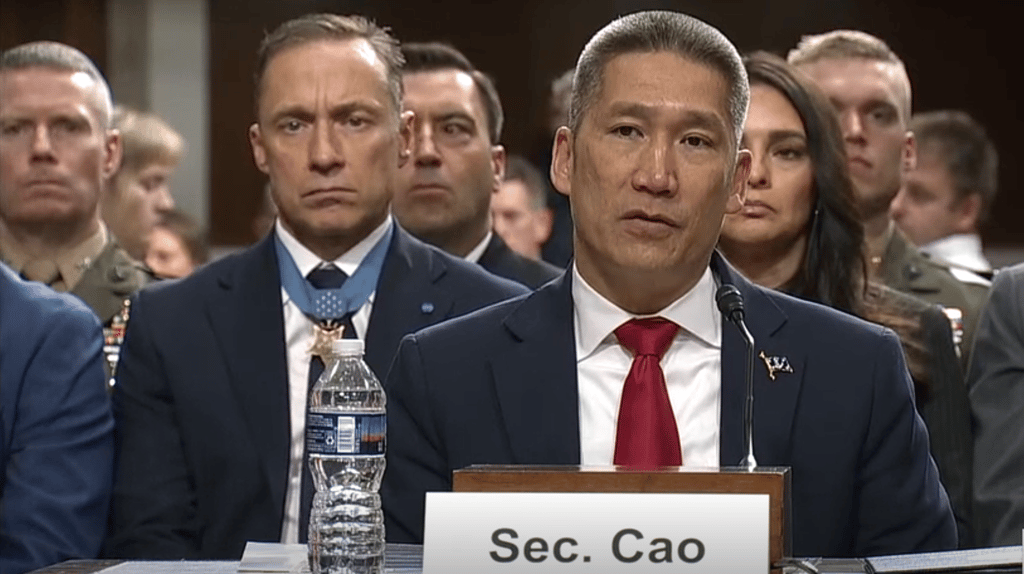
Acting Navy Secretary Hung Cao is up for Senate confirmation to take the job on a permanent basis, and his first hearing portends a contentious relationship with Congress. On Tuesday, senators of both parties questioned Cao intently on the status of the war in Iran, Navy readiness, recruitment, and the problem of suicide in the ranks - a problem Cao has highlighted himself.
The most heated exchange came during a discussion of the situation aboard USS Abraham Lincoln during her record-setting Arabian Sea deployment, which kept the carrier continuously under way for longer than any flat-top in recent memory. The resupply situation for Lincoln was difficult because of Iranian attacks on the base at Bahrain, Navy officials have said, forcing Military Sealift Command's oilers and dry stores ships to operate out of faraway Diego Garcia instead. Some crewmembers' stories of fatigue, poor rations, hunger and shortages reached family members at home, sparking a minor furor and drawing the attention of Congress and the media. According to Cao's account, the Lincoln Carrier Strike Group experienced eight known suicide attempts and no completed suicides during the deployment.
At the hearing, Cao characterized the suicide attempts in the Lincoln CSG as "suicide mitigations," emphasizing successful prevention efforts.
"All the carriers have chaplains, as well as mental resiliency counselors, as well as the mental health specialists. So that's why - you say eight suicide attempts, I see it as eight suicide mitigations that we're able to keep these young men and women [alive]," Cao said, answering a question from Sen. Angus King (I-ME).
In follow-up questioning, Cao used the term "mitigations" again, and Sen. Kirsten Gillibrand (D-NY) took him to task for it, accusing him of "minimizing" and "compartmentalizing" a situation of severe mental strain. She noted that one Lincoln sailor had jumped over the side.
"The fact that a service member, a sailor went overboard [on Lincoln] is beyond a mitigation. It is an attempted suicide that, but for the grace of God, was unsuccessful," Gillibrand said.
Cao suggested that that particular act was not a suicide attempt. "He jumped overboard with a life preserver on, and again, he admitted it to the commanding officer afterwards," Cao said.
"What was he trying to do, swim to Guam?" Gillibrand retorted. "Did he jump overboard where he could swim to shore?"
Cao emphasized that servicemembers sign up for hard duty, and that the conditions are not always ideal. "I have done many deployments to Iraq, Afghanistan, Somalia. I have been in places that we get two MREs a day and five bottles of water. That's what I got. And then, you know, talk about no showers or anything else," Cao said.
Asked about reports of sailors losing unhealthy amounts of weight because of short rations on board certain deployed vessels, Cao downplayed the rumors of physical limits on food availability. "It's just not [a shortage] - it's like my kids opening up the refrigerator door and saying 'there's nothing to eat in here,'" he said, implying that the complaints were a matter of taste and preference.
Separately, Cao came under fire over the cost of the war, and whether his team had an accurate accounting. He admitted that the security situation at the 5th Fleet base in Bahrain is still too challenging for the Navy to go in and assess the full impact of Iranian strikes, and that the service does not yet know what it would cost to rebuild. "We're still making all the assessments because it's a nonpermissive area for us to go," he said.
Senators also pressured him about the president's executive order to transform one future Ford-class carrier with steam-powered catapults and hydraulic elevators, substituting out the current electromagnetic equipment in the design. Industry observers suggest that this would be a multibillion-dollar engineering effort to modify a single vessel, after procurement and steel cutting have already begun, and could leave the ship saddled with a lower sortie generation rate and an inability to launch future aircraft classes.
"I do hope you'll consider the experience of those who've been operating these [electromagnetic] launchers on the Ford in deciding before you, before you decide to go down a path that will be more expensive and also less capable," Sen. Tim Kaine (D-VA) told Cao. Kaine is the ranking member of the Senate Seapower Subcommittee and its likely chair beginning in January.
"Secretary Cao, returning to steam is a nonstarter. And everybody needs to understand that," said longtime defense procurement leader Sen. Roger Wicker (R-MS), rejecting the White House's plan.

No comments:
Post a Comment