Showing posts sorted by date for query bonapartism. Sort by relevance Show all posts

Saturday, October 24, 2026

Russia’s peripheral imperialism: Class, ideology and war
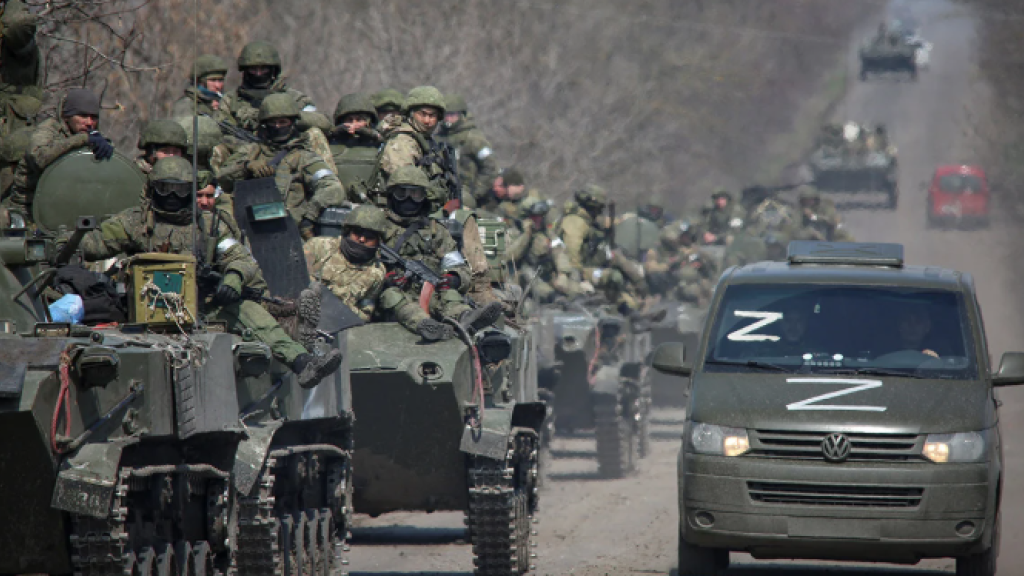

Pro-Russian troops invading Ukraine 2022

Russia’s invasion of Ukraine presents a problem for analyses that identify imperialism exclusively with the dominant centres of global capitalism. How can a country dependent on commodity exports, imported technology and external financial networks itself act as an imperialist power? In our contribution to the forthcoming Suhrkamp anthology on contemporary imperialism and anti-imperialism, Boris Kagarlitsky and I argue that dependence and domination can coexist. A state subordinately integrated into global capitalism can exercise imperial power over weaker neighbours. Russia exemplifies this combination — an empire of the periphery.

Russia’s contemporary imperialism must be understood through the class order that emerged from the Soviet Union’s dissolution. Privatisation transferred productive assets, natural resources and financial infrastructure into the hands of a narrow group whose fortunes depended heavily on political access. The resulting concentration of ownership established a durable relationship between economic privilege and state power. Control over public office, regulatory decisions and state property became a means of private accumulation. 

Commodity exports, especially oil and gas, sustained this order. According to Rosstat (Russia’s Federal State Statistics Service), mineral products accounted for about 70% of the country’s merchandise exports in the early 2010s and still represented 63.3% in 2019, before the pandemic. Export revenues financed public expenditure, supported domestic demand and permitted selective redistribution, while generating enormous private fortunes. During the commodity boom of the 2000s, economic growth helped stabilise a social settlement in which rising incomes accompanied extreme inequalities of wealth and power. Yet much of the surplus generated within Russia flowed abroad through capital flight, offshore holdings and purchases of foreign assets. By 2015, Russians’ offshore wealth was estimated at roughly three-quarters of annual national income.

This external orientation was integral to the accumulation regime. Russia supplied resources to the world economy while relying on more advanced capitalist centres for technology, finance and preserving elite wealth. Integration enriched its dominant classes without producing a sustained transformation of the country’s productive structure. Their position combined domestic power with external dependence. Within this arrangement, access to political authority remained a decisive determinant of profitability. State contracts, resource concessions, subsidised finance and administrative protection sustained powerful business networks. The state was therefore a central terrain of accumulation, and the boundary between political and economic elites was often indistinct.

Russia’s ruling bloc therefore confronted a contradiction rooted in its own formation. Its wealth depended on participation in a global order that constrained its ambitions, while its domestic power rested on arrangements that obstructed a developmental alternative. This tension provides the starting point for understanding the relationship between the crisis of dependent accumulation and Russia’s increasingly confrontational imperial project.

From the crisis of accumulation to war

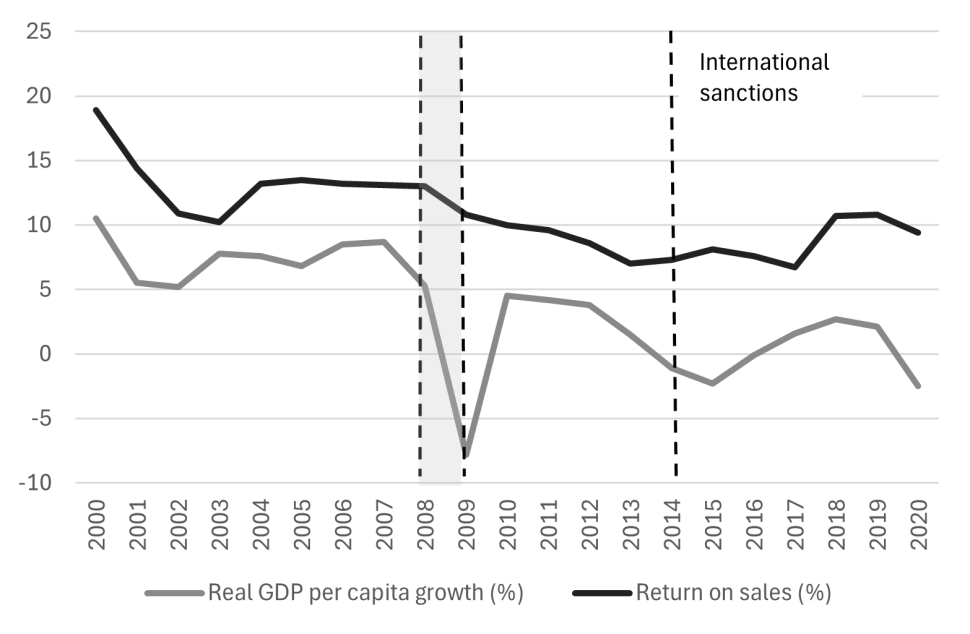
The 2008 Global Financial Crisis exposed the vulnerability of Russia’s accumulation regime. Real GDP per capita contracted by about 8% in 2009, and the subsequent recovery failed to restore the dynamism of the commodity boom. Average annual real GDP per capita growth fell from about 7.3% in 2000–08 to 1.7% in 2010–19. The slowdown therefore began before the sanctions imposed in 2014. High export earnings temporarily eased the pressure, but resource dependence, weak productive investment and the externalisation of wealth increasingly constrained sustained expansion.
Image
Figure 1: Russia: Growth and profitability before the invasion, 2000–20
Figure 1: Russia: Growth and profitability before the invasion, 2000–20. Source: Authors’ calculations based on Rosstat. Real GDP per capita growth is calculated as the annual GDP per capita volume index minus 100; return on sales is reported as a percentage.

Profitability also weakened, although its trajectory was uneven. Returns on sales stood at about 13–14% in the mid-2000s, compared with about 7–10% through much of the following decade. Their recovery to about 11% in 2018–19 shows this was not an uninterrupted decline. Nevertheless, the combination of slower growth and generally lower sales profitability indicates the accumulation regime’s difficulties preceded the pandemic and full-scale invasion.

This trajectory matters for assessing the alternatives available to Russia’s ruling bloc. In Russia’s New Imperialism: Capital and Ideology, Ilya Budraitskis and Ilya Matveev argue continued cooperation with the West would have better served Russian capitalist interests than the confrontation unleashed by the invasion. This counterfactual supports their emphasis on ideological commitments overriding economic interests. Yet the superiority of that alternative requires demonstration. Continued participation in the existing international arrangements offered opportunities, but the pre-war record also reveals mounting difficulties in sustaining growth and profitability within those arrangements.

These trends do not establish that invasion was economically preferable. They do, however, show why the relative advantages of continued cooperation cannot simply be assumed from the existence of profitable international ties: the model’s constraints and their differing implications for capitalist groups also require examination. A convincing comparison must assess both the prospects of continued integration and the possibilities for domestic restructuring. The economic damage caused by war cannot, by itself, establish that the decision lacked a material or class rationale.

The constraints on accumulation had political consequences. A sustained developmental program would have required redirecting resources toward productive investment and challenging the privileges of networks controlling existing rents. The ruling bloc had strong reasons to preserve the arrangements that generated its wealth, even as their capacity to sustain growth diminished. Its divisions also mattered: owners with substantial international interests did not necessarily share the priorities of groups whose fortunes depended more directly on domestic political access. For the latter, preserving control over resources and state-mediated opportunities could outweigh the advantages of further international integration.

Ukraine became a decisive arena in which these contradictions intersected with geopolitical conflict. Volodymyr Ishchenko argues its competing orientations were rooted in class relations: influential sections of the professional middle class associated their advancement with Western integration and alignment with transnational capital; political capitalists sought to preserve advantages grounded in privileged access to the state. Neither project adequately represented the independent interests of the working class. Ukraine’s westward shift therefore expressed a particular constellation of social interests and political forces, rather than an undifferentiated national interest. It threatened Russia’s regional influence and the prospects for an economic and political sphere organised around Moscow. These interacting class projects and geopolitical strategies help explain the confrontation without making Russia’s invasion either necessary or justified.

An attempt to subordinate Ukraine could appear to offer a means of preserving regional power and extending politically controlled accumulation. This does not establish that particular businesses directed the decision or that invasion followed a coherent economic plan. The choice depended on the leadership’s assessment of alternatives and its expectations of Ukrainian resistance and Western responses. A strategy premised on rapid victory could reflect identifiable interests while catastrophically misjudging the means of advancing them.

That ideology can shape political decisions is unproblematic within historical materialism. In his letter to Joseph Bloch, Friedrich Engels rejected reducing history to economic causation alone, emphasising that political institutions and ideological forms influence historical struggles and can predominate in determining their form. The issue is how ideological commitments develop within, and act upon, material relations and class struggles. Imperial convictions may sincerely motivate political leaders without their holders recognising their connection to the reproduction of class power. The analytical difficulty arises when the explanation treats ideology as detached from these relations, leaving the social foundations and class content of political decisions unexplained.

Public rhetoric cannot establish either the sincerity of those convictions or their weight in a specific decision. We must distinguish ideas informing the invasion from propaganda legitimising it and narratives developed to sustain a prolonged war. Budraitskis and Matveev describe an increased emphasis on civilisational and moral struggle after the failure to secure a rapid victory. That subsequent development cannot simply be read backwards as proof of the original motivation. 

Budraitskis and Matveev connect the Russian leadership’s worldview to the experience of post-Soviet primitive accumulation. Our disagreement concerns whether their explanation sufficiently connects subsequent strategic choices to the continuing reproduction of class power. The leadership’s autonomy from individual capitalists does not establish its independence from the class order. Where political authority itself provides access to wealth, separating the interests of rulers from those of capitalists is particularly problematic — a feature central to Kagarlitsky’s account of post-Soviet capitalism. The relevant questions concern which forms of accumulation the state protects, which groups it privileges, and how ideological commitments shape its pursuit of those objectives.

The invasion can therefore be understood as a contingent decision combining imperial conviction, the defence of an established social order and profound strategic miscalculation. Its subsequent costs cannot settle what its architects expected to achieve. Nor can later gains prove their original intentions.

Wartime stabilisation and its limits

The war has produced a mixed picture for Russian capital. Bank of Russia figures show Russia’s outward FDI stock fell from US$374.6 billion in 2021 to US$235 billion in 2025, while inward FDI declined from US$497.7 billion to US$258.2 billion, reductions of about 37% and 48%, respectively. These changes reflect transactions and valuation adjustments, rather than equivalent realised losses, but demonstrate a substantial contraction in cross-border investment positions.

Meanwhile, military procurement, subsidised credit and infrastructure spending have opened domestic opportunities for businesses with privileged access to state decisions. Property transfers provide another channel. These include court-ordered seizures from Russian owners — through challenges to privatisation, anti-corruption proceedings and other legal mechanisms — and placing foreign-owned businesses under “temporary management,” transferring control without immediately extinguishing ownership rights. Estimates compiled by the New Eurasian Strategies Centre put the value of assets seized during 2022–25 at 5–6.5 trillion roubles. These interventions can penalise owners deemed disloyal and reward politically connected groups, reinforcing the dependence of private accumulation on state power.

Public expenditure has been central to this reorganisation. Official federal defence allocations rose from about 3.5 trillion roubles in 2021 to more than 13 trillion in 2025, increasing from about 15% to more than 30% of federal expenditure. Over the same period, the combined share allocated to social policy, healthcare and education fell from about 37% to 25%, despite nominal increases in spending. The state has sustained demand through a pronounced shift toward military production and its associated supply chains.

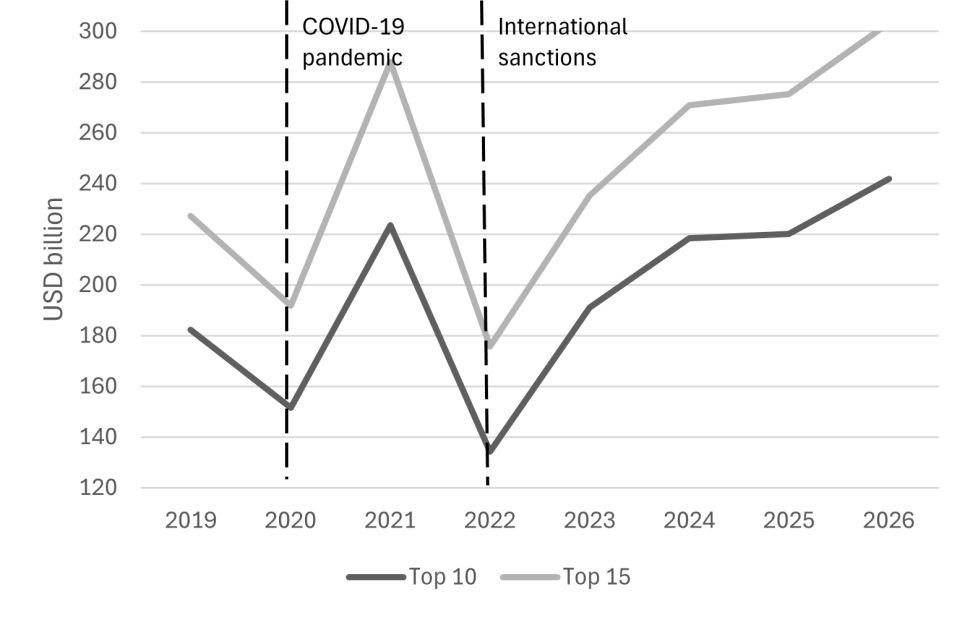
The recovery of wealth among Russia’s richest billionaires illustrates the capacity of large capital to adapt. Although their combined wealth fell sharply in 2022 relative to the exceptional peak of 2021, the decline was considerably smaller against the pre-pandemic benchmark of 2019. By 2023, the combined wealth of the richest ten and the richest fifteen billionaires had surpassed their 2019 levels, with further increases thereafter (Figure 2). These estimates reflect asset valuations as well as accumulated profits, but they demonstrate that the initial shock was followed by a rapid restoration of wealth at the top.
Image
Figure 2: Wealth of Russia’s richest 10 and 15 billionaires, 2019–26
Figure 2: Wealth of Russia’s richest 10 and 15 billionaires, 2019–26. Source: Authors’ calculations based on Forbes, World’s Billionaires lists, various years.

Enterprise profitability also complicates the picture of economic losses. Rosstat figures demonstrate aggregate return on sales averaged 12.5% during 2022–25, compared with 8.6% in 2011–20. The rise began before the invasion, reaching 14.7% in 2021, and, although it has subsequently dropped, wartime sales margins remained appreciably above their previous decade’s average.

These outcomes do not establish that Russian businesses are better off than they would have been without the invasion. Answering that question requires an assessment of opportunity costs: a comparison with plausible alternative trajectories, including the profits, investment opportunities and productive capacities forgone. Budraitskis and Matveev acknowledge differing assessments of these costs, depending on the time horizon and whether the focus is particular businesses, capital as a whole or the wider economy. These questions remain unsettled, making a categorical verdict on the net economic consequences premature. Short-term enrichment can coexist with longer-term developmental damage, just as gains for powerful owners can coexist with substantial losses for society.

Even if that counterfactual assessment established a net economic loss for Russian capital, a further question would remain: whether the decision nevertheless reflected an attempt to preserve its political and social power. Michał Kalecki’s argument about full employment is instructive: business leaders may resist policies that raise profits when those policies threaten their authority over labour and political influence. Preserving class domination can take precedence over maximising immediate returns. This does not prove that war serves capital’s collective interests; it explains why profitability alone cannot settle the question.

The relationship is further complicated by the lumpenisation of the bourgeoisie. Drawing on André Gunder Frank’s concept of the lumpenbourgeoisie, this denotes a ruling class whose enrichment reproduces dependency rather than sustaining an autonomous developmental project. In Russia, rent extraction, offshore wealth preservation and dependence on political access have reinforced this orientation. Fragmented by competing private interests, the bourgeoisie struggles to articulate a common political project beyond enrichment. State leaders consequently acquire greater scope to define its collective interests while pursuing institutional and personal priorities of their own.

Karl Marx’s analysis of Bonapartism illuminates this relationship: an executive power can acquire considerable autonomy from the bourgeoisie’s political representatives while safeguarding the property relations and social order underpinning its domination. Preserving that order may involve overriding particular capitalists and imposing losses on them. Such autonomy neither guarantees successful decisions nor eliminates their class content. The relevant distinction is between the fortunes of individual owners and the reproduction of capitalist power — a distinction that becomes especially important when considering who bears the social costs of wartime stabilisation.

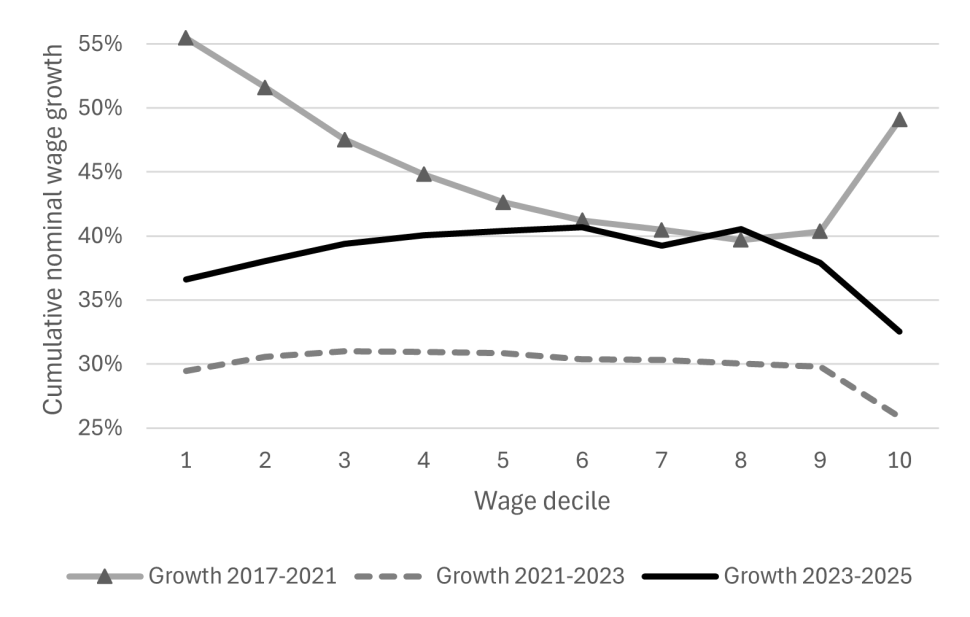
Within Russia, the principal social burden falls on the wider population, although its distribution is uneven. Labour shortages, military payments and expanding defence production have raised incomes for some workers and households. Yet aggregate wage growth conceals differences in the distribution of gains. The strongly pro-poor pattern of 2017–21 became considerably flatter in 2021–23. During 2023–25, the lowest-paid groups received smaller percentage raises than several middle groups (Figure 3). The later pattern therefore weakened the relative position of the lowest-paid compared with parts of the middle when it comes to wage distribution.
Image
Figure 3: Distribution of wage gains before and during the war
Figure 3: Distribution of wage gains before and during the war. Source: Authors’ calculations based on Rosstat, wage-distribution statistics.

Alongside these inequalities, households bear the costs of deaths and injuries, inflation, intensified work, indebtedness and the diversion of public resources from civilian priorities. According to the Bank of Russia, household indebtedness rose from about 27.6 trillion roubles in early 2022 to more than 43 trillion by early 2026. Higher earnings in selected sectors have also failed to translate into stronger independent labour organisation or democratic control over economic decisions.

Wartime stabilisation has reproduced external dependence. Despite official celebrations of import substitution, Russia’s reorientation has not amounted to delinking in Samir Amin’s sense: the subordination of external economic relations to the priorities of internally centred development. Commodity exports have been redirected toward new markets, while China has assumed a larger role in supplying machinery and equipment. The direction of dependence has changed more substantially than its underlying structure. Military demand supports selected industries, but has not established a broadly diversified economy organised around domestic social needs and productive development.

Internationalism and possibilities for the left

Russia’s confrontation with Western powers offers no socialist alternative to the order it challenges. Its imperial project reproduces capitalist domination at home and seeks to impose political subordination abroad. Equally, opposition to that project cannot require socialists to identify their objectives with those of Western governments. The starting point must be the capacity of working people to organise independently and challenge the forces sustaining war.

Inside Russia, repression and organisational weakness should not be mistaken for the disappearance of a left social constituency. In a recent letter to me from the penal colony where he is detained, Kagarlitsky identified a generational change: younger people are less shaped by inherited anti-Soviet hostility, while also being less inclined to equate contemporary left politics with the Soviet experience. He also observed greater receptivity among parts of the liberal intelligentsia. Letters reaching him from different regions suggest that interest extends beyond a narrow metropolitan milieu. These observations indicate an opening, rather than demonstrate the existence of an already consolidated movement.

The distinction is crucial. Dissatisfaction with inequality, arbitrary power and the costs of war does not automatically produce socialist organisation. Kagarlitsky emphasised in the same letter that public interest must be transformed into political support. That requires connecting immediate concerns over wages, public services and social protection with demands for democratic rights and an end to the war. It also requires rebuilding the relationships, institutions and capacities for collective action that repression and prolonged depoliticisation have weakened.

For the left outside Russia, solidarity should help sustain those capacities. Supporting political prisoners and their families, independent socialist media, labour initiatives and networks connecting activists inside the country with those in exile are practical contributions. Exile can preserve intellectual and organisational resources, provided it maintains connections with the experiences and struggles of people who remain in Russia. International support should strengthen their capacity to articulate and pursue their own political objectives.

Such solidarity must extend to Ukraine’s independent labour and democratic movements, alongside unequivocal opposition to invasion and annexation and recognition of Ukrainian self-determination. Defending national rights and building independent class organisation are connected tasks. Cooperation between Russian and Ukrainian socialists can advance both without obscuring the unequal responsibilities of aggressor and invaded society. Peace and democratisation would widen the space for these struggles, opening questions of ownership, redistribution and public priorities to popular contestation. The socialist objective is to turn that opening into greater power for working people over the conditions of their lives.

Saturday, June 13, 2026

Trumpism, Mamdani and the revolutionary party we need

Zohran Mamdani

Anthony Teso has written a critique of my recent text on the situation in the United States. I will restrict my response to a few points.

Teso notes there is much common ground on how we view Donald Trump and Trumpism. There are also, of course, salient differences:

  • My focus was on providing a quick descriptive sketch (initially for a non-US audience) — which Teso largely accepts — discussing Trump and Trumpism, and outlining aspects of popular resistance to both.
  • Teso focused on presenting a specific theoretical perspective on the “state form” of Trumpism (something he tags as “patrimonial Bonapartism”), which he feels provides a more adequate position on the resistance to Trumpism than the one I provide. In particular, he seems dissatisfied with (1) my “inventory of protests” (which fails to pose “the organization problem … concretely”), and (2) my positive evaluation of the meaning of the Zohran Mamdani campaign in New York City (an evaluation he critically characterises as “celebrating Mamdani”).

Teso concludes: “Socialist analysis must identify both the structure it faces and the organization capable of acting on that knowledge...”

Limits of my presentation

The purpose of my presentation to German audiences (which the editors of LINKS and Communis titled “Defining Trumpism, defeating Trump”) was far more limited than Teso assumes. It was certainly meant to be more descriptive than theoretical. I am gratified that my critic finds little fault with the description, which he tells us provides useful raw material for his own theorising.

My presentation was meant to be part of a collective process (which includes Teso, myself and many others) of trying to make sense of “what is.” There are various questions I do not pretend to answer — including what should be the finished theoretical characterisation of Trumpism.

‘State form’ structure

In contrast, Teso seems satisfied he can provide such a characterisation, drawing from Karl Marx, Nicos Poulantzas and Max Weber. The result is the conceptualisation of “a patrimonial Bonapartism regime.” I find this theoretical venture quite interesting, but I am not confident I fully understand its meaning.

In particular, it is not clear to me that this conceptual contribution actually transforms my descriptive “inventory” into “a coherent explanation.” Nor am I convinced that it actually provides the strategic, tactical and organisational clarity Teso seeks. This is not meant to dismiss his theorising, but rather to view his theorising as part of a collective process yet to run its course.

Revolutionary party

Teso refers to “the organization capable of acting” on theoretical clarifications, which, of course, is the revolutionary party. Teso would surely agree, however, that we are far from such a party. While he offers nothing that would somehow bring this necessary entity into being, he criticises my presentation for offering nothing but, at best, vague generalities on this vital question.

The fact that this question is central to my thinking (and in my presentation should be understood as being assumed) finds corroboration in much that I have written over the years — including this year, for example, in “Lenin and Today’s Socialist Struggle in the United States.”

Pointing to the Communist International in Vladimir Lenin’s time, I noted that revolutionary activists were animated by aspirations relevant to our own time:

1. The deepening of democracy and the expansion of socialist consciousness;

2. The realisation of working-class capacities for mass action and united fronts;

3. The combined advance of winning life-giving reforms and of revolutionary liberation.

This led to the next point:

It makes sense for revolutionary socialists in the United States … to be actively engaged … in efforts to build class-conscious struggles of the actual, diverse working class in the United States — through mass movements and united front coalitions — geared to win victories beneficial to the working class and all oppressed people. … This should involve a blend of mass actions, socialist agitation and education, and socialist electoral work that will guide the efforts of an evolving network of revolutionary collectives stretching throughout our country.

On Mamdani

This ties in with Teso’s objections to my comments on Mamdani. These comments are grounded in the perspectives of a revolutionary socialist organisation to which Teso and I belong, Solidarity. Specifically, there is the October 2 statement, “The Zohran Mamdani Campaign: Solidarity with the Movement & Critical Notes on the Future”, and the December 2 statement, “The Struggle Continues…”.

The December 2 statement asserts:

A definite high point has been Zohran Mamdani’s victorious mayoral campaign in New York City, with a program that begins to speak to the needs of the great majority of people in a city they helped build but that has become increasingly unaffordable for them…

Revolutionary socialists — including members and supporters of Solidarity, as well as currents we are close to — should wholeheartedly support this victory and join with like-minded activists in and around DSA [Democratic Socialists of America], whose continued organizing will be absolutely essential to advancing the progressive and affordability agenda embodied in Mamdani’s electoral campaign.

Such activism — with positive and negative lessons learned — provides the basis for a mass socialist consciousness and movement, a precondition for the crystallisation of the revolutionary party we need. Or so it seems to me.

Tuesday, June 09, 2026

On Trump and Trumpism: Inventory versus state form

trump nope poster

“Trumpism and the state form” by Anthony Teso, is appearing simultaneously on LINKS and Communis. In this reply, Teso critically engages with Le Blanc's article “Defining Trumpism, defeating Trump,” which appeared, also simultaneously, on LINKS and Communis.

Paul Le Blanc’s “Defining Trumpism, defeating Trump” is a significant contribution from a committed comrade, and I want to start by outlining our substantial areas of agreement. Le Blanc and I agree that Trump is a symptom rather than a disease, that Trumpism will outlast the man, and that the regime is not yet a fascist one in any rigorous sense. We agree the Democratic Party helped bring Trump into being through its decades-long abandonment of the working-class base to which it stakes a claim and that liberal co-belligerents in the anti-Trump resistance become, at a certain point, part of the problem rather than the solution. We agree that the radicalizing layer is a precarious and expanding working class and that the “mandate” Trump claims to have is a razor-thin fiction. On the conjuncture, Le Blanc and I are largely on the same side of the barricade.

My disagreement is not with his conclusions. The focus is on the method he uses to reach them, and on its limitations. My argument is simple: because Le Blanc works at the level of inventory rather than state form, he can gesture toward the right answers without fully grounding his diagnosis of the regime or his account of how it might be defeated. He poses the decisive question of our moment — what kind of regime is this? — and then answers it by enumeration. He gives us a list: the January 6 paramilitaries, Christian nationalism, the Heritage Foundation’s Project 2025, and the captured Republican Party. “Several essential elements help define Trumpism,” he writes, and proceeds to name them. But a list of elements is not a definition. It is an inventory. And an inventory, however accurate, operates at the wrong level of abstraction to answer the question Le Blanc himself has raised.

The hole where the state should be

I have argued elsewhere that the Trump regime is best grasped as patrimonial Bonapartism: a personalist executive that has acquired relative autonomy from the class it nonetheless serves, ruling through loyalty rather than legality, balancing fractions of capital against one another and commanding a mass movement it cannot fully discipline. The point of the concept is not terminological elegance. It is to identify the regime’s concrete vulnerabilities: the brittleness of a personalist rule, the instability of a mass base that cannot be fully commanded, and the conditional character of elite support. I will not rehearse that argument in full here. I raise it because Le Blanc’s own essay assembles, almost despite itself, the raw materials the concept is built from and then leaves them lying unassembled on the floor.

Consider his own account. One section of the ruling class has concluded that Trump’s authoritarianism can stabilize a system whose instability threatens profits. At the same time, the MAGA movement is, by Le Blanc’s own description, only loosely under Trump’s control; “as a whole,” he writes, it “cannot be understood as being under his control.” These are the defining features of a Bonapartist configuration: an executive that serves capital without directly expressing the rule of any single faction, and a mass base mobilized from above that retains an autonomy its sponsor cannot fully command. Marx described this relation in 1852, when he showed how Louis Bonaparte could represent a class precisely by seeming to stand above all classes.

Le Blanc has the data. What he lacks is a clear concept of how the state should be structured to organize the data into a coherent explanation. And so the analysis, having gestured at structure, slides back into the register it claimed to be leaving behind: the psychology of the man. We are told at length that Trump is arrogant, bigoted, dishonest, a bully, a braggart and an ignorant self-promoter who glorifies his ignorance. All true, no doubt. But Le Blanc opened by insisting we look past the headlines to “the underlying ideology and social forces.” The catalog of Trump’s vices is the headline. It is precisely the level of abstraction at which liberal commentary has been stranded for a decade and which a Marxist account exists to transcend.

Why ‘not yet fascism’ is a right answer reached the wrong way

Le Blanc’s treatment of the question of fascism illustrates the cost. His conclusion is accurate: this is not a consolidated fascist regime, there is still room for protest and organization, and the apparatus has yet to be seized in the manner that fascism typically necessitates. I hold the same position. But look at how he arrives there. He writes that “we are dealing with something that is not yet a fascist regime.” The work in that sentence is done by the word “yet.” It is a temporal hedge, not a structural determination. It tells us where we are on a timeline without telling us what kind of thing is moving along it.

This matters strategically, not merely terminologically. If the reason Trumpism is considered “not yet” fascism is that it has not progressed far enough, then the implied politics suggest a need for vigilance against a critical threshold: monitor the moment of crossing and intensify resistance as it approaches. But if the regime has a determinate present form — a patrimonial Bonapartism with its laws of motion and its own characteristic instabilities — then the strategic question changes. We are not waiting at a gate. We are confronting a specific structure with specific vulnerabilities, as previously stated: the brittleness of a personalistic rule, the fractiousness of a base that cannot be commanded, and the conditional and revocable character of the capital fraction’s support. Naming the form tells us where to push. The timeline metaphor only tells us to brace.

Nicos Poulantzas understood that the authoritarian restructuring of the capitalist state was not a rest stop on the road to fascism but a distinct configuration of the state form under conditions of crisis. In other words, the question is not simply how far a regime has advanced along a single continuum but what kind of structure it presently is. To collapse that distinction into a question of degree, of how close we are to Benito Mussolini or Adolf Hitler, is to lose exactly what is analytically and strategically usable. Le Blanc raises the comparison to Mussolini and Hitler and then sensibly declines it. But declining a bad comparison is not the same as offering a good concept.

The patrimonial moment Le Blanc names but does not theorize

One more thing in Le Blanc’s inventory deserves to be highlighted, as his method underuses it the most. He quotes ex-Republican operative Tim Miller on a party that advanced arguments its own apparatus did not believe in, and Stuart Stevens on Trump as “the logical conclusion” of fifty years of Republican degeneration. This is excellent material. But Le Blanc reads it mainly as a story about cynicism and racism, moral categories, when it is also, and more usefully, a story about the hollowing-out of legal-rational party structures and their replacement by relations of personal fealty.

That replacement has a name in the Weberian vocabulary: it is the displacement of bureaucratic-legal authority by patrimonial authority, a rule organized around the household and the loyalty of retainers rather than around office and rule. The purges of the disloyal, the elevation of family and courtiers, and the treatment of the state apparatus as a personal possession to be staffed by clients: these are not merely the vices of a “mediocrity,” as Le Blanc has it. They are the operating principles of a determinate mode of rule. Calling Trump a mediocrity is satisfying and accurate, but this judgment focuses on the individual rather than providing an analysis of the system. The patrimonial logic does not depend on Trump being clever. It depends on the prior decay of the institutions Trumpism colonizes, which is precisely what Miller and Stevens, read structurally, describe.

This theoretical issue matters because it bears directly on strategy. If we misidentify the form of rule, we also misidentify where its weak points lie and what kind of political organization is required to exploit them.

From resistance to breakthrough: The missing vehicle

The essay’s strategic section is where Le Blanc’s enumerative method exacts its highest price. Le Blanc walks us through the mass mobilizations (“Hands Off,” May Day, the “No Kings” demonstrations) and the electoral expressions of the socialist revival: Bernie Sanders, the Squad, and, most dramatically, Zohran Mamdani’s victory in New York. He rightly concedes that these figures define socialism vaguely and compromise too far with the establishment and capitalist system. He then closes by saying a “revolutionary breakthrough becomes possible,” but “will depend… on the ability of left-wing and socialist forces to grow and mature in ways that help make this happen.”

That sentence should be the beginning of an argument, not the end of one. The maturation of socialist forces is cited as the key factor for a breakthrough to happen, but there is no consideration of the organizational structure that transforms scattered protests into lasting power. This is the mirror image of a tendency I have criticized at length on the contemporary left: the habit of naming a party into existence, of mistaking the declaration of an organization for its construction. Le Blanc does the inverse. Rather than prematurely declaring the vehicle, he defers it to a future “maturation” whose mechanism remains unspecified. Both moves avoid the hard part, which is the actual problem of organization: what relation between mass struggle, electoral intervention, and a disciplined political nucleus could convert the energy of “No Kings” into something that survives the next demobilization.

And here the evasion has a precise location. Le Blanc tells us the organized left was “absorbed into the Democratic Party.” Yet, in the same essay, he celebrates Mamdani’s victory, won on the Democratic ballot line, inside the party he has just diagnosed as the graveyard of the left. That tension does not invalidate his point, but it does create a strategic problem the essay leaves unaddressed. The question of the ballot line, of the clean break, the dirty break and the dirty stay, of whether socialists can use the Democratic ballot without being used by it, is the central strategic question that the Mamdani campaign poses. An essay that raises Mamdani as its most dramatic evidence and then leaves the ballot-line question untouched stops short of the decisive problem.

What is at stake in the level of abstraction?

None of this is a charge of bad faith or bad politics. Le Blanc’s instincts are sound, and his broad strokes of conjunctural reading align with mine. The argument I am making is narrower and, I think, more useful for that. The method of enumeration, which involves listing the elements of Trumpism and the moments of resistance, cannot adequately address either question. Le Blanc himself highlights the type of regime that confronts us and the means by which it can be defeated. An inventory of features will never yield a concept of form, and an inventory of protests will never yield a theory of organization.

We agree the regime is not fascist, but we disagree that you can establish this without a theory of the state form; the enumerative method guarantees this is necessary. We do not disagree that the Democrats are part of the problem; we disagree with celebrating Mamdani while leaving the ballot-line question untouched. We agree that a revolutionary breakthrough depends on the maturation of socialist forces, but we disagree that “maturation” means anything until the organizational problem is posed concretely.

Defining Trumpism and defeating Trump (Le Blanc’s own program, a beneficial one) requires raising the analysis a level: from the elements to the form, from the moments to the vehicle. Patrimonial Bonapartism is my proposal for a definition of Trumpism. The party’s unresolved problem is the name with which I would frame the problem of defeating Trump. I offer both as the work his essay leaves undone — and that the moment will not let us defer — rather than as a rebuke to a comrade whose conclusions I largely share. Socialist analysis must identify both the structure it faces and the organization capable of acting on that knowledge; otherwise, it will merely register dangers and applaud resistance. 

Defining Trumpism, defeating Trump

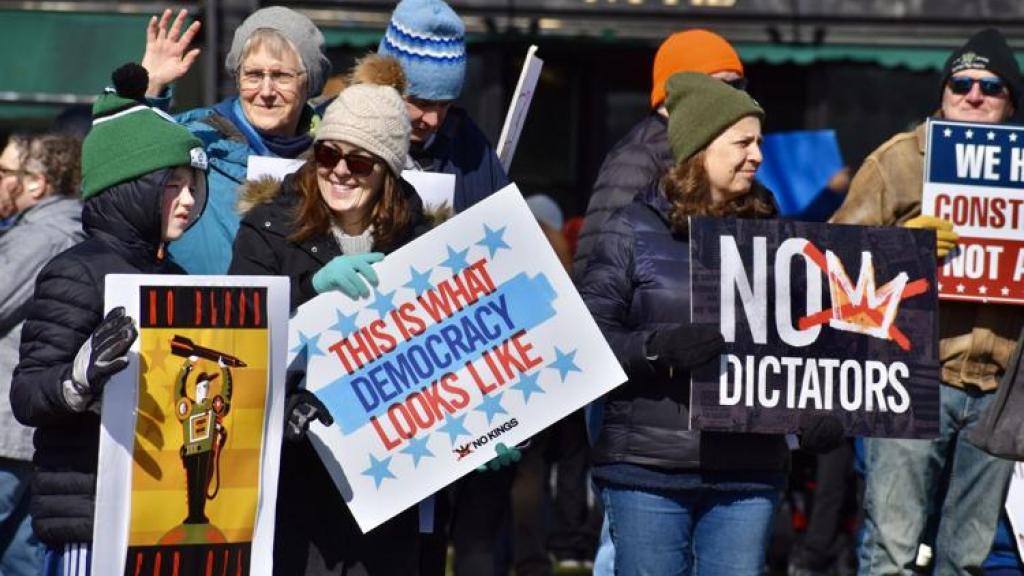
No Kings protest

“Defining Trumpism, defeating Trump” is based on talks given by Paul Le Blanc in Potsdam, Hamburg, Frankfurt and Mannheim, during a May speaking tour in Germany. It is appearing simultaneously on LINKS and Communis.

I will begin this presentation with a brief overview of the global context. I will then offer some comments about the Donald Trump phenomenon and what I call “Trumpism.” I will also briefly touch on the debate of whether we are dealing here with fascism. Finally, I will conclude with comments on the upsurge against Trump and Trumpism, some strengths and limitations of this resistance, and what the future may bring.

Three snapshots of the overall context 

But first, let me sketch out three snapshots of the overall context.

1. We are in a period of transition

Just as three decades ago we transitioned from the Cold War era to the age of globalization, we have now entered an age of crisis, chaos and unraveling. The structure and dynamics of the global economy generate deepening inequalities, instabilities and destructiveness, which throw into question the future of human civilization.

This has been accompanied by a sharp tilt to the right by a significant section of the ruling class but also within the larger population, even if this is fiercely resisted by many others. Trump’s right-wing extremism is only one manifestation of a larger, deeper trend. The eroding quality of life for more and more of the world’s laboring majorities is being matched by growing authoritarianism, irrationality and imperialist violence.

Most serious of all, however, is the imminent threat to humanity’s survival: a voracious market economy designed to further enrich incredibly wealthy elites is intimately connected with the immense environmental destruction engulfing our world with cascading floods, wildfires, pollution, climate change, and more.

2. There has been a deep erosion and partial collapse of the organized labor movement

The workers movement in the United States persists, in large measure, as a bureaucratic and largely ineffectual shell of what it once was. Related to this is a generalized disintegration and melting away of the traditional organized left. This amounts to a dramatic erosion of the organized source of practical political perspectives, accumulations of experience, and seasoned cadres and organizers.

In the late 20th century, the two major currents on the left were essentially reformist, entangled in the liberal capitalist Democratic Party. One was the social-democratic milieu, at the core of which was the Socialist Party of America. The other was the Stalinist and post-Stalinist milieu, at the core of which was the Communist Party USA. In addition, there was an array of independent Marxists, left-wing pacifists, Trotskyists and would-be Trotskyists, a temporary groundswell of Maoists, and successive waves of a very broad, vibrantly active “New Left.”

This multi-faceted array was given a coherence and weight largely because of its complex interrelationship with the larger working-class movement. With the transition from the Cold War to globalization, with the fading and erosion of the left-wing subculture, and with the aging and falling away of cadres and organizers, traditional left organizations failed to renew and replenish themselves adequately, continuing to exist only as fragmentary remnants.

3. The present age of crisis, chaos and unraveling has had a radicalizing impact on new layers of young people who are essentially part of a precarious but expanding working class

This was reflected in the Occupy Wall Street insurgency, the Black Lives Matter insurgency, a multi-faceted women’s liberation insurgency, and in new manifestations of union organizing and strike actions. It has also been reflected in the Bernie Sanders campaigns and other substantial electoral efforts to bring socialism into mainstream US politics, generally within the context of the Democratic Party.

It has furthermore been reflected in the substantial growth of Democratic Socialists of America (DSA), with a paper membership now of 100,000. Although influenced by social-democratic reformism, DSA has been a magnet for a variety of radical currents.

Trump and Trumpism

Every day a cascade of news headlines tells us of new and often mismanaged developments related to the Trump regime: horrific, but often blundering, policies of imperialist expansion and overreach, from Gaza, Venezuela and the Iran fiasco, to threats against Cuba, Greenland and even Canada; intensification of vicious (but seemingly unsustainable) anti-immigrant repression; growing scandals related to the mishandled files of the late sex offender Jeffery Epstein, whom Trump — himself long embroiled in sex scandals — befriended for years; and economic policies that benefit billionaires but have devastating consequences for most Americans.

I want to focus not on the headlines, but on the underlying ideology and social forces behind the Trump regime, and explore our growing anti-Trump resistance.

Before examining the ideology sometimes labeled as Trumpism, let us pause to consider the mediocrity with whose name this “ism” is identified. Trump’s qualities certainly include arrogance and bigotry, and he is notorious for being a fundamentally dishonest person, with an inclination to be a bully and a braggart. He is a self-promoting “go-getter” who compulsively highlights his achievements but also claims to have gone further and gotten more than is the case. An ignorant man who glorifies his ignorance (with the aggressive assertion “I don’t read books!”), he claims to know far more than he does. He takes credit for accomplishments that are not his.

His billionaire status has added luster, resources and authority to the narcissistic self-construction of the person that is Trump. He is quintessentially, and very proudly, a capitalist. Some critics insist Trump is a fascist. Others question whether he is consistent and coherent enough to be even comparable to a Benito Mussolini or an Adolf Hitler. But Trumpism transcends the dysfunctionality, corruption and desperate but dangerous flailing about of this ageing individual and his regime. Several essential elements help define Trumpism.

One element is armed and dangerous; namely, the forces that came together to storm the Capitol on January 6, 2021, which included the Proud Boys, the Oath Keepers, militant components of the Tea Party movement, latter-day partisans of the old Southern Confederacy, and various Nazi and white supremacist groups. These once-marginalized elements have come into the political mainstream and grown substantially, with the active encouragement of Trump and others around him. But this cunning, avaricious, profoundly limited individual and his acolytes were hardly capable of controlling them. Indeed, as a whole, the huge and diverse MAGA movement cannot be understood as being under his control.

Blended into segments of this pro-Trump constituency is something called “Christian nationalism,” which rejects the ideals of radical democracy enshrined in the Declaration of Independence. Instead, it asserts that the US was founded by Christians who wanted to build a nation on the foundation of God’s will, as defined by right-wing fundamentalists who see the notion of equal-rights democracy as a heresy incompatible with Christianity.

Another essential element of Trumpism can be found in a quite different cluster of conservative entities and individuals drawn together in The Heritage Foundation’s Project 2025. Founded in the 1970s, the Heritage Foundation has served as a center for conservative academics, intellectuals and policymakers since the Reagan presidency.

Its most recent big effort was a 900-page, Mandate for Leadership: The Conservative Promise, which is meant to serve as a policy-making guide for the second Trump administration. According to its self-description:

This book is the product of more than 400 scholars and policy experts from across the conservative movement and around the country. Contributors include former elected officials, world-renowned economists, and veterans from four presidential Administrations.

The bottom line of this conservative manifesto is a defense of unrestrained capitalism. The US president’s primary goal , we are told, should be to unleash “the dynamic genius of free enterprise.” This vision of capitalism dovetails with proposals to impose a centralized authoritarian regime that can enforce a wide range of right-wing policies.

Another essential element in Trumpism has been the Republican Party. Leading party figures and staffers, much like the conservative mainstream as a whole, did not start out as Trump supporters. Yet, as explained by Tim Miller, one knowledgeable ex-Republican operative, to win elections he and others like him “advanced arguments that none of us believed” and “made people feel aggrieved about issues we had no intent or ability to solve.”1

Miller confessed that a quiet and unacknowledged racism was often employed:

These tactics became not just unchecked but supercharged by a right-wing media ecosystem that we were in bed with and that had its own nefarious incentives, sucking in clicks and views through rage hustling without any intention of delivering something that might bring value to ordinary people’s lives.

Another ex-Republican operative, Stuart Stevens, insisted Trump “is the logical conclusion of what the Republican Party became over the last fifty years or so,”2 a natural product of the seeds of racism, self-deception and anger that became the party’s essence.

Regardless of what happens to Trump, the larger phenomenon of Trumpism will be with us for some time. Trump is not the disease, he is the symptom of a malaise that has been prevalent within the US for many years.

This is a global phenomenon involving powerful movements — and sometimes governments — in various countries: Argentina, Brazil, France, Germany, Greece, Hungary, India, Italy, Norway, Russia, Turkey, the US, and more. A combination of terms is used to describe what is happening: right-wing populism, authoritarian xenophobic ultra-nationalism, etc. All seek to capture its complex content.

Sometimes the word “fascism” is applied, but we are dealing with something that is not yet a fascist regime. There is room to protest and organize against what Trump represents. There are broad forces, not just on the left, in opposition to him. Democratic Party liberals and centrists have helped organize recent protests. They see Trumpism as a threat to stability and any kind of coherent, durable system. Those of us on the left need to work with some of these forces where there is agreement. But, at a certain point, we need to go beyond what some of these people represent, because they are part of the problem. They helped to bring Trump into being through their own limitations and inadequacies.

Looking beyond Trump

To be effective in resisting Trumpism, we must understand it. But to do that adequately, we must look beyond Trumpism. From Democratic Party liberals and centrists to moderately conservative Republicans, the old political establishment has been discredited over the past several decades: facing problems, dealing with problems, failing to deal with problems, unable to deal with problems that are hurting and scaring large numbers of people. The American Dream that a majority felt they could finally start enjoying has been disrupted and seems to be fading.

Democrats and the old-line Republicans have been unable to face this. They have lied about it, saying, “Oh no, everything’s fine.” But people knew everything was not fine, and this fueled a radicalization within the US population, the US working class and the electorate. Another aspect of working-class experience is that the labor movement and trade unions tied in with the Democratic Party proved increasingly unable to help workers. Unions were progressively eliminated as a key force on the US economic and political scene.

People who are hurting and increasingly finding their lives disrupted are looking for solutions. The solutions offered by the Democratic Party and the old version of the Republican Party do not work anymore. Trump presented a new way of seeing things that was not part of the US political mainstream. He made all kinds of inflated promises while attacking and scapegoating people of color and immigrants, saying that they are the problem. Trump was projected as the kind of man who was going to “solve” the problem.

A large segment of the American people — though not a majority — have been drawn to that outlook. A segment of the US ruling class (not all of it ) has also concluded that Trump’s authoritarian policies can help maintain a certain stability. Instability is threatening their profits and system, so they are prepared to embrace his policies.

Such a situation did not exist during the Vietnam War period of the 1960s and early ’70s. Many had illusions about the system’s long-term viability, illusions that are harder to sustain today. This affects the kind of politicians people are inclined to support and the solutions they look for. It poses a more complex situation than one that could presumably be resolved simply by ending the war and providing civil rights legislation to advance equal opportunity for all. Addressing this complexity is a matter to which I will return shortly.

Throughout much of the 20th century, the organized left was a dynamic force of considerable significance in the US. Among workers and the oppressed, it mobilized effective struggles that won genuine victories. It inspired hopes for further struggles that would advance human rights, improve the lives of the working-class majority, and bring to birth a better world. Among the wealthy and powerful, it inspired fear and rage.

By the end of the 20th century, however, the organized left had largely been absorbed into the Democratic Party. Some of its rhetoric, many of its values, and much of its reform agenda (often diluted) can now be found in that party; but a sincere and practical commitment to replace the economic dictatorship of capitalism with the economic democracy of socialism is no longer on the table.

The most powerful elements in the Democratic Party are entwined in the capitalist economy. With capitalism entering an era of disintegration and decay, they have no real solutions to offer. Campaign rhetoric aside, they are incapable of providing a durable alternative to Trumpism. They have compromised working-class interests for decades to help maintain capitalist profitability, wreaking havoc on the party’s working-class base.

Putting forward a resistance that makes possible a revolutionary breakthrough

There have been waves of protest demonstrations over the past year. The first big one was in April 2025, under the slogan of “Hands Off” — hands off the health care system, education system and various other things that are being dismantled or attacked by the Trump regime. This was followed by smaller but still huge May Day demonstrations, focusing especially on social and economic issues, but also referencing foreign policy: Palestine, Ukraine, etc.

The biggest protests of all were the “No Kings” demonstrations: a huge outpouring of anger, rage and ridicule of Trump’s pretensions of being popular and powerful. People said, “No Kings,” with many accusing him of being a fascist, a totalitarian, a dictator. There was agreement on defending principles in the revolutionary Declaration of Independence, and in the more conservative US Constitution, both of which he is walking all over. These mass actions of resistance have continued into the Spring of 2026.

Pro-Trump elements have not come close to mobilizing anything on this scale. Trump claims to have an overwhelming mandate from the people — that is a lie. He won an electoral majority, but certainly not a landslide majority. He did not get an absolute majority among the people. He was able to rack up more popular votes than his competitors in 2024, but his mandate is razor thin. And he is eroding his base of support with policies that hurt us all.

Mass mobilizations on the streets of Los Angeles, Minneapolis, Chicago and elsewhere have defeated concerted and violent efforts by Trump forces deployed to intimidate and overwhelm resistance to Trumpism’s policies. Those policies are supported by a hard core of Trump supporters, in the belief that this will Make America Great Again. But the hearts and minds of a majority cannot be found in that right-wing hard core.

Equal opportunity and a better life for all, the things that have been central to the American Dream, are not on the cards right now. Increasing numbers of people are facing this reality and thinking through their situation in new ways. There is a radicalization. Some of it has been drawn in a right-wing authoritarian direction, but there are also more left-wing ideas in circulation now than at the start of this century.

In terms of electoral efforts and educational outreach, Sanders has been putting forward socialism as a solution. So has a radical cluster in Congress, the so-called Squad. Most dramatically, Zohran Mamdani was overwhelmingly voted in as New York City mayor running as an open democratic socialist. All of this has had a big impact.

The way these figures define socialism tends to be vague and sometimes goes too far in compromising with the political establishment and capitalist system. But the idea of socialism, of economic democracy, of the economy being controlled by the majority — that is, by the working class — is part of the solution. That is a difficult thing for some people to grasp or feel comfortable with, but realities are fluid right now, and there is tremendous discontent.

As the recent demonstrations indicate, there is a growing rejection of Trump’s phony so-called solutions. The process may stop or push back some of Trump’s worst policies. But such protests and acts of resistance by themselves will not solve the underlying problems. Those problems remain. Some people involved in the protests and resistance still harbor illusions and hopes in the Democratic Party. But for significant numbers of people, it is no longer a credible solution to the problems we face.

Socialist perspectives must be put forward in a way that makes sense to people. They need to be tied to actual struggles to improve working-class people’s lives. But it must be understood that these are just initial steps; we have to go much further. The current economic system will continue to undermine improvements and protections we are fighting for. Those in control of the system will do all they can to undermine and defeat our efforts to create a decent life for all. We need an economic democracy — that is what socialism is about.

The mass protests and struggles to defend and improve people’s lives are needed , but by themselves are not enough. As more people come to understand this through their lived experience, a revolutionary breakthrough becomes possible. Such a breakthrough will depend, however, on the ability of left-wing and socialist forces to grow and mature in ways that help make this happen.

  • 1

    Tim Miller, Why We Did It: A Travelogue from the Republican Road to Hell (New York: Harper, 2022), p. xii.

  • 2

    Stuart Stevens, It Was All a Lie: How the Republican Party Became Donald Trump (New York: Vintage Books, 2021), pp. xiii, 4.