Thursday, November 05, 2026


Submariner to Oversee Construction of U.S. Navy's Future Surface Fleet
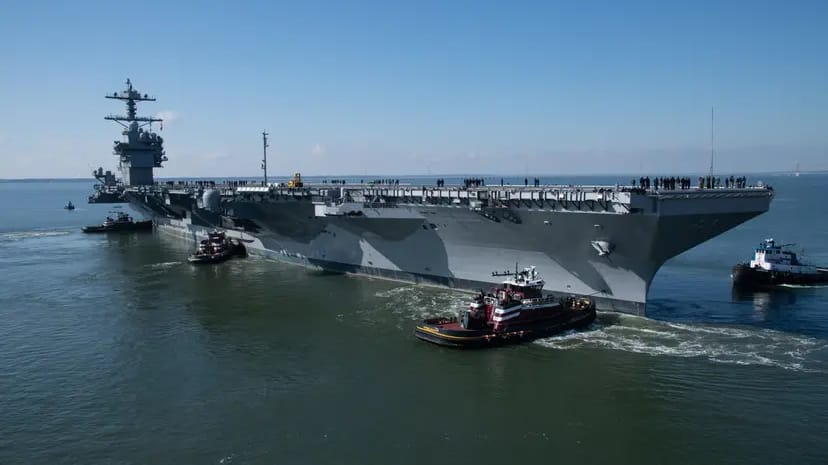
HII
Image courtesy HII

The U.S. Navy's top civilian leader has appointed a career submariner to oversee construction of the future surface fleet.

Hung Cao, Acting Navy Secretary, announced Wednesday that he has selected Rear Adm. Jonathan Rucker to the post of Portfolio Acquisition Executive (PAE) Maritime, a recently created administrative post. The PAE structure makes Rucker a direct report to the Assistant Secretary of the Navy for Research, Development and Acquisition, former submarine officer William F. Mahan (serving in a performing-the-duties-of capacity).  

The PAE structure - used now by all of the service branches - is designed to remove the silos around individual programs and streamline bureaucratic acquisition processes, in the hopes of getting better overall outcomes in less time. It puts a single person in charge of a broad portfolio of R&D and buying decisions.

Adm. Rucker has served as program manager for the Navy's attack submarines and its Columbia-class ballistic missile submarines, the service's top acquisition priority. While in charge of the Columbia program (2018-2022) and later as the director of design and construction for Direct Reporting Portfolio Manager Submarines (April-October 2026), Adm. Rucker helped deal with the deep-rooted supply chain issues that have pushed back delivery dates for both the Virginia-class and the Columbia-class.  

"Admiral Rucker is the right leader at the right time to bring accountability to and accelerate our American shipbuilding system," said Acting Navy Secretary Cao in a statement.

As PAE Maritime, Adm. Rucker inherits all of the Navy's surface shipbuilding programs, all of which were behind schedule as of last year and some of which may face challenging fiscal pressures in future budget years. Pressing questions include the workforce and supply chain issues that have dogged the Navy's procurement efforts; getting the right mix of manned/unmanned platforms; and nurturing new shipyard capacity for distributed and small-vessel shipbuilding.

“We owe it to our Sailors and Marines to deliver the ships they need at speed with capability and quality to ensure they maintain our competitive advantage,” said Rucker in a statement.

 

Saildrone Wins Court Challenge to USN’s New Procurement Evaluation Program

Saildrone
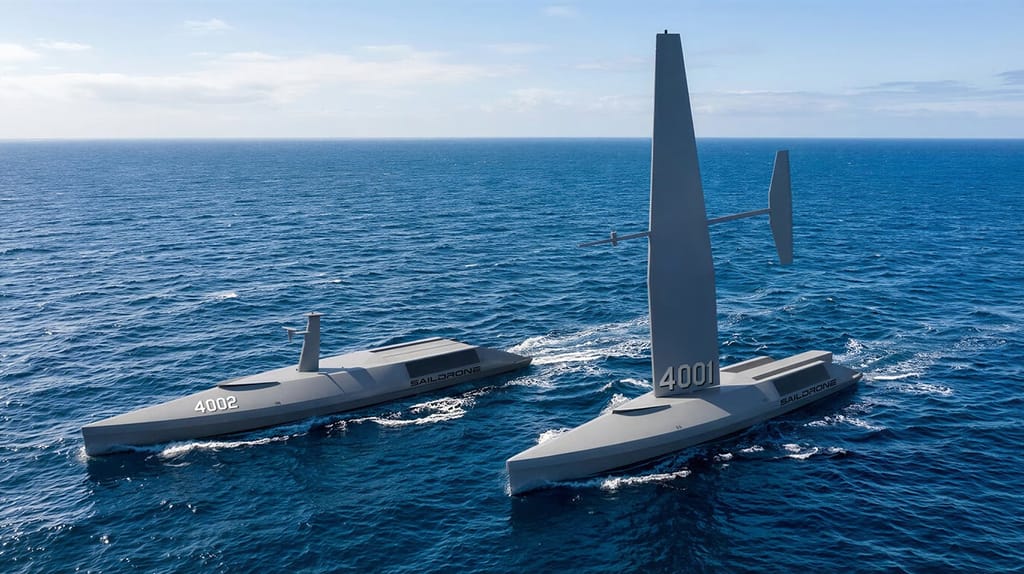
Renderings of Saildrone Spectre in Stealth Strike configuration (left) and Silent Endurance configuration (right) (Saildrone)

Saildrone, a manufacturer of unmanned surface vehicles, prevailed in court after it challenged the U.S. Navy’s new procurement evaluation program touted by the Pentagon to speed up the process. It is seen as a rare example where a supplier was able to prevail against the government and, according to lawyers, shows that the government can’t place a major procurement beyond judicial review.

The case stemmed from the U.S. Navy’s competitive program for the development of a new Medium Unmanned Surface Vessel (MUSV). The Navy has increasingly developed and deployed these drones, and this new program envisions a class of medium-size vessels, 

The Pentagon has sought to modernize and speed up the procurement process, reports The New York Times. The newspaper wrote about the selection process for this program, reporting last summer about the problems and calling the process “messy from the start.” It said participants had been left confused and frustrated. In September, the Navy reported it had awarded initial orders for 10 vessels each from Galliano Marine Services, HII, and Saronic Technologies following successful at-sea testing.

Saildrone sued, alleging that it had been unlawfully excluded after the Navy deemed Saildrone’s entry non-compliant across all three of the evaluation criteria. Saildrone was excluded from the final demonstration phase and challenged the Navy, arguing that it was being falsely deemed non-compliant.

Two of the three determinations were dropped reports Saildrone after it filed the challenge, but a third remained as a disqualifier. Saildrone took it to court along with another competitor, Blue Water Autonomy, which was also denied the right to conduct its demonstration. 

Judge Philip S. Hadji of the United States Court of Federal Claims agreed with the company, finding that the Navy “engaged in disparate treatment” and had “acted in an arbitrary and capricious manner in its review of Saildrone’s proposal.”  The judge in his ruling set aside the Navy’s decision to eliminate Saildrone from the competition.

The court determined that Saildrone was unlawfully excluded and ordered the Navy to promptly reevaluate Saildrone’s proposal using the same criteria it applied to other competitors. Until it does, the Navy cannot commit more than $1.5 billion of the program’s $2.1 billion budget to production.

Reporting on the case, The New York Times highlights that it was an “unusual victory for the industry.” It notes that most companies protesting government bidding decisions do not prevail and that it was rare for a small defense contractor to overturn a decision. 

The lawyers at the firm Selendy Gay, which represented Saildrone, commented that it is “a decision with implications far beyond a single competition.” They note that the judge rejected the government’s claim that the court “had no power to hear challenges to Other Transaction (OT) competitions,” which the lawyers note now steer billions of dollars in defense spending. 

“The government argued that the Navy’s prototype competition fell outside the court’s bid-protest jurisdiction. Judge Hadji disagreed, holding that the competition was sufficiently connected to the Navy’s ultimate procurement of the vessels,” writes Selendy Gay partners Laura King and Faith Gay, who represented Saildrone, along with Corey Stoughton, Gabrielle Kanter, John Juenemann, and Samuel Axelrod, and co-counsel Carla J. Weiss of Nichols Law.

Saildrone’s founder and CEO Richard Jenkins highlighted that the ruling is a win for fair competition, for taxpayers, and for national security. In a prepared statement, he, however, said, “The future of naval warfare will be fought on the water, not in a courtroom. We are eager to move beyond this litigation and return our entire focus to delivering world-leading maritime autonomy for the US Navy.”

The judge, however, also decided that the Navy’s evaluation of Blue Water Autonomy was “reasonable.” Blue Water’s protest was denied.


Design Basis Agreement Reached for 150-Passenger NYC Hydrogen Ferry

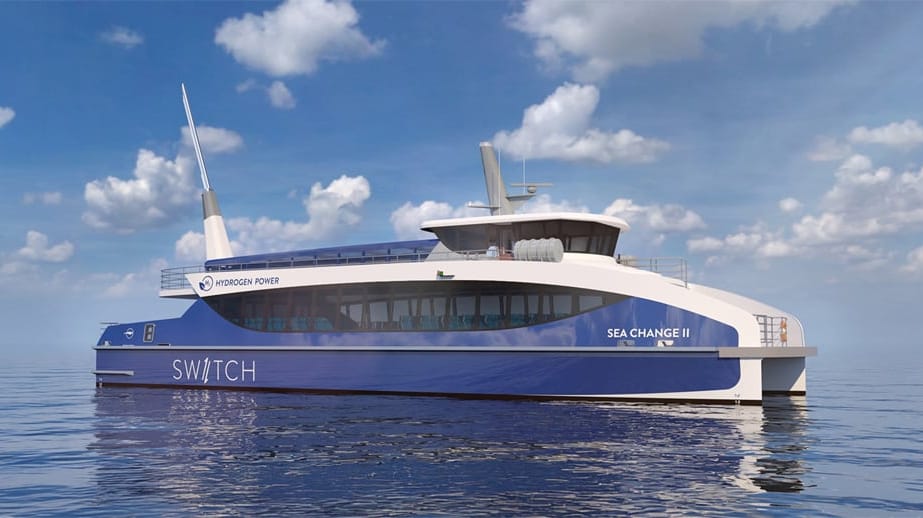
hydrogen-powered ferry concept
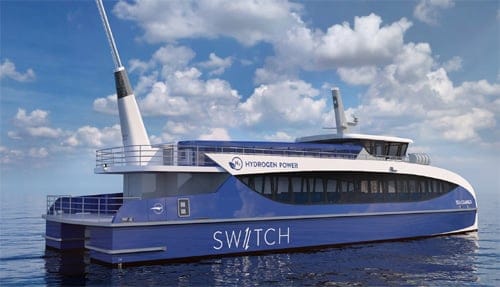
Design for a 150 passenger hydrogen-powered ferry (Incat Crowther)

A Design Basis Agreement (DBA) was secured by Incat Crowther in partnership with SWITCH Maritime from the United States Coast Guard for a proposed 150-passenger hydrogen fuel cell-electric fast ferry platform designed to operate in New York  City. The project is being called a “significant regulatory milestone,” as SWITCH, which pioneered the first hydrogen fuel cell-electric propulsion in the United States in 2024, looks to expand the commercial applications for the technology.

The companies highlighted the challenges, noting that the USCG Subchapter T regulation, the set of rules and standards that governs the design, construction, and operation of passenger vessels with a capacity of less than 150 passengers, does not currently include guidance or regulation written specifically for hydrogen fuel cell-electric propulsion and hydrogen storage. Switch, Incat Crowther, and the vessel project team worked directly with the USCG to build a regulatory framework that demonstrates sufficient equivalency in safety and risk mitigation. The International Maritime Organization (IMO) approved the Interim Guidelines for the Safety of Ships Using Hydrogen as Fuel in May 2026. These guidelines served as an important foundation for the DBA process, adding more structure while reducing time to approval.

Signing the DBA with the Coast Guard is a critical milestone in advancing the development of the SWITCH-150,” said Francisco Planells, Director of the Newbuild Program, Switch Maritime. “With the DBA in hand, Switch, our project team, and the USCG have a clear and defined framework that will inform vessel construction, commissioning, and ultimately operation.”

The program envisions a 28-meter (92-foot) ferry designed to carry 150 passengers at a cruising speed of 25 knots. It is based on Incat’s catamaran design built of aluminum and would incorporate 1576 kWh of batteries.

With 720 kilograms of stored, compressed hydrogen capacity, it will be able to run a range of routes across New York ferry networks with a full day of range. The main deck will feature comfortable seating for 150 passengers, ample luggage storage, a kiosk, three bathrooms including a wheelchair accessible bathroom, and large windows to allow passengers to enjoy the iconic views on New York’s waterways.

SWITCH-150 draws directly from the technical, regulatory, and operating framework set by Switch’s first vessel, Sea Change, a 70-foot ferry with a capacity of up to 75 passengers. Also designed by Incat Crowther, Sea Change was the first hydrogen fuel cell-electric ferry in the United States. It received its DBA from the USCG in 2020 and its Certificate of Inspection (COI) in 2024, permitting it to begin passenger service in July 2024, operating in San Francisco Bay.

“The DBA is validation of the smart engineering and safety-focused approach built into the vessel design, giving operators confidence that hydrogen fuel cell-electric propulsion can be delivered on a fast ferry of this size. With the DBA now in place, our focus moves to taking the design through detailed development and into a complete digital shipbuilding package ready for construction,” said Dan Mace, Technical Manager, Incat Crowther.

SWITCH highlights the advantages of the concept, noting that the SWITCH-150 platform is designed to align with the performance and operating specifications that ferry operators have come to expect from diesel vessels. Powered by an integrated hydrogen fuel cell-electric propulsion and hydrogen storage system, SWITCH says the vessel will have the capability to perform high-frequency, high-intensity ferry operations like an existing diesel vessel. This means parallel service speeds, a daily bunkering schedule, and no need to increase dwell time or alter service to account for vessel charging. It will not require costly and complicated shoreside charging infrastructure and power grid upgrades, instead supplied by mobile hydrogen refueling equipment. SWITCH-150, they report, can be seamlessly integrated into an ongoing ferry operation, rather than requiring scheduling changes or a system-wide reorientation, as would be required for a comparably specified battery-electric vessel.

The first SWITCH-150 is intended to operate in New York City, based at the Brooklyn Navy Yard. The development of New York’s first hydrogen fuel cell electric ferry is supported by a $2 million grant from the New York State Energy Research and Development Authority (NYSERDA).

First Flight II LPD Heads Out on Builder's Trials

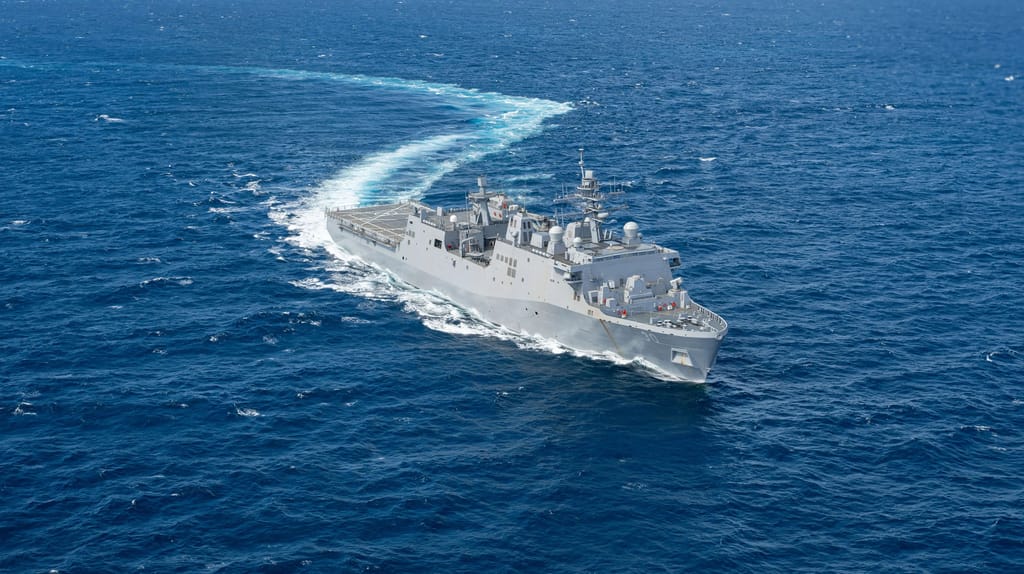
LPD
Press handout courtesy Huntington Ingalls

Ingalls Shipbuilding has completed builder's trials for the future USS Harrisburg (LPD 30), the first of the Flight II San Antonio-class amphibious transport dock ships. It is far from the last: the HII division and its subcontractors are in various phases of work for LPD 31 through 35, all already on contract.

The Navy decided to build a second flight of 13 San Antonio-class amphibs in 2018, and the award for LPD 30 went out the next year. LPD 30 was laid down in January 2022 and launched in October 2024. As of a September 2024 review by GAO, it was about 15 months behind schedule, consistent with other Navy shipbuilding programs. Commissioning is expected in the summer of 2027. 

From keel-laying to drydock flooding, China's state-owned shipbuilder CSSC can launch a comparably-sized Type 071 LPD in four months. China's navy is the world's largest, and is the pacing threat for U.S. Navy planning purposes. 

To accelerate progress on the LPD series, HII has adopted the idea of distributed shipbuilding - outsourcing production of subassemblies to smaller shipyards, then putting together the partially-completed hull sections at its own facility. The practice requires precision and discipline, but has worked successfully for other programs, like the Royal Navy's Queen Elizabeth-class carriers and the U.S. Navy's next generation of submarines. 

LPD 32, the future USS Philadelphia, will contain six modular units from Eastern Shipbuilding Group - the Florida Panhandle yard known for its workboats and ferries, which has made big bets on entering the defense shipbuilding space. ESG says that it is already at work on producing the units for delivery in the second half of 2027. 

"Our team is fully engaged and ready to deliver these six complex modules on schedule in 2027. This collaboration showcases the strength of the Gulf Coast shipbuilding industrial base and underscores our shared commitment to national defense," said Joey D’Isernia, CEO and Chairman of Eastern Shipbuilding Group. 


Long Beach Gets World's First Hydrofoiling Electric Pilot Boat

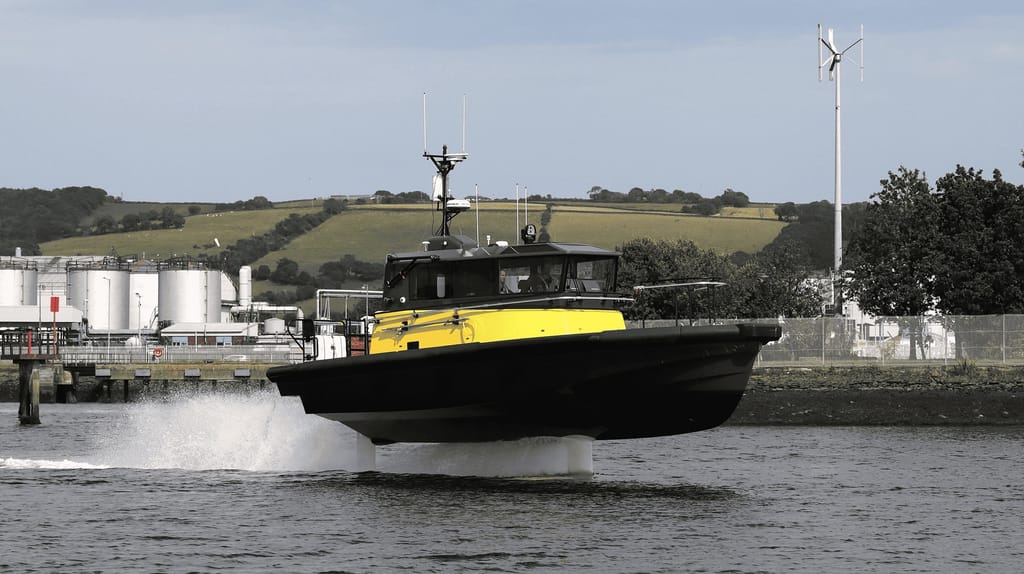
The Artemis EF-12 (Artemis file image)

The Belfast-based electric boatbuilder Artemis Technologies has sold a specially-adapted version of its hydrofoiling electric speedboat to Jacobsen Pilot Service, the pilotage provider for Port of Long Beach. Artemis launched the first vessel in the newly-designed EF-12 Pilot class in June 2026, and announced the first sale in a social media post on Wednesday. 

Artemis says that the EF-12 is the first pilot boat in the world to combine electric propulsion and hydrofoil technology. The technologies are synergistic, the firm says: hydrofoiling gets the hull out of the water, reducing drag and boosting battery range. The heart of the design is a pair of combined hydrofoil-propeller-rudder units, which sit on struts below the centerline. 

For busy pilots in need of swift transport, the design can hit 32 knots with four passengers aboard, and it has a range of up to 40 nautical miles at cruising speed - plus a quiet and smooth ride above the waves. During development, Artemis consulted with pilot boat operators from around the world to get feedback, and conducted a series of trials with Cork Pilots at the Port of Cork to perform early testing. The  design of the hydrofoils' rudder system allows the operator a high degree of control over yaw, giving the pilot boat an advantage when making contact with the side of a ship's hull and then breaking away, according to Artemis. 


At Long Beach, the EF-12 design will see considerable use and a high degree of public exposure. The San Pedro Bay port complex is the busiest container hub in the Western Hemisphere, and Jacobsen facilitates more than 7,000 vessel movements in and out of the harbor every year. For the operator, it will save the expense of 40,000 gallons of diesel per year - upwards of $200,000 at current prices - and will reduce CO2 emissions by 400 tonnes annually. For the port, it means a reduction in NOx, SOx and PM emissions, which are priority targets because of their health effects.  

The Port of Long Beach is supporting the purchase of the Artemis pilot boat with funds from the state of California's Port and Freight Infrastructure Program. Long Beach holds $380 million in two grant awards from the program, and is using the funding to pursue zero-emissions initiatives and rail improvements. 


World's Biggest Battery-Electric Ferry Enters Commercial Service

Incat
Image courtesy Incat

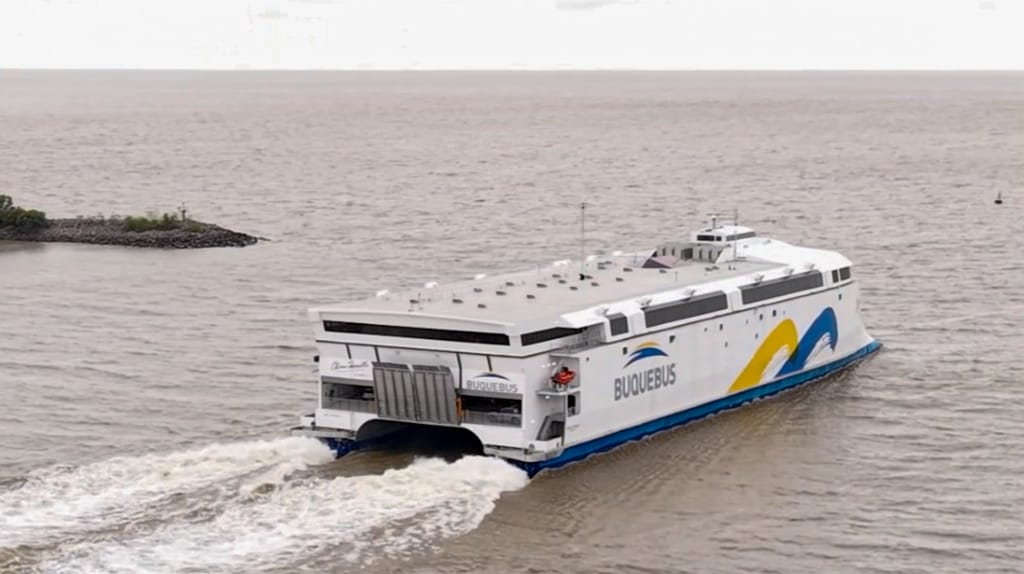
The Ecuadorian ferry operator Buquebus has begun commercial operations with the world's largest battery-powered ferry, the China Zorrilla, named after a regionally famous actress. 

China Zorrilla is an aluminum fast-ferry constructed at  Incat, a pioneer in the aluminum-multihull ferry space. After construction at Incat's yard in Tasmania, the vessel was loaded out on a heavy lift ship and transported to the Rio de la Plata. 

Capable of carrying up to 225 vehicles and 2,100 passengers, China Zorrilla is larger and has a bigger battery bank than any other battery-electric vessel. The 130-meter ropax has a deadweight capacity of about 960 tonnes, and has enough spare internal volume to accommodate a massive duty-free retail space.

According to Wärtsilä, the supplier of her power and propulsion systems, the design challenge was to build a zero-emissions ferry that could make 25 knots on a 60-kilometer route, and would be capable of shallow-water operations. The solution included 41 MWh worth of battery capacity, eight electric propulsion motors and eight axial flow waterjets. A pierside DC charging system restores the batteries to readiness with about 40 minutes, and is part of the scheduled operation for each one-way trip. 

The vessel is named for "China" Zorrilla (originally Concepción Matilde Zorrilla), a locally-famous actress who made her name in the Uruguayan and Argentinian theater scenes. She appeared in countless plays, movies and television shows from the 1950s up through at least 2007. She passed away in 2014.


BAE Systems' Sale of Dormant Australian Naval Shipyard Raises Concerns

Williamstown shipyard Australia
Williamstown shipyard closed a decade ago but the proposed sale to a real estate management company is attracting opposition (BAE Systems file photo)

The likelihood of a new political debate over Chinese ownership and the sale of key elements of Australian infrastructure is growing as opponents cite the proposed sale of a former shipyard site to a real estate management company in part owned by a Hong Kong-based company. The issue of Chinese control has come to the forefront over the past few years as the political debate grew over the  Port of Darwin, which was leased to a Chinese company.

News broke in mid-October with the publication Australian Defense Magazine first reporting that BAE Systems had confirmed the sale process of the Williamstown naval shipyard near the Port of Melbourne, and the last in Victoria. BAE confirmed to the magazine the sale was in process but declined further details.

A spokesperson for the real estate developer EMKC3 confirmed to the magazine that it had a sale contract. It said future uses for the site were being discussed, but as per the terms of the contract, it would not provide additional comments. EMCK3 is in part owned by a Chinese group of the same name based in Hong Kong.

The Williamstown shipyard is significant because of its location and its long history. There has been shipbuilding in the Williamstown area since the 1850s. The current site was the location of the Victorian Navy before federation in 1901, and shipbuilding commenced at the current site in 1913.

Reports highlight that the yard was the builder of the ANZAC class frigates operated by the Australian and New Zealand Navy. It also contributed blocks and internal outfitting for HMAS Canberra and HMAS Adelaide, Australia’s current ship-landing helicopter docks (LHD) and, in the case of Canberra, the Fleet Flagship of the Royal Australian Navy.

The yard became part of BAE Systems during the acquisition in 1987 of Tenix Defence, which was one of the largest defense contracts in Australia. The yard, however, lost out on newer contracts, and after the delivery of the landing helicopter docks, BAE began to wind down the operation. The yard, which just a few years earlier had employed 1,000 or more people, was closed by 2017.

Reports indicated that BAE had put the 17-hectare site up for sale in 2024 with an estimated value of A$200 million. Australian Defense Magazine believes EMCK3 has agreed to pay “considerably less.”

The state passes legislation requiring the site to remain used for marine engineering and industrial purposes. Near the entrance to the Port of Melbourne and only a few miles from the container port, it is a prime location next to a marina and oil storage facility. Critics of the sale point out it is one of only a few yards in Australia capable of building large naval ships.

Reports say it is unlikely the buyer would be seeking to use it for residential or other purposes. However, the issues of foreign control have already begun to be mentioned. The sale and future use of the site will require approval both at the Commonwealth and State levels.

Concerns over Chinese control emerged after Landbridge was given a 99-year lease on the Port of Darwin. The current Prime Minister, Anthony Albanese, has repeatedly raised the discussion of bringing the port back under Australian control. Chinese officials have objected, and the company has said it would pursue legal claims for breach of the contract for the Port of Darwin. It points out its investments and efforts to turn around the port, while opponents claim it has failed to meet its obligations.


Fortescue's First "Green" Bulker Bunkers Ammonia at Port Hedland

Fortescue bulker
Courtesy Fortescue

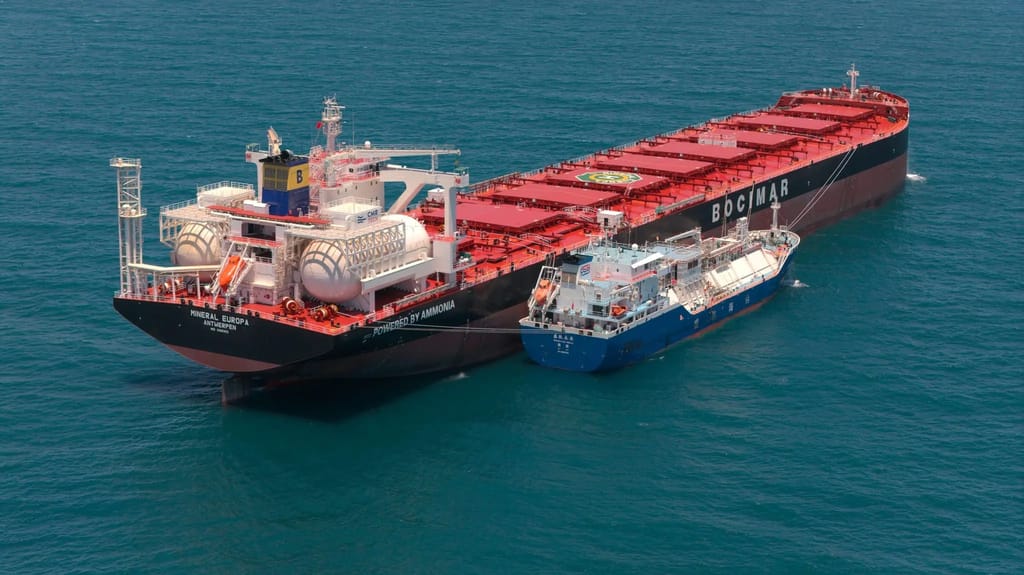
A Capesize ore carrier has fueled up with green ammonia at Port Hedland, Australia, in a first for the Australian market and for mining giant Fortescue's export operations. 

The Fortescue-chartered Mineral Europa is a 200,000 dwt bulker operated by Belgian owner CMB.Tech. She is deployed on the core trade lane from Port Hedland to China - the destination for two-thirds of the global iron ore trade.

The green ammonia used at Port Hedland has no carbon emissions when used as a marine fuel, according to Fortescue. Port authority Pilbara Ports says that if multiplied across the Australia-centered iron ore fleet, switching to ammonia bunkering could cut emissions by as much as 4.5 million tonnes of CO2 annually. 

Norwegian ammonia producer Yara has a massive conventional natural gas-to-ammonia plant in the Pilbara region, positioning it to add carbon-capture ammonia production in future. 

Another firm, WAH2 Clean Ammonia, has ambitions to set up a nearby blue ammonia plant (natural gas-derived ammonia, produced using a carbon capture and storage process). WAH2 has a feedstock deal with Chevron for its natural gas and a bunkering partnership with bunker-vessel operator Oceania Marine Energy. 

Eventually, Fortescue would like to develop a value-added, low-carbon iron trade that involves a higher degree of processing before shipment. The idea is to use hydrogen - produced from renewable sources - to smelt iron ore into sponge iron ("green iron"), a deoxygenated iron raw material that could be used to produce high-grade steel in China. 


Hybrid-Electric Expedition Cruise Ship Built in Chile Set for Delivery

hybrid expedition cruise ship
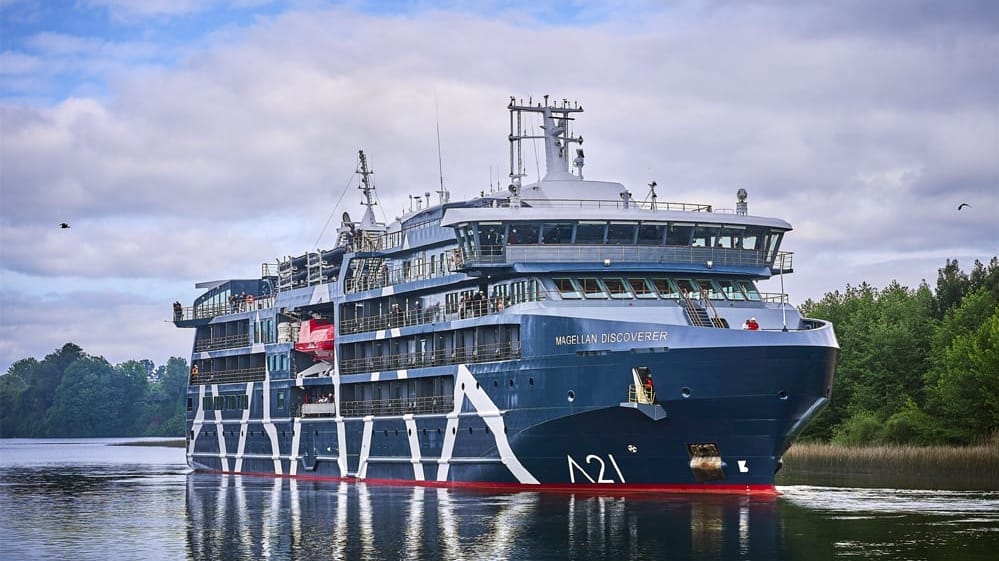
Magellan Discovererr is the first hybrid-electric polar expedition cruise ship built in the Americas (ASENAV)

Chilean shipbuilder ASENAV (Astilleros y Servicios Navales S.A.), the biggest shipyard in Chile, highlighted the departure of the innovative new exploration cruise ship Magellan Discoverer from its shipyard this week. The cruise ship, which took about 33 months to build and involved more than 500 employees, contractors, and suppliers, departed ASENAV’s shipyard in Corral for its final trials before delivery and entry into service in December.

The 5,258 gross ton cruise ship is being hailed as the first hybrid-electric expedition cruise ship ever built in the Americas. Designed and built by ASENAV, the ship was created for long-range polar expeditions, and according to its builders and owners, Antarctica21, it will set a new standard for responsible Antarctic explorations. Antarctica21 says, “Every system on board has been engineered to reduce environmental impact while delivering an exceptional expedition experience.”

The hybrid-electric propulsion system is driven by ABB’s Onboard DC Grid, a modular platform that integrates generator power with Corvus Energy Battery Storage System to enable flexible energy management. Power and propulsion come from two MAN main engines and gensets, totaling 4,800 ekW of power for two ABB Azipod units. The marine lithium battery bank was developed by Corvus Energy. It will give the ship a speed in open waters of 14 knots.

ASENAV highlights that the systems optimize energy efficiency while reducing CO2 emissions and underwater noise. The ship was designed to operate in one of the most extreme environments on the planet. The hybrid systems give the vessel the ability to sail for up to 60 days without refueling.

It is also equipped with a heat recovery system that will allow the heat generated in the exhaust gas to be recovered and used for water heating, while the elevator technology captures and converts energy generated during braking into electricity to recharge the batteries. The Vessel Performance Management System employs approximately 100 sensors and will analyze performance, including energy consumption, generator performance, and navigation speed.

“This vessel marks a leap forward in sustainable engineering, positioning ASENAV as a leading shipyard in the local maritime industry and placing Chile at the forefront of global innovation and design for vessels of this type,” said Fernando Rodríguez, General Manager of ASENAV.

Magellan Discoverer is 94 meters (308 feet) in length with accommodations for up to 96 passengers, although it is limited to 88 passengers for the fly-cruise operations in Antarctica. The ship will have 67 staff and crewmembers. It has a reinforced hull and robust bow, giving it the ability to break through ice barriers up to 80 centimeters (2.6 feet) thick. It received a Polar Class PC6 rating and an IMO Tier III certification.

Aboard, the passengers will experience a boutique, yacht-like style experience. The ship has a large lounge and dining room as well as an observation deck, library, and prep area for expeditions.

“This new ship not only represents a technological leap in sustainability, but also a reflection of national talent and what we are capable of achieving when we strive for excellence. We are proud to collaborate with ASENAV on this project that unites cutting-edge engineering with a responsible vision of tourism in the most remote territory on the planet,” said Jaime Vásquez, president of Antarctica21.

The order for the ship was placed in 2023, expanding on ASENAV’s prior newbuild for Antarctica21, Magellan Explorer, delivered in 2019. The ship reportedly cost approximately $90 million to build, with steel cutting beginning in February 2024, and the hull was launched in October 2025. Earlier this year, the ship was moved along the Calle Calle River from the yard in Valdivia to Corral in preparation for trials.

Magellan Discoverer departed on October 26 for her final sea trials, where her operational performance, maneuverability, and systems functionality are being evaluated under real-world conditions. She is scheduled to depart for Punta Arenas, Chile, before her entry into service on December 15. She will spend the first few months operating in the Antarctic as part of Antarctica21’s fly-cruise program, where passengers fly to King George Island to join the ship, avoiding the difficult crossing of the Drake Passage.

The cruise line says her unique design will improve overall efficiency and operational flexibility, while minimizing the impact on wildlife and the environment.
 

Wednesday, November 04, 2026


Dockworkers Worldwide Strike Against Militarization, Wages and More

dockworkers strike
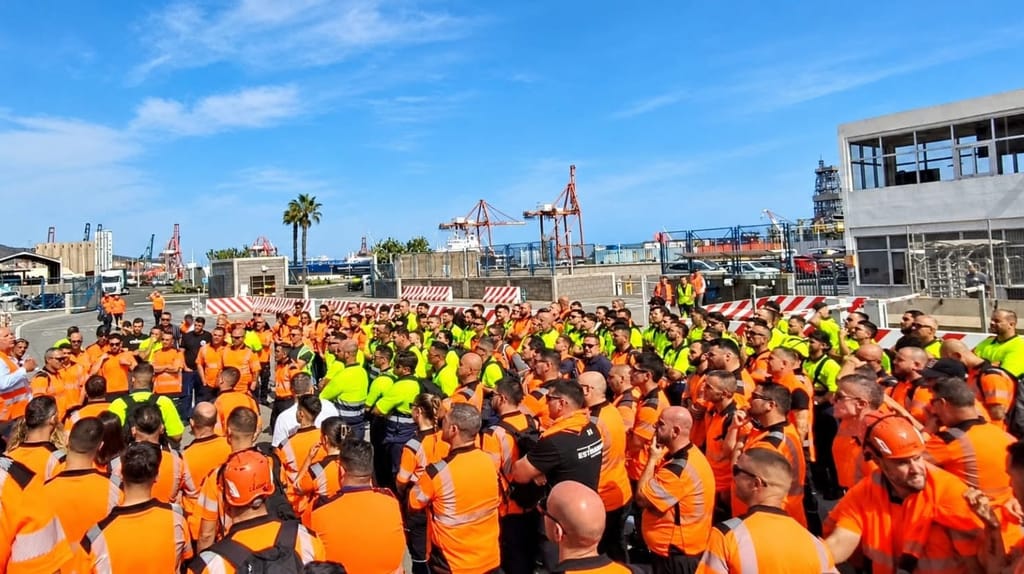
Dockworkers in Spain joined the coordinated effort (European Dockworkers Council)

In what is being called the largest action of its kind, dockworkers around the world joined a strike call on Friday that was reportedly impacting as many as 113 ports in 22 countries. What was originally billed by the organizers as an effort against militarization of ports and shipments of war-related cargoes, however, took on a local tone with demonstrations against working conditions, calls for wage increases, and other issues.

Organizers highlighted that for two years dockworkers have stopped cargoes, mostly one ship at a time, to protest military cargoes. They pointed to efforts in Tangier, Piraeus, France, Spain, and elsewhere, using the broad theme “Dockworkers do not work for war.” The individual protests did result in delaying some ships and cargoes while others were diverted. The U.S. Federal Maritime Commission recently announced it is planning penalties against Spain after Maersk Line, Ltd. ships were forced to divert over the suspicion they were carrying military-related cargoes to Israel.

In February 2026, the unions called for their first day of action. The coordinated efforts on February 6 reportedly involved 20 ports in seven countries. Organizers asserted they stopped five suspected ships.

Today’s action also started as a demonstration against militarization and specifically the war in Gaza. However, it quickly expanded to include local issues such as demands in France for increased minimum wages and higher salaries rather than bonuses, which the unions highlighted do not contribute to social security coverage. Other workers demonstrated against their working conditions.

Workers in the Port of Le Havre, France demonstrated and called for increased salaries (European Dockworkers Council)

The European Dockworkers Council led the call for action and reported it would include strikes in France, Italy, Greece, and Turkey, as well as stoppages in Morocco and Cyprus. Later reports said the ILWU in California was joining the effort at the ports of Oakland and San Francisco. The Hamburg chapter of Ver.di was also reported to have joined, while the European Dockworkers Council said it had also expanded to include more countries such as Sweden and Slovenia.

They claimed that the action was impacting ports that collectively handle 13.5 percent of global shipping and 63 percent of container activity. They said the one-day delay would result in costs of $57 million, with $2.8 billion worth of cargo not moving. Organizers claimed in the Mediterranean alone they would disrupt more than 40 percent of cargo.

It was unclear how much impact the action really had, with analysts saying one day would not have a dramatic global impact on supply chains and operations. Several companies, however, had warned of potential delays

There were also some sympathy actions. In Italy, Unione Sindacale di Base called for a 24-hour general strike, but there were reports that the government was ordering workers not to strike and to return to their jobs. In Greece, the seafarers' union also called a strike, and ferries to the islands were disrupted.  The French unions said that 24 ports were involved in the action, but it was separate from a nationwide general strike which is now scheduled for November 5.

The organizers predicted that this would not be the last of their coordinated efforts. They asserted that an international dockworkers’ movement is emerging and would continue to strike to stop the militarization of ports and the exports of war-related materials.


The Risk of a Full-Scale Conflict With Iran is at its Peak

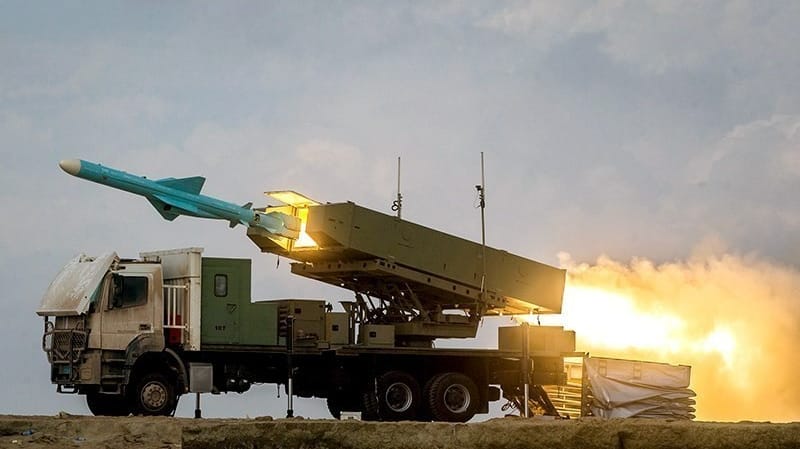
Test launch of an Iranian Noor antiship missile (Tasnim / CC BY)

Shipowners, managers and seafarers need to have a sense of where the risk of a resumption of the U.S.-Iran war currently sits, and putting aside temptations to be precise with regard to timing, the risk of a resumption of full-scale war could not be higher than it is now - and it will stay at that level for the next week. And the initiative to restart the war could be taken by Israel, Iran, the United States or even, conceivably, the Gulf states themselves.

From a political perspective, Prime Minister Netanyahu’s desire to resume hostilities has been advertised by his clashes with the Israeli chief of staff. President Trump may be tempted to do so before seats change hands in Congress. Iran is under increasing pressure domestically as the oil money runs out and imports dry up, and could leverage a patriotic war as a diversion. Some of the Gulf states do not want to see any arrangement come into play that gives Iran more control over the Strait of Hormuz than it used to have, and they might move if they were threatened with a fait accompli or a deal to which they were not a party.

From a military perspective, the United States has been clearing dependents and nonessential personnel from forward bases and embassies in the region, and it has mastered the art of prosecuting long-range warfare without giving away any indicators and warnings. Israel is always ready, and the fake full-scale attack mounted last week, which stopped just short of Iran’s borders, may have been an attempt to get the Iranians to unmask their air defense systems in order to update the electronic signatures of the systems that will need to be attacked.

A series of covert, unannounced military strikes by the United States on targets in Iran in recent days may also be viewed as an attempt to prepare the battlefield, and unexplained fires and explosions at a number of sites in Iran could likewise be part of shaping operations.

Iran may want to avoid another war, knowing the damage that will be done to its infrastructure. But its leaders evidently feel a war is imminent and have been trying to pressure the Gulf states to urge restraint on the United States and Israel by threatening attacks on a wide range of civilian targets. But if Iran feels threatened and thinks an attack is imminent, it may be tempted to make a preemptive first move.

The opinions expressed herein are the author's and not necessarily those of The Maritime Executive.