Tuesday, November 10, 2026

 Trump says post-war Ukraine will have a 'different shape' ahead of Abu Dhabi talks
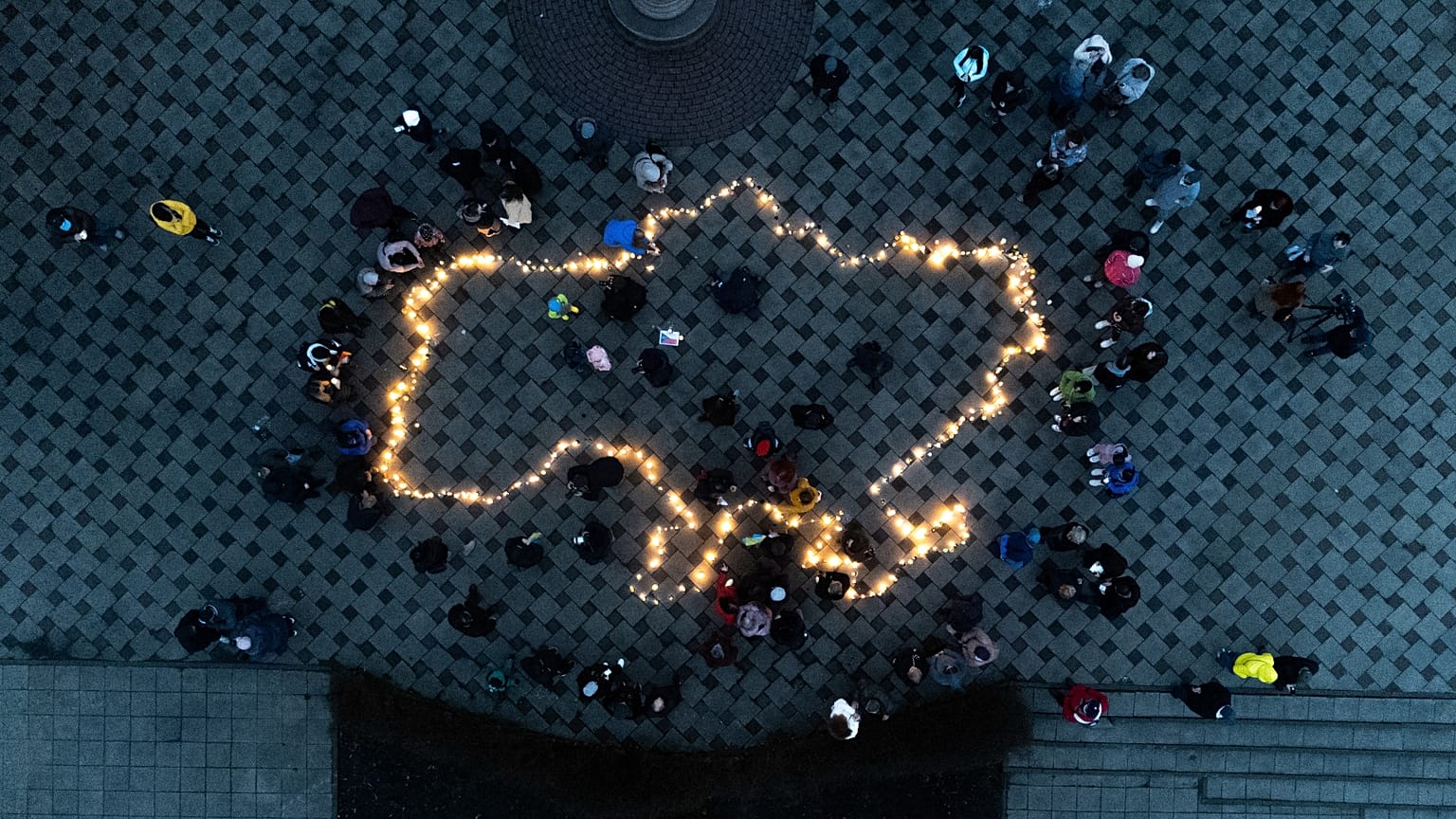
People light candles in a shape of the map of Ukraine during a commemorative event on the anniversary of the liberation of territory from Russia in Bucha, Ukraine 31 Mar 2023.
Copyright AP Photo/Mstyslav Chernov

By Sasha Vakulina
Published on

The US president expressed confidence that a peace agreement between Kyiv and Moscow was within reach, despite deep divisions over territorial concessions and post-war security guarantees.

US President Donald Trump suggested that Ukraine's territory could change as part of a future agreement with Russia, days before US-mediated talks between Kyiv and Moscow in Abu Dhabi."I think we're going to have it done and I think it's going to happen, and they're going to end up with a little bit different shape (for) Ukraine," Trump told CBS's "60 Minutes" in an interview published on Monday.

His remarks come ahead of trilateral negotiations involving Ukraine, Russia and the US, scheduled for 10–11 November in Abu Dhabi, the UAE.

Trump expressed confidence that an agreement was within reach, although Kyiv and Moscow remain deeply divided over territorial concessions and the security arrangements that would follow any ceasefire.

"There's a very important meeting taking place," Trump said. "I believe that that war is going to end and it's going to end soon. And the only reason it's going to end is because of me."

The US president did not elaborate on what he meant by Ukraine having a different shape or specify which territorial changes he envisaged.

Rubio points to progress on security guarantees

US Secretary of State Marco Rubio said on Sunday that progress had been made in discussions over post-war security arrangements for Ukraine and Europe, suggesting that further advances could follow this week's negotiations.

Speaking ahead of a visit to Paris for talks with G7 foreign ministers, Rubio said a central question was what security arrangements would be needed to protect Ukraine and the wider European continent after the war.

"What is the postwar security infrastructure of Ukraine and more broadly of the European continent going to look like?" Rubio told reporters.

"I think that's what the president's alluding to - is that there's been some advances made in what that architecture could look like post-conflict," he added.

European Commission President Ursula von der Leyen confirmed that the EU would also be present in Abu Dhabi alongside its partners.

France will also be represented at the negotiations, according to Foreign Minister Jean-Noël Barrot.

Territorial disputes remain a major obstacle

Russia and Ukraine remain far apart over the terms of a potential settlement, particularly the future of Ukrainian territories occupied by Moscow's forces.

Vladimir Putin has repeatedly demanded that Ukraine withdraw its troops from four regions that Moscow illegally claimed to annex in 2022, despite never establishing full control over them.

The Kremlin also insisted that Kyiv abandon its ambitions to join NATO and accept restrictions on the size and capabilities of its armed forces.

Ukraine categorically rejected the demands to cede territory, including areas Russia has failed to capture militarily, and insists that credible security guarantees are essential to prevent another Russian invasion.

Kyiv called for an immediate ceasefire as a first step towards a broader settlement, maintaining that territorial questions would ultimately require direct talks between Zelenskyy and Putin.

Asked about the biggest obstacle to reaching an agreement, Trump pointed to the relationship between the two leaders.

"It was the hatred between Zelensky and Putin," he said.

When asked whether Zelenskyy's hostility towards Putin was understandable given Russia's invasion, Trump referred to what he described as disrespect towards Moscow during an earlier meeting between the two presidents.

Asked whether he trusted Putin or Zelenskyy more, Trump declined to choose.

"I'd rather not say, but I get along with both," he said, adding that he did not believe Putin was deliberately prolonging negotiations.


Who's who from Ukraine and Russia at the Abu Dhabi peace talks?
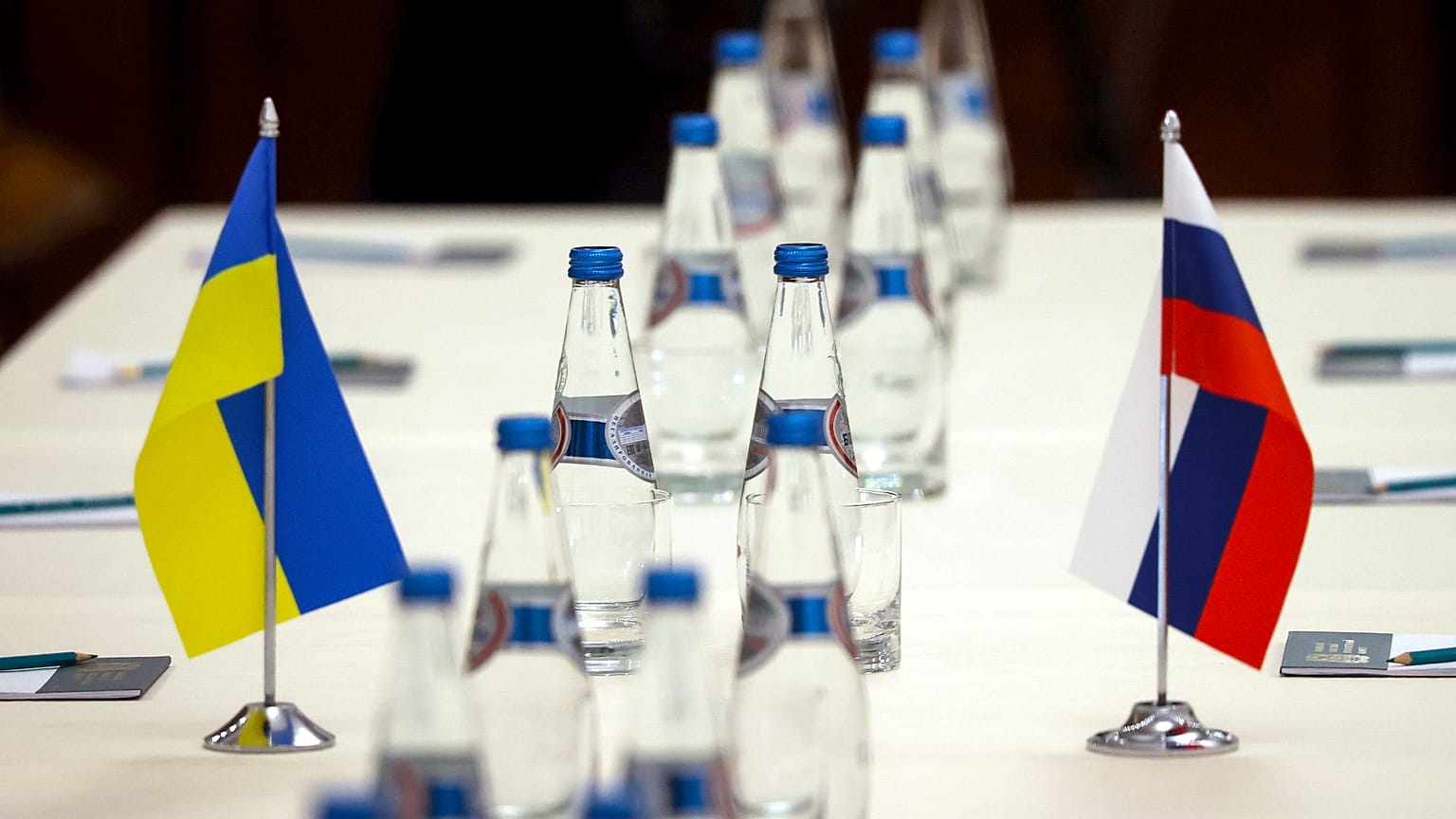
FILE: Ukrainian and Russian national flags are placed on the table ahead of peace talks between delegations in a guest house in the Gomel region, Belarus is seen Feb. 28, 2022
Copyright AP Photo

By Sasha Vakulina
Published on

The composition of the Ukrainian and Russian delegations at the Abu Dhabi peace talks offers clues to what could be discussed behind closed doors as US-mediated negotiations resume for the first time in nine months.

Ukraine and Russia will return to the negotiating table in Abu Dhabi on November 10–11, nine months after their last round of US-mediated talks. The composition of their delegations offers clues about what each side hopes to achieve.

Kyiv is sticking largely with the same team that took part in previous rounds, signalling continuity in its push for a ceasefire as a first step towards a broader peace agreement.

Moscow, meanwhile, is bringing senior military and diplomatic officials, including Deputy Foreign Minister Sergei Ryabkov, who helped draft Russia's sweeping security demands to NATO shortly before its full-scale invasion of Ukraine in 2022.

His inclusion raises the possibility that the Kremlin intends to broaden the negotiations beyond Ukraine to Europe's wider security architecture, particularly after US President Donald Trump suggested that an eventual agreement could extend beyond Ukraine.

Ukraine: Continuity in ceasefire push

Ukraine's delegation will again be led by Foreign Intelligence Service head Rustem Umerov, who has played a central role in previous negotiations with Moscow.

He will be joined by Kyrylo Budanov, head of Volodymyr Zelenskyy's office, Davyd Arakhamia, leader of the presidential ruling Servant of the People parliamentary faction, and Serhii Kyslytsia, first deputy head of the presidential office.

Arakhamia was also in Washington last week, attending a White House meeting hosted by US First Lady Melania Trump on Thursday following the humanitarian ceasefire in Russian-occupied Oleshky.

All four took part in earlier rounds of negotiations, providing continuity as Kyiv seeks to secure a ceasefire and negotiate guarantees against renewed Russian aggression.

Ukraine has repeatedly indicated its willingness to consider different forms of ceasefire, while maintaining that any broader agreement must protect its sovereignty and provide credible security guarantees.

The largely unchanged negotiating team suggests Kyiv intends to maintain that approach rather than substantially revise its position ahead of the renewed talks.
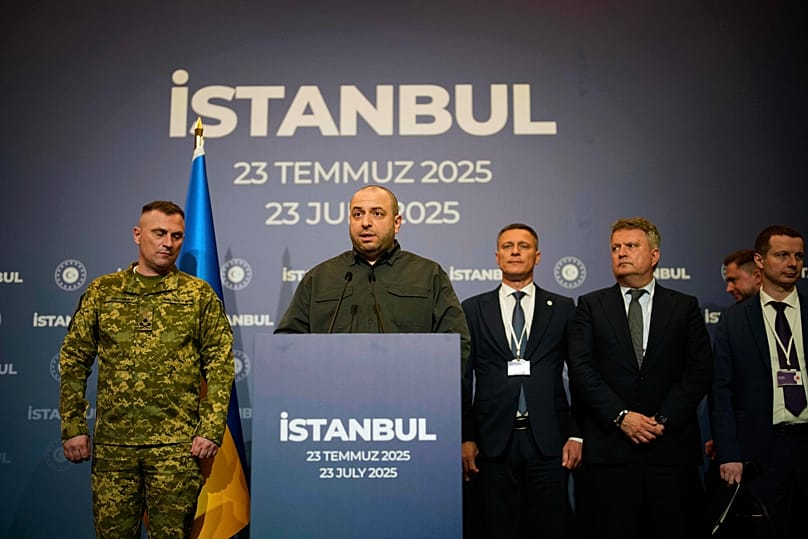
Head of Ukrainian delegation Rustem Umerov talks to journalists during a news conference, Istanbul, Turkey, July 23, 2025 AP Photo

Russia: A familiar face, with significant addition

Russia's delegation will again be led by Vladimir Medinsky, a Kremlin aide and former culture minister who has represented Moscow in previous negotiations with Ukraine.

A staunch supporter of Russia's invasion, Medinsky edited a three-volume textbook, 'Military History of Russia', published in January 2025, which portrays the war in Ukraine as a continuation of the Soviet struggle against Nazi Germany.

Aimed at schoolchildren, the book claims Russia was "forced" to invade Ukraine in February 2022 over NATO’s expansion policy and the 2014 ousting of Ukraine’s pro-Russian president, Viktor Yanukovych, which it labelled "a Western-backed coup".

The three-volume book calls Ukraine an "aggressive anti-Russian bridgehead" and emphasises "battlefield heroism" while pointing at historic parallels between modern Russian military tactics and those of the Soviet army during World War II, which Russia calls "the Great Patriotic War".

In 2014, when Russia first invaded Ukraine, Medinsky, then Russia’s culture minister, issued a document declaring that "Russia is not Europe," arguing that the rest of the continent was morally inferior.

This wasn’t the first time Medinsky tried to show Russia’s superiority to other nations. In 2013, he said that Russia’s "perseverance" in the face of all 20th-century catastrophes indicates that the Russian people "have an extra chromosome".

His return suggests continuity in Moscow's negotiating approach, but the addition of senior diplomatic and military officials raises questions about the scope of the discussions.
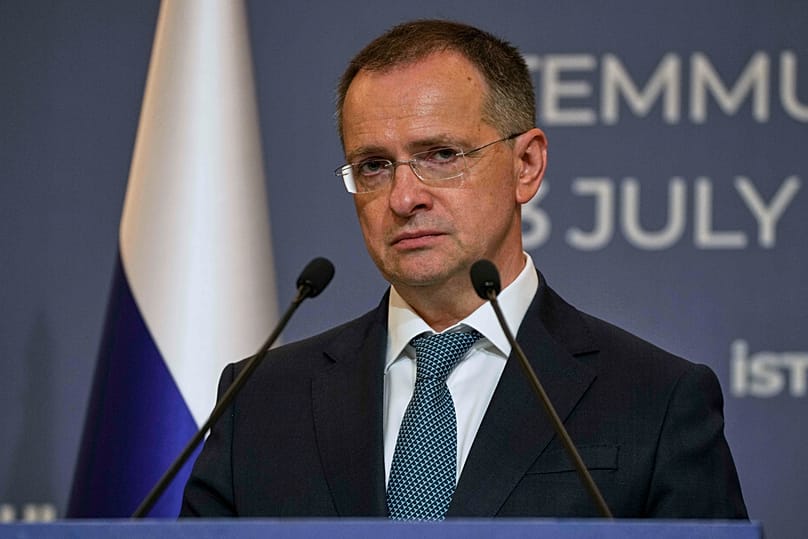
Russian presidential aide Vladimir Medinsky at a news conference after a meeting between Russian and Ukrainian delegations in Istanbul, July 23, 2025 AP Photo


Among them is Deputy Foreign Minister Sergei Ryabkov, who is joining the Ukraine peace negotiations for the first time.

Ryabkov oversees Russia's relations with the United States, as well as arms control and non-proliferation issues, including those concerning Iran's nuclear programme.

He was closely involved in Moscow's security demands to Washington and NATO in December 2021, shortly before Russia launched its full-scale invasion.

Those proposals called for an end to further NATO enlargement, including Ukrainian membership, and restrictions on the alliance's military presence in eastern Europe, effectively seeking a rollback to its pre-1997 positions.

Moscow also demanded limits on military exercises and missile deployments, alongside restrictions on nuclear weapons stationed outside their countries of origin.

The Institute for the Study of War (ISW) has suggested that Moscow could use Ryabkov's experience with those demands to undermine Ukraine's efforts to secure post-war security guarantees.

The US-based think tank also pointed to the negotiating records of other Russian delegates, including Medinsky and Deputy Foreign Minister Mikhail Galuzin, who have previously insisted that any settlement address what Moscow calls the war's "root causes".

ISW argued that the composition of the Russian delegation raised doubts about the Kremlin's willingness to engage in meaningful negotiations.

Ryabkov's participation comes days after US President Donald Trump met Russian envoy Kirill Dmitriev at the White House on Thursday and suggested that an eventual agreement could extend beyond Ukraine.

"There's going to be an agreement. It's going to be a big agreement, and it's going to involve more than Ukraine," Trump said, adding that it could potentially involve all of Europe.

Although neither Washington nor Moscow has specified whether NATO's wider security arrangements will be on the agenda, Trump's remarks and Ryabkov's appointment have brought renewed attention to the possibility.

Russia is also sending Yuri Zhigarlovsky, deputy head of the General Staff's Main Operational Directorate, which is responsible for military planning and operations.

The Russian delegation met President Vladimir Putin on Friday during a Security Council meeting partly devoted to preparations for the talks.

The presence of senior military and diplomatic officials suggests that discussions could extend across political and security issues, although it remains unclear whether Moscow is prepared to compromise on its longstanding demands.

Choosing Where And How To Extract Water On Mars


This is a Hubble Space Telescope photo of Mars taken when the planet was 50 million miles from Earth on May 12, 2016. Credits: NASA, ESA, the Hubble Heritage Team (STScI/AURA), J. Bell (ASU), and M. Wolff (Space Science Institute)


November 8, 2026

By Eurasia Review


Key Takeaways:

A review in Planet by Xueying Li and colleagues finds that Martian water usability depends on burial depth, material strength, thermal properties and impurities, not water content alone, requiring extraction methods matched to local geology.

Low latitudes mainly hold water in hydrated minerals needing energy-intensive heating, mid-latitudes may offer more accessible pore ice or buried glaciers, and high-latitude ice faces greater operational challenges.

Promising approaches such as in-situ thermal sublimation or Rodwell-type melting must still solve heat transfer, vapor capture, phase-change control under low pressure and impurity management before supporting life support or propellant production.


The suitability of a water resource on Mars depends on more than its water content. Burial depth, material strength, thermal properties, and impurities all influence how readily water can be extracted. For future missions, resource availability and extraction technology must therefore be evaluated together.

In a review published in Planet, Xueying Li and colleagues from Harbin Institute of Technology examine Martian water resources and the technologies proposed for their extraction. The article links the distribution and forms of occurrence of Martian water, together with the properties of water-bearing materials, to the requirements of different extraction methods.

The review examines how water resources and their accessibility vary across Martian latitudes. At low latitudes, water is commonly bound within hydrated minerals and requires heating for extraction, which can be energy-intensive. Mid-latitude regions may contain pore ice, excess ice, and buried glaciers, potentially offering a favorable balance between resource accessibility and operating conditions. High-latitude and polar regions contain extensive ice resources, but present greater environmental and operational challenges.


These differences make the selection of extraction technology highly dependent on local geological conditions. Excavation followed by heating must overcome challenges related to cutting resistance, tool wear, and limited excavation forces under low gravity. In situ thermal sublimation methods can reduce the need for excavation and material handling, but their effectiveness depends on efficient heat transfer and vapor capture.

For relatively pure, massive ice deposits, Rodwell-type systems could enable sustained water extraction through subsurface melting. However, their application on Mars would require controlling water phase changes under low atmospheric pressure, preventing borehole blockage from vapor condensation and refreezing, and managing impurity accumulation.

The review brings together geological observations and engineering considerations to assess the practical extractability of Martian water resources. This integrated perspective helps explain why a method suited to one deposit may perform poorly at another, and why water content alone is insufficient for selecting a suitable extraction site.

Further progress will depend on better characterization of subsurface water resources, more efficient extraction and purification technologies, and experimental validation under representative Martian conditions. Ultimately, these technologies must be integrated into broader resource utilization systems that support life support, propellant production, and long-term surface operations.


VELIKOVSKY WAS RIGHT

Could Jupiter’s Electric Skies Be Alive? Science Needs A Harder Test – Analysis


Jupiter’s Io-driven plasma forms complex, self-organizing structures that can resemble life-like behaviors, yet no plasma life has been verified and ordinary physics remains the primary explanation.

AI analysis of archival 
Juno data, upcoming Juice and Europa Clipper observations, and developmental quantum magnetometers could systematically test candidates against known waves, instabilities, and instrument effects.

Any claim of nonliving information transfer or exotic life would require pre-specified cross-instrument evidence and laboratory discrimination from hysteresis, with the most probable outcome being improved magnetospheric models rather than biological discovery.


Jupiter’s plasma can organize itself into astonishing structures. AI, archival spacecraft data and experimental quantum sensors could help test whether any unusual behavior exceeds ordinary physics—without mistaking resemblance for life.

Every second, Jupiter’s volcanic moon Io supplies roughly a metric ton of material to the giant planet’s magnetic environment. Particles become electrically charged, gather in a vast torus around the moon’s orbit and help feed auroras that illuminate Jupiter’s poles. The result is a restless electrical system in which matter moves, concentrates, disperses and reforms. NASA’s description of Io makes the underlying physics clear; the spectacle needs no biology to explain it.

But suppose an instrument found a plasma structure that persisted for hours, recovered its shape after a disturbance and appeared to split into similar structures. Would that make it alive? Not yet. Those behaviors can be produced by physical forces in nonliving matter. The more interesting question is what observation would justify a claim that something more is occurring.

at question has renewed relevance. On September 28, 2026, the European Space Agency’s Jupiter Icy Moons Explorer, Juice, completed an Earth flyby on its long route to Jupiter. NASA’s Europa Clipper is preparing for its own Earth flyby in December, with arrival at Jupiter planned for April 2030. Neither mission is designed to hunt plasma organisms. Together with the observations already returned by Juno, however, they are reminders that the Jovian system is becoming an exceptionally well-studied natural laboratory.

The scientific position must remain unmistakable: no plasma life or plasma intelligence has been verified at Jupiter, and no extraterrestrial life has been confirmed anywhere. The value of an adventurous hypothesis depends on whether it can be made vulnerable to evidence, not on how vividly it can be imagined.

Why Jupiter makes the question interesting

Jupiter rotates in roughly ten hours and drives one of the solar system’s most powerful magnetospheres. Io supplies sulfur and oxygen that become ionized; interactions among moons, particles and magnetic fields generate currents, waves, auroras and structures across many scales. A peer-reviewed review of the Io–Europa plasma environment shows how a complicated system can emerge from familiar physical processes acting together.

There is a serious research tradition behind asking how far such self-organization can go. In a 2007 New Journal of Physics study, physicists modeled dusty plasmas that could form stable helical structures with some features reminiscent of reproduction and memory. That was provocative work on complex matter, not evidence of living material at Jupiter. Its relevance is to the experimental question: when an organized structure looks lifelike, what ordinary mechanisms can produce the same appearance?

For example, a bright plasma feature may follow an energy gradient without seeking food. A vortex may divide without reproducing. A configuration may return to its earlier state because the surrounding magnetic field has changed back, rather than because it inherited instructions from an ancestor. Each resemblance makes a good physics question. None is a biological verdict.

NASA’s working discussion of life emphasizes a self-sustaining chemical system capable of Darwinian evolution. An unfamiliar kind of life might not resemble terrestrial cells or carry DNA, so that definition cannot settle every possibility. Yet an alternative hypothesis still owes a mechanism for maintaining information, transmitting it to later structures and producing heritable differences that matter to persistence and reproduction. Mere complexity, motion or energy exchange falls short.

Let AI search, but make physics the rival

The first investigation need not begin with a new spacecraft. Juno has already observed Jovian magnetic fields, charged particles and plasma waves, and NASA’s Planetary Data System holds public Juno instrument records. A research team could align those observations by time, spacecraft position, instrument calibration and local plasma conditions, then ask whether candidate structures behave differently from established waves, instabilities, or transient interactions with Io and Europa.

AI would be useful as a search assistant, not an automatic life detector. NASA has already used machine learning to help select magnetic-reconnection observations from its Magnetospheric Multiscale mission near Earth. A comparable Jovian study could rank rare combinations of signals for expert inspection. The crucial question would be whether the candidate survives serious attempts to reproduce it with ordinary plasma physics and realistic instrument effects.

That means training and testing on separate time periods, holding out different orbital geometries, and injecting simulated structures to quantify detection and false-alarm rates. If analysts search millions of intervals, a few remarkable-looking patterns are inevitable by chance. An anomaly score is a reason to investigate, not a probability that life exists.

The strongest test would look for relationships across independent measurements: fields, particle populations, waves and emissions with the timing and spatial behavior predicted in advance. A repeated pattern should be checked against physical transport, spacecraft motion and the same calibration error appearing in more than one sensor. Independent teams should be able to rerun the analysis from the original data. A result that disappears under a better magnetic-field model is progress in understanding Jupiter, not a failed search.

Quantum sensors would measure the world, not certify life

New instruments may eventually make these tests sharper. NASA’s Jet Propulsion Laboratory and Glenn Research Center are developing a silicon-carbide quantum magnetometer that uses atomic-scale defects in a semiconductor to detect magnetic fields electrically. Its attraction is practical: potentially compact hardware, low power requirements and improved calibration options in demanding environments.

The qualification is as important as the invention. NASA describes the technology as developmental; it is not assigned to a Jupiter mission, and its proposed ability to operate in high radiation has not established the performance of a complete flight instrument in the Jovian environment. Even a superb magnetometer would detect magnetic fields, not identify an organism. Conventional sensors, particle analyzers and plasma-wave instruments would remain essential.

The next generation of missions already offers a useful test of this measurement logic. Europa Clipper’s magnetic-field and plasma instruments are designed to separate Europa’s ocean-related induction signal from the surrounding Jovian plasma. Meanwhile, Juice carries a magnetometer, particle sensors and a radio-plasma-wave package for its Jupiter-system science beginning in 2031. These are carefully defined physical investigations, not plasma-life experiments. They illustrate the kind of cross-instrument reasoning any future, more speculative search would need.

A future small-satellite or laboratory program could compare a quantum sensor with a well-calibrated conventional alternative under the same field, vibration and radiation conditions. It should report measurement error, stability and recovery, as well as what new inference those measurements actually support. The word “quantum” cannot replace those comparisons.

The experiment worth doing even if nothing is alive

Before asking for a dedicated mission, researchers could build magnetized and dusty-plasma experiments in laboratories and define the results that would distinguish ordinary instabilities from sustained information transfer. Perturb the magnetic field, change the energy supply, track repeated formation and ask whether any apparently inherited characteristic persists across independent cycles. Physical memory, such as hysteresis, must compete as an explanation before anyone invokes learning or evolution.

That research can be international and comparatively inexpensive. NASA’s Juno archive and ESA’s future Jovian measurements provide different observing geometries; laboratory groups can publish protocols and compare predictions before seeing the next data. NASA’s Ladder of Life Detection offers a framework for debating what observations support biological claims, while explicitly declining to certify any particular instrument or biosignature. A proposed plasma-life test would need even more careful criteria because no verified example exists to calibrate against.

The likely near-term result is better plasma physics, not evidence of organisms. That is still worth pursuing. A disciplined null result could rule out a specified mechanism under tested conditions, even though it could never rule out every imaginable exotic life form. More importantly, the same work could improve models of Jupiter’s magnetosphere, spacecraft radiation environments and future instrument design.

Jupiter does not have to be alive to teach us how matter organizes itself. The scientific opportunity is to ask the imaginative question, give nonliving physics the strongest possible chance to answer it, and accept what the measurements show. If a truly unfamiliar form of life exists in those electric skies, it will deserve a discovery built on more than a striking shape.


About Burak Oktenli
Burak Oktenli holds an MBA and a Master of Professional Studies in Applied Intelligence from Georgetown University. His research addresses the governance of authority in autonomous and AI-enabled systems, and his writing has appeared at the Modern War Institute at West Point, RUSI, RealClearDefense, RealClearMarkets, and Geopolitical Monitor. He is the author of Authority Architectures for Autonomous Systems, a ten-volume series on how authority in autonomous systems is delegated, monitored and recovered, at authority-architecture.me.
View all posts by Burak Oktenli →


Which European country loses the most money when workers strike?

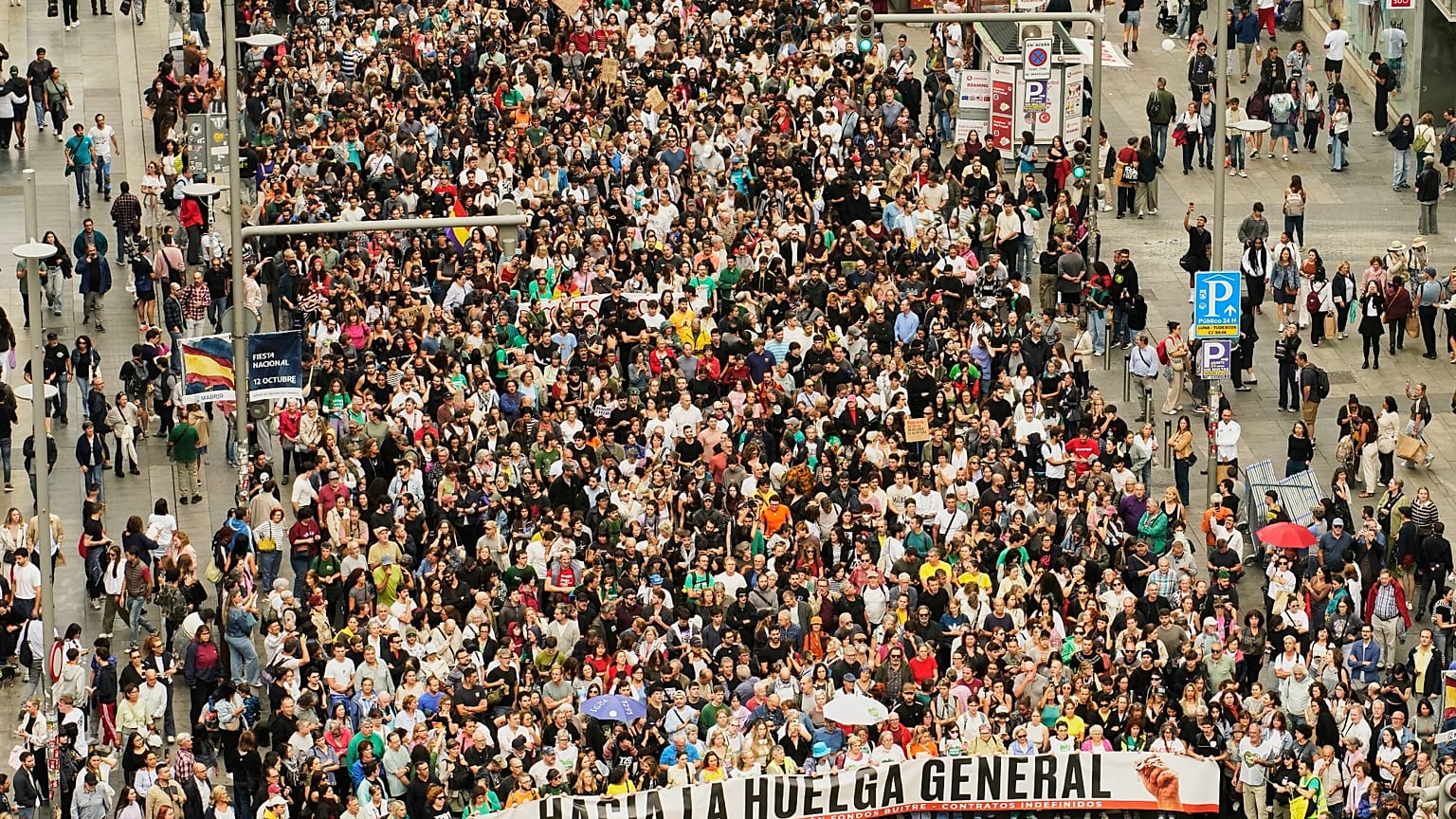
FILE-People demonstrate to demand stronger laws to protect renters in Madrid, Spain Saturday, Oct. 3, 2026. The banner reads in Spanish: toward the general strike.
Copyright AP Photo

By Piero Cingari
Published on

Ahead of Spain's first joint general strike since 2012, Euronews compares what a day of walkouts costs Europe's economies.

The last time Spain's two biggest unions called a general strike together, in November 2012, the country was deep in an austerity crisis.

Fourteen years later, Spanish workers will try to bring the country to a halt again.

This time, the grievances are about the basics, and they sound much the same in Madrid, Paris, Brussels and Rome: rents people can afford, wages that keep up with prices and public services that work.

The 24-hour walkout called by the Comisiones Obreras (CCOO) and Unión General de Trabajadores (UGT) unions for Wednesday comes 18 days before Spain’s snap general election on 29 November.

Spain is not alone.

France had a national day of strikes and protests over the cost of living on 5 November. Italy's CGIL union has called a general strike for 20 November, and Belgian unions have threatened one for the week of 23 November.

Last year was already exceptional.

Preliminary data from the European Trade Union Institute (ETUI), a Brussels-based research centre, suggest that 2025 was the EU's biggest year for strikes since 1991.

The question is which economies pay the most.

Germany would pay the biggest bill

The simplest way to compare countries is to apply the same formula to each one.

Take a country's annual economic output, measured by gross domestic product (GDP), and divide it by 365 to get one day's output. Then assume one in five workers stops work, and that roughly a fifth of that day's output is lost with them.

On that basis, Germany, Europe's largest economy, would lose about €2.5 billion in a single day, according to Eurostat GDP data for 2025.

France comes second at about €1.6 billion, followed by Italy at about €1.2 billion.

Spain would lose about €930 million. Its economy produced €1.69 trillion last year, which works out to about €4.6 billion a day.

Smaller economies have smaller bills. A strike of the same size would cost Belgium about €350 million and Portugal about €170 million.

This is a rough estimate. Strikes are rarely spread evenly: they hit transport, schools and public services hardest, while many factories and offices keep running.

Why much of the bill is never paid

The national accounts tell a calmer story than the cost estimates published before each walkout.

France is the best test case, because its statisticians have measured the effect of strikes several times. The Banque de France estimated that the pension reform strikes of March and April 2023 cut French growth by about 0.1 percentage points in the first quarter of that year.

It then found a catch-up of about 0.1 points in the second quarter. In other words, most of the lost activity came back within three months.

The Banque de France noted that this was in line with France's statistics office, INSEE, which estimated that the social movements of spring 2018 had reduced GDP by about 0.1 points.

The reason is simple: a strike is not like a fire that destroys stock. The cargo is still shipped, the hospital appointment is rescheduled and the factory works an extra shift the following week.

Some losses are permanent, though, and they fall on specific people. Strikers lose a day's pay. Governments lose the tax on activity that never happens. Airlines and hotels cannot get back a cancelled flight or an empty room.

Belgium shows the real risk is repetition

Belgium shows what happens when strikes stop being one-off events.

According to the ETUI, the country lost 1,354,845 working days to strikes in 2025, or 313 days for every 1,000 employees. That broke the previous record of 299, set in 1993.

The gap with its neighbours is large.

In the Netherlands, 23 strikes cost almost 60,000 working days in 2025, according to Statistics Netherlands (CBS).

In Germany, the Institute of Economic and Social Research (WSI) estimates that about 645,000 days were lost in 2025, below the long-term trend, in an economy almost seven times the size of Belgium's.

This is what one-off cost estimates miss. A single strike day is quickly recovered, but strikes every month leave a lasting mark on the economy.

The power grid will give the first count

Spain has an unusual way of measuring how many people strike: electricity use.

During the November 2012 general strike, the Interior Ministry said that early in the morning, electricity demand was 11.4% below normal for that time of day, using data from grid operator Red Eléctrica. During the March 2012 strike, the drop at the same hour had been 15.4%.

The grid data is likely to give the first estimate of turnout again on Wednesday, before unions and the government put out their own, usually very different, numbers.

Air travel is still uncertain. As of Monday, the government had not published the minimum flight services for the strike, even though airport and airline staff are covered by the call.

Investors have barely reacted

So far, markets don't seem worried. Spain's IBEX 35 index closed Monday at 19,742.5 points, up 14.1% this year and about 3% below its all-time high of 20,356.5.

The companies most exposed to a strike day have done better than that.

Shares of Meliá Hotels International, one of Spain's largest hotel chains, are up 38% this year. Aena, which runs most of Spain's airports, is up 21%.

For investors, one strike day is like a storm that delays flights for a day. Belgium shows the other possibility: strikes that become so frequent they are a permanent feature of the economy.

For Spain, the cost of Wednesday's strike will be measured in lost hours. Whether the wider protest wave changes anything will be decided at the ballot box on 29 November.

France: Mélenchon Fires Up His Base For Le Pen Runoff

France's Jean-Luc Mélenchon. Photo Credit: @JLMelenchon, X video screenshot


Key Takeaways:

On Saturday Jean-Luc Mélenchon rallied 20,000 supporters near Paris, positioning France Unbowed for a presidential showdown with Marine Le Pen and urging youthful followers to convert parents and grandparents.

He reaffirmed radical positions—leaving NATO, supporting Donbas self-determination, escorting Gaza aid flotillas—while softening attacks on social democrats and omitting Europe.

With older voters decisive and current polls unfavourable among them, the campaign’s challenge is to broaden the enthusiastic youth base into a runoff coalition within six months.


(Rapporteur) — The 20,000 supporters cheering Jean-Luc Mélenchon at his political convention near Paris on Saturday had their marching orders: go home and convince your parents and grandparents.

The far-left leader’s France Unbowed (LFI) movement, which is rising in the polls, used the gathering to cement the prospect of a presidential showdown with far-right leader Marine Le Pen and galvanise his troops against their designated enemies.


LFI leaders portrayed Macronists and their “far-right allies” as part of the same establishment, vowing to campaign relentlessly to “bring the far right back to the dustbin of history, where it belongs”.

This came two weeks after Le Pen assembled 10,000 supporters in Orléans, courting conservatives as potential coalition partners.

Mélenchon, meanwhile, called for sweeping change. “I only have one reasonable thing to suggest: change everything,” he said during his hour-long speech.

His Le Bourget rally highlighted the 75-year-old’s central electoral challenge in his fourth presidential bid: how to turn an enthusiastic, youthful crowd into a coalition broad enough to reach the runoff, despite widespread opposition to his candidacy.
The whole menu

Mélenchon vowed not to “water down his wine” to please others, a French expression for moderating one’s stance, instead doubling down on policies that divide the social democrats and centrists he needs to win over.


He condemned Russia’s invasion of Ukraine while denouncing escalation by “warmongers” and calling for self-determination in the Donbas. He also said France would leave NATO and stay out of American wars.

On Israel, he promised action against what he described as genocide in Gaza and the gradual annexation of the West Bank. French ships, he pledged, would escort civilian aid flotillas if elected.

Calls to end the war in Gaza drew some of the loudest cheers from a crowd dotted with keffiyehs, also sold at the entrance of the convention. Environmental pledges drew less enthusiasm, although party officials said climate policy was now a central pillar.

The young, diverse crowd embodied the “new France” at the heart of Mélenchon’s strategy: a country he describes as positively transformed by immigration, women’s rights and the demands of younger generations.

“You either love France as it is or you don’t. We do,” he said. “You don’t pick and choose – it’s the whole menu,” he added, calling on the ‘New France’ to hold its chin up.

Rap performances and songs punctuated the speeches. One video featured a French flag marked with 93, the number of Seine-Saint-Denis, a poor Paris suburb and LFI stronghold. Speakers saluted single mothers, Uber drivers, teachers and protesting students.

“We’ve become much younger and diverse,” one party official said, adding that many attendees were first-time rally goers, motivated less by left-wing ideology than by opposition to discrimination.
Now convince grandma

The challenge is to turn enthusiasm into broader electoral support.


Short, Netflix-style films presented proposals from Mélenchon’s 212-page manifesto on education and work, complemented by theatrical performances. Purchasing power, housing and low-paid jobs featured heavily.

“We don’t want this to be a sad campaign,” said Antoine Léaument, an MP and France Unbowed’s communications director.

Supporters received a 100-page “victory notebook”, combining voter-registration checklists with arguments for dinner-table debates. A WhatsApp group distributes campaign material, while a gaming app rewards participation.

With older voters carrying considerable electoral weight, Mélenchon cannot rely on Gen Z alone.

“Convince your parents, convince your grandparents,” Mélenchon’s lieutenant Manuel Bompard urged.

Le Pen has a head start. She is courting conservative allies such as former Republican leader Éric Ciotti and cultivating a presidential image, pressuring EU leaders over budget negotiations as if already at the table.

Mélenchon’s rally offered little evidence of support beyond his existing camp, apart from overtures to Communists and Greens. Policies targeting older voters included home care, support for family caregivers and replacing commercial nursing homes with nonprofit providers.

Still, he struck a softer tone, making no mention of Europe and sparing social democrats from his attacks.

“Don’t ask yourselves whether you like me,” he said. “Ask whether you think the solutions we are proposing should be implemented.”

For now, polling suggests many older voters remain unconvinced. His young supporters have six months to change their minds.Nicoletta Ionta contributed reporting.


About Rapporteur
Rapporteur, formerly EurActiv, is Europe’s expert media organisation for policy and politics. Through deeply reported journalism, trusted expertise and a commitment to engagement with our audiences, we aim to help the people shaping Europe’s future make better decisions.
View all posts by Rapporteur →


Ukrainian Foreign Affairs Ministry hits back at hard-left leader Jean-Luc Mélenchon over Donbas referendum

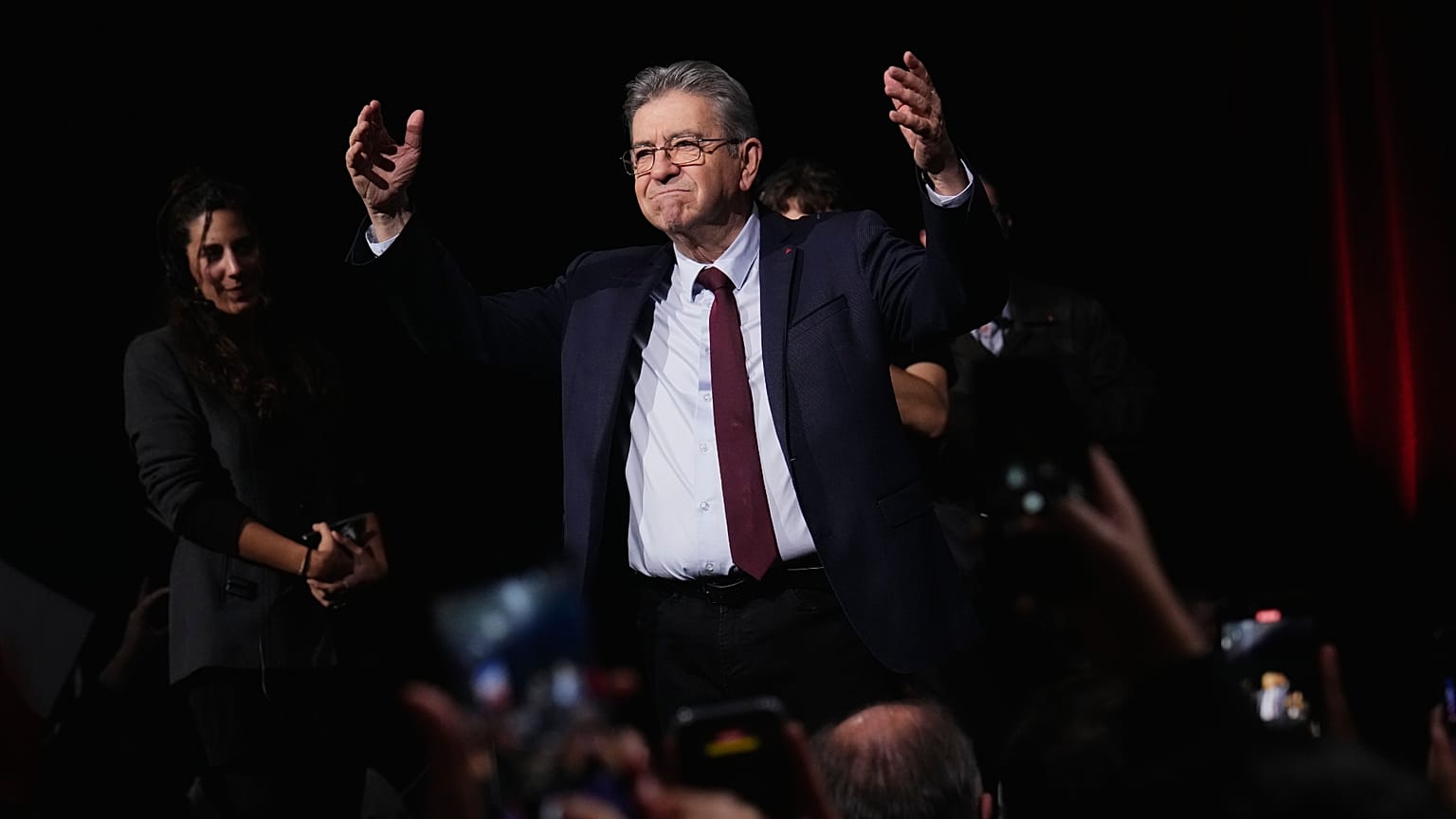
French left-wing party La France Insoumise (LFI) candidate, Jean-Luc Melenchon, gestures during a campaign rally in Le Bourget, 7 November 2026.
Copyright AP Photo

By Estelle Nilsson-Julien
Published on

The leader of the hard-left France Unbowed party declared that Ukrainians living in the Donbas should be "consulted' on their future.

Ukraine's spokesperson on Foreign Affairs Heorhii Tykhyi hit back at Jean-Luc Mélenchon on Monday, after the leader of the hard-left France Unbowed party, declared that Ukrainians living in the Donbas should be "consulted' on their future.

During a major campaign ally on Saturday, Mélenchon said that his party refused to "allow discussions about peace in Ukraine" to be headed by European leaders. This comes as France, Germany and the UK are set to take part in US mediated Russia-Ukraine talks in Abu Dhabi on Tuesday, alongside a joint EU team.

"We cannot accept the notion of a peace agreement that involves territorial concessions in Ukraine without first seeking the consent of the affected populations to live on either side of the border", said Mélenchon.

Responding to Mélenchon's remarks on X, Tykhyi declared that Ukrainians had "already settled the question of their country's border" during the country's 1991 independence referendum

Tykhyi said that Russia had chosen to "disregard the choice of Ukrainians" with its invasion of Ukraine, adding that "'referendums' under occupation are a tool of annexation, not an expression of the people's will."

"No civilised, democratic country would ever accept this for its own borders, so it should not be proposed to Ukrainians", he said.

Moscow has already staged sham consultations in annexed Crimea and in the four regions of south-eastern Ukraine it partially controls, procedures rejected by Kyiv and the international community.

France's Foreign Affairs Minister Jean-Noël Barrot also weighed in on the controversy Sunday, describing Mélenchon as a "mouthpiece of the Kremlin."

"All over the world the Kremlin is trying to convince heads of state and government that, basically, the Donbas is Russian and that the war of aggression is a war to liberate the Donbas", said Barrot.

"This is obviously of unprecedented seriousness and, in my view, definitively disqualifies him [Mélenchon] from holding the offices he aspires to", he added.

The France Unbowed party programme affords less space to the question of Russia's war against Ukraine in comparison with the Israeli-Palestinian conflict, which is featured more prominently.

The war in Ukraine has become an increasingly controversial topic over the course of France's presidential elections. The far-right candidate, Marine Le Pen, said in mid-October that she would end French financial aid to Ukraine, which she estimated at €6 billion a year, if she were to win the 2027 presidential election.

Ukrainian President Volodymyr Zelenskyy then responded that "Madame Le Pen does not have a very good grasp of certain details" of French-Ukrainian military cooperation, defending a "win-win" partnership that he said was also beneficial to France's security.


French pupils step up protests as government concessions fall flat

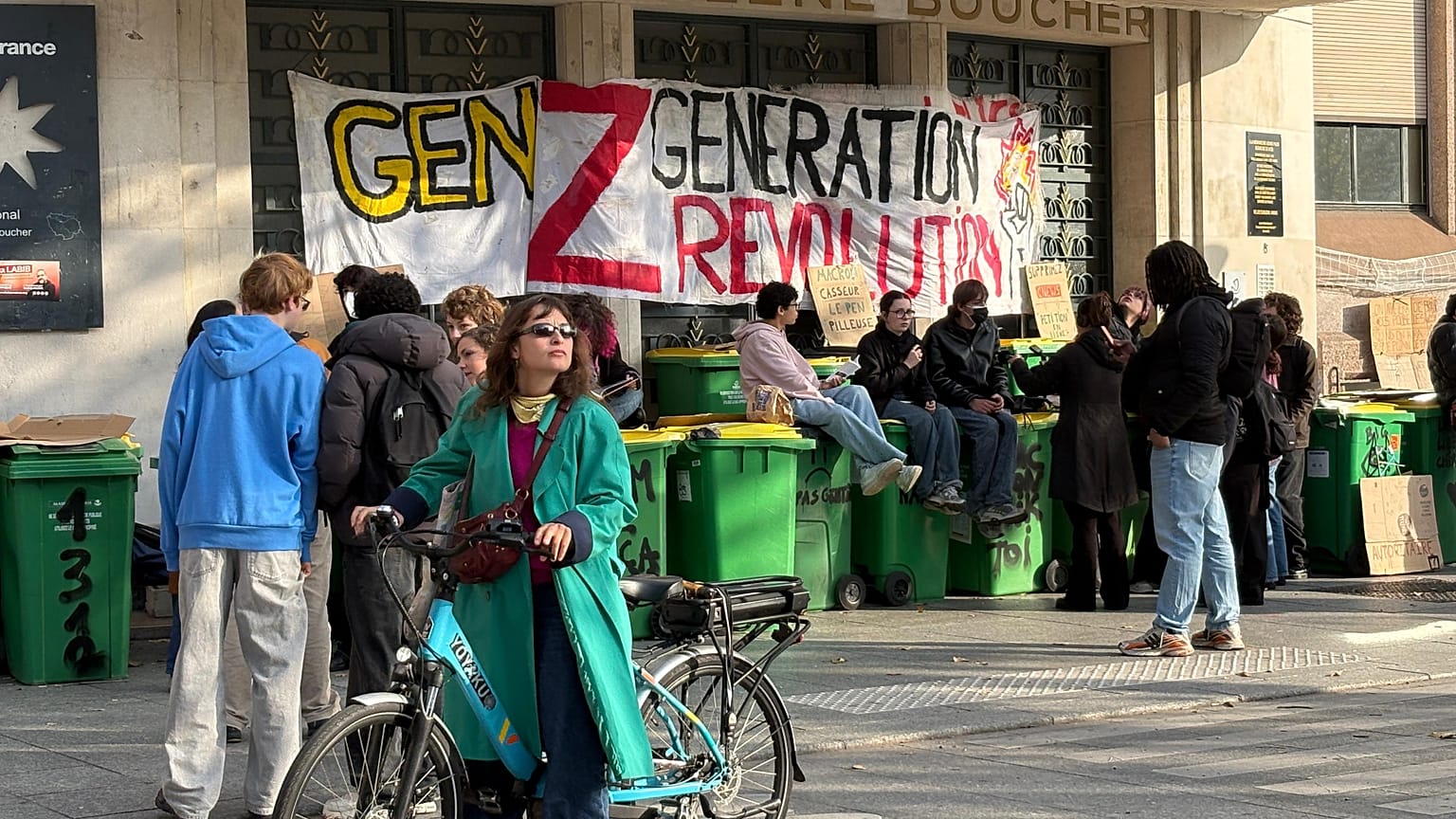
Students stand in front of a barricaded secondary school to protest against the lack of resources in schools, in Paris, Monday 2 November 2026.
Copyright AP Photo/Nicolas Garriga

By Nathan Joubioux
Published on

Unions walked out of talks with the prime minister’s office over the presence of the far right, while firework mortars have been set off inside schools as tensions rise.

Secondary school pupils in France are back on the streets on Tuesday. Nearly two months into their protest movement, the government’s concessions have failed to bring it to an end.

A coalition of trade unions and youth organisations has called a nationwide day of strikes and demonstrations. It is the latest escalation in a dispute that has seen sporadic violence at schools across the country.

Two weeks ago, Prime Minister Sébastien Lecornu’s government tried to calm things down. It promised to overhaul Parcoursup, France’s national online platform for allocating university places, from 2027 and to replace it completely in 2028. It also pledged more money for school buildings and extra resources for the most deprived schools.

Protesters were not won over. Relations got worse at a meeting on the Parcoursup reform at the prime minister’s office in Paris. Most of the pupil and student groups, along with education unions, walked out in protest at the presence of far-right and business representatives.

"We are calling on everyone who supports the legitimate demands of young people, but also those of workers, to be out on the streets," said Éloïse Lefebvre-Milon, co-leader of the Union étudiante student union, after leaving the talks.

The coalition includes some of France’s biggest labour unions, such as the CGT and FO, alongside pupil and student organisations. It said in a joint statement that now was the time "to step up the mobilisation by continuing to put pressure on the government".

"Giving fresh momentum to the mobilisation"

Pupil leaders say they have no intention of backing down. "The balance of power is in our favour, we have to keep going," said Ryad Rani, president of the Union syndicale lycéenne, a secondary school pupils’ union.

“We have to stay mobilised. We are not only fighting for ourselves. We are fighting for teachers, for their working conditions,” Rani said.

Sophie Vénétitay heads Snes-FSU, the largest union for secondary school teachers. She said Tuesday’s action would include “supervised and secure marches”, since tensions outside schools are rising.

Youth protests have a long history of putting pressure on French governments. Former president François Hollande faced mass demonstrations against his labour reforms in 2016. At the time, he privately compared a student movement to toothpaste: "You can get it out of the tube, but you cannot get it back in."

Violence reported in several secondary schools

Most of the protests have been peaceful, but there has been a string of violent incidents on the fringes.

On Monday, firework mortars were set off inside two secondary schools in Seine-et-Marne, in theeast of Paris. The regional council said two pupils were hurt at one of them. At the other, nobody was injured, but education officials said pupils were left "in shock".

Police arrested five people after trouble outside schools in Le Havre and Rouen in Normandy, according to France 3 Normandie (source in French). Fireworks were also set off outside a school in Angers in western France (source in French). Further incidents were reported in the north-eastern Meurthe-et-Moselle department, according to Ici (source in French).