Thursday, November 19, 2026

Fetterman doomed: Top data guru says voter hatred is 'off the page'


Senator John Fetterman on Capitol Hill in Washington, D.C., March 19, 2026. REUTERS/Jonathan Ernst
November 16, 2026
ALTERNET

Few expected that Sen. John Fetterman would not face a massive uphill battle for reelection given his toxic reputation among Democrats, but as CNN's top polling guru, Harry Enten, explained, that pessimism is "underselling" how doomed he truly is, with his disapproval numbers "off the page."

Despite getting elected in 2022 as a progressive candidate, Fetterman, a Pennsylvania Democrat, has made an unmistakable shift to the right during his time as a sitting senator, often breaking with the rest of his party and their on certain issues, and backing President Donald Trump, especially on matters involving U.S. support for Israel. All of those factors have combined to create historically bleak reelection odds, should he choose to run again as a Democrat in 2028.

During a new segment on the senator from Monday morning, Enten explained why all the doomsaying around Fetterman has still not truly captured the true scope of how much voters now despise him, with one particular head-spinning slide showing just how massively his popularity has tanked in Pennsylvania.


"Sometimes a slide says it all, and you literally get the inverse on it," Enten said. "Look at this, [among] Pennsylvania Dems: John Fetterman is not popular. You know, you go back two years ago, [his net popularity] was plus 56 points. It's literally the inverse. Now it's literally the inverse; it's negative 56 points. That is a change of... 112 points in the negative direction... In just two years time, Pennsylvania Democrats despise, they hate, hate, hate John Fetterman."

Enten further explained that host John Berman was "underselling" things considerably when he noted that Fetterman is facing a "challenging" reelection bid in 2028. He showed a chart comparing the party approval ratings of senators who lost a reelection primary, which ranged from former Sen. Bob Smith, who was 15 points above water with voters, down to Sen. Lisa Murkowski, who was 15 points underwater when she lost a reelection primary bid in 2010, though she was later successfully reelected as a write-in candidate.


"When it comes to senators who would run for reelection and then lost the primary, simply put, there is no historical analogy that quite fits the moment right now of just how unpopular John Fetterman is," Enten explained. "If he runs in a Democratic primary, unless, I don't know, we're literally moved to planet Krypton, he is almost certainly going to lose that primary based upon what we see, historically speaking. Normally, if you're running in a primary as a senator, if you're at about, let's say, zero points, as many approve as disapprove, you would be in trouble. And he's down at negative 56 points among Pennsylvania Democrats. He's really in a deep load of you-know-what."



Leaker claims Trump gutted America’s top cyber defense agency


(REUTERS)
November 18, 2026 
ALTERNET


Miles Taylor, former DHS analyst and whistleblower from President Donald Trump’s first term, warned that Trump has decimated the U.S. counter-espionage units to the point where federal officials can’t even say in good time whether or not an outage is the result of terrorism.

Secretary of State Marco Rubio tried to reassure Americans on Wednesday after a slate of outages impacting everything from email to airline flights.

“We're always on the lookout for anything that poses a threat to the American people, to the American economy, or to the national security,” declared Rubio, speaking with reporters. “We are always hyper vigilant about that, and we're always on the lookout for it. But we see no indications that these things are interrelated, one event to the other, or that they're the work of malign actors.”


But Taylor, a security expert, told CNN anchor Kasie Hunt on Wednesday that there’s little reason to take the administration at its word after President Donald Trump worked so hard to destroy U.S. intelligence.

“The big thing that the secretary of state left out is, were this, an AI-enabled cyber-attack, are we prepared to cope with it? And I'm sure that if asked that question, he would have said, ‘yes, we're prepared,’ but that wouldn't be the honest answer.”


“We are as unprepared as we have been in years. And that's largely because the administration has decimated our domestic cyber defenses,” said Taylor. “It was six years ago yesterday that Donald Trump fired my former colleague, (Former United States Director of the Cybersecurity and Infrastructure Security Agency) Chris Krebs by tweet. Chris ran a department I helped create via legislation, cyber and infrastructure security agency (CISA), to protect our domestic networks. I stood behind Donald Trump as he signed that legislation into law. He very much didn't understand what he was signing into law. And after Chris refused to say that the 2020 election was stolen, Donald Trump not only got rid of him, but he came back to office and his administration has decimated CISA.”

Taylor added that he still speaks with his old co-workers and that they describe a system in shambles.

“I've been talking to current and former employees over there who say they have a threadbare staff for responding to this truly historic moment we are in of AI-enabled cyber vulnerabilities. And that's what's scary because at a minimum what happen over the last week is a preview of what is likely to happen with AI attacks and we have an administration and a federal government that’s not prepared to respond to it,” said Taylor.


Americans are revolting against Trump's right-wing Christian makeover: report


REUTERS/Eric Lee
November 18, 2026
 ALTERNET

Despite what evangelical Republicans and MAGA podcasters tell themselves, Baptist News Global reports the vast majority of Americans have had it with the idea of living under a Christian theocracy. And there appears to be more and more who don’t care for it every year.

“Most Americans support a pluralistic democracy. They don’t want to live in a Christian nationalist world where there’s a hierarchy between Christians and everybody else or between white Christians and everybody else,” said Robert P. Jones, president of Public Religion Research Institute, in a webinar discussion with experts on religion and politics.

Surveys, he said, find only a quarter of independents and one-fifths of Democrats to be “adherents” or “sympathizers” of an authoritarian ideology, including one based on their own religion.But he said conservatives appear to be in the minority in the belief that the nation is specially favored by God and should ideally be governed by white conservative Christians.


In fact, GNS reports 56 percent of Republicans say they believe government and society should be run by conservative Christians, while 67 percent of white evangelicals and 54 percent of Hispanic Protestants were the only religious groups with majorities supportive of Christian nationalism.

“I should say it has become the majority view of the current Republican Party and it has become the view of two-thirds of white evangelical Protestants, and that’s why the struggle feels the way it does,” said Jones, the author of “Backslide: Reclaiming a Faith and a Nation After the Christian Turn Against Democracy.”


The steady drip of surveys now have the rush of a recent election to seal the argument, said Jones, with exit polling indicating just how “far out of the mainstream white evangelical voters are compared to the rest of the voters” in Texas.

“They’re really pulling away from all the rest of the voters in the state,” said Jones, who worried that evangelicals are slipping further and further out on a dangerous limb while the rest of the nation veers away — reducing them to a fringe element.

But the evangelical contingent is a talkative group, said Samuel Perry, a sociologist at the University of Oklahoma and co-author of Taking America Back for God: Christian Nationalism in the United States. And their full-throated advocacy has shown many Americans just how “bizarre” right-wing extremist personalities and beliefs have become.


“Among them are Doug Wilson, a Calvinist pastor in Idaho and self-described Christian nationalist who has led prayer services at the Pentagon for Defense Secretary Pete Hegseth,” reports BNC, who “has advocated for repeal of the 19th Amendment, which guarantees the right of women to vote.”

On top of that, surveys and exit polls confirm that the number of white evangelicals is unquestionably shrinking. In Texas, for example, they now comprise only 13 percent of the population compared to 19 percent a decade ago. White evangelicals are turning out at rates higher than other Texans — as they have for decades — but even this enthusiastic percentage can’t avoid the fact that there are fewer and fewer of them every year.

Critics say it’s now getting to the point where even some of the most vociferous advocates of Christian nationalism among MAGA are making their social media posts during church hours. Many MAGA do not even regularly attend church, despite advocating passionately for church-run government.


COP31: Public Money Should Not Bankroll a Cruel, Failing Food System

Governments across the globe have the choice at COP31 to unleash its power of agroecology and divert funds to a food system that nourishes people, supports fair livelihoods, and gives animals better lives while protecting the planet.


At the JBS meat plant in Lins, Brazil, workers with sharp knives carefully take apart what was once a 1,000-pound steer, making sure to cut along the correct anotomical divisions in the search for the best cuts of beef.
(Photo by Juan Forero/The Washington Post via Getty Images)

Tennyson Williams
Nov 14, 2026
Common Dreams


At COP 31, governments will be talking about tackling climate change and food system resilience, but unless they tackle their own contradictions, this is just hot air.

The contradictions are stark. This year, the African Development Bank warned that El Niño could cost the continent up to $20 billion. Despite a football field-sized field of tropical rainforest being destroyed every day by farms supplying industrial agriculture giant JBS, the Nigerian government has approved major expansion into Nigeria by JBS.

Nigerians needs answers about the real consequences of JBS’ expansion. Corporations like JBS concentrate power in the hands of a few, very rich people, such as Brazilian billionaire Joesely Batista whose shares control JBS and who met with US President Donald Trump just a day before Trump set out reduced tariffs on beef imports.

The opportunity to have a food system that is equitable, humane, and sustainable is truly exciting and a tangible prospect.

These giant industrial agriculture corporations also put pressure on precious nature resources; 1 kilogram of animal protein requires roughly 100 times more water than 1 kg of grain protein. They threaten livelihoods and how families support and feed themselves; when smallholder farmers already produce over 90% of the nation’s food—what will happen to them? Then the job creation narrative pushed by JBS needs questioning. Why not ask JBS workers in Colorado, who this year walked out in protest about labor rights abuses?

In Europe during unprecedented summer heat, the UK government set out increased support for chicken production in the name of food security, despite previously acknowledging that in the UK “animal farming at its current scale is unsustainable without a reliance on imports,” With South American soy providing 18% of produced animal feed.

Just two months earlier, the UK saw its biggest ever environmental lawsuit being brought to the High Court in London, by over 4,000 people, against Welsh Water and Avara Foods. Avara Foods are allegedly raising an estimated 24 million chickens in the catchment area. Litigants cited damage to three rivers, including the iconic River Wye, with impact on local ecosystems, communities, and tourism reliant businesses on these once thriving rivers.

Industrial agriculture is not the answer to hunger either. An estimated 766 million tonnes of grain is diverted annually to feed farmed animals rather than people. Nor is this a food system that provides food security. Quite the opposite, this is a teetering system that relies on synthetic fertilizers, imported animal feed, and fossil fuels. It’s hugely vulnerable to climate change, supply chain shocks, and geopolitical instability, including the conflicts involving Russia and Ukraine and Iran and the US.

Industrial agriculture even threatens the effectiveness of vital medicines. Antibiotic overuse in industrial agriculture has been linked to nearly 2,000 premature deaths in the UK alone. Antibiotics are given to animals to aid their survival and growth in the harsh conditions in which they are forced to live. Let’s be clear, we are risking antimicrobial resistance so that a few people can continue to put profit before animal welfare.

But central to this failing system is injustice. This is injustice not only for people and the planet, but for the over 90 billion animals trapped right now in the system. This cannot be overlooked in talk of climate change and food security. Every cow, sheep, pig, chicken, and goat is a sentient being capable of feeling pain and fear. Mother pigs are kept so confined that they cannot turn around. Chickens buckle under the weight of their selectively bred bodies. Baby animals are routinely mutilated without pain relief. Industrial agriculture is a horror system for animals.

The good news is, there is a better food system, called agroecology. Evidence increasingly demonstrates it has the power to provide long-term food and reduce animal suffering. Agroecology works with nature not against it. It adapts to climate change and offers resilience against market shocks. It connects how we grow food with how we treat animals, protect ecosystems, and support livelihoods. The opportunity to have a food system that is equitable, humane, and sustainable is truly exciting and a tangible prospect.

Governments across the globe have the choice at COP31 to unleash its power. They have the choice to stop using our money to prop up an unjust, cruel, and failing food system and divert to a food system that nourishes people, supports fair livelihoods, and gives animals better lives while protecting the planet. They must aid businesses to pursue the opportunities needed here alongside increased plant rich food production.

In Africa, how we produce our food must be shaped by the knowledge and insight of the people who grow it now and by the communities who depend on it. The government must also make finance and practical support accessible to them.

Factory farming grew following the Second World War, when maximizing food production was an urgent priority. Today we must judge success by more than volume. Our world has changed; we know more about animal sentience, ecological limits, and the fragility of supply chains,

That is what we do at World Animal Protection, we work to protect animals from cruelty and suffering. Governments must stop funding relentless cruelty to animals. At COP31, we don’t need more contradictions and hot air from governments. We need meaningful change.


Our work is licensed under Creative Commons (CC BY-NC-ND 3.0). Feel free to republish and share widely.


Tennyson Williams
Tennyson Williams is the priority director and country lead for Africa at World Animal Protection, where he also serves in the Global Senior Leadership Team. World Animal Protection is a global charity that works to end animal cruelty and suffering. With over 20 years’ experience in international development, he has held senior roles with ActionAid International. This includes regional director for West and Central Africa and country director in Kenya and Sierra Leone. He also served at the United Nations High Commission for Refugees (UNHCR) and the International Livestock Research Institute (ILRI) in Nairobi, Kenya. Tennyson is a Sierra Leonean national with a background in zoology and zoonotic diseases. He has led major programs across Africa, contributed to national development strategies, and engaged in research and consultancy for the Department for International Development (DFID), and for civil societies.
Full Bio >


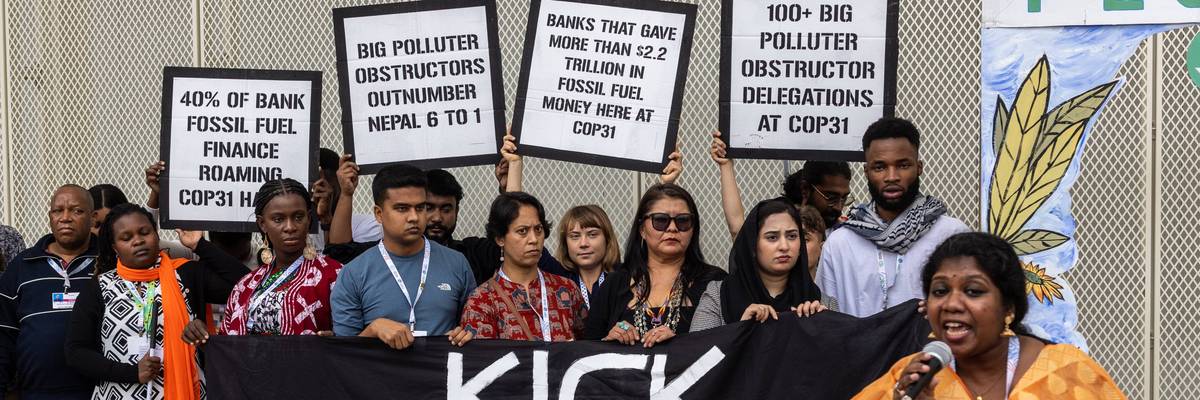
‘Kick These Big Polluters Out!’ Worst-of-the-Worst Corporate Obstructionists Dominate UN Climate Summit

“You can’t put out a fire while handing the matches to the arsonists. And you certainly can’t expect the arsonists to write the evacuation plan.”


Activist Greta Thunberg attends “Kick Big Polluters Out” protest on day five at the COP31 UNFCCC Climate Conference on November 13, 2026 in Antalya, Turkey.
(Photo by Burak Kara/Getty Images)


Brad Reed
Nov 13, 2026
COMMON  DREAMS

A coalition of environmental organizations is warning that the COP31 climate summit in Antalya, Türkiye is in danger of being co-opted by big polluters.

An analysis released on Friday by the Kick Big Polluters Out (KBPO) coalition finds that more than 100 polluting corporations and trade associations—including from fossil fuel, Big Tech, and industrial agriculture—have sent delegations to COP31.

Among the largest delegations, the report says, are International Emissions Trading Association (IETA), which sent 29 delegates; BNP Paribas, which sent 22; HSBC, which sent 19; and Amazon, which sent 12.

The analysis also shows that banks “collectively representing more than $2.2 trillion in fossil fuel financing from 2021-2025” have a presence at COP31.

The KBPO report notes that these industries and associations “have demonstrated track records of being notably misaligned with or obstructing climate policy... indicating they can be a threat to the strong climate action COP31 must urgently deliver.”

These polluters’ delegations are so big that they vastly outnumber delegations sent by many nations that are most endangered by the climate emergency, including Niger, the Philippines, and Nepal.

Maikel Peuki, director of the Papua chapter of the Indonesian Forum for Living Environment (WALHI) and a KBPO partner, said allowing big polluters to have a seat at the COP31 table would have dire consequences for his country’s environment.

“In Papua our forests and coastal areas are being targeted for fossil fuel and food estate projects and carbon-offsetting schemes by major corporate emitters,” said Maikel Peuki. “This is not a genuine solution to the climate crisis. Those who cause pollution should be the ones to pay for the damage they have created.”

Peuki’s remarks were echoed by Lien Vandamme, senior campaigner for the Center for International Environmental Law’s Climate and energy program.

“You can’t put out a fire while handing the matches to the arsonists,” said Vandamme. “And you certainly can’t expect the arsonists to write the evacuation plan. It’s therefore no surprise that the UN climate talks continue to fail in delivering the climate action that is needed. It’s time to show Big Polluters the door and fundamentally change the rules that keep rolling out the red carpet for them.”

Prakash Dalal, director of Friends of the Earth Nepal, accused big polluters of causing “loss of livelihood, emotional damage, trauma, and survival challenges” for people in his country, adding that “we cannot tolerate the disproportionate space given to them compared to civil society and our country delegations.”

“We need to kick these big polluters out!” Dalal emphasizes. “This should be a moral and legal obligation for the COP.”

The presence of polluters also drew the ire of climate activist Greta Thunberg, according to a Thursday report in Latin Times.

While protesting outside COP31, Thunberg decried the negotiations for being “filled with lobbyists” who are “paid by the very destructive industries” profiting from continued fossil fuel dependence.

Thunberg also accused governments attending COP31 of using the event to “whitewash themselves” without taking real action.

As Pollution-Fueled Climate Disasters Intensify, Flood Deaths Hit 13-Year High

Deadlier flood disasters “are the foreseeable consequences of a fossil-fueled economy in which those who pollute most are also the best protected from its consequences,” said one campaigner.


A damaged section of a highway in Nuwakot, central Nepal, is seen on August 27, 2026, following an outburst of a glacial lake in Tibet. Rescue teams collect the bodies of people killed in the flooding, while residents displaced by the disaster shelter in elevated areas.
(Photo by Sanjit Pariyar/NurPhoto via Getty Images)

Julia Conley
Nov 12, 2026
COMMON DREAMS

An analysis released Thursday by anti-poverty group Oxfam juxtaposed the soaring number of flood-related deaths worldwide with the ultrawealthy’s ability to insulate themselves from the climate disasters that are growing more common and devastating as oil and gas emissions continue.

The group found that as monthly temperature records were shattered in more than 100 countries this year, flood deaths reached a 13-year high—driven largely by catastrophic flooding in Nepal and Tibet in August, when a glacier collapse sent a “wall of water more than 100 meters high, traveling at 180 kilometers per hour,” which swept through a valley and killed more than 1,500 people, with 5,600 still missing.

The flooding disaster, which the chief of the United Nations Office for Project Services said last month should be a “defining moment” for an international community grappling with how to mitigate the impacts of the climate emergency, accounted for about three-quarters of the 8,000 people who died in floods this year.

“Deaths from flooding are seven times higher in more unequal countries,” noted Oxfam, while people in the Global South are far less likely to have contributed meaningfully to the carbon pollution that scientists say is heating the planet, putting the 1.5°C limit set by the Paris Agreement in 2015 out of reach, and causing the loss of glaciers and more extreme weather disasters.

“The carbon pollution of a person in the richest 1% has contributed 34 times more to today’s extreme heatwaves than the average person, and 100 times more than someone in the poorest 50%,” said Oxfam.

In September, the UN found that with countries contributing far too little to efforts to reduce carbon emissions, the planet is now expected to overshoot the 1.5°C threshold, and said policymakers must now focus on ensuring the overshoot is temporary.

But on Thursday, as world leaders gathered in Antalya, Türkiye for the United Nations Climate Change Conference (COP31), a report warned that the Earth could in fact be heading for an “irrevocable” breach of the 1.5°C limit.

“The carbon pollution of a person in the richest 1% has contributed 34 time more to today’s extreme heatwaves than the average person, and 100 times more than someone in the poorest 50%.”

The record number of flooding deaths this year, said Amitabh Behar, executive director of Oxfam International, “are not accidents of weather. They are the foreseeable consequences of a fossil-fueled economy in which those who pollute most are also the best protected from its consequences.”

Oxfam also emphasized that while flooding deaths are soaring, one trend at COP31 demonstrated how the ultrarich are making devastating disasters in communities around the world more likely.

The group analyzed data from Polluterjet, finding that 87 private jets landed at Antalya Airport since November 7, just before COP31 began, emitting an estimated 777 tons of carbon dioxide.

“Nigerian billionaire Aliko Dangote’s private jet flew approximately 4,370 kilometers from Lagos to Antalya, emitting an estimated 30 tons of carbon, roughly as much as the average person emits in six years,” said Oxfam. “During COP30 last year, 66 private jet journeys were recorded.”

According to the Global Solidarity Levies Task Force, taxing private jets owned by about 250,000 people around the world could raise $45 billion per year, “nearly 12 times the amount rich countries gave to UN climate funds in 2025.”

“While families mourn loved ones killed by floods and endure blistering heat, the ultrawealthy carry on flying in private jets, high above the devastating consequences,” said Behar. “Governments must stop treating the extraordinarily polluting luxuries of the superrich as an untouchable privilege. Taxing private jets is an obvious first step.”
Trump’s GOP law ripped food aid from millions of kids faster than anyone feared: analysis


By: Brad Reed,
 Common Dreams
Nov 18, 2026

Trump’s GOP law ripped food aid from millions of kids faster than anyone feared: analysis
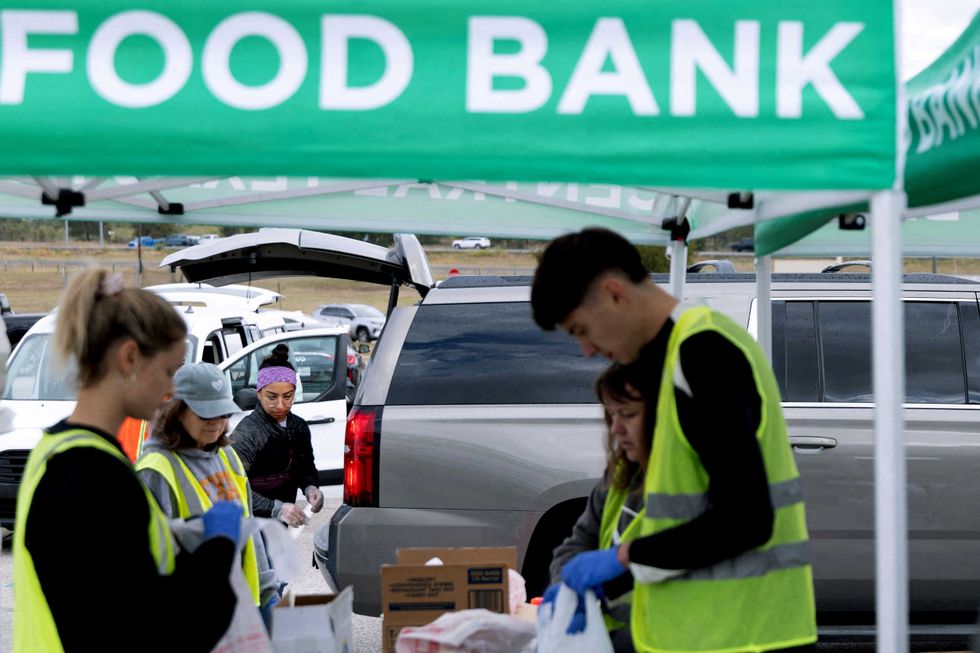
FILE PHOTO: Volunteers place food items in vehicles during a mobile food distribution at Cedar Creek High School, as nearly 42 million Americans face a potential lapse in Supplemental Nutrition Assistance Program (SNAP) benefits, known as food stamps, due to the second-longest U.S. government shutdown, in Cedar Creek, Texas, U.S., November 1, 2025. REUTERS/Kaylee Greenlee/File Photo


Cuts to federal food assistance in Republicans’ 2025 budget law are leading to drops in participation that are significantly higher than those projected by the Congressional Budget Office, according to an analysis published on Tuesday by economist Diane Schanzenbach.


Schanzenbach, a professor at the McCourt School of Public Policy at Georgetown University, found that participation in the Supplemental Nutrition Assistance Program (SNAP) fell by 13% in the year after President Donald Trump signed the One Big Beautiful Bill Act in

The decline in SNAP enrollment has been “much faster and deeper than anticipated,” Schanzenbach wrote, and participation in the program is now at its lowest rate since 2009.

“SNAP participation fell in every state except Alaska,” the economist explained. “The size of the drops varied widely: over 50% in Arizona, about 20% in Texas and 22% in Florida, compared with 7% in California and 9% in New York.”

Given that the unemployment rate has gone up since the start of Trump’s second term, there is no chance that drops of this size can be attributed to normal changes in economic conditions, Schanzenbach added, making it likely the GOP budget law’s cuts to the program are a main culprit.

The most high-profile change to the program was expanding work requirements to more recipients, but Schanzenbach found that these new eligibility rules alone “don’t account for the full decline.”

“Families with children are largely outside the new work requirements, yet an estimated 2 million fewer children received SNAP in October 2026 than in July 2025,” she explained. “This likely reflects some combination of eligible households lost at renewal over paperwork, fewer new applicants, and immigrant families staying away for fear of immigration enforcement, including members who remain eligible.”

State governments are another important variable determining SNAP participation declines, and Schanzenbach pointed to Arizona as an example of what happens when a state moves aggressively to reduce the risk of incurring financial penalties under the budget law’s payment error rate provisions.

“Arizona moved earliest and most aggressively to cut its error rate, and its caseload fell by about half between July 2025 and July 2026, the steepest drop in the country,” she wrote. “At the same time, the number of state staff determining eligibility fell from 1,370 in July 2024 to 880 a year later. Applicants described phone lines that wouldn’t connect, being informed of interview appointments after they were scheduled to occur, and cases closed over a single wrong document.”

The impact of these cuts on hunger is now more difficult to determine, Schanzenbach said, because the US Department of Agriculture no longer conducts an annual Food Security Survey.

That said, the economist projected that “losing SNAP benefits is likely to raise food insecurity for many families,” while pointing to the increased activity seen at food banks across the US as evidence of the cuts’ impact.

“In the face of these dramatic reductions in SNAP participation,” Schanzenbach wrote in her conclusion, “it becomes even more important to restore the collection of national food insecurity data so that policymakers can assess whether the shrinking caseload means more families are going without enough to eat.”


‘Beyond Cruel’: Warren Says Congress Must Stop Trump’s Latest Assault on Food Aid

Sen. Elizabeth Warren warned that President Donald Trump “wants to rip food assistance away from 6 million more who are already struggling to get by because of his sky-high gas prices and chaotic tariffs.”


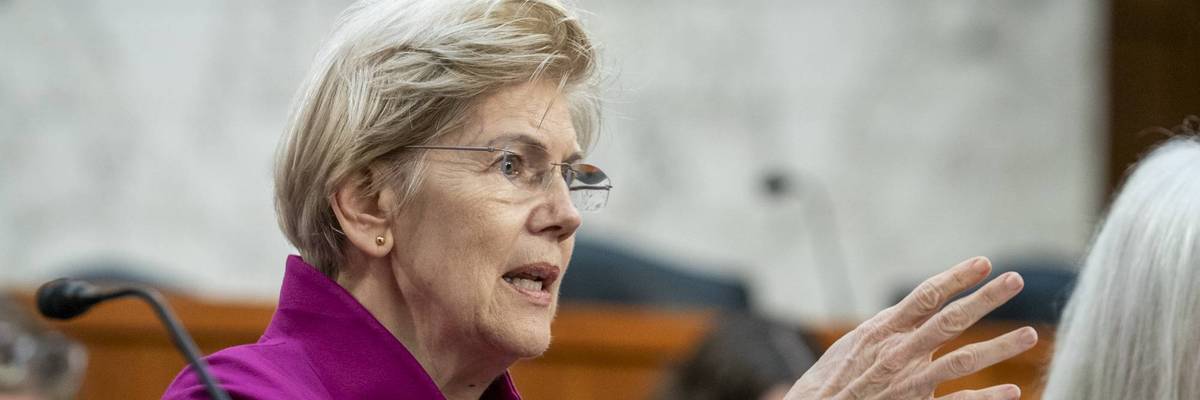
Sen. Elizabeth Warren (D-Mass.) speaks at a forum on June 23, 2026 in Washington, DC.
(Photo by Maxine Wallace/The Washington Post via Getty Images)

Jake Johnson
Nov 13, 2026
COMMON DREAMS

US Sen. Elizabeth Warren said Thursday that Congress must act to stop a new Trump administration assault on federal nutrition assistance that would strip aid from over 6 million people, compounding the hunger disaster created by the Republican budget law enacted last year.

“This is beyond cruel,” Warren (D-Mass.) wrote in a social media post, referring to a rule proposed by the US Department of Agriculture (USDA) that would curtail a policy known as broad-based categorical eligibility. The USDA’s own analysis estimates that its proposal, published in the Federal Register earlier this week, would take Supplemental Nutrition Assistance Program (SNAP) benefits from roughly 6.3 million people in 2029, the first year the rule would take full effect.

Warren noted that 5.5 million people have already lost federal nutrition aid since enactment of the 2025 Trump-GOP budget law, which instituted the largest SNAP cuts in the program’s history.

“Now, he wants to rip food assistance away from 6 million more who are already struggling to get by because of his sky-high gas prices and chaotic tariffs,” the senator wrote. “Congress needs to stop this.”

After a rule is published in the Federal Register, Congress has 60 legislative days to introduce a Congressional Review Act resolution to overturn it. Democrats will take control of the House and Senate on January 3, 2027.

The new USDA rule takes aim at broad-based categorical eligibility, which lets states automatically deem recipients of other federal benefits eligible for SNAP—reducing administrative burdens for state officials and program enrollees. Under the Trump administration’s rule, which is open for public comment until December 10, households with gross incomes above 130% of the federal poverty line would lose SNAP benefits, according to the Center on Budget and Policy Priorities.

Experts have noted that the Trump administration’s attack on broad-based categorical eligibility would, if finalized, have far-reaching impacts, including reduced access to free school meals.

In a statement on Friday, the Children’s Defense Fund urged the Trump administration to “reverse course” on its proposal, warning it would harm kids across the US.

“Many public schools use SNAP to automatically enroll children in free meal programs, meaning any child who loses SNAP access could also lose automatic eligibility for free school meals, exacerbating food insecurity in school districts across the country,” the group said.


Mexican Officials Fear Stephen Miller Will Push Trump to ‘Authorize Direct US Military Action’ in Their Country


Miller is reportedly demanding that Mexico drive the number of daily unauthorized border crossings to zero, which they have told him is impossible.


Brad Reed
Nov 13, 2026
COMMON DREAMS

Officials in Mexico are reportedly worried that new White House Chief of Staff Stephen Miller will goad President Donald Trump into launching a military invasion of their country.

Politico reported Thursday that concerns about Miller—a fanatical anti-immigration zealot with a long documented history of promoting white nationalist literature and conspiracy theories—are being expressed by “government officials, business leaders, and other power players” throughout Mexico.

Specifically, these officials fear that Miller will “push Trump to authorize direct US military action on Mexican soil” if it doesn’t do even more to crack down on migration at the US southern border.

John Feeley, a former senior US diplomat who has been in contact with several Mexican officials, told Politico that “no one is pleased, to say the least” about Miller’s promotion.

A Friday report in The New York Times revealed that Miller has been haranguing Mexican officials for weeks to get unauthorized crossings into the US down to zero per day, which they have told him would be impossible given that the US-Mexico border is roughly 2,000 miles long.

In a Thursday social media post, Trump threatened Mexico over a purported migrant caravan that he claimed was heading toward the US border.

“Many of the people in these Caravans are those that various countries don’t want—'Send them to America,’ they say,” Trump wrote, without citing any evidence to back up his claims. “But they will not be accepted! MEXICO MUST STOP THEM, NOW, and if they do not do so, the Tariffs on Mexico will be IMMEDIATELY DOUBLED.”

A Tuesday op-ed written by columnist Leo Zuckermann published in Mexican media outlet Excelsior declared Miller a “danger” and the polar opposite of predecessor Susie Wiles, whom he described as “a skilled, disciplined, and pragmatic political operative.”

Zuckermann also cited reporting from New York Times journalists Maggie Haberman and Jonathan Swan that Miller in the past has demanded military attacks on Mexican soil against suspected drug cartels.

“Let’s be clear,” Zuckermann emphasized. “The new chief of staff is a racist who does not look favorably upon our country... At any moment, he could revive plans to attack Mexico and convince Trump of their necessity.”
‘A Proven Champion of Working People’: Union With 600,000 Members Backs Van Hollen for Majority Leader

“Senator Van Hollen understands this is a fight of workers vs. billionaires and has the courage to deliver the change voters demanded,” said the International Association of Machinists and Aerospace Workers.


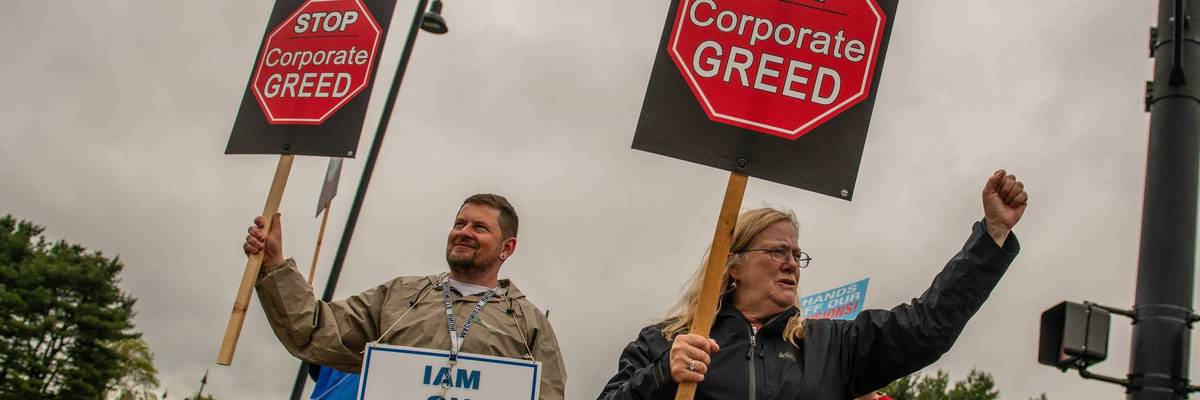
Machinists union members hold placards during a strike on May 5, 2025 in East Hartford, Connecticut.
(Photo by Roy De La Cruz/SOPA Images/LightRocket via Getty Images)

Jake Johnson
Nov 13, 2026
COMMON DREAMS

A machinists union with around 600,000 members issued a statement on Thursday endorsing US Sen. Chris Van Hollen’s bid for Senate majority leader in the new Congress, calling the Maryland Democrat “a proven champion of working people who will fight to unrig an economy stacked against working families.”

“The IAM Union proudly supports Senator Chris Van Hollen for Senate Majority Leader,” said Brian Bryant, president of the International Association of Machinists and Aerospace Workers. “Senator Van Hollen understands this is a fight of workers vs. billionaires and has the courage to deliver the change voters demanded. Workers did their part on election night. Now it’s Senate Democrats’ turn. Senator Van Hollen is the right choice.”

‘The People Have Spoken’: Largest US Nurses Union Backs Van Hollen for Senate Majority Leader

‘This Is a Wide Open Race,’ Says Van Hollen as Support for His Majority Leader Bid Grows


IAM’s statement came shortly after Van Hollen, an outspoken supporter of labor unions, announced that he would challenge Sen. Chuck Schumer (D-NY) for the majority leader post.

“In this election, Americans called on us to unrig an economy rigged against working people and fueled by political corruption,” Van Hollen wrote on social media late Thursday. “To deliver, we need new leadership. This isn’t about any one person—it’s about answering that call. That’s why I’m running for Senate majority leader.”

The Maryland senator acknowledged he would be the “underdog” in the contest but disputed Schumer’s claim to have already locked down enough support to win. Senate Democrats are expected to vote for majority leader by secret ballot in early December.

Van Hollen told MS NOW on Thursday that he has the support of “more than 10” of 55 Democratic senators and senators-elect so far, including Sen. Bernie Sanders (I-Vt.) and Sen.-elect Abdul El-Sayed (D-Mich.).

“Now people will have to make a decision, one way or the other,” said Van Hollen, “and they have to decide whether they want to vote for change or whether they want to vote for the status quo.”

The progressive advocacy group RootsAction, which says it has more than a million supporters online, announced Friday that it plans to “build on the campaign that we launched early this week, when activists responded to our mass emails by telling their Democratic senators to urge Van Hollen to run for the top Senate post.”

“Now that he has done so, the imperative task is for Democrats nationwide to make sure that their voices are heard and heeded within the Capitol bubble,” the group said in a statement. “At this historic moment, that bubble must be burst so that grassroots Democrats finally have the bold leadership in the Senate that they deserve. Political business as usual is absolutely unacceptable, and that means Schumer is unacceptable as the Senate Democratic leader.”
200,000+ Demand Incoming Dem Majority ‘Step Up for Student Debtors’ and Win Loan Payment Pause

“A historic number of voters sent a clear message to Congress this election that they want mass economic relief and financial breathing room,” said one campaigner.


Student debt protesters hold signs reading “I am not profit” and “borrowers not billionaires” in this photo posted to social media by The Debt Collective on May 17, 2025.
(Photo by The Debt Collective/X)


Brett Wilkins
Nov 12, 2026
COMMON DREAMS


More than 200,000 student borrowers and their allies, as well as a coalition of advocacy groups, demanded Thursday that Democratic congressional leaders seize the moment of their soon-to-be majorities in both houses of Congress to win a student loan repayment pause.

A petition circulated by the Student Debt Crisis Center (SDCC) demanding President Donald Trump act to pause all federal student loan repayments and interest had collected 209,359 signatures as of Thursday afternoon.

The petition accuses the Department of Education under Education Secretary Linda McMahon—who has said she shares Trump’s goal of abolishing the DOE—of having “failed Americans” by moving the student loan portfolio to the US Treasury Department, creating lengthy delays in and “egregious account errors” in application processing, not granting loan forgiveness to qualified borrowers, making repayment less affordable, announcing the end of the Saving on a Valuable Education plan, and restarting interest accrual on SAVE plans. Dozens of Democratic lawmakers last week pressed McMahon to answer for these failures.

“Amid an affordability crisis and the current state of affairs, student loan payments should be the last thing on anyone’s mind,” the petition states. “Student loan payments are an unacceptable source of additional stress for Americans who are already stretched thin.”


“We called for a payment pause in 2025, which the Department of Education chose to ignore, but we are resuming our call for a pause right now,” the document adds. “Given the growing economic anxiety and hardship facing Americans, an immediate payment pause is not just necessary; it is imperative.”

SDCC said in a statement announcing the petition:
Following the midterms, affordability is top of mind for millions of Americans. With a new Congress opening the door for real change, beginning with a payment pause would give student loan borrowers necessary relief while the 120th Congress legislates and conducts oversight. Lawmakers are already demanding answers from the Department of Education on their extensive failures managing the federal student loan system. Now, borrowers are holding those in charge accountable.

“The results of the midterm election are undeniable—Americans need relief from the burden of unaffordable living, and they need it now,” said SDCC founder and president Natalia Abrams.

“Implementing an immediate pause on student loan payments and interest wouldn’t just be an effective way of providing relief, it would also free up room in the paychecks of over 43 million borrowers to pay bills, care for their families, and revitalize their local economies,” Abrams added. “It’s a no-brainer.”

The Federal Reserve Bank of New York reported Tuesday that outstanding student loan debt reached approximately $1.66 trillion in the third quarter of 2026, making it the second-largest category of household debt after mortgages.

Meanwhile, Federal Student Aid, a DOE agency, highlighted earlier this year that more than 42 million people hold federal student loans, with the federally managed portfolio alone exceeding $1.64 trillion.

On Wednesday, around 20 advocacy groups wrote to Senate Minority Leader Chuck Schumer and House Minority Leader Hakeem Jeffries, both New York Democrats, urging them to pressure Trump to sign legislation pausing student loan repayments after Democrats take back control of Congress in January.


“The student debt system is on the brink of breakdown, and today it functions worse than it did before the COVID-era payment pause,” the groups contended in their letter, referring to the suspension of repayments during the first Trump administration that continued during former President Joe Biden’s tenure before ending in 2023.

“We do not make this request lightly,” the letter continues. “It is grounded in a documented and worsening pattern of administrative failure that is causing real, immediate, and irreparable harm to millions of borrowers.”

“The chaos and disarray in the current system are not the fault of borrowers, and borrowers should not bear the consequences,” the signers asserted. “A pause is the only responsible course until the department can guarantee that the system works as the law requires.”

Groups signing the letter include the American Association of University Professors, Debt Collective, Democratic Socialists of America, Sunrise Movement, SDCC, and the University of California Student Association.

“A historic number of voters sent a clear message to Congress this election that they want mass economic relief and financial breathing room,” Debt Collective co-founder Astra Taylor said on Bluesky. “Trump paused student loans once. Democrats should push him to get it done again.”

Corporate Democrats could also prove to be an obstacle to debt relief. Both Schumer and Jeffries backed legislation that effectively prohibited the Biden administration from extending the pandemic-era payment pause.

Schumer had previously been among the most prominent congressional advocates for student debt relief, repeatedly urging Biden to extend the payment moratorium and cancel as much as $50,000 in debt per borrower.

During Trump’s second term, his administration has moved aggressively to resume collections. In April 2025, the DOE announced that it would restart collections on defaulted federal student loans the following month, and that it would seize federal tax refunds and other payments through the Treasury Offset Program.

The department also announced plans to garnish borrowers’ wages. In July 2025, it notified borrowers that interest would resume accruing on loans enrolled in Biden’s SAVE repayment plan, which had been blocked by a federal court injunction. The administration subsequently announced plans to eliminate SAVE. However, the Trump administration has also twice delayed involuntary collections, including the planned wage garnishments, amid public outcry.

As of September, more than 9.3 million student loan borrowers were in default, owing approximately $234 billion.
After the Midterms, It’s Time for New Working-Class Strategies to Dethrone the Rich

What working people did with others outside the ballot box to improve their lives and those of their children and grandchildren is what secured the victories of the past.


Protesters hold a banner reading “toward the general strike” along Gran Via street during a demonstration against the housing crisis on October 3, 2026 in Madrid, Spain.
(Photo by Pablo Blazquez Dominguez/Getty Images)


Seth Sandronsky
Nov 14, 2026
Common Dreams

The resounding Democratic Party candidates’ victories over Republican opponents on November 3 begs the question of a new political moment in the US. Is it similar to Blue Waves of the recent past—meaning a change in political party but no improvement in the material conditions of the American population?

To ask the question means, in my view, to unpack the powerful actors that hold the reins of power, economically and politically. The actors are corporate America and the wealthy, the ruling class.

This class of owners was large and in charge before the November 3 midterm elections. Crucially, that anti-GOP vote failed to dislodge this class that controls the profit system.

Money shapes policies in ways that votes don’t under the current imbalance of power between the rulers and the ruled.

It’s a case of voting against President Donald Trump and GOP candidates. It’s not the same thing, I suggest, as a vote for Democrats who allied with Republicans to coordinate and fund the daily operations of the American empire, or hegemon, arming and funding Israel’s genocide of Palestinians in Gaza, before the November 3 midterm elections.

The franchise or the vote is necessary but not sufficient to alter the relationship of domination and subordination between the rulers and the ruled in America. What follows from that relationship is more of the same, war abroad, directly in Iran, and by proxy in Ukraine, to the detriment of living and working standards in the US.

The two-party monopoly, or duopoly, and its addiction to perpetual war, retains a stranglehold over American society. All is not lost.
Take heart. There are tactics and strategies that address this relationship beyond voting for Democrats.

And I am not talking about the 1960s and protests against the American War in Vietnam. As a youngster, I participated along with millions of others across the US.

Rather, I am talking about the here and now. Consider this.


People in Spain have gone on a general strike to protest the scarcity of affordable rental housing. Millions of Spanish people are participating.

Students in France and throughout Europe have taken to the streets to protest substandard education conditions and overall living situations against the backdrop of elected officials funding Ukraine’s proxy war against Russia. European elites’ animus toward Russia has a kind of parallel to how the ruling class of Israel and the US demonizes the nation of Iran.

In the US, there is a history of general strikes, one you don’t learn about in school. There was a Seattle General Strike of 1919 and the Oakland General Strike of 1946, for instance.

It’s been 80 years since a general strike in America. I recall talking to a friend passing out flyers to a No Kings rally earlier this year.

She mentioned talk of a general strike in the fall. Well, it’s fall now, and a general strike seems nowhere near on the horizon.

Instead, there’s euphoria about the landslide midterm vote against Republicans and for Democrats. Meanwhile, the robust voter mobilization is over, and danger looms as the population gets a green light to lapse back into observing national, state, and local politics.

This of course is in part what fuels the establishment of pay-for-play politics that sidelines the (non-)voting public. A symptom of this is that each election season is breaking fundraising records.

“In the 2026 midterms, the 40 biggest donors made more than $2.4 billion in campaign finance contributions through mid-October,” according to the Brennan Center. “The top 40 have given more in every midterm since 2014, and the total from this cycle is eight times the giving of 2014’s top donors, even accounting for inflation.”

The working class, to use the language of the marketplace, can’t with its votes compete with that amount of money in pay-to-play politics. Money shapes policies in ways that votes don’t under the current imbalance of power between the rulers and the ruled

That statement might appear strange. Americans are taught that voting defines democracy.

However, the transformational working class victories of the past—from abolishing chattel slavery to ending child labor—were not the outcomes of voting. What working people did with others outside the ballot box to improve their lives and those of their children and grandchildren is what secured such victories.

Time for new working-class tactics and strategies to forge an American movement politics that puts people first? If not now, then when?


Our work is licensed under Creative Commons (CC BY-NC-ND 3.0). Feel free to republish and share widely.

Seth Sandronsky
Seth Sandronsky is a Sacramento journalist and member of the freelancers unit of the Pacific Media Workers Guild.
Full Bio >