Thursday, November 19, 2026

Myanmar Government Guilty of Genocide, International Court of Justice Says in Historic Ruling

“After everything our people have endured, this moment gives us renewed hope for justice, dignity, and a better future,” said one Rohingya refugee.



Rohingya refugees watch the International Court of Justice (ICJ) ruling over whether Myanmar committed genocide against Rohingya Muslims, on a screen at a camp in Bangladesh’s Cox’s Bazar on November 19, 2026.
(Photo by Salahuddin Ahmed/AFP via Getty Images)

Stephen Prager
Nov 19, 2026
COMMON DREAMS

In a historic ruling, the International Court of Justice on Thursday found Myanmar’s government responsible for committing genocide against the Rohingya Muslim minority during its brutal military campaign in 2017.

It is the first time in the ICJ’s 80-year history that it has found a state responsible for committing genocide under the 1948 Genocide Convention, with the court ruling in a 9-6 vote that “the only reasonable inference that can explain Myanmar’s actions is an intention to destroy a substantial part” of the Rohingya population.


US Taxpayer Coalition Urges ICC to Issue Arrest Warrants for Trump, Rubio Over Gaza Genocide


ICJ President Yuji Iwasawa said the court found that during Myanmar’s military campaign that began in northern Rakhine State in August 2017, “security forces killed thousands of Rohingya civilians, perpetrated widespread acts of sexual violence, as well as acts of extreme violence against children, and attacked fleeing Rohingya as they sought to flee in large numbers.”


In the case brought by the West African nation of The Gambia, the court found that the evidence supported UN investigators’ estimate that at least 10,000 Rohingya were killed, including women and children. It also showed soldiers committed widespread rape and sexual violence. The ICJ additionally found that Rohingya villages were systematically burned and destroyed while neighboring villages belonging to other ethnic groups were spared. In all, more than 700,000 Rohingya were forced to flee into neighboring Bangladesh.

The court ordered Myanmar to investigate, prosecute, and punish suspects, and enact laws implementing the Genocide Convention to prevent future violations. It also ordered the country to facilitate the voluntary return of displaced Rohingya, help locate missing people, return or replace lost or damaged property, provide rehabilitation for victims, and ensure protection against discrimination. Myanmar must also compensate the Rohingya for harm done with an amount to be determined later, the ICJ said.

The ruling was celebrated by human rights advocates. Amnesty International’s Secretary General Agnes Callamard called it “a historic and authoritative recognition of the atrocities committed against the Rohingya and a rare moment of justice for survivors, victims and their families.”


She said the ruling “must serve as a wake-up call to the international community” and “must not simply be ignored,” especially since those who committed the atrocities are still in positions of power.

“The man who oversaw a campaign of crimes against humanity and other crimes under international law against the Rohingya, the former head of the armed forces, Senior General Min Aung Hlaing, is now Myanmar’s president following engineered elections,” she said. “Governments should not welcome him on the international stage, especially as grave violations continue unchecked inside Myanmar. Instead, they should stop any transfer of all weapons, security and surveillance equipment, and military and security assistance to Myanmar.”

Maria Elena Vignoli, senior international justice counsel at Human Rights Watch, said that in addition to being a “long-awaited recognition of the suffering the Rohingya have endured from Myanmar’s military,” it also “provides a significant precedent for victims of genocide, and other grave crimes, across the world in their own quest for justice.”

Nimer Sultany, a law professor at the University of London’s School of Oriental and African Studies, said the ruling had massive implications for the December 2023 genocide case brought before the ICJ against Israel over its military campaign in Gaza.

“The court’s application of the law to the facts in Myanmar makes it highly likely it will reach a similar conclusion in the case of Israel, given the scale of its crimes in Gaza,” he said, adding that the ruling “breathes new life into the Genocide Convention.”

Amid systematic attacks against international law led by the Trump administration, which has waged war on institutions such as the International Criminal Court (ICC), Antonio Guterres, the United Nations secretary-general, said the ruling against Myanmar “is a demonstration of international justice & a reaffirmation that impunity for such horrific acts must not stand.”


While the ICJ’s rulings are legally binding, it has no independent means of compelling Myanmar to comply.

University of Manitoba law professor and genocide scholar Kjell Anderson argued that while the ruling “will not immediately change the situation on the ground,” it may help to “mobilize attention and support for the Rohingya.”

“This should also help to create some moral clarity for states in the region—like Malaysia, Thailand, India, and China—that are cozying up to the Myanmar government, and, in some cases, sending Rohingya back into a tremendously dangerous situation.”

Anderson shared a message he received from a Rohingya friend living in the Kutupalong camp in Bangladesh.

“Today is a deeply emotional and historic day for the Rohingya,” they said. “After everything our people have endured, this moment gives us renewed hope for justice, dignity, and a better future and return to the homeland.”
The Nvidia Coup, the Great AI Battle, and the Manufacturing of a Chinese Spy Plot

We need to be wary of the manufactured China threat that the national security establishment is using it to promote political and economic agendas that are not in the interests of the people—American, Chinese, or other.


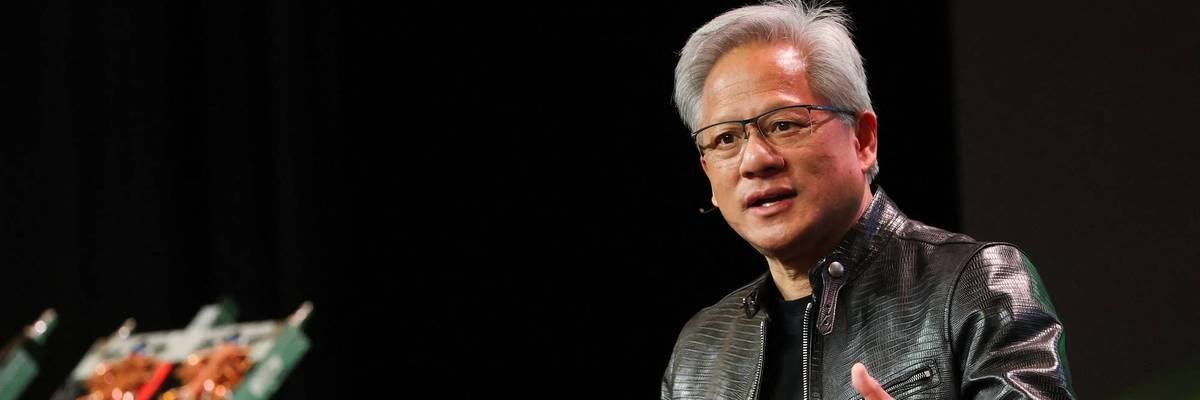
Nvidia founder and former CEO Jensen Huang speaks about the Vera Rubin AI platform during a question and answer session with reporters at the annual Consumer Electronics Show (CES) in Las Vegas, Nevada, on January 6, 2026.
(Photo by Patrick T. Fallon / AFP via Getty Images)

Megan Russell
Nov 19, 2026
Common Dreams

In recent days, the world has been forced to become a bystander in another all-too-common story about another rich CEO cheating on his wife. This time, it’s Jensen Huang, co-founder of Nvidia, whose net worth exceeds $147 billion.

It should come as no surprise that another billionaire—who are, as a whole, already entitled by default—has transgressed the contractual arrangements of a marriage (and not just once or even twice).

But Jensen Huang’s sex life is not the story here. Nor should it be.

When we hear of yet another “Chinese spy” plot, we need to take a beat and understand that these stories are part of an ongoing project to manufacture fear of China, while building mistrust in Chinese technology.

The reason why this story has suffocated the current news cycle is because Alice Huang, the first known affair partner, has been reportedly accused by US officials of being a “Chinese spy”—which is actually not the story, either.

The story is much more complex, and it has to do with the ongoing race to AI dominance and control, the struggle of the US to maintain global hegemony over China, the absurd and often contradictory over-securitization of the tech industry, and some probable malign intentions as far as the US security establishment and corporate interests are concerned.

Before we get into it, we need to get one thing clear: US officials have a history of claiming any and every Chinese person—and thing—is a spy. Remember that interview of TikTok CEO Chew Shou Zi (who, by the way, is Singaporean, not Chinese), when Tom Cotton, a hardcore anti-China war hawk, kept asking if he’s a member of the Communist Party of China? “No, I’m Singaporean,” Shou Zi repeated repeatedly. At the time, they were considering banning TikTok, claiming that China was using it to spy on American children (they were, in truth, worried about the pro-Palestine content and growing anger toward the Israeli genocide). In other words, it was a censorship scheme to control the nation’s youth, which have become much more critical of Israel in recent years—China was just the bait.

But anyway, everything from China seems to be a spy plot: social media apps, weather balloons, cranes, students… coffee makers. That’s right, they’ve even gone so far as to accuse Chinese-made coffee makers of spying on the American people. You know, so China can use coffee-drinking data to hatch a grand plot to take over the US hot beverage industry and wipe out Big Coffee.

I’ll never forget the Select Committee on the CCP hearing when Congressman Tim Burchett (R-Tenn.) exclaimed with concerning amounts of sincerity, “[China] knows how many paperclips you all are using in the Longworth building!” Oh no, not the paperclips. Scary.

It’s as ridiculous as it sounds. Which is why, when we hear of yet another “Chinese spy” plot, we need to take a beat and understand that these stories are part of an ongoing project to manufacture fear of China, while building mistrust in Chinese technology—you know, so China’s industry won’t surpass the US, at least when it comes to critical technology.

So instead of buying into yet another spy narrative with no real evidence, let’s pause and examine the story. The real story.

The Timeline: From Tech Scandal to Sex Scandal to Spy Scandal

In October 2025, The New York Times released its first report on Nvidia’s business relationship with Singapore-based company Megaspeed International. It was focused solely on chip purchases—nothing yet about affairs or spies.

The article detailed an investigation into suspected circumvention of recent US export restrictions on advanced Nvidia AI chips. In April 2025, the US banned exports without a special license (which would cost Nvidia up to $5.5 billion). Jensen Huang and associates lobbied hard against these new restrictions. In July, Nvidia struck a deal—they could continue to sell H20 products as long as the US government received 15% of revenues from China. However, concerns remained that other advanced chips (H100, H200, etc.) were being physically diverted into China via Megaspeed’s Southeast Asian data centers. Nvidia and Megaspeed both denied wrongdoing, and US officials acknowledged they had no conclusive evidence that chips had been illegally diverted.

It wasn’t until May 2026 that a firm called “Culper Research” released a 40-page report, titled “Nvidia: The China Problem,” alleging a closer relationship between Nvidia and Chinese commercial companies. The report also detailed the relationship between Jensen Huang and Alice Huang, calling it “uncomfortably close.” Interestingly, the report came out on May 13, the same day President Donald Trump added Jensen Huang to his list of billionaires joining the delegation to Beijing, which occurred over the next few days.


 Coincidence?

The biggest contradiction is completely missing from the mainstream news cycle, and it’s this: China doesn’t want to rely on US tech.

Side note: “Culper Research” is a short-betting firm that releases ~negative~ reports on companies while betting against them. Their main profit structure is making money when the stocks fall. It’s run by a guy named Christian Lamarco, and was named after the “Culper Spy Ring,” which reported the movement of British forces to General George Washington during the American Revolution. Ha.

This isn’t Culper Research’s first foray into tackling complicated and “suspicious” links between US and Chinese companies. They seem, in fact, like they’ve become a sort of anti-China watchdog, calling out American companies who make the mistake of working too closely with Chinese ones. In short, they make a profit off of playing into the national security establishment’s racialized China crackdown.

The “spy story” didn’t make it to the news cycles until early November 2026, when the affair allegations started to be reported in public US media—also leading up to another planned Trump-Xi summit in later November. As soon as it became hot news, it was quickly spun from a story about tech exports to a great affair scandal, and then, almost out of nowhere, a spy plot.

Where do the spy allegations even come from? According to reports, this storyline was derived from anonymous “US intelligence officials.” No evidence has been released. The US Department of Justice has even stated that it has not yet determined if Alice Huang is a spy. According to The Washington Post, an anonymous intelligence official explained that Marco Rubio took a CIA report on the matter and “wrote his own” in “more assertive terms.” When the memo leaked, the media took the story and ran with it.

So no evidence—just another manufactured spy plot written and leaked by a China hawk and escalated by mainstream media with a clear agenda: “Jensen Huang must go,” writes The Economist.

Let’s talk about why certain interests want Jensen Huang gone. But first, the contradictory evidence.

The Contradiction: China Doesn’t Want to Depend on US Tech

The biggest contradiction is completely missing from the mainstream news cycle, and it’s this: China doesn’t want to rely on US tech. It’s actually one of their top policy priorities. Chinese officials have been actively trying to prevent reliance on US tech in order to develop their own tech sovereignty and help their own domestic chip industry grow. Over the past year, China has repeatedly canceled Nvidia chip purchases and ordered top companies, including ByteDance and Alibaba, to stop buying them. They’ve even sent party officials to major ports to enhance customs inspection and ensure nothing was coming through the border without authorization. In November 2026, over 600,000 Nvidia chips were blocked and left sitting in Hong Kong.

So really, the notion that China is using honeypot spies to find ways to get more chips into the country makes no sense at all—it’s a complete contradiction to state policy, and would be in direct opposition to its security and industry goals.

If Megaspeed was, in fact, renting out computing power to Chinese companies, it was more of a private sector workaround to official state policy, not a secret operation coordinated by the Chinese government. Therefore, if Alice Huang was loyal to anyone, it was her company’s profit margins.

The Connection: Who Benefits From a Manufactured Spy Plot?


On November 12, Jensen Huang was forced to resign from his position as CEO. Interesting that a mere affair could be used to take out a billionaire executive, when others have gotten away with far worse crimes—rape, human trafficking, pedophilia, regular trips to Epstein Island, to name a few. Why were they protected, while Huang was proactively ousted?

The real story is becoming clear. US government officials—including Marco Rubio—in coordination with the mainstream media, have essentially taken out top CEO Jensen Huang. Why would they want that? Why would they intentionally hurt one of the highest-profiting US companies, the first company to ever surpass a $5 trillion valuation, the backbone of the American economy, the most critical company to the ongoing tech race, which has vast political and economic implications?

Who even benefits from that? Let’s list them!


1. China War Hawks

First, you have to understand one crucial point: The current endgame of US policy, that all anti-China hawks are barreling toward at breakneck speed, is a complete decoupling from China’s economy. Why? So the US can wage a prolonged war on China. That’s not possible if the US relies on China for any material, especially the critical minerals and technology that are imperative for weapons making and war waging.

Jensen Huang was a problem because he lobbied against decoupling. He favored a more economically harmonious relationship with China (because it profited him and Nvidia). His efforts largely worked, and he seemed to have had the direct ear of President Trump, who even supported him during the scandal. Under former President Joe Biden, chip restrictions grew significantly. But Trump, ever the businessman, has often sided with profit over the security establishment’s official position. Jensen Huang also seems to have had, according to mainstream media, a long history of being listened to within his own company—The New York Times writes, “Nvidia board has a history of letting Jensen Huang get his way.” Solution? Dump him. Put someone new in there who will do as they’re told.

We also can’t forget the obvious racialized undertones: Jensen Huang is Asian. The US security establishment doesn’t want an Asian person running the top US semiconductor industry, especially not during the current climate of new McCarthyism.

So overall, removing Jensen Huang will provide more flexibility to push for decoupling. And the whole manufactured spy plot works to the advantage of China hawks and national security officials pushing for greater chip restrictions. Already, lawmakers are using the scandal to garner support for three chip-export restriction measures to be added to the 2027 National Defense Authorization Act—the AI Overwatch Act, the Chip Security Act, and the MATCH Act—all of which give Congress greater ability to restrict chip exports.

This happened, all perfectly coordinated with Trump’s next meeting with Xi in the coming week. We can be sure that the outcomes of those talks, along with the successive policy, will continue to shine a light on what US policymakers really hoped to achieve from the Jensen Huang coup.

2. AI Monopolies and Other Big Tech Companies


Profit is played like a zero-sum game. Where Nvidia loses out, others pick up the losses, like scavengers stealing the scraps of a predator’s kill.

So who wins from Nvidia’s loss? Let’s start with one of the biggest advocates for greater chip restrictions—AI monopolist, Anthropic.

Anthropic has donated $40 million to Public First Action (PFA), an AI policy organization that supports stricter AI regulations and tighter chip control. In July 2026, PFA announced the launch of a $15 million Conservative AI Consensus Project to support members of Congress who back stronger AI regulations and chip controls—including John Moolenaar and Brian Mast, who called for an investigation into Jensen Huang. Their lobby, AnthroPAC, has also given thousands of dollars to some of the biggest China hawks in Congress, who have called for an investigation into and the resignation of Jensen Huang. Anthropic CEO Dario Amodei doesn’t have the relationship with Trump that Huang enjoyed—hence the need to ply Congress in their favor. Additionally, think tanks like the Center for a New American Security (whose CEO, Richard Fontaine, is on Anthropic’s board) have petitioned for Jensen Huang’s removal.

The battle of AI is a battle over who gets to control knowledge, technology, and the future of humanity—will it be monopolistic corporations or the people of the world?

But it’s not just about chip controls. Anthropic, OpenAI, and other Big Tech companies have lobbied to ban open-source AI models, which Jensen Huang has repeatedly defended. “I stuck my head out and defended open models, and, if you will, saved the world,” Huang said, speaking on his opinion that open models are both safer and the foundation to entire industries being created. He also mentioned his preference not to “stick his head out” (guess he had a feeling it could be his undoing).

There is an ongoing battle between open-source and closed-source AI models, or as Chen Deli, senior researcher at DeepSeek, writes, “Open source versus closed source, light versus darkness. A decisive battle between two futures, two destinies for humanity.” In other words, the battle of AI is a battle over who gets to control knowledge, technology, and the future of humanity—will it be monopolistic corporations or the people of the world? AI will either, in the hands of the elite, be a tool of domination, or, in the hands of the people, be used as a shared resource for human progress and development.

The Great AI Battle is playing out as we speak. And Jensen Huang was the rare US executive supporting open-source models.

China has been the biggest advocate for the creation and use of open-source AI models. Meanwhile, US organizations like Anthropic and other Big Tech companies have been lobbying to ban them (China’s open-source models are cutting into their profits). Which is why Jensen Huang’s removal, and influence over the open- vs. closed-source battle, works to their benefit.

And all of this is going down after midterm elections, prior to the next Trump-Xi meeting, and leading up to Anthropic’s IPO date (when a private company’s shares officially begin trading on the public stock exchange), which is slated for—you’ll never guess—this week! November 18. Coincidence? No! There are no coincidences!

4. Israel?

What do you mean the three new Nvidia CEO contenders are ALL Israeli?

What will Israel gain from having Nvidia in its back pocket—other than direct access to the world’s leading supplier of advanced AI chips and computing technology, which provides the computing power necessary for all advanced technology, modern data centers, intelligence systems, autonomous weapons, mass surveillance, and more—during its ongoing war on Iran?

What does Israel stand to gain, indeed.

The Danger of the “China Threat” Narrative

To close, we need to be wary of the manufactured China threat. The national security establishment is using it to promote political and economic agendas that are not in the interests of the people—American, Chinese, or other.

This is happening in parallel with an expansive US military buildup in the Pacific, a burgeoning $1.5 trillion war budget, and an administration of anti-China war hawks who are dead set on preparing the US for war on China. Decoupling economies is just one part of that. The Great AI Battle is just one part of that. We can also point to unprecedented military preparation and extensive threat manufacturing, which has poisoned many layers of American society already.

Some advice before you go: When you hear about another China spy plot, take a step back. Think about who benefits. The truth is always in the details.


Our work is licensed under Creative Commons (CC BY-NC-ND 3.0). Feel free to republish and share widely.


Megan Russell
Megan Russell is CODEPINK's China is Not Our Enemy Campaign Coordinator. She graduated from the London School of Economics with a Master’s Degree in Conflict Studies. Prior to that, she attended NYU where she studied Conflict, Culture, and International Law. Megan spent one year studying in Shanghai, and over eight years studying Chinese Mandarin. Her research focuses on the intersection between US-China affairs, peacebuilding, and international development.
Full Bio >
Diverse Coalition Pushes Democrats to Aggressively Probe Nvidia, Trump, and Lutnick

“Should a handful of billionaires and a corrupt president have the power to sell out the rest of us so they can get even richer, or do the American people get a say in their own future?”


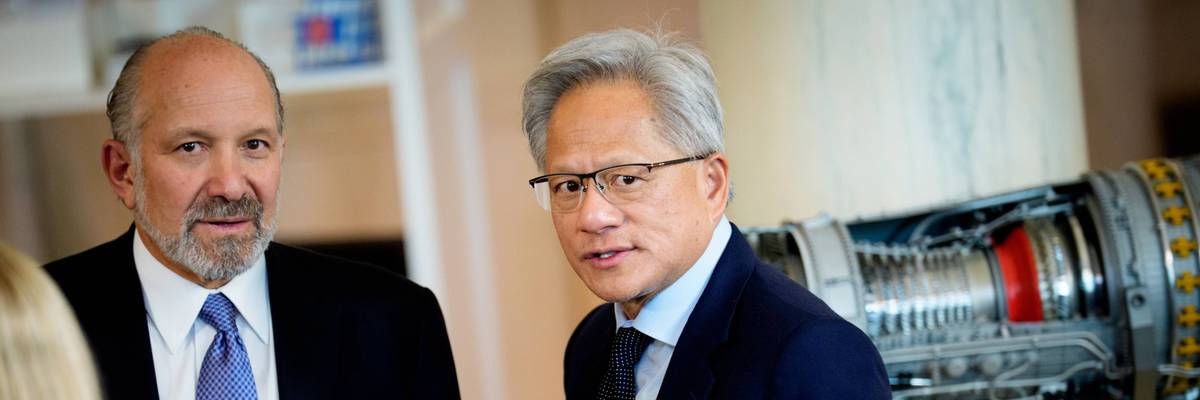
US Commerce Secretary Howard Lutnick and then-Nvidia CEO Jensen Huang spoke in the Cross Hall of the White House on April 30, 2025 in Washington, DC.
(Photo by Andrew Harnik/Getty Images)

Jake Johnson
Nov 13, 2026
COMMON DREAMS

A broad coalition of advocacy organizations on Friday urged Democratic lawmakers to aggressively wield their investigative powers in the new Congress to scrutinize US President Donald Trump and his administration’s relationship with Jensen Huang, the scandal-engulfed former chief executive of the AI chip giant Nvidia.

“While CEO Jensen Huang has resigned, that should not mean that he escapes scrutiny of Nvidia’s actions,” Guardrails Action, Indivisible, the American Federation of Teachers, and seven other groups wrote in a letter to Sen. Chuck Schumer (D-NY) and Rep. Hakeem Jeffries (D-NY). “Beyond the obvious and pressing concerns regarding legislation on chip exports is a question at the very core of our democracy: Should a handful of billionaires and a corrupt president have the power to sell out the rest of us so they can get even richer, or do the American people get a say in their own future?”

The letter came a day after Huang stepped down as head of Nvidia following revelations of two extramarital affairs—one with a subordinate and another with a woman flagged by US intelligence agencies for potential ties to the Chinese government.

Over the past two years, Huang has developed a close relationship with Trump, and the CEO’s professional demise has heightened scrutiny of White House policy decisions that have benefited the company—including licenses to export AI chips to China.

“Nvidia, the second-largest corporation in the world, gave $25 million to Trump’s ballroom,” the advocacy coalition noted on Friday. “Its former CEO, Jensen Huang, traveled with Trump on Air Force One to China, and attended Trump’s state dinner with Chinese President Xi Jinping. At the same time, according to recent bombshell reporting, Huang was having an affair with a suspected Chinese spy, who led Megaspeed, a company under investigation for allegedly smuggling restricted Nvidia chips into China.”

“Rather than take action, President Trump ignored the warnings; a Commerce Department investigation was even halted after direct intervention by Nvidia’s general counsel,” the groups observed.

The coalition specifically called on Democrats in both the House and Senate to commit to three actions:Immediately demand that Nvidia, the White House, and the Commerce Department preserve all communications regarding export approvals, the Megaspeed investigation, intelligence warnings about Alice Huang, and Nvidia’s ballroom contribution.
Hold public hearings within the first 30 days of the new Congress, seeking sworn testimony from former Nvidia CEO Jensen Huang, Commerce Secretary Howard Lutnick, and Under Secretary of Commerce for Industry and Security Jeffrey Kessler.
Issue subpoenas if Nvidia or administration officials refuse to turn over documents or testify.

“The concentration of power and wealth from AI, and the risks that come with it, are historic,” the groups wrote. “Countering that power is the most important fight of our lifetime. The American people put their trust in Democrats to put them first; now let’s prove they were right.”

As Common Dreams reported on Thursday, a pair of high-ranking congressional Democrats have already launched an investigation into what they characterized as a “scheme” by the Trump administration to “mask an unconstitutional export tax as a national security tariff action—benefiting both Nvidia and the Chinese government.”

The Democrats, Sen. Ron Wyden (D-Ore.) and Rep. Richard Neal (D-Mass.), announced their investigation in a letter to Lutnick, a billionaire businessman whose department is under fire for lax oversight of Nvidia chip exports. Wyden and Neal noted in their letter that Lutnick’s Commerce Department “has approved sales to Chinese companies with government and military ties—including Chinese ‘cutout’ companies with no physical presence at their listed addresses.”

CNN reported Friday that some of Trump’s advisers “have begun discussing” whether Lutnick should be fired. In an interview on Friday morning, Treasury Secretary Scott Bessent blamed Lutnick for what he described as “leakage” of Nvidia’s advanced AI chips to China.

According to Axios, Lutnick “has repeatedly stood in the way” of efforts to crack down on companies “suspected of diverting Nvidia’s advanced AI chips to China.”

“Howard Lutnick should resign or be fired,” US Rep. Ted Lieu (D-Calif.) wrote on Thursday.
Leaker claims Trump gutted America’s top cyber defense agency


(REUTERS)
November 18, 2026 
ALTERNET


Miles Taylor, former DHS analyst and whistleblower from President Donald Trump’s first term, warned that Trump has decimated the U.S. counter-espionage units to the point where federal officials can’t even say in good time whether or not an outage is the result of terrorism.

Secretary of State Marco Rubio tried to reassure Americans on Wednesday after a slate of outages impacting everything from email to airline flights.

“We're always on the lookout for anything that poses a threat to the American people, to the American economy, or to the national security,” declared Rubio, speaking with reporters. “We are always hyper vigilant about that, and we're always on the lookout for it. But we see no indications that these things are interrelated, one event to the other, or that they're the work of malign actors.”


But Taylor, a security expert, told CNN anchor Kasie Hunt on Wednesday that there’s little reason to take the administration at its word after President Donald Trump worked so hard to destroy U.S. intelligence.

“The big thing that the secretary of state left out is, were this, an AI-enabled cyber-attack, are we prepared to cope with it? And I'm sure that if asked that question, he would have said, ‘yes, we're prepared,’ but that wouldn't be the honest answer.”


“We are as unprepared as we have been in years. And that's largely because the administration has decimated our domestic cyber defenses,” said Taylor. “It was six years ago yesterday that Donald Trump fired my former colleague, (Former United States Director of the Cybersecurity and Infrastructure Security Agency) Chris Krebs by tweet. Chris ran a department I helped create via legislation, cyber and infrastructure security agency (CISA), to protect our domestic networks. I stood behind Donald Trump as he signed that legislation into law. He very much didn't understand what he was signing into law. And after Chris refused to say that the 2020 election was stolen, Donald Trump not only got rid of him, but he came back to office and his administration has decimated CISA.”

Taylor added that he still speaks with his old co-workers and that they describe a system in shambles.

“I've been talking to current and former employees over there who say they have a threadbare staff for responding to this truly historic moment we are in of AI-enabled cyber vulnerabilities. And that's what's scary because at a minimum what happen over the last week is a preview of what is likely to happen with AI attacks and we have an administration and a federal government that’s not prepared to respond to it,” said Taylor.


Alex Karp Says Palantir Is “Progressive” Now, Months After Fascist Manifesto

Karp, who gave $1 million to MAGA Inc. in 2024, said after the midterms that he’s been a Democrat his “whole life.”

November 12, 2026

Alex Karp speak onstage during The New York Times DealBook Summit 2025 at Jazz at Lincoln Center on December 3, 2025 in New York City.David Dee Delgado / Getty Images for The New York Times

As Democrats prepare for their sweeping campaign to investigate corporate abuses during the upcoming Congress, Palantir CEO Alex Karp claimed this week that he and his company — a massive Trump administration collaborator — are actually “progressive” now.

Karp, who gave $1 million to MAGA Inc. in 2024 and another million for Donald Trump’s inauguration, told Politico Playbook on Wednesday that he’s always been a Democrat.

“I’ve been a Democrat my whole life. I grew up in a far left environment. I know more about being a progressive than almost anybody on the planet, and I absolutely believe Palantir — all of our products are essentially progressive,” he told Politico, speaking of his company that has a $30 million contract with Immigration and Customs Enforcement (ICE) to aid Trump’s mass deportation campaign.


Far from being progressive, Karp and his company have helped to accelerate the Trump administration’s descent into fascism while wooing Trump in order to gain favor with the government.

Just in April, Palantir landed in hot water for posting a far right, 22-point manifesto that it said was a summary of Karp’s 2025 book, The Technological Republic. Critics described the X post as technofascist, as it espoused a pro-war, pro-policing ideology, lamented the post-Holocaust “neutering” of Nazi Germany and Japan, and said that cultures that have “produced vital advances” are superior to those that are “dysfunctional and regressive.”


Nurses Across US Demand Hospitals Cut Ties With Palantir, Citing ICE and Gaza
National Nurses United is expanding its campaign against Palantir in a global week of action starting on September 28.  
By Shireen Akram-Boshar , Truthout  September 11, 2026


The tech CEO has been on the record many times branding himself and Palantir as undertaking a far right effort, with Karp calling his company “anti-woke” and praising the Trump administration’s anti-immigration measures.

But in the Politico interview, Karp claimed that he was happy that Trump acknowledged that “we kinda went too far” on immigration — a misrepresentation of Trump’s words earlier this week. Karp used the word “progressive” eight times to describe his political philosophy, despite the fact that progressivism is typically known for being antiwar, pro-immigrant, and opposed to tech companies like Palantir.

On top of Karp’s contributions to Trump, Palantir was recently revealed to have donated $10 million to Trump’s East Wing ballroom project. In exchange for these gifts, the Trump administration has helped to propel Palantir to being one of the top recipients of federal contracts, embedding its AI systems in the military and recruiting the company to mine Americans’ data to help monitor and build cases against people targeted by Trump’s deportation campaign.

Karp also appears to have given Republican House candidate Jay Obernolte $7,000 in January, federal disclosures show, though he listed his employer as “Plantatir Technologies” — making it so that his company wouldn’t come up in database search queries for Palantir, spelled correctly.

Karp’s comments represent what is likely a naked attempt to woo Democrats before they take control of Congress in January.

Some Democratic committees have already looked into Palantir for its dealings with the Trump administration and its work in building out mass surveillance systems for the federal government. This has spurred Palantir to hire former Democratic Sen. Jon Tester this week, in preparation for the new Congress. Palantir and other tech firms have also donated to House Minority Leader Hakeem Jeffries (D-New York), who is poised to become speaker of the Democratically-controlled House.
Ahead of Anthropic IPO, Critics Warn of Potential Threat to ‘Entire Financial System’

“Anyone holding a broad index fund will likely own this company within weeks of its listing, whether or not they ever decide to buy a single share.”


Anthropic co-founder and CEO Dario Amodei arrives at the White House on September 29, 2026 in Washington, DC.
(Photo by Finn Gomez/Getty Images)

Jake Johnson
Nov 19, 2026
COMMON DREAMS

With the artificial intelligence giant Anthropic set to make its record-shattering debut on the public market on Thursday, US Sen. Elizabeth Warren and other critics of the AI industry warned that the company’s IPO brings systemic risks to the global financial system—on top of the grave threats posed by its technology.

“Anthropic is planning to IPO even as the company warns of ‘existential risks to humanity’ and fails to answer for the potential threats to Americans’ retirements and the entire financial system if this IPO goes awry,” Warren (D-Mass.), the top Democrat on the Senate Banking Committee, said in a statement Wednesday. “Meanwhile, Trump’s regulators are asleep at the switch.”

Warren called on the Securities and Exchange Commission (SEC) to urgently “protect investors” and demanded that Congress “act quickly to put in place safeguards on advanced AI development.”

The senator’s statement came after Anthropic announced that it raised a record $81.3 billion for its IPO, surpassing the $75 billion raised by Elon Musk’s SpaceX. Anthropic said it would price its shares at $83 each, putting the AI giant’s valuation above $1.5 trillion.

Evan LeFlore, director of AI, innovation, and economic opportunity at Better Markets, noted that “anyone holding a broad index fund will likely own this company within weeks of its listing, whether or not they ever decide to buy a single share.”

“They deserve to know what they are being handed,” said LeFlore. “The money in this industry is moving in a circle, and every American has a stake in understanding that. The companies that sell Anthropic its computing power are also buying its stock, and Anthropic spends that money straight back with them. Each lap around the circle gets booked as revenue and treated as proof that the demand is real. This reaches well beyond the people who buy shares.”

“A broad index fund already holds the suppliers on the other side of these deals, so millions of Americans are on every side of this circle without having chosen any of it, and the build-out driving it is financed substantially with debt,” LeFlore added. “If the demand turns out to be thinner than the revenue suggests, the losses will not stay inside the AI industry.”

A recent report authored by experts at the Open Markets Institute and the Americans for Financial Reform Education Fund warned that the AI boom “represents one of the largest speculative frenzies in history.”

“The risk is rising that AI companies will be unable to meet their fast-growing debt obligations,” the report stated. “Regardless of where market stress originates, the industry’s extensive circular financial arrangements mean that turmoil could easily spread and devastate the entire tech sector.”

Anthropic’s stock market debut comes amid broad and intensifying fears about the far-reaching threats of advancements in AI technology. Anthropic, led by CEO Dario Amodei, has warned that AI models could pose “catastrophic or existential risks to humanity,” and the company claims to be committed to safety—a commitment that many AI industry insiders have disputed.

“Neither company is acting responsibly,” Jacob Coxon, an AI researcher, said of OpenAI and Anthropic after resigning from his position at the latter company in September. “They are racing straight to self-improving superintelligence and gambling with our lives.”

A statement released Wednesday by a broad coalition of AI safety advocates, legal experts, and scientists observes that Anthropic warns “recursively self-improving AI could concentrate power and escape human control, yet races to build it first.”

“The company uses safety branding to court investors, employees, and the public—even as it has quietly weakened its safety pledges and lobbied for self-serving regulation,” the statement reads. “Anthropic is not a safe AI company, and we must reject its reckless attempt to amass power in the name of the greater good.”

Sen. Chris Van Hollen (D-Md.), who is running to lead the Senate Democratic caucus in the new Congress, said Wednesday that Anthropic’s IPO highlights “how AI’s rapid development is great for the billionaire class but extremely dangerous for humanity.”

“We need to act now to address these risks, hold AI companies accountable, and protect the American people,” the senator said.
Trump’s $1.5 Trillion War Budget Is a Check for Spiritual Death

Think about what we should be spending money on instead: programs of social uplift—programs like Medicare for All, universal childcare, and tuition-free college.


Military equipment is shown in a still from the film Earth's Greatest Enemy.
(Image via Empire Files)

Ryan Wentz
Nov 18, 2026
Common Dreams

In the coming weeks, Congress will be voting on President Donald Trump’s proposed $1.5 trillion war budget, double the number it was under Joe Biden, which, of course, was already far too high. If passed, the US military budget will be larger than the military budgets of the next 34 countries combined. Thirty-four countries combined. What’s more, while the Pentagon has been audited eight times, not once has it passed.

In 1967, Martin Luther King Jr. declared, “A nation that continues year after year to spend more money on military defense than on programs of social uplift is approaching spiritual death.” Think about what we should be spending money on: programs of social uplift—programs like Medicare for All, universal childcare, and tuition-free college. We desperately need to address the climate crisis, improve public transportation, and raise the minimum wage.

According to the National Priorities Project, last year, our $1.07 trillion war budget could have funded:122.47 million public housing units or
10.06 million livable wage jobs for a single parent with two children or
471.98 million people receiving SNAP benefits or
11.4 million elementary school teachers or
28.69 million borrowers receiving federal student loan forgiveness or
64.19 million people receiving paid parental leave or
125.15 million people receiving Medicaid or
2.02 billion households with solar electricity.

The list goes on.

The justification for this massive budget, and for wars and imperialism in general, is a pile of lies. One outrageous lie after another—so many of them that the warmongers in Washington have seemingly lost track of them.

A couple of days ago, journalist Rania Khalek, who was in the halls of Congress with Medea Benjamin and dozens of Codepink organizers from around the country, asked Rep. Joe Wilson (R-SC) if he’d continue to support funding the Iran War despite its unpopularity. The representative’s answer? “I oppose terrorists who murder babies, putting them in microwaves.” This simply never happened. America’s best and brightest, folks.

Several years ago, then-Secretary of State and ex-CIA Director Mike Pompeo admitted: “I was the CIA director. We lied, we cheated, we stole. It was like we had entire training courses. It reminds you of the glory of the American experiment.” Yes, he actually said that—and he wasn’t wrong.

That’s what the US empire does: the White House, Congress, the corporate media, the CIA, and the Pentagon. Lies, lies, and more lies.

They lie about Iran and boom: The US bombs an Iranian elementary school and kills roughly 160 schoolchildren and staff.

They lie about Venezuela and boom: The US kidnaps Venezuela’s president and first lady and steals its oil.

They lie about drug trafficking and boom: The US wages a deadly bombing campaign against fishermen in the Caribbean and the Pacific.

They lie about Cuba and boom: The US blocks fuel from reaching the island, strangling the Cuban people.

They lie about Gaza and boom: genocide.

Contrary to popular American mythology, we don’t promote human rights and spread democracy abroad. We kill people, overthrow governments, starve entire populations, arm genocidal apartheid regimes and absolute monarchies, threaten international institutions, and destroy ecosystems.

Dr. King was right: The US empire is a project of spiritual, physical, and economic death.

Our movement, however, fights for truth, meaning we fight for life. We know a better world is possible. We see the children of Gaza, Iran, and Cuba as our own. We understand that diplomacy, not war, is the way to build peace. We seek to be good neighbors, not only in the Western Hemisphere, but all across the globe. We want clean air and water, safety, and dignity for all.

That’s why we must mobilize to stop this $1.5 trillion war budget. Because we love and value life—here in Los Angeles, in Rafah, in Tehran, in Havana, and beyond. Commit to the struggle. Dare to imagine something beyond the horizon. Join an organization (like Codepink!), start a book club, apply pressure on your representatives, engage in direct action, and never lose hope.

Only together will we win. As Arundhati Roy said in 2002: “Another world is not only possible, she’s on her way. Maybe many of us won’t be here to greet her, but on a quiet day, if I listen very carefully, I can hear her breathing.”


Our work is licensed under Creative Commons (CC BY-NC-ND 3.0). Feel free to republish and share widely.


Ryan Wentz
Ryan Wentz is Codepink’s national organizing manager. He is based in Los Angeles.
Full Bio >
Driven by US and China, Planet-Heating Emissions From Data Centers Set to Rise by 70% by 2030: IEA

The rapid data center build-out represents the “nail in the coffin for the planet’s life support systems,” said one expert.


An aerial view shows a 49.5 megawatt three-level data center under construction on October 29, 2026 in Vernon, California.
(Photo by Mario Tama/Getty Images)


Julia Conley
Nov 19, 2026
COMMON DREAMS


With the US and China turning to fossil fuels to power the data centers that the countries are pushing to rapidly build, the International Energy Agency said in its annual World Energy Outlook on Thursday that planet-heating emissions from the facilities are projected to rise by 70% by 2030.

The two countries are not alone in pushing for the expansion of massive data centers, which require large amounts of energy to operate and cool continuously running servers.


But the IEA noted that in the European Union, developers are expected to use renewable energy for about 70% of their data center needs by 2030. In Canada, the agency identified plans for 11 gigawatts of gas generation to power data centers over the next four years, and in the rest of the world, developers are expected to use gas plants for their energy needs with a combined capacity of just 4 gigawatts.

Developers in the US, meanwhile, currently have plans for about 180 gigawatts of new gas-fired plants to power their data centers, and the country is expected to rely on gas for about 60% of its electricity needs for the facilities.

In China, about half of data centers’ electricity will come from coal-fired plants by the end of the decade.

The IEA’s report was released a day after 14 Democrats in the US Congress joined Republicans in advancing the Bipartisan American Affordability and Jobs Act (BAAJA), a key permitting reform bill that would speed up fossil fuel projects and artificial intelligence data centers by limiting environmental reviews.

Christopher Wright, a professor at the University of Sydney and author of Organizing Responses to Climate Change, said the IEA report showed that the rapid data center build-out represents the “nail in the coffin for the planet’s life support systems.”

The report was released as world leaders continued negotiations at the United Nations Climate Change Conference in Antalya, Türkiye, where campaigners, scientists, and policymakers have demanded a final agreement that includes concrete commitments to phase out the emissions that are projected to explode due to data centers.

The Climate Action Tracker said last week that without decisive action to slash fossil fuel emissions, the planet is headed for an “irrevocable overshoot” of the 1.5°C limit set by the Paris climate agreement in 2015. UN agencies have also warned in recent weeks that avoiding at least a temporary overshoot of the threshold is no longer possible, and drawing down fossil fuel emissions is now needed to ensure the breach is only temporary.

Following the disruption to world energy markets by the Iran War started by Israel and the US earlier this year, IEA executive director Fatih Birol said Thursday that he does not “see any credible pathway for the energy world to return to the way it was before.”

Policy decisions, suggested the IEA, including those regarding how to power artificial intelligence and data centers, will determine the world’s energy and climate future.
Coalition of 115 Groups Calls for Immediate Data Center Moratorium on US Public Lands

“These shared lands should not be sacrificed to an unprecedented wave of industrial development without a national conversation about whether that development belongs there in the first place.”


Bureau of Land Management land is seen near Nine Mile Canyon, Utah 
on December 19, 2024. A hyperscale data center has been proposed in the area.
(Photo by James Roh for The Washington Post via Getty Images)


Julia Conley
Nov 18, 2026
COMMON DREAMS

As the Trump administration and members of Congress on both sides of the aisle push to speed up data center development—against the wishes of the vast majority of Americans, according to recent polling—a coalition of more than 100 conservation and advocacy groups urged two top administration officials on Wednesday to impose an immediate moratorium on the facilities on public lands, arguing that “fundamental threshold issues” must be resolved before such development.

According to US Bureau of Land Management (BLM) records, at least 17 data center campuses and 13 related infrastructure projects—including transmission lines and access roads—have been proposed across more than 24,000 acres of federal land in Arizona, Idaho, Nevada, Oregon, Utah, and Wyoming.

Those projects have been proposed without determining “whether this new industrial use is legally authorized on public lands and, even if it is, whether large-scale data centers are an appropriate use of America’s public lands,” wrote the coalition of 115 groups to Interior Secretary Doug Burgum and Agriculture Secretary Brooke Rollins on Wednesday.

“There is no comprehensive federal policy addressing these questions, no meaningful public process examining the consequences of this new use, and no adequate framework for addressing enormous demands on water and energy, impacts to wildlife and cultural resources, or effects on tribal nations and nearby communities,” added the groups, including Defenders of Wildlife, the Sierra Club, Montana Conservation Voters, and Public Employees for Environmental Responsibility (PEER).

The letter follows recent reporting by ProPublica that showed Burgum has up to $64 million invested in artificial intelligence companies, many of which are pushing for the expansion of data centers to power their technology, while hundreds of President Donald Trump’s political appointees also have significant financial ties to the industry.

More than 320 officials appointed by Trump have ties to Google parent company Alphabet, which plans to spend nearly $200 billion this year on the data center build-out. More than 240 of them have investments or other financial ties to Meta Platforms, which is also developing data centers.

“The Trump administration is treating America’s public lands like a line item in their own investment portfolio, and conflicted Data Center Doug Burgum, who has tens of millions invested in the speculative AI data center build-out, is leading the charge,” said Jayson O’Neill, a spokesperson for Save Our Parks. “This administration and Burgum will continue to use their power to give away our public lands to AI data center developers unless Congress steps in to block it.”

The coalition called a moratorium on data centers on public lands “the minimum responsible step.”

“It would give tribal nations, communities, lawmakers, and the public an opportunity to understand what is being proposed and to weigh in on whether commercial data centers are compatible with public land laws, purposes, and values. It would also allow for full examination of environmental impacts, cumulative demands on water and energy, and the consequences of transforming shared public lands into industrial sites.”

Public support for data centers has plummeted amid reporting on their massive consumption of energy and water and their contributions to climate pollution.

Last week, the Interior Department released a five-year plan that includes potentially selling off public lands—a proposal, O’Neill told ProPublica on Tuesday, to “sell off what’s left to AI data center developers and [Burgum’s] extractive resource buddies.”

According to More Than Just Parks, projects already proposed for public lands include:Project Beehive, proposed by Valar Atomics, on over 9,000 acres of BLM land in Carbon County, Utah, and 17 miles from the Nine Mile Canyon Area of critical environmental concern;
On the Mark Data Center near Silver Springs, Nevada, and 23 miles from Stillwater National Wildlife Refuge; and
A 4-million-square-foot data center campus with its own gas plant near Blacks Creek Reservoir, on 3,200 to 3,700 acres of BLM land.

A dozen Democrats in Congress are pushing to limit or ban data centers on or near public lands, according to reporting by ProPublica on Tuesday, with some citing the reports on Trump administration officials’ ties to the AI industry.


Rep. Rashida Tlaib (D-Mich.) told the outlet she would “continue building the coalition” for the No AI Data Centers on Federal Lands Act, which she introduced in July in the Republican-controlled Congress. Democrats are set to take control of the US House of Representatives and the Senate in January.

“The American people expect public lands to be managed for the benefit of everyone, not a handful of corporations,” said Jose Witt, Nevada state director for the Wilderness Society. “These are the places we hike, hunt, and connect with the natural world, yet the administration is poised to dramatically reshape how public lands are used to benefit big tech and the data center industry. The recent election made clear that Americans want a check on data center development, and we urge the administration and Congress to pause data center construction on public lands so we can fully assess the impacts and give the public a real say.”

The coalition wrote to Burgum and Rollins two days after 21 members of the Democratic caucus in the Senate voted to end debate on the Bipartisan American Affordability and Jobs Act, which would speed up the federal permitting process for data centers and fossil fuel projects. Advocates have warned that the bill’s changes to federal law would open up public lands for the facilities.

“America’s public lands belong to all of us,” reads the Wednesday letter. “They provide places to hunt, fish, hike, camp, and connect with nature; protect clean water, wildlife habitat, cultural resources, and landscapes important to tribal nations; and preserve opportunities and experiences that cannot simply be recreated once they are lost. These shared lands should not be sacrificed to an unprecedented wave of industrial development without a national conversation about whether that development belongs there in the first place.”


U.S. Farmers gear up for war over leaked bill that could open door to land seizures

By: Daniel Hampton
Nov 18, 2026
RAW STORY

Farmers gear up for war over leaked bill that could open door to land seizures
Demonstrators chant and hold signs during a protest against data centers outside Rockford City Hall in Rockford, Illinois, US, November 17, 2026. REUTERS/Yong Li Xuan


Ohio farmers are mobilizing against a leaked draft bill they fear could let energy developers take their land for data centers, just two weeks after voters in 18 Ohio communities voted against the projects.

The draft, obtained by WEWS, would expand Ohio’s definition of a “public utility” to include developers holding a state Power Siting Board certificate for electric transmission lines or gas pipelines. According to legal experts cited by the outlet, a transmission developer could then seize land to power or host a data center. The draft would also let those companies use a fast-track process called “quick take,” WDTN reported. Under quick take, a company deposits money, takes the property, and settles the final price later in court.

The Ohio Farm Bureau has braced for the proposal since June, when the Ohio Business Roundtable’s push to change eminent domain law came to light. The group says it does not oppose data centers.

“We are aware of efforts to further erode the limited protections that landowners have, allowing for quick take of property without first paying for the property and determining a landowner’s rights and compensation through a court of law,” the Bureau’s Evan Callicoat said.

Gretchan Francis, whose family farm has already lost land to highway projects, said losing land to a data center would be devastating.

“I think anybody would feel the same way if their personal land was taken for a data center,” she said.

Champaign County farmer Josh Gentis told WDTN that lawmakers should take heed of the election, when Ohio voters went 21 for 21 against data centers. Farmers are preparing a calling campaign to pressure legislators to kill the bill.

Republicans have fretted over the issue since at least August, with a National Republican Senatorial Committee memo telling AI companies that backlash threatened the party’s hold on an Ohio Senate seat. Even former Trump voters in Ohio soured on the president over his support for the facilities, and national polling has shown broad opposition across party lines.

Incoming state Senate President Bill Reineke (R-Tiffin), who is working on the bill, said it would not extend eminent domain to anyone who lacks that power today. He called it a framework to bring the state in line with 45 other states. Alexandra Denney of the Ohio Business Roundtable said the goal is a reliable, affordable grid and that the group does not intend to expand eminent domain. After the draft was read to her, she said she would need to look at the public utility language.

The bill has not been formally introduced.
Our Bodies, Our Land: Why Climate Justice Starts With Protecting Native Bodies

As we honor Native Heritage Month and wrap up COP31, I am called upon by my ancestors to remember the inseparable tie between body and earth, and the destruction caused by governments and extractive industries upon both.


Activists march for missing and murdered Indigenous women at the Women’s March California 2019 on January 19, 2019 in Los Angeles, California.
(Photo by Sarah Morris/Getty Images)

Amory Malin
Nov 19, 2026
Common Dreams

As I write, the kwi’neì kulám [oak tree relatives] shimmer their brilliant vibrancies across the white spotted sky. With firm certainty, their strong bases plunge past where my eyes can see. We are not, altogether, different,

kwi’neì kulám and I.


‘Without Demarcation, There Is No Climate Solution,’ Brazilian Indigenous Leader Tells COP31


Our bodies carry the story of our relationship with the land, to the waters, and with one another. Our bodies carry the story of our ancestors. This relationship tells us that our bodies and our land are not two separate things.

I join my relatives in the pursuit of healthy land, safety for Native women and girls, and self-determination for all Indigenous peoples.

Mohawk grandmother and traditional midwife Katsi Cook’s teachings describe “the undeniable connection between the health of our bodies and the health of our planet.” She has said, “Violence that happens on the land is intimately connected to the violence that happens to our bodies.”

As we honor Native Heritage Month and wrap up this year’s United Nations Climate Change Conference (COP31), I am called upon by my ancestors to remember the inseparable tie between body and earth, and the destruction caused by governments and extractive industries upon both.

The United States’ failed genocidal colonial project has always been about conquering our land by erasing our bodies. Environmental destructive industries are disproportionately located close to Native reservations. The United Nations has condemned areas where low-income and marginalized groups bear the disproportionate burden of exposure to pollution and toxic substances as “sacrifice zones.” In the US, this practice is commonplace—the health and safety of marginalized people is viewed as expendable.

Many Native scholars take this argument a step further, demonstrating the strategic and systematic ways that the US government oppresses Indigenous people through Land Violence, which is defined as “a tactic that seeks to eliminate Indigenous peoples in order to gain access to land and waters.” Deliberate exposure to pesticides, uranium mining, toxic pollution, chemicals produced by extractive industries—such as coal, mineral, oil, and tar sands—are settler tactics that have been continuously used against Native people.

Amnesty International’s recent report “We’re Here to Protect Mother Earth: Indigenous Rights and Nevada’s Lithium Boom,” found that an estimated 79% of all known US lithium reserves lie within 35 miles of Tribal reservations. The report found that lithium mining significantly restricted Tribal Nation’s access to traditional foods, medicines, gathering places, and sacred sites. In tandem, they created significant health concerns for Native people due to chemical hazards. The effects of land violence perpetrated by extraction industries, such as lithium or uranium mines, are often invisible until years later. These health concerns include harms to the reproductive system, as illustrated in the report “Violence on the Land, Violence on our Bodies,” which connects proximity to extraction sites to high levels of toxins in breast milk, infertility, miscarriages, premature births, premature menopause, reproductive system cancers, and an inability to produce healthy children—a cruel and intentional attack on our next generation.

When our land suffers, we suffer. My hand grazes kwi’neì kulám [oak tree relatives], feeling their textured surface. With firm warmth, we stand heart to heart until we weep.

The violence against Native people is not an epidemic, it is a deliberate and political attempt to control our land, bounded by colonial oppression. Violence against Native women, in particular, is an urgent matter and a human rights crisis: More than 4 in 5 Native American women experience violence in their lifetime, and 56.1% of Native American women have experienced sexual violence in their lifetime. Homicide is the third leading cause of death among Indigenous women ages 10-24. In some reservations, Indigenous people are murdered at more than 10 times the national average.

Areas with extractive industries are intertwined with heightened levels of violence against Native women and girls, including serious concerns around sexual violence. Companies build temporary housing for large numbers of non-Indigenous and predominantly male workers near extractive industry sites. These “man camps” have been linked to a rise in violent crimes, including sexual violence, against Native women and girls living near extractive project sites. Despite ample evidence of increased sexual violence, there is little done by governments or industries to prevent such violence.

We cannot live healthy and safe lives when our bodies and lands undergo violence. We have a responsibility to protect our kwi’neì [relatives] and demand accountability from the US government in its colonial efforts to erase our bodies, while attempting to conquer our land.

The United Nations Declaration on the Rights of Indigenous Peoples (UNDRIP) affirms the right for Indigenous peoples to self-determination, including to give or withhold consent to projects affecting their land and resources. It is time for the United States to codify these principles into domestic law so that we as Native people can protect ourselves in the way we know best; through love and accountability to all of our relatives—the waters, plants, animals, and each other.

The United States cannot fulfill its human rights obligations to Indigenous people without confronting its own history of settler violence. Violence against Native women is not traditional—it is the direct result of colonization. The US perpetuates systemic violence against Native women and girls through settler colonial tactics. It is time the US government provide Tribal authorities with the resources and funding needed for Tribes to protect and seek justice for their citizens—including rape kits and training for administrators, flexible funding for Tribal shelters, increased cooperation with Tribal law enforcement, and enhanced jurisdiction for Tribal Courts.

This Native Heritage Month, and as global climate leaders return from COP31, I join my relatives in the pursuit of healthy land, safety for Native women and girls, and self-determination for all Indigenous peoples. Great Michi Saagiig Nishnaabeg scholar Leane Simpson asks of us:
Rebel against the permanence of settler colonial reality and not just “dream alternative realities” but to create them, on the ground in the physical world, in spite of being occupied. If we accept colonial permanence, then our rebellion can only take place within settler colonial thought and reality.

I make a promise to you, kwi’neì kulám [oak tree relatives,] that as I dream and rebel, your voice will join me.


Our work is licensed under Creative Commons (CC BY-NC-ND 3.0). Feel free to republish and share widely.

Amory Malin
Amory Malin is a citizen of the Cow Creek Band of Umpqua Tribe. She is the Indigenous Rights fellow at Amnesty International USA. Her work is concentrated on research and polices impacting the safety and sovereignty of Indigenous women, Two-Spirit relatives, and children. The knowledge shared in this op-ed is not new. Generations of Native people have been fighting for our right to safety and sovereignty, and we will continue to do so until the end of time.
Full Bio >