Zelenskyy Says Russia Wants To Bring North Korean Troops Into Ukraine War Again
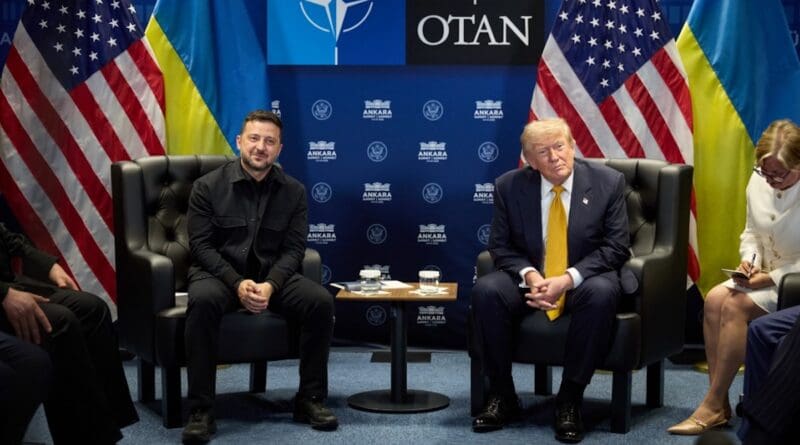
U.S. President Trump and Ukraine’s President Zelenskyy attend a meeting on the sidelines of NATO summit in The Hague. Photo Credit: Ukrainian Presidential Press Service
July 26, 2026
By RFE RL
Key Takeaways:
Ukrainian Deep Strikes: Kyiv reported successful long-range drone attacks on Russian targets, including a Caspian Sea oil platform and vessels linked to military cargo with Iran, an enterprise in Kirov, a logistics facility in Yekaterinburg, an oil refinery in Tyumen, and a fuel depot in Rostov-on-Don.
Russian Attacks and Casualties: Russia continued strikes that killed at least 10 people near Kyiv (including at a drone technology exhibition), six in Slovyansk, and three postal workers in Sumy, prompting a day of mourning in the Kyiv region.
President Volodymyr Zelenskyy said that Moscow wants to bring in thousands of North Korean soldiers again for its invasion of Ukraine, with preparations in Russia having been under way since early summer.
“Russia wants to bring in another 30,000 North Korean troops,” Zelenskyy wrote in Telegram on July 25, adding that “preparations have been under way in Russia’s Voronezh region since June to receive them.”
There was no immediate comment on the Ukrainian president’s claim from either Russia or North Korea.
A potential deployment of North Korean troops to the war in Ukraine would mark the second such development since 2024, when they were deployed to fight in Russia’s Kursk region following a surprise incursion by Ukrainian forces.
Zelenskyy’s statement came as Kyiv and Moscow continued to exchange daily air attacks amid near stalemate on the front line.
Since the beginning of the year, Russia has managed to capture a little amount of territory, marking a sharp slowdown from previous months. Some researchers concluded that Ukraine has actually recaptured land, a noteworthy feat more than four years into the war.
Separately, Ukraine has increasingly used long-range drones to target defense-industrial facilities, oil infrastructure, and logistics hubs deep inside Russia in an effort to curb Moscow’s energy revenues, which help fund its invasion.
On July 25, Zelenskyy said that Ukrainian forces had achieved “very good results” in strikes on Russian targets in the Caspian Sea, including vessels involved in transporting military cargo to Iran and a Russian warship.
Ukraine’s Security Service (SBU) said the Caspian Sea operation included drone strikes on the Filanovsky offshore oil platform, operated by Russian oil company Lukoil. According to the SBU, two cargo vessels — Port Olya 2 and Begey — were also targeted. It said the ships had been used to transport military cargo between Russia and Iran.
Iranian Foreign Ministry said the Ukrainian attack on July 25 targeted an Iranian commercial vessel, adding that the strike killed one sailor and injured another. Russia has not commented on the reported strikes.
Describing the Ukrainian attacks as “long-range sanctions” in response to Russian strikes, Zelenskyy said Kyiv also targeted “an enterprise in Kirov” that supplies components for Russian weapons, “a logistics facility in Yekaterinburg,” an oil refinery in Tyumen, and a fuel depot in Rostov-on-Don.
Ukrainian media reported that the target in Yekaterinburg was a logistics warehouse belonging to Russia’s largest online retailer, Wildberries, which is allegedly used to support the country’s military logistics, a claim Moscow has denied.
The attack could be the latest in a number of similar strikes on the retailer’s facilities over the past week.
Russia’s Defense Ministry said air defenses intercepted and destroyed 328 Ukrainian drones overnight on July 24-25, without saying how many reached their targets. Separately, Russia’s regional officials reported injuries and damage in the country’s southern Rostov region.
The Ukrainian strikes came as Kyiv observed a day of mourning after a Russian ballistic missile strike near Kyiv that killed at least 10 people and left almost 100 injured at the exhibition of drone technology near the Ukrainian capital in July 24.
Condemning the attack as a “terrorist act,” acting Kyiv Regional Military Administration head Ruslan Oliynyk said “the enemy cynically struck a place where people were,” adding that flags would be flown at half-mast across the region.
Elsewhere, six people were killed in Russian glide bomb attacks on the key frontline city of Slovyansk in the Donetsk region on July 24.
Speaking to RFE/RL’s Ukrainian Service, an injured Slovyansk resident with a bandaged head said he had lost his wife in the strikes, on what would have been her 50th birthday.
“My wife was supposed to turn 50 today. She was killed. My mother-in-law and daughter are in the hospital,” he added, standing beside his blood-stained car with shattered windows.
In the Sumy region on July 25, three drivers working for a private postal and parcel delivery company were killed after a Russian drone struck one of the company’s facilities.
Regional Governor Oleh Hryhorov said “the Russians deliberately struck a civilian facility where people were staying and working.” He added that a large fire broke out and rescuers were initially unable to fully respond because of the threat of further attacks.
Two men were found dead at the scene, while a third died on the way to hospital after suffering critical injuries.
About RFE RL
RFE/RL journalists report the news in 21 countries where a free press is banned by the government or not fully established.
View all posts by RFE
U.S. President Trump and Ukraine’s President Zelenskyy attend a meeting on the sidelines of NATO summit in The Hague. Photo Credit: Ukrainian Presidential Press Service
July 26, 2026
By RFE RL
Key Takeaways:
North Korean Troop Claim: Ukrainian President Volodymyr Zelenskyy stated that Russia is preparing to deploy another 30,000 North Korean soldiers, with preparations underway in Russia’s Voronezh region since June; this would mark a second such deployment after 2024.
Ukrainian Deep Strikes: Kyiv reported successful long-range drone attacks on Russian targets, including a Caspian Sea oil platform and vessels linked to military cargo with Iran, an enterprise in Kirov, a logistics facility in Yekaterinburg, an oil refinery in Tyumen, and a fuel depot in Rostov-on-Don.
Russian Attacks and Casualties: Russia continued strikes that killed at least 10 people near Kyiv (including at a drone technology exhibition), six in Slovyansk, and three postal workers in Sumy, prompting a day of mourning in the Kyiv region.
President Volodymyr Zelenskyy said that Moscow wants to bring in thousands of North Korean soldiers again for its invasion of Ukraine, with preparations in Russia having been under way since early summer.
“Russia wants to bring in another 30,000 North Korean troops,” Zelenskyy wrote in Telegram on July 25, adding that “preparations have been under way in Russia’s Voronezh region since June to receive them.”
There was no immediate comment on the Ukrainian president’s claim from either Russia or North Korea.
A potential deployment of North Korean troops to the war in Ukraine would mark the second such development since 2024, when they were deployed to fight in Russia’s Kursk region following a surprise incursion by Ukrainian forces.
Zelenskyy’s statement came as Kyiv and Moscow continued to exchange daily air attacks amid near stalemate on the front line.
Since the beginning of the year, Russia has managed to capture a little amount of territory, marking a sharp slowdown from previous months. Some researchers concluded that Ukraine has actually recaptured land, a noteworthy feat more than four years into the war.
Separately, Ukraine has increasingly used long-range drones to target defense-industrial facilities, oil infrastructure, and logistics hubs deep inside Russia in an effort to curb Moscow’s energy revenues, which help fund its invasion.
On July 25, Zelenskyy said that Ukrainian forces had achieved “very good results” in strikes on Russian targets in the Caspian Sea, including vessels involved in transporting military cargo to Iran and a Russian warship.
Ukraine’s Security Service (SBU) said the Caspian Sea operation included drone strikes on the Filanovsky offshore oil platform, operated by Russian oil company Lukoil. According to the SBU, two cargo vessels — Port Olya 2 and Begey — were also targeted. It said the ships had been used to transport military cargo between Russia and Iran.
Iranian Foreign Ministry said the Ukrainian attack on July 25 targeted an Iranian commercial vessel, adding that the strike killed one sailor and injured another. Russia has not commented on the reported strikes.
Describing the Ukrainian attacks as “long-range sanctions” in response to Russian strikes, Zelenskyy said Kyiv also targeted “an enterprise in Kirov” that supplies components for Russian weapons, “a logistics facility in Yekaterinburg,” an oil refinery in Tyumen, and a fuel depot in Rostov-on-Don.
Ukrainian media reported that the target in Yekaterinburg was a logistics warehouse belonging to Russia’s largest online retailer, Wildberries, which is allegedly used to support the country’s military logistics, a claim Moscow has denied.
The attack could be the latest in a number of similar strikes on the retailer’s facilities over the past week.
Russia’s Defense Ministry said air defenses intercepted and destroyed 328 Ukrainian drones overnight on July 24-25, without saying how many reached their targets. Separately, Russia’s regional officials reported injuries and damage in the country’s southern Rostov region.
The Ukrainian strikes came as Kyiv observed a day of mourning after a Russian ballistic missile strike near Kyiv that killed at least 10 people and left almost 100 injured at the exhibition of drone technology near the Ukrainian capital in July 24.
Condemning the attack as a “terrorist act,” acting Kyiv Regional Military Administration head Ruslan Oliynyk said “the enemy cynically struck a place where people were,” adding that flags would be flown at half-mast across the region.
Elsewhere, six people were killed in Russian glide bomb attacks on the key frontline city of Slovyansk in the Donetsk region on July 24.
Speaking to RFE/RL’s Ukrainian Service, an injured Slovyansk resident with a bandaged head said he had lost his wife in the strikes, on what would have been her 50th birthday.
“My wife was supposed to turn 50 today. She was killed. My mother-in-law and daughter are in the hospital,” he added, standing beside his blood-stained car with shattered windows.
In the Sumy region on July 25, three drivers working for a private postal and parcel delivery company were killed after a Russian drone struck one of the company’s facilities.
Regional Governor Oleh Hryhorov said “the Russians deliberately struck a civilian facility where people were staying and working.” He added that a large fire broke out and rescuers were initially unable to fully respond because of the threat of further attacks.
Two men were found dead at the scene, while a third died on the way to hospital after suffering critical injuries.
About RFE RL
RFE/RL journalists report the news in 21 countries where a free press is banned by the government or not fully established.
View all posts by RFE

File photo of Russia's President Vladimir Putin arriving in Pyongyang with Chairman of State Affairs of the Democratic People’s Republic of Korea Kim Jong-un. Photo Credit: Kremlin.ru
July 26, 2026
Elcano Royal Institute
By Youngjun Kim
Key Takeaways:
North Korea’s large-scale military support for Russia has transformed what began as a European war into a broader Eurasian security challenge, with direct implications for the Indo-Pacific and the Korean Peninsula.
Pyongyang’s troop deployment and ammunition transfers to Russia mark a decisive shift from diplomatic alignment to direct military collaboration, creating the basis for a deeper Russia-North Korea security relationship.
Although China, Russia and North Korea are not permanent ideological allies, their shared interest in weakening the US-led international order could sustain pragmatic and interest-based military cooperation.
Analysis
North Korea’s military cooperation with Russia during the Russia-Ukraine War has been one of the most surprising developments in global affairs. At the outset of the conflict, the Biden Administration, together with its Western allies, formed a value-based alliance and imposed maximum pressure and sweeping sanctions on Russia. Many expected Russia to become internationally isolated and eventually be forced to concede. Backed by indirect military and economic assistance from the West, Ukraine also mounted a strong defence. Against this backdrop, North Korea made a move that few had anticipated. By openly supporting Russia, it provided large-scale shipments of ammunition and deployed thousands of troops. What had initially been regarded as a European conflict gradually evolved into a war with strategic implications across the Eurasian continent.
From North Korea’s perspective, this marked its first large-scale overseas troop deployment since the Korean War and became a turning point in restoring and deepening relations with Russia after the end of the Cold War. As the war progressed, military cooperation between Russia and North Korea continued to expand. Russia also officially invited North Korea to participate in joint military exercises with China. As a result, the world is now approaching a situation in which it may soon witness joint military exercises involving China, Russia and North Korea, an unprecedented development that did not occur even during the Cold War.
The ideological foundation underpinning North Korea is Juche, or self-reliance theory. At its core, Jucheemphasises achieving ideological, economic and military independence through self-reliance and autonomous national defence, without depending on external military assistance. Although North Korea survived the Korean War with substantial support from the Soviet Union and China, Kim Il Sung came to believe that the country should become capable of defending itself without relying on either power. This conviction was shaped in part by North Korea’s wartime experience. During the Korean War, the Soviet Union and China exercised significant influence over military operations and the armistice negotiations, often regardless of Pyongyang’s own preferences.
Furthermore, the failed attempt by pro-Soviet and pro-Chinese factions to remove Kim Il Sung in the late 1950s reinforced his determination to consolidate political independence, ultimately contributing to the withdrawal of Chinese Volunteer Forces that had remained in North Korea after the Korean War. Consequently, North Korean historical narratives emphasised not only resistance against what they describe as US imperialism but also the preservation of national independence from Chinese influence. This dual emphasis has become an integral part of North Korea’s official interpretation of its modern history.
Following the end of the Cold War and the collapse of Soviet support, North Korea’s economy became increasingly dependent on China. From Pyongyang’s perspective, this growing dependence risked expanding China’s political, economic and psychological influence over the country. Kim Jong Il therefore sought to improve relations with the US, Japan and South Korea, while pursuing negotiations over North Korea’s nuclear program as a means of reducing China’s leverage. However, with the arrival of the George W. Bush Administration, North Korea became increasingly isolated over its nuclear programme. During the subsequent famine, in which hundreds of thousands to millions of people are estimated to have died, North Korea’s expectations of external support remained largely unmet, further reinforcing its perception of strategic vulnerability.
After assuming power, Kim Jong Un purged prominent figures regarded as having close ties to China, including his uncle, Jang Song Thaek, and his half-brother, Kim Jong Nam, while initially attempting to improve relations with both the US and South Korea. Following the failure of the Hanoi Summit, however, North Korea fundamentally re-oriented its foreign policy. It abandoned engagement with South Korea by defining inter-Korean relations as relations between two hostile states and shifted its diplomatic priorities towards strengthening ties with China and Russia. North Korea’s large-scale deployment of troops to support Russia represents a decisive turning point. It goes beyond the diplomatic cooperation pursued under Kim Il Sung and Kim Jong Il by extending the relationship into direct military collaboration. If this trajectory continues, Russia-North Korea military cooperation could gradually evolve into trilateral military cooperation among North Korea, China and Russia. Such cooperation, should it become institutionalised, would have implications extending beyond regional security and could emerge as a matter of global strategic concern.
1. The risk of institutionalised China-Russia-North Korea military cooperation
When China and Russia began conducting combined military exercises in 2018, military experts in Washington DC and London largely dismissed these activities as symbolic demonstrations, assuming that cooperation between two traditional rivals would be short-lived. However, by 2022 China-Russia combined exercises had significantly expanded in scale and complexity. Some even included participation by other countries such as India, reflecting growing discussions on interoperability and operational coordination among participating forces. Although China and Russia remain historical competitors, they appear to share a broader strategic objective of transforming the US-led international order into a more multipolar system.
In this context, the possibility of North Korea joining such exercises should not be excluded and may, in fact, become increasingly plausible over time. While China and Russia may not be permanent allies, they are likely to continue cooperating at least until they achieve meaningful progress in reshaping or undermining the liberal international order. From this perspective, their cooperation may be best understood as strategic and interest-based rather than ideological or permanent in nature. The Trump administration appeared to show greater openness to a multipolar world order, implicitly recognising the influence of five major powers: a ‘Core Five’ comprising China, Russia, the US, India and Japan. Even beyond the Trump presidency, both Democratic and Republican administrations are likely to face structural constraints in maintaining the US’s traditional global policing role, particularly as its relative power declines. As a result, a gradual adjustment toward burden-sharing and selective engagement in global security affairs may become increasingly necessary in US foreign policy, regardless of party leadership.
Recently, Chinese leader Xi Jinping has visited North Korea, emphasising the importance of military cooperation and highlighting the potential for economic cooperation in the Tumen River region. As a commander of the US Forces Korea once described South Korea as an ‘aircraft carrier’ positioned against China, Beijing may view North Korea as a strategic platform for projecting power into the Pacific and as a geopolitical instrument for deterring or exerting pressure on the US and Japan. Over the decades, this did not happen because North Korea did not want to become a platform for foreign troops and foreign power. That may now be changing.
If military cooperation among China, Russia and North Korea continues to deepen, joint military exercises involving Chinese and Russian forces on North Korean territory could become increasingly plausible, similar in concept to the combined military exercises conducted by the US and South Korea. Russian nuclear-powered submarines, Chinese nuclear-powered submarines and even Chinese aircraft carriers could also potentially make extended deployments to North Korean ports such as Wonsan, should future political and military agreements permit such arrangements. Wonsan could become, in effect, China’s equivalent of Pyeongtaek: a forward platform in the Pacific and a strategic position against the US and Japan.
Likewise, similar to the US-South Korea extended deterrence framework, China, Russia and North Korea could expand cooperation in the nuclear domain. Such cooperation might include joint strategic planning or tabletop exercises involving hypothetical nuclear strike scenarios against US and allied military facilities, including Pyeongtaek, Okinawa and Guam. Furthermore, comparable to multinational exercises conducted among European and Indo-Pacific partners, China, Russia and North Korea could potentially conduct integrated joint exercises across the maritime, land, air, cyber and strategic domains, including simulated operations targeting Seoul, Pyeongtaek, Tokyo, Guam and Okinawa.
Should trilateral military cooperation continue to deepen, the US, South Korea and Japan would face increasing challenges in deterring or counterbalancing these developments and might require stronger deterrence capabilities and closer security cooperation. From this perspective, the long-term strategic implications of China-Russia-North Korea military cooperation may pose a greater challenge to the international security environment than North Korean nuclear tests alone. The Russia-Ukraine War demonstrated North Korea’s willingness to provide direct military support to a strategic partner. If military alignment among China, Russia and North Korea continues to expand, future regional crises, including a potential contingency on the Korean Peninsula or in the Taiwan Strait, could involve varying forms of military coordination or mutual support among the three countries. While the specific form and extent of such cooperation remain uncertain, the possibility has become an increasingly important consideration in regional and global security assessments.
2. EU-ROK responses: deterrence, resilience and diplomacy
In response to these developments, Europe and South Korea face significant challenges. Nevertheless, their cooperation can be strengthened along two broad lines of effort. First, Europe and the Indo-Pacific democracies should expand military cooperation to address the growing strategic implications of China-Russia-North Korea security cooperation. Beyond the traditional domains of land, sea and air, closer collaboration should be pursued across emerging domains such as space and cyberspace. Europe, together with South Korea, the US, Japan, Australia, New Zealand, the Philippines and other like-minded partners, should deepen security and defence cooperation through more frequent multinational exercises, enhanced interoperability, expanded military education and personnel exchanges, and closer defence industrial cooperation. Joint training in both the Atlantic and the Indo-Pacific would contribute to greater operational coordination and reinforce the perception of a unified security community.
Recent conflicts, including the Russia-Ukraine War, the conflict between Israel and Iran, and the Venezuela crisis, have demonstrated the evolving character of future warfare driven by advanced science and technology. North Korea and Russia are likely to draw important lessons from these experiences and further develop their military capabilities accordingly. At the same time, China continues to accelerate the modernisation of its military by expanding its capabilities in nuclear missiles, cyber operations and space systems through advanced technological innovation. In this context, military cooperation among China, Russia and North Korea extends beyond conventional military domains. It increasingly encompasses cooperation in strategic technologies, including nuclear deterrence, missile systems, cyber operations, space capabilities and cognitive warfare.
As a result, Europe and South Korea face the prospect of being exposed to multidomain security threats on a continuous basis –24-hours a day, seven days a week–. Cyber operations, information warfare and psychological influence campaigns could increasingly penetrate the daily lives of ordinary citizens, extending the battlefield beyond traditional military environments. North Korea, China and Russia have long demonstrated strength in information operations, including the use of social media, disinformation, election interference and other forms of cognitive and psychological warfare. Advances in artificial intelligence and other emerging technologies have the potential to further enhance the scale, speed and effectiveness of these activities. Europe and South Korea should therefore strengthen cooperation to develop advanced technological deterrence capabilities capable of countering threats in cyber, space, information and other emerging domains.
Building resilience should constitute another important pillar of cooperation. Modern conflicts have demonstrated that critical infrastructure –including energy systems, communications networks, transportation and digital services– may become a primary target during the opening stages of a crisis or armed conflict. Europe and South Korea should therefore expand cooperation to enhance the resilience of critical infrastructure, improve cyber defence and strengthen crisis preparedness. Unlike traditional military threats that primarily target armed forces during wartime, the emerging military challenges posed by China, Russia and North Korea increasingly affect civilian populations during both peacetime and conflict, making comprehensive resilience an essential component of national and allied security.
Defence industrial cooperation also represents a critical pillar of collaboration between Europe and South Korea. The Russia-Ukraine War has prompted European countries to increase defence spending and has reinforced the principle that Europe must assume greater responsibility for its own defence. At the same time, South Korea’s defence industry, which has evolved in response to the persistent military threat from North Korea, has become an increasingly important supplier of advanced defence systems to European countries. Rather than viewing one another as competitors, Europe and South Korea should pursue a strategy of mutual growth through joint research and development, collaborative technological innovation and the expansion of defence markets in response to the evolving security challenges posed by China, Russia and North Korea.
By combining Europe’s long-standing defence industrial expertise and operational experience with South Korea’s advanced manufacturing capabilities and rapid production capacity, both sides can strengthen their defence industrial bases and develop next-generation military capabilities suited to emerging multidomain threats. Such cooperation would not only enhance deterrence but also contribute to more resilient and sustainable defence supply chains, strengthen technological competitiveness and reinforce the long-term security of both Europe and the Indo-Pacific. As security challenges become increasingly interconnected across regions, defence industrial cooperation should be regarded as a strategic investment in the collective defence of democratic partners rather than simply a commercial relationship.
Secondly, diplomatic efforts should be strengthened to prevent the further institutionalisation and expansion of military cooperation between China, Russia and North Korea. Despite the recent growth in security cooperation, each of the three countries also has important economic and political interests beyond military affairs. Kim Jong Un has promoted Wonsan as a major tourism destination, while Vladimir Putin has repeatedly emphasised the economic development of the Russian Far East, including Vladivostok, as a gateway to the Asia-Pacific rather than solely as a military stronghold. Following the eventual conclusion of the Russia-Ukraine War, South Korea and Europe should actively explore diplomatic initiatives that reduce incentives for deeper trilateral military alignment and encourage greater regional stability.
Conclusions
Ultimately, responding to this evolving security environment will require a balanced strategy that combines stronger deterrence with sustained diplomatic engagement. Enhancing military preparedness alone is unlikely to be sufficient, just as diplomacy without credible deterrence may prove inadequate. As the strategic landscape continues to evolve, both approaches will need to be pursued simultaneously to reduce the risks associated with an increasingly interconnected security environment across Europe and the Indo-Pacific.
About the author: Youngjun Kim is a Professor and Dean of College of Strategic Studies at the Korea National Defense University (KNDU), and a Nonresident fellow at the National Bureau of Asian Research (NBR) in Washington, DC. He was a Visiting Professor at the Elliott School of International Affairs at George Washington University (2023).
Source: This article was published by Elcano Royal Institute and written in association with the Korea Foundation
About Elcano Royal Institute
The Elcano Royal Institute (Real Instituto Elcano) is a private entity, independent of both the Public Administration and the companies that provide most of its funding. It was established, under the honorary presidency of HRH the Prince of Asturias, on 2 December 2001 as a forum for analysis and debate on international affairs and particularly on Spain’s international relations. Its output aims to be of use to Spain’s decision-makers, both public and private, active on the international scene. Its work should similarly promote the knowledge of Spain in the strategic scenarios in which the country’s interests are at stake.
View all posts by Elcano Royal Institute →

No comments:
Post a Comment