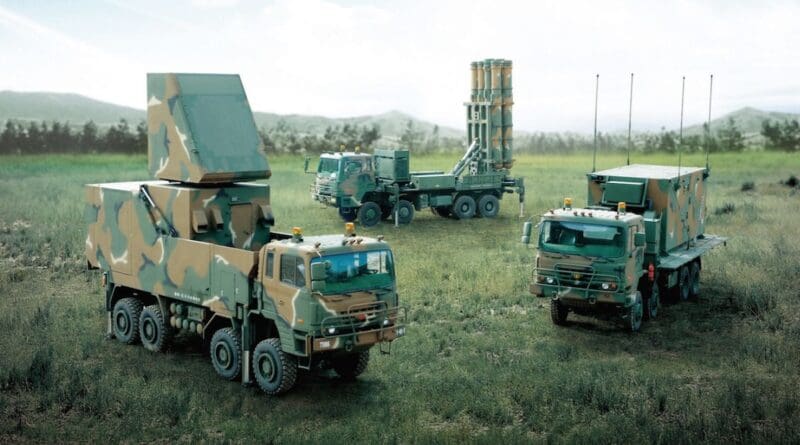
South Korean M-SAM's multifunction radar, vertical launcher, and control center vehicle mockup models. Photo Credit: 방위사업청 - Defense Acquisition Program Administration (DAPA), Wikipedia Commons
July 27, 2026
Geopolitical Monitor
By Dr. Ju Hyung Kim
Key Takeaways:
South Korea’s Opportunity: Seoul should market a full Korean package (C-UAS systems, Cheongung-II, potential L-SAM, and combat management network) focused on sustainment—local stockpiles, maintenance, training, and possible co-production—to help GCC states endure prolonged campaigns rather than simply selling individual launchers.
Missile and drone operations amid the Iran war revealed a structural vulnerability in Gulf air defense. Although the Gulf Cooperation Council (GCC) states have some of the world’s most advanced missile interceptors, high-end systems alone cannot offer an affordable and sustainable defense against prolonged attacks involving ballistic missiles, cruise missiles, and one-way attack drones.
Apparently, Iran does not use a fixed combination of weapons. It adjusts the drone-missile ratio depending on political objectives, available inventory, the survivability of launchers, and the condition of the opponent’s air defense network. Therefore, GCC states need a layered defense portfolio capable of defending against Iran’s various salvo patterns.
South Korea is well positioned to present such a portfolio. Nonetheless, instead of providing individual systems such as Cheongung-II, Seoul should propose an integrated Korean air-defense package based on evolving Iranian attacks.
Iran’s Evolving Salvo Mix
Iran’s attack against Israel in April 2024 is a good reference point. During Operation True Promise, Iran launched approximately 170 one-way drones, 120 ballistic missiles, and 30 cruise missiles. Hence, the salvo consisted of roughly 53 percent drones, 38 percent ballistic missiles, and 9 percent cruise missiles.
These weapons approached at different speeds, altitudes, and times. Slower drones imposed long-term pressure on sensors, fighter jets, and command systems. Cruise missiles made low-altitude detection difficult, while ballistic missiles compressed decision-making and engagement timelines.
Previous attacks in the Gulf followed a different pattern. For example, the September 2019 strike against Saudi Arabia’s Abqaiq and Khurais facilities was primarily conducted by drones and low-flying cruise missiles. Using gaps in radar coverage and point defense, they temporarily suspended Saudi crude oil production by roughly 5.7 million barrels per day.
These distinctions matter. The Abqaiq case represented a precision low-altitude penetration attack. Operation True Promise demonstrated a massive layered salvo that was designed to strain the entire defensive network.
The June 2025 Israel-Iran war illustrated how the composition could change during a protracted conflict. In twelve days, Iran reportedly launched roughly 550 ballistic missiles and 1,000 drones, generating ratios of 35 percent and 65 percent for ballistic missiles and drones, respectively.
Meanwhile, in the initial 100 hours of the 2026 Iranian war, more than 2,000 drones and 500 ballistic missiles were launched, making the composition even more drone-heavy, suggesting an approximate ratio of 80 percent drones and 20 percent missiles.
To be sure, these figures should not be treated as fixed estimates. Nonetheless, they indicate three comprehensive scenarios:limited retaliation involving roughly 50–55 percent drones;
sustained operations involving 65–70 percent drones;
and a prolonged war of attrition in which drones may account for approximately 75–80 percent of the threat.
The Problem of Interceptor Economy
In responding to high-end threats, such as ballistic missiles, Patriot and THAAD remain essential. However, repeatedly using expensive interceptors against cheaper drones would rapidly become financially and operationally unsustainable.
Effective defense must assign an appropriate response to each target. Electronic warfare, guns, short-range missiles, fighter jets, helicopters, and drones should address low-cost threats. Medium- and upper-tier missile systems should be reserved for cruise and ballistic missiles.
To make this happen, an integrated command-and-control network is required that can categorize inbound objects, set engagement priorities, allocate interceptors, and monitor ammunition consumption.
A Korean Layered Package
South Korea should propose a defense architecture that is composed of four layers.
The first layer should consist of Counter-Unmanned Aerial Systems (C-UAS). Since drones may constitute half to four-fifths of an Iranian attack, C-UAS capability should be central, not supplementary. A South Korean package should be able to combine low-altitude radar, passive sensors, electronic warfare, guns, low-cost guided missiles, and drones.
The second layer should be structured around Cheongung-II. By complementing the existing Patriot and THAAD systems, the system could offer medium-tier defense against aircraft, cruise missiles, and some ballistic missile threats. Its core value would lie not in replacing American systems but in distributing the defense burden and diversifying the supply chains of GCC states.
As a complementary system for upper-tier defense, the third layer should include L-SAM. Although L-SAM should not immediately be portrayed as a direct substitute for THAAD batteries, it may become an additional option for GCC states seeking greater strategic autonomy and protection against high-altitude ballistic missile threats.
The fourth layer should be an integrated combat management system that links existing GCC radars, aircraft, and Western systems. Such a network would construct a shared operational map, sort threats, and suggest which weapons should engage each target.
Given the GCC’s internal political sensitivities, the structure should be flexible. National systems can initially be developed bilaterally and may be connected through a selective intelligence-sharing system.
Selling Sustainment, Not Launchers
The true test of Gulf air defense does not hinge on whether the first salvo attack can be defeated. It hinges on whether it can continue to operate after seven, 30, and 90 days.
A protracted conflict depletes interceptor stockpiles, strains maintenance systems, consumes operational manpower, and reveals the weaknesses of resupply systems. Thus, alongside weapons, South Korea should provide a sustainability package.
The package should include locally stored reserves, dispersed ammunition facilities, maintenance and repair centers, simulators, and immediate resupply systems. Local assembly or production of some interceptors and C-UAS munitions could further enhance resilience.
Stockpile planning should reflect various types of Iranian attack scenarios. Naturally, GCC governments should calculate how many low-cost C-UAS systems and medium- and upper-tier interceptors would be needed for 30-, 60-, and 90-day campaigns.
From Supplier to Strategic Partner
Iran’s changing salvo ratio shows why the Gulf does not need a purely C-UAS solution or a defense network solely dedicated to ballistic missiles. The Gulf requires a layered system that can deal with both mass and sophistication.
Therefore, South Korea’s comparative advantage should lie in pairing its C-UAS systems, Cheongung-II, a prospective L-SAM layer, and integrated command-and-control with localized maintenance, production, training, and stockpiling.
By proposing such a broader set of options, South Korea could be elevated from merely selling missile batteries to becoming a long-term partner in building the Gulf’s ability to withstand prolonged missile and drone warfare.
By Dr. Ju Hyung Kim
Key Takeaways:
Vulnerability to Mixed Salvos: Despite advanced interceptors like Patriot and THAAD, GCC states face an unsustainable “interceptor economy” problem against Iran’s evolving attacks, which combine high volumes of low-cost drones (often 50–80% of salvos) with ballistic and cruise missiles, straining sensors, decision timelines, and expensive munitions.
Need for Layered Defense: Effective protection requires a multi-tier architecture that assigns appropriate, cost-effective responses to each threat type—prioritizing C-UAS (electronic warfare, guns, low-cost missiles) for drones while reserving higher-tier systems for more sophisticated missiles—linked by integrated command-and-control.
South Korea’s Opportunity: Seoul should market a full Korean package (C-UAS systems, Cheongung-II, potential L-SAM, and combat management network) focused on sustainment—local stockpiles, maintenance, training, and possible co-production—to help GCC states endure prolonged campaigns rather than simply selling individual launchers.
Missile and drone operations amid the Iran war revealed a structural vulnerability in Gulf air defense. Although the Gulf Cooperation Council (GCC) states have some of the world’s most advanced missile interceptors, high-end systems alone cannot offer an affordable and sustainable defense against prolonged attacks involving ballistic missiles, cruise missiles, and one-way attack drones.
Apparently, Iran does not use a fixed combination of weapons. It adjusts the drone-missile ratio depending on political objectives, available inventory, the survivability of launchers, and the condition of the opponent’s air defense network. Therefore, GCC states need a layered defense portfolio capable of defending against Iran’s various salvo patterns.
South Korea is well positioned to present such a portfolio. Nonetheless, instead of providing individual systems such as Cheongung-II, Seoul should propose an integrated Korean air-defense package based on evolving Iranian attacks.
Iran’s Evolving Salvo Mix
Iran’s attack against Israel in April 2024 is a good reference point. During Operation True Promise, Iran launched approximately 170 one-way drones, 120 ballistic missiles, and 30 cruise missiles. Hence, the salvo consisted of roughly 53 percent drones, 38 percent ballistic missiles, and 9 percent cruise missiles.
These weapons approached at different speeds, altitudes, and times. Slower drones imposed long-term pressure on sensors, fighter jets, and command systems. Cruise missiles made low-altitude detection difficult, while ballistic missiles compressed decision-making and engagement timelines.
Previous attacks in the Gulf followed a different pattern. For example, the September 2019 strike against Saudi Arabia’s Abqaiq and Khurais facilities was primarily conducted by drones and low-flying cruise missiles. Using gaps in radar coverage and point defense, they temporarily suspended Saudi crude oil production by roughly 5.7 million barrels per day.
These distinctions matter. The Abqaiq case represented a precision low-altitude penetration attack. Operation True Promise demonstrated a massive layered salvo that was designed to strain the entire defensive network.
The June 2025 Israel-Iran war illustrated how the composition could change during a protracted conflict. In twelve days, Iran reportedly launched roughly 550 ballistic missiles and 1,000 drones, generating ratios of 35 percent and 65 percent for ballistic missiles and drones, respectively.
Meanwhile, in the initial 100 hours of the 2026 Iranian war, more than 2,000 drones and 500 ballistic missiles were launched, making the composition even more drone-heavy, suggesting an approximate ratio of 80 percent drones and 20 percent missiles.
To be sure, these figures should not be treated as fixed estimates. Nonetheless, they indicate three comprehensive scenarios:limited retaliation involving roughly 50–55 percent drones;
sustained operations involving 65–70 percent drones;
and a prolonged war of attrition in which drones may account for approximately 75–80 percent of the threat.
The Problem of Interceptor Economy
In responding to high-end threats, such as ballistic missiles, Patriot and THAAD remain essential. However, repeatedly using expensive interceptors against cheaper drones would rapidly become financially and operationally unsustainable.
Effective defense must assign an appropriate response to each target. Electronic warfare, guns, short-range missiles, fighter jets, helicopters, and drones should address low-cost threats. Medium- and upper-tier missile systems should be reserved for cruise and ballistic missiles.
To make this happen, an integrated command-and-control network is required that can categorize inbound objects, set engagement priorities, allocate interceptors, and monitor ammunition consumption.
A Korean Layered Package
South Korea should propose a defense architecture that is composed of four layers.
The first layer should consist of Counter-Unmanned Aerial Systems (C-UAS). Since drones may constitute half to four-fifths of an Iranian attack, C-UAS capability should be central, not supplementary. A South Korean package should be able to combine low-altitude radar, passive sensors, electronic warfare, guns, low-cost guided missiles, and drones.
The second layer should be structured around Cheongung-II. By complementing the existing Patriot and THAAD systems, the system could offer medium-tier defense against aircraft, cruise missiles, and some ballistic missile threats. Its core value would lie not in replacing American systems but in distributing the defense burden and diversifying the supply chains of GCC states.
As a complementary system for upper-tier defense, the third layer should include L-SAM. Although L-SAM should not immediately be portrayed as a direct substitute for THAAD batteries, it may become an additional option for GCC states seeking greater strategic autonomy and protection against high-altitude ballistic missile threats.
The fourth layer should be an integrated combat management system that links existing GCC radars, aircraft, and Western systems. Such a network would construct a shared operational map, sort threats, and suggest which weapons should engage each target.
Given the GCC’s internal political sensitivities, the structure should be flexible. National systems can initially be developed bilaterally and may be connected through a selective intelligence-sharing system.
Selling Sustainment, Not Launchers
The true test of Gulf air defense does not hinge on whether the first salvo attack can be defeated. It hinges on whether it can continue to operate after seven, 30, and 90 days.
A protracted conflict depletes interceptor stockpiles, strains maintenance systems, consumes operational manpower, and reveals the weaknesses of resupply systems. Thus, alongside weapons, South Korea should provide a sustainability package.
The package should include locally stored reserves, dispersed ammunition facilities, maintenance and repair centers, simulators, and immediate resupply systems. Local assembly or production of some interceptors and C-UAS munitions could further enhance resilience.
Stockpile planning should reflect various types of Iranian attack scenarios. Naturally, GCC governments should calculate how many low-cost C-UAS systems and medium- and upper-tier interceptors would be needed for 30-, 60-, and 90-day campaigns.
From Supplier to Strategic Partner
Iran’s changing salvo ratio shows why the Gulf does not need a purely C-UAS solution or a defense network solely dedicated to ballistic missiles. The Gulf requires a layered system that can deal with both mass and sophistication.
Therefore, South Korea’s comparative advantage should lie in pairing its C-UAS systems, Cheongung-II, a prospective L-SAM layer, and integrated command-and-control with localized maintenance, production, training, and stockpiling.
By proposing such a broader set of options, South Korea could be elevated from merely selling missile batteries to becoming a long-term partner in building the Gulf’s ability to withstand prolonged missile and drone warfare.
The views and opinions expressed in this article are those of the author alone and do not represent those of Geopoliticalmonitor.com
About Geopolitical Monitor
Geopoliticalmonitor.com is an open-source intelligence collection and forecasting service, providing research, analysis and up to date coverage on situations and events that have a substantive impact on political, military and economic affairs.
View all posts by Geopolitical Monitor →
About Geopolitical Monitor
Geopoliticalmonitor.com is an open-source intelligence collection and forecasting service, providing research, analysis and up to date coverage on situations and events that have a substantive impact on political, military and economic affairs.
View all posts by Geopolitical Monitor →

No comments:
Post a Comment