BAN DEEP SEA MINING!
US aims to issue deep-sea mining permits within months, Interior Secretary Burgum says
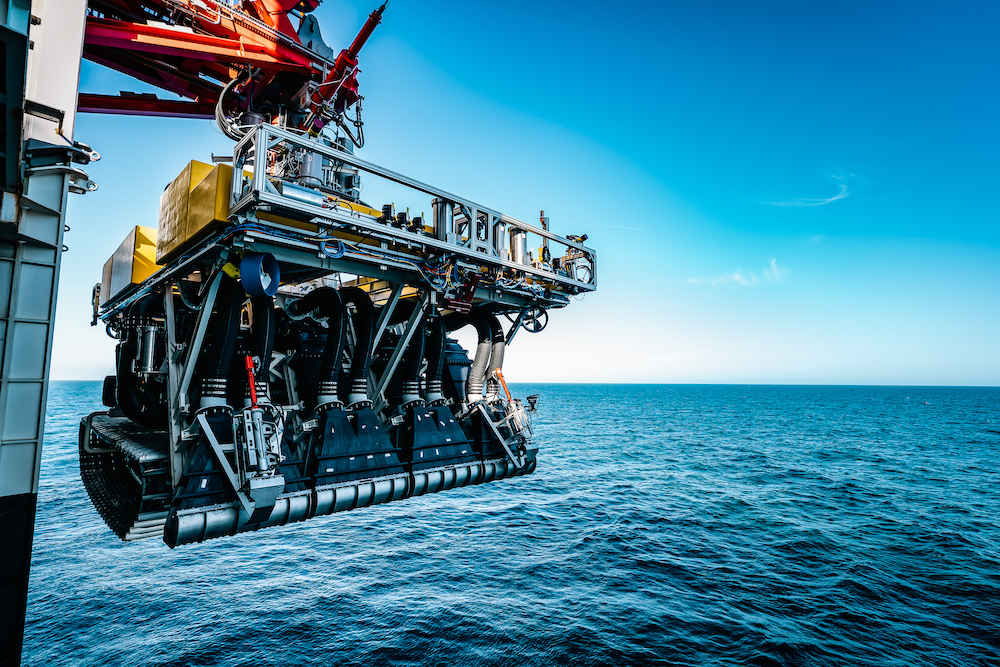
The Trump administration on Monday signaled it is nearing approval for permits to mine the deep sea, part of a broader push to boost U.S. access to the critical minerals used across much of the country’s economy.

Interior Secretary Doug Burgum said during a gathering of G20 energy ministers in Houston that permits could come within months as the administration pursues a strategy of “energy addition” to expand supply chains for the country and allies.
Since returning to office last year, President Donald Trump has taken steps to bolster the nascent deep-sea mining industry, although he has yet to issue operational permits for it to proceed.
The specter of seabed mining being allowed to commence has alarmed many environmentalists due to concern it could cause irreversible biodiversity loss.
Parts of the Pacific Ocean and elsewhere are estimated to contain large amounts of potato-shaped rocks known as polymetallic nodules that contain the building blocks for electric vehicles, weapons and electronics.
“Those nodules that we just have to go out and vacuum up off the (sea) floor are filled with these critical minerals that we need,” Burgum said. “And of course, part of that is assuring that we’ve got diverse, secure, affordable supply of critical minerals.”
U.S. access to critical minerals — especially those processed by Chinese companies — has dwindled in the past 18 months as Beijing has limited exports. That, in turn, has ratcheted up pressure on Washington to support efforts to boost domestic mining.
When asked when the federal government could issue deep-sea permits, Burgum said: “Those discussions are going on right now,” adding that, “You’ll be hearing more in the weeks and months ahead because there’s some exciting developments that are coming on that front.”
Burgum’s Interior Department oversees the Marine Minerals Administration, which must approve any permits to mine U.S. territorial waters.
The MMA review process would start with a lease sale to give private companies exclusive access to mine part of the seabed. That would be followed by a process to consider an operational permit, which would take into account a range of scientific data.
Separately, Trump aims to have the Commerce Department issue international permits, a step that could set up a clash with the United Nations-backed International Seabed Authority, which has been trying to set standards for more than 25 years.
Companies that have formally asked for seabed mining permits include The Metals Company and privately held Impossible Metals. Several others have applied for exploration permits.
(Reporting by Ernest Scheyder; additional reporting by Sheila Dang, Georgina McCartney and Evan Garcia; Editing by Bill Berkrot)
Green Manganese demonstrates single process critical metals recovery from polymetallic nodules

Green Manganese Technologies said it has successfully completed initial metallurgical test work demonstrating that its proprietary hydrometallurgical process can recover multiple critical metals from polymetallic nodules through a single, integrated process.
Polymetallic nodules, found resting unattached on the deep-ocean floor contain nickel, cobalt, copper, and manganese – core inputs for global battery, electronics, and defense supply chains.
As interest in ocean-based mineral resources grows, efficiently processing the complex matrix of metals contained in nodules remains a primary bottleneck to commercial deployment.
Unlike conventional processing flowsheets that rely on multi-stage pyrometallurgical smelting—sequentially calcining and smelting nodules to separate a nickel-copper-cobalt alloy from a manganese silicate slag—Green Manganese says its hydrometallurgical platform is engineered to extract all principal critical metals from polymetallic nodules in one integrated process.
By bypassing Submerged Arc Furnaces (SAF), electrolysis, and multi-phase converting steps entirely, Green Manganese said process consumes up to 5 times less energy while achieving greater than 90% recovery of manganese, nickel, cobalt, and copper simultaneously.
Selectively dissolving the manganese minerals releases associated critical metals into a unified process solution. Simultaneously, iron minerals are converted into hematite, simplifying downstream handling and creating an additional value stream to recover iron, titanium, and rare earth elements, maximizing overall resource utilization.
“What makes polymetallic nodules so compelling is that several critical metals are concentrated in a single rock,” Green Manganese Technologies CEO Alexey Demykin said in a news release.
“Instead of forcing a next-generation multi-metal feedstock into legacy technologies built for single ores, this new era of critical minerals demands a fundamental shift in processing,” Demykin said. “By extracting manganese, nickel, cobalt, and copper in one integrated hydrometallurgical circuit, we bypass energy-intensive thermal stages entirely—delivering a streamlined, low-emission pathway to multiple high-value products.”
Green Manganese said its hydrometallurgical platform uses specialized manganese chemistry to extract target metals from complex, manganese-bearing materials. As deep-sea resource developers move closer to commercial collection, the company said its results demonstrate a viable route to simplify nodule processing, establishing a foundation for further pilot-scale testing and commercial collaboration.

No comments:
Post a Comment