World Nuclear News
Indiana to get its first power-producing nuclear reactor
_96111.jpg)
Naval Weapons Station Crane is described by the US Department of War as one of the nation's "premier warfighting innovation and capability development hubs". This reactor deployment "marks the first step in a larger, unified Department-wide effort to deploy safe and secure nuclear power for national security", with the micromodular reactor (MMR) installation providing reliable, around-the-clock power independent of the commercial electric grid, capable of sustaining critical operations under the most demanding conditions, it said.
The MMR installation is being executed through the Army's Janus Program, and implements two Executive Orders issued by President Donald Trump last year: Executive Order 14299 - Deploying Advanced Nuclear Reactor Technologies for National Security, which aims for operation of an Army-regulated nuclear reactor at a domestic military installation no later than 30 September 2028, and Executive Order 14302 - Reinvigorating the Nuclear Industrial Base. The Department said the MMR will be installed at Crane by the September 2028 deadline.
Launched last October, Janus is a next-generation nuclear power programme aimed at delivering "resilient, secure, and assured energy to support national defence installations and critical missions". The US Department of War's 9 September announcement comes several weeks after the US Department of the Army selected five microreactor developers for deployment at five Department of War installations as part of the programme.
The MMR installation at Crane is being executed through the Janus Program in coordination with the Department of the Navy, the Department of War Innovation Unit, and the Office of the Assistant Secretary of War for Critical Technologies, which is leading the coordination of key stakeholders across the Department to integrate and execute the Crane project.
"At Critical Technologies, we start from a simple first principle: a technology matters only when it reaches the mission," Mike Dodd, Assistant Secretary of War for Critical Technologies, said. "Our standard is to field and deploy capability within 24 months or less."
This initiative builds on more than a year of close coordination between the Department of War and Indiana state leadership, the Department said, adding that it "will continue to work with Federal, state, and local partners throughout the required safety, environmental, regulatory, and installation processes. Nuclear safety, physical security, cybersecurity, and responsible stewardship of taxpayer resources will remain central at every stage."
Indiana Senator Todd Young described the announcement is "exciting news" for Indiana, saying: "This first-of-its-kind mission will bring the highest levels of nuclear expertise to our state and is another example of the important role Hoosiers are playing in our national security."
China launches Global Network for SMR Innovation
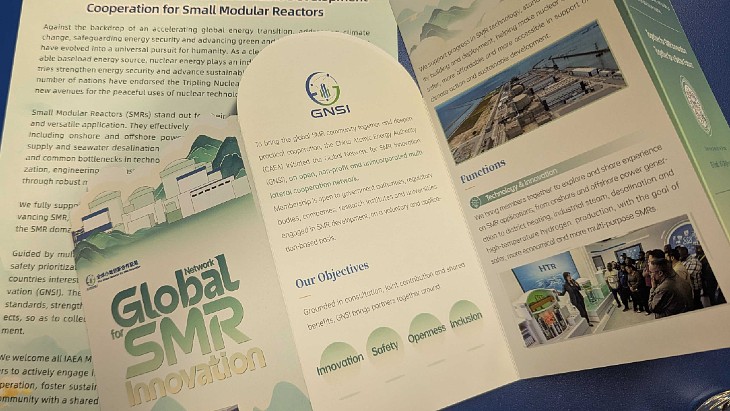
In an event to promote the launch of the initiative at the 70th IAEA General Conference in Vienna, the message was that small modular reactors (SMRs) "are expected to play a critical role in the global expansion of nuclear energy", with a wide range of uses beyond electricity generation, such as offshore power, high-temperature hydrogen production, district heating and desalination.
The meeting was told that the technology, regulatory, economic and supply chain challenges require multinational cooperation and collective efforts.
The organisers of the Global Network for SMR Innovation (GNSI) stressed that the "non-profit, unincorporated and open cooperation mechanism" would complement the International Atomic Energy Agency, with all membership voluntary and open to government departments, regulatory bodies, companies, research institutes and universities.
Structurally, it will have a governing board, a secretariat, specialised committees and working groups. The first general assembly and inaugural conference is scheduled for the end of this year, attendees were told. All members will be bound by confidentiality, with intellectual property ownership "determined through consultation".
The event featured speakers from a range of Chinese enterprises involved in SMR development, including the ACP100 - also known as the Linglong One - the first of which is currently being commissioned on the island of Hainan. This has a rated power of 125 MWe, a 24-month refuelling schedule, a 58-month construction timeline and requires a land area of 20.6 hectares. There was discussion also of the Guohe series, including the Gen 3+ GH300 and the GH200T, which would be 200 MWt or 50-60 MWe.
In addition, there was an overview of the HTR-PM, a pebble bed modular high temperature gas-cooled reactor (HTGR), and a proposal that the new initiative could facilitate the sharing of practical HTGR experience in design, construction and operation as well as "enhance communication on safety regulation and technical standards and deepen industrial collaboration with joint R&D, supply chain cooperation and talent development".
CGN said its "key driver" was the 200 MWt HuaPeng-1 integral natural circulation pressurised SMR, which would have an estimated construction timeline of 36 months and need a site area of 10 hectares. It would provide global partners with "deployment-ready SMR products and offer end-to-end project services and open R&D for scenario-specific SMR development.
The event heard from representatives of Pakistan, Thailand and Nigeria about their support for the project and the opportunities for cooperation in the potential development of SMRs and SMR projects.
Deputy Director General of the International Atomic Energy Agency Huang Wei noted the agency's latest projection for future nuclear energy capacity - which could lead to as many as 1,000 SMRs globally by 2060 - and said the agency was "pleased to see China taking proactive steps to build a favourable level playing field for nuclear energy to release its full potential. The launch of this Global Network for SMR Innovation by China will further reinforce the IAEA's activities and efforts in strengthening international cooperation on SMRs".
UK regulators to begin Xe-100 design assessment
_52450.jpg)
The decision was announced exactly a year after British multinational energy and services company Centrica and X-energy Reactor - a subsidiary of X-energy LLC of the USA - signed a Joint Development Agreement to deploy X-energy's Xe-100 advanced modular reactors in the UK. The companies have identified EDF and Centrica's Hartlepool site in the north-east of England as the preferred first location for a planned UK fleet of up to 6 GWe.
Generic Design Assessment (GDA) is a voluntary process through which the UK's nuclear regulators - the Office for Nuclear Regulation (ONR), Environment Agency and Natural Resources Wales - assess the safety, security and environmental implications of new reactor designs intended for deployment in Great Britain (England, Scotland and Wales), separately from applications to build them at specific sites. Successful completion of the three-step GDA culminates in the issue of a Design Acceptance Confirmation from the ONR and a Statement of Design Acceptability from the Environment Agency.
The ONR said the GDA will begin "once the necessary arrangements around timescales and resources have been put in place". X-energy UK Holding Ltd is also currently engaging with UK regulators as part of a Tier 3 Preliminary Design Review on selected topic areas of the Xe-100 design, the regulator noted.
X-energy submitted its application to enter the GDA process for the Xe-100 in June. GDA acceptance formally triggers the process of assessing the design’s acceptability for deployment and operation ahead of the technical and environmental evaluations required for site-specific licensing and permitting, which is expected to take about three years.
The submission builds on the Xe-100's US licensing progress and is expected to benefit from expanded collaboration between the UK regulators and the US Nuclear Regulatory Commission (NRC), X-energy said, enabling NRC-reviewed design documentation and safety analyses into UK design reviews. The NRC has been actively engaged in pre-application activities with X Energy since September 2018.
Over the past year, the partners have carried out early project activities including formal Early Engagement with UK nuclear regulators as well as the submission and subsequent acceptance of the Xe-100 into GDA process. They have also submitted a proposal for entry into the UK Government's Advanced Nuclear Pipeline, a register of privately led advanced nuclear projects seeking deployment in England or Wales that the government has assessed and believes are, in principle, sufficiently mature and could credibly be delivered in the UK, subject to regulatory and government approvals. The results of that submission are imminent, the companies said.
"Across both sides of the Atlantic, X-energy is advancing fleet-scale deployment of our technology, and it begins with a strong regulatory foundation that enables us to drive efficiency from the first project to a full commercial fleet. Together with Centrica, we are advancing the development work required to move from a first project at Hartlepool to a fleet of Xe-100 plants across the country," X-energy CEO Clay Sell said. "The UK has the industrial capability, nuclear expertise and policy ambition to lead the deployment of advanced nuclear technology, and we are committed to building the partnerships and supply chain needed to deliver that opportunity."
Centrica CEO Chris O’Shea said the milestone shows the "tremendous progress" made by the partnership in just 12 months. "Without energy security, we don’t have true national security. Nuclear has a critical role to play in this," he said.
"Deploying advanced nuclear technology at scale, with up to 6GW of new capacity across the UK, will not only strengthen our energy security, but it will create tens of billions of economic value and thousands of highly skilled jobs.
"Starting at Hartlepool, we want to help build a resilient, low-carbon energy system that can power homes and industry for decades to come."
The partnership has already engaged a range of specialist firms to commence site studies and planning and consenting activities, and collaborated with local bodies in Hartlepool to support workforce development and training, including the launch of a new Nuclear and Electrical Trades Academy.
The Xe-100 is a Generation IV advanced reactor design producing an output of 80 MW of electricity, or 200 MW thermal. A standard 'four-pack' configuration would allow for total power output of 320 MWe, scalable to up to 12 units per site. The Xe-100 uses tri-structural isotropic (TRISO) particle fuel, which has additional safety benefits because it can withstand very high temperatures without melting, and can provide both electricity and process heat. X-energy is advancing its initial Xe-100 plant in the USA with Dow Inc on the Texas Gulf Coast, and is also developing a further plant with Energy Northwest in collaboration with Amazon, to build up to 12 units near Energy Northwest's Columbia Generating Station in Washington State.
eVinci sets temperature record during zero-power criticality tests
_66007.jpg)
The work was completed in partnership with Los Alamos National Laboratory and the Nevada National Security Site (NNSS) at the US Department of Energy's National Nuclear Security Administration (NNSA) National Criticality Experiments Research Center (NCERC) in Nevada.
As well as reaching zero-power high-temperature criticality at 663 degrees Celsius, Westinghouse researchers also made a subcritical reactivity measurement at a peak core temperature of 1,011 degrees C, a record high temperature for a reactivity measurement at NCERC. These achievements generated high-quality, temperature-dependent data to further strengthen analytical models and accelerate prototype design, the company said, continuing experimental work which started with eVinci zero-power criticality testing earlier this year and advancing understanding of how the reactor design behaves as representative materials are heated toward operating conditions.
“For nearly a century, Westinghouse pioneers have not waited for the future of nuclear energy - they have engineered it. This milestone brings that same spirit to the eVinci programme,” said Dan Sumner, Westinghouse President and Chief Executive Officer. “Our teams are rapidly building, testing, learning and improving advanced nuclear technologies, turning uncertainty into validated evidence and strengthening the design for a highly-deployable advanced microreactor solution for our customers. We appreciate the strong support of the US Department of Energy, NNSA, Los Alamos National Laboratory and NNSS in helping us advance this important work.”
The eVinci is a heat pipe-cooled microreactor which can produce up to 5 MWe with a 15 MWt core design. The TRISO-fuelled reactor core is designed to run for eight or more full-power years before refuelling, and the factory-built and assembled reactor can be shipped in a container to provide versatile, scalable energy for a variety of applications, including defence and in space.
Groundwork begins for demonstration Hualong One 2.0 units
_98552.jpg)
The construction of two Hualong One (HPR1000) reactors as Phase II of the Jinqimen plant was approved during a State Council executive meeting chaired by Chinese Premier Li Qiang on 31 July. The units have been designated as demonstration projects of the Hualong One 2.0 reactor design.
Hualong One 2.0 is described as "an advanced pressurised water reactor (PWR) nuclear power technology combining third-generation and advanced technologies, developed through independent innovation and overall collaboration, based on feedback from the construction and operation experience of Hualong One". CNNC noted that, so far, 10 Hualong One units are commercially operational both domestically and internationally, with another 37 units approved for construction.
China National Nuclear Corporation (CNNC) announced that a mobilisation meeting for the construction of the units was held on 9 September, during which "the first blast of the Phase II excavation was successfully detonated, marking the full-scale advancement of Phase II construction".
The construction of two Hualong One reactors as Phase I of the Jinqimen plant was approved by China's State Council in December 2023. A ground-breaking ceremony was held in February 2024 to mark the start of work on the units. First concrete for the foundation of the reactor building of unit 1 was poured on 10 August last year, marking the official start of construction of the unit. First concrete for unit 2 was poured on 4 April this year.
_a7870616.jpg)
The Jinqimen site (Image: CNNC)
CNNC subsidiary CNNC Zhejiang Energy Co Ltd is responsible for project investment, construction and operations management of the new plant, which will eventually house six Hualong One units. Another CNNC subsidiary, China Nuclear Engineering & Construction Corporation, is responsible for the construction of the nuclear island, conventional island, and key facilities of the Jinqimen nuclear power project.
Once all six units have been completed, the total installed capacity of the Jinqimen plant will be about 7.2 GWe, and the annual grid-connected electricity will be some 55 TWh, which according to CNNC is equivalent to half of Ningbo's total electricity consumption in 2024. The plant, it said, will reduce carbon dioxide emissions by about 45 million tonnes. "This will provide strong support for energy and power supply and green and low-carbon transformation in Zhejiang Province and the Yangtze River Delta region," the company said.
First SMR funding agreed by European Investment Bank
_29695_19459.jpg)
The European Investment Bank (EIB) is owned by the 27 European Union member states, who are split in their opinions on nuclear energy. In the past it has generally avoided new nuclear projects and only invested in nuclear-related safety projects, such as at Chernobyl. But in the past year or so it has issued loans for a Romanian reactor refurbishment project and for a project to extend the Georges Besse II uranium enrichment plant in Tricastin in southern France.
This is now its first investment in a small modular reactor technology (SMR).
The money is to support Steady Energy's research and development, testing and licensing activities as it seeks to move towards commercial development, and will be provided for activities between this year and 2028.
EIB Group Vice-President Karl Nehammer said: "The support to Steady Energy is a flagship example of how the EIB Group is backing innovation to strengthen Europe's competitiveness, enhancing energy autonomy and expanding access to affordable clean energy. We are actively looking to support Europe's most promising SMR pioneers. By providing stable, low-carbon energy alongside renewables, SMRs can help build a more secure and resilient European energy mix, reducing reliance on fossil fuels and exposure to volatile energy prices."
Steady Energy CEO Tommi Nyman said: "More than 40 percent of final energy demand is heat. Most of the heat we consume comes from fossil fuels. With Steady Energy's solution, we can wean ourselves further away from imported fuels. We are extremely pleased that the EIB has decided to support Steady Energy as we proceed towards our first concrete projects in the next few years."
The EIB investment is in the form of a senior unsecured convertible loan, which gives the EIB the option to convert its investment into listed shares in the future.
The EIB said the investment was in line with the European Commission's strategy to bring Europe's first SMRs online by the early 2030s. It says it "adopts a technology-neutral approach in line with the European Union's decarbonisation goal and the objectives of ensuring security of energy supply and competitiveness in an environmentally sustainable, cost-efficient, effective, safe and socially acceptable way".
In total in 2025, the European Investment Bank agreed EUR100 billion in new financing and advisory services for 870 projects "under eight core priorities that support EU policy objectives: climate action and the environment, digitalisation and technological innovation, security and defence, territorial cohesion, agriculture and the bioeconomy, social infrastructure, strong global partnerships and the savings and investments union".
Steady Energy's reactor
Steady Energy was spun out of Finland's VTT Technical Research Centre in 2023. The LDR-50 SMR, with a thermal output of 50 MW, is designed to operate at around 150°C. Unlike most SMRs being developed around the world, it is not designed to generate electricity - or electricity and heat. Instead, it is designed to only produce heat and is focused on district heating, as well as industrial steam production and desalination projects.
The company has already signed agreements for 15 reactors in Finland, with its reactor design currently being assessed by the Finnish Radiation and Nuclear Safety Authority, STUK. In June 2025, STUK said the draft concept assessment for Steady Energy's LDR-50 found that "nuclear and radiation safety, security arrangements, emergency arrangements and nuclear material safeguards solutions are such that they can be designed to meet safety requirements".
The aim is for construction of the first plant - to be the clean energy source for a district heating scheme - to begin in 2029.
Listen: Steady Energy on the September 2024 WNN podcast:

No comments:
Post a Comment