Shipments of certain advanced US chips to Malaysia, Thailand and Singapore need a licence from November 19, under a Commerce Department rule aimed at Chinese firms renting computing power abroad.
The interim final rule, released by the department's Bureau of Industry and Security on November 16 and listed for publication in the Federal Register on November 19, also names Indonesia and Brazil, all five described as countries "which present a higher-than-normal risk of diversion". Chips bound for buyers headquartered in the US, or owned by a US parent, are exempt, provided the exporter files new reports.
A second control follows the computing rather than the hardware. A data centre anywhere in the world needs a licence for advanced chips if it supplies more than 12mn units of "aggregate TPP", the rule's measure of combined processing performance, to companies headquartered in China, Macau or other Country Group D:5 states. That ceiling equals roughly 750 of Nvidia's H100 processors, according to Malaysian brokerage Kenanga. Operators already serving such clients have 90 days to get a licence, and must vet customers for direct or indirect Chinese ownership or control.
"The rule is designed to ensure that existing restrictions on access to sensitive American technology cannot be circumvented through remote computing arrangements involving data centers in third countries," the bureau said in its announcement, adding that the Treasury and the National Security Council had written and directed it. The same text scraps the Biden administration's AI Diffusion rule of January 2025.
Southeast Asia's fastest-growing property business is the one in the line of fire. Its data-centre build-out, financed by US cloud giants, Japanese capital and operators with Chinese roots alike, rests on renting out exactly the processing power Washington now polices. Malaysia had 1,039 MW of capacity under construction at end-June and Thailand 859 MW, according to property consultancy Cushman & Wakefield's half-year update. Johor alone had a 3,088 MW pipeline on top of 1,110 MW already running.
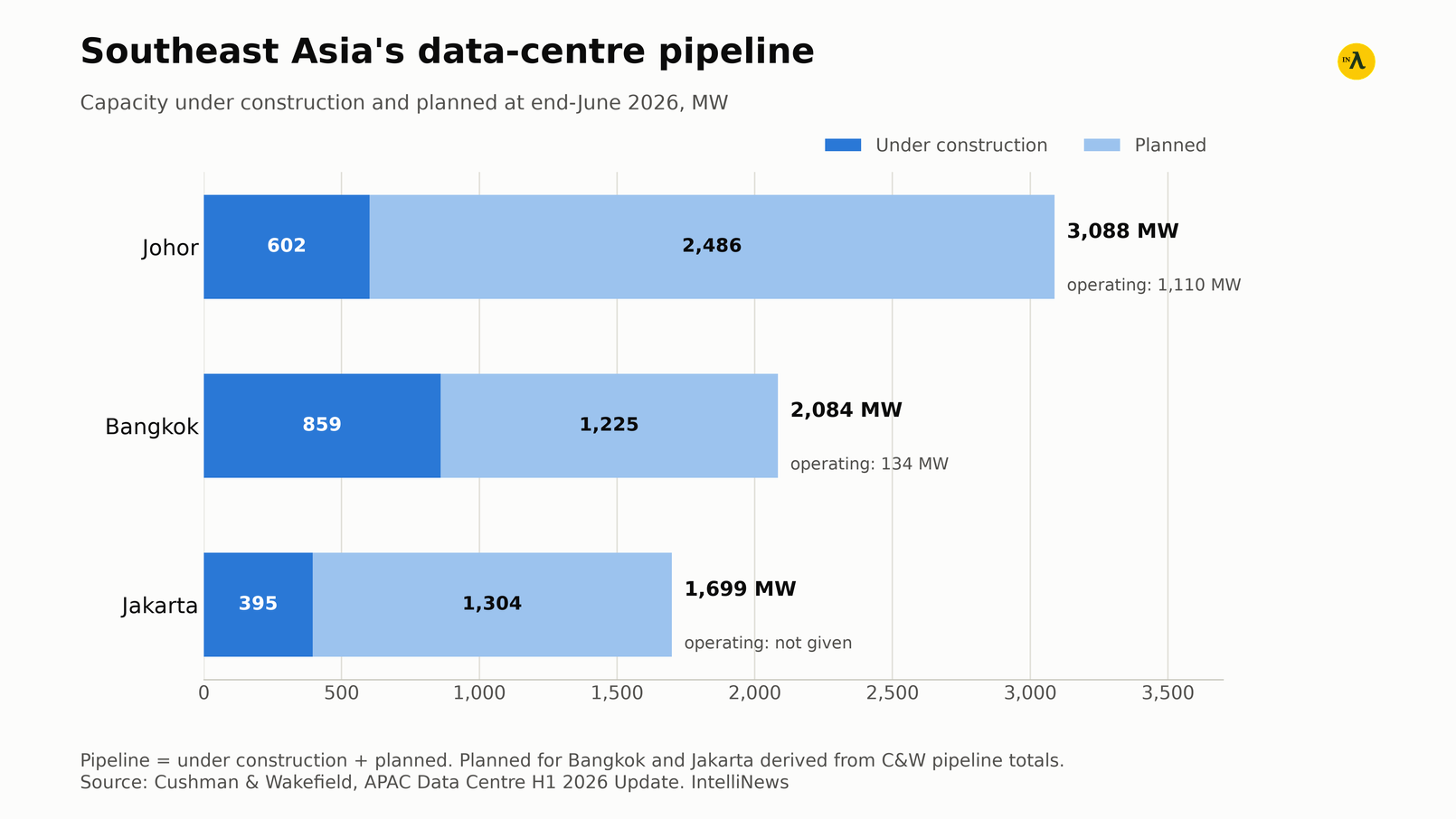
Data-centre capacity under construction and planned in Johor, Bangkok and Jakarta at end-June 2026, MW. Source: Cushman & Wakefield, APAC Data Centre H1 2026 Update. IntelliNews
Johor in the spotlight
Malaysia has required permits to export, tranship or move US-made high-performance AI chips in transit since July 2025. Customs officers seized 30 servers with advanced chips at Kuala Lumpur International Airport in October, the fifth case this year tied to one syndicate. On November 12 Investment, Trade and Industry Minister Johari Abdul Ghani said companies applying to build data centres would have to disclose the operator, the site and the number of GPUs they plan to import.
GDS Holdings, one of China's biggest operators, opened a hyperscale campus in Johor and then spun off its overseas arm as Singapore-based DayOne in January 2025. DayOne borrowed another $3.7bn from seven banks for Johor in October. Google, whose US headquarters can keep it outside the new country licence, pledged $15bn for Malaysian campuses in 2027-28 on November 4. Kenanga expects the curbs to reshape Malaysia's boom rather than derail it.
Singapore's trading record
Singapore's exposure comes through trading more than concrete. Prosecutors charged three men with fraud in early 2025 over Dell and Supermicro servers fitted with Nvidia chips that moved on to Malaysia after false statements about the end user.
"The issue is not with the law. We have the laws. It's with enforcement, and we are enforcing," Law and Home Affairs Minister K Shanmugam said on March 3, 2025.
This autumn attention shifted to Megaspeed, a Singapore-based cloud company and Nvidia customer. A US memo alleged that one of its executives reported to China's Ministry of State Security, The Business Times reported, and Jensen Huang resigned as Nvidia's chief executive on November 12. Megaspeed says it complies with US export rules.
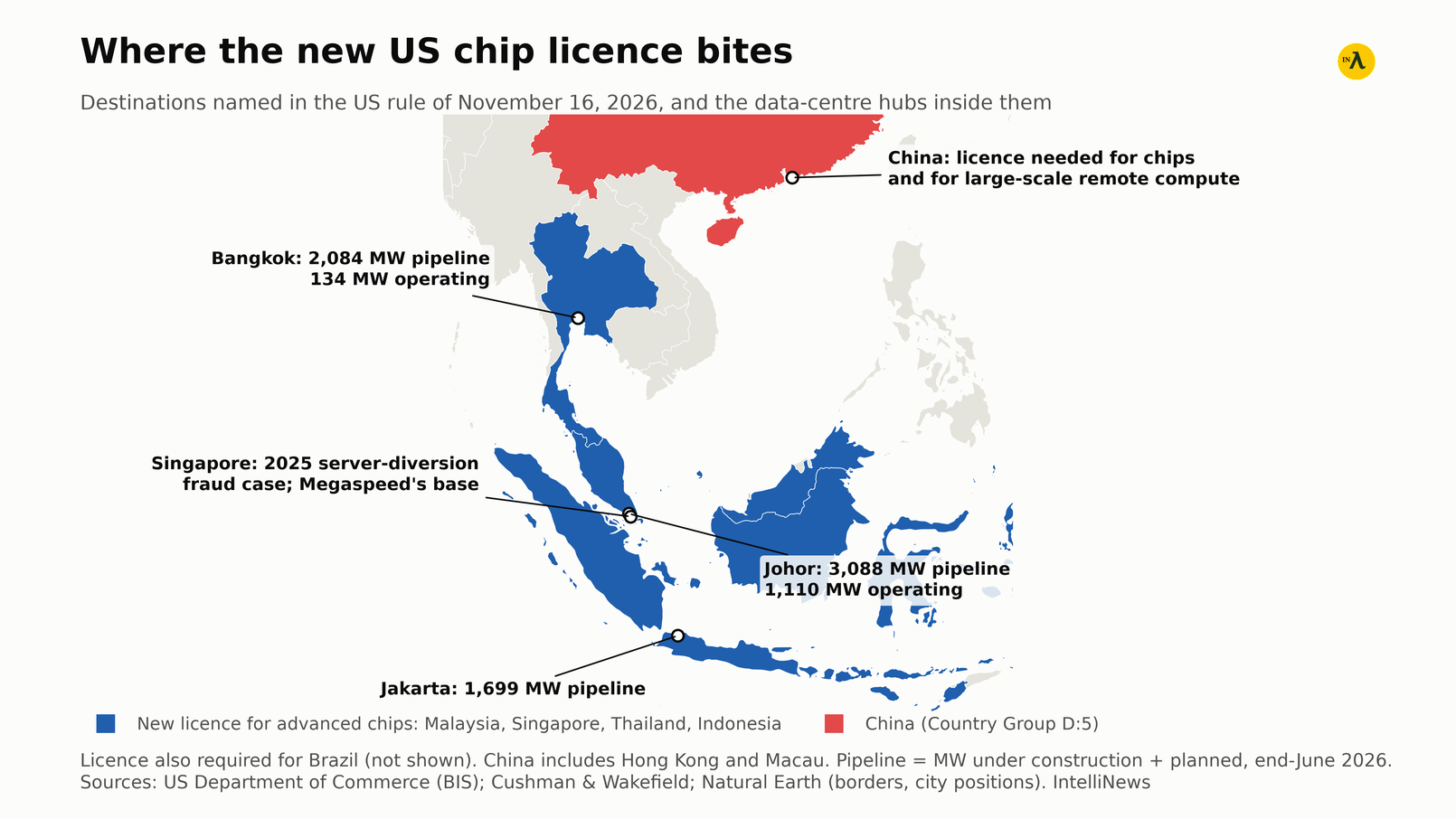
Southeast Asian destinations that now need a US licence for advanced chips, and the main data-centre hubs inside them. Sources: US Department of Commerce (BIS); Cushman & Wakefield; Natural Earth. IntelliNews
Thailand builds into the rule
Bangkok had 859 MW under construction at end-June, up 148% in six months, against just 134 MW in operation. Most of the capacity Bangkok is counting on has yet to be fitted out, and the advanced chips for it now come with a licence attached. Thai authorities had already halted 49 projects in September and frozen decisions on 117 more over power and water.
Beijing objects
The rule is "yet another case of the US overstretching the concept of national security", Chinese foreign ministry spokesperson Guo Jiakun said on November 17. "China will do what is necessary to firmly safeguard its legitimate rights and interests," he added.
The pressure on the region's server halls has been building for 18 months, from Malaysia's 2025 probe into Chinese engineers flying in training data for local Nvidia servers, through a slowdown in Malaysian approvals and a regional backlash over water and power. Each step raised the cost of serving Chinese clients from Southeast Asia, and a US licence on every advanced chip now sits on top of them all.

No comments:
Post a Comment