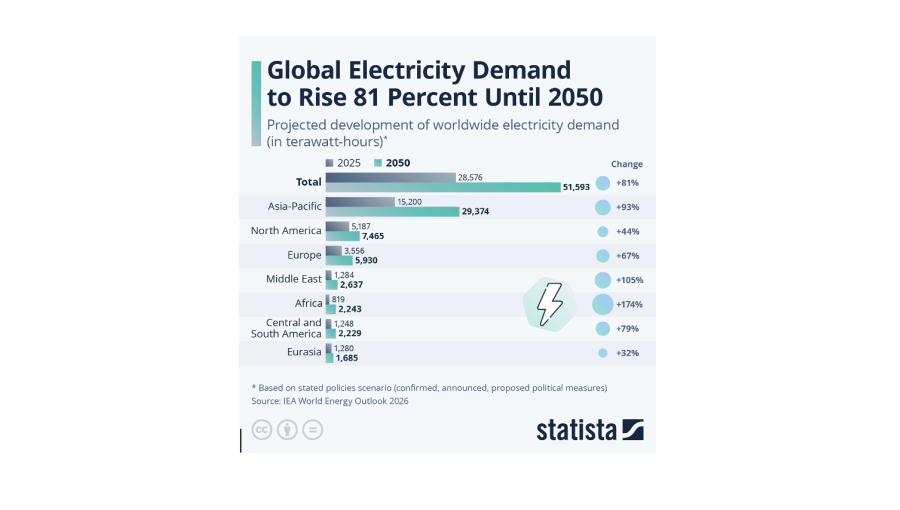
World electricity demand will grow 81% by 2050 and India's will nearly triple, the International Energy Agency (IEA) projects in its World Energy Outlook 2026.
The figures come from the agency's Stated Policies Scenario (STEPS), which models the policies governments have adopted or announced. Demand rises from 28,576 terawatt-hours (TWh) in 2025 to 51,593 TWh in 2050, according to the report's annex tables. Its Current Policies Scenario ends up in almost the same place, at 52,462 TWh, because slower electrification is offset by smaller efficiency gains on appliances, cooling and industrial motors.
Electricity is taking a bigger slice of the world's energy use even as the same report sees oil demand falling this year for the first time since 2020. Power's share of final energy consumption rises from 23% in 2025 to 29% by 2035 in the STEPS. Data centres double their consumption to 1,000 TWh by 2030 on the back of the AI boom, while electric cars, heat pumps and the electrification of industry add load, mainly in China, the EU and Japan. In poorer, hotter countries much of the new demand comes from air conditioning: in emerging and developing economies outside China, 85% of households are exposed to high temperatures but fewer than 20% of them own an air conditioner. "Already today, for the first time in energy history, global cooling needs are overtaking those for heating," the IEA said.
Asia-Pacific's demand climbs 93% to 29,374 TWh, 57% of the world total. China adds the most in absolute terms, up 77% from 9,777 TWh to 17,351 TWh, keeping its share at about a third as the first electrostate matures. India's demand rises from 1,641 TWh to 4,892 TWh, lifting its share of the world total from 5.7% to 9.5%, while Southeast Asia's grows 148%.
The fastest growth is in Africa, where demand rises 174% to 2,243 TWh, and the Middle East, up 105% to 2,637 TWh. Even so, the two regions together account for less than a tenth of world demand in 2050.
Growth is slower in the rich world. US demand rises 42% to 6,050 TWh, about 12% of the 2050 total, and the EU's 67% to 4,157 TWh, or 8%. Russia is among the laggards: its demand grows only 15%, from 996 TWh to 1,146 TWh, and the wider Eurasia region's by 32%. Japan's rises 12%.
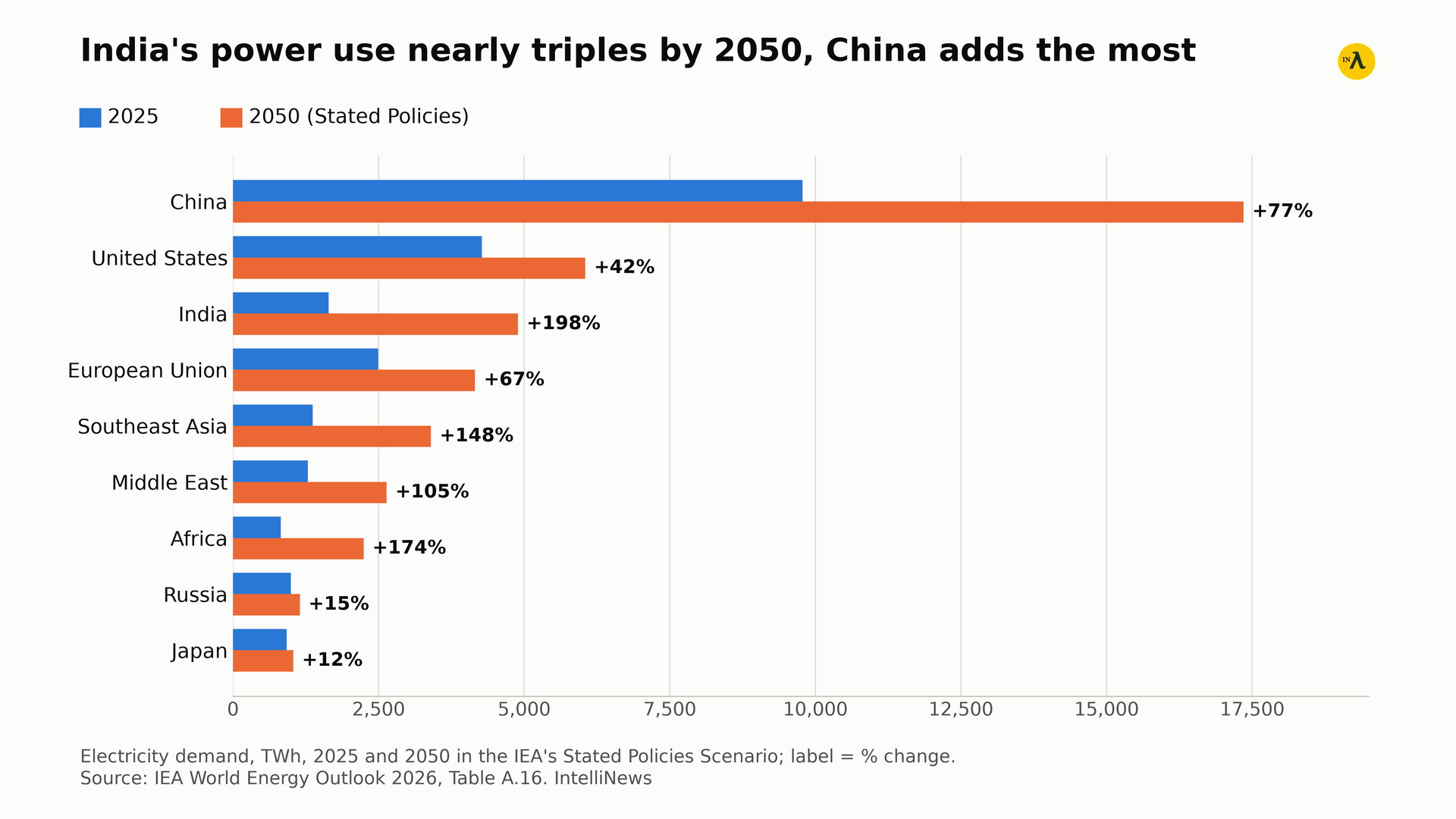
Electricity demand in 2025 and 2050 (IEA Stated Policies Scenario), TWh. Source: IEA World Energy Outlook 2026, Table A.16. IntelliNews
Supply grows almost as fast. World generation rises 78% from 32,402 TWh to 57,800 TWh, and renewables' output climbs 250% from 10,830 TWh to 37,919 TWh, taking their share from a third to 66%. Solar alone supplies 31% of the world's power in 2050, up from 8%, with wind at 20%, extending the build-out in which China is the world's green energy champion.
Nuclear output more than doubles, up 125% from 2,856 TWh to 6,439 TWh, edging its share from 9% to 11%. Unabated fossil fuels fall from 57% of generation to 23%. Coal takes the hit, its output down from 10,864 TWh to 5,146 TWh and its share from 34% to 9%, while gas-fired generation still rises 14% to 7,982 TWh. Fossil plants fitted with carbon capture produce just 45 TWh in 2050.
Statista has charted the projections in global electricity demand by region and global generation by source..
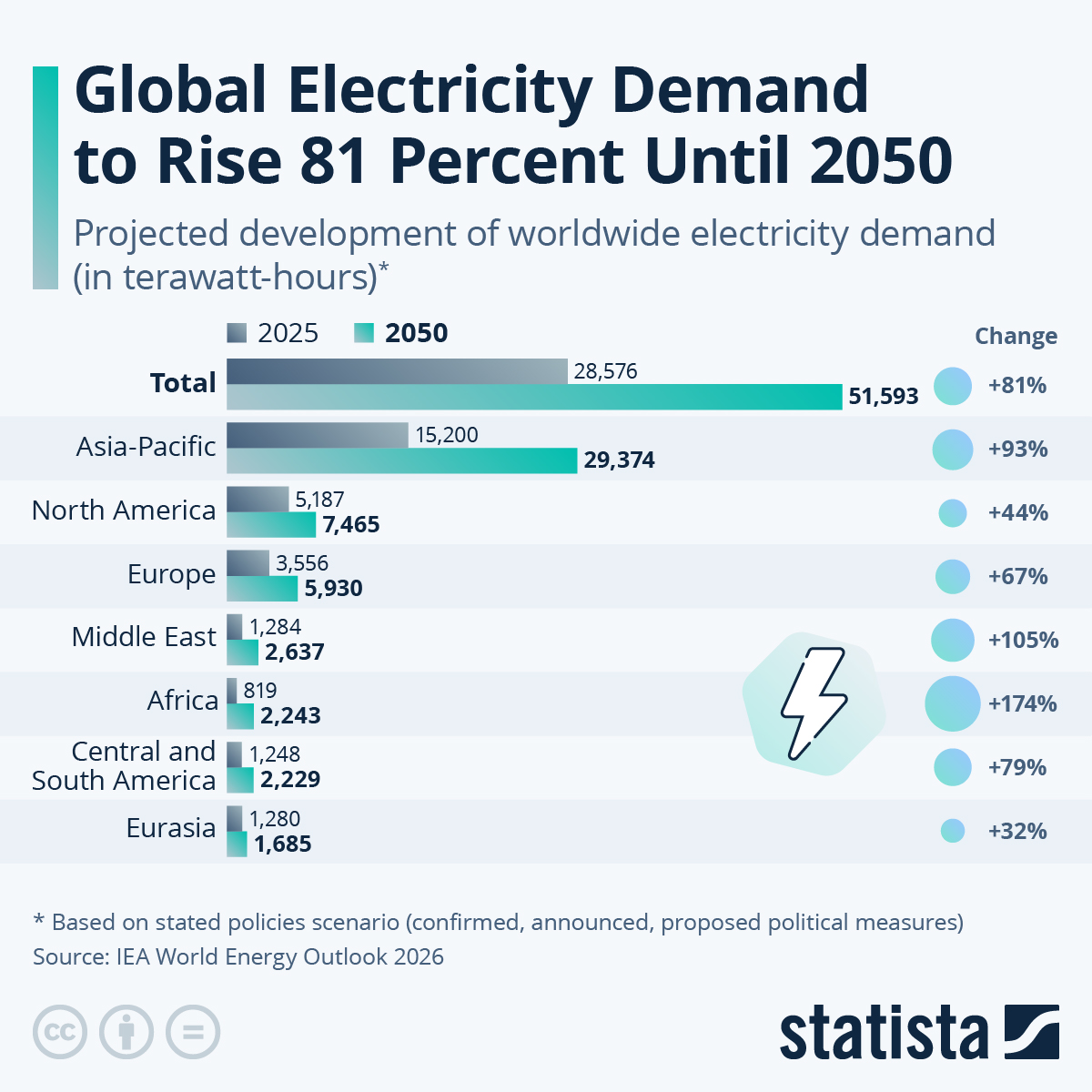
Source: Statista, based on IEA World Energy Outlook 2026 (Stated Policies Scenario). CC BY-ND 3.0. statista.com/chart/29282
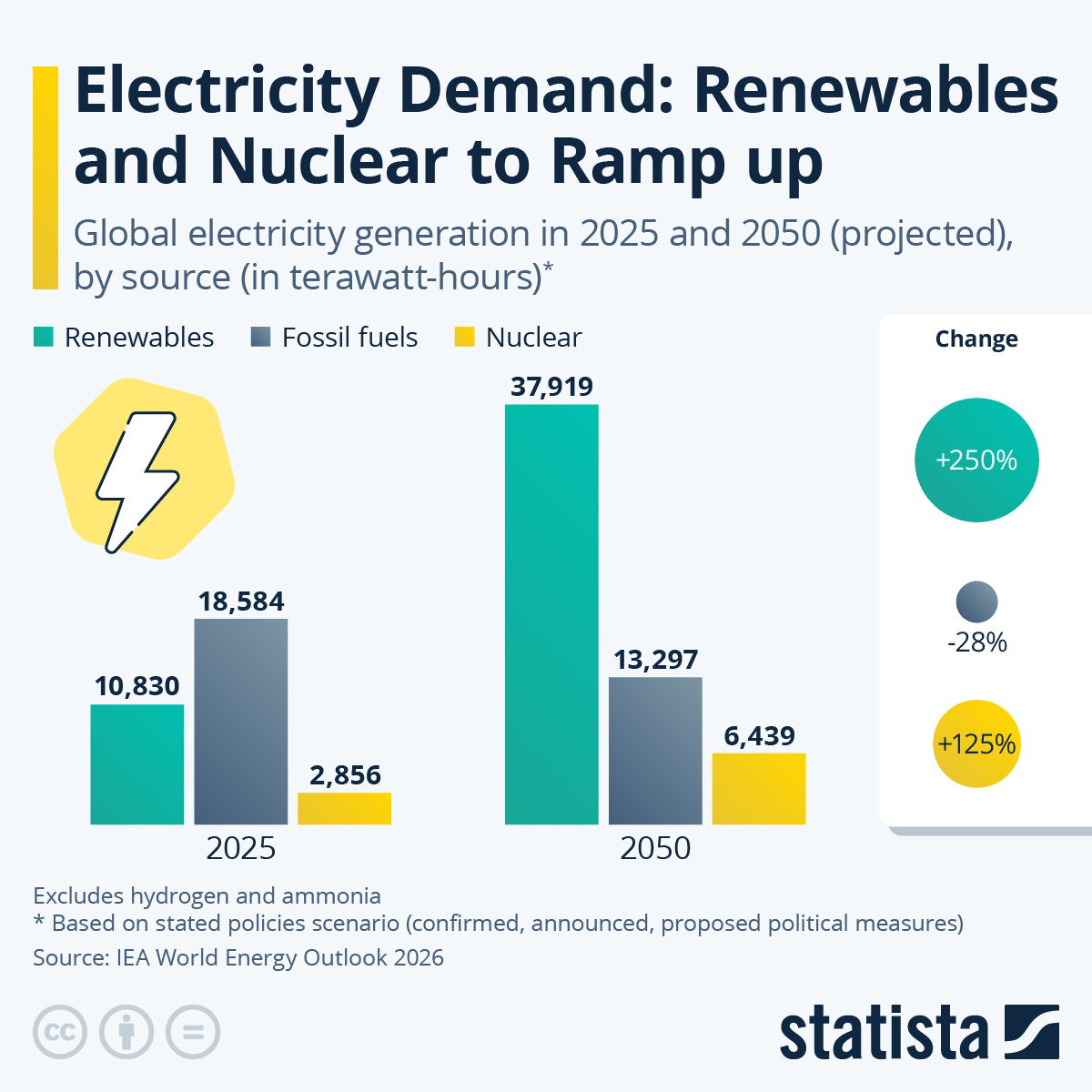
Source: Statista, based on IEA World Energy Outlook 2026 (Stated Policies Scenario). CC BY-ND 3.0. statista.com/chart/17515
This article was produced with the help of the IntelliNews Lambda analytical tool

No comments:
Post a Comment