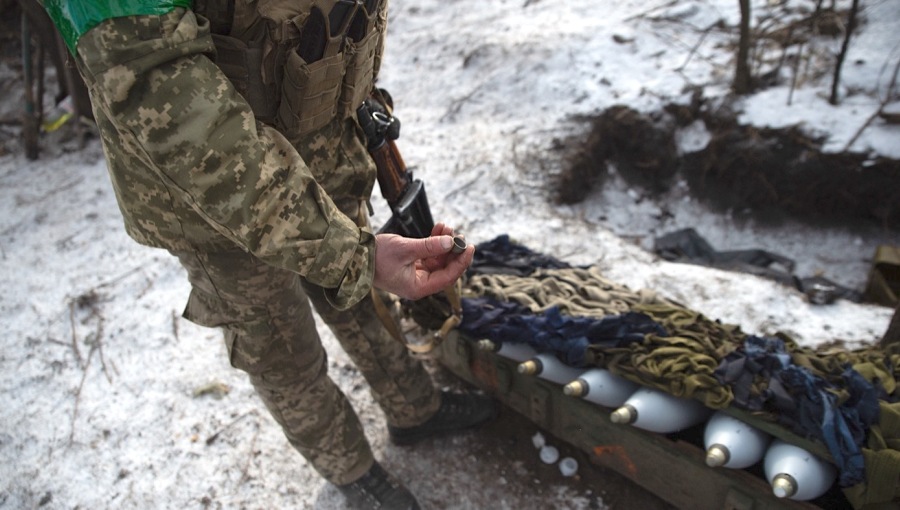
Russia's military budget is a fifth of America's in dollars, but counted in artillery shells rather than dollars, it buys close to 90% as much.
And the Kremlin is spending big - and more than it can afford. Nominally, Russia's military spending this year is on course to approach RUB17 trillion ($211bn), which is as much as RUB5 trillion ($62bn) more than it initially planned to spend at the start of this year.
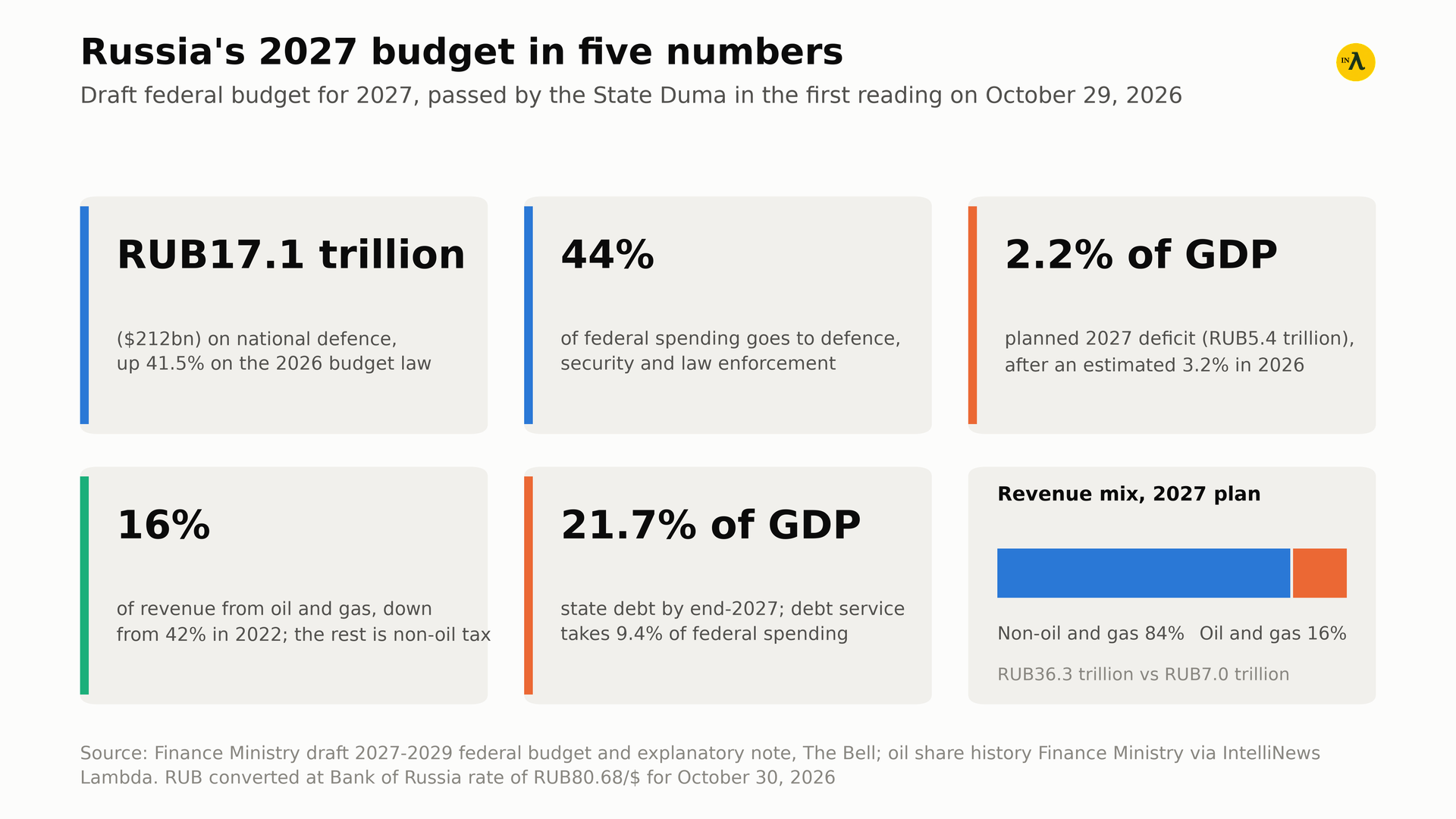
While official figures are opaque, the government's budget plan had pencilled in RUB12.1 trillion ($150bn) for "national defence" in 2026, while SIPRI estimated total actual planned military expenditure at RUB14.9 trillion ($185bn), or 6.3% of GDP, in March. Next year's 2027 budget will lift defence spending again to RUB17.1 trillion ($212bn), or a whopping 41% of all spending.
It's a lot of money, but it is still only a fifth of what the $961.6bn the Pentagon requested for FY2026. And if President Donald Trump gets his way, that will rise to $1.5 trillion next year.
However, spend a dollar in Russia and it goes a lot further than one spent in the US as wages and input costs are a lot lower. Consequently, economists prefer to compare PPP (purchase power parity) adjusted spending that takes this difference in price into account.
At the Bank of Russia's official rate of RUB80.56 to the dollar, RUB17 trillion ($211bn) adjusted for PPP Russia's defence spending is worth about $574bn - not 22% of US spending but close to 60% of the US figure - still a big gap, but may be enough to keep Russia in the game if it went to war with the US.
The International Institute for Strategic Studies made the same kind of adjustment in its Military Balance 2025, valuing Russia's 2024 defence spending of RUB13.1 trillion ($163bn) at $462bn in PPP terms - more than the EU and the UK combined that would be in the frontline if war in Europe really does break out.
Artillery shell units
The story doesn’t stop there as even the PPP adjustment flatters the US. The PPP adjustment is an aggregate adjustment to the value of the currency that takes everything into account, but military production is very specific. The difference between what a dollar spent in the market can buy you in the market is not the same as what it pays for in Russia’s drone factory in the Alabuga Special Economic Zone in Tatarstan or the artillery shell plants in the depths of Siberia.
On the flip side, the US defence sector is bloated, and its products are, in comparative terms, badly overpriced. Instead of comparing dollar-for-adjusted dollars, it makes more sense to compare the cost of production of like-with-like. A dollar of Pentagon money buys fewer shells, tanks and jets than a dollar's worth of rubles does in Russia. Counting the military spending in terms of "artillery shell production units" then Russia's spending on the weapons it actually uses in its war in Ukraine is just under 90% of US spending.
Artillery shell units are the basic comparison as everything that goes into making the Soviet-era standard 152mm shell is Russian: the metal, the gunpowder, the power, the labour. One shell costs an estimated $1000 to make, according to defence publication Militarnyi, whereas the Nato equivalent 155mm shell costs $4000 to make in the US, according to consultancy Bain & Company. The PPP adjustment implies the Russian shell should be about 2.7-times cheaper, but the actual difference is Russian shells are four-times cheaper to make than American shells.
If the war were entirely about shelling the enemy then Russia and the US spending is almost on a par.
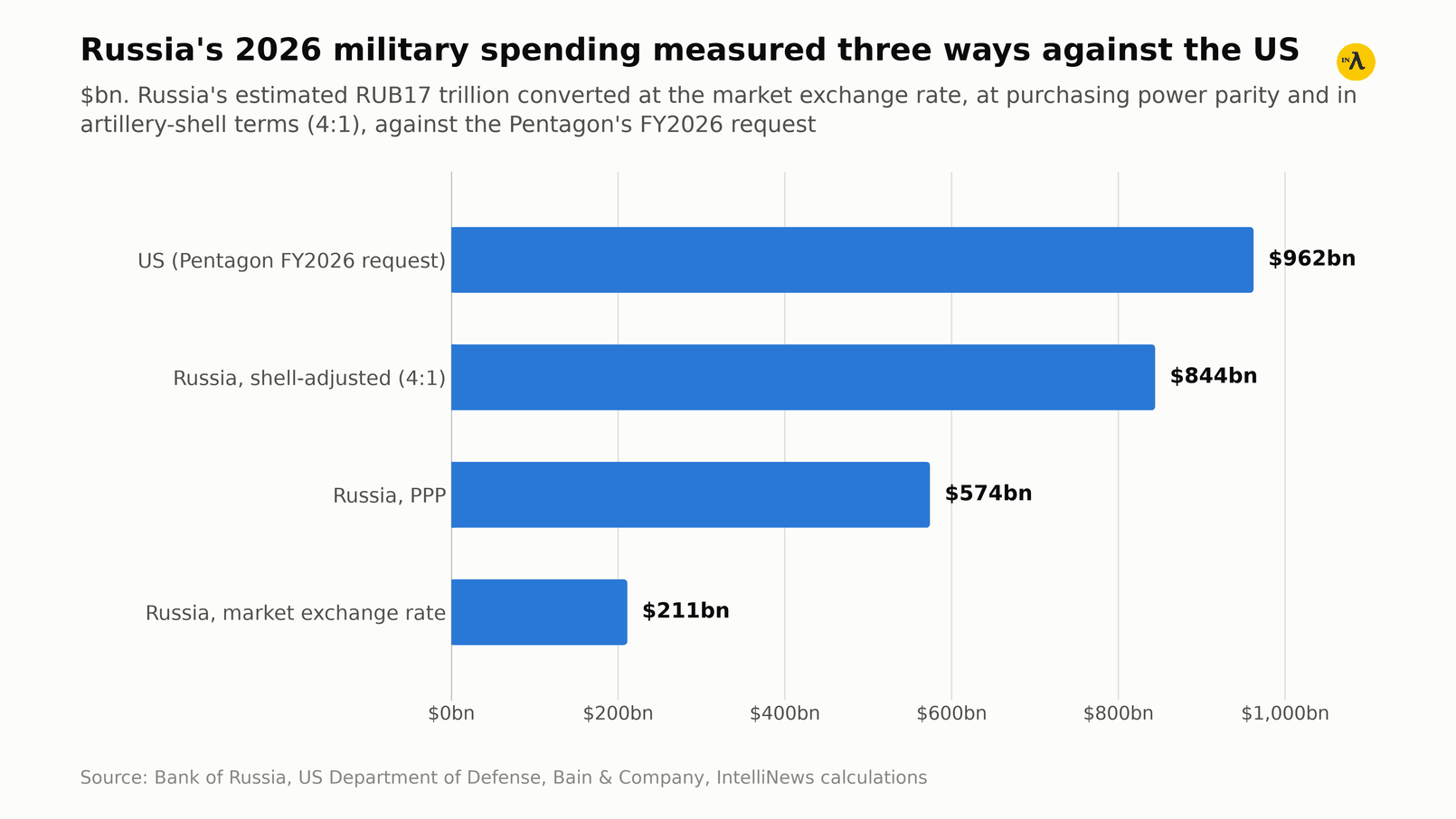
Russia's 2026 military spending at the market rate, at PPP and in artillery-shell terms, against the Pentagon's FY2026 request. Source: Bank of Russia, US Department of Defense, Bain & Company, IntelliNews calculations
Artillery is the simplest place to start and they have played a key role in the early stages of the Ukraine conflict which was largely an artillery duel for the first two years; Russia was lobbying ten shells on to the Armed Forces of Ukraine (AFU) for every one they could fire back. By 2023 Ukraine was already in crisis as it was running out of ammunition and the West scrambled to find more shells after its own stockpile was depleted.
The cost is not the only factor to consider in military spending comparisons: there is no point having more money to spend if you don't have the industrial capacity to make the shells. Bain reckoned Russia would turn out 4.5mn shells in 2024 against the combined production of 1.3mn in the US and the EU. Since then Russia has doubled or tripled its production capacity.
The US is struggling to scale up. The Army raised 155mm output from 14,000 to 36,000 rounds a month by March 2026, or 432,000 a year, missing its goal of 100,000 a month by October 2025, the Pentagon's inspector general found in a report published on July 9.
Just how wide the gap is between the US defence sector’s ability to make something as simple as shells was highlighted by the US military’s catastrophic failure to expand domestic explosives production.
The Holston Army Ammunition Plant in Kingsport, Tennessee, operated by BAE Systems, is the country’s sole domestic producer of RDX and HMX - two powerful explosives used in missiles, bombs and artillery ammunition. The US Army committed one billion dollars to modernise the 84-year-old facility, but production increased a meagre 3% of its 1944 peak. Further upgrades intended to increase capacity have been delayed until at least 2029, and the plant faces a backlog of orders stretching one to two years. The lack of these two explosives threatens to become a crucial bottleneck that will severely hamper the US ability to wage war at a time when demand for munitions is sky high and rising.
At the same time the US only has three plants making the metal parts for shells which suffer from similar problems related to underinvestment. Output of shells is currently capped at 71,000 a month, according to the Wall Street Journal. Russia's howitzer output alone is about eight-times higher than the US rate.
At Bain's 4:1 ratio, Russia's $211bn buys as many shells as $844bn spent in the US, or 88% of the Pentagon's request. On the 2025 Russian contract price the ratio is 3.1:1, which still puts Russia's spending at about $654bn in US shell terms, or 68%.
| Artillery shell | US / Nato | Russia |
| Standard round | 155mm (M795 high-explosive) | 152mm (OF25 high-explosive) |
| Estimated unit cost (Bain & Company, 2024) | about $4,000 | about $1,000 |
| Russian contract price, 2025 | - | RUB104,000 ($1,291) |
| Shells bought for $1mn | 250 | about 775-1,000 |
| Output | 36,000 155mm rounds a month (March 2026) | 3.4mn howitzer rounds in 2025; 7mn artillery rounds of all types |
| Russian spending in US shell terms | $962bn (US request) | $654bn-844bn (68%-88% of US) |
Sources: Bain & Company via Sky News; Militarnyi; Estonian Foreign Intelligence Service; US Department of Defense Office of Inspector General; IntelliNews calculations
Tanks and fighter jets
Russia has a big advantage over the US in shell production, but the bigger, more complicated platforms show a smaller discount. A serial T-90M, the so-called Amarta Main Battle Tank, Russia's most modern in production, costs about RUB350mn ($4.3mn), military journalist Kirill Fedorov estimated in April, while the Kyiv Post has put it at about $4.5mn. Russia has never published the price. The US Army's FY2020 procurement budget gave a gross unit cost of $10.6mn for the M1A2 SEPv3 Abrams, the US' best tanks - about 2.5 times as much and on a par with the PPP dollar -adjusted spending.
The Su-57 fifth-generation fighter costs about RUB2.2bn (34.6mnatthe2019averageexchangerate)aplanewhenthedefenceministryordered76foraboutRUB170bn(2.6bn) in 2019, Kommersant reported. By comparison the US' fifth generation F-35 has an average buy-and-fly cost of $82.5mn - about 2.4 times the Su-57's price, and the latest contract for 296 jets came to $24.3bn for the airframes alone.
On armour and aircraft the multiplier of 2.4-2.5 sits just below the economy-wide PPP ratio of 2.7, putting Russia's spending at about 52%-54% of the US level in tank or jet units.
| Platform | US | Russia | Cost ratio (US:Russia) |
| Main battle tank | M1A2 SEPv3 Abrams: $10.6mn (Army FY2020 budget) | T-90M: about RUB350mn ($4.3mn) to $4.5mn (estimates) | about 2.5:1 |
| Fifth-generation fighter | F-35A: $82.5mn average flyaway (Lots 15-17) | Su-57: about RUB2.2bn ($34.6mn at 2019 rate) (2019 contract) | about 2.4:1 |
Russian prices are estimates or press-reported contract totals; US prices are official budget or programme figures. Sources: US Army, F-35 Joint Program Office, Kommersant, Kyiv Post, IntelliNews calculations
Drones and missiles
In drones the unit-price edge disappears altogether but the volume edge takes over. IntelliNews published an infographic guide to Russia and Ukraine’s missiles and drones, where the key takeaway is the Kremlin this year has upgraded its workhorse Geran-2 drone, based on the prop-driven Iranian-designed Shahed-136 loitering munition, to the much more advanced and hard to stop Geran-4 and the cruise missile-lite Geran-5, plus the very similar Banderol cheap and power cruise missile against which Ukraine has at best partial protection.
Leaked documents put Russia's projected cost of a localised Geran-2 at about $48,800 in 2023, Militarnyi reported in February 2024. The US LUCAS, a copy of the Shahed, costs about $35,000 a unit, according to US Central Command. But the LUCAS is still on the drawing board and not in serial production. Currently, what drones the US has costs between $20mn and $250mn to make with its best known drone, the MQ-9 Reaper costing 30mn–50mn each - two orders of magnitude more than Russia's drones, which are now state-of-the-art.
In effect the US has next to nothing in its drone arsenal, whereas Russia was producing an estimated 2mn drones and 2,500 missiles a year by 2025, much of it at the Alabuga plant in Tatarstan, and now builds about 3,000 jet-powered Geran-4 drones a month. Europe's combined drone production is estimated to be 300,000 a year by comparison.
Russia has already moved beyond the original Iranian design following a technology swap in 2015 and since then the two wars in Ukraine and Iran have been driving an expanding CRINK (China, Russia, Iran, and North Korea) technology swap where each partner is helping the others develop better weapons based on hard battlefield data. As a result Russia is currently winning the drone arms race with Ukraine, whereas the US has been reduced to trying to reverse engineer Iran's technology.
The Geran-2 flies at 150-180 km/h. The Geran-3 reaches 300-370 km/h, the Geran-4 about 500 km/h, and the Geran-5 reportedly over 1,000km/h. Ukraine's fastest interceptor drone can manage 450kmh and so can't catch Russia's newest missiles from behind. With an estimated cost of $170,000-200,000 apiece, according to Defense Express, the Geran-4 is one of the most effective drones on the battlefield.
The Banderol, a cross between a strike drone and a light cruise missile, cruises at 500-560 km/h, and estimates of its cost run from up to $50,000 to $150,000-300,000, Ukrainska Pravda reported in September. The US has no jet-powered one-way attack drone in mass production at all.
Missiles are harder to compare, because Moscow publishes no prices but a wealth of experience earned from the seven decades of the Cold War. Ukrainian estimates put an Iskander-M ballistic missile at about $3mn and a Kh-101 cruise missile at about $13mn, Forbes Ukraine calculated.
The US Army's budget requests put its comparable Precision Strike Missile at $1.7mn-3.5mn, and trade-press estimates put a Tomahawk at $1.9mn-3.6mn, so on these figures the US pays less per missile. Russia's edge lies in weapons the US does not have at all: the hypersonic Kinzhal, estimated at $10mn-15mn, and the Oreshnik intermediate-range missile, put at $20mn-50mn by Ukrainian sources. China, Russia and now Iran all have hypersonic missiles, while the US version is also still in development.
| Weapon | US | Russia | Note |
| One-way attack drone | LUCAS: about $35,000 | Geran-2: about $48,800 (2023 projected cost) | US cheaper per unit; Russia makes thousands a month |
| Jet drone / light cruise missile | none in mass production | Geran-4: $170,000-200,000 (est.); Geran-5: not published; Banderol: up to $50,000 to $300,000 (est.) | Speeds 450-600 km/h |
| Short-range ballistic missile | PrSM: $1.7mn-3.5mn; ATACMS: about $1.5mn | Iskander-M: about $3mn (est.) | No Russian advantage on these estimates |
| Cruise missile | Tomahawk: $1.9mn-3.6mn (est.) | Kh-101: about $13mn (est.) | Russian prices are Ukrainian estimates |
| Hypersonic / intermediate-range | none in service | Kinzhal: $10mn-15mn; Oreshnik: $20mn-50mn (est.) | No US equivalent fielded |
Sources: US Central Command, US Army budget requests, Militarnyi, Defense Express, Ukrainska Pravda, Forbes Ukraine, ArmyInform
The chip in the machine
Cost and capacity are two of the three limits on Russia's war machine. The third is technology, and it is the one the Kremlin controls least.
Russia's drones and missiles are cheap and they are plentiful, but unlike the artillery shells they are not Russian all the way through. Strip the casing off a Geran or an Iskander and what is inside is a smorgasbord of components, much of it Western.
President Volodymyr Zelenskiy made the audit public on June 2: five Kalibr cruise missiles fired at Ukraine contained 145 foreign components between them, 33 Iskanders contained 1,122, and 650 strike drones of various types contained more than 17,000. Russian drones and missiles, he said, “cannot be produced at all without components imported from other countries”.
As Kyiv finds itself under a 24/7 bombardment of missiles and drones as Putin escalates the increasingly brutal tit-for-tat missile war, Bankova’s pleas for the West to crank up its technology sanctions have become increasingly shrill. Russia can out-produce the West on shells because it can find everything it needs at home, but it cannot out-produce the West on signal processors, programmable logic and radiation-hardened memory, because it does not make them. But Russia does have friends who do and they are getting increasingly good at it.
Ukraine's Defence Intelligence now publishes the evidence component by component on its War&Sanctions portal, and the catalogue is countable. IntelliNews tallied every card on the portal for four weapons – 464 in all. The pattern is not the simple one. Substitution is happening, but it runs in two directions at once.
On drones, Russia is going Chinese:
Geran-2: In a sample whose newest identified part dates from June 2023, 70 of 75 catalogued components came from firms headquartered in the US and its allies and just three from China.
Geran-4: with parts made as late as March 2026, the Western share is down to 56 of 74 and China's is up to 12. The Iranian Mado engine that powered the original has gone, replaced by Chinese Telefly turbojets. Colonel Oleksandr Zaruba of Ukraine's weapons testing institute said in June that around 50 parts in each Shahed are now made in China or Taiwan.
On missiles, Russia is substituting for itself:
Kh-101 cruise missile: in a sample whose newest part dates from November 2022, carried 138 catalogued components of which four were Russian.
Iskander-M: in a sample with parts made as recently as April 2025 carried 177, of which 38 were Russian – Mikron, Morion, Proton, Kremnii El – and a further eight came from Integral, the Belarusian state chipmaker. Even so, two-thirds of that missile is still Western by origin.
Integral is a lesson in itself. It shipped more than 6mn microchips worth $130mn into Russia between March 2022 and June 2024, 80% of all Belarusian chip exports to the country, and Ukraine's SBU has confirmed its parts inside Iskander, Kh-101, Kh-59M2A and S-300 missiles. Its own production lines run on German microscopes, Swiss vacuum valves, British vacuum systems, Japanese wafer slicers and American test rigs, fed by 99.999% pure hydrochloric acid routed out of Germany through Poland, Turkey and Kazakhstan. The substitute for Western technology is manufactured with Western technology.
The deepest layer has not moved at all. The Kometa is Russia's own anti-jamming navigation module, the thing it built to replace Iran's Nasir receiver and the reason Geran drones still fly through Ukrainian electronic warfare; its antenna has gone from four elements in mid-2023 to sixteen. It is Russian-designed and Russian-assembled – and of its 37 foreign components, 34 come from Western firms and 28 from American ones. Russia has substituted the module. It has not substituted the silicon inside it.
That is the ceiling. Russia's three mass-scale chip plants – Mikron, Angstrem and Milandr, all in Zelenograd – produce at 90 nanometres. The industry ministry's roadmap targets 28nm by 2028 and 14nm by 2030, which IntelliNews has reported as unrealistic; China is already below 10nm and the US is heading for 2nm.
Up to 82% of Russia's electronic components were imported before 2022, and the state is putting about RUB175bn ($2.2bn) a year into microelectronics against an estimated RUB1.5-2.5 trillion for a single modern fab and RUB3-5 trillion for the equipment to fill it. Russia cannot buy the lithography machines and it cannot build them.
Which is why Kyiv keeps pressing. Tighten the export controls hard enough and the lines at Alabuga and Izhevsk slow, because the parts cannot be made at home and the workarounds – distributors in Hong Kong, shell companies, the long daisy-chain through Central Asia and the Gulf – are expensive and traceable. The Kyiv School of Economics found $7.3bn of critical battlefield components reaching Russia from coalition-based firms in a single year, almost all through third-country intermediaries.
But the window is closing, and not because enforcement is improving. Every Chinese part that replaces an American one is a part the West can no longer switch off, and Chinese quality is rising fast – the CRINK technology swap means Beijing is now a developer of these systems, not merely a supplier of parts for them. Conflict Armament Research has recorded a “discernible increase” in Chinese content in Shahed-type drones.
Sanctions on Western technology would bite today. On present trends they will not bite for much longer.
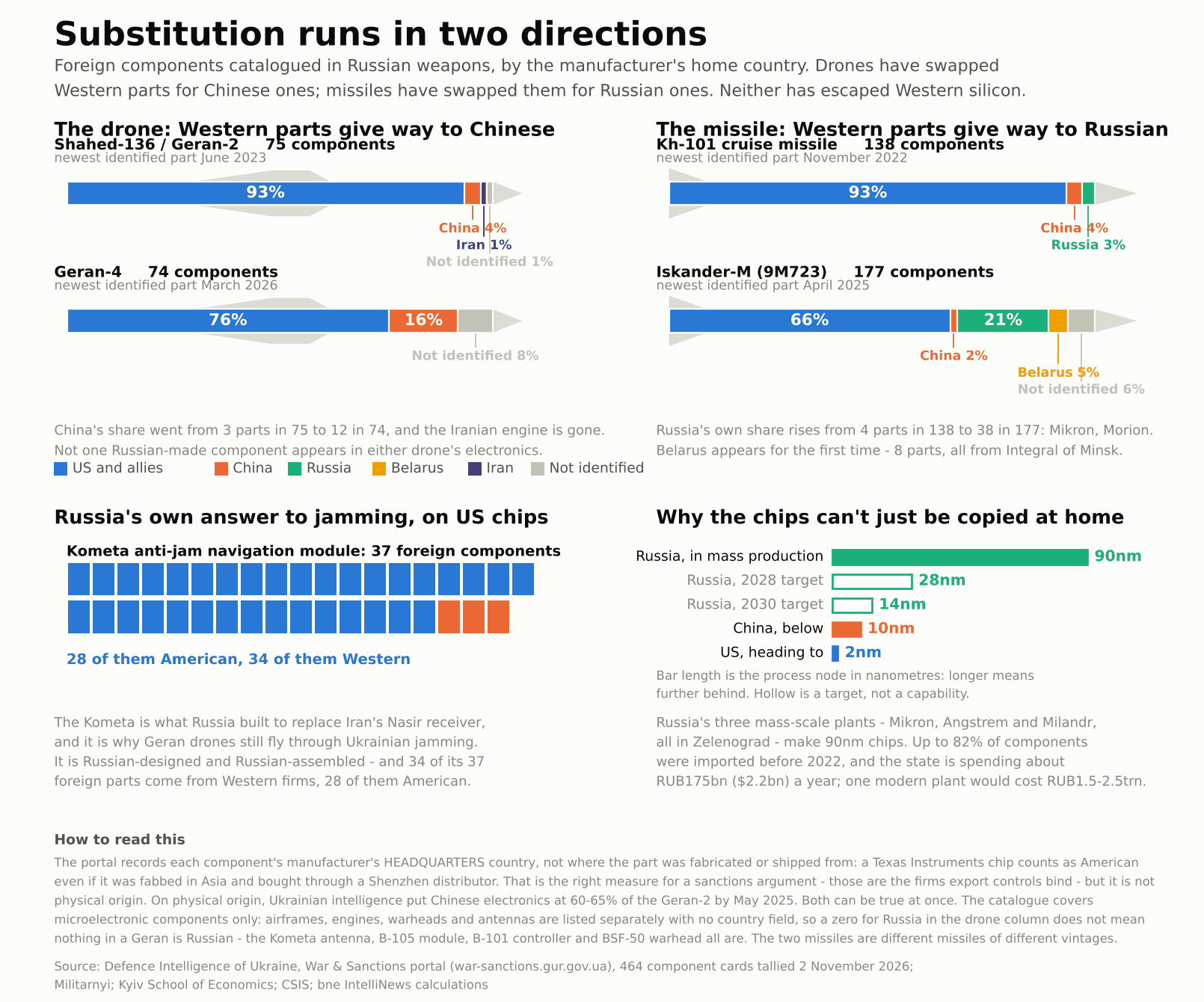
Foreign components catalogued by Ukraine's Defence Intelligence in two Russian drones and two Russian missiles, by the manufacturer's home country. Source: War&Sanctions portal, 464 component cards tallied by bne IntelliNews on November 2; Militarnyi; Kyiv School of Economics; CSIS
The like-for-like index
Set side by side, the categories show where Russia's money goes furthest. In shells, the ammunition this war burns through fastest, Russia's ruble buys three to four times as much as a Pentagon dollar. In tanks and jets the multiplier is about 2.5. In drones Russia pays roughly the same per unit as the US but unlike the US, already has large-scale, fully developed production, churning them out in the millions a year. In hypersonic missiles, Russia has no American rival to price against and America has no effective air defence to protect against them.
| Measure | Cost ratio (US:Russia) | Russia's $211bn in US-equivalent terms | Share of US $962bn |
| Market exchange rate | 1:1 | $211bn | 22% |
| Drones (Geran-2 vs LUCAS) | 0.7:1 | $151bn | 16% |
| Fifth-generation fighters | 2.4:1 | $502bn | 52% |
| Main battle tanks | 2.5:1 | $521bn | 54% |
| Economy-wide PPP | 2.7:1 | $574bn | 60% |
| Shells (2025 contract price) | 3.1:1 | $654bn | 68% |
| Shells (Bain & Company) | 4:1 | $844bn | 88% |
Ratios apply one weapon class to the whole budget for illustration only. Source: IntelliNews calculations from the sources above
Preparing for the wrong war
"Generals always prepare to fight the last war," British Prime Minister Winston Churchill quipped. The US is still buying what it has always built: stealth fighters, heavy tanks and expensive precision missiles. Russia's biggest advantage is that it is fighting a war now and buying for it.
Ukraine has turned war into an asymmetric contest where the cost-to-kill ratio decides who wins, not who has the biggest or smartest bombs. A Patriot PAC-3 interceptor costs about $4mn, while the drones fired at it cost $20,000-30,000. An attacker can make 150-200 drones for every interceptor. The new paradigm is a man with a flywatter trying to fend off an attack by a swarm of hornets.
The doctrine has shifted the “Command of the Commons” doctrine the US has been following for decades - the deployment of powerful weapons in bases scattered around the world so it can respond to any crisis quickly with overwhelming force - to the Command of the Reload, in which the side that can build more cheap, "good-enough" weapons wins.
Ukraine is praised for its pioneering drone innovations, but Russia is innovating too and currently has the edge in drones over Ukraine. The CRINK technology swap and informal alliance is proving to be decisive. The only answer the US has to the CRINK hypersonic missiles is the Army's Dark Eagle that has flown a few flight tests and its first battery of eight missiles is assigned to a unit in Washington state. Its first operational fielding was expected in July, according to the Congressional Research Service brief on the programme. The Air Force revived its own ARRW hypersonic missile with a $694mn production contract earlier this year.
The pace of change on the Russian side is fast. The Geran family has gone from 150-180 km/h for the Geran-2 to 450-600 km/h for the Geran-5 in under two years and Russia is keeping its foot on the pedal. US weapons development has no war driving it at that speed.
Washington had a chance to learn from the experts but fluffed it. Zelenskiy offered Trump a mega-deal in July 2025, Ukrainian drones in exchange for American missiles, and a $50bn drone deal was rejected. "We don't need any help," Trump said in March, as the US rolled out the LUCAS instead.
The US war on Iran that began in February has shown what that costs. Iran's asymmetric tactics have blunted American air power, and eight months on Tehran is still setting preconditions for ending the war. The US and Israel armed themselves for the wrong war, and Russia's military is far more powerful than Iran's. Even if the US outspends Russia by about 10% in like-for-like terms, it is spending more of that money on the wrong weapons, and risks the same experience in any war with Russia's far more powerful and experienced army.
This article was produced with the help of IntelliNews Lambda analytical tool

No comments:
Post a Comment