Taiwan is about to demolish the oldest coal units at Taichung, one of the world's biggest coal power stations, and is replacing them with imported gas, not wind and sun.
Two new gas-fired units at the plant ran together at full rated output for the first time on September 4, during a visit by Premier Cho Jung-tai, state utility Taiwan Power Co (Taipower) said. It expected the first to enter commercial service at the end of September and the second in March 2027, and said demolition of coal units 1 and 2 would start in October.
A second phase adds four combined-cycle gas units with 4.8-5.2 GW of capacity between 2031 and 2034, while the remaining coal units are retired or kept in reserve. Taipower said it was working to the three goals Cho set for the site: "eliminating coal-fired power generation by the end of 2034, transitioning existing coal-fired units to emergency standby status, and reassessing the number of emergency standby units in 2032."
The plan shows how Taiwan's energy transition has worked in practice. Coal is leaving the grid, nuclear has already gone, and liquefied natural gas (LNG) shipped in by sea has taken their place. Gas produced 31.0% of the island's electricity in 2015 and 48.2% in 2025, according to monthly generation data from the energy think tank Ember. In the first eight months of 2026 it passed half, at 51.3%, while coal fell to 33.8% from 45.9% a decade earlier.
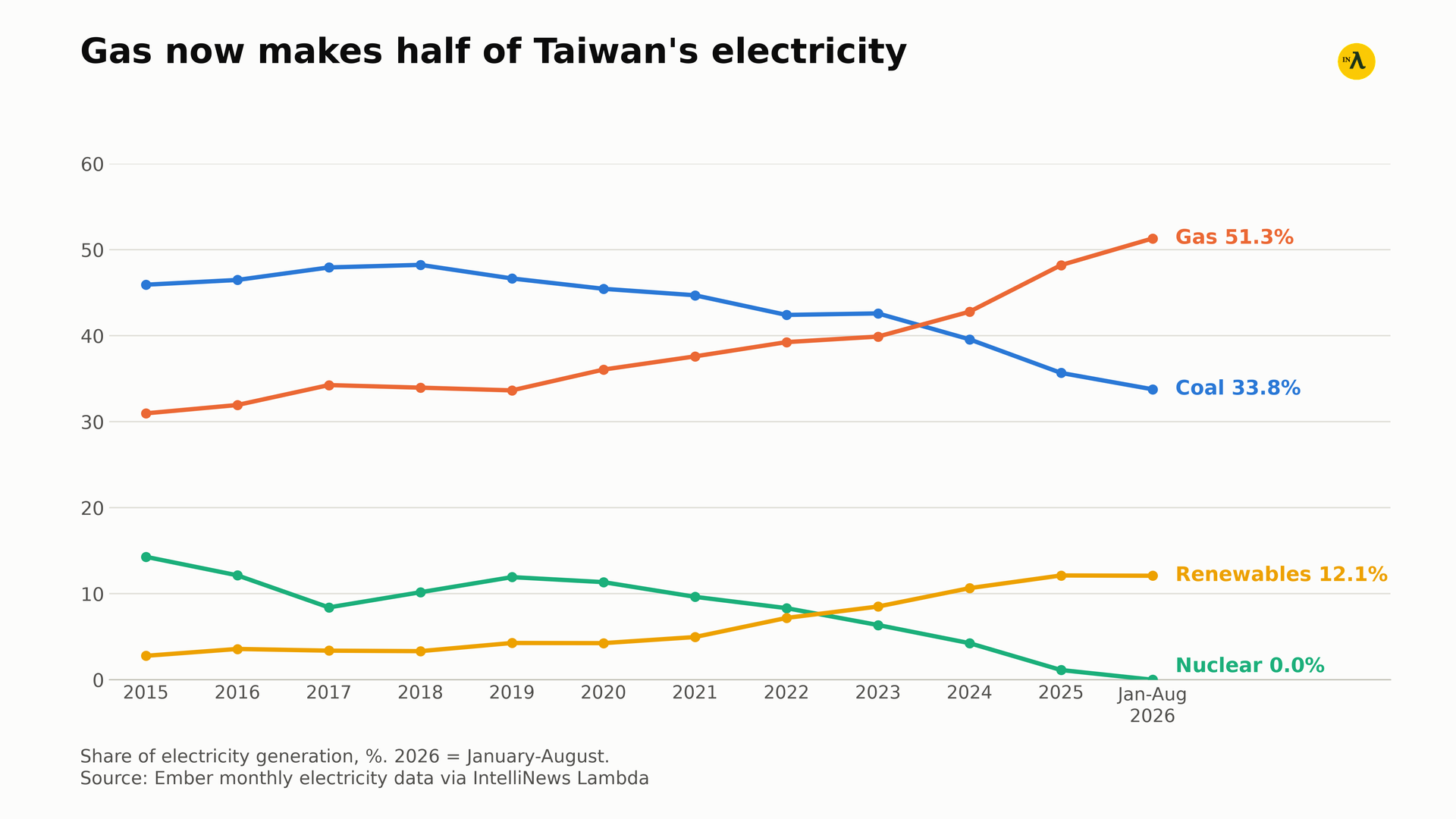
Share of Taiwan's electricity generation by source, %. 2026 covers January-August. Source: Ember monthly electricity data via IntelliNews Lambda.
Taichung is where the swap matters most. The city used nearly 35bn kWh of electricity in 2025, around 15% of Taiwan's total and more than any other city for seven years running, and its own coal units have not covered local demand since 2019, Taipower said. The plant burned 11mn tonnes of coal last year against a peak of 18.39mn tonnes in 2014, CNA reported. Taipower says it has spent TWD44.1bn ($1.34bn) on pollution controls since 2017 and cut the plant's air pollutant emissions by 80%.
City officials want more. Taichung Deputy Secretary-General Lin Ku-lung urged the central government to produce a concrete coal reduction plan, noting that Taipower had promised to cut coal use to 10.5mn tonnes this year and that its plans before 2031 remained unclear, CNA reported.
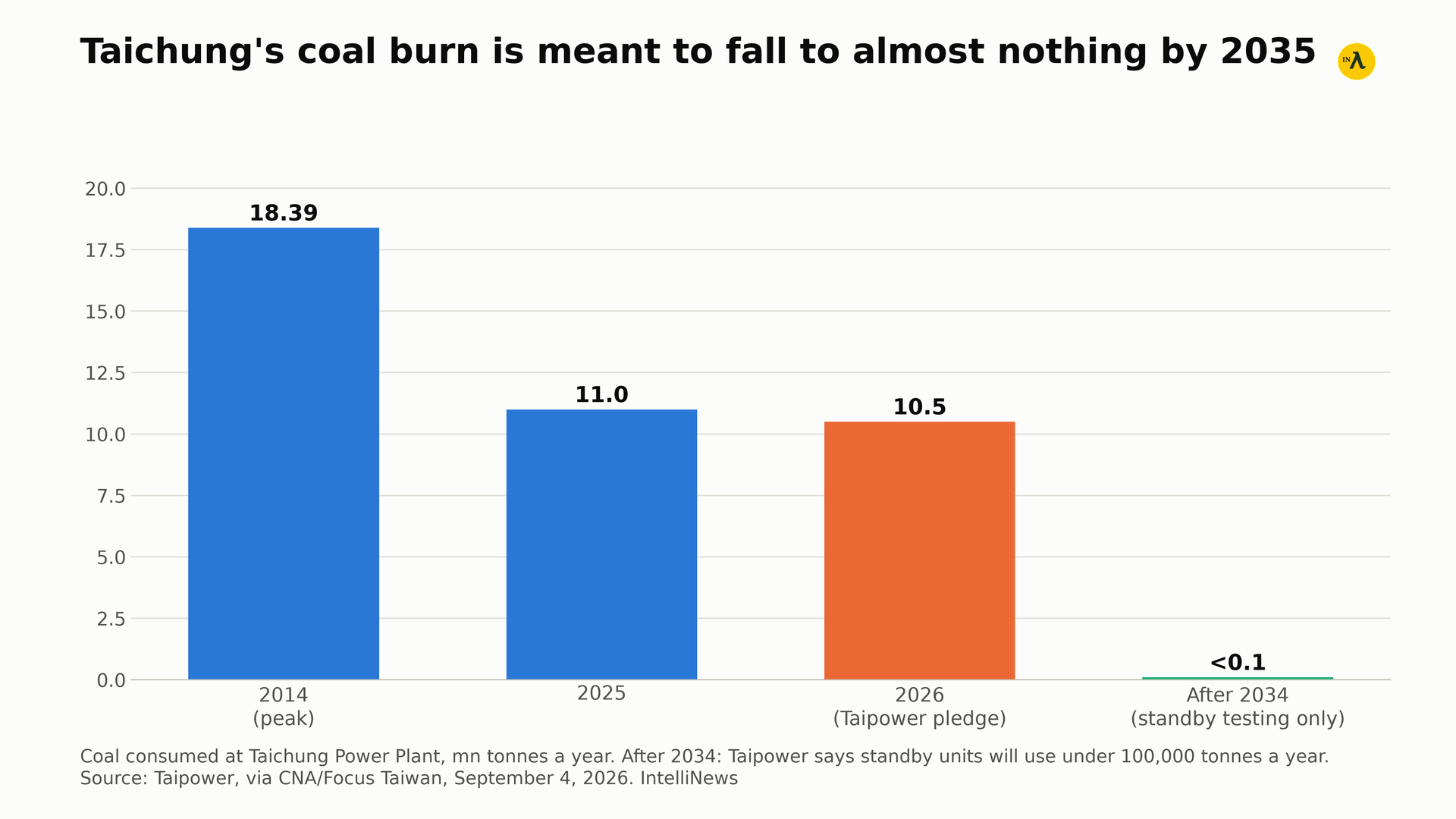
Coal consumed at Taichung Power Plant, mn tonnes a year. The 2026 figure is the target Taipower has promised; after 2034 standby units are to use under 100,000 tonnes a year. Source: Taipower, via CNA, September 4, 2026. IntelliNews.
The second phase hit a legal obstacle a month after the premier's visit. The Taipei High Administrative Court revoked the environmental impact assessment for the new gas units, the Taipei Times reported on October 9, ruling that the standards used to judge construction pollution were wrong and that the combined effect of the old coal units and the new gas units had not been properly reviewed. Residents of Taichung, Changhua and Nantou who brought the case argued the 5.5 GW project had been rushed through and wanted it cut to 2.6 GW. The environment ministry was expected to appeal, and Taipower said the new gas units were needed before six coal units could be closed.
Money is the other fight. Taipower's coal budget for next year is TWD10bn higher than this year's, although it expects to burn nearly 800,000 tonnes less coal. The utility blamed higher international coal prices and told critics not to draw conclusions from selective figures.
Gas has become far dearer since the US-Israeli war with Iran began in February and shut the Strait of Hormuz. Taipower's gas bill had risen by more than TWD70bn by the end of August compared with the months before the war, Vice Economics Minister Lai Chien-hsin told lawmakers, and the Cabinet has asked the legislature to approve a TWD71.1bn ($2.18bn) rescue for the loss-making utility. In August Taipower warned that its fuel costs for 2026 could rise by more than TWD120bn ($3.68bn).
The war has also shown how thin the margin is. President Lai Ching-te said in March that LNG stocks covered 12 to 14 days, and a US think tank's war game found that a blockade of the Taiwan Strait would drain gas reserves in 10 days. When Qatari supplies were disrupted in the spring, Taipower began buying coal-fired power from the privately run Mailiao plant, Bloomberg reported. Washington wants Taipei to look east for gas: US President Donald Trump said in October that Taiwan had agreed to take 30% of the LNG from the planned Alaska export project.
Renewables were supposed to make this dependence temporary. The government set a 2025 target of 20% of power from renewable sources, alongside 50% from gas and 30% from coal. Ember's figures put renewables at 12.1% in 2025 and the same in the first eight months of this year. Economic Affairs Minister Kung Ming-hsin admitted in February that the 20% goal would be missed again at the end of 2026, blaming new laws that bar ground-mounted solar from protected areas.
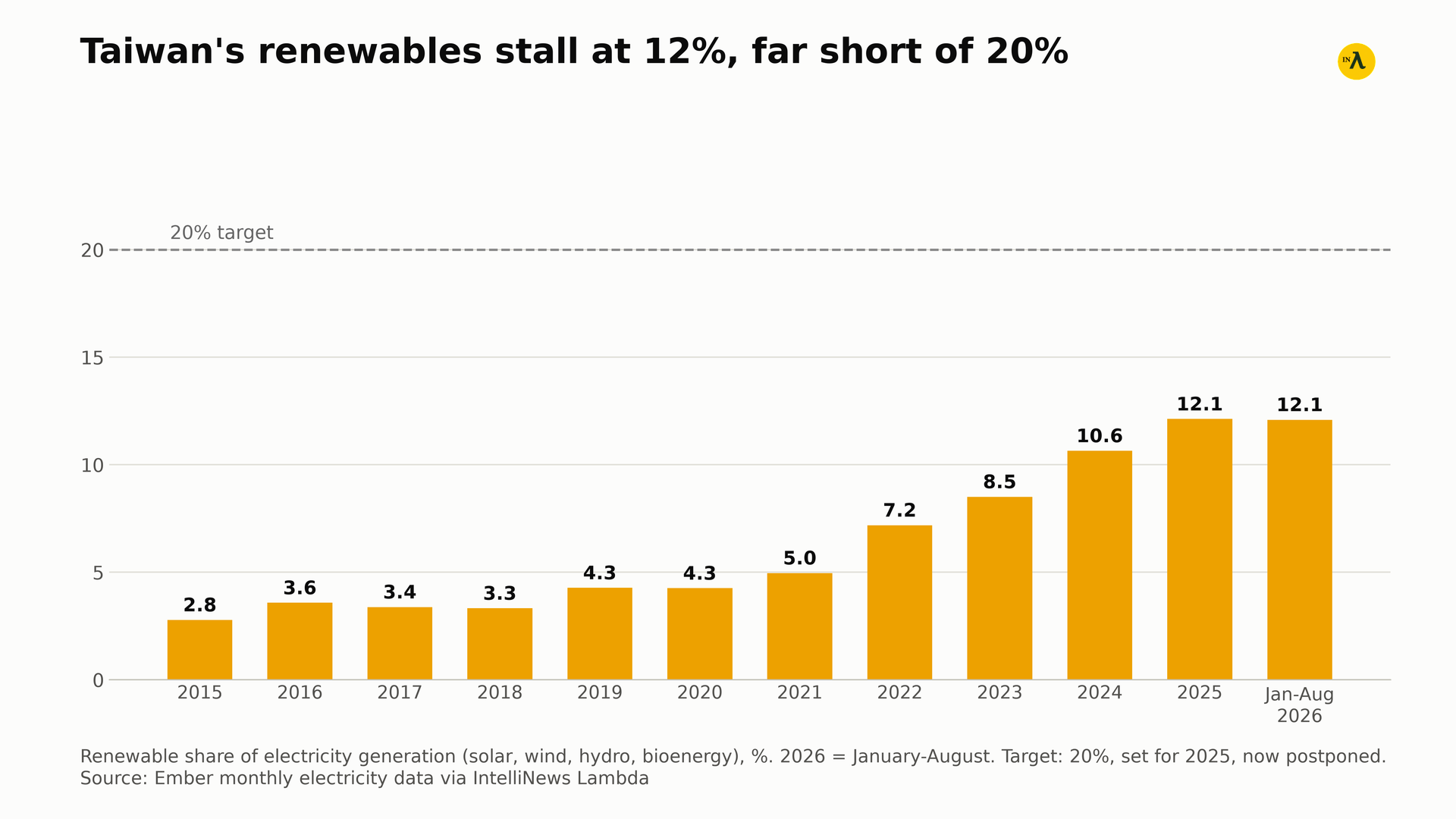
Renewable share of Taiwan's electricity generation, %, against the 20% target first set for 2025. 2026 covers January-August. Source: Ember monthly electricity data via IntelliNews Lambda.
Offshore wind, the centrepiece of the plan, has been slowed by rising supply costs, local-content rules and tougher permits, leaving Taiwan's renewables push well behind schedule. Wind produced 4.2% of the island's power and solar 6.2% in January-August, Ember data show.
That gap is pushing the ruling Democratic Progressive Party back towards the reactors it closed. The Nuclear Safety Commission finished its review of Taipower's plan to restart Maanshan in late September, though the utility still has to complete ageing, radiation and seismic checks. Kung has said the plant could be generating again as soon as 2028.
Demand will not wait for it. At Taichung, Kung said the ministry had raised its forecasts for electricity demand growth and told Taipower to keep the second gas phase on schedule, while the utility plans 43 new substations over 15 years to serve chipmakers and AI users. Until Maanshan restarts and the offshore wind farms arrive, each coal unit Taichung retires will be replaced by gas that has to cross the sea.
This article was produced with the help of IntelliNews Lambda analytical tool

No comments:
Post a Comment