Ukraine brings down part of Russia's strategic Crimea bridge
17.11.2026,

President Volodymyr Zelensky said that a Ukrainian airstrike brought down part of Russia's strategic Crimea bridge, a key supply route for Russian forces in southern Ukraine.
Zelensky published footage on social media on Tuesday morning showing that the main arch of the road bridge and part of its roadway had collapsed.
The debris lay in shallow water and appeared likely to also block shipping between the Black Sea and the Sea of Azov.
"Today, everyone can see the consequences for the main military crossing from Russian territory into our Ukrainian Crimea," Zelensky wrote.
Road traffic across the bridge was suspended, Russian authorities said. Rail services on the parallel railway bridge resumed after a brief halt.
Russian Deputy Prime Minister Marat Khusnullin briefed President Vladimir Putin on the situation, Kremlin spokesman Dmitry Peskov said, according to state news agency TASS.
Peskov pledged that the bridge would be rebuilt "better than before." Russia's Investigative Committee opened a terrorism investigation into the damage.
Ukraine had already caused damage to the Crimean Bridge, also known as the Kerch Bridge, in an attack overnight into Monday, bringing traffic to a halt for several hours.
Large-scale Ukrainian air attack
Ukrainian arms manufacturer Fire Point shared a photograph of the collapsed bridge on X. Unofficial Ukrainian accounts said the bridge was hit by one of the company's FP-5 Flamingo cruise missiles.
The strike was part of a large-scale Ukrainian air attack overnight. Russia's Defence Ministry said it had intercepted 1,441 Ukrainian attack drones.
The figure could not be independently verified in detail, but suggested an unusually large Ukrainian attack.
Putin's prestige project
The 19-kilometre bridge linking mainland Russia with the Crimean Peninsula, which Moscow illegally annexed from Ukraine in 2014, was a prestige project for Putin. Russia completed the road bridge in 2018.
The crossing is also used to move Russian troops and supplies to forces in southern Ukraine.
Ukraine regards the bridge as an illegal structure built on its territory and has repeatedly sought to destroy it to disrupt Russian supplies.
An explosion in October 2022 brought down sections of the roadway and set a freight train ablaze. Russian authorities said a truck had exploded, and Putin accused Ukraine of a terrorist attack. Traffic was restricted for months.
The bridge was damaged again in July 2023.
Russian strikes damage Kiev bridges
Russia, meanwhile, attacked Kiev and other Ukrainian cities overnight with ballistic missiles and drones.
Kiev Mayor Vitali Klitschko said the capital's Northern and Southern bridges had been damaged. In a video filmed on the Northern Bridge on Tuesday morning, he said repairs would be carried out.
Both crossings were initially closed to traffic. Footage showed residents walking across them in pouring rain from the eastern to the western bank of the Dnipro River.
Russia has repeatedly attacked Kiev's bridges since late September, causing severe traffic disruption in the capital, which is divided by the river.
Missile War Monitor:
Zelenskiy says Ukraine's drones have knocked out 55% of Russia's refining capacity
Ukrainian drones have put more than 55% of Russia's oil refining capacity out of action, President Volodymyr Zelenskiy said in his evening address on November 15.
Zelenskiy said he had received a report from Commander-in-Chief Mykhailo Drapatyi on what Kyiv calls its "long-range sanctions". "We are now achieving results practically every day, and as of today, we have disabled more than 55% of Russia's oil refining capacity," he said, according to Ukrainska Pravda. "This is our justified response to Russia's refusal to de-escalate and its strikes on our energy infrastructure."
The figure is the highest Kyiv has claimed, up from the 51% the defence ministry gave on October 4 and 45% in September, and it lands as Russia's third fuel crisis of the year takes hold. The first wave of shortages started in May and was already hitting the real economy by July before easing as damaged plants restarted. A second round arrived with the harvest in August, and regions reimposed rationing in September. This time the drones are reaching deeper into Siberia and returning to plants as soon as they are repaired, and Rosneft reimposed fuel rationing in several regions on November 9.
Almost every Russian refinery of any size has now been hit. The Missile War Monitor's refinery damage ledger tracks 33 crude oil refineries, counting Bashneft's three Ufa plants separately, and records drone strikes on 29 of them since June 2022, 218 strikes in all. The four that have never been hit are the plants furthest from Ukraine, in Siberia and the Far East: Achinsk, Angarsk, Komsomolsk and Khabarovsk. The plants that have been hit have nameplate capacity of about 277mn tonnes a year, or 85% of Russia's 327mn tonnes. Ryazan is the most-attacked, with 17 strikes, followed by Yaroslavl, Afipsky and the Ufa complex with 16 each.
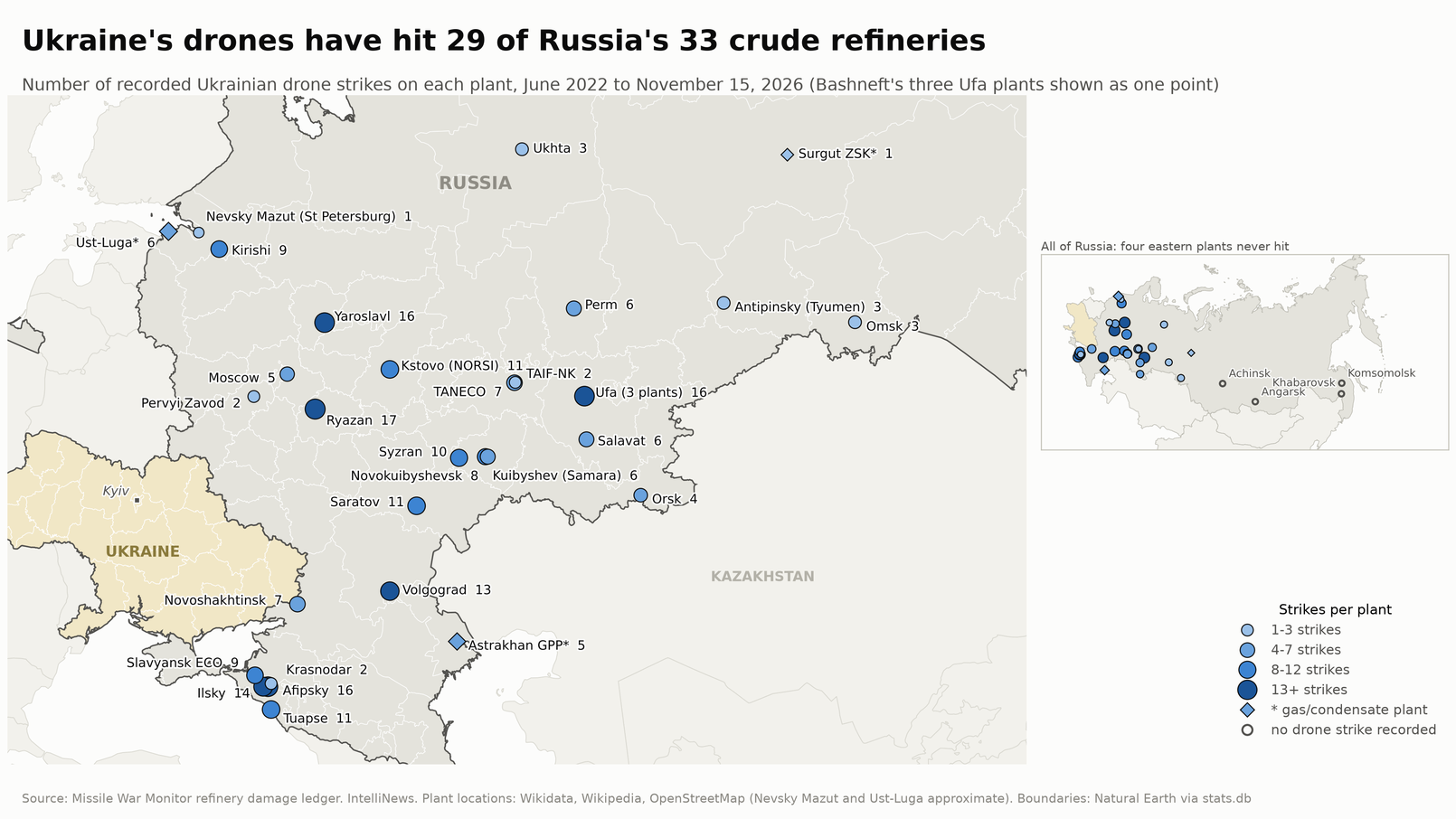
Recorded Ukrainian drone strikes on each Russian oil refinery, June 2022 to November 15, 2026. Diamonds mark gas and condensate plants; hollow circles mark refineries with no strike recorded. Source: Missile War Monitor refinery damage ledger. IntelliNews
Counts of the total vary with what is included. Ukraine's military intelligence agency HUR said in early November that strikes had put 15 of Russia's 38 major refineries out of action by the end of September. The ledger also logs strikes on three gas and condensate processing plants, at Ust-Luga, Astrakhan and Surgut, which it keeps out of the refining totals.
Kyiv's 55% is far above any independent tally. The 12 refineries last reported fully halted in the ledger have combined capacity of 133mn tonnes a year, about 41% of the national total, and Lukoil's Kstovo plant was running at about a quarter of capacity in September. Moscow's own count is much lower: Deputy Prime Minister Alexander Novak said in early September that about 10% of refining capacity was under repair.
Ukraine has hit nine refineries since November 1, against seven strikes on refineries in the whole of October, according to the ledger. Strikes resumed on October 30 after a pause that followed US President Donald Trump's push for an energy truce, and the targets have included Russia's second-largest refinery at Kirishi on November 9 and its largest, Gazprom Neft's plant at Omsk, on November 11, where residents reported a fire near the refinery. Volgograd governor Andrei Bocharov said falling debris killed four workers at an enterprise in the city's southern industrial zone on November 13, without naming Lukoil's refinery there. Ukraine's General Staff said its drones hit the only primary distillation unit at the TAIF-NK refinery in Nizhnekamsk on November 15, a claim not confirmed by the company.
The campaign has also reached Russia's export ports as the drone war shifts to crippling ports. A satellite image taken on November 15 shows at least five petroleum storage tanks completely burned out at Ust-Luga, Russia's main Baltic export hub, after the drone attack overnight on November 11, Radio Liberty's Ukrainian service reported. Leningrad region governor Alexander Drozdenko said the strike set the port on fire and injured three workers.
Zelenskiy linked the strikes directly to Russia's attacks on Ukraine's power grid. Russian forces have stepped up strikes on energy facilities in the Zaporizhzhia and Dnipropetrovska oblasts since September, with 131 strikes on the Dnipropetrovska oblast alone, he said, and he called on partners to focus on missiles for Patriot and NASAMS air-defence systems. Ukraine will also work with its partners to increase drone production, he said.
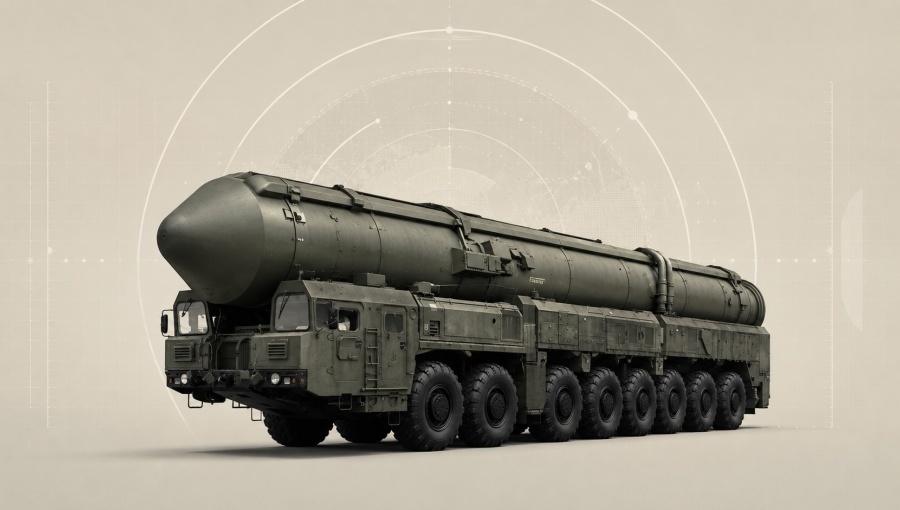
Ukraine attacked the Crimean Bridge and sent about 600 drones at the Moscow region overnight, Russian officials said on November 16. Road traffic over the bridge was restricted until about midday.
"The enemy has delivered an attack on the Crimean Bridge," Sergei Aksyonov, the Russian-installed head of occupied Crimea, said on November 16, adding that an operational headquarters had been set up in Kerch, TASS reported. He gave no damage, no casualties and no time for the attack. The 19 km bridge across the Kerch Strait is the only fixed link between Russia and the peninsula and carries both road and rail traffic.
SOURCING NOTE: the bridge attack rests on Aksyonov's statement alone at the time of writing. No Ukrainian body has claimed it, no weapon is named and no damage is described by either side. TASS's own lede says traffic is restricted through Monday afternoon while Aksyonov's quote says until about midday; the quote is used. A Ukrainian outlet's headline that trains were delayed was seen but not read and is not printed.
Moscow mayor Sergei Sobyanin said about 600 drones flew towards the Moscow region between 17:00 on November 15 and 08:00 on November 16, that most were destroyed at long range by defence ministry air defences and that 191 were brought down on approach to the capital, the city portal M24 reported. Vnukovo and Sheremetyevo airports accepted and dispatched flights only by arrangement for part of the night; M24 later reported Sheremetyevo back to normal operations. No damage or casualties in the capital were reported.
Russia's defence ministry said its air defences intercepted 1,336 fixed-wing Ukrainian drones overnight over the Moscow region, 14 other regions, Crimea and the Azov and Black Seas, and that an oil depot in Azov in the Rostov region had been attacked, with the damage being clarified. It published no breakdown by region.
ACCURACY NOTE: the 600 and the 1,336 are Russian official figures and are not independently verified. The 600 is Sobyanin's count of drones heading for the Moscow region; the 1,336 is the ministry's national overnight total, and the two are not comparable. Sobyanin's running total was published in instalments of 57, 82, 114, 139 and 191 through the night, which are cumulative counts, not conflicting ones. AFP rendered the ministry's figure as more than 1,300. The ministry's headline says shot down and its text says intercepted.
Azov: Rostov governor Yuri Slyusar said fires broke out at four industrial facilities in Azov after the overnight attack and that three men were taken to hospital, with the extent of the damage being clarified. In the Millerovo district, debris damaged three houses and a gas pipeline in the village of Rogalik and started a fire, with no casualties, he said. The Russian outlet Astra said the area hit holds the oil depot of Flash Energy, with 10 tanks and more than 6,500 cubic metres of storage, and a gas distribution station operated by Yug-Impeks.
SOURCING NOTE: no official has named the four Azov facilities; the Flash Energy depot and the Yug-Impeks station are Astra's open-source identification. UNN describes both as oil depots, which differs from Astra on Yug-Impeks. Social media accounts tracking strikes reported Ukrainian FP-5 Flamingo cruise missiles over the area; no source has confirmed it and it is not reported here as a fact. No Ukrainian General Staff statement on the night of November 15-16 had been published at the time of writing. Rostov's three sea ports were brought to a standstill by drone strikes earlier this month, as IntelliNews reported.
Russia sent 158 attack drones at Ukraine from 18:00 on November 15, 77 of them jet-powered Shaheds, with Gerbera drones and Parodiya decoys, Ukraine's air force said. It said 131 were shot down or suppressed, including 55 of the jet drones, that hits were recorded at 19 locations and debris fell at 11, on preliminary figures with drones still in the air. It reported no missiles.
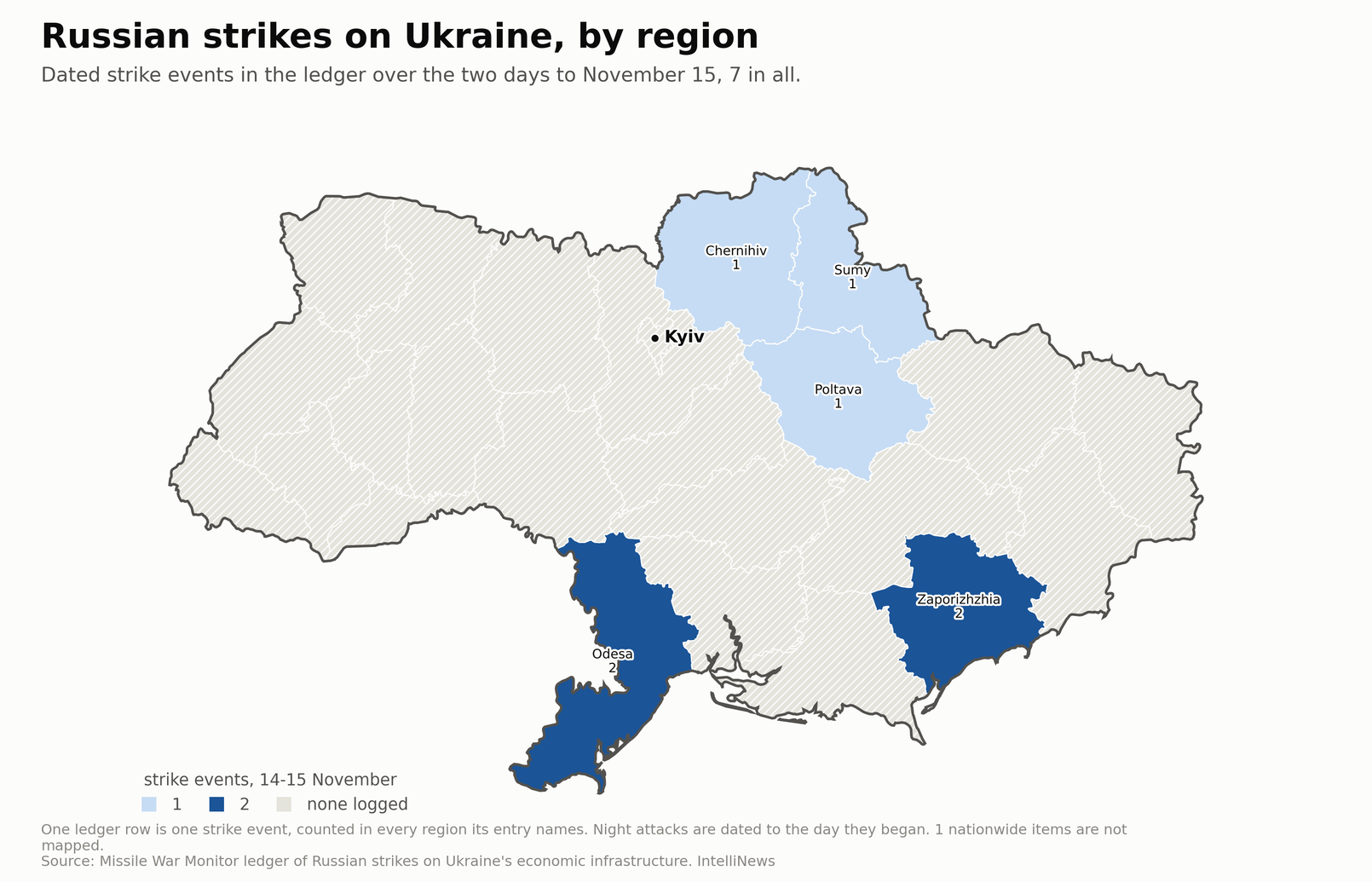
Russian strikes on Ukraine's economic infrastructure by region over the two days to the Missile War Monitor ledger's as-of date. One ledger row is one strike event, counted in every region its Region cell names, and night attacks are dated to the day they began. A region with no figure is hatched, not read as zero. Source: IntelliNews Missile War Monitor ledger.
Refinery strikes
Tatarstan: Ukraine's General Staff said its forces hit the TAIF-NK refinery in Nizhnekamsk on the night of November 14-15, damaging the plant's sole primary processing unit, ELOU-AVT-7, and starting a fire, with the extent of the damage being assessed. It said the neighbouring Nizhnekamskneftekhim petrochemical complex, part of Sibur, was hit in the same attack, with explosions and a fire. That makes Nizhnekamsk the ninth dated refinery strike of November in our ledger, against seven in the whole of October.
Nizhnekamsk mayor Radmir Belyaev said the city came under a prolonged attack that damaged industrial-zone facilities and a residential building, and put the injured at six, up from three, Interfax reported. He named no plant. Tatarstan's president's press service said a drone hit a flat on Mendeleev Street without its warhead detonating, and that falling debris set fire to an ethylbenzene tank car at Biklyan station at about 07:00, halting rail traffic until the fire was out.
SOURCING NOTE: the refinery and the unit are named by Ukraine's General Staff, carried by the Kyiv Independent and Censor.net; neither TAIF nor any Russian official has confirmed a hit on the refinery, and no halt has been reported. The refinery ledger also records an ELOU-AVT-7 at the neighbouring TANECO refinery, hit on September 13; which plant the General Staff means rests on its own wording, which names TAIF-NK. Ukrainska Pravda's English report calls it the Nizhnekamsk oil refinery without naming the operator. The injured count is unreconciled: three, then six on the mayor's figures, and a headline of seven that was not verified.
Nationwide: President Volodymyr Zelenskiy said on November 15 that Ukrainian strikes had halted more than 55% of Russia's oil refining capacity, citing a report from Major General Mykhailo Drapatyi. The figure is Kyiv's own and is not broken down by plant. Drones have hit plants making about 55% of Russia's petrol since strikes resumed on October 30, on International Energy Agency figures reported by IntelliNews, a different measure of a different product.
Our refinery ledger's running capacity figure has not moved. No halt or cut at a named plant has been re-confirmed in reporting dated November, so the figure for the month stands at nil against Russia's 327mn tonnes a year of nameplate capacity. Up to 145.8mn tonnes a year, or 45% of the total, is offline if the halts reported in September and October still hold. Russian officials put capacity under repair at about 10%, a figure given by Deputy Prime Minister Alexander Novak in early September.
FIGURE NOTE: Zelenskiy's 55%, the ledger's upper bound of 45% and Novak's 10% are three different claims on three different bases and are not reconciled here. Zelenskiy's is a Ukrainian military estimate with no published method; the ledger's counts plants reported halted or cut, mostly on unnamed industry sources cited by Reuters, and assumes September and October halts still hold; Novak's is two months old. The ledger's November figure of nil is a gap in confirmation, not a claim that nothing is down. A Reuters report of November 10, carried by UNN, put the cut from recent attacks at 30%.
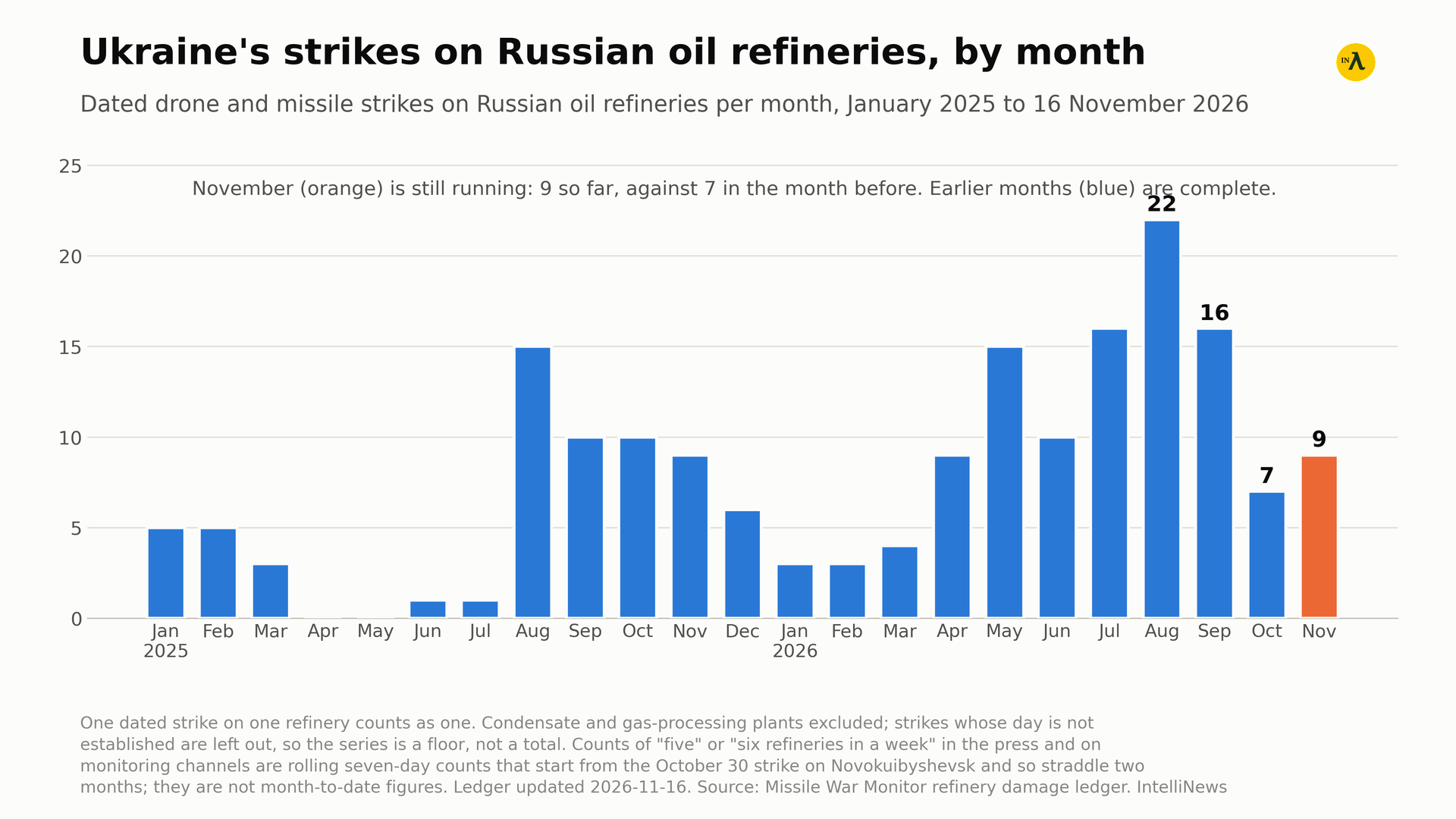
Ukraine's strikes on Russian oil refineries, by month, from the Missile War Monitor refinery ledger, rebuilt on November 16. The series is a floor, not a total: condensate, gas-processing, pipeline and pumping facilities are excluded, and a strike whose month is known but whose day is not is left out. Completed months are blue and the month in hand is orange, because it is a running count. Source: IntelliNews Missile War Monitor refinery ledger.
Metal plants hit
No strike on a steel, iron ore, coke, ferroalloy, pipe or non-ferrous plant in Ukraine was reported in the two days to November 16. Vinnytsia's regional governor said a critical industrial facility was hit overnight without naming it, and an enterprise in Kamianske, home to the Dniprovsky iron and steel works, was hit, with no details given; neither is identified as a metals plant.
Oil depots, factories and military targets in Russia
Astrakhan region: Ukraine's General Staff said its forces struck the Akhtubinsk military airfield on the night of November 14-15, setting off a powerful secondary detonation at a store of kits for air-launched guided missiles, and hit a mobile PRV-13 radar altimeter. The airfield hosts the defence ministry's 929th State Flight Test Centre and a Su-34 unit, about 650 km from the front. Astrakhan governor Igor Babushkin said 31 drones were destroyed over the north of the region.
UPDATE NOTE: the previous edition carried the Akhtubinsk strike as a monitoring-channel claim only. It is now a Ukrainian General Staff claim. No Russian official has confirmed damage, and the count of at least 30 explosions comes from the monitoring channel Exilenova+ alone.
Oryol region: the General Staff said the same night's strikes hit the so-called Tsymbulova drone port near the village of Tsymbulova, a site it said Russia uses to store, prepare and launch attack drones. No Russian official has commented.
Bryansk region: the General Staff said it hit the Monolit plant in Trubchevsk, which it described as making aircraft including helicopters, spare parts and components, and doing metalworking. It gave no damage details and no Russian official has commented.
Leningrad region, update: a satellite image taken on November 15 and published by Radio Liberty's Ukrainian service shows at least five petroleum storage tanks completely burned out at the Baltic port of Ust-Luga after the Ukrainian drone attack of November 11, with traces of firefighting foam beside others, Ukrainska Pravda reported.
Nationwide: Russia's defence ministry said 230 Ukrainian drones were destroyed between 08:00 and 20:00 Moscow time on November 15 over Crimea, the Belgorod, Bryansk and Kursk regions and the Black Sea. Belgorod's emergency centre said three civilians were injured when drones attacked cars on the Graivoron road and in Shebekino, and Kursk governor Alexander Khinshtein said drones were dropping explosive devices on Rylsk, where two civilians were seriously wounded, TASS reported.
The weather report
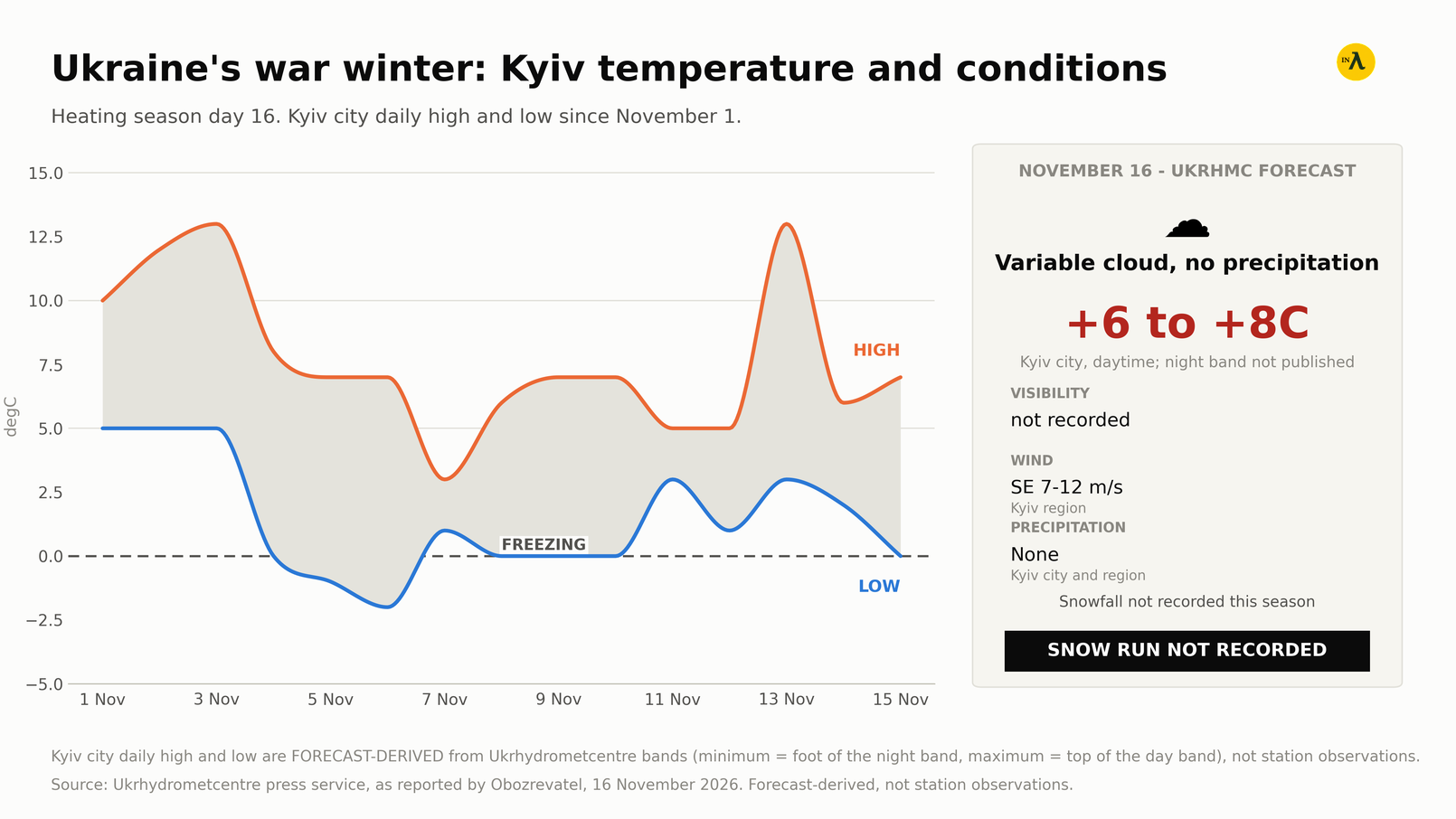
Day 16 of the heating season, counted from November 1. Ukraine's hydrometeorological centre forecast variable cloud and no precipitation in Kyiv and the region on November 16, with daytime highs of +6 to +8C in the city and +3 to +8C across the region and a south-easterly wind of 7 to 12 metres a second, Obozrevatel reported.
Kyiv: the centre's published forecast as carried gave no night band for the city, so no overnight minimum is recorded for November 16. The Kyiv outlet Kyiv24 put the night at about +1C in the city and 1 to 3C of frost in places across the region, without naming its source.
WEATHER NOTE: the overnight figure is left empty in the record rather than filled from an unattributed forecast, and the graphic shows the missing reading as a gap. Snow is not recorded: there is no snow ledger yet, and "not recorded" is not the same claim as zero. The hydrometeorological centre forecast on November 14 that rain reaches most of the country by November 18 with night temperatures back above zero from November 17 and no snow expected yet; that week-ahead forecast has not been re-checked against a later issue in this edition.
Ukraine under fire
Dnipro: a repeat strike on the city on the morning of November 16 killed one person, said Oleksandr Hanzha, head of the Dnipropetrovsk regional military administration. A woman of 44 was injured in the first strike and taken to hospital in moderate condition, and three more people were injured in the second. Apartment blocks lost windows and balconies and cars burned on a road, Censor.net reported.
Dnipropetrovsk region: Russia launched nearly 20 drone attacks on six districts overnight, the regional administration and rescue service said. An enterprise in Kamianske was hit, transport infrastructure in Dnipro and a gas pipeline in the Nikopol district were damaged, and two people were injured in Pavlohrad, where a school, three apartment buildings and a car were damaged.
Odesa region: Russia launched what governor Oleh Kiper called a mass attack on the region on November 15. A DTEK energy facility was hit and about 41,000 families were temporarily without power, he said. In Chornomorsk six people were injured and energy infrastructure, an office building, a gas pipeline and residential facades were damaged, the interior ministry said, and in Odesa a car dealership and storage facilities including grain warehouses were destroyed, Kiper said. A second mass attack overnight on November 16 damaged unnamed infrastructure facilities, houses and a car and started fires, with no injuries on preliminary information, Kiper and the emergency service said.
UPDATE NOTE: the previous edition carried a Russian defence ministry claim of strikes on Chornomorsk port facilities on the night of November 14-15. The Ukrainian interior ministry's account of damage in Chornomorsk on November 15 describes energy infrastructure, an office building and a gas pipeline, not port facilities, and the two accounts are not reconciled.
Kharkiv: Russian drones hit a high-rise residential building in the Shevchenkivskyi district at about 18:00 on November 15, and a children's educational facility in a later attack using a Molniya drone, mayor Ihor Terekhov said; a jet-powered drone struck the Slobidskyi district at 22:17. Regional governor Oleh Syniehubov said nine people were injured in the region over the day.
Kyiv region: a warehouse at an enterprise in the Vyshhorod district caught fire and four houses were damaged in a morning attack on November 16, with no casualties, the regional military administration said. No strike on Kyiv city was reported.
Zaporizhzhia region: Russian forces carried out 910 strikes on 44 settlements in the day to the morning of November 16, including a missile strike on Zaporizhzhia city, killing one and injuring four, said Ivan Fedorov, co-chair of the regional defence council.
TOLL NOTE: Mykhailo Semikin, acting head of the regional administration, separately reported two deaths, a man of 59 in Bilenke and a woman in the Khortytskyi district. The two officials' periods may differ and the totals are not reconciled.
Kherson: Russian shelling, drones and aircraft hit 34 settlements in the day to the morning of November 15 without civilian casualties, said regional governor Oleksandr Prokudin.
Nationwide: Zelenskiy said Russia had launched more than 2,300 attack drones, 1,590 guided aerial bombs and 15 missiles of various types at Ukraine over the past week. At least four civilians were killed and 69 injured in the day to the morning of November 15, the Kyiv Independent reported from regional officials' figures.
Power and energy
Zaporizhzhia region: an attack at about 12:30 on November 15 damaged electrical equipment and cut power to 359,000 consumers in Zaporizhzhia city and the government-held part of the region, said Andrii Stasevskyi, head of Zaporizhzhiaoblenergo. Critical infrastructure was reconnected within four and a half hours and Semikin said power was restored across the region at 19:51. Hourly outage schedules apply on November 16.
Dnipropetrovsk region: Ukrenergo, the grid operator, imposed emergency outages in the Zaporizhzhia and Dnipropetrovsk regions on November 15 after another attack damaged electrical equipment, without giving the scale, and part of Dnipro and Kamianske lost power after a repeat strike on an energy facility, Ukrainska Pravda reported.
Cherkasy region: several energy facilities in the Zvenyhorodka district were attacked overnight on November 16 and some consumers lost power, said Ihor Taburets, head of the regional military administration, without giving a number. A drone hit the grounds of an enterprise that is not operating and started a fire, and there were no casualties.
Vinnytsia region: a critical industrial facility and energy facilities were hit overnight, with no casualties, said regional governor Natalia Zabolotna. Hourly outage schedules apply from 06:00 to midnight on November 16 on Ukrenergo's instruction, with power limits for business all day.
Zhytomyr region: drones hit energy infrastructure and damaged four houses in the Zhytomyr and Cherniakhiv communities on the night of November 14-15, with no casualties, the regional military administration said. In the Kirovohrad region an industrial infrastructure facility was attacked overnight, the emergency service said.
Sumy region: part of the region remains without a stable electricity supply after a breakdown at a high-voltage facility, Ukrainska Pravda reported. Zelenskiy said energy infrastructure in the Zaporizhzhia, Sumy, Odesa, Zhytomyr and Kirovohrad regions and railway infrastructure in the Dnipropetrovsk, Kharkiv and Zaporizhzhia regions were attacked overnight and on the morning of November 15 alone.
Rail: Ukraine has lost 630 locomotives damaged or destroyed since the full-scale invasion, nearly 400 of them this year, Mykola Kalashnyk, minister for restoration, infrastructure and transport, told the Verkhovna Rada, counting almost 15 attacks on rolling stock so far this month and an average of 37 to 40 locomotives put out of service a month, Ukrinform reported on November 14.
Aid: the Bundestag's budget committee approved an extra EUR200mn in winter aid for Ukraine on November 13 from the development ministry's crisis fund, covering electricity, heating and water as well as schools, kindergartens, agriculture and civil protection, Germany's foreign ministry said.
Data centres, telecoms, media and R&D
No strike on a data centre, hosting provider, telecoms operator, mobile mast, broadcaster, newsroom, university or research site in Ukraine was reported in the two days to November 16. The children's educational facility hit in Kharkiv on the evening of November 15 is recorded in the section above.
Weapons and technology
Starshield: Zelenskiy said speed restrictions on Starshield terminals along the front line and in occupied territory are stopping Ukrainian interceptor drones from catching Russia's jet-powered Shaheds, which are getting through to substations. "Our interceptor drones lose connection with their operators at a speed of 161 km/h (100 mph) and simply cannot catch up with Russian jet-powered Shaheds," he said on November 15, adding that he had told the foreign and defence ministries and his office to work with Washington and SpaceX to lift them. SpaceX told Axios the reports were false and that there had been no change.
SOURCING NOTE: the 161 km/h cap is Zelenskiy's figure; the Kyiv Post describes it as reportedly applying, and SpaceX denies any change. A failure rate for affected missions rising from 10% to 50% to 100% over three days comes from one unnamed Ukrainian official quoted by Axios. The Congressional Ukraine Caucus, on behalf of 105 members, demanded a full accounting on November 12. Fire Point's chief executive Iryna Terekh told Breaking Defense she wants Starshield coverage extended 200 to 300 km beyond the front. A New York Sun report that Ukraine has turned to the Israeli system HiSKY cites a pro-war Russian Telegram channel and does not link it to refinery strikes; that link circulates only on social media and is not printed as a fact.
Denmark: Zelenskiy said Ukraine needs 800,000 20mm rounds for its F-16s' cannons over six months to shoot down jet drones and that Denmark had agreed to resolve the issue, Militarnyi reported, citing Ukrinform. He also said the number of F-16s flying combat missions at once must rise 2.5 times. On FREYJA, the joint anti-ballistic system, he said Ukraine's missile and the Danish radar are ready, the first components from partners, Interfax-Ukraine reported.
FIGURE NOTE: no cost or financing terms for the ammunition were given, and the agreement is Zelenskiy's account alone. Denmark delivered more than 50,000 rounds in October. FREYJA's remaining components depend on partners and no delivery date has been given.
United States: licensing paperwork for Ukraine to produce Patriot interceptors remains stalled at the Pentagon, a Radio Liberty correspondent reported on X on November 14, citing two unnamed sources. The Pentagon did not comment.
Arson and sabotage in the EU and the UK
Estonia: intruders tried to break into the premises of the drone maker Threod Systems in Viimsi, outside Tallinn, at about 03:00 on November 14 with the aim of setting the building on fire and causing an explosion, and were stopped by the company's own security staff, Prosecutor General Astrid Asi said. Eight residents of Latvia were detained. The Internal Security Service said Russia was behind the attempt and that the GRU, Russia's military intelligence agency, coordinated it. Foreign Minister Margus Tsahkna said Estonia would close its border crossings with Russia from December 1.
ATTRIBUTION NOTE: the GRU attribution is the Estonian Internal Security Service's and the foreign minister's, stated by them; Russia's foreign ministry had not commented. Prosecutors applied to remand five of the eight suspects; that the court granted it is reported by Politico but was not confirmed elsewhere. Sources differ on the border: Estonian World says road crossings, other reports say all crossings. Latvia's security service searched nine locations and found explosive items, pyrotechnics and ammunition. The August arson at Milrem Robotics, which supplies ground drones to Ukraine, was attributed by Estonian authorities to Russian intelligence in September.
Romania: drones hit three commercial vessels near the Danube delta over two days: the Palau-flagged Larissa 1 about 12 km off Sfantu Gheorghe at about 21:40 on November 13, with a cargo crane damaged, and the Greek-flagged tanker Evia Petrol V and the bulk carrier Marsol near the Sulina canal on the evening of November 14, both catching fire, with no casualties, the Kyiv Independent reported. Romania's defence ministry said it detected an aerial target east of Snake Island and scrambled F-16s. Prime Minister Luca Niculescu called the incidents unacceptable and a violation of international law.
ATTRIBUTION NOTE: Romanian authorities have not publicly identified the origin of the drones, and the vessels are recorded here as incidents, not attributed strikes. Niculescu's condemnation is reported by Ukrainska Pravda citing European Pravda and his post on X, and frames the incidents within Russia's war. Anadolu's headline counts two vessels, which matches the November 14 incidents only.
Mediterranean: the EU's Operation Irini boarded the crude tanker MV Midag on November 13 and found it sailing under a false flag, EU foreign policy chief Kaja Kallas said on November 15, adding that EU foreign ministers are due to approve new Russia sanctions listings on November 16 targeting banks, buyers and companies that support the shadow fleet.
Poland: the Ukrainian embassy called "Slava UPA" graffiti painted on two monuments in Warsaw, including the Monument to the Heroes of the Warsaw Ghetto, a Russian provocation and part of Russia's hybrid war. Warsaw police are investigating and have identified no perpetrators, and no Polish official has attributed it.
Tit for tat
Both sides are fighting a war of bridges as much as a war of power stations. The Crimean Bridge attack comes as Ukraine works along Russia's land route to Crimea, damaging the road surface of a bridge on the R-280 highway near Taganrog on November 15 and closing it, while Russia has struck the crossings over the Dnipro in Kyiv and the bridges linking southern Bessarabia to Odesa. The French open-source analyst Clément Molin counts nine of 29 key Ukrainian crossings hit by Russia and 21 of 40 bridges on the road to Crimea hit by Ukraine, with 27 Russian pontoons and bypasses built beside them; that count is his own and is not verified.
Neither campaign has yet cut a route. On Molin's account the Zatoka bridge still stands after dozens of strikes and Russia keeps its supply line to Crimea open on pontoons, while Kyiv is building eight reserve crossings over the Dnipro. What both sides are buying is cost and delay: 359,000 consumers in Zaporizhzhia without power for an afternoon, a Moscow night with two airports on restrictions, and a winter in which the frost has only just begun.
Russian missile and drone production
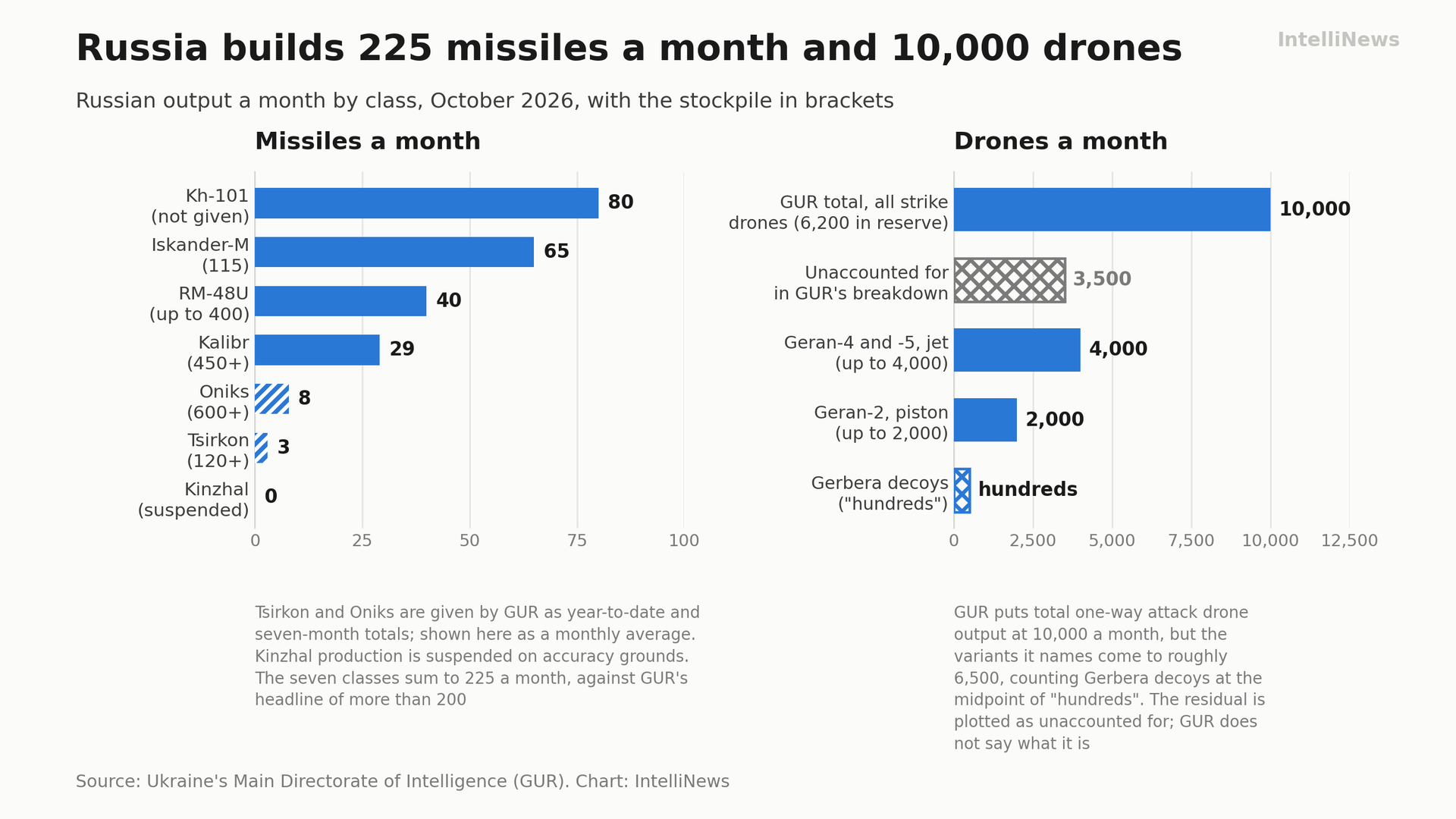
Russian missile and drone output a month by class, on Ukraine's Main Directorate of Intelligence assessment of October 2026, with stockpiles in brackets.
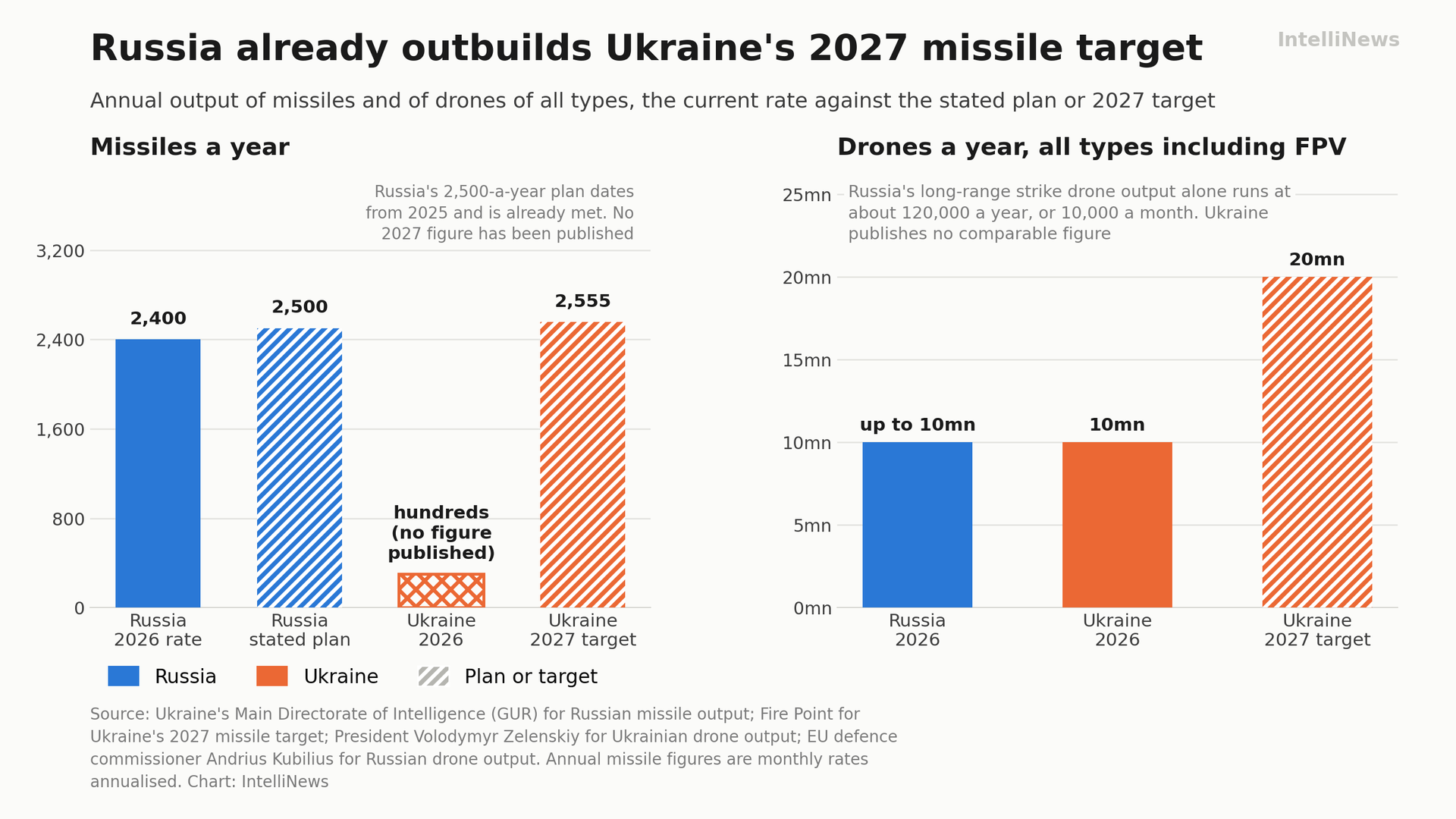
Annual missile and drone output, Russia's current rate against Ukraine's 2027 targets.
The ledgers
The running ledgers are kept as eight public ledgers at permanent addresses. The first three are non-exhaustive, every row is sourced, and where only one side has spoken the row says so. Defence ministry figures are recorded as claims, and in the sabotage ledger attribution is given exactly as the authorities state it and no further. The fourth tracks what has happened to Ukraine's steel, iron ore, coke, ferroalloy and non-ferrous plants since 2021, grouped by owner. The fifth tracks strikes on data centres, telecoms, media and research sites, the sixth strikes on Ukraine's power plants, substations and grid, the seventh the EU's sanctions on Russia, and the eighth refinery strikes.
RUSSIA STRIKES LEDGER: Russian strikes on Ukraine's economic infrastructure, 810 rows
UKRAINE STRIKES LEDGER: Ukrainian strikes on economic infrastructure in Russia and occupied territory, 500 rows
ARSON & SABOTAGE LEDGER: Arson, sabotage and drone incursions in the EU and the UK, 127 rows
METAL STRIKES LEDGER: Ukraine's metals and mining assets: 2021 baseline against status in September 2026, 38 plants and mines
DATA CENTRE & TELECOM STRIKES LEDGER: Data centres, telecoms, media and research sites hit in Ukraine, 46 rows
ENERGY STRIKES LEDGER: Russian strikes on Ukraine's power plants, substations and grid, 270 rows
EU SANCTIONS LEDGER: EU sanctions on Russia — package details, exemptions and implementation deadlines
REFINERY STRIKES LEDGER: Russian oil refineries hit, and how badly, 27 refineries
| Refinery | Region | Capacity (mn t/yr) | Strikes | Latest hit | Worst damage (0-4) | Status now |
| Ryazan | Ryazan region | 17.1 | 17 | November 5, 2026 | 4 | Partly operating: AT-6 primary unit halted after 15 Oct strike; AVT-1, AVT-3, AVT-4 running (October 16, 2026) |
| Moscow (Kapotnya) | Moscow | 12 | 5 | September 20, 2026 | 4 | Halted (September 22, 2026) |
| Kirishi (KINEF) | Leningrad region | 20.1 | 9 | November 9, 2026 | 4 | Halted (September 15, 2026) |
| Yaroslavl (Slavneft-YANOS) | Yaroslavl region | 15 | 16 | November 3, 2026 | 4 | Halted (September 17, 2026) |
| Nizhny Novgorod (Lukoil NORSI, Kstovo) | Nizhny Novgorod region | 17 | 11 | November 1, 2026 | 4 | Partly operating (~25%) per September reports; fire and significant damage reported 1 Nov 2026, status since not known (September 15, 2026) |
| Volgograd | Volgograd region | 14.8 | 13 | November 13, 2026 | 4 | Halted (October 6, 2026) |
| Saratov | Saratov region | 7 | 11 | November 7, 2026 | 4 | Halted (September 16, 2026) |
| Syzran | Samara region | 8.5 | 10 | September 15, 2026 | 4 | Halted (September 16, 2026) |
| Novokuibyshevsk | Samara region | 8.3 | 8 | October 30, 2026 | 4 | Fire reported 30 Oct 2026; Fire Point claims hits incl. diesel hydrotreater; not officially confirmed; operating status unknown (October 30, 2026) |
| Kuibyshev (Samara) | Samara region | 7 | 6 | September 23, 2026 | 4 | Unknown after 22 Sep 2026 strike (September 23, 2026) |
| Tuapse | Krasnodar region | 12 | 11 | May 27, 2026 | 4 | Halted (no restart reported) (April 21, 2026) |
| Afipsky | Krasnodar region | 6.2 | 16 | November 6, 2026 | 1 | No halt reported (August 27, 2026) |
| Ilsky | Krasnodar region | 6.6 | 14 | September 26, 2026 | 3 | Halt claimed by Ukraine's Fire Point, not confirmed (September 26, 2026) |
| Slavyansk ECO | Krasnodar region | 5.2 | 9 | September 13, 2026 | 4 | No halt reported after 13 Sep 2026 (September 17, 2026) |
| Krasnodar | Krasnodar region | 3 | 2 | August 30, 2025 | 1 | No halt reported (August 30, 2025) |
| Novoshakhtinsk | Rostov region | 5 | 7 | September 25, 2026 | 4 | Halted (temporarily suspended) (September 25, 2026) |
| Ufa group (Bashneft: Ufaneftekhim, Novoil, UNPZ) | Bashkortostan | 23.4 | 16 | October 31, 2026 | 2 | Operating, units under repair (September); strike reported 31 Oct 2026, status since not known (September 22, 2026) |
| Salavat | Bashkortostan | 10 | 6 | October 8, 2026 | 4 | Halted (no restart reported) (August 14, 2026) |
| Nizhnekamsk (TANECO) | Tatarstan | 16 | 7 | September 13, 2026 | 4 | Unclear / partly operating (September 18, 2026) |
| Nizhnekamsk (TAIF-NK) | Tatarstan | 7.3 | 2 | November 15, 2026 | 0 | Fire; damage being assessed; no halt reported (November 15, 2026) |
| Perm (Lukoil) | Perm region | 13.1 | 6 | September 25, 2026 | 4 | Halted (September 25, 2026) |
| Orsk | Orenburg region | 6.6 | 4 | August 11, 2026 | 4 | Halted (repairs up to six months) (August 13, 2026) |
| Omsk | Omsk region | 21 | 3 | November 11, 2026 | 4 | Unclear (restarted late July; later reported stopped) (September 15, 2026) |
| Tyumen (Antipinsky) | Tyumen region | 9 | 3 | July 25, 2026 | 4 | Halted (no restart reported) (July 28, 2026) |
| Ukhta (Lukoil) | Komi Republic | 4.2 | 3 | October 9, 2026 | 1 | Unknown (February 12, 2026) |
| Pervyi Zavod (Kaluga mini-refinery) | Kaluga region | 1.2 | 2 | May 10, 2024 | 1 | Operating (November 19, 2025) |
| Nevsky Mazut (St Petersburg) | St Petersburg | 1 | January 31, 2024 | 1 | Unknown (January 31, 2024) |
Russian oil refineries hit by Ukrainian strikes, as of November 16, 2026. Non-exhaustive; strike counts are floors. Damage: 0 claimed, no damage confirmed; 1 fire or minor damage; 2 secondary unit damaged, output reduced; 3 primary distillation unit damaged; 4 refinery halted. Plants reported halted or cut in Nov 2026 account for about 0 mn t/yr, about 0% of the 327 mn t/yr nameplate total; up to 145.8 mn t/yr (45%) if earlier halts still hold. Russian officials put capacity under repair at about 10% (Deputy Prime Minister Alexander Novak, early September). Status mostly from unnamed industry sources cited by Reuters. Full sourced ledger:
https://docs.google.com/spreadsheets/d/1AHjZvX9Hf-6jdKxcTE8Dw7f6O2_svY0kX54sqKPyU_s
This monitor was produced with the help of IntelliNews Lambda analytical tool

No comments:
Post a Comment