Sunday, October 19, 2025


‘Forty years on, women in Labour are still being told to wait their turn’


Photo: chrisdorney/Shutterstock

I read the article by Jessica Smith and found myself thinking about 1988. I learned a lot about the Labour Party that year: when I stood to be CLP Women’s Officer, I was taken to one side, told there was an incumbent and that it would be inappropriate to stand against her. I should wait my turn.

I was a delegate to annual conference and, when reporting back to another branch, watched as the few women there got up and walked out in unison about half an hour into the meeting. I was invited to follow them only to be told that we would now make tea and coffee for the (male) delegates.

There was a leadership election that year, and I stood behind Ron Todd in the queue to register our (paper) votes. The woman in front of him presented her one CLP vote for Benn/Heffer, whereupon Ron laughed, said ‘Sorry love’ and declared ‘Eight million votes from the TGWU for Neil Kinnock and Roy Hattersley’.

Power.

Although I have been a member for almost forty years (apart from a two year break when it all felt a bit grim) it’s years since I have been an activist. So it was a shock to return to ‘active service’ a couple of years ago and see what has, and what hasn’t changed. 

READ MORE: ‘Young Labour women must take up space’

Jessica describes being made to feel like she shouldn’t be in the room, that she has to police herself, that she mustn’t ever make a mistake or misspeak. No one should be made to feel like this, particularly within a political party that prides itself on progressive values.

One of the joys of my working life has been the opportunity to learn from those who have gone before, to understand the struggles and fights of the past, what has worked and what hasn’t. But that on its own isn’t enough, without action and without the next generations we risk being pickled in aspic, looking backwards and not forwards. So the time I spend with young people in the housing sector is a joy, and a privilege. I have learned so much, hopefully shared a bit of wisdom and held doors open for them to run through. I’m proud of helping make the case for CIH Futures and am now watching those first cohorts begin to change the world, solving problems in a way that blows my mind. They are incredible people.

At no point have I felt like I now do in the Labour Party, where the pockets of contempt towards people, particularly women, of my age is overwhelming. WhatsApp groups are full of disdain for ‘Boomers’ and it all feels a bit too Logan’s Run for comfort. This is by no means universal, but there are pockets, and those pockets are pretty deep, and pretty dark.

Subscribe here to our daily newsletter roundup of Labour news, analysis and comment– and follow us on BlueskyWhatsAppX and Facebook.

As always in the Labour Party, so much of this comes from factionalism, with a side order of old-fashioned misogyny. I have watched as young women are volunteered for (often admin) tasks without their agreement, seen the distress caused when instructions on how to vote are sent by WhatsApp during meetings. Ageist epithets are used when older women refuse to be biddable and all in the name of one faction of the party or another one. There are a plethora of unaccountable organisations exerting real power and influence both on the edges of and at the heart of Labour and the party would be well advised to get a grip of some of these.

External structures increasingly recognise that diversity is best served having time limits on boards and committees. This is hard for democratic institutions to grapple with but we must be mindful of balance and of diversity in all its forms, including opinion.

So Jessica, your voice needs to be heard, it is not okay that you are made to feel unwelcome, just like it wasn’t okay forty years ago. I’d love to sit and have a brew with you, to learn from you and maybe hatch out a plan to call out the ageism and misogyny that still exists in Labour. Whatever you do, don’t give up.


‘After years of sewage and debt, Thames Water doesn’t deserve another free pass’


Photo: Jessica Girvan/Shutterstock

Ofwat is currently deciding whether to let Thames Water pollute our rivers and seas outside of current legal limits for the next 15 years. 

As many of us are already acutely aware, Thames Water is crumbling. It has a debt pile of approximately £20 billion. Households are paying more and more for a broken service. Burst pipes, water outages and road closures have all become new norms. Last year, Thames Water had the highest rate of serious pollution incidents out of all the English water companies.

In an attempt to keep hold of the utility, Thames Water’s creditors (mostly US hedge funds and investment firms that are now using the name London and Valley Water) have put forward a deal to water regulator Ofwat. As part of this deal, they have stated that a ‘full return to legal, regulatory and environmental compliance’ would not take place until at least 2035-2040. Instead, they have put forward their own ‘improvement accountability framework’ as a set of obligations which they are prepared to keep. What does this mean in practice? Thames Water’s creditors want to set their own rules.

Here are five clear reasons why this deal must not go ahead. 

It would result in 15 more years of pollution of our rivers and seas

The deal proposes an expected return to full environmental compliance in 2035-2040, meaning they will be breaching their licence until at least that time. Our rivers and seas simply cannot withstand 15 more years of pollution. 

It would set a dangerous precedent for all other English water companies

If Thames Water can set their own rules – and protect their profits as a result – all other water companies will want to do the same. This decision impacts not just Thames Water households, but every single household in England. 

There is a complete lack of transparency and accountability

Details of the ‘improved accountability framework’ have not been made clear to members of the public. We fund the water system through our bills, and rely on water companies to deliver this essential service. We are the biggest and most important group of stakeholders in our water system, and deserve a say in how it is run. Water is a natural monopoly, meaning that we cannot simply choose to get our water somewhere else if the terms and conditions of one provider don’t suit us.

READ MORE:

It is not the best value for the public purse 

Thames Water creditors have offered a 25% debt write-off. Much more debt would be written off under special administration. The previous government’s plans under Project Timber involved a 40% debt haircut for some creditors. We could cut more.

This is not what this government promised 

This government promised to be tough on water pollution, including a pledge that sewage pollution will be cut in half by the end of the decade. In this deal, Thames Water creditors set out an ‘ambition’ – not even a commitment – to reduce sewage outflows 30% by 2030, which falls significantly short of former Environment Secretary Steve Reed’s target. 

What’s more, Reed has specifically said of Thames Water that ‘it is only right that the company is subject to the same consequences as any other water company’. 

By accepting this deal, this government would be undermining their promised action on sewage not just ahead of the next election, but for the two elections after that.

Subscribe here to our daily newsletter roundup of Labour news, analysis and comment– and follow us on BlueskyWhatsAppX and Facebook.

Bring Thames Water into special administration, followed by permanent public ownership

Ofwat has a choice. Special administration is the clear and viable alternative to selling our water system down the river. 

Special administration is a form of temporary public ownership. This mechanism – which exists to protect the running of vital public services – can be used to wipe out a vast proportion of Thames Water’s debts and stabilise the company. 

From there, we must bring water into permanent public ownership. A precedent was set for this by Railtrack, which became publicly owned Network Rail after it was brought into special administration under Blair in 2001. Blair’s government would absolutely have brought Thames Water into public ownership by now. 

Under public ownership, households and environmental groups would have a say on the board of Thames Water, and money that is currently spent on shareholder payouts would be spent on tackling sewage and reducing bills.

We Own It are campaigning for Ofwat so say no to Thames Water’s outrageous deal. Our petition has already been signed by over 15,000 people. You can add your name here.


Keir Starmer the football fan really should know better

Philosophy Football’s Mark Perryman defends the ban on Maccabi Tel Aviv fans at Villa Park.

“This is the wrong decision, We will not tolerate antisemitism on our streets. The role of the police is to ensure all football fans can enjoy the game, without fear of violence or intimidation.”

At ‘best’ this tweet from Sir Keir Starmer is ill-informed, at worst it is naked and dangerous opportunism.

Ill-informed. As a former Director of Public Prosecutions, I would have thought our Prime Minister might know banning away fans because of the risk of public disorder isn’t in the least unusual.

Dangerous opportunism. As an Arsenal fan, Sir Keir is more familiar with the North London derby but as a football fan he is presumably aware of the Celtic versus Rangers derby. When Celtic and Rangers fans are banned from travelling to the away fixture, is it because they’re Catholic or Protestant? No, of course not, again, it’s because of the risk of public disorder. Likewise Maccabi Tel Aviv fans haven’t been banned from their club’s Champions League match away against Aston Villa because they are Jewish, it’s because of the risk of public disorder.

And what might that risk be? Because many, football fans or not, cannot countenance the fact that while Russia, quite rightly, was, instantly banned from all UEFA competitions following its invasion of Ukraine, Israel committing a genocide on Gaza was not. Protests outside Villa Park have been taking place against the game, entirely peacefully. There would have been protests on the night of the game, against Israel’s genocide, not against Jews. Again, a former DPP should know the difference.

But also, once more as a football fan, Sir Keir might be expected to know at least something about Maccabi Tel Aviv’s fans. They are notorious in Israel for their racism towards Arab players and clubs, in the Israeli League. This would be akin to Arsenal fans taunting Spurs as a so-called ‘Jewish’ club, not because of a long-standing North London football rivalry – an analogy Sir Keir the gooner would surely understand, and actions he’d condemn.

And Maccabi fans export all of this, mixing their racism and hooliganism. This was seen most recently in Amsterdam just a year ago at their November 2024 Europa League game against Ajax. This was widely reported but Sir Keir once again seems to have missed all of this. Funny that, I thought he was a football fan?

No fan likes to see away supporters banned. The rivalry inside the stadium is part of what makes being there so special. But sometimes bans are imposed for public safety reasons. That’s the reason for this ban, not antisemitism. Sir Keir should take down his tweet and apologise, but I won’t be holding my breath.

Mark Perryman is the co-founder of the self-styled ‘sporting outfitters of intellectual distinction’ AKA Philosophy Football.

Image: https://www.goodfon.com/sports/wallpaper-aston-villa-fc-birmingham.html Attribution-NonCommercial 4.0 International CC BY-NC 4.0 Deed and https://vectorportal.com/vector/maccabi-tel-aviv-vector-logo.ai/6265 Attribution-NonCommercial 4.0 International CC BY-NC 4.0 Deed

 UK

The Starmer Symptom – the Mark Perryman Interview

In the latest edition of the Labour Left Podcast Bryn Griffiths talks to Mark Perryman, the editor of the best book on Keir Starmer so far, The Starmer Symptom.

Mark comes from a different political place to me so I really looked forward to our discussion. In the 1980s I was supporting Tony Benn alongside Jeremy Corbyn and selling Brighton Labour Briefing in my local Labour Party.   Meanwhile Mark was a member of the Communist Party and part of the Marxism Today team which was occasionally unimpressed by those of us on the Labour left. 

Historically Mark Perryman came from what was called the soft left so it was always going to be interesting to see how far our paths have converged in the face of the Starmer-McSweeney axis.  Previously I had interviewed Neal Lawson of Compass and the brains behind the new soft left grouping Mainstream and concluded that “The hard left and the soft left are talking again” so the signs were good.

When Labour Hub published its first Labour Left Podcast episode two years ago with Liz Davies as our guest, we set ourselves the big task of considering the all-important strategic question of how does the left and in particular the Labour left make a comeback?  It is this strategic question which dominates the podcast.

We start by discussing the role that Marxism Today played in the 1980s during the period of Thatcherism.  Mark states in his book that “my front is popular”, so I press him on what exactly that statement means to him.  What flows is a valuable discussion about coalition-building.  Key to the discussion is the concept of pluralism.

I like to draw upon Antonio Gramsci’s ideas. So, Mark reveals the thinking behind the title of the book.

Having grappled with the concepts that underpin Mark’s thinking, we get down to the daunting task of applying them to today.  So, prepare for wide-ranging discussion where we consider how we should understand Labour’s sandcastle majority? How can we beat Reform? What’s Labour like according to Morgan McSweeney? 

A common theme amongst those of us that criticised Marxism Today was that it was great on the diagnosis of the new challenges we faced; but not so good on the prescription of what we should do about the challenges so effectively described.  In the interview, I challenge The Starmer Symptom on exactly the same grounds.  So, much of the interview is taken up with pushing Mark to set out his strategy to win.  Along the way, we discuss the launch of Mainstream,  economic policy, responding to the Deputy Leadership contest, proportional representation and more.

By the end of the podcast, you will appreciate that Mark Perryman is always up for a robust debate, so why don’t you invite him to speak at your local Labour Party political education meeting?  Mark would be delighted to come and discuss his essay ‘Testing the limits of Labourism’ and he will share 50% of the book sales on the day to help fund the event.  If you are interested, mail him at Mark@Perrymanemails.net for a booking.

I don’t usually tell you in advance who the Labour Left Podcast class hero of the month is going to be but given Mark’s choice I feel I must.  Mark chose our wonderful late comrade Mike Marqusee. I loved the discussion that ensued. If like me you knew and admired Mike, I am sure you’ll enjoy the nomination which occurs at the end of the episode.

If you’re new to the Labour Left Podcast, please take a good look at our back catalogue as nearly all the episodes were designed to be timeless contributions to debates on the left. 

The last episode was with John McDonnell of the Socialist Campaign Group where we explored the ideas behind his decades of Labour Left activity;  socialist feminist Lynne Segal of Beyond the Fragments looked back at her hugely impressive history of activisma recent episode interviewed John’s comrade Richard Burgon of the Socialist Campaign Group; previous episodes have looked at the fight for a United Ireland with historian Geoff Bell; a conversation with Compass’s Neal Lawson; Rachel Shabi talking about her book The Truth About Antisemitism;  Bernard Regan of the Palestinian Solidarity Campaign;  Prof Harvey J Kaye on the legacy of the Communist Historians; Prof Corinne Fowler, talking about her book Our Island Stories: Country Walks Through Colonial Britain; Andrew Fisher telling the story behind For the Many Not the Few, Labour’s 2017 manifesto; Jeremy Gilbert, a Professor of Cultural and Political Theory, a champion of Gramsci, talking about Thatcherism; episodes with Mish Rahman, Rachel Godfrey Wood and Hilary Schan on the contemporary Labour Left; Mike Phipps, author of Don’t Stop Thinking About Tomorrow, taking a long term look at the Labour Left;  Mike Jackson, co-founder of Lesbians and Gays Support the Miners, on the Great 1984-85 Miners’ Strike; political activist Liz Davies telling her story as the dissenter within Blair’s New Labour; Rachel Garnham, a current co-Chair of the Campaign for Labour Party Democracy looking back at the history of the fight for democracy in the British Labour Party; and finally myself telling the story of Brighton Labour Briefing, a local Bennite magazine in the 1980s.

You can watch the podcast on YouTube, Apple Podcasts here, Audible here, Substack here and listen to it on Spotify here.  You can even ask Alexa to play the Labour Left Podcast. If your favourite podcast site isn’t listed, just search for the Labour Left Podcast

Bryn Griffiths is an activist in Colchester Labour Party and North Essex World Transformed. He is the Vice-Chair of Momentum and sits on the Campaign for Labour Party Democracy’s Executive. 

Bryn hosts Labour Hub’s spin off – the Labour Left Podcast.  You can find all the episodes of the podcast here  or if you prefer audio platforms (for example Amazon, Audible Spotify, Apple, etc.), go to your favourite podcast provider and just search for the Labour Left Podcast.

Mike Phipps of Labour Hub previously reviewed Mark Perryman’s The Starmer Symptom and you can find the review here.

UK

Ash Sarkar exposes the scam of privatisation on  BBC Question Time


17 October, 2025 
Left Foot Forward

"Privatisation has been a failed experiment, it has cost this country dearly and it is an experiment that needs to end.

"

Novara Media’s Ash Sarkar has perfectly illustrated how privatisation is ripping off the British public. On the most recent episode of the BBC‘s flagship political debate programme Question Time, there was a discussion around whether British people paid enough tax for good public services.

Sarkar used the debate to explain how privatisation is at the core of why public services are broken.

Sarkar began by setting out what’s wrong with Britain’s public services at the moment and the impact this is having on British politics. She told the audience: “There are two things in this country which are unfortunately really true. One is: everything is too expensive. And the other is: nothing works.

“And that’s the picture of our public services, and I think that’s why people feel so frustrated. And everything that you can see in politics, whether it’s the Tories’ collapse last year, the fact that this Labour government polls worse than a cold sore, that people are flocking to Reform, that the Greens are racing up the polls – it’s because of these two facts, everything is too expensive and nothing works.”

Sarkar then said that “taxation is a part of that”, but went onto explain the role of privatisation in undermining public services.

She said: “The first thing I actually want to talk about is where we’re paying too much money. So, 200 billion pounds of our money has been paid out to shareholders for privatised utilities like rail and mail and energy and buses and stuff of that nature. That’s money that could have gone into reducing customers’ bills or investing in infrastructure. It hasn’t. It’s gone out in the form of shareholder profit.

“Or if you look at social care – which is really the monster under the bed whenever you look at any local authority’s budget – the role of private equity is disgusting. So, nearly a quarter of foster placements and children’s residential homes are run by companies backed by private equity, and they’re looking for profit margins of about 20 per cent or more. So it’s hugely expensive for local authorities and the money isn’t going into workers’ wages, it’s going into private equity.

“So the first thing we need to do is admit that privatisation has been a failed experiment, it has cost this country dearly and it is an experiment that needs to end.”


Chris Jarvis is head of strategy and development at Left Foot Forward
UK

Boris Johnson says Chat GPT should be used to cut the costs of care in bizarre interview


17 October, 2025 

“You know suddenly you’re going to be onto bringing the costs down.”


In a bizarre interview, Boris Johnson talked effusively about Chat GPT helping him to write his books and said it should be used to make care cheaper for older people and those with disabilities.

Johnson said he sees “great promise in this technology because we’re all simple, we’re human beings.”

The Tory former prime minister said looking after older people, people with disabilities and the welfare system more broadly costs “an absolute fortune”.

“If you have automated systems that can engage with people and say ‘ah Mrs Miggins, it’s time for your pill. You need to do this. Do you need any help with your shopping? I can get you somebody.’”.

“You know suddenly you’re going to be onto bringing the costs down,” Johnson told Al Arabiya English.

AI can provide prompts and reminders, but it cannot provide the care that a human does.

During the covid-19 pandemic, Johnson was heavily criticised for ordering the discharge of 25,000 people from hospitals into care homes in order to clear NHS beds, including some who were infected with Covid-19.

Between early March and early June 2020, nearly 20,000 care home residents in England and Wales died from Covid-19.

Johnson also admitted he uses Chat GPT to write his books. He praised Chat GPT, saying “I love AI”, before asking the interviewer: “Do you use AI, […] Do you use Chat GPT?”.

Johnson said: “I love Chat GPT. I love it. Chat GPT is fantastic.”

Asked what he uses Chat GPT for, Johnson said he is writing “various books” and that he uses it to “ask questions”.

He also said that he loved that Chat GPT calls him “clever. “It always says ‘oh you’re so clever, you’re brilliant, you’re excellent, you have such insight. I love it,” he told the journalist.

Since leaving office, Johnson has made £5.1 million from delivering 34 speeches between October 2022 and May 2024.

Harper Collins paid him a £2 million advance for his book ‘Unleashed’, published in October 2024, which briefly topped the bestseller charts but then “slumped well below expectations”.

A recent Guardian investigation found that Boris Johnson used contacts he developed as prime minister to lobby for business deals in the UAE and Saudi Arabia.

He was also paid £240,000 by hedge fund Merlyn Advisors to meet Venezuelan President Nicolás Maduro.

Reports in early 2024 revealed Johnson’s involvement with the hedge fund and its founder, Maarten Petermann. Johnson met with Petermann a week before the end of his time as prime minister.

Acoba wrote to Johnson in March 2024, but the leaked files show that he had actually signed a contract with the hedge fund months earlier, in 2023.

Olivia Barber is a reporter at Left Foot Forward

 Gen Z’s political rebellion is just getting started


Yesterday
Right-Wing Watch
Left Foot Forward.

What’s emerging isn’t a single youth movement but a fractured political landscape. Some are turning left, others veering hard right, but most are turning away from ‘traditional’ parties altogether.


“Because youth’s a mask and it don’t last, live it long and live it fast,” sang Rod Stewart in The Killing of Georgie in 1976, a line that once captured the hopeful, rebellious energy of youth movements in the 1960s and ’70s. Back then, youthful defiance was powered by optimism, economic growth, and newfound freedoms. Today, that same defiance is back, but, this time, instead of prosperity fuelling rebellion, it’s stagnation.

Generation Z is angry, priced out of housing, trapped in insecure work, crippled by the extortionate cost of education, and disillusioned with a political establishment that feels indifferent to their future. And unlike past generations, they have tools – social media platforms that offer a louder voice than ever before, and they’re using them to reject the status quo.

But what’s emerging isn’t a single youth movement but a fractured political landscape. Some are turning left, others veering hard right, but most are turning away from ‘traditional’ parties altogether.

A generation divided


Financial Times’ data journalist John Burn-Murdoch says Gen Z might be more accurately split into two: one liberal and predominantly female, the other increasingly conservative and predominantly male. The divide isn’t just ideological, it’s gendered.

In the UK’s 2024 general election, fewer 18 to 24-year-olds voted for Labour than middle-aged voters. While only 9 percent voted Reform UK, that number is expected to rise. A recent John Smith Centre poll found 26 percent of young men aged 16–29 felt ‘warm’ towards Reform, compared with just 15 percent of young women.

But this isn’t just a rebellion against the left. It’s a rejection of liberal democracy itself, a generation unsure whether the system can still deliver. While women lean into Green Party-style progressivism, young men are drifting toward nationalist, anti-immigration populism. One European study found 21 percent of young men backed far-right parties in 2024, compared to 14 percent of young women.

As the FT’s Jemima Kelly argues, the old adage, “If you’re not a liberal when you’re young, you have no heart…,” no longer applies. Given that there is abundant evidence that this generation has plenty of heart, albeit not always expressed politically, what’s more likely is that they’ve lost faith in institutions and traditional parties, and are “doubtful that liberal democracy can do anything worthwhile.”

Populism with personality


Enter the populist with personality – apparently.

“Donald Trump and Nigel Farage are funny. They’ve got more personality than Keir Starmer,” my 16-year-old son told me recently. Granted, he likes to wind me up, but what’s worrying is that he’s not alone in his thinking, far from it.

Many young men in particular see figures like Farage as refreshingly blunt, even entertaining. And for a generation raised on TikTok, personality matters.

TikTok, with its short, emotionally charged clips, rewards content that is provocative, humorous, and shareable, all traits’ populists excel at. Farage’s personal account boasts over 1.2 million followers, dwarfing his rivals. Reform UK itself has more TikTok followers than all three main parties combined. Their brand of informal, meme-ready messaging hits the right note for younger audiences, especially young men, who make up the majority of TikTok users, 44.3 percent female vs 55.7 percent male, according to global data.

The blame game

So why are young men especially attracted to the far right?

Beyond the perceived ‘charisma’ of its leader and its mastery of TikTok, Reform and much of the far-right’s appeal among young men may lie in its ability to translate complex societal challenges into simple, blame-oriented narratives.

“Young men in Western Europe are feeling increasingly disillusioned,” says Professor Anand Menon, director of think-tank UK in a Changing Europe. “There are all sorts of sociological reasons, such as not understanding their role in society or being the primary breadwinner anymore.”

According to Menon, far-right parties across Europe are capitalising on this discontent, pushing a message that “how elites have let you down,” and telling you “’it’s no fault of your own. It’s all down to immigrants’. Some sections of younger males find that a very appealing and persuasive message.”

At a time when traditional roles and paths to success are dissolving, especially for young men, such messaging resonates. It provides identity, purpose, and, crucially, someone to blame.

Meanwhile, many young women, who are more likely to attend university and be exposed to socially liberal environments, are moving left.

In the 2024 general election, the Green Party performed especially well with young women, winning 23 percent of their vote, nearly double it received from young men.

These national trends echo the dynamics I see in my son’s friendship group. The boys lean right, sceptical on issues like immigration, climate change, and gender identity. The girls, on the other hand, tend to be more sympathetic to progressive values and causes.

This week, the Green Party of England and Wales announced it has surpassed 100,000 members for the first time, a nearly 50 percent surge since Zack Polanski took over as leader just last month. Polanski’s pitch of bold communication and “eco-populism” appears to be resonating, particularly with younger voters drawn to a more dynamic political message.

The Conservative Party doesn’t publish official membership numbers but estimates put them at around 120,000. If the Greens continue their momentum, they may soon overtake the Tories in membership.

Of course, membership doesn’t always translate into electoral victory. Under Jeremy Corbyn, Labour reached over 500,000 members at its peak and still lost two general elections. And while one recent poll put the Greens at 15 percent, most have them hovering around 11 or 12 percent, suggesting limited movement in the polls since Polanski took charge.

Still, the shift is meaningful. Researchers have identified a clear trend – young people are fed up with a two-party system that no longer delivers for them and the political landscape among the under-25s is polarising.

As Dr Ceri Fowler, a fellow in comparative politics at Oxford University, put it:

“Young people are still more progressive in their attitudes compared to older generations, but when you break that down there is a divide where young men are more right wing and young women more left wing. And it isn’t a divide between the two main parties, it’s at the more extreme ends, so either for support by men for Reform, or women for the Greens.”


Blame the Boomers?


It could be argued that at the heart of this shift is resentment towards older generations.

Many young people see Baby Boomers as having had it all: secure jobs, affordable homes, generous pensions. And they believe Boomers have consistently voted in ways that make life harder for younger generations.
Take Brexit, voted for largely by older generations.

It’s “pretty evident” that “places with lots of older voters voted for Brexit while places with more younger voters voted Remain,” said Rob Ford, professor of political science at the University of Manchester.

David Cameron’s decision to hold the referendum in 2016, followed by Boris Johnson’s hardline approach and abandonment of the single market, plunged the UK into years of political and economic uncertainty.

And it’s young people, in particular, who have felt the decline. The freedom to live, work and travel across the EU was snatched from them, perhaps the greatest betrayal of all.

Even Keir Starmer has finally admitted that Brexit was a mistake. But for many young voters, the damage is done. The establishment, left and right, is seen as complicit.

No wonder they’re looking elsewhere.


Can the centre hold?

The question now is whether mainstream parties can catch up. Can they speak to young people’s anger without pandering to populism? Can they offer solutions that feel real, not recycled? And can they bridge the growing gender divide in youth politics?

Worryingly, the seemingly youth-savvy Reform seems to be ‘bridging the gender divide’ case. The party know it has to do more to attract female voters, as well as male, and there are already signs the party’s gender gap is starting to narrow.

Luke Tryl, from pollsters More in Common, says: “While Reform still has a gender gap and its voters remain more male overall, this gender gap has narrowed since the general election, as the party’s vote share has expanded – with Gen X women in particular swinging toward Reform.”

In August, Reform launched a Women for Reform campaign, fronted by its only female MP Sarah Pochin and Dame Andrea Jenkyns, the mayor of Greater Lincolnshire, claiming they care about the safety and security of women and girls.


But the irony is glaring. As Hope Not Hope noted in response:

“From the top down, Reform idolises misogynists… Reform UK are a misogynist magnet, packed with candidates posting pro-Andrew Tate and Jordan Peterson content alongside anti-feminist and pro-domestic violence jokes and memes.”

Like generations before them, Gen Z is rebelling, this time, against the political establishment that feels increasingly disconnected from their lives. But, unlike their predecessors, who turned to the Daily Mail, Telegraph or Guardian to shape their worldview, whether they tilt towards progressive change or reactionary backlash, may hinge on who shouts loudest on TikTok.

Because if, as Rod Stewart sang, youth is a mask that doesn’t last, this generation is going to live it long and live it fast, then today’s leaders have a choice – catch up, or step aside.

Gabrielle Pickard-Whitehead is author of Right-Wing Watch


Peru’s Gen Z helps bring down the president


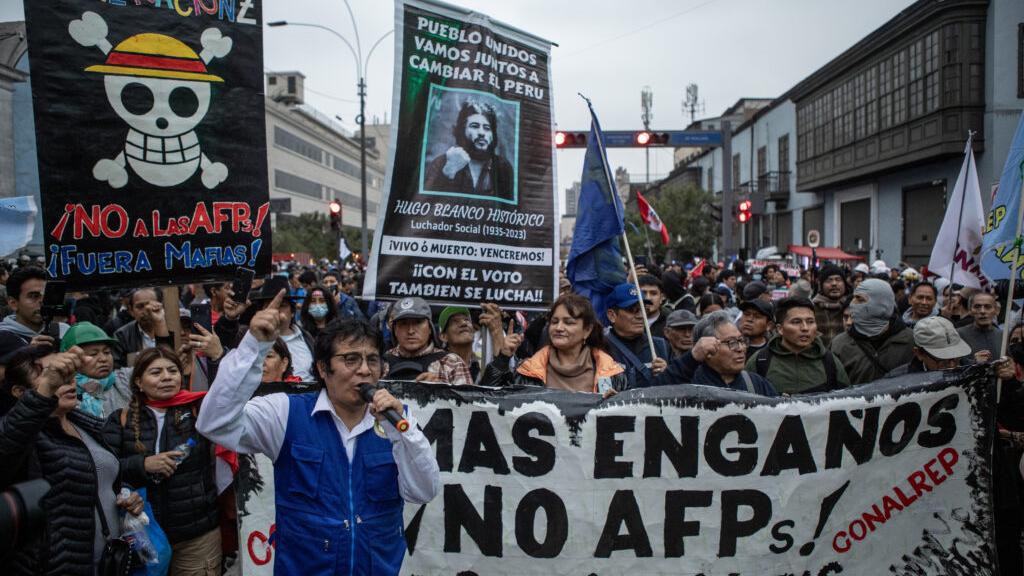
Transport workers, university students, and Generation Z groups—represented by the One Piece symbol—leading the march toward Congress in Lima. (Stifs Paucca Suárez)

First published at NACLA.

Dozens of protesters jump for joy outside the Peru’s Congress of the Republic. It’s October 10 and President Dina Boluarte has just been removed from office by the same lawmakers who shielded her for almost three years.

The day before, Peru’s long-running social and political crises reached a boiling point. Presidential candidate Phillip Butters was attacked with stones during a provocative visit to a southern town whose protesters he had long denounced as “terrorists.” In Lima, a brutal shooting at a concert by a well-renowned cumbia band left five musicians injured, heightening the sense that crime was spiraling out of control. Hours after the shooting, in the early hours of Friday morning, Boluarte was impeached by Congress after a quick hearing she chose not to attend.

But public anger at the government has much deeper roots. The current wave of outrage and discontent began on September 20, when dozens of young people took to the streets of downtown Lima to protest a pension reform law that would require them to contribute to the national pension fund from the age of 18. Police responded to the demonstration with force.

“There was too much repression,” says Jessica, a 19-year-old college student who only provided her first name out of security concerns. “They fired directly at the protesters’ bodies. One boy was hit in the chest by a bullet. If he hadn’t put his arm up, he would have died,” she says.

This violence has continued in the protests that followed. At a demonstration in Lima on September 21, the police detained Samuel Rodríguez, a young man who had tried to help an officer but ended up being arrested. Later that week, 18 protesters were injured at another demonstration in Lima, including an elderly man whose assault quickly went viral after being caught on camera.

As with recent protests in NepalMorocco, and Madagascar, young people have been leading the charge in denouncing Peru’s crisis — and demanding change. Like their global counterparts, Peru’s youth have rallied under a flag with a smiling skull and straw hat from the anime show One Piece, whose main character, the young pirate Monkey D. Luffy, embarks with his crew on a journey to overthrow corrupt powers and find freedom. It’s a fitting symbol for the the philosophy of Generation Z: to change everything.

A violent state in ruins

Social tensions in Peru, the product of a deep-seated political crisis, have been on the rise since 2022, when former President Pedro Castillo staged a failed self-coup in an attempt to overcome congressional obstruction. Boluarte, his vice president at the time, took office as president and soon colluded with center and right-wing forces to remain in power.

Boluarte’s presidency, marred by corruption scandals, failed to address even the most basic concerns of Peruvians. “There is a growing sense of unrest,” says Omar Coronel, a political scientist at the Pontifical Catholic University of Peru. “Not only among young people, but throughout the country. Since 2023, polls have been very consistent, giving the president and Congress an approval rating of less than 10 percent.”

Violence against protesters has become commonplace across the country, fueling the current uprising. “My first protest was on September 20. I was in the front row,” says Jessica. “What I saw made me feel sick. The police show no mercy. They shoot you because they shoot you. If there’s a child there, they don’t care. If there’s an elderly person there, they don’t care.”

While violence against demonstrators has long been a feature of the Peruvian state, Boluarte’s government has been exceptionally brutal. The crackdown started immediately after the fall of Castillo, when the south of the country erupted in protest in late 2022 and early 2023 in Castillo’s defense. Forty-nine people were killed by police during demonstrations in the heavily-Indigenous towns of Apurímac, Ayacucho, and Puno — including bystanders and seven teenagers. The January 9 massacre in Puno became infamous for its brutality: at least 18 people were shot dead in a single day, in what the Inter-American Court of Human Rights described as a “massacre.”

The government denied all accusations, labeling the protesters “terrorists.” At a press conference with international media, Boluarte told reporters, “Puno is not Peru,” an offensive statement that is emblematic of Peru’s deep geographical divides.

In Lima, meanwhile, people remained on the sidelines. “There was no support from us. We were still in a bubble,” says 22-year-old Lima resident Yacok Solano. “That’s why there’s resentment towards the people of Lima. When you live in Lima, you think it’s the center of the world.”

Recent demonstrations, however, have spread nationwide — a reflection of the country’s deepening crisis. In just nine years, Peru has had seven presidents, a cycle that has has bred institutional instability, impunity, and corruption. Generation Z and its allies are now calling for nothing less than a complete restructuring of the country.

The roots of popular discontent

On September 5, the government approved a pension reform that required all those over 18 to contribute to the system starting in 2027. The law also made contributions mandatory for self-employed workers and set the retirement age at 65. The austerity measure provoked immediate backlash.

Seventy percent of Peru’s workforce is informal, a figure that is even higher among youth. The 2021 National Youth Report revealed that 83 percent of jobs held by young people are informal. The divide between Lima and the Andean regions is stark: while informality in urban areas reaches 79 percent, in rural areas it climbs to 96 percent. Meanwhile, the average income for young people is around $320 per month, just above the minimum wage.

The economic precarity of the vast majority of Peru’s population stands in stark contrast to the conduct of its leaders. In July, Boluarte doubled her salary to about $10,000 per month. The country’s politicians “ don’t think about the people,” says Jessica. “They don’t think about young people. They only think about lining their pockets, plundering the country, and doing whatever they want with it.”

Peru’s powerful transport workers have also joined the protests. Long subject to violence at the hands of criminal groups — this year alone, more than 180 drivers have been murdered for refusing to pay extortion fees — their pleas for protection have fallen on deaf ears. Boluarte responded to their concerns by advising drivers to avoid being targeted by “not answering phone calls” from unknown numbers. With nowhere else to turn, they have linked up with the Gen Z protesters to demand an overhaul of the status quo.

Jessica echoes the feeling of a sprawling crisis linked to insecurity. “It wasn’t just the AFP law that affected me, but what I saw in the news. Crime, laws that favor criminals, extortion. That’s what sparked Generation Z to take to the streets in protest,” she says.

“Discontent is exploding on all sides,” says Noelia Chávez, a sociologist at the Pontifical Catholic University. “But in Peru, there are no parties, leaders, or political projects that serve as a reference point. Young people are protesting because there is a direct cause that affects them. And added to this discourse against injustice is that of a corrupt government whose repression they experience firsthand.”

This discontent has already claimed its first political casualty: Boluarte, who was removed and replaced by Congress President José Jerí on October 10. Yet according to activists, her removal is only the beginning. Gen Z says the marches will continue.

From TikTok to the streets

Instagram and TikTok are the main platforms Gen Z uses to stay informed. With memes and short videos that quickly go viral, they have become skilled at generating simple messages that can generate massive popular outrage on the streets. They coordinate demonstrations through Telegram and Facebook groups.

“These are young people who have resources, time, and more opportunities to go out and march than other generations,” says Chávez. “Although they are a heterogeneous group, they share the same identity linked to the political and social situation and, above all, the use of technology.”

The hashtags #GenZ, #corupción, and #ProtestasPeru generate content that incites anger, outrage, and protest. When Boluarte fell, young people drew on this playbook to quickly mobilize crowds to surround the Brazilian and Ecuadorian embassies to prevent her possible escape. According to Jessica, a poster with Boluarte’s photo was shared on Whatsapp with the message: “No to the rat’s escape.”

“We are organizing ourselves better, creating alliances, and gradually bringing more people on board. With the little experience we have, we are achieving a lot,” she says.

The organizing power of Peru’s young protesters has long been discounted. Boluarte’s Minister of Transport and Communications, César Sandoval, mockingly called them “Degeneration Z.” Yet for now, it seems the protesters have had the last laugh.

A global phenomenon

Peru’s youth movement has drawn inspiration from uprisings abroad. They learned how protests can yield results after Nepalese youth burned down Parliament and forced the resignation of Prime Minister Khadga Prasad Oli. His wife, Rajyalaxmi Chitrakar, died from her injuries after their home was set on fire.

Nepalese anger and discontent towards the country’s “nepo babies” — the children of politicians who flaunted their ostentatious lifestyles online amid growing inequality — translated easily to Peruvians’ frustration with their own political elite.

Generational identity is crucial to framing the protests in the Global South as a struggle by young people for their future. In Peru, it is mortgaged by the certainty that the pension system will fail; in Nepal, by unemployment and external economic dependence.

Still, youth-led protests face limits. “The mobilizations of Generation Z function more as a brake on authoritarianism than as a social movement that transforms reality,” says political scientist Coronel. “Young people have a legitimate claim to restore democracy and the balance of powers, but we must bear in mind that this generation is huge and varied.”

But today’s young people draw on a wealth of shared symbols to creatively denounce the concentration of power in the hands of the few. In this scenario, the One Piece flag has become a powerful emblem. The anime portrays political elites as a parasitic group that benefits from the citizenry and, for that reason, deserves to be overthrown.

The road ahead

The young Peruvians leading the protests say their fight is far from over. They continue to draw on symbols from the anime show that inspired them to take action. In a recent video announcing a national march for October 15, a dozen young people appear with their faces pixelated, standing before a One Piece flag that hangs on the living room wall.

Though the struggle ahead will be difficult, the country’s new president, José Jerí, is a clear target. A 38-year-old lawyer affiliated with the Somos Perú party, his background includes allegations of rape, illicit enrichment, and contempt of court. The new president also shielded Boluarte from being investigated for the massacres committed under her watch.

Generation Z has achieved a large victory against corruption and impunity with Boluarte’s removal. But, like the pirate Monkey D. Luffy and his crew, there are still many seas to sail.

Lucero Chávez is a journalist specializing in gender, citizenship, and migration. She was born in Lima, Peru, and lives in Santiago, Chile. Her articles have been published on Epicentro TV, Anfibia Chile, and La Indómita. She is the founder of La Válvula, the V side of news.