Monday, November 02, 2026

Recent virus outbreaks show urgent need to complete pandemic treaty, says WHO chief

A man sells newspapers in Abuja, Nigeria Wednesday, Oct. 21, 2026.
Copyright AP Photo/Afolabi Sotunde

By Marta Iraola Iribarren with AFP
Published on


The WHO chief said recent outbreaks of Ebola and hantavirus show why countries must finalise the agreement without delay.

Deadly outbreaks such as the Ebola Bundibugyo virus currently spreading in Africa show the urgent need to complete an international pandemic treaty, World Health Organization (WHO) chief Tedros Adhanom Ghebreyesus said on Monday during a negotiating meeting in Geneva.

Wealthy countries and developing nations remain at odds over how the Pandemic Treaty, adopted last year as a framework to handle future COVID-like pandemics, will work in practice.

When countries adopted the Pandemic Agreement in May 2025, they left out the tricky issue of how its key mechanism would operate, to get the deal over the line.

The agreement’s Pathogen Access and Benefit-Sharing (PABS) system governs how pathogens with pandemic potential can be obtained, and how products derived from them, such as vaccines, tests and treatments, are distributed.

Pointing to several recent deadly disease outbreaks caused by the new Ebola strain and hantavirus, Tedros stressed that completing a pandemic treaty was "about protecting people".

"A pathogen threat anywhere can become a threat everywhere, to people of every country," he said, according to a written version of his statement. "The outbreak of hantavirus earlier this year, and the ongoing Ebola epidemic in DRC remind us of this threat."

Tedros highlighted that, during the COVID-19 pandemic, “the world developed vaccines in record time, but too many countries were left waiting while others secured far more than they needed”.

“Timely access to vaccines and affordable medicines was a recurring concern raised by Member States during my meetings across all six WHO regions”, Hans Kluge, WHO Regional Director for Europe, currently on special leave as he is running for WHO Director-General.

“That is why we need a system where countries can quickly share pathogen samples and data, while ensuring that the vaccines, tests and treatments developed from them are shared fairly,” he said in a post on X, adding that the world cannot afford to repeat the inequalities we witnessed during the COVID-19 pandemic.


Ebola kills over 5,300 in fastest-growing outbreak on record


By Marta Iraola Iribarren with AFP
Published on

The outbreak, caused by the rare Bundibugyo virus, has infected more than 10,000 people since May and has spread to Kenya, Uganda and Nigeria.

Africa's latest Ebola outbreak has killed nearly 5,400 people, the vast majority of them in the Democratic Republic of Congo (DRC), according to the continent's top health agency.

Africa Centres for Disease Control and Prevention (Africa CDC) told the AFP on Monday that the outbreak, which has spread to other countries on the continent, has killed 5,376 people – 5,372 in the DRC and two each in Kenya and Uganda.

The outbreak, which began in the DRC in May, has infected more than 10,000 people, with an over 50% fatality rate, according to the country’s latest data from 31 October, making it the fastest-growing and most widespread Ebola epidemic on record.

Neighbouring Uganda recorded 20 cases, almost all involving people who had travelled from the DRC, before being declared Ebola-free in August.

In October, Kenya recorded nine infections, marking the first time the country had reported an Ebola case.

That same month, Nigeria, Africa’s most populous country, reported an Ebola case involving a 42-year-old Swiss woman whose husband works at his country’s embassy in Abuja. The couple had travelled to Uganda before returning home.

The outbreak is caused by the rare Bundibugyo virus, which has no approved vaccine or treatment. The virus is transmitted through contact with bodily fluids and causes haemorrhagic fever.

In recent weeks, clinical trials of the Ervebo vaccine, which has proved effective against the more common Zaire strain of Ebola, have begun.

RX = SEX SUPPRESSION
Why Weren’t We Warned? – OpEd

Surveys show sharply reduced sexual activity among young people worldwide, contributing to historic low fertility rates in OECD countries; cited factors include housing costs, lower alcohol use, mental-health issues tied to screen time, and, increasingly, sexual side effects from prescribed drugs.

SSRI antidepressants (Prozac, Zoloft, Paxil and others), along with isotretinoin and finasteride, are linked to sexual dysfunction that can persist after discontinuation—a condition known as PSSD—yet the US FDA still lacks a specific warning despite alerts issued by the EMA, MHRA and regulators in at least 35 countries.

Psychiatrist David Healy, who has compiled more than 1,000 case reports, estimates that a large share of SSRI users experience some sexual impairment and that millions of young Americans may be affected, underscoring the absence of informed consent when these drugs are prescribed.


In my day, being young was dominated by three basics: sex, drugs, and rock ’n’ roll.

Boy, that world has changed.

Seems like our kids aren’t having much sex these days.


Drugs? Yes, mostly of the prescribed type.

And rock ‘n’ roll? Well, not much anymore, as the listening tastes of today’s youth center on hip-hop and AI-enhanced electronic pop that hardly passes for music nowadays.

But it is the lack of sex that seems to be most concerning.

Apparently, the fact that young people aren’t having much sex today is being captured in surveys from around the world. This is proving to be worrisome not simply as a cultural artifact, but because the lack of sex is resulting in plunging birth rates, causing fertility in nearly every OECD country to drop to historic lows. The lack of sex is not only shrinking populations, but also causing huge demographic changes as countries turn older. What exactly is going on?

Those who study the sexual habits of young people generally point to three key reasons: There’s the unaffordability of housing, which makes younger people live at home longer (not exactly conducive to lots of sex). There’s the lack of booze—the social lubricant that used to be a precursor to most intimacy—and apparently kids aren’t as drinking much today as we used to. Then there’s the third one: youth mental health issues, which are exacerbated by too much screen time, isolation, and loneliness.


Seems like kids aren’t dating much these days, at least not in person. Probably spending so much time with your face buried in your phone will leave you less interested and less competent in successfully hooking up with a real person you would otherwise want to shag.

I would add a fourth reason, and one that is slowly gaining attention in medical circles. Several commonly prescribed drugs, particularly antidepressants, are causing sexual dysfunction in youth. The most surprising aspect of this is that sometimes the sexual dysfunction is permanent and continues after the person stops taking the drug, a phenomenon well enough documented to have its own name, PSSD (Post-SSRI Sexual Dysfunction).

SSRI antidepressants, such as Prozac, Zoloft, and Paxil, among others, as well as drugs for acne (isotretinoin) and baldness (finasteride) are at the top of the list of treatments capable of causing serious and sometimes long-term sexual dysfunction, described as numb genitalia, inability to orgasm, emotional blunting, and so on.

The proportion of our youth taking antidepressants—despite warnings against using these drugs in young people—grew enormously during and after Covid. The medical journal Pediatrics reported that in the US monthly antidepressant dispensing rates to ages 12–25 increased 66.3% from January 2016 to December 2022 (from ~2,576 to ~4,285 per 100,000 people). The number of individuals in this age group with more than one dispensed antidepressant rose 46.1%. More recent data from the CDC shows that about 19.3% of adults in the US currently “take medication for their mental health,” which would mostly be SSRI antidepressants.

All of this poses the question: Is the rate of SSRI prescribing affecting sexual activity across a broad spectrum of people in America today?

A Long Time Coming for Warning About What’s Happening in Plain Sight

It was 23 years ago (2003) that the Medicines and Healthcare Products Regulatory Agency (MHRA) in the UK issued its first warning that SSRIs increased suicide and self-harm risks in young people, even though they knew of this problem for a long time. The US FDA followed with its own black box warning in 2004, later extended through age 24. The UK’s 2003 warning was likewise limited to young people, until this month.

Fast forward to now, the MHRA issued warnings this month about suicidal thoughts and behaviours associated with SSRIs in patients of all ages—not just those under 25—as covered by the US black box warning—as well as warnings about post-SSRI sexual dysfunction.

Shockingly, the US FDA has yet to require a specific warning about persistent post-SSRI sexual dysfunction (PSSD), revealing even further how much the US system has been captured by the drug companies it allegedly regulates.

At least 35 countries in the world that regulate prescription drugs have national warnings on antidepressants. In 2019, the European Medicines Agency (EMA) officially concluded that Selective Serotonin Reuptake Inhibitors (SSRIs) and Serotonin-Norepinephrine Reuptake Inhibitors (SNRIs) can cause long-lasting, persistent sexual dysfunction that remains even after a patient stops taking the medication.

If you live in Canada, Australia, the UK, and most countries in Europe there are warnings on antidepressants that they can cause patients to suffer permanent sexual dysfunction. As for the US? Nada.


Emma: A Real-Life Situation

The issue of antidepressant sexual dysfunction arrived at my doorstep late in 2019 when I was contacted by a young woman with a story to tell. She knew that I wrote a lot about drug safety and she asked to meet me. She had an unimaginably tragic story.

Emma met me in my office, and I turned on my voice recorder. For the next two hours, her voice often quivering with emotion, she told me how, at 17 and still in high school, she was prescribed the antidepressant citalopram (also known as Celexa). It is one in a class of selective serotonin reuptake inhibitor (SSRI) antidepressants, a class that includes drugs like escitalopram (Lexapro), sertraline (Zoloft), fluoxetine (Prozac), and paroxetine (Paxil).

The psychiatrist told her that it might help her deal with her impulsiveness and depression. Emma admitted that over the years the drug might have helped some, but there was also something very worrying happening: she felt she was losing whatever libido she had.


Growing increasingly concerned about how it might be affecting her sexuality, she asked her physician directly if the drug could be the problem. She was assured that the antidepressant might “lead to some loss of libido, but it would come back after she stopped the drug.” Emma was persistent, bothered by what was happening to her body, and eventually her doctor switched her to a different antidepressant, which she stopped several months later.

She described what happened next: “I woke up one morning to abruptly discover that all sexual sensation I had disappeared from my body. My clitoris was now no more than an inert and sensationless nub of flesh. I was unable to feel attraction, arousal, or orgasm.” Not only did her body seem incapable of responding, but she was also engulfed by a kind of emotional blunting that was almost too hard to take.

“Now I wonder if I will ever find romance or love, or have a normal life,” she says, eyes brimming with tears. “Instead of desire and libido returning, they disappeared.”
Antidepressants and Sexual Dysfunction:


“No one knows a prescription drug’s side effects like the person taking it.”

Sixty years ago, psychiatrist Frank Ayd, credited with pioneering the clinical use of early antidepressant amitriptyline, noticed that this drug affected the libido, causing effects that weren’t otherwise due to the patients’ depression.

While psychiatrists typically maintain that depression can have a debilitating effect on one’s sexual function, it has taken a long while to suspect the drug. Over the years published reports and case studies have accumulated, detailing a condition definitely linked to antidepressants, which some people can suffer from for months, years, or decades. It can include genital numbness, total lack of arousal or orgasm, and a blunted ability to feel emotions. Like many drug safety issues, where the Eli Lillys of the world have a financial interest in shaping the public record of their products, it has taken a long time for this knowledge to penetrate the medical literature in a way that seriously influences prescribing.

Nobody knows this better than Dr. David Healy, an Irish psychiatrist and psychopharmacologist who lives in Wales.

I have known Dr. Healy for decades, and heard of him first when he was in the headlines in the early 2000s after being accepted for a job at the prestigious Centre for Addictions and Mental Health (CAMH) at the University of Toronto, only to have it rescinded after giving a lecture about SSRIs and their potential dangers. The case drew international media coverage and became a cause célèbre for debates over industry funding of academic medicine.

Because of the new warnings in the UK applied to antidepressants announced this month I called to talk to Dr. Healy.

I was quickly reminded of how much the PSSD issue has dominated his research over the last 20 years or so. Dr. David Healy has become, probably by accident, the world’s foremost expert on PSSD. Not only does he know the history of sexual dysfunction and psychiatric drugs, he knows about it from the ground up—from first-hand accounts of patients. He has studied and written about this extensively and told me that while some early reports were made to British regulators of a patient with post-treatment genital arousal disorder in the late 1980s, the first report of PSSD was filed with regulatory agencies in 1991.


Dr. Healy told me he saw his first patient with what was later called PSSD in the year 2000. She was a 35-year-old woman who told him that three months after stopping treatment, “she could rub a hard-bristled brush across her genitals and feel nothing.”

Wondering how frequently these effects occurred and generally concerned about sexual impacts caused by SSRI antidepressants, and drugs for prostate problems (finasteride) and acne (isotretinoin), Dr Healy started a website to collect case studies. The key principle of his website, Rxisk.org, is captured in its motto: “No one knows a prescription drug’s side effects like the person taking it.”

By 2018, he had enough reports to publish his results: a series of almost 300 cases of sexual dysfunction collected from 37 countries and linked to 14 different drugs. He wrote that some symptoms were unique to antidepressants, such as premature ejaculation and persistent genital arousal disorder (PGAD), but other drugs were also linked to “genital anesthesia, pleasureless or weak orgasm, loss of libido and impotence.”

When he published those initial results the impact of that paper was huge, because, finally, there was a body of research that could make regulators around the world start warning prescribers, and in turn patients, of the sex-destroying potential of these drugs.

To strengthen the warnings on these drugs, Dr. Healy and his colleagues filed petitions on the sexual side effects of SSRIs and SNRIs with the US FDA, Health Canada, and the European Medicines Agency (EMA). Probably thanks to Dr. Healy’s assistance, the EMA was the first to issue warnings of SSRI/SNRI antidepressants and their links to sexual side effects.

For Dr. Healy, the facts indisputably show that SSRI and SNRI antidepressants often cause sexual dysfunction in both men and women. It seems astonishing to say this, but Dr. Healy contends that almost everyone taking an SSRI/SSRI experiences some form of sexual dysfunction. He estimates that given current prescribing rates, as much as 20 percent of the population may not be able to make love the way they want as a result of the drugs.

Think about that for a second….

Thankfully, some of that effect is transitory and minimal, yet for others, people like Emma who have been reporting their symptoms and joining online chat groups around the world to exchange information, this is no small matter. For them, the impact is profound, with faint hope of any cure at the moment. And they are angry. Really angry.

Today Dr. Healy has more than 1,000 case studies across most countries in the world. These case studies expand the range of antidepressant problems he’s seeing, including what is known as VSS or Visual Snow Syndrome. This neurological condition is linked to serotonin reuptake inhibiting antidepressants (SSRIs, SNRIs, and related agents).
Why Weren’t We Told?

Emma’s main frustration in what happened to her sexuality was that no one ever told her that taking an antidepressant for a short period of time was going to substantially alter her sexuality. She had no warning whatsoever. She had never heard of PSSD.


David Healy reminds me that antidepressants aren’t the only drugs that are related to PSSD.

“What if a man is told he could take this drug for hair loss but it could disrupt his ability to make love? Or what if you tell a young woman that this acne drug could also permanently impact that person’s sex life? Would they take it?“

“Of course they’d say no to those drugs,” he says. This is the crux of the issue, how physicians, when prescribing these drugs, “inform” the patients of the potential problems.

He suspects those conversations still aren’t happening when it comes to the prescribing of antidepressants, despite these new warnings in the UK.

For Emma, the whole issue comes down to what she refers to as “informed consent.”

She doesn’t think that antidepressants should be banned or that people shouldn’t be prescribed them, when there is no alternative. It was the not knowing that stings so much.

“None of the doctors over the years ever mentioned the sexual side effects of these drugs. Not a word,” said Emma, the anger rising in her voice. Asked why she came to me to tell me her story she was firm: “I don’t want anyone else to go through what I’m going through.”

Time will tell whether the word is getting out.

And if it is getting out, we could have a revolution on our hands.

But speaking of revolutions, David Healy said something quite compelling: When young guys want to avoid baldness, and they take a drug, they are doing something revolutionary that their fathers couldn’t do. Similarly, when a young woman takes an acne drug, that might be a way to revolt against the wishes of her mother. But if both of those people were told by the prescriber that these drugs could cause them to never have the ability to make love, they would absolutely slam on the brakes.

But antidepressants are different. Maybe a quarter of families will have one parent on them, and hence the message about the impact of the drug on their sex lives might not hit home.


Consider the Math

There are about 100 million youth in the US under 25. Coincidentally, these people would have all been born after Dr. Healy was seeing his first patients for PSSD.

Of those, maybe 10% are on antidepressants. That’s 10 million youth whose sex lives could be up for grabs. Of those 10 million, maybe 20% have serious impediments in their sex lives. That’s 2 million young people possibly facing these issues.


Many will be suffering in silence over sexual difficulties or a completely absent sex life, and have no idea their situation is linked to antidepressants. Those who find out about how their lives have been absolutely broken by drug harms they were never told about are going to be angry. This is how revolutions are made.

Dr. Healy and I looked at each other and wondered aloud: “When is the Revolution going to start?” When a substantial and vocal body of youth in the US realize they’ve been ripped off of one of life’s most important things, and they realize the government is behind this, heads are going to roll.

Perhaps you can say you heard it here first, and that after reading this article, the youth of today cannot now say that they haven’t been warned.

This article was published by Brownstone Institute


About Alan Cassels
Alan Cassels is a Brownstone Fellow and a drug policy researcher and author who has written extensively about disease mongering. He is the author of four books, including The ABCs of Disease Mongering: An Epidemic in 26 Letters.
View all posts by Alan Cassels →

Vučić's departure threatens Russia's influence across the Western Balkans, Carnegie says

Vučić's departure threatens Russia's influence across the Western Balkans, Carnegie says
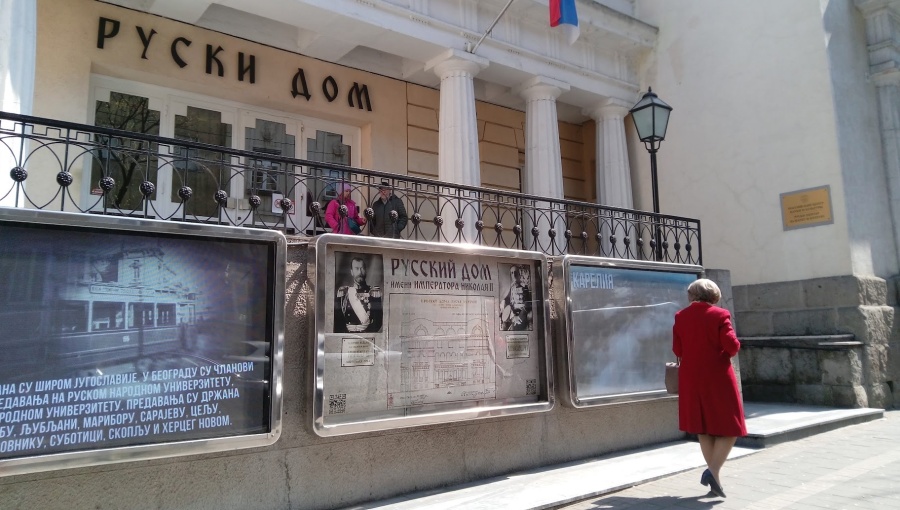
The Russia House cultural centre in Serbia's capital Belgrade. / bne IntelliNewsFacebookTwitterLinkedIn
By Clare Nuttall in Glasgow October 31, 2026

The defeat of Aleksandar Vučić in Serbia's October 25 election could undermine Russia's influence across the Western Balkans by depriving Moscow of its most important political ally in the region, while a new government seeking to tackle corruption may find it increasingly difficult to maintain close economic ties with the Kremlin, a report by the Carnegie Russia Eurasia Center said.

Although the student-led opposition movement that won the election has pledged to maintain cooperation with Moscow, its plans to overhaul state institutions and improve transparency are likely to bring it into conflict with Russian business interests and political networks embedded in Serbia, Carnegie fellow Maksim Samorukov wrote in an analysis published on October 30.

"The two are mutually exclusive, even if the new leaders in Belgrade haven't yet realized it," Samorukov wrote, referring to the movement's stated ambitions to fight corruption while continuing lucrative cooperation with Russia.

The report argues that Moscow's relationship with Serbia has historically proved resilient to changes of government, but that the circumstances surrounding Vučić's departure are different from previous political transitions.

When Vučić's party came to power in 2012, replacing Boris Tadić, he maintained continuity in relations with Moscow by relying on established political figures with longstanding Kremlin connections. These included Aleksandar Vulin and Ivica Dačić, as well as Srbijagas chief Dušan Bajatović, who has served in the position since 2008 and remains a key interlocutor with Russian gas giant Gazprom.

Vučić himself, who speaks fluent Russian, developed close personal relationships with Russian officials and an understanding of the Kremlin's political sensitivities, allowing him to manage occasional disputes without seriously damaging bilateral relations.

The Student List lacks comparable connections, while the Socialist Party, which supplied many of Vučić's key contacts in Moscow, failed to enter parliament and is unlikely to participate in the new government.

Plans to remove officials associated with the previous administration from state institutions and companies could also threaten Russian interests, given the longstanding relationships between Russian businesses and Serbian political and economic elites.

Corruption fight could strain Moscow ties

Samorukov said the new leadership's commitment to institutional reform would be difficult to reconcile with the way Russian companies have traditionally conducted business in Serbia.

The Kremlin has said it hopes to maintain "constructive relations" with the incoming government, but its approach to the political transition could complicate efforts to preserve those ties.

For two years, Moscow has supported Vučić's portrayal of the student protests as a Western-backed attempt at regime change. The Kremlin's established hostility towards popular uprisings against pro-Russian governments, particularly following Ukraine's 2014 Maidan revolution, is likely to make it suspicious of the new Serbian authorities.

The diversity of the Student List movement could add to the tensions. Its members may make statements supporting closer European integration or criticising Russian policies, which Moscow could interpret as evidence that the election was part of a Western effort to weaken its position.

Samorukov argued that the Russian leadership had become increasingly unwilling to reconsider its established political assumptions, making it difficult for Moscow to adapt to the new situation in Belgrade.

The wider geopolitical environment has also changed since Vučić first came to power. Russia and the European Union were then still seeking areas of cooperation, including in Serbia, whereas Moscow now regards the EU as a strategic adversary.

Brussels has welcomed the election result and could offer the incoming government financial support and faster progress towards EU membership in exchange for reforms and closer alignment with European foreign policy.

Energy leverage and Kosovo

The immediate test of Serbia's balancing act could come through energy relations. The country's gas supply contract with Russia expires at the end of 2026, while negotiations over the sale of Russian-owned oil company NIS remain unresolved.

Samorukov said Moscow could use its position in the energy sector to exert pressure on the new government, leaving Belgrade to weigh the costs of maintaining its traditional relationship with Russia against the benefits of closer ties with the EU.

"On the one side is a wary and exigent Moscow, offering Serbia little more than energy blackmail," he wrote, contrasting this with a Brussels willing to support the new leadership's institutional and economic priorities.

Serbia's refusal to recognise Kosovo's independence remains a potential obstacle to closer alignment with the EU and a longstanding basis for cooperation with Russia, which opposes Kosovo's statehood.

However, Samorukov argued that Belgrade's reliance on Moscow over the issue should not be overstated. The Kremlin would be unlikely to change its position on Kosovo even if relations with Serbia deteriorated, potentially making it easier for the new government to reduce cooperation with Russia without immediately changing its own stance.

Regional implications

Vučić's departure could have consequences across the Western Balkans, where Russia has relied on Serbia's political and economic weight to maintain its influence.

Serbia is the largest country in the region, and under Vučić its political networks helped promote nationalist narratives and sustain ethnic tensions that complicated efforts to advance European integration.

Samorukov said the Kremlin had benefited from the overlap between its own regional objectives and Vučić's political strategy, with both sides exploiting nationalist sentiment and unresolved ethnic disputes.

"Without Vučić, Russia's influence in the Western Balkans can no longer count upon the state resources of the largest country in the region," he wrote.

He pointed to neighbouring Montenegro as a possible precedent for Serbia. The end of Milo Đukanović's long period in power was initially accompanied by fears that Russian influence and Serbian nationalism would regain ground. Instead, Montenegro's political transition and subsequent democratic reforms have helped it become one of the leading candidates for EU membership.

The report suggests Serbia could follow a similar path, although the transition will depend on whether the new leadership can overcome institutional resistance and deliver meaningful reforms.

For the EU, the election presents an opportunity to reduce Russian influence in a strategically important part of Europe while advancing the integration of the Western Balkans. Whether that opportunity is realised will depend partly on how quickly the incoming Serbian government translates its promises of institutional renewal into policy.

How Albania’s Deep Democratic Crisis Took Root: April 21, 2008, Still Shapes Today – Analysis


November 3, 2026
 IFIMES
By Amb. Assoc. Prof. Dr. Arben Cici

Key Takeaways:

The essay traces Albania’s current crisis to the 21 April 2008 constitutional amendments, adopted by consensus of the two main parties, which introduced closed-list regional proportional voting and strengthened party leaders’ control over candidate selection, thereby weakening parliamentary independence and oversight.

Power has become highly personalized: MPs depend on party leaders more than on voters, the presidency risks functioning as an extension of the majority, and limited internal party democracy plus barriers to new entrants restrict meaningful competition and accountability.

The resulting system fuels emigration, perceptions of nepotism and corruption, and a deeper crisis of representation in which citizens doubt that elections can change how power is exercised; the author argues that lasting reform requires restoring institutional autonomy and citizen sovereignty rather than merely rotating officeholders.


What Albania is experiencing today is not merely a crisis of government. It is a crisis of a political system that, for years, has worked to concentrate power, restrict political competition, and distance citizens from decision-making.

The roots of this crisis can be traced, in significant part, to 21 April 2008[2], when constitutional amendments adopted at the eleventh hour fundamentally altered the architecture of political representation in Albania.

That day, it was not merely a matter of changing a few articles of the Constitution. The rules of the political game were changed. And when those who hold power are also in a position to rewrite the rules governing its exercise, the first question must be straightforward: who gained more power, and who lost the ability to hold that power in check?

The answer leads us to a problem that has become increasingly difficult to ignore: the concentration of power in the hands of party leaders, the weakening of Parliament as an institution of oversight, and the emergence of a system in which citizens vote but do not always have a meaningful opportunity to determine who represents them.

To understand this crisis, we must examine not only how the country is governed, but also the rules that determine who enters politics, who makes decisions, who exercises oversight, and how much power citizens have to change the system.
1. 2008: When Political Parties Became More Powerful Than Their Elected Representatives

The constitutional amendments of 21 April 2008, were adopted with the consensus of Albania’s two main political forces at the time: the Democratic Party, led by Sali Berisha, and the Socialist Party, led by Edi Rama.[3]

The reform was not simply the product of an ordinary confrontation between the governing majority and the opposition. It was supported by the two parties that represented the principal poles of political power in Albania. Despite their disagreements over governance, they agreed to change the fundamental rules of political representation.

The transition to a regional proportional electoral system with closed lists brought a fundamental change in the relationship between elected representatives and political power, increasing the importance of political parties and their leaders in selecting parliamentary candidates.

In a functioning democracy, members of Parliament should represent citizens, exercise their mandates independently, and hold the government accountable. Yet when candidacy, political advancement, and future electoral prospects depend heavily on decisions made by party leadership, a form of dependency emerges that can undermine this role.

This is one of the most serious problems facing Albania’s political model: Parliament is becoming less an institution that scrutinizes the executive and more a mechanism for supporting the decisions of a parliamentary majority controlled by the party leadership.


This does not mean that every member of Parliament has abandoned their independence or that every parliamentary decision is personally dictated by a party leader. It means that the system creates strong incentives for obedience to the party hierarchy and makes political independence more costly.

Democracy is weakened not only when the law is violated. It is also weakened when institutional rules and political practices discourage elected representatives from exercising the freedom and responsibility that their mandates are supposed to guarantee.
2. The Party Leader: From Political Leadership to the Concentration of Power[4]

In a functioning democracy, a party leader heads a political organization. The leader must earn the support of party members, face internal competition, account for political results, and step aside when confidence in their leadership is lost.


In Albania, however, a strong tendency toward the personalization of party power has become entrenched.

The party leader is no longer simply the person who directs the organization. The leader has become the principal gateway to parliamentary office, political advancement, and the distribution of opportunities within the party.

When this control is combined with strict parliamentary discipline and weak internal democracy, a dangerous relationship emerges: members of Parliament depend on the party, the party depends on its leader, and decision-making becomes concentrated within an increasingly narrow circle.

This is the model of personalized political power that has taken root in Albania.

In such a system, institutions continue to exist, Parliament meets, laws are passed, and elections are held. But the decisive question is whether these institutions possess the autonomy necessary to constrain power or whether they risk serving primarily to legitimize decisions made elsewhere.

Democracy cannot be measured solely by the existence of elections. It must also be measured by the genuine ability to challenge those in power, compete within political parties, and hold the government accountable.


When these opportunities diminish, as they have in Albania, elections may continue to take place while the quality of democracy suffers profound damage.
3. The Two Main Parties and the Closing of the Political System[5]

Albania’s political system is characterized by substantial advantages enjoyed by the two main parties in political competition. This is not simply a question of how many parties hold seats in Parliament. It is a question of how the system operates and whether meaningful opportunities exist to compete within it.

When major parties exercise strong control over candidate selection, possess established nationwide organizational structures, command substantial resources, and exert considerable influence over the political agenda, new parties face significant barriers to entry.

The regional proportional system does not automatically exclude smaller parties from representation, nor does it, by itself, prove the existence of a permanent agreement between the two main parties. Nevertheless, the interaction between electoral rules, internal party control, and unequal access to resources can make it more difficult for new political alternatives to emerge and establish themselves as credible competitors.

This creates a democratic paradox.

Citizens are told that they are free to choose, yet the alternatives capable of becoming genuinely competitive remain limited.

Citizens are told that they can punish the government at the ballot box, yet the opposition may fail to offer a convincing break from the same model of personalized power and internal party control. Citizens are told that change comes through elections, yet changing the names at the top of institutions does not guarantee a change in the way power is exercised.

Citizens are told that free elections are the means through which they can change those in power and build the state. Yet, in Albania, elections have too often failed to produce the institutional changes necessary to strengthen the state and restore public accountability.

When political alternatives fail to offer credible institutional change, a transfer of power may replace officeholders without changing the system that reproduces the same problems.

This is the heart of Albania’s crisis of political representation: dissatisfaction with the government is substantial and legitimate, but distrust of the way the entire political class operates may run even deeper.

4. The Prime Minister and the Concentration of Executive Power[6]

The constitutional amendments of 2008 also affected the mechanisms governing relations between state institutions, including the method of electing the President and the relationship between the executive and Parliament.

It would not be accurate to claim that the Constitution granted the prime minister absolute power. Albania remained a parliamentary republic, with institutions and constitutional procedures formally designed to constrain government authority.

The problem, however, goes deeper than the legal wording.

Absolute power may not exist in the constitutional text, yet the concentration of power can become a practical reality when oversight mechanisms fail to function properly.

If the prime minister controls the parliamentary majority, the majority follows the party hierarchy, and members of Parliament have little room to dissent, parliamentary oversight of the government can be significantly weakened, sometimes to the point of becoming largely ineffective. If supervisory institutions lack sufficient independence, authority, or capacity, holding the executive accountable becomes increasingly difficult.

A prime minister does not need to amend the Constitution every day to concentrate power. It may be enough for the institutions meant to impose limits to lack the independence, will, or capacity to do so effectively.

This is the central institutional problem facing Albania: the gap between the formal existence of democratic checks and their effective exercise in practice.
5. The President: An Extension of the Parliamentary Majority and the Executive

One of the most significant weaknesses of the mechanism for electing the President in Albania[7] is the risk that it produces not a guarantor of the Constitution and democratic balances, but a President who is institutionally constrained and politically dependent on the majority that elected him, effectively rendering him a figure subservient to that majority’s political will.


When the head of state is elected through the will of a parliamentary majority and subsequently acts as though bound to follow that majority’s political preferences, the institution risks losing its very constitutional raison d’être.

The current President serves as a telling example of this problem. He has not convincingly demonstrated an ability to rise above the logic of competing political factions and embody the role of an institutional figure acting beyond narrow party interests.

Nevertheless, the method of election does not explain everything. Personal integrity, character, and the willingness to exercise constitutional powers are also decisive. The manner in which the office is exercised matters just as much as the mechanism through which its holder is elected.

Under these circumstances, the presidency risks being perceived not as an institution that embodies national unity and safeguards constitutional balance, but as one constrained by the interests of the political majority.

The President should not be an extension of the parliamentary majority that elects him. The office should be exercised with impartiality, integrity, and institutional responsibility.

Throughout his term, the President has failed to establish himself convincingly as an independent and impartial national figure capable of commanding respect across political divisions and possessing the institutional dignity necessary to help facilitate a solution to the deep crisis currently afflicting Albania.
6. When Members of Parliament Fear the Party Leader More Than the Voters

This is one of the most problematic consequences that can arise from closed party lists. In a functioning democracy, members of Parliament should have strong incentives to answer to citizens. They should consider the public interest, the quality of legislation, and the consequences of their decisions.

But when a political career depends primarily on the position assigned by the party leader on an electoral list, those priorities can be reversed.

Instead of asking, “What do my constituents expect of me?“, a representative may begin asking, “What does the party leader expect of me?”

Instead of speaking out against a bad decision, the representative may choose silence. When elected representatives have stronger incentives to obey their party leaders than to answer to the judgment of citizens, the connection between the vote and political accountability is weakened. And when that connection weakens, citizens begin to feel excluded from decision-making. They vote, but do not feel represented.


They demand accountability and protest, but encounter a system in which responsibility is dispersed among institutions, parties, and individuals, making it difficult to determine who is truly accountable for the decisions being made.

This is how the crisis of representation deepens in Albania.
7. The Social Consequences: Emigration, Corruption[8] and the Loss of Hope

Political crisis does not remain confined within the walls of Parliament, the President’s Office, or independent institutions. It affects the economy, society, and the everyday lives of Albanian citizens.

When people believe that advancement depends more on political connections than ability, when nepotism is perceived as a normal feature of public institutions, and when opportunities appear reserved for those close to power, confidence in justice and equality of opportunity is undermined.

When young people see no realistic opportunity to build careers on merit, some seek opportunities abroad[9]. When entrepreneurs believe that success depends on proximity to those in power, economic competition is damaged. When corruption is not punished credibly, citizens lose faith that the law applies equally to everyone. When political parties are seen as closed organizations, capable people may leave politics or abandon the idea of participating in it altogether.

Of course, emigration, corruption, economic inequality, and institutional weakness have multiple historical, economic, and social causes. They cannot be attributed to a single constitutional reform. However, the amendments of 2008 contributed to a political framework in which the concentration of power and the weakening of accountability could reinforce one another, fostering a sense of political untouchability and the arrogance that often accompanies it.

Thus, the model of representation matters because it determines how easily citizens can challenge flawed decisions and hold those in power accountable. It also influences how effectively democracy, accountability, and transparency function in practice.

When these democratic mechanisms fail to function effectively, problems accumulate, leaving citizens feeling increasingly powerless to resolve them through ordinary institutional channels and more inclined to resort to the legitimate mechanism of public protest.

A society does not lose hope only when it becomes poorer. It also loses hope when people come to believe that hard work, ability, and honesty are not enough to change their circumstances.


This is Albanian society today.
8. Political Nepotism and the Marginalisation of Qualified Individuals

When power becomes personalized and political parties close themselves to internal competition, conditions emerge in which political loyalty is valued more highly than professional ability.

In such a system, people with competence, integrity, and new ideas may find it difficult to advance within the political hierarchy unless they enjoy the support of party leaders.

Meanwhile, those who maintain close relationships with the center of power may enjoy substantial advantages. This creates a vicious cycle.

Political parties become less open to new ideas. Internal competition weakens. Decision-making becomes concentrated in the hands of the party leader and a narrow circle of associates, whether in the governing majority or the opposition.

Mistakes are repeated because those capable of challenging them lack sufficient influence or are excluded from decision-making. When loyalty and servility are rewarded more than ability and integrity, politics risks losing precisely the people who could improve it.

Citizens consequently begin to perceive politics as a sphere reserved for a limited group of leaders and their supporters. This is why internal party democracy is not an organizational luxury. It is a fundamental condition for democracy throughout the country.

If the parties seeking to govern the state do not guarantee competition, transparency, and accountability within their own organizations, they risk reproducing the same model in public institutions.

This is what has happened in Albania.
9. Why Today’s Civic Uprising Is About More Than Just the Government

When public dissatisfaction is directed against a government, the political solution may appear relatively straightforward: elections, a transfer of power, and a new majority.


But when dissatisfaction is directed against the way the entire political system operates, the crisis is of a different nature. Citizens no longer ask only whether the current government should leave office. They ask whether political parties are capable of providing genuine representation. They ask whether Parliament can hold the government accountable. They ask whether elections can bring about profound change or merely replace the people occupying positions of power. They ask whether the judiciary, public administration, and state institutions serve the public interest or are influenced by political interests.

This is why opposition to a government can develop into opposition to an entire model of governance. If part of society concludes that neither the government nor the opposition offers a convincing path to change, the crisis cannot be resolved simply by replacing one with the other.

The rules and practices that make power difficult to scrutinize and allow it to become concentrated in the hands of a few must also change.

This does not mean that all political parties are identical, that the government and opposition always bear equal responsibility, or that every protest expresses the same political position. The government has a direct and distinct responsibility because it has both the duty and the institutional instruments to address economic, social, and financial problems, uphold the rule of law, and strengthen public trust.

The government’s conduct directly influences whether the risk of social division deepens or subsides, and whether the situation escalates toward open conflict with potentially devastating consequences for society. Unfortunately, this risk is not currently diminishing in Albania.

When a crisis of confidence becomes systemic, no political force can demand trust simply by presenting itself as the opponent of the government. It must demonstrate concretely what it intends to change about the exercise of power and how it will constrain its own authority.

An opposition whose only objective is to take power is not necessarily the answer to a systemic crisis. The answer must be a political and institutional alternative that accepts clear rules, independent oversight, and equal accountability for whoever governs.

What must change?

The crisis requires fundamental changes. The solution requires restoring a state whose institutions serve the public interest rather than the political survival of those in power, a state that, in the eyes of many citizens, was effectively taken from them through the concentration of power that followed the constitutional changes of 21 April 2008.

The Constitution must not be an agreement designed to preserve the political survival of the elites. It must guarantee that no political elite can become unaccountable.


Yet this is precisely the danger that Albania’s political development since 21 April 2008, has brought into sharper focus.

When we speak about the crisis of Albanian democracy today, we must look beyond the government of the day, the latest scandal, or the latest protest. We must examine the political model that connects these developments and shapes the relationship between citizens and power.

The problem is not merely who governs today. The problem is whether citizens have a meaningful opportunity to decide who represents them, who governs them tomorrow, how the exercise of power is scrutinized, and how those who no longer serve the public interest can be removed through democratic means.

For this very reason, April 21, 2008, remains a date worth recalling in the country’s political memory, not to pretend that history began on that day, but to ensure that we do not forget how the rules of representation were altered and what consequences those changes may have had for the balance of power in Albania.

It is a way of saying that if we wish to understand the present, we must look back at the decisions that helped shape the system in which we live.

The constitutional amendments of April 21, 2008, do not explain the entire history of Albanian democracy. However, they represent an important point of reference for examining how the rules of representation changed and how those changes may have contributed to the concentration of political power.

They remind us that decisions about the rules of democracy have consequences that extend far beyond the terms of office of those who approve them.

For a democracy does not necessarily die on the day elections fail. Rather, it weakens gradually: when elections continue, yet competition becomes increasingly restricted; when Parliament exists, yet its oversight of the government wanes; when political parties compete against one another, yet permit no genuine competition within their own ranks.

And when a citizen comes to believe that their vote cannot change anything fundamental, the crisis is no longer confined to politics alone.

It becomes a crisis of faith in democracy itself. Democracy cannot be restored solely through the will of those who benefit from its weaknesses. It also requires the persistence of citizens who insist on making it work.


Protest in support of changing a system that fails to guarantee genuine representation, accountability, and effective oversight of power is therefore legitimate. It becomes necessary when ordinary democratic mechanisms fail to produce the required corrections.

And it becomes a civic and democratic imperative when silence, passivity, and the endless repetition of the same political model threaten to deepen the crisis even further.

To protest for the transformation of a system that fails to guarantee representation, accountability, and effective checks on power is not to oppose democracy. It is to demand more democracy, a real democracy in which institutions serve citizens rather than the political interests of those who control them.

Albania does not simply need a change of government. It needs a democracy in which power does not belong to a party leader, a political party, or the government, but is constrained by independent institutions and answerable to citizens.

It needs a state in which the law is not applied according to the interests of those in power, institutions are not used as instruments of political parties, and citizens are not merely voters for a single day but the bearers of sovereignty every day.

The young men and women protesting in the streets of Albania are among those who understand this demand most clearly. They are not simply calling for different people to occupy positions of power.

They are demanding a state that belongs to its citizens, institutions that answer to the public, and a political system in which no leader can place himself above the law.

Their demand for the restoration of the state is, at its core, a demand to reclaim the democratic promise that was compromised when the rules of political representation were changed on 21 April 2008.

The question facing Albania today is therefore not simply who will govern tomorrow, but whether the citizens of this country will finally be able to reclaim the power that democracy has always promised them.

Footnotes:

IFIMES – International Institute for Middle East and Balkan Studies, based in Ljubljana, Slovenia, has a special consultative status with the United Nations Economic and Social Council ECOSOC/UN in New York since 2018, and it is the publisher of the international scientific journal “European Perspectives”, link: https://www.europeanperspectives.org/en
Amended by Law No. 9904, dated April 21, 2008, the Constitution of the Republic of Albania, published in the Official Gazette No. 61/2008. Publication by the Centre for Official Publications, August 2016.

According to the vote by the members of the Assembly of Albania on the constitutional amendments: 115 in favor, 17 against, 3 abstentions, and 1 did not vote. Proceedings of the Assembly of Albania, Year 2008, No. 2. 17th Legislature. Pages 554–579.

Constitution of the Republic of Albania, THE ASSEMBLY, CHAPTER I, ELECTION AND TERM, Articles 64, 65, and 68, amended by Law No. 9904, dated April 21, 2008, published in the Official Gazette No. 61/2008.

Constitution of the Republic of Albania, THE ASSEMBLY, CHAPTER I, ELECTION AND TERM, Article 68, amended by Law No. 9904, dated April 21, 2008, published in the Official Gazette No. 61/2008.

Two constitutional articles addressing motions of confidence and no-confidence. Articles 104 and 105, amended by Law No. 9404, dated 21 April 2008, Constitution of the Republic of Albania, PART FIVE: THE COUNCIL OF MINISTERS; published in the Official Gazette No. 61/2008.

Two articles stipulating the procedures for the election of the President, Constitution of the Republic of Albania, PART FOUR: THE PRESIDENT OF THE REPUBLIC, Article 87 & Article 88, amended by Law No. 9404, dated 21 April 2008; published in the Official Gazette No. 61/2008.

The 2025 data show that citizens display high levels of pessimism: 77% believe that the current corruption situation will remain unchanged. MONITORING CORRUPTION IN ALBANIA 2025 https://seldi.net/wp-content/uploads/2026/03/ACER_SELDI_EN_CMS-2025_.pdf

Albanian Center for Economic Research (ACER), Southeast European Leadership for Development and Integrity (SELDI)

Albania Ranks High in EU’s Foreign Nationalities, Albanian Daily News, January 30, 2026.


About IFIMES
IFIMES – International Institute for Middle-East and Balkan studies, based in Ljubljana, Slovenia, has special consultative status with the Economic and Social Council ECOSOC/UN since 2018. IFIMES is also the publisher of the biannual international scientific journal European Perspectives. IFIMES gathers and selects various information and sources on key conflict areas in the world. The Institute analyses mutual relations among parties with an aim to promote the importance of reconciliation, early prevention/preventive diplomacy and disarmament/ confidence building measures in the regional or global conflict resolution of the existing conflicts and the role of preventive actions against new global disputes.
View all posts by IFIMES →

Bulgaria’s Presidential Election Winner Pledges Reset With Russia


Bulgaria's Iliana Iotova. Photo Credit: President.bg, Wikipedia Commons


November 3, 2026

Balkan Insight

By Svetoslav Todorov

Key Takeaways:

Acting President Iliana Iotova won Bulgaria’s runoff on Sunday with 57.6 percent against pro-EU candidate Andrey Gyurov’s 39.5 percent, on low 29.1 percent turnout, securing a five-year mandate backed by Progressive Bulgaria and her former BSP.

She campaigned as “the President of peace,” pledging a more balanced stance toward Russia, skepticism of further military aid to Ukraine, and less automatic obedience to the EU.

Her vice-president will be Bulgarian News Agency director Kiril Valchev; the result follows Rumen Radev’s resignation as president to lead Progressive Bulgaria to power, making Iotova acting president until the election.


Bulgaria’s acting President, Iliana Iotova, cemented a five-year mandate after winning the runoff election on Sunday. Backed by the Progressive Bulgaria government and her former Bulgarian Socialist Party, BSP, Iotova won 57.6 per cent of votes cast against the pro-EU opposition candidate, Andrey Gyurov, on 39.5 per cent. Turnout was low at 29.1 per cent, but higher than the all-time low of 22.98 per cent registered in the first round on October 25.

“People believed in our way of politics, which pledged dialogue, conversations, searching for decisions, coordination,” Iotova said on Sunday evening in a briefing that Prime Minister Rumen Radev also attended and where he answered most of the questions.


“Bulgarians chose the future instead of the past, they chose peace, stability, normalcy”, said Radev, both of them dodging questions on the low turnout.

Iotova built her campaign as “the President of peace”: she has pledged to offer a more balanced attitude towards Russia and be skeptical about further military aid to Ukraine. She has also called for Bulgaria to be less obedient to the EU.

“If you say yes to everything, which was Bulgaria’s case for decades, you are voiceless … but things have changed a lot, times have changed in the EU, too”, Iotova said in a TV debate with Andrey Gyurov.

In an interview on October 30 on YouTube with two pro-Russian commentators, she said: “I don’t see Russia as an enemy state … I hope Russia will take part in Europe’s future security architecture.”

During her campaign, Iotova was criticised, along with Prime Minister and Progressive Bulgaria leader Rumen Radev, for remaining elusive about drone attacks in the Black Sea, including in Bulgaria’s zone, and for a lack of preparedness.

Her Vice will be Kiril Valchev, Director of the Bulgarian News Agency, the country’s official newswire, his nomination raising questions about Bulgaria’s media freedom and political ties.

After her victory on Sunday, Iotova said all the criticism from the opposition had been a form of aggressive political attacking, adding: “But we didn’t allow ourselves this speech of hate.”

Iotova was born in 1964 in Sofia. She worked as a TV presenter and news editor at Bulgarian National Television in the 1990s. Her time there is remembered for a controversy from 1995, when, on air, she prioritized coverage of then-Socialist Prime Minister Zhan Videnov doing a traditional dance, or horo, at a public event instead of covering the death of 14 soldiers during an accident – the case became colloquially known as “the blood horo”.

Iotova’s involvement with the Moscow-aligned Bulgarian Socialist Party started in 1997, first as a head of the party’s press office. She joined the party аs Bulgaria was going through an economic crisis and was pressured by mass protests aimed at Socialist-led cabinets.


Iotova became an MP in 2005, when the BSP clung to power through a coalition with the NDSV, the National Movement for Stability and Progress, the now faded party of former monarch Simeon Saxe-Coburg-Gotha.

She became a Member of the European Parliament in 2007 and again in 2014.

In 2016, she resigned from the EP to become a Vice President when Rumen Radev won his first term.

She remained in position until January 2026 when, following months of speculation, Radev resigned from the Presidency to form his own party, Progressive Bulgaria, which won the April elections. This made Iotova acting President, while Radev became the first politician to have served both as President and Prime Minister


About Balkan Insight
The Balkan Insight (formerly the Balkin Investigative Reporting Network, BIRN) is a close group of editors and trainers that enables journalists in the region to produce in-depth analytical and investigative journalism on complex political, economic and social themes. BIRN emerged from the Balkan programme of the Institute for War & Peace Reporting, IWPR, in 2005. The original IWPR Balkans team was mandated to localise that programme and make it sustainable, in light of changing realities in the region and the maturity of the IWPR intervention. Since then, its work in publishing, media training and public debate activities has become synonymous with quality, reliability and impartiality. A fully-independent and local network, it is now developing as an efficient and self-sustainable regional institution to enhance the capacity for journalism that pushes for public debate on European-oriented political and economic reform.

View all posts by Balkan Insight →


Germany’s hydrogen pipeline network races ahead of electrolysis capacity

Germany’s hydrogen pipeline network races ahead of electrolysis capacity
Germany’s hydrogen pipeline network is expanding ahead of installed electrolysis capacity, while taxpayers carry much of the risk if customers never arrive. / bne IntelliNewsFacebook
By Ben Aris in Berlin November 1, 2026

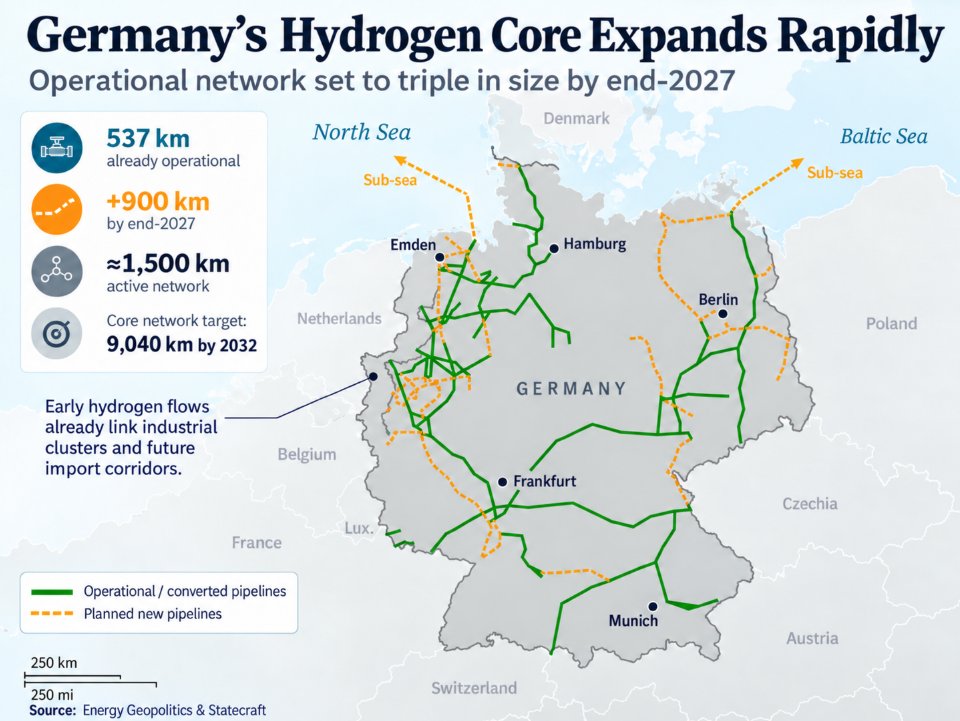
Germany will nearly triple its working hydrogen pipeline network to around 1,500 km by end-2027, for hydrogen it still doesn't produce. Germany's operational electrolysis capacity  ot make hydrogen stood at only 181 MW at the start of 2026, against a 10 GW target for 2030.

Germany's hydrogen core network: operational or converted pipelines (green) and planned new lines (orange). The map is schematic. Source: Energy Geopolitics & Statecraft, via Francesco Sassi (@Frank_Stones)

Gas transmission operators had 537 km of hydrogen pipelines in service on the second anniversary of the network's approval and will add another 900 km this year and next, their industry association FNB Gas said on October 22. Most of what is running is converted natural gas pipe: 507 km of the lines readied last year, the longest a 400 km stretch from Lubmin on the Baltic coast to Bobbau in Saxony-Anhalt that GASCADE filled with hydrogen in December 2025.

The country is putting the pipeline horse before the production cart. Germany had only 181 MW of electrolysis capacity in operation at the start of 2026, against a target of 10 GW by 2030. The country is building expensive network assets before a viable hydrogen market exists, and the state has promised to pick up most of the bill if the customers never arrive, according to energy analyst Francesco Sassi, author of the Energy Geopolitics & Statecraft newsletter.

"The network operators have delivered: the first pipelines are in the ground and industry is reserving transport capacity. But every further pipeline needs customers, and every new customer needs enough hydrogen," FNB Gas managing director Barbara Fischer said. "Only if supply and demand keep growing will the core network as a whole be a success."

A network ahead of its customers

The Bundesnetzagentur approved the 9,040 km core network, the Wasserstoff-Kernnetz, in October 2024 at an estimated cost of €18.9bn, with completion due in 2032. About 60% of it is converted gas pipeline and the rest new build, linking industrial clusters in the Ruhr and the east German chemical triangle to storage sites, ports and import corridors.

The second draft of the first joint gas and hydrogen network development plan (NEP 2025) foresees a 9,241 km hydrogen transmission system by 2037 and total investment of €24bn, FNB Gas said. Presenting the first draft in March, Fischer said network expansion would cost about 30% more than earlier scenarios assumed, mainly because of higher material and construction costs, the utilities trade paper ZfK reported.

Shippers have been able to book binding entry and exit capacity on the network since March 19, and paid reservations reached just under 6 GW by the latest deadline, double the level in May. Those bookings have not yet turned into firm offtake contracts, according to Sassi.

Electrolysers stall

The 181 MW figure comes from an analysis of electrolysis projects by the Institute of Energy Economics at the University of Cologne (EWI) published in January. A further 1.3 GW had reached a final investment decision or was under construction, so up to 1.5 GW could be running by end-2027. Even if every project announced for completion by 2030 were built, capacity would reach 8.7 GW, and almost 3 GW of schemes had already been struck off EWI's database as cancelled or dormant.

EWI blamed high production costs, buyers' low willingness to pay and regulatory uncertainty. Delays were visible early: Shell's 100 MW Refhyne 2 electrolyser at its Rheinland refinery reached a final investment decision only in July 2024, two years later than first planned.

The taxpayer's guarantee

Operators recover their costs through a uniform ramp-up tariff, which the Bundesnetzagentur set at €25/kWh/h/a in July 2025, so that the first users do not pay for an empty network. The gap between fee income and costs in the early years is paid out of an amortisation account funded by a KfW credit line of up to €24bn, to be repaid from surplus fees as traffic grows, by 2055 at the latest.

If the account is still in deficit in 2055, the federal government covers 76% of the shortfall and the network operators the remaining 24%. With hydrogen-fired power plants that were meant to be big customers delayed, the state may end up carrying that 76% share, according to Sassi.

FNB Gas wants still more protection. Fischer called for financing terms for the core network that "adequately reflect" the operators' ramp-up risks, along with an extension of Germany's climate protection contracts for industry and state backing for import corridors.

Brussels lowers its sights

The European Commission opened a consultation on a renewed hydrogen strategy on October 26, running to November 23. Its call for evidence says renewable and low-carbon hydrogen is developing more slowly than expected because of "high costs, limited demand, investment uncertainty and infrastructure constraints", and that planned projects fall short of the estimated 3-4mn tonnes of renewable hydrogen needed by 2030 to meet the EU's consumption targets.

That is a long way below the REPowerEU ambition of 10mn tonnes of domestic production plus 10mn tonnes of imports by 2030, which the European Court of Auditors said in July 2024 needed a "reality check". A draft Commission impact assessment on the post-2030 renewables framework floated replacing binding national renewable hydrogen quotas with an indicative EU-wide consumption target of 8mn tonnes a year by 2040, Argus reported on September 10.

Imports to fill the gap

Berlin already expects to buy most of its hydrogen abroad. Its import strategy, adopted in July 2024, puts national demand for hydrogen and its derivatives at 95-130 TWh in 2030, of which around 50-70% (45-90 TWh) would have to be imported.

However, that international supply doesn't exist yet either. The world's two largest makers of hydrogen are the US and China. China accounted for almost 30% of global output of nearly 100mn tonnes in 2024—roughly 30mn tonnes. The US Department of Energy puts US production at approximately 10mn tonnes annually. However, they are likely to consume their entire production for domestic needs leavnig almost nothing for export.

Transporting hydrogen over such long distances is a seperate headache as hydrogen liquifies at -253C - 20C above absolute zero, the second lowest liquidification point of all elements after helium. That is a very expensive process and evapouration while in transit is a major problem.

Algeria, Tunisia, Italy, Austria and Germany signed the Algiers Declaration on the SoutH2 Corridor in October, a pipeline project meant to carry up to 4mn tonnes a year of green hydrogen north from Algeria, largely through converted gas lines, and a German trade mission toured Algeria and Tunisia in September looking for projects. Germany's H2Global auctions have bought derivatives from further afield: the first round gave Fertiglobe a contract to ship green ammonia from Egypt at €1,000 per tonne, and India's AM Green won the Asia lot of the second round with a ten-year deal worth at least €585mn, Argus reported on September 30.

Relying on imports for half or more of demand by 2030 exposes Europe to new geopolitical, transport and conversion risks along the North African and Iberian corridors, according to Sassi. FNB Gas chairman Matthias Jenn sees the opposite outcome, saying a successful ramp-up would make Germany "less dependent on individual countries from which we import energy".