Monday, November 02, 2026


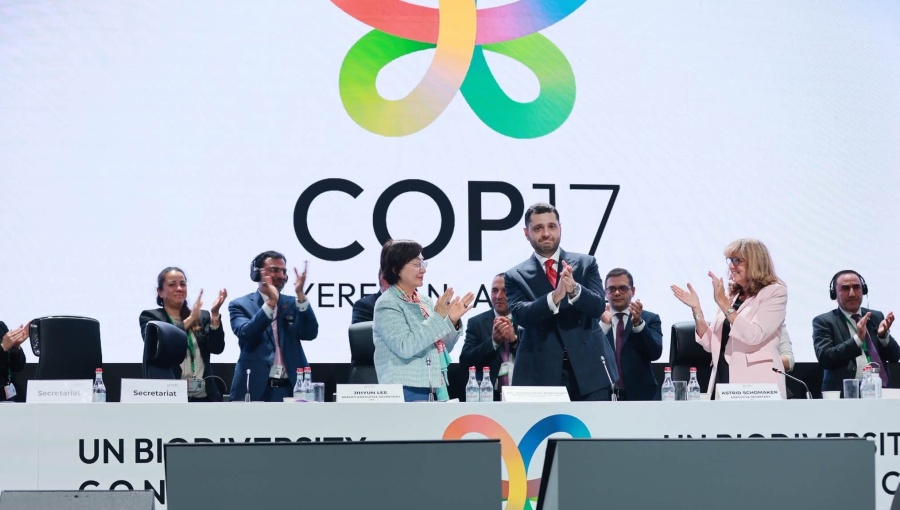
COP17 in Armenia gives biodiversity targets a new roadmap but leaves funding questions

COP17 in Armenia gives biodiversity targets a new roadmap but leaves funding questions
/ Hambardzum Matevosyan via FacebookFacebook
By Clare Nuttall in Glasgow November 1, 2026

Governments agreed a plan to accelerate efforts to halt biodiversity loss by 2030 at a United Nations summit in Armenia, adopting a roadmap for the remaining four years to meet global targets, but disputes over funding and limited contributions to a corporate benefit-sharing fund exposed continuing obstacles to implementation.

Negotiators from 182 parties to the Convention on Biological Diversity adopted the first global review of progress towards the Kunming-Montreal Global Biodiversity Framework, agreed in 2022, after two weeks of talks in Yerevan that continued beyond their scheduled Friday conclusion.

The resulting agreement, dubbed the Yerevan Pathway, sets priorities for accelerating implementation of the framework's 23 targets. The review found that the world remains off track to meet them by 2030. The pathway calls on governments to reform subsidies that harm nature, increase financial, scientific and technical support for developing countries, and align national budgets and economic decisions with biodiversity goals.

“We cannot protect nature while continuing to finance its destruction,” said Astrid Schomaker, executive secretary of the Convention on Biological Diversity, according to a UN statement issued after the event.

The agreement also calls for stronger monitoring and reporting. Among its priorities is reforming at least $500 billion in environmentally harmful subsidies by 2030.

“We’ve seen more treats than tricks today at COP17,” said Daudi Sumba, WWF International's chief conservation officer.

“The Global Review is a strong signal to countries that they must do better when it comes to action for nature, but without clear scaling of the funds to be able to deliver, I fear finance will remain the key issue that continues to haunt the UN biodiversity summits,” he said.

Finance was among the most contentious issues, with governments struggling to agree on arrangements for biodiversity funding after 2030. They eventually adopted criteria to guide the design of a future permanent financial mechanism, agreed to allow a voluntary broadening of the contributor base and called for a formal review of the Global Environment Facility and Global Biodiversity Framework Fund.

The talks also sought to advance the Cali Fund, established to collect contributions from companies benefiting commercially from digital sequence information derived from genetic resources. The fund aims to raise at least $1 billion annually, with money intended to support biodiversity conservation, including in countries and communities providing genetic resources.

However, only around $10,000 had been pledged by the close of COP17. Governments reaffirmed indicative corporate contribution rates and agreed to issue certificates provisionally to help prevent duplicate payments. A review of the fund is scheduled for COP18.

“Almost 35 years later, we’re still not seeing the companies that profit off nature sharing their benefits with the Indigenous Peoples and Local Communities that act as the custodians of much of the biodiversity that their businesses rely upon,” said Vishaish Uppal, WWF-India's director of governance, law and policy.

Delegates also adopted the Sevan Guidelines, setting out the operating rules for a permanent body intended to strengthen the role of Indigenous Peoples and local communities in shaping global biodiversity policy.

The conference adopted more than 40 decisions, covering issues including protected areas and forests, wildlife management, invasive alien species, marine and coastal biodiversity and synthetic biology.

The Armenian presidency said the conference had mobilised $1.8 billion in pledges. The UN separately reported nearly $2 billion in new biodiversity funding announcements, including $560 million through the Global Environment Facility's latest replenishment and $500 million from the Species Recovery Alliance. A further $330 million was announced for the Value Nature Fund, which aims to mobilise private investment in nature.

Other initiatives included a biodiversity bond and investment incubator launched by the Asian Development Bank, as well as new indicators intended to improve monitoring and accountability.

“Over these two weeks we have demonstrated that differences can be bridged, commitments can become decisions and cooperation can deliver,” said COP17 President Hambardzum Matevosyan, Armenia's environment minister.

UN Environment Programme Executive Director Inger Andersen said the talks showed that countries could find common ground through multilateral cooperation.

“In Yerevan, we saw environmental multilateralism prevail once again,” she said.

But WWF said the funding announcements would need to translate into predictable finance and action. “The Yerevan Pathway acknowledges what African countries already know: we have to move much faster from commitments to implementation,” said Durrel Nzene Halleson, WWF Africa's head of policy and partnerships.

Schomaker said the ultimate test would be what governments changed after returning home.

Ecuador's capital Quito was selected to host COP18 in 2028, following a vote against Panama. The next summit will take place with only two years remaining before the 2030 biodiversity targets fall due.


Russia's influence in Africa grows by a third in a decade but stays a quarter of China's

Russia's influence in Africa grows by a third in a decade but stays a quarter of China's
Trade of $30.4bn and a 15% share of the arms market make Moscow a security partner for the Sahel, but an economic minnow on a continent where China trades 12 times as much. / bne IntelliNewsFacebook
By Ben Aris in Berlin November 2, 2026

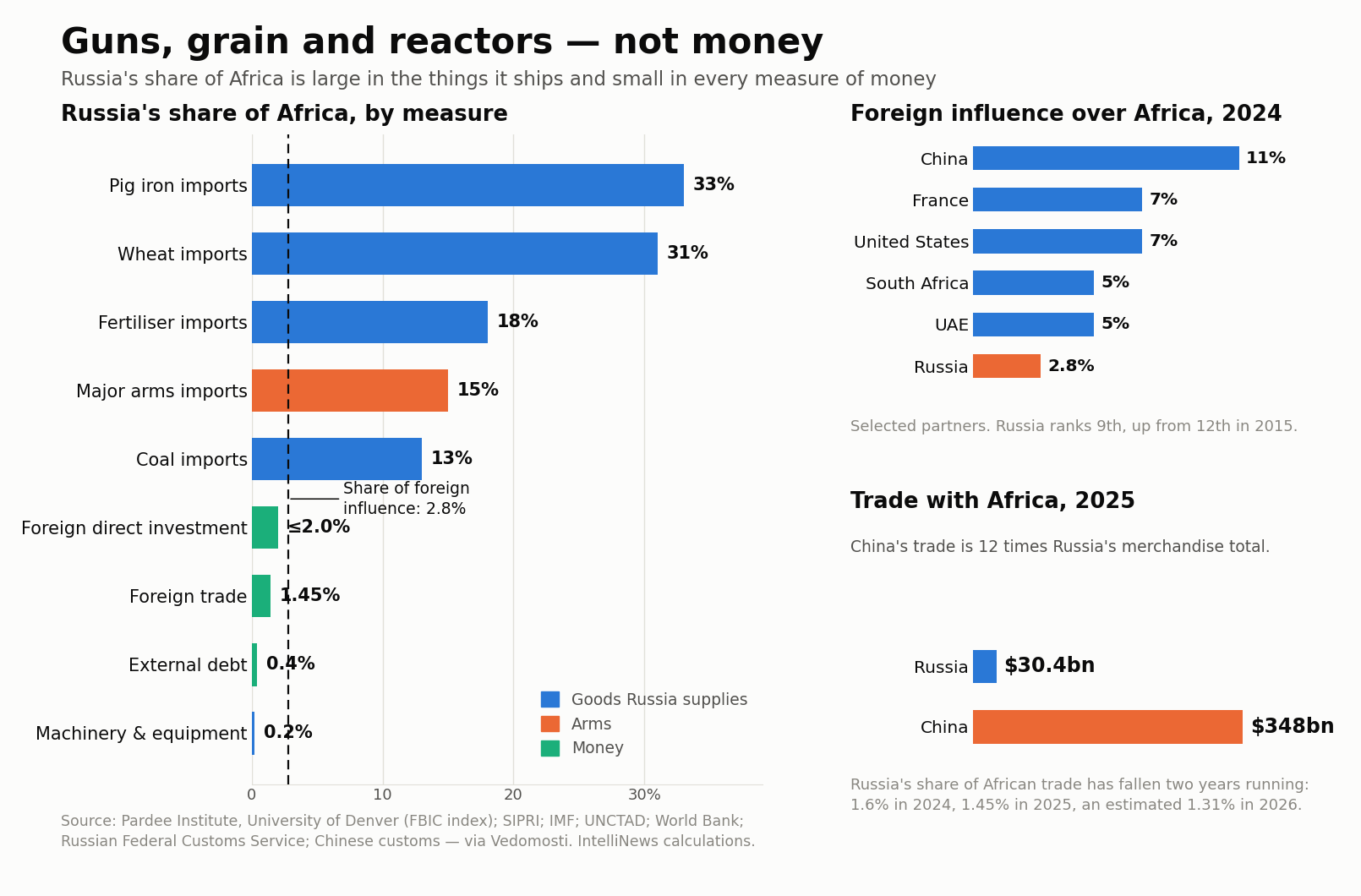
Russia’s share of foreign influence in Africa has grown by more than a quarter in a decade to 2.8%, Vedomosti reported on November 2, but still trails China, France and the US.

The measure is the Foreign Bilateral Influence Capacity (FBIC) index compiled by the Pardee Institute at the University of Denver, which scores every pair of countries on trade, diplomatic and arms ties and on how dependent one is on the other. Russia’s share of the influence foreign states exert over Africa rose from 2.2% in 2015 to a peak of 3% in 2021 before slipping back to 2.8% in 2024, lifting it from 12th to ninth place among Africa’s partners. China leads with 11%, ahead of France and the US on 7% each, with South Africa and the UAE on 5%, according to the paper’s calculations.

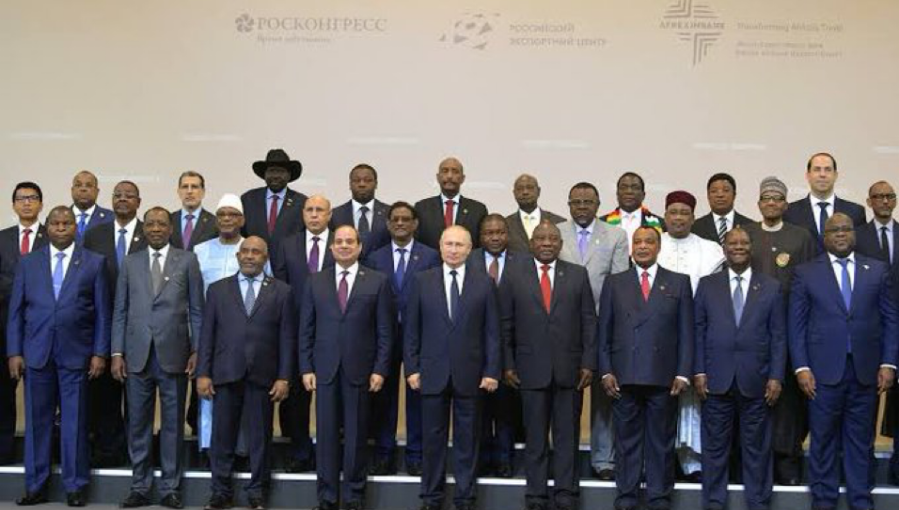
The numbers put a size on a relationship the Kremlin presents as one of its biggest foreign-policy wins. Military governments across the Sahel have sent French and US troops home and turned to Moscow, and delegations from 48 African countries came to Moscow for the third Russia-Africa summit on October 28-29. Yet on every hard economic measure Russia remains a minor partner: it accounts for about 1.5% of Africa’s foreign trade, at most 2% of its foreign direct investment and 0.4% of its external debt. Its expanding pull on the continent rests on guns, grain and reactors, not money.
Trade stuck at $30bn

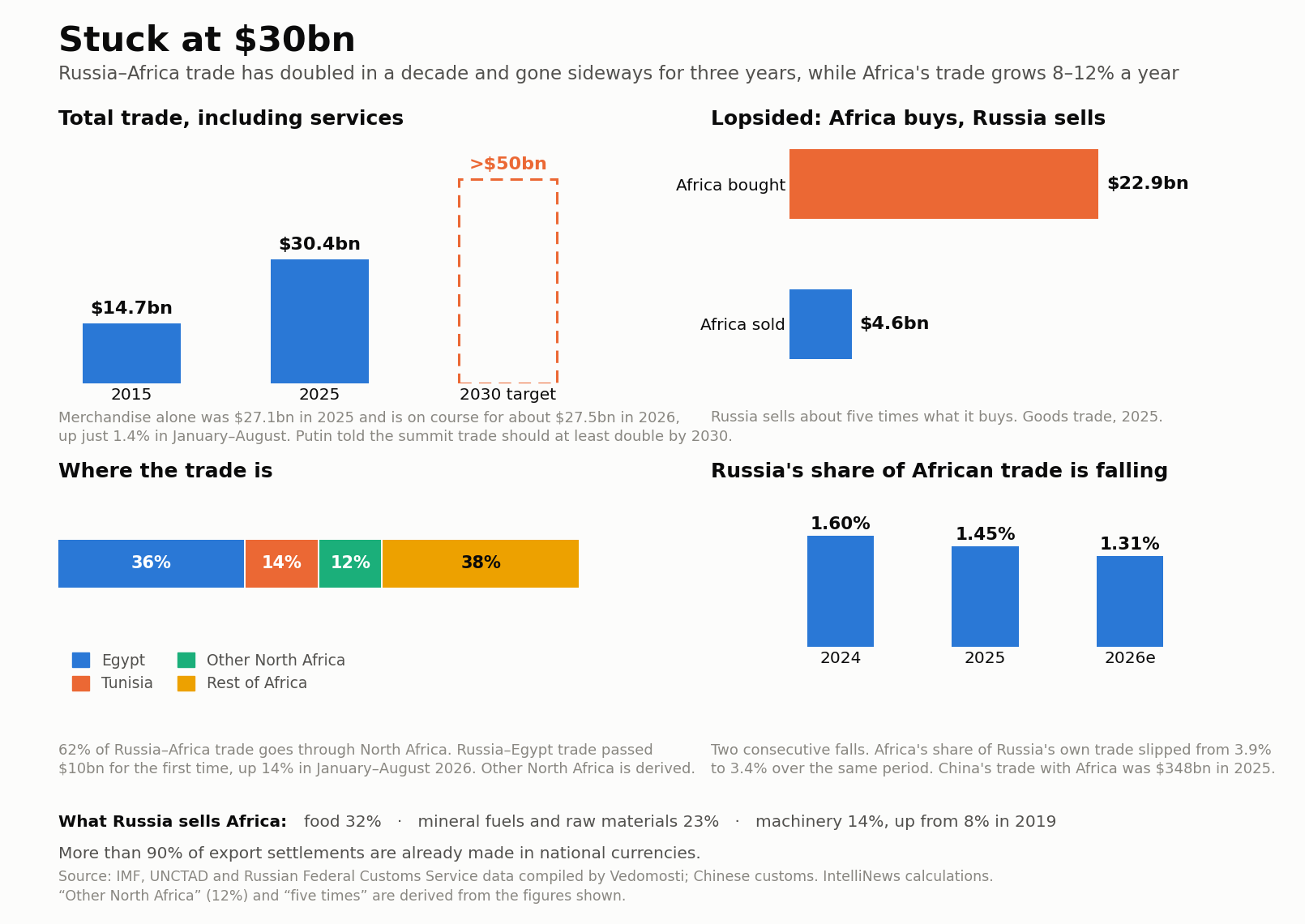
Trade between Russia and Africa reached $30.4bn in 2025, including $3.3bn of services, according to IMF, UNCTAD and Federal Customs Service data compiled by Vedomosti. That is double the $14.7bn of 2015, and 53% higher in real terms.

Merchandise trade came to $27.1bn on customs figures, close to the “more than $27bn” Kremlin aide Yuri Ushakov said on the eve of the summit, and up more than 60% from $16.8bn at the time of the first summit in Sochi in 2019.

Merchandise trade rose just 1.4% in January-August 2026 and is on course for about $27.5bn this year, while total trade has hovered around $30bn for three years as Africa’s overall foreign trade grows by 8-12% a year.

Russia’s share of the continent’s trade has fallen for two years in a row, from 1.6% in 2024 to 1.45% in 2025 and an estimated 1.31% in 2026, and Africa’s share of Russia’s own trade fell from 3.9% to 3.4% over the same period. President Vladimir Putin told the summit that trade should at least double, to more than $50bn, by 2030.

China’s trade with Africa reached a record $348bn in 2025, according to Chinese customs data, more than 12 times Russia’s merchandise total.

Africa sold Russia goods worth $4.6bn in 2025 and bought $22.9bn, and 62% of the total goes through North Africa, with Egypt alone accounting for 36% and Tunisia for 14%. Putin said Russia-Egypt trade had passed $10bn for the first time, with growth of 14% in January-August 2026. Food made up 32% of Russian exports to the continent, mineral fuels and raw materials 23% and machinery 14%, up from 8% in 2019.

Russia supplies 31% of Africa’s wheat imports, 33% of its pig iron, 18% of its fertilisers and 13% of its coal, but only 0.2% of its machinery and equipment. Putin said Russia shipped more than 18mn tonnes of grain to Africa in 2025 and 13mn tonnes in the first nine months of 2026, and fertiliser deliveries have passed 2.2mn tonnes this year. That role is now under strain: Ukrainian drone attacks on Black Sea and Azov port infrastructure are expected to cut Russian wheat exports by about 40% year on year in July-October, according to the Rusagrotrans analytical centre, feeding a food price shock that lands hardest on import-dependent North African states.

More than 90% of export settlements are already made in national currencies, but they go through indirect channels that raise costs, according to Mikhail Margelov, vice president of the Russian International Affairs Council. Putin used the summit to pitch Russia’s digital-currency payment system to African governments as one immune to Western sanctions, part of a wider push for a BRICS Pay alternative to SWIFT.
Debt, investment and megaprojects

Africa’s external debt reached $1.17 trillion at the end of 2024, according to the World Bank, of which $4.5bn, mostly owed by Egypt, is owed to Russia – 0.4% of the total, or 2.3% counting debts Moscow has already forgiven. Russia had written off $23bn of African debt by 2023, Putin said at that year’s summit, including $4.8bn owed by Ethiopia, $4.6bn by Libya, $4.7bn by Algeria and $3.5bn by Angola.

Africa’s inward foreign direct investment stock stood at about $1.07 trillion in 2024, according to UNCTAD. The Central Bank of Russia recorded just $138mn of Russian FDI on the continent at the start of 2022, though it withheld data for Algeria, Angola, Nigeria, Ghana, Morocco and the Democratic Republic of Congo, and much Russian money arrives through Cyprus and other intermediaries. Estimates that count the largest projects put Russian investment at $8bn-$20bn, or roughly 1-2% of that stock.

The biggest single item is Rosatom’s El Dabaa nuclear power plant in Egypt, valued at about $29bn, 85% of it financed by a $25bn Russian loan. Putin and Egyptian President Abdel Fattah El-Sisi discussed the plant at the Kremlin on October 28. Russia’s nuclear exports are booming and Rosatom is using them to bind clients in for decades through fuel supply – uranium is the new gas.

Rosatom CEO Alexei Likhachev said on October 30 that more large projects were being reviewed with Uganda and Ghana and surveys would start shortly in Ethiopia, while nine countries have shown interest in small floating nuclear plants. Ghana opened talks with Rosatom at the summit and Mali pressed Moscow to speed up its own planned plant.

Ghana’s foreign minister Samuel Okudzeto Ablakwa said on October 31 that Russia would work with Accra on a 2,000 MW nuclear plant and had agreed a defence pact covering military equipment for Ghana’s armed forces.

Most of the rest of the pipeline is in resources. Rosneft holds 30% of Egypt’s Zohr gas field, a stake worth $2.15bn in 2026 prices, Nordgold has invested about $1.5bn in Guinea’s Lefa gold mine since 2010, Lukoil’s oil stakes in Ghana and Congo exceed $2.4bn, though the sanctioned company has agreed to sell most of its foreign assets, and Rosatom is preparing the $1.2bn Mkuju River uranium project in Tanzania. Rusal agreed at the summit to mine Ghana’s bauxite and build Ghana’s first alumina refinery, South Sudan offered Zarubezhneft Petronas’ former oil stakes, Sudan offered Russia a Red Sea free zone and Mozambique began talks on a north-south railway.

Guns for gold

The Soviet Union supplied 58% of Africa’s arms imports in 1985, $3.2bn out of $5.5bn, according to a US arms control agency report, and Russia’s cumulative share since 1991 is 36%.

In 2021-2025 the US supplied 19% of Africa’s imports of major arms, China 17%, Russia 15% and France 8.3%, according to the Stockholm International Peace Research Institute (SIPRI). Vedomosti values Russia’s deliveries at more than $4.3bn out of $29bn. African arms imports dropped 41% from the previous five years and Algeria’s fell 78%, though SIPRI says unverified reports of Algerian deals with Russia suggest its estimates may be low. In sub-Saharan Africa China leads with 22%, ahead of Russia on 12% and Turkey on 11%. Rosoboronexport has signed about 150 contracts with African states worth more than $20bn since 2023, its director general Alexander Mikheev said in May, though signed contracts are not the same as deliveries.

Russian troops and instructors from the Defence Ministry’s Africa Corps - the successor to the PMC Wagner Group - and associated units are in Mali, the Central African Republic, Libya, Niger and Burkina Faso.

The Africa Corps helped Niger’s junta put down a mutiny in Niamey in August, Moscow is upgrading six Libyan airbases to support its Sahel operations, and in 2025 it pressed the Central African Republic to swap Wagner for the Africa Corps and pay in cash. Malian refugees have accused Russian fighters of torture and killings.

Security work has not turned into commercial gains: in Mali, Western companies control most gold mining while Russia carries much of the cost of keeping order, according to Andrei Fedorov of the Institute for African Studies at the Russian Academy of Sciences.

Where Moscow counts

Russia accounts for 12% of the foreign influence on Rwanda, 11% on Algeria, 10% on Uganda, 9% on Egypt, 8% on Togo, 7% on Sudan and 6% on Ethiopia, Mali and Angola, on the FBIC measure. Moscow’s closest security partners register less: IntelliNews calculations from the index put Russia’s 2024 share at 4.3% in the Central African Republic, 3.8% in Burkina Faso and 2.2% in Niger, because the index counts formal trade, diplomacy and arms transfers rather than mercenaries and security contracts.
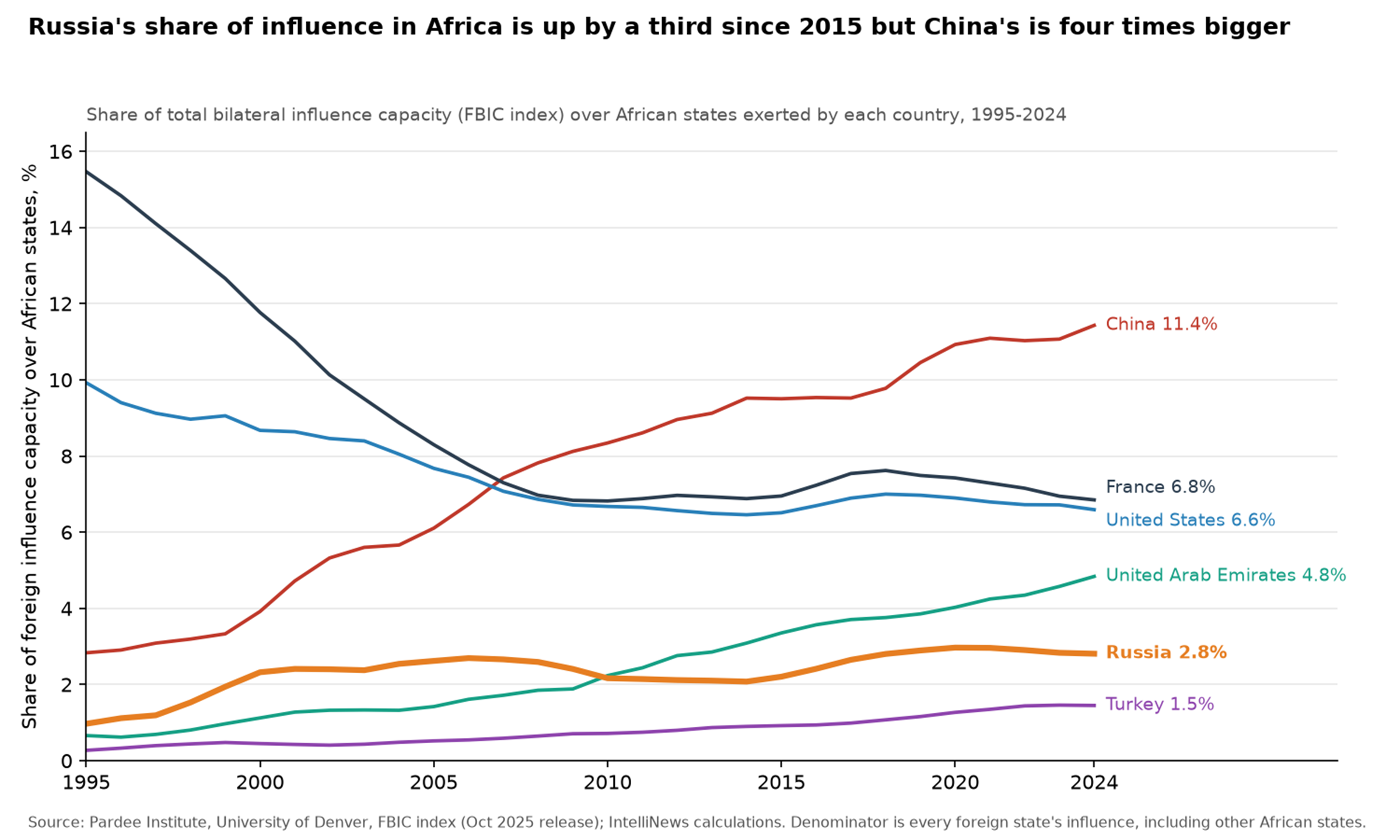
Share of foreign influence capacity over African states by partner, 1995-2024. Source: Pardee Institute, University of Denver, FBIC index; IntelliNews calculations.

France held 15.5% of foreign influence in Africa in 1995 and the US almost 10%, against 2.8% for China, according to IntelliNews calculations from the same dataset. China overtook both by 2007. The UAE has climbed from under 1% to 4.8% and Turkey from 0.3% to 1.5%. BRICS members together now account for 33% of the foreign influence on African states, Europe for 28% and other African states for 27%, according to Vedomosti.

The Pretoria-based Institute for Security Studies (ISS) expects Russia’s weight in Africa to keep rising to 2050, but more slowly than China’s, held back by its weak economic levers, sanctions and uncertainty over its future.

The Soviet inheritance

Those “accustomed to thinking in terms of their colonial past” are trying to drive Africans back into “debt bondage”, Putin told the summit’s plenary session on October 28, quoting Burkina Faso’s revolutionary leader Thomas Sankara: “Debt is neocolonialism.”

By 1989 the Soviet Union had built or begun some 350 industrial plants in Africa, including the Aswan Dam in Egypt, steelworks in Algeria and Nigeria and hydroelectric stations in Angola, trained 450,000 specialists and lent $50bn at 2-3%, half of which was later written off. Its 1985 trade with key African partners came to $4.1bn, 2.6% of the continent’s $159bn total, with Libya, Egypt and Algeria the main partners. Broader estimates put the Soviet share of Africa’s total foreign interaction at 10-15%, according to Ekaterina Novikova of the Plekhanov Russian University of Economics.

“The Soviet project was very progressive. We helped develop entire industries on a turnkey basis – what’s called sovereign industrialisation,” said Denis Degterev of the Institute for African Studies.

The collapse was steep: Russia’s share of Africa’s trade fell to 0.5% in 1995 and was still only 0.7% in 2010, before recovering to 1.1% in 2015, 1.5% in 2019 and a post-Soviet high of 1.6% in 2024. Russia now has diplomatic relations with all 54 African states and embassies in more than 45, and the number of African students in Russia has risen by half since 2020 to 40,000, according to Putin.

“Russia’s policy in Africa has shed Soviet altruism and has a pronounced commercial character,” Novikova told Vedomosti. The lack of a strategy and of systematic coordination is the central weakness of Russian policy on the continent, according to Margelov, who argues that Moscow needs a dedicated development-finance vehicle on the model of China’s state policy banks. Fedorov wants to revive the Soviet State Committee for Foreign Economic Relations, which ran the USSR’s aid and construction projects abroad.

The summit gave Moscow its headline deals – a Ghanaian alumina refinery, South Sudanese oil, a possible Red Sea foothold and a queue of reactor customers – and a promise to move Russian production to the continent to escape sanctions. The numbers say the gap between that ambition and Russia’s economic weight remains wide: a 2.8% share of influence, a share of trade below 1.5% and falling, and a security presence that has yet to pay its way.
 

US moves to strip South Africa and Rwanda of duty-free trade access under AGOA from January

US moves to strip South Africa and Rwanda of duty-free trade access under AGOA from January
/ illustration by IntelliNewsFacebook
By Brian Kenety November 2, 2026

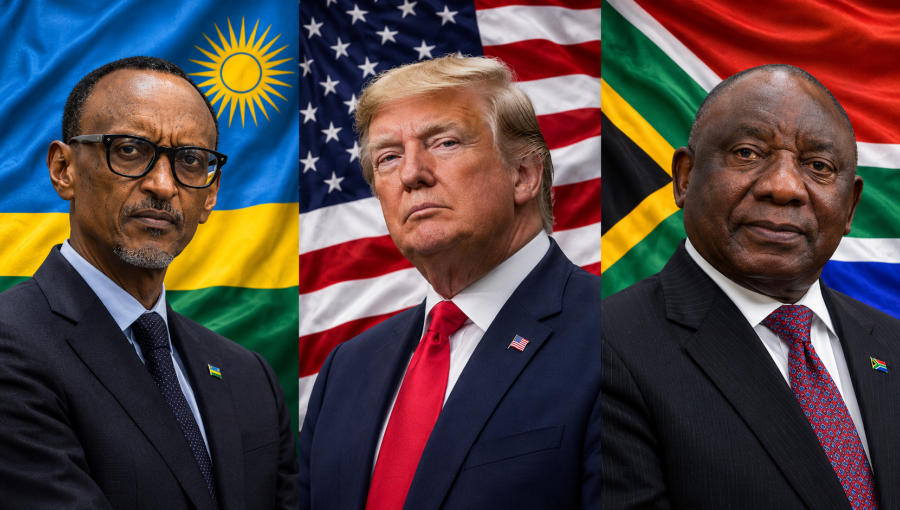
The United States plans to remove South Africa and Rwanda from the African Growth and Opportunity Act (AGOA) from January 1, 2027, ending preferential access to the American market for two African economies as Washington tightens eligibility under the trade programme.

US Trade Representative Jamieson Greer announced on November 2 that President Donald Trump intended to terminate both countries’ AGOA eligibility after finding, following an annual interagency review led by USTR, that their governments were engaging in practices inconsistent with the programme’s criteria. Trump notified Congress and the two governments of the decision, Reuters reported.

For South Africa, Washington cited barriers to US trade and investment, corruption and threats to US national security and foreign policy interests. For Rwanda, it cited trade and investment barriers, rule of law, political pluralism, worker rights, human rights and threats to US national security and foreign policy interests.

South Africa is AGOA’s largest beneficiary, with US duty-free imports under the programme worth $1.6bn in 2025, according to the Congressional Research Service. AGOA gives eligible African countries duty-free access for thousands of products, including agricultural goods, vehicles and manufactured products.

AGOA preferences do not override separate US tariffs on certain products. Duties on vehicles, steel and aluminium already apply, and South Africa’s earnings from vehicle exports to the US fell to ZAR8bn in 2025 from about ZAR17.7bn in 2024, Sowetan reported. Withdrawal from AGOA would remove preferential access rather than end trade with the United States. South Africa’s trade ministry said last week that AGOA exports accounted for about 10% of its exports to the US and 1% of its global exports, Reuters reported.

The US took 7.1% of South Africa’s merchandise exports in 2025, down from 7.7% in 2024, as Germany overtook it to become the country’s second-largest export destination after China, according to the South African Reserve Bank, IntelliNews reported. A February 2025 study by the Solidarity Research Institute estimated that exports to the US supported 576,164 South African jobs, about half of them in sectors that benefit from AGOA terms.

Trade, Industry and Competition Minister Parks Tau told the National Economic Development and Labour Council on October 29 that South Africa was “ready whatever the decision” and that its “doors remain open for dialogue”, SAnews reported. “Whatever the outcome, our economy will remain stable, our exporters will keep trading,” he said, adding that South Africa “will have 60 days to address them before any suspension” if US concerns remained. Tau put bilateral trade at $28.8bn in 2025 and said more than 600 American companies operating in South Africa support about 134,600 jobs, while US firms had made more than $5bn in investment commitments over the past year.

President Cyril Ramaphosa warned on October 19 that the country must prepare for possible exclusion, describing the potential impact on jobs as “devastating”. Pretoria has been pursuing alternative markets in Africa, Asia and Europe, and China introduced zero-tariff treatment for qualifying South African products from May 1, 2026 to April 30, 2028. Relations with Washington have deteriorated over disagreements involving South Africa’s domestic policies and its genocide case against Israel at the International Court of Justice. Pretoria rejects US allegations of persecution against white South Africans, while Israel denies genocide. At a Senate hearing in December 2025, Greer said South Africa was “a unique problem” and that he was open to treating it differently under AGOA, IntelliNews reported, citing IOL.

US Ambassador to South Africa Leo Brent Bozell III called the decision a “predictable and preventable outcome” of “the rejection by South Africa’s government of real concerns raised by the US government”, adding that “the South African government must understand the gravity of the situation”, in a post on X on November 2, SAPeople reported. He said he remained “hopeful that we can find a path forward to address our larger bilateral concerns”.

Labour federation Cosatu said it was “deeply concerned” and urged the government to “utilise the next 60 days before this exit comes into effect”, Sowetan reported. Trade union Solidarity blamed Pretoria. “The government, Lamola and Ramaphosa must take full responsibility for this exclusion,” said Jaco Kleynhans, its head of public relations, referring to International Relations Minister Ronald Lamola. “Ordinary workers and industries will now pay the price for political negligence,” he said, Food For Mzansi reported.

Agricultural exporters, among AGOA’s main South African users, warned of higher costs rather than lost access. Wandile Sihlobo, the presidential envoy on agriculture and land, estimated that losing AGOA preferences could add about 3.4 percentage points to tariffs on certain qualifying products now facing a 12.5% US duty, taking the rate to about 15.9%, below the 30% levied in 2025. The impact would vary by product. “We will have access, but with slightly higher tariffs,” he said, according to Food For Mzansi. Farm lobby AgriSA said the priority was retaining American customers and protecting rural jobs. “This will be a loss not just for us, but the US consumer will lose too,” said Boitshoko Ntshabele, chief executive of the Citrus Growers’ Association of Southern Africa, Sowetan reported.

Rwanda lost AGOA benefits for apparel exports in July 2018 following a dispute over its higher duties on imports of second-hand clothing from the US. The January termination would extend beyond that product-specific suspension, although Rwanda’s exposure is small: US goods imports from the country totalled $43.3mn in 2025, according to USTR. Neither government had issued an immediate response to Washington’s November 2 announcement, Reuters reported. Rwanda’s Foreign Minister Olivier Nduhungirehe told AFP last week, before the decision, that “Rwanda must not be held as a scapegoat for what is happening in Congo forever”, eNCA reported. Kigali denies US accusations that it backs the M23 rebel group in eastern Democratic Republic of Congo.

The decision follows a one-year renewal in February, which extended AGOA to December 31, 2026 retroactively after it lapsed on September 30, 2025, and Congress’s September extension of AGOA through December 2028. Country eligibility remains subject to annual US review, and the president must notify Congress at least 60 days before terminating a country’s benefits. The planned January exclusions would therefore affect South Africa and Rwanda individually rather than terminate the wider programme. Washington last removed beneficiaries in January 2024, when Gabon, Niger, the Central African Republic and Uganda lost eligibility.

See IntelliNews: South Africa warns of devastating job losses if US withdraws AGOA trade benefits
See IntelliNews: Washington renews US-Africa trade pact AGOA for single year; Trump’s tariffs still bite
See IntelliNews: South African exports could lose duty-free access to US under Washington’s proposed Africa trade deal
See IntelliNews: South Africa’s agricultural exports rose by more than 10% y/y in 2025 despite US trade complications


Argentina's ex-president Kirchner eyes 2027 run against Milei

Argentina's ex-president Kirchner eyes 2027 run against Milei
The convicted former president's conditional bid threatens to reopen Peronism's leadership fight just as Axel Kicillof was emerging as the opposition's standard-bearer.Facebook
Twitter
By IntelliNews Latam desk November 2, 2026

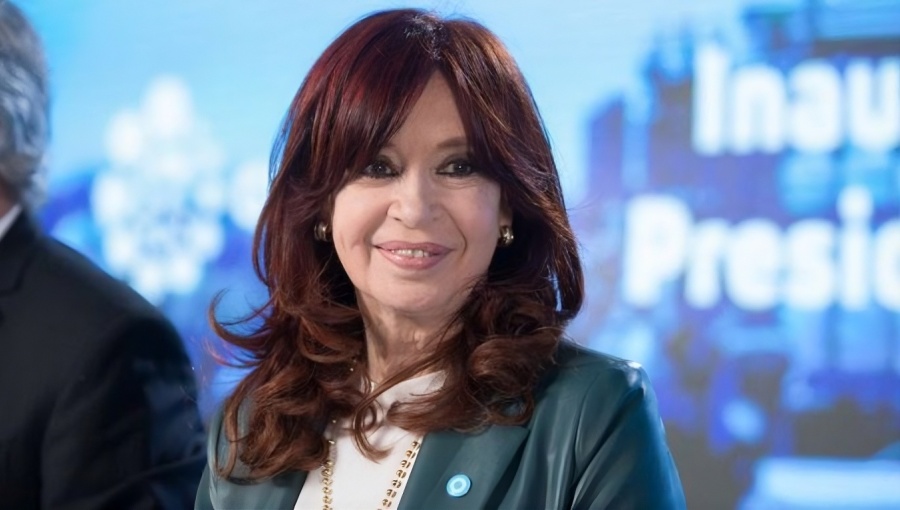
Cristina Fernandez de Kirchner, Argentina's convicted ex-president, would consider running against Javier Milei in 2027 if her ban from office is lifted, the Washington Post reported.

"When I recover my political rights, why not?" Kirchner, 73, said in her first interview with a foreign outlet since her sentencing, adding that the opposition had yet to unite behind a candidate. She is serving a six-year sentence at her Buenos Aires apartment and is barred for life from holding public office.

Kirchner's remarks reopen a leadership contest that Peronism, the populist leftist movement she leads, had begun to settle in favour of Axel Kicillof, the governor of Buenos Aires Province and her former economy minister. Kicillof has spent the past two months building a national movement to take on Milei, without declaring a candidacy, and a Trespuntozero poll in May found 42% of respondents would definitely or possibly vote for him, against 34% for the right-wing libertarian leader.

The rift is already visible. On October 17, Peronist Loyalty Day, Kicillof told a rally in La Matanza that "Peronism will govern Argentina again", while Kirchner's son Maximo, who leads the La Campora faction, staged a rival event in Resistencia, in Chaco Province. "Cristina is no longer its undisputed leader, but she has retained the ability to prevent new leadership from consolidating," political scientist María Esperanza Casullo told AP in September.

Any comeback now depends on her lawyers. Kirchner and her counsel Rafael Valim, who advised Brazil's President Luiz Inacio Lula da Silva when he fought his own corruption convictions, have asked the UN Human Rights Committee to rule that she was denied due process. The committee cannot overturn national courts, although Argentina is bound by the International Covenant on Civil and Political Rights. "If Argentina fails to comply, I foresee an irresistible social mobilisation by the Argentine people," Valim told the Washington Post.

Kirchner, who served as Argentina's president from 2007 to 2015 and as vice-president from 2019 to 2023, was convicted in 2022 over the award of road-building contracts in Santa Cruz province to a business ally, and the Supreme Court upheld the verdict in June 2025. She also faces a new money-laundering trial that opened last month. She denies wrongdoing. "Tell me where I put the money," she said, arguing that a guilty politician could have bought off a judiciary she called corrupt.

She conceded that Peronism had brought about its own defeat in 2023. Consumer prices rose 211.4% in 2023, including December after Milei took office, while poverty reached 41.7% in the second half. Milei then beat Economy Minister Sergio Massa with almost 56% of the vote, promising to revive the economy through libertarian shock therapy. "There was a breakdown in the culture of work," Kirchner said, describing voters who saw neighbours on state benefits earning as much as those who worked eight-hour days.

Milei’s economic record is mixed. Annual inflation slowed to 33.4% in September from a peak of 289.4% in April 2024, and his La Libertad Avanza party won the October 2025 midterm elections with 40.8% of the vote. Poverty, however, rose to 32.3% in the first half of 2026 and unemployment climbed to 7.9% in the second quarter, according to the INDEC statistics agency. Foreign investment is returning in export-oriented sectors such as oil and mining, while manufacturing and traditional industry are showing signs of strain.

A University of San Andrés survey in October put disapproval of his government at 60%, yet La Libertad Avanza still led voting intentions with 26% to the Peronists' 24%. Economy Minister Luis Caputo said in September that fear of a Peronist return could weigh on investors before the vote, calling Kirchnerism "hell" and Kicillof "the antichrist".

Kirchner, who still chairs the Justicialist Party, polls slightly better than Milei, though both have approval ratings in the 30s, according to the Washington Post. She predicted that the right-wing tide would turn and Republicans would lose the US midterms on November 3, saying that Donald Trump, the man who has done everything to help right-wing governments win in Latin America, "will lose the elections in his own country".


Pakistan pins its Afghan border war on India

Pakistan pins its Afghan border war on India
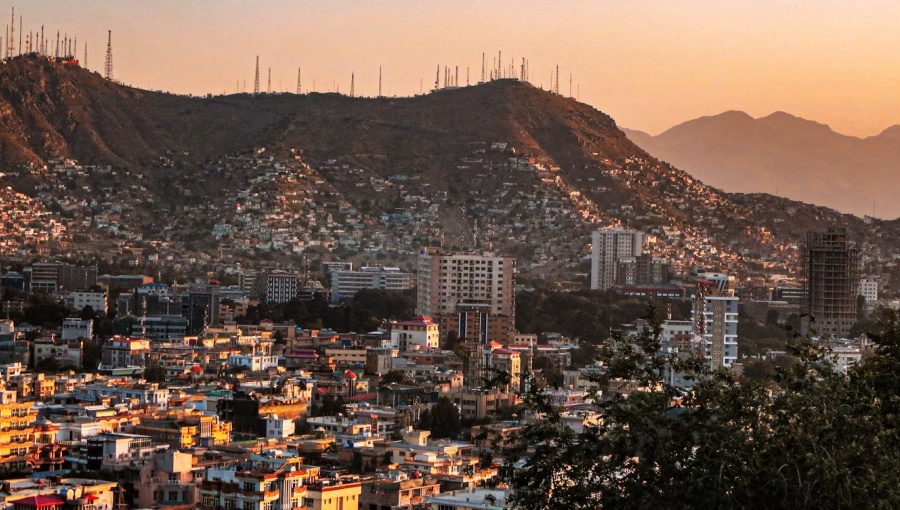
Islamabad's chief military spokesman has threatened Kabul with serious consequences and cast the TTP and BLA as Indian proxies, folding two hostile frontiers into one. / Mohammad Hussaini - Unsplash\
By Mark Buckton in New Taipei November 2, 2026

Pakistan's army has accused Afghanistan's Taliban of sheltering militants and warned it of serious consequences, while alleging that India is behind the violence.

Lieutenant General Ahmed Sharif Chaudhry, who heads Inter-Services Public Relations (ISPR), the military's media wing, made the threat in an interview with an unnamed foreign outlet, Dunya News reported on November 1. He called India the biggest sponsor of terrorism inside Pakistan, cast the Taliban administration as New Delhi's proxy and described both Tehreek-e-Taliban Pakistan (TTP) and the Balochistan Liberation Army (BLA) as Indian instruments.

Islamabad had a single demand, he said: that Kabul stop backing the militants who operate on Pakistani soil. If it did not, serious consequences would follow. His warning to the Taliban accused Kabul of sheltering TTP leader Noor Wali Mehsud along with Bashir Zeb and Gul Bahadur, and of letting fighters and weapons flow across the border. Pakistan's forces could handle any threat from Afghanistan, drones included, he added.

By merging the western frontier with the eastern rivalry, the generals are telling audiences at home and abroad that the Afghan conflict is India's war fought by other means. That account turns every bombing in Khyber Pakhtunkhwa and Balochistan into proof of a foreign hand rather than a failure of Pakistani policy. For now, New Delhi has rejected earlier accusations that it arms anti-Pakistan groups, and Islamabad has put no public evidence on the table.

The two armies traded fire along the Durand Line in October 2025, in the same week that the Taliban's foreign minister, Amir Khan Muttaqi, was in New Delhi, where India said it would turn its Kabul mission into a full embassy. A ceasefire was followed by talks in Istanbul that broke up without a deal.

"Regrettably, the Afghan side gave no assurances, kept deviating from the core issue and resorted to blame game, deflection and ruses," said Information Minister Attaullah Tarar after the first round.

Pakistan then shut the crossings, cutting bilateral trade to below $1bn a year, and business groups put the cost to Pakistan at more than $4.5bn by December. Open war came on February 26, when Afghan forces attacked border posts along the 2,600 km frontier and Islamabad launched Operation Ghazab lil-Haq. In March Kabul said a Pakistani strike on a drug rehabilitation centre in the capital had killed about 400 people, which Islamabad denied. Mediation by Saudi Arabia, Turkey and Qatar bought only a pause for Eid.

Rounds of talks in Doha, Istanbul, Riyadh and Urumqi never produced the written guarantees Islamabad wanted, and in June Defence Minister Khawaja Asif said the security talks had collapsed. He put the number of Pakistani soldiers and civilians killed in militant attacks since 2022 at more than 4,300. Pakistani aircraft struck eastern Afghanistan twice that month, and the UN mission in the country counted at least 28 civilians dead in the second raid. Washington backed Pakistan's right to self-defence all the same.

After further strikes on Kunar and Paktika in September, Taliban spokesman Zabihullah Mujahid promised that Afghans would deliver "an appropriate response".

Inside Pakistan, the armed forces recorded 3,145 militant incidents and 819 deaths among soldiers, police and civilians between January and early August, along with 28 suicide bombings they blamed on fighters based across the border. One of those, at an anti-militant rally in Kabal in the Swat Valley on August 2, killed at least 14 people. In Balochistan, ISPR now routinely brands the separatists it fights as Fitna al-Hindustan, a label that writes India into every casualty report.

India handed the generals material when it struck targets across Pakistan during Operation Sindoor in May 2025 after a militant attack at Pahalgam in Kashmir killed 26 civilians, and the two governments were still arguing over who won that war at the UN General Assembly in September. There, External Affairs Minister S Jaishankar, without naming Pakistan, accused a "serial practitioner of terrorism" of distorting the record.

New Delhi has also kept its channel to Kabul open, and on October 14 it held consultations with Russia on Afghanistan and Pakistan. Moscow in July 2025 became the first country to recognise the Taliban government.

Washington sounds sympathetic. Speaking in Atlanta, US Secretary of State Marco Rubio said:

"Pakistan is concerned about terrorist attacks that are being sponsored from the territory of Afghanistan. They feel that the Taliban is not doing enough to constrain those attacks, and they've taken action against it."

Pakistan's Foreign Office welcomed the remarks on November 1 and said it would back sincere efforts by the US and other friendly states to broker dialogue with Kabul. It then attached a price: verifiable action against the TTP, the BLA and the other groups it says operate from Afghan soil.

The information ministry had gone further the day before, calling terrorism launched from Afghan territory a red line and reserving Pakistan's right to take whatever steps it judges necessary, within international law, to remove threats to its security.

That is the condition Kabul has refused for a year, and Chaudhry's interview makes it harder still to meet. A Taliban government that denies sheltering the TTP is unlikely to move against fighters it is now told are Indian agents, since doing so would concede Islamabad's whole case. By binding the western and eastern border flare-ups, Pakistan's generals have made any settlement with the Taliban hostage to a rivalry with New Delhi that still shows no sign of cooling.

US revives push to sell Russian gas to Europe via Ukraine

US revives push to sell Russian gas to Europe via Ukraine
Kushner and Witkoff promoted a plan for Russian gas to reach Europe through Ukraine via a US intermediary. / bne IntelliNews
By Ben Aris in Berlin November 2, 2026

US officials are promoting a plan for Russia to resume natural gas sales to Europe via Ukraine’s pipelines, with a US intermediary, the Wall Street Journal reported on November 2, citing unnamed US, European and Ukrainian officials.

US envoys Jared Kushner and Steve Witkoff promoted the idea during trips to Moscow and Kyiv in September. The proposal was put on the back burner last month after Ukraine paused strikes on Russian refineries under pressure from US President Donald Trump. Kyiv has since resumed attacks, Bloomberg reported. The source account does not say that officials formally put the proposal back on the table, so this story describes the renewed promotion without asserting a formal revival.

Witkoff and Kushner first urged Kyiv and European governments to resume Russian gas imports in October, and the European Commission rejected the idea within days. Routing Russian gas through a US intermediary could test how the EU’s legally binding phase-out applies to this arrangement. The regulation bars qualifying long-term Russian LNG contracts from January 1, 2027 and pipeline supplies from September 30, 2027, or November 1 if storage targets are not met. Its application to a US intermediary has not been established.

European capitals have so far closed ranks. “We should not buy anything that goes into Putin’s war chest, including Russian gas,” German Economy and Energy Minister Katherina Reiche said on October 26, as Poland’s Finance and Economy Minister Andrzej Domanski ruled out any return to Russian gas at a Polish-German business forum in Warsaw. Slovakia is the outlier and has said it will keep buying Russian gas, and the Kremlin has urged Europe not to rule out a return.

The refinery pause that shelved the gas plan lasted about two weeks. Washington refused Kyiv any reward for halting the strikes, and Ukraine broke the pause on October 30 when drones hit Rosneft's Novokuibyshevsk refinery in Samara region.

Relations between Washington and Kyiv hit a low last month after Trump struck a Russian diesel deal with President Vladimir Putin, under which the US held off tightening sanctions on Russia in return for Moscow supplying limited volumes of diesel to the global market to cool prices.

European gas prices reached their highest in almost four years, with the Dutch TTF benchmark approaching €100 per MWh in late October as conflict in the Middle East disrupted Qatari LNG exports. EU storage was 74.89% full on October 29, against a five-year average of about 89.7% for late October. Germany’s tanks were 61.61% full, adding to concerns over its ability to refill storage over the summer.

Ukraine’s transit pipelines are intact, and flows could resume if a deal were reached. Russian gas exports to Europe via Ukraine stopped when the five-year transit agreement expired at the end of 2024 and Kyiv declined to renew it.