Tuesday, November 17, 2026

Portugal plans support for vulnerable families and microenterprises to buy electric cars


Copyright AP Photo

By Joana Mourão Carvalho
Published on 17 November 2026 - EURONEWS


Will subsidies for buying electric cars make mobility more sustainable in Portugal? The measure aims to help vulnerable families but raises doubts about running costs, reliance on private cars and EU policy towards Chinese competition.

The most vulnerable families and microenterprises in Portugal will be entitled to support for the purchase of electric cars. The announcement came at the beginning of November, during the debate on the State Budget for 2027, when the environment minister, Maria da Graça Carvalho, said that the government would support the purchase of more than 20,000 vehicles, intending to cover up to 80% of the value of the vehicle, up to a maximum of 15,000 euros.


The announcement raised questions from the outset. The details of the measure are still not fully known, also because final approval by the European Commission is still needed, since this support is included in the Social Climate Plan, with an estimated allocation of 104.5 million euros to subsidise the purchase of around 5,500 vehicles by the poorest families in a first phase, a target that could grow by about another thousand units during the negotiations still under way in Brussels.

The aim of the programme, and of this measure in particular, is "to combat energy poverty and promote more accessible and sustainable mobility", focusing on vulnerable families, "more exposed to the impacts of rising fossil fuel prices".

Thus, the government expects "to support the electrification of mobility of 5,500 vulnerable families" and "around 9,000 microenterprises".

According to the environment minister, the government chose to focus on vulnerable families because Portugal is one of the European countries where lower income households have more vehicles of their own. The average is around 20%, Maria da Graça Carvalho said, rising to 24% in rural areas. In the outskirts of large cities it is around 23%. These are generally older cars, with high carbon emissions, which the government wants to see replaced.

With regard to rural areas in particular, the minister stressed that people have a car "because they need one" and because "public transport does not solve problems in low-density regions".

Who is the support for?

According to the government, in total, 1.5 million households may be covered by this measure. First of all, it is aimed at beneficiaries of the social electricity tariff. There are about 750,000 families and they will have priority when applications are assessed. Then there are households with incomes below 80% of the national median income, that is up to 11,572 euros a year.

How much is the support worth?


The amount of funding has not yet been finalised and may range between 70% and 90%, but the Environment Ministry indicates that it should be 80% of the value of the vehicle. The amount of support can be increased by 1,000 euros if an old vehicle is handed in to be scrapped. There will also be support for buying chargers.

In addition, in the case of vulnerable families, VAT will not be borne by them, said (source in Portuguese) the environment minister in an interview with Rádio Observador. According to Maria da Graça Carvalho, VAT will be covered by other funding.

"It is not the programme that covers it, but we have other funding for VAT. And we do not require scrappage [of an old combustion car]. It is the only case in which we do not require scrappage. Why? Because in that way they [low-income families] can sell the car. So in this model between 2,000 and 3,000 euros are left for the family to pay. And therefore, if the family manages to sell the old car for 2,000, 3,000 euros, it can swap it for an electric car without having to put in its own funding [to make up the 20%]," she explained.


Environment minister announced last week a VAT exemption for low-income families when buying electric cars Maria da Graça Carvalho/Facebook

Families will be able to receive a maximum of 15,000 euros per vehicle. There will also be a cap on the price of vehicles that can be bought with the support. The programme will accept applications to buy electric vehicles costing up to 37,500 euros, new or used and less than five years old, because of battery life, as long as they are bought from a dealership, that is they cannot be bought from private sellers.

Payment will be made through a voucher system, as happens with the E-Lar scheme created by the government to replace gas cookers and water heaters, and there will be no need to pay money up front when buying the vehicle.

After buying the car with the support, can it be sold straight away?

Vehicles bought under this support scheme cannot be sold before three years have passed.

And what is planned for companies?

Maria da Graça Carvalho also said that the government will support, with 228 million euros, around 9,000 microenterprises, with a turnover of up to two million euros and fewer than 10 workers, in buying 13,700 electric vehicles, and companies will be able to apply for one or two cars. In this case the subsidy will cover up to 100%, excluding VAT.

Microenterprises will also be required to hand in one vehicle to be scrapped for each electric vehicle they buy. In addition, to qualify for support to buy electric cars they must also prove that fuel accounts for at least 5% of their expenditure.

And for public transport?

Electrification will also reach public transport. Co-financing worth 125.5 million euros is also planned for the purchase of 700 electric buses for low-density areas, intended for example for the mobility of workers and students and for transporting patients in these territories.

This funding includes buying charging infrastructure and shelters by the transport authorities.

Is electrifying private cars the best way to solve the problem?

Despite the environmental and social objectives of the measure, there are questions about how effective it will be and about the impact it may have on mobility patterns in Portugal.

António Alvarenga, a professor at Nova School of Business and Economics (Nova SBE), speaking to Euronews, believes that the incentive to buy electric vehicles may represent a positive step towards decarbonisation, but warns of some contradictory effects that need to be taken into account.

From an environmental point of view, the professor draws attention to the risk that the measure will encourage behaviour that produces a result opposite to what is intended. He gives as an example a family that until then used public transport or soft mobility options such as bicycles every day but, encouraged by state support, starts to use a private car. In that scenario, instead of reducing emissions, the incentive could help to increase them by replacing more sustainable ways of travel with a more polluting individual solution.

However the issue is not limited to vehicle emissions. Alvarenga believes that it is also necessary to assess the impact of the measure on road traffic volumes. By encouraging the purchase of electric cars, the government is promoting a change in the technology used, but not necessarily a reduction in the number of cars on the road.

On the contrary, by making it easier to buy a private car, the support may help to maintain or even increase dependence on individual transport, without resolving structural problems such as congestion, the use of public space and pressure on infrastructure.

For the professor, the energy transition should not focus exclusively on replacing combustion cars with electric vehicles. Reducing dependence on private cars remains one of the key challenges for a truly sustainable mobility policy.

Should the priority be buying cars or strengthening public transport?

Using public funds to subsidise the purchase of private cars also raises the question of investment priorities. In particular when there are other structural needs still to be addressed, such as strengthening public transport, rail and mobility solutions in suburban and rural areas.

Even so, António Alvarenga believes that, despite the limitations identified, "it is better to go ahead with this measure than not to go ahead with any".

The professor acknowledges that the incentive to buy electric vehicles does not solve Portugal's structural mobility problems, but believes that it can represent a positive step towards decarbonisation. In his view, the search for an ideal solution should not prevent the implementation of measures which, even if insufficient, may produce results.
How can the government ensure that the support leads to a real improvement in these families' mobility conditions?

Another challenge relates to the conditions needed to use an electric vehicle on a daily basis, especially for lower income families.
Even if they receive significant support when they buy the car, not all families have a garage or access to a private charging point, leaving them dependent on the public network.

On this point, Alvarenga draws attention to weaknesses in the current public charging system, which he considers not very transparent in terms of costs, with high prices and not very intuitive to use. The multiplicity of operators and the need to use different cards and apps make the network particularly complex for users.

Thus, although access to a car may be made easier by the subsidy, using it still represents a financial and logistical burden that may penalise precisely the families the measure is intended to support.

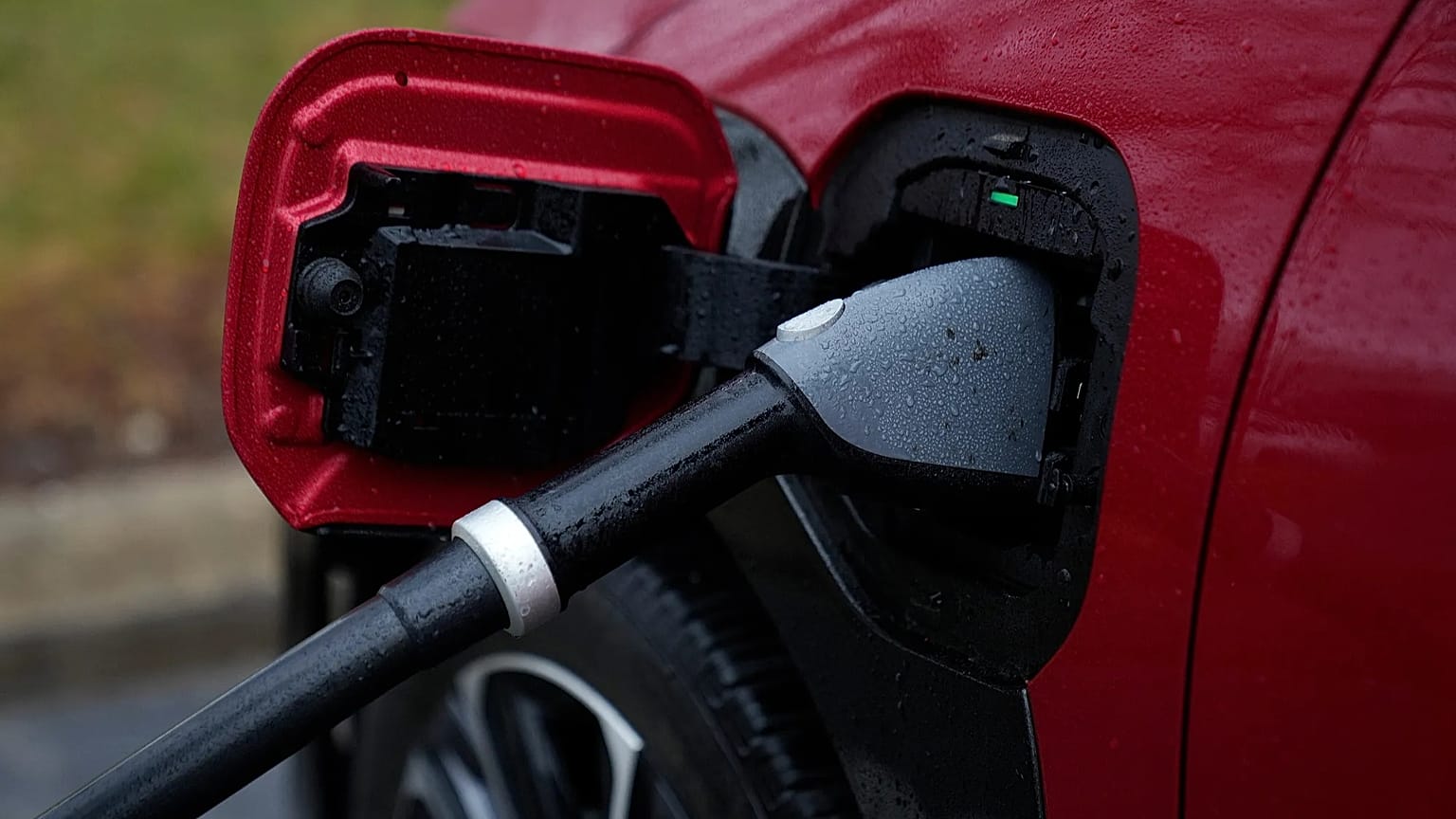
Not all families have a garage or access to a private charging point AP Photo


The risk that dealerships will absorb part of the subsidy

There are also questions about how public incentives may influence the sale price of electric vehicles.

António Alvarenga warns of the possibility that dealerships will adjust prices according to the amount made available by the state, absorbing part of the benefit that should reach consumers.

In that scenario, the subsidy may not translate into a real reduction in the financial effort required from families, instead benefiting sellers and manufacturers. This is therefore a risk that raises questions about how effective the measure is and about the monitoring mechanisms needed to ensure that public support really reaches its target groups.

Can electric cars made in China also benefit from the support?

Another issue raised by the Nova SBE professor concerns the origin of the vehicles that may benefit from Portuguese incentives.

Based on the criteria published by the government, only six electric cars are eligible for support for purchase by lower income families, and with the exception of the Citroën ë-C3 and the Renault Twingo they are all made in China.

The choice is even more limited when the 15,000 euro threshold is taken into account. Only three cars sold in Portugal fit within the price limit. Only the most affordable version of the Dacia Spring, priced at 13,740 euros, meets the threshold.

With the supplement associated with scrappage, which raises the threshold to 16,000 euros, the Leapmotor T03 at 15.284,5 euros and the Renault Twingo E-Tech at 15.845,3 euros may be added.

Of these three models, at least one is made in China, while the new Dacia Spring has recently started to be produced in Novo Mesto in Slovenia, on the same line as the Renault Twingo E-Tech. The first generation was made in China.


Most of the models eligible for the support scheme are made in China AP Photo

António Alvarenga accepts that public support may end up indirectly financing the purchase of cars made in China. This raises questions about the consistency between the environmental objectives of the measure and the European industrial policy, especially in a context of growing competition between European and Chinese manufacturers.

In this context the professor points to the example of France, which has adopted a different model for granting incentives to buy electric cars.

Since January 2024, the awarding of incentives for buying electric cars in France has excluded models made in China, even if they are from non-Chinese brands, because of environmental criteria and the carbon footprint associated with the manufacturing process and the energy used to make the vehicles.

The change came after the French authorities identified that around one third of the public incentives awarded were benefiting consumers who bought vehicles made in China.

The French programme represented an annual cost of around one billion euros and offered incentives of between 5,000 and 7,000 euros for buyers of electric cars. According to the French Finance Ministry, channelling a significant share of this support to cars made in China helped to increase imports and intensify competitive pressure on domestic manufacturers.

This text was translated with the help of artificial intelligence and originally published in Portuguese


 

Renault to create 2,000 jobs in France while cutting 1,000 others by 2028

The Renault logo is pictured at the Paris Motor Show in Paris, Monday Oct.12, 2026.
Copyright AP Photo

By Angela Barnes
Published on
French car maker Renault announced on Monday plans to create 2,000 jobs by 2028, mostly production roles, while cutting 1,000 mainly administrative staff as it seeks to hold off tough Chinese competition.

French carmaker Renault announced on Monday plans to create 2,000 jobs by 2028, mostly in production, while cutting 1,000, mainly administrative, posts as it seeks to fend off tough competition from China.

The carmaker presented unions with its France Industrie FutuREady project, which aims to transform its industrial activities to respond to the growing challenge posed by Chinese carmakers to European vehicle manufacturers.

The reorganisation will involve the creation of 2,000 new jobs over two years, mainly "blue-collar" positions, Thierry Charvet, head of quality, manufacturing and supply chain, said during a call with journalists.

Renault has around 15,000 industrial jobs in France

The plan will see 1,650 operators and production workers hired at its plants, along with 250 employees in indirect functions and 100 young graduates.

Renault also announced 1,000 voluntary departures among "white-collar" staff in indirect and administrative functions, under a scheme that still has to be negotiated with the unions.

The CFDT trade union criticised the pace of the planned changes as a "forced march schedule".

Certain jobs deemed strategic will be protected, including those in battery engineering, electronics and software, electric powertrains and industrial maintenance.

The company announced in September that it would invest €600 million ($660m) in Spain by 2030 to produce five new models.

Europe's car industry faces weak demand, excess production capacity and intensifying competition from Chinese manufacturers.


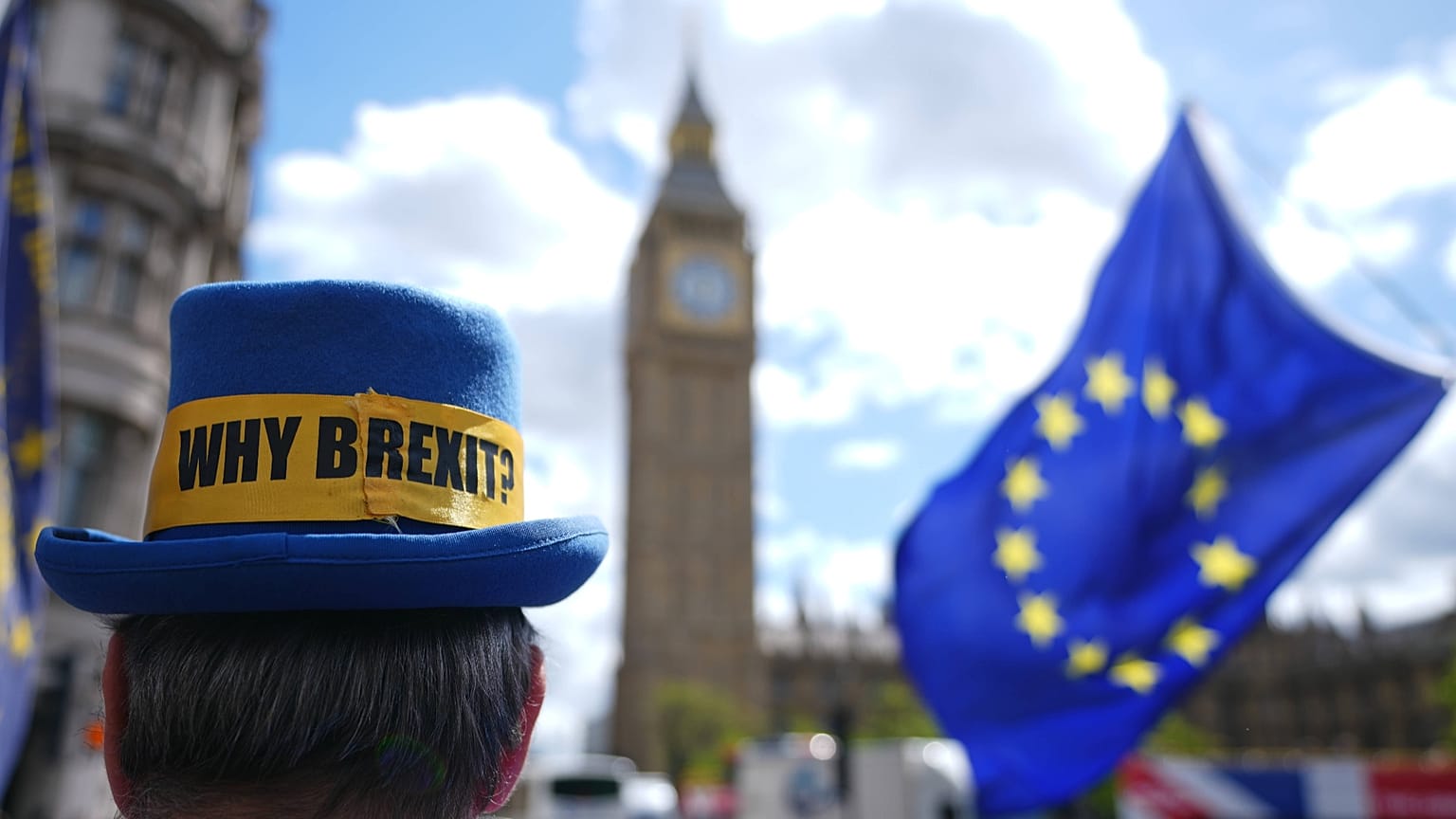
UK leader Andy Burnham says Brexit hasn't worked ahead of reset summit with EU

A pro-EU campaigner stands near parliament in London, 20 May, 2026
Copyright AP Photo


By Gavin Blackburn
Published on

Burnham argued that the promise of the pro-Brexit campaign that Britain would "take back control" of its borders, laws and economy had not been delivered.

British Prime Minister Andy Burnham said on Monday that it’s time to admit that Brexit has not delivered for the UK and that the country needs a much closer relationship with the European Union to combat growing isolationism around the world.

He compared the outcome of Britain's divorce from the EU, triggered by a 2016 referendum, to the Hans Christian Andersen fairy tale “The Emperor’s New Clothes,” in which no one is willing to tell the ruler that he is, in fact, naked.

“Well, I do try to say things as I see them," Burnham said in a speech on foreign policy at the Lord Mayor’s Banquet in London’s financial district.

“The Brexit we were given has not worked. We have lost more than we gained."

Seeking to draw a line under a decade of political turmoil that has made him Britain's seventh prime minister since 2016, Burnham said the UK was back on the world stage.

He argued the country is well positioned to lead in an era of renewed international cooperation because of its experience since 2016.

"Brexit was the first domino to fall in a global move toward more isolationism and protectionism," he said. “It was exactly what our enemies wanted. Russia wanted disunity within NATO and a weaker Europe."

Britain's Prime Minister Andy Burnham poses for a photograph upon arrival at the annual Lord Mayor's Banquet at Guildhall in London, 16 November, 2026 AP Photo

Burnham spoke ahead of a UK-EU summit in Brussels on Friday that is a key step in his pledge to reset relations with the 27-nation bloc, a decade after the vote to leave and six years after the departure in 2020.

It is expected to seal a trade deal for food and drink, agreements on energy and emissions trading and a plan to let young people work for limited periods across Britain and the EU.

Burnham argued that the promise of the pro-Brexit campaign that Britain would “take back control” of its borders, laws and economy had not been delivered.

Trade with EU countries is down sharply and estimates of the economic damage range from 4% to 8% of the UK's gross domestic product, he said.

Most economists agree that Brexit has hurt the British economy but UK politicians have been wary of reopening a painful debate.

Not Burnham. He said that soon after the summit, he will open a national conversation on Britain’s long-term relationship with the bloc.

European Union flags flap in the wind outside EU headquarters in Brussels, 4 November, 2026 AP Photo


His spokesperson Tom Wells said pm Monday that “no assumptions are being made” and “the British public will be the boss of any outcome.”

Until the next general election, Burnham remains bound by the pledge of his predecessor Keir Starmer, whom he replaced as centre-left Labour Party leader and prime minister, not to rejoin the bloc’s tariff-free customs union or frictionless single market for goods, services and workers.

Erasing that pledge would reignite a subject that split the country. The referendum vote was 52% in favour of leaving the EU and 48% in support of staying in.

Brexit-backing former Conservative Prime Minister Boris Johnson said if Burnham tried to take Britain back into the EU, “people will wake up to what is going on. They won’t want it and he won’t succeed.”

DR Congo Ebola outbreak still out of control six months on, Africa CDC warns

Africa's top public health agency has warned that the Ebola outbreak in DR Congo remains out of control six months after it was declared, citing deadly attacks on health workers, unpaid staff and a shortage of resources.


Issued on: 16/11/2026 - RFI

A port health official checks travellers' information at a health screening station at Murtala Muhammed International Airport following reports of an Ebola case in Nigeria, Lagos, Nigeria, on 22 October, 2026. © REUTERS - Sodiq Adelakun

Officially declared on 15 May, the Ebola epidemic affecting the eastern Democratic Republic of Congo (DRC) has continued to spread, reaching eight provinces across the country six months after it first emerged in Ituri.

"We are all in agreement today to say that this outbreak is still serious, and is still not under control," Jean Kaseya, director-general of the Africa Centres for Disease Control and Prevention (Africa CDC), said on Sunday.

In an interview with RFI, he described the outbreak as "extremely serious".

More than 11,200 infections and 5,500 deaths have been reported, according to government data.

More than 80 percent of new cases are being detected among people who were not on contact-tracing lists, while over 65 percent of deaths occur in communities rather than healthcare facilities, Kaseya said. Ebola is most contagious during the late stages of the disease.

"If we don't stop this outbreak now, it will be the worst Ebola outbreak that the world will have," he warned.

A health worker wears full gear at a Ebola treatment camp in Butembo, Congo, Wednesday, on 30 September, 2026. © AP Photo/Sebastien Kitsa Musayi

While research into treatments and vaccines is progressing, efforts to contain the outbreak on the ground continue to face major obstacles.

Driven by the rare Bundibugyo species of the virus, the epidemic is already the second-largest Ebola outbreak on record, after the 2014–2016 outbreak in West Africa, which infected more than 28,600 people and killed over 11,000.

Regional concerns

The outbreak has also spread beyond the DRC over the past six months, reaching Uganda, Kenya and Nigeria.

"Uganda has managed to bring the epidemic under control," Kaseya explained. "We had declared its end there – even though two cases, one from Kenya and one from Nigeria, had passed through Uganda."

The situation in Kenya has also improved. Last week, the country announced that the final patient had been discharged from facilities used to monitor people who had come into contact with infected individuals.

"We have also seen very good results in Nigeria," Kaseya added. "Not all the identified cases tested positive; at present, the situation appears to be under control."

However, the Africa CDC chief remains concerned about the continuing spread of the epidemic within the DRC and the risk of further cross-border transmission.

"First, there is the Central African Republic, which is a major source of concern for me. Second, there is South Sudan, which also remains a major source of concern."

He also highlighted the potential risk to Rwanda and Burundi if the outbreak spreads from the Beni-Butembo area towards Goma and Bukavu.

"And, of course, there are all the other countries that could be affected indirectly," he added.

Kaseya told RFI that the lack of an effective vaccine against the Bundibugyo strain remains one of the biggest challenges.

A vaccine "should have been available for the past 19 years, given that the Bundibugyo strain has been known for that long," he said.

He added that the absence of treatments and diagnostic tests specifically designed for the strain had contributed to the scale of the epidemic.

Research into treatments and vaccines is progressing, however, with several clinical trials already underway, according to RFI's correspondent in Kinshasa, Paulina Zidi.

The "Tumaini" clinical trial – named after the Swahili word for "hope" – is focusing on vaccine development.

A group of experts from the World Health Organization (WHO) has recommended adding two new vaccine candidates specifically developed to target the Bundibugyo virus.

Meanwhile, the Ebo-Pep trial is examining whether the oral antiviral drug obeldesivir can prevent the disease from developing in people exposed to the virus.

The trial is being conducted at several locations, including treatment centres in Ituri managed by the medical NGO Alima.

Challenges on the ground

Insecurity in eastern DRC, large-scale population movements and weaknesses in healthcare and disease surveillance have all contributed to the scale of the outbreak.

Around $2.9 billion has been pledged internationally to help fight the epidemic.

However, despite these commitments, much-needed assistance is still failing to reach some of the worst-affected areas, medical charity Médecins Sans Frontières warned last week.

The organisation highlighted shortages of trained staff, ambulances without fuel and a lack of surveillance teams.

Kaseya acknowledged that coordination between the Congolese government and international donors remains a problem.

"We are not pointing fingers," he said. "We are saying it's a collective failure."

He called on donors to release around $1.6 billion in pledged aid and work more closely with Kinshasa to ensure funds are used effectively and resources are not wasted through duplication.

Kaseya also acknowledged that some healthcare workers had not been paid for months, adding that the Congolese government was working to digitise its payroll system to address the problem.

(with newswires)

Ebola: IOM Urges Wider Surveillance Beyond Formal Routes In DR Congo


A health worker at an Ebola treatment centre in eastern DR Congo is disinfected after treating patients.
Photo Credit: UNOCHA/Priscilla Lecomte


By UN News

Key Takeaways:

IOM has detected 71 confirmed Ebola cases along transit routes in the DRC since the outbreak began, 95 percent of them on informal routes that bypass official checkpoints.

Teams have conducted 55 million screenings across the DRC and 11 neighboring countries and intercepted 258 bodies, while supporting surveillance at 57 displacement sites.

The agency faces a nearly $60 million funding gap for its $110 million regional response through March 2027 as transmission continues among mobile populations.


Seventy-one confirmed Ebola cases have been detected along transit routes in the Democratic Republic of the Congo (DRC) since the outbreak began almost six months ago, the International Organization for Migration (IOM) said on Tuesday.

The cases were picked up at points of entry and control, 95 per cent of them on informal routes that bypass official checkpoints, Dr. Andrew Mbala, IOM’s Regional Ebola Coordinator, told journalists in Geneva, speaking from Nairobi.

With transmission continuing, people on the move and funding running short, the agency says surveillance has to reach well beyond formal border crossings if the outbreak is to be contained.

“Often when people think about response and especially in this context of Ebola, many people tend to think about the hospitals, the treatment centres, the isolation wards and all that,” he said. “We need to think about the mobility of the population.”
Mapping population movements

According to the World Health Organization (WHO), more than 10,400 confirmed cases and 5,103 deaths had been reported in the DRC as of 31 October.

IOM maps the places where people gather, such as markets, bus stations and places of worship. It also maps what it calls “the mobility corridor”, meaning where people are travelling to and from, including areas hit by the outbreak.

Those findings show responders where to send staff and resources.

Since the outbreak began, teams have carried out 55 million screenings in the DRC and 11 neighbouring countries.

Focus on informal routes

Dr. Mbala said most people transporting the bodies of Ebola victims also use informal routes. So far, 258 bodies have been intercepted.

“It is quite important that we look into the points of control and to be able to expand our scope in terms of response to make sure that we cover all the informal routes, not only concentrating on the formal ones,” he said.

IOM also supports surveillance at 57 displacement sites in the DRC, 50 of them in health zones affected by the outbreak. It is helping affected and at-risk countries improve early detection and screening.

The agency needs $110 million for its regional operations through March 2027 but is nearly $60 million short.

Civilians evacuated in Ituri


Elsewhere in the DRC, peacekeepers with the UN mission, MONUSCO, evacuated three civilians, two women and a man, who were wounded in a shooting along the Plaine Savo–Gali road in Ituri Province on Sunday.

They were taken from Bethlehem to Fataki Hospital with a Médecins Sans Frontières (MSF) nurse travelling with them, and all three arrived safely for further treatment.

The mission said the evacuation was part of its work to protect civilians and help people get urgent medical care in areas hit by insecurity.
WHO warns progress on antimicrobial resistance falls short of 2030 targets

Most countries now have national plans to tackle antimicrobial resistance, but few have put the funding in place to implement them, the World Health Organization warned on Monday. The UN health agency said the world was falling behind on efforts to contain drug-resistant infections, which threaten millions of lives and could undermine decades of medical advances.


Issued on: 17/11/2026 - RFI

Antibiotics such as Amoxicillin are misused in some countries, as many patients cannot afford a doctor's visit or the medication, say experts.
 © Getty Image - Tek image /Scienc ephoto library

The warning comes in an annual survey conducted by the World Health Organization (WHO), alongside the United Nations Environment Programme (UNEP), the World Organisation for Animal Health and the Food and Agriculture Organisation (FAO).

Of the 183 countries surveyed, 173 reported having a national action plan to tackle antimicrobial resistance (AMR), up from just 79 in 2017. However, only 42 said their plans were both funded and implemented.

The findings highlight a growing gap between government commitments and concrete action, as resistance to antibiotics and other medicines threatens the future of modern medicine.

Antimicrobial resistance occurs when bacteria and other microorganisms evolve and no longer respond to medicines designed to treat them – a process accelerated by the misuse and overuse of antibiotics and other drugs.

At the UN General Assembly in 2024, countries agreed on a series of targets for 2030 aimed at tackling the problem, which experts warn could undermine decades of medical advances.

"Procedures we now take for granted become far riskier when antibiotics and antimicrobials no longer work," said Jean Pierre Nyemazi, acting director of the WHO's AMR department.

Nyemazi warned that the development of new antibiotics was failing to keep pace with the spread of resistance.

According to the WHO, one in six laboratory-confirmed bacterial infections is resistant to antibiotics, while drug-resistant infections could contribute to more than 39 million deaths worldwide over the next 25 years if current trends persist.

Prevention falls short

The 2026 survey highlighted a critical gap in infection prevention – one of the most effective ways to reduce the need for antibiotics.

The WHO said 128 countries now have national infection prevention and control programmes and guidelines, up from 90 in 2018.

However, only 69 countries, or 38 percent, have implemented these programmes nationwide – well short of the 2030 target of 90 percent.

While 131 countries reported having a national reference laboratory capable of testing antibiotic resistance in common bacteria, only 66 were able to test for both bacterial and fungal resistance.

Countries agreed in 2024 to work towards ensuring that 80 percent have such capabilities by 2030.

To help close the gap, the WHO has released two toolkits designed to strengthen diagnostic capacity – one outlining essential tests and another detailing laboratory procedures.

Surveillance improves, but gaps remain

Surveillance systems have expanded significantly, with 113 countries now monitoring antibiotic use and 109 tracking resistance, compared with 65 and 39 countries respectively in 2017.

However, only 21 countries reported integrating both sets of data.

The WHO says combining information on antibiotic use and resistance is essential to understanding how the use of these medicines drives resistance – and to helping governments develop more effective strategies to contain its spread.
French football boss Diallo anointed to fight Infantino for FIFA presidency

Top executives at the French Football Federation (FFF) are on Tuesday expected to give their formal backing for their president Philippe Diallo to enter the contest to become head of the world game's governing body FIFA.


Issued on: 17/11/2026 - RFI

French Football Federation chief Philippe Diallo is expected to run against Gianni Infantino for the job as president of world football's governing body FIFA. 
REUTERS - Gonzalo Fuentes

By: Paul Myers

Diallo agreed to run against Fifa boss Gianni Infantino in elections on 18 March 2027 after a meeting of the 21-member executive committee at Uefa which organises the sport in Europe.

"Against the backdrop of serious concerns over the direction of Fifa, the national associations called for renewed unity and trust within the global football community," Uefa said in a statement on Monday.

"They also called for a Fifa that places the development of the game in every region of the world at the heart of its mission, upholds the highest standards of governance and works in close partnership with its member associations, confederations and football stakeholder


'Full confidence in Diallo'

"They expressed their full confidence in Philippe Diallo to provide the leadership needed to achieve this ambition."

In September, the FFF withdrew its support for Infantino's bid for a fourth term.

It hit out at his plans to bring private investors into FIFA's commercial operations and the way he was running the 122-year-old organisation.

The 56-year-old had come under fire during the 2026 World Cup after US President Donald Trump intervened in the lifting of a one-match ban for US striker Folarin Balogun, who had been given a red card.

He faced further criticism soon after the World Cup final when media reports revealed a plan to spin off FIFA's commercial businesses – including the men's and women's World Cups and Club World Cups – into a €17 billion subsidiary, with 20 percent owned by private investors including the Kushner family, which has links to Trump.

'Media distortions'

Infantino initially criticised what he described as media distortions of the proposals before withdrawing them.

UEFA led opposition to the plan. It said its members – including 2026 World Cup winners Spain and semi-finalists France and England – would boycott all FIFA competitions, including the men's and women's World Cups, if the proposals were not abandoned.

Infantino has since gathered support for his presidential bid from allies in Africa and South America.

In October, former Switzerland international Ramon Vega became the first person to publicly declare his intention to challenge Infantino.

Japan Football Association Honorary President Kozo Tashima this month announced his intention to run for Fifa's top position. No other candidates are expected before Wednesday night's deadline to register for the race.

Compromise candidate

Nathalie Iannetta, director of sports at Radio France, told French broadcaster Franceinfo: "Diallo is very familiar with both national and international football governing bodies.

"Everyone praises his ability to build consensus and his diplomatic temperament. He will need plenty of both over the next four and a half months to run what is undoubtedly going to be a difficult campaign."

Each of FIFA's 211 member associations has one vote, whatever its size or commercial clout.

The winner needs 106 votes to claim a four-year term. If successful, Infantino, who was first elected on 26 February 2016, would reign until 2031.

He would become the fourth longest-serving Fifa boss behind Sepp Blatter, João Havelange and the Frenchman Jules Rimet who was a founding member of Fifa in 1904 and served as president between 1921 and 1954.

"Let's be clear," added Iannetta. "This is a different battle for Diallo. We are talking about the world of football, which has been in turmoil for several months because of this opposition movement against Infantino.

"This is probably one of the most difficult campaigns to run, with plenty of potential dirty tricks along the way. Infantino is going to fight tooth and nail to hold on to his position."
Russian Federal Subjects Putting Homeless Dogs To Sleep (EUTHANIZED)
Form Deadly New ‘Archipelago’ – OpEd


Key Takeaways:

Since a 2023 federal law allowed regions to kill stray dogs, about 16,000 have been put down in 34 Russian federal subjects, nearly half of them in Astrakhan Oblast.

Most regions still prefer adoption or pounds, but ten have made lethal control their main method, replacing the earlier catch-sterilize-vaccinate-release approach.

Reported dog bites have barely declined in the regions that killed large numbers, prompting animal-rights groups to challenge the laws as ineffective as well as inhumane.

Since the end of 2023 when the governments of Russia’s federal subjects were authorized to kill homeless animals, a relatively small number of these regions and republics have put to death almost 16,000 dogs, thus forming what Takiye Dela journalist Aleksey Semyonov describes as a deadly new “dog archipelago” in Russia.

Almost half of these deaths have taken place in Astrakhan Oblast, another 3300 dogs were put to sleep in Stavropol Kray, 1500 in the Tyva Republic, and 667 in Penza Oblast, he writes, with significantly fewer in other regions and republics (takiedela.ru/notes/arkhipelag-sobak/).

Semyonov says he examined data from the 34 federal subjects where regional governments have adopted laws allowing the authorities to capture and then put down homeless dogs. He notes that officials have been chary about releasing such data and acknowledges that these figures are almost certainly far from complete.


Prior to the issuance in 2023 of the federal law allowing the killing of stray dogs, regional officials were required to catch, then sterilize, vaccinate and release the dogs, an arrangement that did little to reduce the number of strays or the number of complaints of dog attacks by Russian residents.

Even since then, about two-thirds of the federal subjects which have adopted laws allowing the killing of homeless dogs typically tried to find other means of getting the dogs off the streets, including adoption and dispatch to pounds and zoos. But in ten cases, the journalist says, the authorities have chosen execution as the primary means of control.

According to Semyonov, the killing of dogs has done little to reduce the number of bites reported. Indeed, in nine regions where dogs were killed in significant numbers in 2025, only two showed declines and small ones at that regarding the number of bites that residents had suffered from homeless dogs.

Animal rights activists are seeking to overturn these inhumane laws and hope that as people see that killing dogs doesn’t give them the results they want, they will be willing to support other measures to deal with what has long been a problem in Russia (windowoneurasia2.blogspot.com/2023/05/if-duma-enacts-putin-regime-backed.html and windowoneurasia2.blogspot.com/2026/09/more-than-half-of-russian-households.html).


About Paul Goble
Paul Goble is a longtime specialist on ethnic and religious questions in Eurasia. Most recently, he was director of research and publications at the Azerbaijan Diplomatic Academy. Earlier, he served as vice dean for the social sciences and humanities at Audentes University in Tallinn and a senior research associate at the EuroCollege of the University of Tartu in Estonia. He has served in various capacities in the U.S. State Department, the Central Intelligence Agency and the International Broadcasting Bureau as well as at the Voice of America and Radio Free Europe/Radio Liberty and at the Carnegie Endowment for International Peace. Mr. Goble maintains the Window on Eurasia blog and can be contacted directly at paul.goble@gmail.com .
View all posts by Paul Goble →
France's covert military operation in Ukraine revealed by RFI investigation

French military personnel have been operating inside Ukraine for several months under a confidential mission known as "Volia", providing training and technical support to Kyiv's armed forces, according to information gathered and corroborated by RFI.

Issued on: 16/11/2026 - RFI

French specialists in the maintenance of state-of-the-art equipment are being deployed to Ukraine (illustrative photo). AFP - MARTIN BUREAU

Paris has never officially acknowledged the presence of French troops on Ukrainian soil, but several sources familiar with the operation say the mission has been active since at least the summer of 2026.

The deployment is not a combat operation. Instead, French personnel are helping maintain sophisticated military equipment supplied to Ukraine and providing specialist training to its armed forces.

The operation, headed by a French general, takes its name from the Ukrainian word volia, which evokes freedom, resistance and the struggle for independence.

According to RFI's sources, the mission has been deliberately kept out of the public eye, with France relying on an existing military training operation in neighbouring Poland to facilitate the deployment

That operation, known as Gerfaut, has been stationed in Poland since February 2023, notably at the Wedrzyn military camp in the northwest of the country.

It forms part of the European Union Military Assistance Mission in support of Ukraine (EUMAM Ukraine), which was extended on 9 November for another two years, until November 2028.

The Gerfaut mission is based in Wedrzyn, in north-western Poland. French military personnel travelling to Ukraine pass through this country. © Studio graphique FMM

The EU also announced plans to establish a presence in Ukraine to coordinate more closely with the country's military authorities.

Since 2023, around 25,000 Ukrainian soldiers have received training in France and Poland, including non-commissioned officers preparing to lead combat units.

But bringing that expertise closer to the battlefield offers significant advantages.

"Good training takes place under the most realistic conditions possible," one expert told RFI. "The closer this training takes place to the combat zone, the more effective it is."

The same principle applies to logistical and technical support.

Small teams, specialised missions

According to sources contacted by RFI, Volia operates through a relatively small and flexible structure, deploying specialist teams for short periods inside Ukraine.

The Gerfaut mission in Poland provides the logistical framework through which French soldiers can enter the country without publicly disclosing their destination.

RFI was told that French personnel assigned to Ukraine are instructed to say they are travelling to Poland.

Once inside Ukraine, their main responsibilities involve training local forces and maintaining military equipment supplied by France.

These systems include Caesar self-propelled howitzers, Mirage 2000 fighter jets and precision-guided missiles, all of which require specialist technical expertise to remain operational.

French military planners considered using civilian technicians but ultimately ruled out that option because of the risks involved in operating in a country at war.

Instead, personnel have been drawn from regular French military units, including regiments specialising in equipment maintenance and operational support.

Some of these soldiers possess highly specialised technical skills that are difficult to replace.

For security reasons, RFI has chosen not to identify the regiments involved or disclose operational details that could endanger French personnel and those working alongside them.

Beyond providing practical assistance to Ukraine, the mission also offers the French armed forces an opportunity to gather valuable lessons from a conflict in which modern weapons systems are being tested under intense battlefield conditions.


Ukrainian artillerymen were trained in France in May 2024. © Franck Alexandre / RFI

Questions over parliamentary oversight


The revelations raise questions about the legal framework governing France's military involvement in Ukraine, particularly the government's obligations to inform Parliament.

Under Article 35 of the French Constitution, the government must notify Parliament of a decision to deploy armed forces abroad within three days of an intervention beginning, specifying its objectives.

If an operation continues beyond four months, its extension must be submitted to Parliament for authorisation.

However, according to RFI's investigation, neither MPs nor senators have been officially informed about the existence of Volia.

Senator Cédric Perrin, a member of the conservative Les Républicains party and chairman of the Senate's Foreign Affairs, Defence and Armed Forces Committee, argues that a conventional military deployment cannot be exempted from parliamentary scrutiny simply by invoking defence secrecy.

"It is a constitutional obligation," he told RFI. "The President of the Republic, once troops are deployed, must inform Parliament within a specified timeframe. The proper functioning of democracy depends on it."

France would not be the first Western country to deploy military trainers inside Ukraine.

Britain operated its Orbital training mission between 2015 and 2022, while Canada launched Operation Unifier in September 2015. Canadian personnel were subsequently redeployed outside Ukraine following Russia's full-scale invasion in February 2022.

However, France faces a more politically sensitive environment, with support for Ukraine remaining a divisive issue ahead of the 2027 presidential election.

"When it comes to Ukraine, we're walking on eggshells," Perrin acknowledged.

"Society is divided; we must be cautious, but we'll have to discuss it during the presidential election. I still believe that, today, the Ukrainians are fighting for us."

President Emmanuel Macron reiterated France's commitment to Kyiv on Saturday, saying the consequences of the war extended far beyond Ukraine's borders.

"What is at stake in Ukraine concerns us directly. It is the security of us all that is at stake," he wrote on X.


"Helping Ukraine to defend itself means protecting France and the French people."

Members of Macron's entourage, accompanying him to the Francophonie Summit in Cambodia, also emphasised the importance of maintaining a European presence in Ukraine.

"We will be on the ground in Ukraine. Peace in that country is essential for the security of Europeans," they said.

This has been adapted from an original article in French by RFI's Franck Alexandre and lightly edited for clarity

Ukraine brings down part of Russia's strategic Crimea bridge

17.11.2026, 

Photo: Ulf Mauder/dpa

By Friedemann Kohler, dpa

President Volodymyr Zelensky said that a Ukrainian airstrike brought down part of Russia's strategic Crimea bridge, a key supply route for Russian forces in southern Ukraine.

Zelensky published footage on social media on Tuesday morning showing that the main arch of the road bridge and part of its roadway had collapsed.

The debris lay in shallow water and appeared likely to also block shipping between the Black Sea and the Sea of Azov.

"Today, everyone can see the consequences for the main military crossing from Russian territory into our Ukrainian Crimea," Zelensky wrote.

Road traffic across the bridge was suspended, Russian authorities said. Rail services on the parallel railway bridge resumed after a brief halt.

Russian Deputy Prime Minister Marat Khusnullin briefed President Vladimir Putin on the situation, Kremlin spokesman Dmitry Peskov said, according to state news agency TASS.

Peskov pledged that the bridge would be rebuilt "better than before." Russia's Investigative Committee opened a terrorism investigation into the damage.

Ukraine had already caused damage to the Crimean Bridge, also known as the Kerch Bridge, in an attack overnight into Monday, bringing traffic to a halt for several hours.

Large-scale Ukrainian air attack

Ukrainian arms manufacturer Fire Point shared a photograph of the collapsed bridge on X. Unofficial Ukrainian accounts said the bridge was hit by one of the company's FP-5 Flamingo cruise missiles.

The strike was part of a large-scale Ukrainian air attack overnight. Russia's Defence Ministry said it had intercepted 1,441 Ukrainian attack drones.

The figure could not be independently verified in detail, but suggested an unusually large Ukrainian attack.

Putin's prestige project

The 19-kilometre bridge linking mainland Russia with the Crimean Peninsula, which Moscow illegally annexed from Ukraine in 2014, was a prestige project for Putin. Russia completed the road bridge in 2018.

The crossing is also used to move Russian troops and supplies to forces in southern Ukraine.

Ukraine regards the bridge as an illegal structure built on its territory and has repeatedly sought to destroy it to disrupt Russian supplies.

An explosion in October 2022 brought down sections of the roadway and set a freight train ablaze. Russian authorities said a truck had exploded, and Putin accused Ukraine of a terrorist attack. Traffic was restricted for months.

The bridge was damaged again in July 2023.

Russian strikes damage Kiev bridges

Russia, meanwhile, attacked Kiev and other Ukrainian cities overnight with ballistic missiles and drones.

Kiev Mayor Vitali Klitschko said the capital's Northern and Southern bridges had been damaged. In a video filmed on the Northern Bridge on Tuesday morning, he said repairs would be carried out.

Both crossings were initially closed to traffic. Footage showed residents walking across them in pouring rain from the eastern to the western bank of the Dnipro River.

Russia has repeatedly attacked Kiev's bridges since late September, causing severe traffic disruption in the capital, which is divided by the river.

Missile War Monitor: 


Zelenskiy says Ukraine's drones have knocked out 55% of Russia's refining capacity


By Ben Aris in Berlin November 16, 2026


Ukrainian drones have put more than 55% of Russia's oil refining capacity out of action, President Volodymyr Zelenskiy said in his evening address on November 15.

Zelenskiy said he had received a report from Commander-in-Chief Mykhailo Drapatyi on what Kyiv calls its "long-range sanctions". "We are now achieving results practically every day, and as of today, we have disabled more than 55% of Russia's oil refining capacity," he said, according to Ukrainska Pravda. "This is our justified response to Russia's refusal to de-escalate and its strikes on our energy infrastructure."

The figure is the highest Kyiv has claimed, up from the 51% the defence ministry gave on October 4 and 45% in September, and it lands as Russia's third fuel crisis of the year takes hold. The first wave of shortages started in May and was already hitting the real economy by July before easing as damaged plants restarted. A second round arrived with the harvest in August, and regions reimposed rationing in September. This time the drones are reaching deeper into Siberia and returning to plants as soon as they are repaired, and Rosneft reimposed fuel rationing in several regions on November 9.

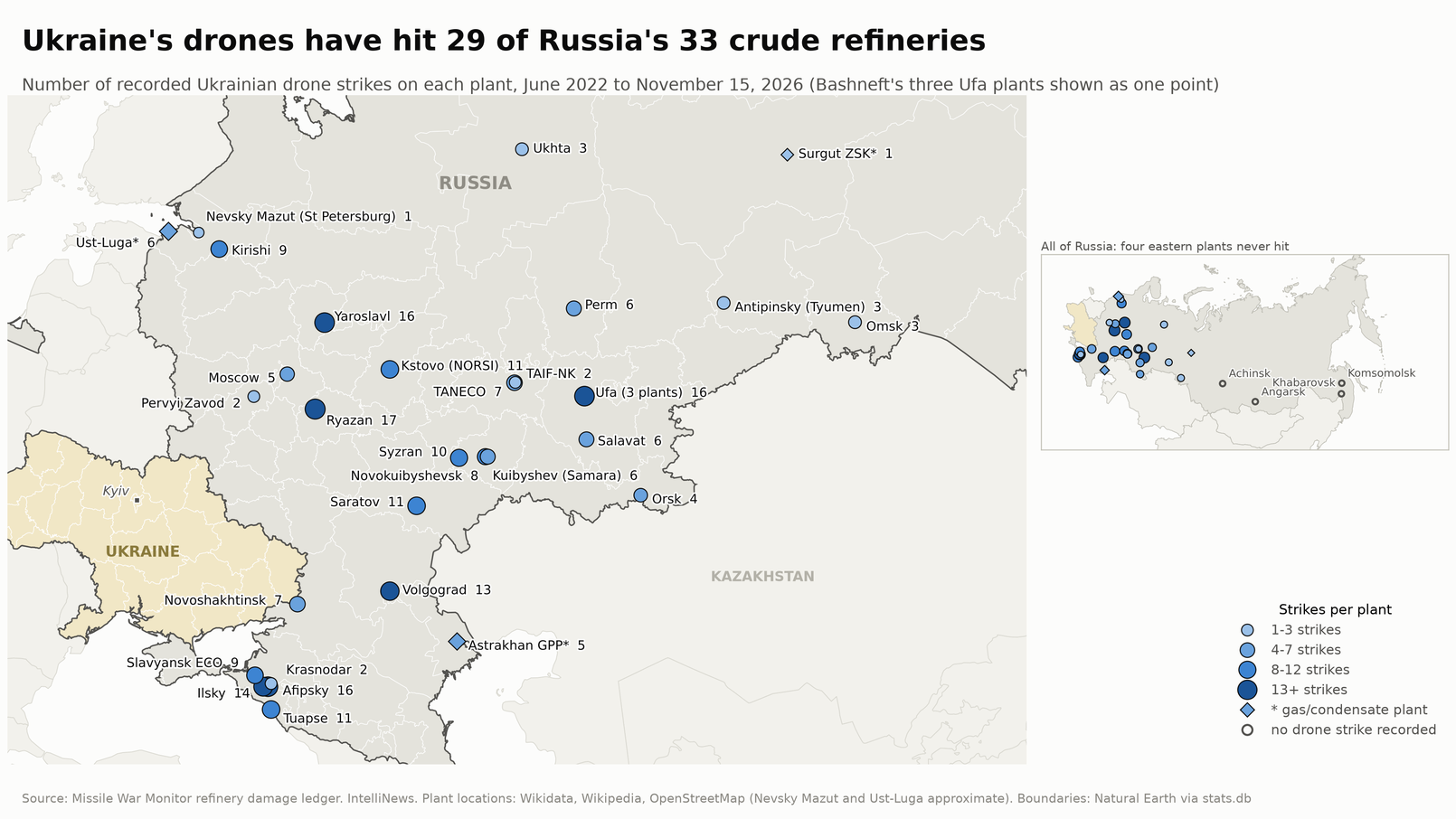
Almost every Russian refinery of any size has now been hit. The Missile War Monitor's refinery damage ledger tracks 33 crude oil refineries, counting Bashneft's three Ufa plants separately, and records drone strikes on 29 of them since June 2022, 218 strikes in all. The four that have never been hit are the plants furthest from Ukraine, in Siberia and the Far East: Achinsk, Angarsk, Komsomolsk and Khabarovsk. The plants that have been hit have nameplate capacity of about 277mn tonnes a year, or 85% of Russia's 327mn tonnes. Ryazan is the most-attacked, with 17 strikes, followed by Yaroslavl, Afipsky and the Ufa complex with 16 each.

Recorded Ukrainian drone strikes on each Russian oil refinery, June 2022 to November 15, 2026. Diamonds mark gas and condensate plants; hollow circles mark refineries with no strike recorded. Source: Missile War Monitor refinery damage ledger. IntelliNews

Counts of the total vary with what is included. Ukraine's military intelligence agency HUR said in early November that strikes had put 15 of Russia's 38 major refineries out of action by the end of September. The ledger also logs strikes on three gas and condensate processing plants, at Ust-Luga, Astrakhan and Surgut, which it keeps out of the refining totals.

Kyiv's 55% is far above any independent tally. The 12 refineries last reported fully halted in the ledger have combined capacity of 133mn tonnes a year, about 41% of the national total, and Lukoil's Kstovo plant was running at about a quarter of capacity in September. Moscow's own count is much lower: Deputy Prime Minister Alexander Novak said in early September that about 10% of refining capacity was under repair.

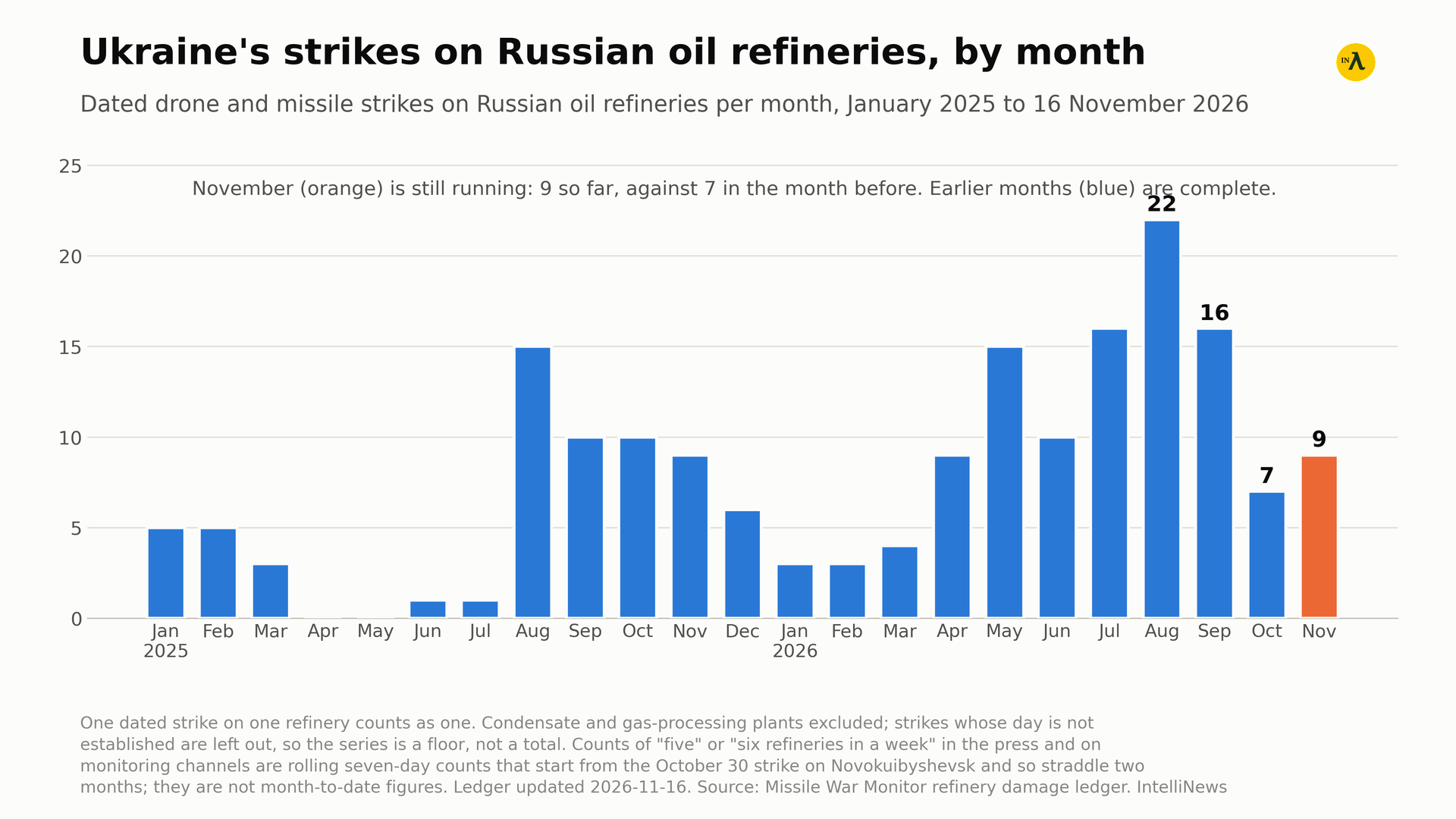
Ukraine has hit nine refineries since November 1, against seven strikes on refineries in the whole of October, according to the ledger. Strikes resumed on October 30 after a pause that followed US President Donald Trump's push for an energy truce, and the targets have included Russia's second-largest refinery at Kirishi on November 9 and its largest, Gazprom Neft's plant at Omsk, on November 11, where residents reported a fire near the refinery. Volgograd governor Andrei Bocharov said falling debris killed four workers at an enterprise in the city's southern industrial zone on November 13, without naming Lukoil's refinery there. Ukraine's General Staff said its drones hit the only primary distillation unit at the TAIF-NK refinery in Nizhnekamsk on November 15, a claim not confirmed by the company.

The campaign has also reached Russia's export ports as the drone war shifts to crippling ports. A satellite image taken on November 15 shows at least five petroleum storage tanks completely burned out at Ust-Luga, Russia's main Baltic export hub, after the drone attack overnight on November 11, Radio Liberty's Ukrainian service reported. Leningrad region governor Alexander Drozdenko said the strike set the port on fire and injured three workers.

Zelenskiy linked the strikes directly to Russia's attacks on Ukraine's power grid. Russian forces have stepped up strikes on energy facilities in the Zaporizhzhia and Dnipropetrovska oblasts since September, with 131 strikes on the Dnipropetrovska oblast alone, he said, and he called on partners to focus on missiles for Patriot and NASAMS air-defence systems. Ukraine will also work with its partners to increase drone production, he said.

Ukraine attacks the Crimean Bridge and sends about 600 drones at Moscow

Missile War Monitor: Ukraine attacks the Crimean Bridge and sends about 600 drones at Moscow
Ukraine attacked the Crimean Bridge and sent about 600 drones at the Moscow region overnight, Russian officials said, while fires broke out at four industrial facilities in Azov and Russia hit power in Zaporizhzhia, Cherkasy and Vinnytsia and killed one in a repeat strike on Dnipro. / bne IntelliNews
By Ben Aris in Berlin November 16, 2026

Ukraine attacked the Crimean Bridge and sent about 600 drones at the Moscow region overnight, Russian officials said on November 16. Road traffic over the bridge was restricted until about midday.

"The enemy has delivered an attack on the Crimean Bridge," Sergei Aksyonov, the Russian-installed head of occupied Crimea, said on November 16, adding that an operational headquarters had been set up in Kerch, TASS reported. He gave no damage, no casualties and no time for the attack. The 19 km bridge across the Kerch Strait is the only fixed link between Russia and the peninsula and carries both road and rail traffic.

SOURCING NOTE: the bridge attack rests on Aksyonov's statement alone at the time of writing. No Ukrainian body has claimed it, no weapon is named and no damage is described by either side. TASS's own lede says traffic is restricted through Monday afternoon while Aksyonov's quote says until about midday; the quote is used. A Ukrainian outlet's headline that trains were delayed was seen but not read and is not printed.

Moscow mayor Sergei Sobyanin said about 600 drones flew towards the Moscow region between 17:00 on November 15 and 08:00 on November 16, that most were destroyed at long range by defence ministry air defences and that 191 were brought down on approach to the capital, the city portal M24 reported. Vnukovo and Sheremetyevo airports accepted and dispatched flights only by arrangement for part of the night; M24 later reported Sheremetyevo back to normal operations. No damage or casualties in the capital were reported.

Russia's defence ministry said its air defences intercepted 1,336 fixed-wing Ukrainian drones overnight over the Moscow region, 14 other regions, Crimea and the Azov and Black Seas, and that an oil depot in Azov in the Rostov region had been attacked, with the damage being clarified. It published no breakdown by region.

ACCURACY NOTE: the 600 and the 1,336 are Russian official figures and are not independently verified. The 600 is Sobyanin's count of drones heading for the Moscow region; the 1,336 is the ministry's national overnight total, and the two are not comparable. Sobyanin's running total was published in instalments of 57, 82, 114, 139 and 191 through the night, which are cumulative counts, not conflicting ones. AFP rendered the ministry's figure as more than 1,300. The ministry's headline says shot down and its text says intercepted.

Azov: Rostov governor Yuri Slyusar said fires broke out at four industrial facilities in Azov after the overnight attack and that three men were taken to hospital, with the extent of the damage being clarified. In the Millerovo district, debris damaged three houses and a gas pipeline in the village of Rogalik and started a fire, with no casualties, he said. The Russian outlet Astra said the area hit holds the oil depot of Flash Energy, with 10 tanks and more than 6,500 cubic metres of storage, and a gas distribution station operated by Yug-Impeks.

SOURCING NOTE: no official has named the four Azov facilities; the Flash Energy depot and the Yug-Impeks station are Astra's open-source identification. UNN describes both as oil depots, which differs from Astra on Yug-Impeks. Social media accounts tracking strikes reported Ukrainian FP-5 Flamingo cruise missiles over the area; no source has confirmed it and it is not reported here as a fact. No Ukrainian General Staff statement on the night of November 15-16 had been published at the time of writing. Rostov's three sea ports were brought to a standstill by drone strikes earlier this month, as IntelliNews reported.

Russia sent 158 attack drones at Ukraine from 18:00 on November 15, 77 of them jet-powered Shaheds, with Gerbera drones and Parodiya decoys, Ukraine's air force said. It said 131 were shot down or suppressed, including 55 of the jet drones, that hits were recorded at 19 locations and debris fell at 11, on preliminary figures with drones still in the air. It reported no missiles.

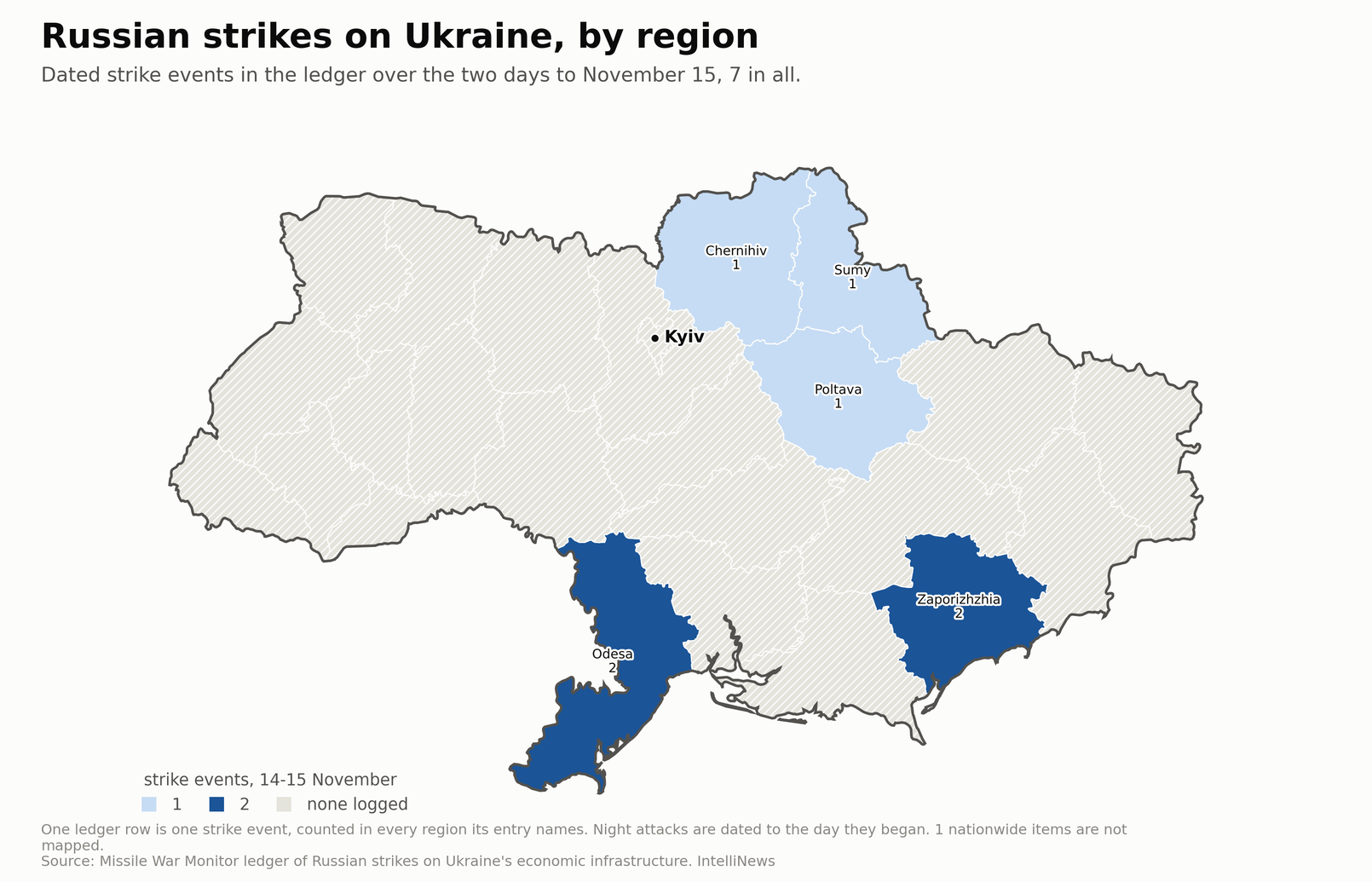
Russian strikes on Ukraine's economic infrastructure by region over the two days to the Missile War Monitor ledger's as-of date. One ledger row is one strike event, counted in every region its Region cell names, and night attacks are dated to the day they began. A region with no figure is hatched, not read as zero. Source: IntelliNews Missile War Monitor ledger.

Refinery strikes

Tatarstan: Ukraine's General Staff said its forces hit the TAIF-NK refinery in Nizhnekamsk on the night of November 14-15, damaging the plant's sole primary processing unit, ELOU-AVT-7, and starting a fire, with the extent of the damage being assessed. It said the neighbouring Nizhnekamskneftekhim petrochemical complex, part of Sibur, was hit in the same attack, with explosions and a fire. That makes Nizhnekamsk the ninth dated refinery strike of November in our ledger, against seven in the whole of October.

Nizhnekamsk mayor Radmir Belyaev said the city came under a prolonged attack that damaged industrial-zone facilities and a residential building, and put the injured at six, up from three, Interfax reported. He named no plant. Tatarstan's president's press service said a drone hit a flat on Mendeleev Street without its warhead detonating, and that falling debris set fire to an ethylbenzene tank car at Biklyan station at about 07:00, halting rail traffic until the fire was out.

SOURCING NOTE: the refinery and the unit are named by Ukraine's General Staff, carried by the Kyiv Independent and Censor.net; neither TAIF nor any Russian official has confirmed a hit on the refinery, and no halt has been reported. The refinery ledger also records an ELOU-AVT-7 at the neighbouring TANECO refinery, hit on September 13; which plant the General Staff means rests on its own wording, which names TAIF-NK. Ukrainska Pravda's English report calls it the Nizhnekamsk oil refinery without naming the operator. The injured count is unreconciled: three, then six on the mayor's figures, and a headline of seven that was not verified.

Nationwide: President Volodymyr Zelenskiy said on November 15 that Ukrainian strikes had halted more than 55% of Russia's oil refining capacity, citing a report from Major General Mykhailo Drapatyi. The figure is Kyiv's own and is not broken down by plant. Drones have hit plants making about 55% of Russia's petrol since strikes resumed on October 30, on International Energy Agency figures reported by IntelliNews, a different measure of a different product.

Our refinery ledger's running capacity figure has not moved. No halt or cut at a named plant has been re-confirmed in reporting dated November, so the figure for the month stands at nil against Russia's 327mn tonnes a year of nameplate capacity. Up to 145.8mn tonnes a year, or 45% of the total, is offline if the halts reported in September and October still hold. Russian officials put capacity under repair at about 10%, a figure given by Deputy Prime Minister Alexander Novak in early September.

FIGURE NOTE: Zelenskiy's 55%, the ledger's upper bound of 45% and Novak's 10% are three different claims on three different bases and are not reconciled here. Zelenskiy's is a Ukrainian military estimate with no published method; the ledger's counts plants reported halted or cut, mostly on unnamed industry sources cited by Reuters, and assumes September and October halts still hold; Novak's is two months old. The ledger's November figure of nil is a gap in confirmation, not a claim that nothing is down. A Reuters report of November 10, carried by UNN, put the cut from recent attacks at 30%.

Ukraine's strikes on Russian oil refineries, by month, from the Missile War Monitor refinery ledger, rebuilt on November 16. The series is a floor, not a total: condensate, gas-processing, pipeline and pumping facilities are excluded, and a strike whose month is known but whose day is not is left out. Completed months are blue and the month in hand is orange, because it is a running count. Source: IntelliNews Missile War Monitor refinery ledger.

Metal plants hit

No strike on a steel, iron ore, coke, ferroalloy, pipe or non-ferrous plant in Ukraine was reported in the two days to November 16. Vinnytsia's regional governor said a critical industrial facility was hit overnight without naming it, and an enterprise in Kamianske, home to the Dniprovsky iron and steel works, was hit, with no details given; neither is identified as a metals plant.

Oil depots, factories and military targets in Russia

Astrakhan region: Ukraine's General Staff said its forces struck the Akhtubinsk military airfield on the night of November 14-15, setting off a powerful secondary detonation at a store of kits for air-launched guided missiles, and hit a mobile PRV-13 radar altimeter. The airfield hosts the defence ministry's 929th State Flight Test Centre and a Su-34 unit, about 650 km from the front. Astrakhan governor Igor Babushkin said 31 drones were destroyed over the north of the region.

UPDATE NOTE: the previous edition carried the Akhtubinsk strike as a monitoring-channel claim only. It is now a Ukrainian General Staff claim. No Russian official has confirmed damage, and the count of at least 30 explosions comes from the monitoring channel Exilenova+ alone.

Oryol region: the General Staff said the same night's strikes hit the so-called Tsymbulova drone port near the village of Tsymbulova, a site it said Russia uses to store, prepare and launch attack drones. No Russian official has commented.

Bryansk region: the General Staff said it hit the Monolit plant in Trubchevsk, which it described as making aircraft including helicopters, spare parts and components, and doing metalworking. It gave no damage details and no Russian official has commented.

Leningrad region, update: a satellite image taken on November 15 and published by Radio Liberty's Ukrainian service shows at least five petroleum storage tanks completely burned out at the Baltic port of Ust-Luga after the Ukrainian drone attack of November 11, with traces of firefighting foam beside others, Ukrainska Pravda reported.

Nationwide: Russia's defence ministry said 230 Ukrainian drones were destroyed between 08:00 and 20:00 Moscow time on November 15 over Crimea, the Belgorod, Bryansk and Kursk regions and the Black Sea. Belgorod's emergency centre said three civilians were injured when drones attacked cars on the Graivoron road and in Shebekino, and Kursk governor Alexander Khinshtein said drones were dropping explosive devices on Rylsk, where two civilians were seriously wounded, TASS reported.

The weather report

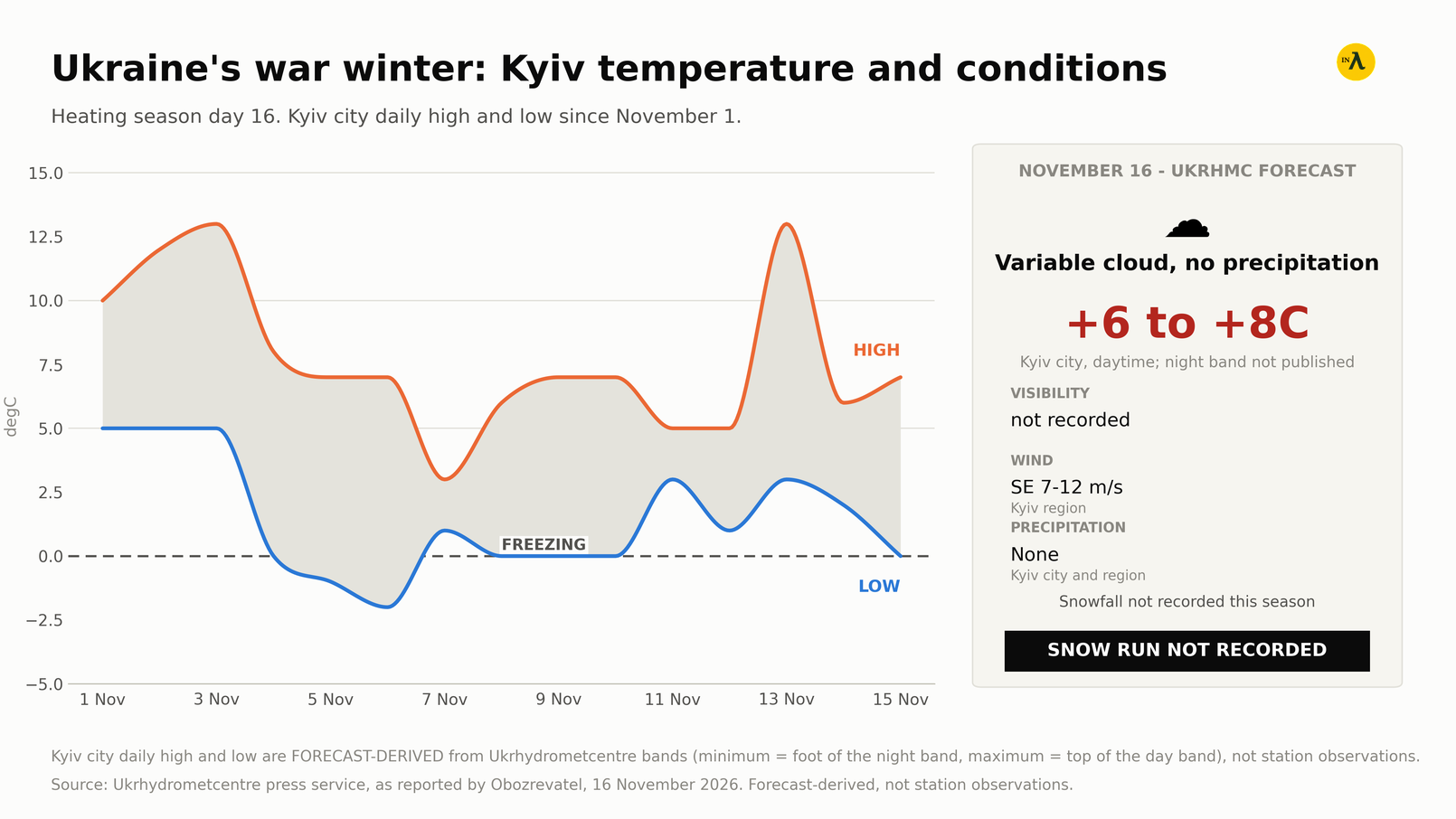
Day 16 of the heating season, counted from November 1. Ukraine's hydrometeorological centre forecast variable cloud and no precipitation in Kyiv and the region on November 16, with daytime highs of +6 to +8C in the city and +3 to +8C across the region and a south-easterly wind of 7 to 12 metres a second, Obozrevatel reported.

Kyiv: the centre's published forecast as carried gave no night band for the city, so no overnight minimum is recorded for November 16. The Kyiv outlet Kyiv24 put the night at about +1C in the city and 1 to 3C of frost in places across the region, without naming its source.

WEATHER NOTE: the overnight figure is left empty in the record rather than filled from an unattributed forecast, and the graphic shows the missing reading as a gap. Snow is not recorded: there is no snow ledger yet, and "not recorded" is not the same claim as zero. The hydrometeorological centre forecast on November 14 that rain reaches most of the country by November 18 with night temperatures back above zero from November 17 and no snow expected yet; that week-ahead forecast has not been re-checked against a later issue in this edition.

​Ukraine under fire

Dnipro: a repeat strike on the city on the morning of November 16 killed one person, said Oleksandr Hanzha, head of the Dnipropetrovsk regional military administration. A woman of 44 was injured in the first strike and taken to hospital in moderate condition, and three more people were injured in the second. Apartment blocks lost windows and balconies and cars burned on a road, Censor.net reported.

Dnipropetrovsk region: Russia launched nearly 20 drone attacks on six districts overnight, the regional administration and rescue service said. An enterprise in Kamianske was hit, transport infrastructure in Dnipro and a gas pipeline in the Nikopol district were damaged, and two people were injured in Pavlohrad, where a school, three apartment buildings and a car were damaged.

Odesa region: Russia launched what governor Oleh Kiper called a mass attack on the region on November 15. A DTEK energy facility was hit and about 41,000 families were temporarily without power, he said. In Chornomorsk six people were injured and energy infrastructure, an office building, a gas pipeline and residential facades were damaged, the interior ministry said, and in Odesa a car dealership and storage facilities including grain warehouses were destroyed, Kiper said. A second mass attack overnight on November 16 damaged unnamed infrastructure facilities, houses and a car and started fires, with no injuries on preliminary information, Kiper and the emergency service said.

UPDATE NOTE: the previous edition carried a Russian defence ministry claim of strikes on Chornomorsk port facilities on the night of November 14-15. The Ukrainian interior ministry's account of damage in Chornomorsk on November 15 describes energy infrastructure, an office building and a gas pipeline, not port facilities, and the two accounts are not reconciled.

Kharkiv: Russian drones hit a high-rise residential building in the Shevchenkivskyi district at about 18:00 on November 15, and a children's educational facility in a later attack using a Molniya drone, mayor Ihor Terekhov said; a jet-powered drone struck the Slobidskyi district at 22:17. Regional governor Oleh Syniehubov said nine people were injured in the region over the day.

Kyiv region: a warehouse at an enterprise in the Vyshhorod district caught fire and four houses were damaged in a morning attack on November 16, with no casualties, the regional military administration said. No strike on Kyiv city was reported.

Zaporizhzhia region: Russian forces carried out 910 strikes on 44 settlements in the day to the morning of November 16, including a missile strike on Zaporizhzhia city, killing one and injuring four, said Ivan Fedorov, co-chair of the regional defence council.

TOLL NOTE: Mykhailo Semikin, acting head of the regional administration, separately reported two deaths, a man of 59 in Bilenke and a woman in the Khortytskyi district. The two officials' periods may differ and the totals are not reconciled.

Kherson: Russian shelling, drones and aircraft hit 34 settlements in the day to the morning of November 15 without civilian casualties, said regional governor Oleksandr Prokudin.

Nationwide: Zelenskiy said Russia had launched more than 2,300 attack drones, 1,590 guided aerial bombs and 15 missiles of various types at Ukraine over the past week. At least four civilians were killed and 69 injured in the day to the morning of November 15, the Kyiv Independent reported from regional officials' figures.

Power and energy

Zaporizhzhia region: an attack at about 12:30 on November 15 damaged electrical equipment and cut power to 359,000 consumers in Zaporizhzhia city and the government-held part of the region, said Andrii Stasevskyi, head of Zaporizhzhiaoblenergo. Critical infrastructure was reconnected within four and a half hours and Semikin said power was restored across the region at 19:51. Hourly outage schedules apply on November 16.

Dnipropetrovsk region: Ukrenergo, the grid operator, imposed emergency outages in the Zaporizhzhia and Dnipropetrovsk regions on November 15 after another attack damaged electrical equipment, without giving the scale, and part of Dnipro and Kamianske lost power after a repeat strike on an energy facility, Ukrainska Pravda reported.

Cherkasy region: several energy facilities in the Zvenyhorodka district were attacked overnight on November 16 and some consumers lost power, said Ihor Taburets, head of the regional military administration, without giving a number. A drone hit the grounds of an enterprise that is not operating and started a fire, and there were no casualties.

Vinnytsia region: a critical industrial facility and energy facilities were hit overnight, with no casualties, said regional governor Natalia Zabolotna. Hourly outage schedules apply from 06:00 to midnight on November 16 on Ukrenergo's instruction, with power limits for business all day.

Zhytomyr region: drones hit energy infrastructure and damaged four houses in the Zhytomyr and Cherniakhiv communities on the night of November 14-15, with no casualties, the regional military administration said. In the Kirovohrad region an industrial infrastructure facility was attacked overnight, the emergency service said.

Sumy region: part of the region remains without a stable electricity supply after a breakdown at a high-voltage facility, Ukrainska Pravda reported. Zelenskiy said energy infrastructure in the Zaporizhzhia, Sumy, Odesa, Zhytomyr and Kirovohrad regions and railway infrastructure in the Dnipropetrovsk, Kharkiv and Zaporizhzhia regions were attacked overnight and on the morning of November 15 alone.

Rail: Ukraine has lost 630 locomotives damaged or destroyed since the full-scale invasion, nearly 400 of them this year, Mykola Kalashnyk, minister for restoration, infrastructure and transport, told the Verkhovna Rada, counting almost 15 attacks on rolling stock so far this month and an average of 37 to 40 locomotives put out of service a month, Ukrinform reported on November 14.

Aid: the Bundestag's budget committee approved an extra EUR200mn in winter aid for Ukraine on November 13 from the development ministry's crisis fund, covering electricity, heating and water as well as schools, kindergartens, agriculture and civil protection, Germany's foreign ministry said.

Data centres, telecoms, media and R&D

No strike on a data centre, hosting provider, telecoms operator, mobile mast, broadcaster, newsroom, university or research site in Ukraine was reported in the two days to November 16. The children's educational facility hit in Kharkiv on the evening of November 15 is recorded in the section above.

Weapons and technology

Starshield: Zelenskiy said speed restrictions on Starshield terminals along the front line and in occupied territory are stopping Ukrainian interceptor drones from catching Russia's jet-powered Shaheds, which are getting through to substations. "Our interceptor drones lose connection with their operators at a speed of 161 km/h (100 mph) and simply cannot catch up with Russian jet-powered Shaheds," he said on November 15, adding that he had told the foreign and defence ministries and his office to work with Washington and SpaceX to lift them. SpaceX told Axios the reports were false and that there had been no change.

SOURCING NOTE: the 161 km/h cap is Zelenskiy's figure; the Kyiv Post describes it as reportedly applying, and SpaceX denies any change. A failure rate for affected missions rising from 10% to 50% to 100% over three days comes from one unnamed Ukrainian official quoted by Axios. The Congressional Ukraine Caucus, on behalf of 105 members, demanded a full accounting on November 12. Fire Point's chief executive Iryna Terekh told Breaking Defense she wants Starshield coverage extended 200 to 300 km beyond the front. A New York Sun report that Ukraine has turned to the Israeli system HiSKY cites a pro-war Russian Telegram channel and does not link it to refinery strikes; that link circulates only on social media and is not printed as a fact.

Denmark: Zelenskiy said Ukraine needs 800,000 20mm rounds for its F-16s' cannons over six months to shoot down jet drones and that Denmark had agreed to resolve the issue, Militarnyi reported, citing Ukrinform. He also said the number of F-16s flying combat missions at once must rise 2.5 times. On FREYJA, the joint anti-ballistic system, he said Ukraine's missile and the Danish radar are ready, the first components from partners, Interfax-Ukraine reported.

FIGURE NOTE: no cost or financing terms for the ammunition were given, and the agreement is Zelenskiy's account alone. Denmark delivered more than 50,000 rounds in October. FREYJA's remaining components depend on partners and no delivery date has been given.

United States: licensing paperwork for Ukraine to produce Patriot interceptors remains stalled at the Pentagon, a Radio Liberty correspondent reported on X on November 14, citing two unnamed sources. The Pentagon did not comment.

Arson and sabotage in the EU and the UK

Estonia: intruders tried to break into the premises of the drone maker Threod Systems in Viimsi, outside Tallinn, at about 03:00 on November 14 with the aim of setting the building on fire and causing an explosion, and were stopped by the company's own security staff, Prosecutor General Astrid Asi said. Eight residents of Latvia were detained. The Internal Security Service said Russia was behind the attempt and that the GRU, Russia's military intelligence agency, coordinated it. Foreign Minister Margus Tsahkna said Estonia would close its border crossings with Russia from December 1.

ATTRIBUTION NOTE: the GRU attribution is the Estonian Internal Security Service's and the foreign minister's, stated by them; Russia's foreign ministry had not commented. Prosecutors applied to remand five of the eight suspects; that the court granted it is reported by Politico but was not confirmed elsewhere. Sources differ on the border: Estonian World says road crossings, other reports say all crossings. Latvia's security service searched nine locations and found explosive items, pyrotechnics and ammunition. The August arson at Milrem Robotics, which supplies ground drones to Ukraine, was attributed by Estonian authorities to Russian intelligence in September.

Romania: drones hit three commercial vessels near the Danube delta over two days: the Palau-flagged Larissa 1 about 12 km off Sfantu Gheorghe at about 21:40 on November 13, with a cargo crane damaged, and the Greek-flagged tanker Evia Petrol V and the bulk carrier Marsol near the Sulina canal on the evening of November 14, both catching fire, with no casualties, the Kyiv Independent reported. Romania's defence ministry said it detected an aerial target east of Snake Island and scrambled F-16s. Prime Minister Luca Niculescu called the incidents unacceptable and a violation of international law.

ATTRIBUTION NOTE: Romanian authorities have not publicly identified the origin of the drones, and the vessels are recorded here as incidents, not attributed strikes. Niculescu's condemnation is reported by Ukrainska Pravda citing European Pravda and his post on X, and frames the incidents within Russia's war. Anadolu's headline counts two vessels, which matches the November 14 incidents only.

Mediterranean: the EU's Operation Irini boarded the crude tanker MV Midag on November 13 and found it sailing under a false flag, EU foreign policy chief Kaja Kallas said on November 15, adding that EU foreign ministers are due to approve new Russia sanctions listings on November 16 targeting banks, buyers and companies that support the shadow fleet.

Poland: the Ukrainian embassy called "Slava UPA" graffiti painted on two monuments in Warsaw, including the Monument to the Heroes of the Warsaw Ghetto, a Russian provocation and part of Russia's hybrid war. Warsaw police are investigating and have identified no perpetrators, and no Polish official has attributed it.

Tit for tat

Both sides are fighting a war of bridges as much as a war of power stations. The Crimean Bridge attack comes as Ukraine works along Russia's land route to Crimea, damaging the road surface of a bridge on the R-280 highway near Taganrog on November 15 and closing it, while Russia has struck the crossings over the Dnipro in Kyiv and the bridges linking southern Bessarabia to Odesa. The French open-source analyst Clément Molin counts nine of 29 key Ukrainian crossings hit by Russia and 21 of 40 bridges on the road to Crimea hit by Ukraine, with 27 Russian pontoons and bypasses built beside them; that count is his own and is not verified.

Neither campaign has yet cut a route. On Molin's account the Zatoka bridge still stands after dozens of strikes and Russia keeps its supply line to Crimea open on pontoons, while Kyiv is building eight reserve crossings over the Dnipro. What both sides are buying is cost and delay: 359,000 consumers in Zaporizhzhia without power for an afternoon, a Moscow night with two airports on restrictions, and a winter in which the frost has only just begun.

Russian missile and drone production

Russian missile and drone output a month by class, on Ukraine's Main Directorate of Intelligence assessment of October 2026, with stockpiles in brackets.

Annual missile and drone output, Russia's current rate against Ukraine's 2027 targets.

The ledgers

The running ledgers are kept as eight public ledgers at permanent addresses. The first three are non-exhaustive, every row is sourced, and where only one side has spoken the row says so. Defence ministry figures are recorded as claims, and in the sabotage ledger attribution is given exactly as the authorities state it and no further. The fourth tracks what has happened to Ukraine's steel, iron ore, coke, ferroalloy and non-ferrous plants since 2021, grouped by owner. The fifth tracks strikes on data centres, telecoms, media and research sites, the sixth strikes on Ukraine's power plants, substations and grid, the seventh the EU's sanctions on Russia, and the eighth refinery strikes.

RUSSIA STRIKES LEDGER: Russian strikes on Ukraine's economic infrastructure, 810 rows

UKRAINE STRIKES LEDGER: Ukrainian strikes on economic infrastructure in Russia and occupied territory, 500 rows

ARSON & SABOTAGE LEDGER: Arson, sabotage and drone incursions in the EU and the UK, 127 rows

METAL STRIKES LEDGER: Ukraine's metals and mining assets: 2021 baseline against status in September 2026, 38 plants and mines

DATA CENTRE & TELECOM STRIKES LEDGER: Data centres, telecoms, media and research sites hit in Ukraine, 46 rows

ENERGY STRIKES LEDGER: Russian strikes on Ukraine's power plants, substations and grid, 270 rows

EU SANCTIONS LEDGER: EU sanctions on Russia — package details, exemptions and implementation deadlines

REFINERY STRIKES LEDGER: Russian oil refineries hit, and how badly, 27 refineries

RefineryRegionCapacity (mn t/yr)StrikesLatest hitWorst damage (0-4)Status now
RyazanRyazan region17.117November 5, 20264Partly operating: AT-6 primary unit halted after 15 Oct strike; AVT-1, AVT-3, AVT-4 running (October 16, 2026)
Moscow (Kapotnya)Moscow125September 20, 20264Halted (September 22, 2026)
Kirishi (KINEF)Leningrad region20.19November 9, 20264Halted (September 15, 2026)
Yaroslavl (Slavneft-YANOS)Yaroslavl region1516November 3, 20264Halted (September 17, 2026)
Nizhny Novgorod (Lukoil NORSI, Kstovo)Nizhny Novgorod region1711November 1, 20264Partly operating (~25%) per September reports; fire and significant damage reported 1 Nov 2026, status since not known (September 15, 2026)
VolgogradVolgograd region14.813November 13, 20264Halted (October 6, 2026)
SaratovSaratov region711November 7, 20264Halted (September 16, 2026)
SyzranSamara region8.510September 15, 20264Halted (September 16, 2026)
NovokuibyshevskSamara region8.38October 30, 20264Fire reported 30 Oct 2026; Fire Point claims hits incl. diesel hydrotreater; not officially confirmed; operating status unknown (October 30, 2026)
Kuibyshev (Samara)Samara region76September 23, 20264Unknown after 22 Sep 2026 strike (September 23, 2026)
TuapseKrasnodar region1211May 27, 20264Halted (no restart reported) (April 21, 2026)
AfipskyKrasnodar region6.216November 6, 20261No halt reported (August 27, 2026)
IlskyKrasnodar region6.614September 26, 20263Halt claimed by Ukraine's Fire Point, not confirmed (September 26, 2026)
Slavyansk ECOKrasnodar region5.29September 13, 20264No halt reported after 13 Sep 2026 (September 17, 2026)
KrasnodarKrasnodar region32August 30, 20251No halt reported (August 30, 2025)
NovoshakhtinskRostov region57September 25, 20264Halted (temporarily suspended) (September 25, 2026)
Ufa group (Bashneft: Ufaneftekhim, Novoil, UNPZ)Bashkortostan23.416October 31, 20262Operating, units under repair (September); strike reported 31 Oct 2026, status since not known (September 22, 2026)
SalavatBashkortostan106October 8, 20264Halted (no restart reported) (August 14, 2026)
Nizhnekamsk (TANECO)Tatarstan167September 13, 20264Unclear / partly operating (September 18, 2026)
Nizhnekamsk (TAIF-NK)Tatarstan7.32November 15, 20260Fire; damage being assessed; no halt reported (November 15, 2026)
Perm (Lukoil)Perm region13.16September 25, 20264Halted (September 25, 2026)
OrskOrenburg region6.64August 11, 20264Halted (repairs up to six months) (August 13, 2026)
OmskOmsk region213November 11, 20264Unclear (restarted late July; later reported stopped) (September 15, 2026)
Tyumen (Antipinsky)Tyumen region93July 25, 20264Halted (no restart reported) (July 28, 2026)
Ukhta (Lukoil)Komi Republic4.23October 9, 20261Unknown (February 12, 2026)
Pervyi Zavod (Kaluga mini-refinery)Kaluga region1.22May 10, 20241Operating (November 19, 2025)
Nevsky Mazut (St Petersburg)St Petersburg 1January 31, 20241Unknown (January 31, 2024)

Russian oil refineries hit by Ukrainian strikes, as of November 16, 2026. Non-exhaustive; strike counts are floors. Damage: 0 claimed, no damage confirmed; 1 fire or minor damage; 2 secondary unit damaged, output reduced; 3 primary distillation unit damaged; 4 refinery halted. Plants reported halted or cut in Nov 2026 account for about 0 mn t/yr, about 0% of the 327 mn t/yr nameplate total; up to 145.8 mn t/yr (45%) if earlier halts still hold. Russian officials put capacity under repair at about 10% (Deputy Prime Minister Alexander Novak, early September). Status mostly from unnamed industry sources cited by Reuters. Full sourced ledger: 

https://docs.google.com/spreadsheets/d/1AHjZvX9Hf-6jdKxcTE8Dw7f6O2_svY0kX54sqKPyU_s

This monitor was produced with the help of IntelliNews Lambda analytical tool