Our Healthcare System Is Failing; Medicare for All Is the Solution
When everybody has guaranteed access to high-quality care without financial barriers, physicians can focus solely on their patients’ needs and patients can trust that our recommendations are based on science.

Participants gather for the Medicare for All Rally in Los Angeles California
When everybody has guaranteed access to high-quality care without financial barriers, physicians can focus solely on their patients’ needs and patients can trust that our recommendations are based on science.
Participants gather for the Medicare for All Rally in Los Angeles California
(Photo by Ronen Tivony/NurPhoto via Getty Images)
Diljeet K. Singh
Jul 23, 2026
Diljeet K. Singh
Jul 23, 2026
Common Dreams
The following remarks were delivered as testimony to the Congressional Progressive Caucus, Medicare for All Shadow Hearing on July 22, 2026.
Thank you for the opportunity to speak about our urgent need for Medicare for All. My name is Dr. Diljeet Singh, and as a practicing gynecologic oncologist, I do not exaggerate when I say our healthcare system is in dire straits. Every day in my clinic, I see patients struggling with the cost of healthcare: a woman on chemotherapy who cannot afford her anti-nausea prescription, or a patient forced to choose between an MRI copay and groceries for her family. If you walked through my clinic, you would know that this is no time to be tinkering with unproven reforms or complex regulations. It is long past time for Medicare for All.
I care for a part-time elementary school teacher whose health plan did not cover routine preventive care. Instead of getting regular Pap smears over the years, she arrived in my office with advanced cervical cancer. She underwent radical surgery followed by chemotherapy and radiation that fundamentally changed her body and her life—and she still has no guarantee of a cure.
Or consider another patient of mine who works two part-time jobs, with no health insurance. She ignored severe abdominal pain until it doubled her over. In the emergency room, she was told she had a potentially cancerous mass. She came to me for care, and thankfully, it turned out to be a non-cancerous ovarian cyst, cured by surgery. Yet, even in this best-case medical scenario, she still owes thousands of dollars. A treatable, curable medical problem absorbed her children’s college savings and her retirement money.
When the drive for profit outweighs patient health, professionals and patients alike are betrayed.
I am speaking to you today as president of Physicians for a National Health Program (PNHP), an organization of more than 25,000 health professionals nationwide. We are working to achieve universal single-payer healthcare—free from corporate middlemen, copays, deductibles, prior authorization, and the risk of medical debt. Similar countries around the world provide care to all while spending only half of what we spend—yet we die younger, face higher maternal mortality, and lose more newborns. We already spend enough money, but at least 35 cents of every healthcare dollar is wasted on insurance administration and corporate profit instead of patient care.
The root cause of this failure is the corporate takeover of healthcare, where financial interests take precedence over the sacred oath we swore as physicians—to prioritize our patients’ health and make evidence-based, patient-centered decisions free from third-party interference.
At PNHP, we conducted a two-year research project speaking with doctors about working in a profit-driven system where financial goals dictate clinical care. We found that doctors, like nurses, suffer from profound “moral injury”—the acute psychological harm caused by systemic barriers that prevent us from providing compassionate, evidence-based care. When the drive for profit outweighs patient health, professionals and patients alike are betrayed, driving clinicians out of medicine in increasing numbers.
Reversing this crisis requires recentering healthcare on patients and aligning with its true mission. The most commonsense solution is single-payer Medicare for All. When everybody has guaranteed access to high-quality care without financial barriers, physicians can focus solely on their patients’ needs and patients can trust that our recommendations are based on science and their healthcare needs—not corporate bottom lines.
Doctors, nurses, and patients understand that we need Medicare for All. Now we need Congress to understand the same thing—and to act with all of the urgency that this moment requires.
Our work is licensed under Creative Commons (CC BY-NC-ND 3.0). Feel free to republish and share widely.
Diljeet K. Singh
Diljeet K. Singh, MD, DrPH is a practicing integrative gynecologic oncologist and the president of Physicians for a National Health Program. She holds degrees from Northwestern University (MD), Harvard School of Public Health (MPH), and the University of Texas School of Public Health (DrPH, Health Services Research) and completed her clinical training at Johns Hopkins Hospital (OB/GYN) and the MD Anderson Cancer Center (GYN ONC).
Full Bio >
The following remarks were delivered as testimony to the Congressional Progressive Caucus, Medicare for All Shadow Hearing on July 22, 2026.
Thank you for the opportunity to speak about our urgent need for Medicare for All. My name is Dr. Diljeet Singh, and as a practicing gynecologic oncologist, I do not exaggerate when I say our healthcare system is in dire straits. Every day in my clinic, I see patients struggling with the cost of healthcare: a woman on chemotherapy who cannot afford her anti-nausea prescription, or a patient forced to choose between an MRI copay and groceries for her family. If you walked through my clinic, you would know that this is no time to be tinkering with unproven reforms or complex regulations. It is long past time for Medicare for All.
I care for a part-time elementary school teacher whose health plan did not cover routine preventive care. Instead of getting regular Pap smears over the years, she arrived in my office with advanced cervical cancer. She underwent radical surgery followed by chemotherapy and radiation that fundamentally changed her body and her life—and she still has no guarantee of a cure.
Or consider another patient of mine who works two part-time jobs, with no health insurance. She ignored severe abdominal pain until it doubled her over. In the emergency room, she was told she had a potentially cancerous mass. She came to me for care, and thankfully, it turned out to be a non-cancerous ovarian cyst, cured by surgery. Yet, even in this best-case medical scenario, she still owes thousands of dollars. A treatable, curable medical problem absorbed her children’s college savings and her retirement money.
When the drive for profit outweighs patient health, professionals and patients alike are betrayed.
I am speaking to you today as president of Physicians for a National Health Program (PNHP), an organization of more than 25,000 health professionals nationwide. We are working to achieve universal single-payer healthcare—free from corporate middlemen, copays, deductibles, prior authorization, and the risk of medical debt. Similar countries around the world provide care to all while spending only half of what we spend—yet we die younger, face higher maternal mortality, and lose more newborns. We already spend enough money, but at least 35 cents of every healthcare dollar is wasted on insurance administration and corporate profit instead of patient care.
The root cause of this failure is the corporate takeover of healthcare, where financial interests take precedence over the sacred oath we swore as physicians—to prioritize our patients’ health and make evidence-based, patient-centered decisions free from third-party interference.
At PNHP, we conducted a two-year research project speaking with doctors about working in a profit-driven system where financial goals dictate clinical care. We found that doctors, like nurses, suffer from profound “moral injury”—the acute psychological harm caused by systemic barriers that prevent us from providing compassionate, evidence-based care. When the drive for profit outweighs patient health, professionals and patients alike are betrayed, driving clinicians out of medicine in increasing numbers.
Reversing this crisis requires recentering healthcare on patients and aligning with its true mission. The most commonsense solution is single-payer Medicare for All. When everybody has guaranteed access to high-quality care without financial barriers, physicians can focus solely on their patients’ needs and patients can trust that our recommendations are based on science and their healthcare needs—not corporate bottom lines.
Doctors, nurses, and patients understand that we need Medicare for All. Now we need Congress to understand the same thing—and to act with all of the urgency that this moment requires.
Our work is licensed under Creative Commons (CC BY-NC-ND 3.0). Feel free to republish and share widely.
Diljeet K. Singh
Diljeet K. Singh, MD, DrPH is a practicing integrative gynecologic oncologist and the president of Physicians for a National Health Program. She holds degrees from Northwestern University (MD), Harvard School of Public Health (MPH), and the University of Texas School of Public Health (DrPH, Health Services Research) and completed her clinical training at Johns Hopkins Hospital (OB/GYN) and the MD Anderson Cancer Center (GYN ONC).
Full Bio >
One advocate warned that new Medicaid rules issued by the Trump administration would have “disastrous impacts on individuals and healthcare systems.”
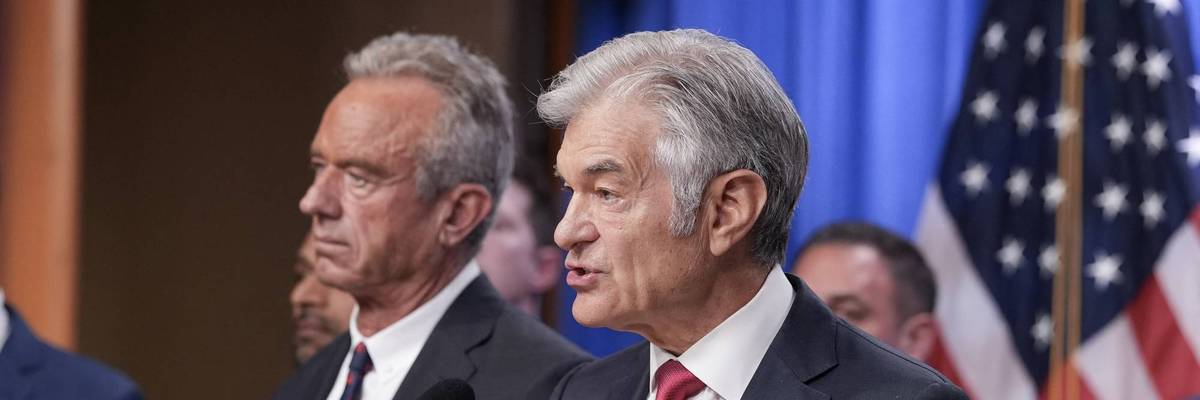
Centers for Medicare and Medicaid Administrator Mehmet Oz speaks during a press conference in Washington, DC on June 23, 2026.
(Photo by Ken Cedeno/AFP via Getty Images)
Jake Johnson
Jul 23, 2026
COMMON DREANS
The Trump administration earlier this week unveiled a new rule that advocates said would make it harder for states to fund their Medicaid programs, compounding damage caused by expanded work requirements and other changes enacted under the 2025 Republican budget law.
The law bars states from creating new provider taxes—levies on hospitals and other healthcare providers—and limits existing ones. The new Centers for Medicare and Medicaid Services (CMS) rule, which is open for public comment until September, would codify the GOP law’s changes.
Anthony Wright, executive director of Families USA, said Wednesday that the CMS rule “goes beyond the harsh restrictions already imposed by Congress to further narrow the options that states have to fund Medicaid services and providers.”
“Along with Congress’ other restrictions on taxing healthcare providers—restrictions that gut Medicaid funding in all states—CMS estimates this new proposed rule will cut $198.7 billion in state Medicaid funding over 10 years,” Wright noted. “This rule comes at a time when states are already under significant budgetary pressure to foot the bill for the cost of implementing complex and unnecessary work reporting requirements; in tandem with a proposed rule that slashes Medicaid provider payments and further eliminates state flexibility.”
“Taken together,” Wright warned, “these three rules serve as a coordinated dismantling of the Medicaid program, including its eligibility systems, payment structures and financing mechanisms, with disastrous impacts on individuals and healthcare systems.”
The Republican budget measure, which President Donald Trump signed into law last summer, includes roughly $900 billion in Medicaid cuts over the next decade. Millions of Americans have lost Medicaid coverage since the GOP law took effect.
Earlier this week, the entire House Democratic caucus implored CMS to “reconsider” its recently published Medicaid work requirement rule, warning it “will create an undue burden for beneficiaries with serious healthcare needs and put people at risk of losing coverage, while also creating significant implementation challenges for states.”
“This rule will require beneficiaries to frequently prove and verify their exemptions in order to maintain coverage, which will cause confusion, create bureaucratic burdens for patients seeking care, and, as a result, will lock patients out of lifesaving treatments,” the lawmakers wrote. “Forcing vulnerable patients to exhaustively document their symptoms simply to maintain access to basic healthcare is both imprudent and inconsistent with federal law.”
.jpg)

No comments:
Post a Comment