Labour days in Indonesia
Indonesia is facing a critical juncture in its contemporary political and economic history. This period bears a striking resemblance to the circumstances that ultimately led to the pivotal Reformasi movement in 1998. In response, President Prabowo Subianto, with his military background and human rights violations, is successfully incorporating the military and labour into his government.
The prevailing discourse asserts a decline of the labour movement due to various factors including deindustrialisation, labour market fragmentation, the rise of identity-based movements, and the exhaustion of institutions that once provided its political framework. The centrality of workers has been called into question due to the shift and restructuring of the battlefield wrought by neoliberal capitalism, resulting in a profound reorganisation of state power with the aim of reshaping class relations between labour and capital.
The current socio-economic climate is characterised by the commodification of public services and concomitant weakening of the welfare system, resulting in a flexible labour force that is increasingly informally employed. This process of regression is marked by the emergence of subcontracting chains, bogus self-employment, contracts without fixed working hours, platform work, the expansion of the labour regime, and the stifling of protectionist legislation. Neoliberal state regulation exploits low incomes, directly undermining the doctrine of labour (social) justice.
The nature of work has historically been characterised by episodic patterns, dispersed across multiple locations, and intricately interwoven with household survival strategies, small-scale commodity production, urbanisation and migration, and debt. This has occurred in the context of a neoliberal-capitalist siege and deep-seated internal contradictions. Neoliberal restructuring did not create these conditions but rather reinforced them. Often portrayed as technological disruption or labour market flexibility, the reality is the deliberate dismantling of wage norms.
It is not the antagonistic relationship between capital and labour that is weakening, but rather the political and organisational forms that once made that antagonism visible, enduring and effective. The state is becoming increasingly involved in the regulation of the foundations of accumulation and the disciplining of labour, representing regulation without protection, rather than a lack of regulation. In Indonesia, this phenomenon has been exemplified by the plight of workers under the jurisdiction of the state and the oligarchy, as evidenced by the neoliberal Omnibus Law, a situation that is further elucidated on Labour Days (or May Day, May 1).
Labour Day
The deep-seated and long-standing divisions within the Indonesian labour movement became most evident on Labour Day in Jakarta earlier this year, following similar events in 2025. The nature of this division is illustrated by the contrast between alignment with the state and opposition to it, reflected in the organisation of two Labour Day events. One event was an official state ceremony at Monas (the National Monument), the site of state ceremonies, while another event, characterised by protest and opposition, was held outside the House of Representatives building, the site of the end of the New Order regime in 1998.
Labour Day at Monas was organised by an alliance of four trade unions — Indonesian Trade Union Confederation (KSPI), the Confederation of All Indonesian Workers’ Unions (KSPSI), Indonesian Workers Welfare Union Confederation (KSBSI) and All-Indonesia Trade Union Confederation-Reform (KSPSI-Pembaruan) — and involved the Labour Party. It featured a large and lavish stage supported by famous artists and various entertainment activities and included leaders invited from the elite, the oligarchy and business sectors, all under police and military protection. Performances included the joged (dance), synonymous with the signature body language of Prabowo’s political persona since the 2024 presidential campaign, and a joyful sing-a-long rendition of the Internationale. Never before in history has that song been sung so joyfully while dancing, given its lyrics and the historical significance behind them.
The other event was organised by the Alliance of Labour Movement with the People (GEBRAK), a coalition of 35 civil society groups and trade unions. The largest contingent was from the Confederation of the Congress of Indonesian Trade Unions (KASBI). In addition to these two major rallies, smaller rallies were held by other trade unions in cities such as Bandung. A similar scenario to Labour Day 2025 was repeated in 2026, with the addition of aggressive political consolidation measures that deepen divisions within the labour movement and weaken it through the hijacking of Labour Day.
Labour’s incorporation into government
In the lead up to Labour Day 2026, the KSPSI president was appointed as Minister for the Environment. Previously, the KSPI, whose chairperson is also the leader of the Labour Party, had become part of Prabowo’s governing coalition. This strategic appointment was a significant development in the political landscape, and was widely covered by the media. It is regarded as a form of soft, transactional politics aimed at strengthening the labour bloc’s support for President.
This appointment is indicative of Prabowo’s endeavours to foster collaboration with the opposition, a move that follows his previous integration of prominent activists from the 1998 Reformasi movement — include those who had been abducted by him — such as Budiman Sudjatmiko, Andi Arief, Nezar Patria, Mugianto Sipin, Pius Lustrilanang and Desmond Mahesa. They have been appointed to his cabinet, as presidential advisers, and as members of the House of Representatives representing the Gerindra Party — the party of which Prabowo is chairperson. As well as abducting students and activists, Prabowo was involved in military operations in Aceh, Papua and East Timor, yet he was never brought to trial. He was dismissed from the military, which prompted him to flee to Jordan for 20 years before subsequently establishing the Gerindra Party and aspiring to become president.
At the inception of the Reformasi era, the Labour Party’s popularity provided a glimmer of hope amid the prevailing dominance of nationalist and religious parties. The impetus for this shift can be traced back to President Joko Widodo (Jokowi)’s inaugural term in 2014, a period that was widely regarded as a landmark moment in the evolution of democracy. This was largely attributed to the unexpected victory of an individual perceived as embodying the aspirations of the populace. However, subsequent events cast doubts on these initial assumptions. The mobilisation that transpired, instead of leading to the anticipated democratisation, ultimately resulted in the establishment of an authoritarian regime that persisted until 2024.
The Labour Party gained significant political prominence following Jokowi’s introduction of the Omnibus Law; by the end of his second term, the party had rejected this legislation, thus effecting a swift reversal of stance. However, this dynamic underwent a rapid transformation during the intensification of the 2024 election process, ultimately resulting in the triumph of Prabowo and his running mate, Jokowi’s eldest son. This outcome was accompanied by substantial constitutional violations.
It is evident that the Labour Party and its affiliated organisations want to persist with their strategy of pursuing legal action on behalf of labour issues, seeking electoral representation through political campaigning, and engaging in lobbying activities directed at a government with which they have now forged an alliance. This political character will accentuate the contradiction between strategies of alignment with state power and opposition.
Authoritarianism
The concept of democracy extends beyond the mere act of elections, encompassing the notion of polyarchy, defined as an open space for legitimate participation and opposition. In the context of Indonesian authoritarian policy under Jokowi and Prabowo, mobilisation of the public, whether online or offline, as well as public protests and foreign subversion, are regarded as a continuous and integrated series of threats. The government’s treatment of dissenting voices as a nuisance could result in the loss of its moral legitimacy, despite retaining formal legitimacy.
Consequently, Prabowo is co-opting workers through the participation of the Labour Party and labour organisations in his government. This represents an escalation of a method of subjugation by the state to convert workers into part of a chain of populism, fascism and militarism, reminiscent of the past disgraceful New Order era. Perhaps only in Indonesia can Labour Day be sponsored by an authoritarian state led by a militaristic president with a history of human rights violations; yet the public, particularly the workers gathered at Monas, are pleased with the social assistance provided and naive as to its origins.
Labour Day has repeatedly been forced into a cycle of short-lived mobilisations without any transformation, and has tended to fail in its struggle to build up into a lasting political force or generalisable class force. Much less has this been possible through traditional strikes, which, although still exist, have lost their effectiveness as a universal weapon. Indonesia has a long history, particularly during the New Order era, of imposing strict restrictions on workers’ rights to strike and organise through military and police intervention, and recognising only the All-Indonesia Workers Union (SPSI) as an official trade union federation.
In the New Order era, Ruslan Wijayasastra, the former Secretary-General of the International Labor Organization (ILO), was arrested in 1968 on charges relating to the 1965 coup d’état and faced the death penalty. In 1993, Marsinah, a factory worker and SPSI activist in the small town of Nganjuk, East Java, was murdered after being tortured and raped; her killer remains unknown to this day. The largest independent trade union confederation, the Indonesian Workers Welfare Union (SBSI) established in 1992, was designated a “banned” organisation in 1994 and its leaders imprisoned. Today, it often operates under the KSBSI, the main supporters of the Labour Party.
In the lead up to Labour Day 2026, Prabowo posthumously honoured Marsinah as a national hero. This move was perceived as contradictory, as it coincided with the posthumous honours bestowed upon General Suharto, the New Order dictator and former father-in-law of Prabowo, as well as General Sarwo Edhie Wibowo, another New Order general and father-in-law of Indonesia’s sixth president Susilo Bambang Yudhoyono (SBY). Together with Suharto, Sarwo Edhie bore responsibility for the 1965–66 anti-Communist genocide. About 3 million people were killed and millions more suffered structural, administrative, social and cultural violence in their daily lives during the 32 years of New Order rule.
The decision to designate Marsinah as a national hero, alongside the charismatic Islamic figure Abdurrahman Wahid (Gus Dur), Indonesia’s fourth president, was a strategic move by Prabowo to win sympathy and appease sentiments of labour — particularly the SPSI — and religious factions regarding the designation of national heroes from the military who have a history of human rights violations.
Lack of independence
At Labour Day 2026, Prabowo delivered a political speech in which he posed the question to assembled workers at Monas: “Is MBG useful or not?”, MBG being the Free Nutritious Meals program, to which the reply was “no”. This caused an awkward and tense situation for the Labour Party and labour organisation leaders on stage. Prabowo provides social assistance to 350,000 workers, and many attended due to this assistance while also fulfilling their obligations as members of the party and organisation.
The politicisation of Labour Day that has occurred is not a shift towards the absence of struggle, but rather the absence of political forms capable of accumulating it as a material consequence of the ever-deepening penetration of accumulation into the conditions of social reproduction. The result is a proliferation of struggles that remain episodic, sectoral or symbolic in nature, to which the state responds with electoralism. Prabowo was the bigger winner on Labour Day.
This is essentially how Labour Day has been organised since the New Order era, when trade unions were controlled by the elite under the influence of an authoritarian government. Despite Reformasi, there has been little change; the Labour Party’s establishment merely appears to have introduced a more democratic element. However, a shift in sentiment towards the government has been observed, with unions becoming either part of the government or the opposition. Both, nevertheless, remain under the control of the same unchanging elite and oligarchy that form the foundation of Indonesia’s government to this day.
May 1 should not be a day for frivolous activities such as Joged and superficial applause, nor should it be a day that fosters complacency in a bureaucracy disconnected from reality. It is imperative to emphasise that workers should not be subjected to further sacrifices, particularly in the context of macroeconomic stabilisation or the internal restructuring of a capitalist state under the guidance of neoliberalism.
Within the context of military practice, there exists a long-standing tradition of singing and dancing in response to the command issued by a superior, a practice widely referred to as Joged Komando. Prabowo, a former army officer, introduced this method to the public during his election campaign. It was a success, so it was used again during Labour Day protests organised by labour organisations that are part of his administration.
Labour policies
Indonesian labour finds itself ensnared within a web of bureaucracy, political systems, financial management and administration that have deviated from the objective of attaining welfare. Consequently, services for workers have become enmeshed in collusion, corruption and nepotism. While this perspective may be perceived as biased, as it establishes an ideal order for a developed nation, the concept remains pertinent in contemporary discourse concerning the perception of workers in Indonesia, both by the state and political right.
In a hybrid prismatic society, labour policies are at least well-intentioned, although their implementation is chaotic due to bureaucratic disorder and political interests. This is the strategy that has been employed by Jokowi and Prabowo to draw labour elements into their government’s orbit. Prabowo has demonstrated his commitment to effective governance, a strategy which has met with success. The contradiction lies in the fact that workers are directly confronted with the Omnibus Law. Contemporary politics has shifted from a discourse of policy to one characterised by the polarisation of identities. This transformation is most acutely experienced by labour.
In May 2026, Indonesia confronted the most precipitous currency devaluation since the 1997 Asian financial crisis, a period that gave rise to an economic and political crisis, ultimately leading to the Reformasi movement. Nevertheless, the day-to-day repercussions of the currency’s weakness are downplayed by the president, who is pursuing ambitious domestic projects, including the MBG and the Merah Putih Village Cooperative across Indonesia; the Food Estate Papua; major expansion of palm oil in Sumatra, Borneo and Papua; the expansion of the extractive industry, particularly the nickel sector in Sulawesi; and augmented military expenditure. The Indonesian left who are part of the president’s cabinet or inner circle have described his projects involving the military as the path of Indonesian Socialism and nationalist projects for the people of Indonesia.
These endeavours have resulted in a financial stranglehold that has precipitated a disruption in the country’s macro- and microeconomic equilibrium, giving rise to escalating debt, inflationary cycles, market contraction and a fiscal crisis, This has exerted a deleterious effect on the labour market, thereby eroding workers’ rights. Financial crisis, coupled with a grassroots political crisis driven by workers, triggered the downfall of Suharto’s New Order regime. Today’s situation could result in a similar fate, but this has not occurred under Prabowo due to the rapid consolidation of links between the civilian and military sectors, despite the economy remaining in a state of disrepair.
Divided labour movement
In Indonesia, the labour movement is predominantly associated with the formal manufacturing sector, encompassing labour-intensive industries such as textiles and capital-intensive sectors including the automotive and steel industries. Domestically, workers have organised to form trade unions that meet government regulatory requirements, while also establishing links with labour organisations at the regional, national and even international levels. Nevertheless, this has not provided workers with significant protection against exploitation by capitalists, the state, or even labour organisations themselves.
The constant flux of governments, presidents, parliamentarians and labour organisations serves only to obscure the enduring presence of the elites and oligarchs who wield genuine power, whether in government or opposition. This phenomenon is exemplified by the occurrence of corporate crises, which often result in redundancies. An example is provided by the labour-intensive operations at Sritex, a textile factory established in 1966 and regarded as one of Indonesia’s oldest and largest.
Renowned for its production of military uniforms for 30 countries, Sritex is a prime example of the Indonesian textile industry. The decline of Sritex had been evident since Jokowi’s administration due to mismanagement and Jokowi’s close ties with China, which allowed cheap Chinese textiles to enter Indonesia easily — legally and illegally — without significant controls. This continued throughout his two terms and persists under Prabowo. Initially, Prabowo’s Deputy Minister of Labour made efforts to address the issue, but less than a year into his tenure, he was arrested by the Corruption Eradication Commission (KPK). Sritex has now closed, hundreds of thousands of permanent employees were laid off and there are no more Labour Day events there.
Another example of a capital-intensive venture is Krakatau Osaka Steel, a joint venture between Krakatau Steel and Japan’s Osaka Steel established in 2012. Krakatau Steel is a state-owned enterprise, founded in 1970 at the inception of the New Order era. The collapse of Krakatau Osaka Steel was precipitated by the influx of inexpensive Chinese steel into the market without government controls, as well as an unforeseen global oversupply, resulting in the factory having to close.
During the Prabowo administration, many companies and factories have closed, yet the government has not released official data on worker redundancies to protect investment. Where such data is available, it is significantly lower than the actual figures. The absence of state protection, labour organisations and labour parties, which have historically been integral to labour practices in Indonesia, has left workers to fend for themselves.
Spontaneous protest in Bandung
Following the implementation of a policy by President SBY (2004–14), Labour Day has been designated as a public holiday since 2014. Labour Day in Bandung is customarily held on the grounds of Gedung Sate, the official residence of the Governor of West Java province, situated opposite the West Java Provincial Legislative Council building.
For the past two decades, the event has been dominated by labour organisations in their distinctive uniforms, featuring unique long marches and speeches from KASBI and Indonesian Metal Workers’ Union (FSPMI), with smaller contingents from SPSI, SBSI and the National Front of Indonesian Workers’ Struggle (FNPBI). Furthermore, the gathering is attended by students from various universities, each of whom is attired in the uniform of their respective institution.
Assembled groups are diverse in appearance and behaviour, with some opting for anonymity by wearing all black, while others are identifiable by their face coverings and the presence of black flags and anarchist or anti-fascist symbols. Over the past decade, these autonomous groups have undergone significant growth in Bandung, becoming a leading force in various actions against government policies, including opposition to the Omnibus Law and the Military Law, and the organisation of Labour Day demonstrations.
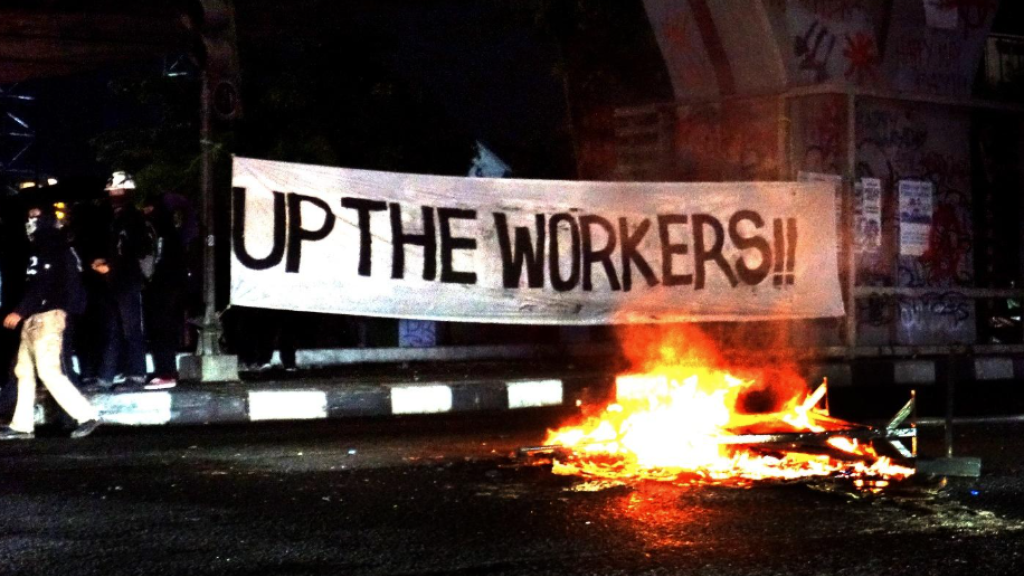
On Labour Day 2026, for the first time in two decades — with the exception of the period during the course of the pandemic — no Labour Day events were organised in Bandung by either state-controlled or opposition trade unions. This was due to the fact that all events were shifted to Jakarta. However, a spontaneous protest materialised on Labour Day 2026 in Bandung, beneath the under flyover Pasupati and in Cikapayang Park in the late afternoon to night. This protest was initiated by an autonomous group that the police categorised as an anarchist “Black Bloc”. The group comprised youth, urban poor, university students, school students, hawkers, young workers, artists, musicians, skaters and local football supporters. Nothing of the sort happened in any other city in Indonesia.
In the days preceding Labor Day 2026, Governor of West Java Dedi Mulyadi — a member of Prabowo’s Gerindra Party — ordered the demolition of infrastructure in the grounds of Gedung Sate and the blocking of public roads with decorative arches and gardens. The main aim was to ensure there were no further protests, including on Labour Day. Since the New Order era, Gedung Sate has served as a historic political arena for civil protests, including Labour Day. It was also here that the Aksi Kamisan (Thursday Action) had taken place since 2013. Initiated in Jakarta in 2007, the protest is organised by victims and the families of victims of human rights violations in Indonesia, such as the 1965–66 genocide and the 1998 tragedy. It is a weekly silent, peaceful protest where participants wear black attire and hold black umbrellas. In Bandung, the protest was started single-handedly by mime artist Wanggi Hoed and has since grown into a much larger protest-movement.
The dismantling of infrastructure commonly used by civilians to stage protests, including Labour Day demonstrations, has not been confined to Bandung. In Jakarta, the steps of a public footbridge in front of the House of Representatives building have been removed, and a barrier wall has been erected to ensure protest crowds remain concentrated and easier to control — to the point where people become reluctant to protest.
If Jokowi wished to claim for himself the title of Bapak Pembangunan (Father of Development), a title bestowed by the New Order regime on Suharto, then Prabowo wishes to claim the legacy of militarism of his former father-in-law, who successfully used the military in the 1965–66 coup and dominated all sectors of civil society for 32 years before being overthrown by the 1998 Reformasi movement.
Student protests
In the period following May Day 2026, a significant development occurred. Said Iqbal, who concurrently presides over the KSPI and the Labour Party, was appointed by Prabowo to the role of Special Presidential Adviser on Labour and Workers’ Welfare. This coincided with the appointment of a new head of the MBG, following the arrest of the previous head on corruption charges.
Subsequent to these appointments, student protests occurred in several cities, including Jakarta, Bandung and Yogyakarta. The protests were to denounce government policies that were exacerbating the situation in Indonesia through chaotic fiscal policies, a red zone debt reaching IDR 10,000 trillion (about 40.75% of Gross Domestic Product), a 33% rise in fuel prices and the lowest currency value in history, accompanied by the military’s increasingly strong grip on the civilian sector and its intensive involvement in various government programs due to changes to military legislation, including amendments to the Police Act. Amid the protests, the Labour Party chairperson issued a statement indicating that workers were not participating in the protests due to the fact that subsidised fuel prices had not increased, and therefore this issue did not have any impact on workers. Instead, the focus of workers was on the issues of outsourcing and wage rises.
Prabowo has been observed to deliver speeches that are inspiring, characterised by populist rhetoric infused with nationalist fervour. However, these speeches are rife with contradictions and lack substance with regard to on-the-ground realities and the notion of a “war on foreign stooges”. When this narrative becomes embedded in policy and public discourse, it risks undermining democratic institutions and civil society organisations, including labour unions, by delegitimising criticism and diminishing the opposition’s bargaining power while increasing its political costs.
Forest fires
In the aftermath of the Reformasi era, there was a marked resurgence in the labour movement. The advent of labour organisations in numerous regions and across a variety of sectors, as well as the substantial growth of labour parties, should be regarded as a primary asset for the labour movement in addressing the injustices faced by workers. This encompasses not only the regional minimum wage and working conditions, but also external factors that influence them, such as the natural environment.
Since the Reformasi era, Indonesia’s tropical forests have suffered from intense, deliberate fires aimed at clearing land for mining and oil palm plantations. The smoke from these fires has had deleterious effects on the health of workers, who have never been protected, compensated or had the risks minimised. The resultant forest fires have spread not only through forested areas but also into towns and cities.
The 2026 forest fire was the largest in Indonesia’s history, and has been raging for four months with minimal intervention. This has enraged the entire Indonesian population, who have been forced to breathe in the smoke produced by this palm oil capitalism. Countless palm oil workers have been compelled to continue their duties while adjacent land, either forest or peatland, is engulfed in flames. Millions of more workers across various formal and informal sectors, particularly in Kalimantan and Sumatra, have been compelled to work in hazardous smoke produced by this perilous form of capitalism.
This situation has led to environmental and labour injustice: while profits are privatised, the ecological and social costs are borne by the public, and particularly the working class. Yet, no labour organisation or labour party has voiced any objections to the government, the House of Representatives or the palm oil oligarchy regarding these forest fires, nor has any defended the rights of workers in the face of this ecocide. The interests of workers extend beyond the regional minimum wage.
Labour Day has traditionally encompassed the myriad day-to-day issues workers face. In subsequent May Day demonstrations, it is imperative that workers mobilise larger crowds to exert substantial pressure on the government, the House of Representatives and the oligarchy regarding the situation faced by workers, and to demand justice and concrete solutions. The establishment of a revolutionary organisation may be as significant as it is sustainable or unattainable. Nevertheless, a luta continua! The struggle continues! Up the workers!
Frans Ari Prasetyo is an independent researcher, planner and photographer whose work explores landscape politics, spatial planning and grassroots movements in Indonesia. His research focuses on the political ecology of land use, infrastructure development and the struggles of marginalized communities, including youth movements, underground collectives and urban-rural populations affected by state and corporate development projects.

No comments:
Post a Comment