The War in Iran Comes Home to ‘Trump Country’
“It’s not tariffs… it’s the war, it’s gas prices, it’s diesel.”
In leaked audio obtained by Axios, Ken Paxton, the Republican nominee for senate in Texas, spoke candidly about what he believes are the biggest issues hurting his campaign. The Iran war, which has dragged on for almost eight months now, has put Texans – and the rest of the nation – in an economic bind, one which President Donald Trump had promised to avoid.
Crude oil prices have once again risen above $100 a barrel. The national average for gasoline is hovering above $4. With Republicans nationwide being burdened by the stench of incumbency – regardless of whether or not the individual candidate is currently in office – a return-to-power seems all but imminent for the Democrats in the House of Representatives, and maybe even the Senate as well.
This is even true in “Trump Country.”
The war itself is a topic which evokes hardline opinions on both sides. Fierce debates have been had in elite circles over the wisdom of launching the military campaign against Iran, the strategic blunders of the Trump administration, and the way in which the war has been conducted. What has been a bipartisan concern, however, is the rise in fuel prices brought upon by the war.
People en masse may not know the technical details of the raging conflict in the Strait of Hormuz, or even where to find it on a map. What they do know is that when they turn on social media or turn on the TV, the campaign ads they see coming from Democrats consistently associate the skyrocketing fuel prices with the war in Iran – attaching the Republican opponent to the White House’s unpopular war.
Meanwhile, the rebuttal from Trump isn’t an explicit denial of these accusations. Rather, he has embraced them.
“It’s a small price to pay,” Trump said at a rally in Alaska on October 14, “for stopping [Iran] from having a nuclear weapon.”
Trump’s fanbase, collectively referred to as “MAGA,” have been known for their unwavering loyalty to the president. Trump famously joked in a 2015 stump speech “I could stand in the middle of Fifth Avenue and shoot somebody, and I wouldn’t lose any voters.” The spirit of this has been generally correct. On most issues, Trump’s supporters have stuck with him regardless of his many contradictions – be it on the Epstein files, government spending, or the merits of various DC swamp creatures.
There has been a crackup, though. Trump’s swagger – his inability to disgust his diehard fans even if he tried – seems to be weakening.
The Iran war, while historically unpopular, isn’t the sole reason for this. Neither is his baseline hawkishness, which contradicts his dovish campaign rhetoric. The majority of Republicans were happy to support Trump’s January 2026 operation in Venezuela, and most also approved of the bombing of various small boats off the coast of Central and South America. But this war had a different effect on Trump’s coalition than the one in Iran.
For one, the Venezuela operation was relatively limited in its scale, and the same can be said for the boat strikes. The fighting in Caracas lasted mere hours and resulted in no American casualties. President Delcy Rodríguez’s regime has remained in power, and blowback – at least in terms of significant negative ramifications – has not been felt in the U.S. to this point (that doesn’t mean it won’t appear in the future, to be clear).
Most importantly, the economic impact of the operation wasn’t notable. There weren’t any immediate concerns about twenty percent of the world’s energy supply being stuck behind a missile-riddled waterway, for example.
The situation has been exactly the reverse in the Middle East.
Iranian restrictions on shipping in the Strait of Hormuz have caused oil prices to spike, leading to a direct and harsh economic impact on Americans. Unlike the in-and-out style of the Venezuela operation, the Iran war has proven to be a quagmire.
The economic pain has been felt across the country, particularly in industries like farming and trucking, which are prominent in middle-America – “Trump Country.” This has led to predictable discontent among voters, who feel that the president is focused on fighting a country across the world, and not only doesn’t care about their financial anguish, but openly says so.
“For you to pay a tiny little bit more for your gasoline,” Trump said at a rally in New York, “just remember, you’re doing it so that a very evil country cannot… have a nuclear weapon. So, remember that. When you have to pay a little bit more, your $4, it’s okay. I mean, I’ll never apologize.”
This anger is being reflected in poll after poll. In Texas, a historic electoral stronghold for the GOP, Democratic nominee James Talarico is giving his party what seems to be their best chance in years to regain one of the state’s senate seats. A recent poll from University of Houston Hobby School of Public Affairs has Talarico leading Paxton by two percent.
The Republican Party is quickly sending money to ruby red states like Kansas and South Carolina, where polling suggests the senate races may be uncharacteristically close. This is an indication of potential panic behind the scenes, as campaign funding of this sort is generally used to bolster candidates in tight battleground races, not shore up what should be landslide victories in rural, conservative states.
Amid this dire situation, some candidates have attempted to distance themselves from the war. Mike Rogers, the Republican nominee for senate in Michigan, said back in September, “the war with Iran needs to end and end quickly.”
“When it does,” Rogers continued, “energy costs will plummet. But Michigan families can’t afford to wait for that to happen. We need to do something now.”
Rogers is hardly changing his tune based on a genuine abandonment of his hawkish instincts. Back in May, Rogers parroted the party line, saying he supported the war because “it is absolutely right to make sure that Iran does not get a nuclear weapon.” In this same discussion, he called it a “win-win-win.”
Rogers is making a last-minute pivot out of desperation. A recent InsiderAdvantage poll shows his Democrat opponent, Abdul El-Sayed, leading by two percent. El-Sayed has sought to appeal to Michiganders who are feeling the economic squeeze, leading the crowd at his rallies in a chant that reads “money out of politics, money in your pocket, Medicare for all.”
Regardless of your opinion on universal healthcare or Citizens United, one candidate is confident and assertive – clearly stating what he believes. The other is insecure and timid, looking for a way to jump off the sinking ship that is the Iran war, before the financially distressed voters get the chance to punish him for having supported it.
The Democrats – at least the ones who can read the room – are making the cost-of-living issue the centerpiece of their campaigns. Whether or not their policies will work to alleviate economic pain is another question, but what is unavoidable as we approach the midterms is the momentum behind the Democrats, particularly in red and battleground states.
Meanwhile, the GOP is being crushed under the weight of their president’s war of choice.
Reprinted with permission from Nolan Denaro’s Substack.
Nolan Denaro is a political analyst, writer, and host of “The Quest For Clarity” podcast, available on YouTube and Spotify. He is a columnist at Antiwar.com, and his work has been published by Responsible Statecraft, the Libertarian Institute, The Daily Caller, and the Ludwig von Mises Institute. He writes on U.S. foreign policy, economics, and current events, with a particular focus on war and imperialism. He maintains a personal Substack blog, and you can follow him on X @nolandenaro. Nolan can be reached for correspondence at nolansdenaro@icloud.com.
Who Is Making Billions From the Iran War?
At a campaign rally over the weekend, President Trump dismissed Americans’ concerns over high oil and gas prices, claiming that it’s a small price to pay for the hundreds of billions of dollars “we” are making from these higher prices.
“We’re making a fortune,” he said. “Hundreds of billions of dollars. Trillions of dollars.”
People are paying a little bit more for gas, he explained, but it doesn’t matter because “we” are making so much money.
The question is, “Who is ‘we’?” We know it is not the American people. They are seeing wage stagnation, inflation, and more pain at the pump. An Economist/YouGov poll earlier this month found that inflation and prices are the top concern among Americans by a wide margin. And in second place were jobs and the economy.
The same poll asked Americans how they rate the state of the US economy and in first place – again by a long shot – was “poor.”
If “we” as in the American people were making hundreds of billions of dollars from the war, you would think these would not be their top two concerns.
But we understand what the President meant by “we.” He meant that part of the “private” sector directly or indirectly in bed with the government war machine. From oil companies to weapons manufacturers and everything in between, war and conflict drive up profits in well-connected corporations at the expense of the rest of us.
That is why we are in a constant state of war. Twenty years in Afghanistan and a similar length in Iraq. Endless bombing in places like Somalia. A twelve-year (and counting) proxy war with Russia in Ukraine. Military bases and covert operations across the globe.
And if we find that the largest military budget in the world does not deliver enough actual weapons to win a war? Well, that’s all good too: just double military spending and accuse anyone who objects of not being patriotic!
“Private” companies with enormous political power – many of them revolving doors between government and business – “make so much money” on war, as Trump would say. Whether these wars produce US wins, loses, or stalemates, these corporations in bed with government always win. The money-printing machine makes sure the money cycles into government-favored companies, while campaign contributions are made to the politicians who support the wars.
And if you don’t support the wars? You get the Thomas Massie treatment.
Endless war produces more corporatism, where the private sector does not exist to provide goods to compete in the free market, but to serve political power and strengthen governmental control over the population. Think of it as welfare for the rich at the expense of the poor. The result is tyranny.
This is the very reason our Founders intended to make it as difficult as possible to wage war. As well-educated students of history, they understood how the concentration of war-making power in the hands of one ruler or an oligarchy would impoverish the masses and lead to a moral and financial bankruptcy. They placed war-making power in the “people’s branch” – Congress – hoping that the people would hold their representatives accountable. We have strayed very far from what they intended and if we are to survive, we must reclaim that authority and responsibility.
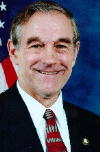 Ron Paul is a former Republican congressman from Texas. He was the 1988 Libertarian Party candidate for president.

No comments:
Post a Comment