
“We have endured fear, and we will not be intimidated,” one Indigenous leader said.
October 30, 2026

A makeshift memorial is seen outside the former Kamloops Indian Residential School in Kamloops, British Columbia, Canada, on September 1, 2021.COLE BURSTON / AFP via Getty Images
It was 3:00 am when Doug George-Kanentiio first arrived at the Mohawk Institute Residential School in Brantford, Ontario, in 1967.
He was 11 years old, and he would go on to spend 18 months at the abusive institution, which was Canada’s longest-running residential school. The notorious school operated for more than 140 years before it closed in 1970.
“They weren’t places of learning, they were places of confinement,” George-Kanentiio said.
Decades later, he still remembers the hunger, fear, and brutality that he and the other Indigenous children who were forced to attend the Mohawk Institute endured there every day.
“Anything you could imagine [being done] to a child, when it comes to abuse, that’s what these individuals did,” said George-Kanentiio, who is from Akwesasne, a Kanien’kehá:ka (Mohawk) community on the U.S.-Canada border, between New York state and the provinces of Ontario and Quebec.
Related Story
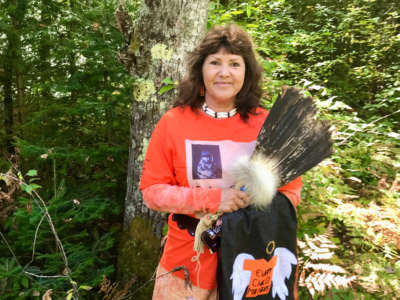
My Childhood Was Stolen, Says Linda Raye Cobe, Indian Boarding School Survivor
Linda Raye Cobe discusses the growing movement of survivors seeking to heal from the “Indian boarding school” system. By Frances Madeson , Truthout October 10, 2022
“It was physically painful and extraordinarily cruel,” he told Truthout.
More than 150,000 First Nations, Metis, and Inuit children were separated from their families and forced to attend residential schools across Canada between the 1870s and the mid-1990s.
The institutions — which aimed to forcibly assimilate Indigenous children into the country’s predominantly white European culture — were rife with physical, sexual, and psychological abuse.
The children were barred from speaking their languages, and thousands are believed to have died while in attendance due to abuse, malnutrition, and rampant disease that resulted from squalid conditions. In 2015, a federal commission of inquiry said the system amounted to “cultural genocide.”
Yet while George-Kanentiio and other survivors have spoken about their abuse for years, efforts to downplay, minimize, and distort facts about the residential school system are getting louder in Canada.
The rising wave of residential school denialism has drawn widespread alarm as Indigenous community leaders and other experts say right-wing figures are trying to derail truth and reconciliation — the process of investigating and redressing the devastating impacts of Canada’s colonial policies, including its residential school system — while harming survivors in the process.
Residential School Denialism Is Spreading
Niigaanwewidam Sinclair, an Indigenous studies professor at the University of Manitoba, likened residential school denialism to Holocaust denialism.
“They’ll say, ‘We’re just asking questions, it’s free speech, we’re trying to just tell the other side,’” he told Truthout.
“They weren’t places of learning, they were places of confinement.”

But he emphasized that residential school denialists are not really interested in a “good-faith conversation.” Instead, Sinclair said, they have two main goals: to “monetize ignorance” and to gain public attention.
“They’re trying to profit off of the fact that for 150 years Canadians were miseducated about Indigenous peoples and residential schools in particular,” he explained.
The issue came to a very public head last month when a group of about two dozen masked men affiliated with white nationalist group Second Sons Canada gathered on the lands of Tk̓emlúps te Secwépemc, an Indigenous (First Nation) community in the province of British Columbia.
Tk̓emlúps te Secwépemc has faced years of pressure from denialists since it announced in 2021 that a preliminary radar search of the grounds of the former Kamloops Indian Residential School had uncovered the potential remains of more than 200 children.
The discovery sparked a reckoning across Canada as people demanded justice for the myriad crimes committed at residential schools, which were funded by the government but run by various churches.
But the findings in Tk̓emlúps te Secwépemc also fueled denialism, with far right activists and politicians seizing on early reporting errors to accuse the community and media outlets of lying.
“The entire country is motivated and moving towards implementing truth and reconciliation,” whereas denialists are “trying to slow things down, and they’re trying to profit,” said Sinclair.
Canada Has Its Own “Charlottesville Moment”
The men who entered Tk̓emlúps te Secwépemc in late September hung a banner on an overpass that day reading, “Got bones?” — a reference to the 2021 discovery of possible remains.
The incident drew widespread condemnation, including from Prime Minister Mark Carney, who called it a “disgusting display of hate.”
For its part, the Tk̓emlúps te Secwépemc community said it would not stop “continuing to share the truth.”
“White supremacy will not instill fear in generations of Survivors and Intergenerational Survivors who have already carried fear for far too long,” Kúkwpi7 (chief) Rosanne Casimir said in a statement. “We have endured fear, and we will not be intimidated.”
Sean Carleton, an expert on residential school denialism who also teaches at the University of Manitoba, said the incident marked “a Canadian Charlottesville moment,” referring to the 2017 white supremacist rally in Charlottesville, Virginia.
Carleton said it’s not a coincidence that the Second Sons Canada “stunt” came just days before millions of Canadians took part in National Day for Truth and Reconciliation rallies and other events.
“Using the tactics of the American far right — because many of them are influenced by this — this [was] basically a stunt by 30 masked dudes trying to derail and distract, deliberately provoking, [and] using racism and the rhetoric of denialism to change the conversation,” he told Truthout.
But Carleton warned that while it may be easy to denounce residential school denialism “when it looks like fascism and white supremacist groups marching in masks,” the phenomenon can be slyer, too.
“We need to have a flexible enough definition to be able to see all of [it], such that we don’t say in this country, ‘Well anything that’s not a provocative banner drop is OK,’” he said. “We need to understand that [denialism] takes different forms and they’re all equally repugnant.”
The Canadian Government Earmarks Funds to Address Misinformation
The Canadian government has acknowledged the issue, saying residential school denialism “compounds the harms” that survivors and Indigenous people across the country experience.
“It was physically painful and extraordinarily cruel.”
In a September statement, the minister of Crown-Indigenous relations, Rebecca Alty, said Ottawa earmarked $3.5 million ($5 million Canadian) for public education on residential schools.
A focus, she said, would be placed “on delivering informative and accessible content that clearly addresses misinformation and denialist claims.”
But many say education alone can’t fix the problem, and calls are growing for Canada to criminalize residential school denialism in the same way that Holocaust denial is criminalized.
The Assembly of First Nations (AFN), a national advocacy group, recently passed an emergency resolution calling for residential school denialism to be categorized as a hate crime.
“This country perpetuates hate crimes, they condone it,” Grand Chief Garrison Settee of Manitoba Keewatinowi Okimakanak, which represents 26 First Nations in Manitoba, said after the unanimous July vote.
“And this is not acceptable to our people, to our survivors, and those that did not survive,” he said.
The Search for Unmarked Graves Continues
In 2021, the government also established the Residential Schools Missing Children Community Support Fund to help communities find and commemorate unmarked burial sites.
Efforts to downplay, minimize, and distort facts about the residential school system are getting louder in Canada.
But three years later, in 2024, Ottawa attempted to cap the amount of funding that would be available, drawing fierce criticism. The decision was later reversed due to public pressure.
“Funding for search activities is an essential part of the debt of justice owed to the families and Nations whose children were forcibly taken away,” Stephanie Scott, executive director of the National Centre for Truth and Reconciliation, said at the time. “Funding must be determined by need, not by arbitrary formula.”
According to George-Kanentiio in Akwesasne, a focus should be placed on finding the children who never came home from the residential schools. He said that means making sure communities who are committed to identifying and uncovering the unmarked graves have the funding to do that work.
“We have to find the children because their spirits still have not been released to go on to their respective journey,” he explained.
“We need to do that, and we are committed to that. Whenever we have a gathering, we reaffirm that — that there’s no peace unless those children are found, and unless the children are found, there’s no justice.”
This article is licensed under Creative Commons (CC BY-NC-ND 4.0), and you are free to share and republish under the terms of the license.
Jillian Kestler-D’Amours
Jillian Kestler-D’Amours is a journalist based in Montreal, Canada. Her work focuses primarily on human rights and social justice issues and Canadian foreign policy.

No comments:
Post a Comment