The Brazilian Victory: Left Unity and Digital Autonomy
November 2, 2026
The leftist leader Luiz Inácio Lula da Silva secured a historic victory in Brazil’s presidential election on 25 October 2026. The result came amid intense political and social polarization and the growing influence of the far right in Brazil and across Latin America, backed by the U.S. far right led by Donald Trump.
The significance of this electoral victory extends beyond Lula securing a fourth term. It also lies in the political and organizational experience that helped make it possible, above all the ability of diverse left-wing and progressive forces, with different programs and ideological outlooks, to forge a broad electoral alliance around common ground in confronting the far right.
A Broad Left-Wing and Progressive Alliance Despite Differences
Lula contested the election with the support of the ‘Brazil Ready for More’ alliance, comprising seven left-wing and progressive parties organized into two party federations and two separate parties. The ‘Brazil of Hope’ federation brought together Lula’s Workers’ Party, the Communist Party of Brazil, and the Green Party. The second federation united the Socialism and Liberty Party, which includes socialist and radical-left currents, with the Sustainability Network. The Brazilian Socialist Party and the Democratic Labour Party also joined the alliance, alongside supportive social movements and trade unions. Lula ran with Geraldo Alckmin of the Brazilian Socialist Party as his vice-presidential candidate.
The importance of this alliance lies in its ability to bring together communists, socialists, the radical left, social democrats, and Greens despite their disagreements over capitalism, the role of the state, and the limits of social reform. These forces agreed on common electoral objectives while preserving their identities and organizational autonomy.
This is one of the most important lessons of the Brazilian experience. Left unity does not require ideological or organizational uniformity. It means being able to work together on common ground while respecting pluralism and differences. Disagreements over Lula’s economic and social policies will naturally persist, including among the forces that supported him at the ballot box.
Unity Does Not Mean Abandoning Criticism or Autonomy
The Brazilian experience raises an important question for left-wing forces around the world. Why do ideological and organizational differences become barriers to cooperation, despite so much common ground, even when these forces face shared political and class challenges?
Pluralism among communists, social democrats, the radical left, environmentalist and feminist currents, and independent leftists can be a source of strength and intellectual and political richness, provided it is managed democratically and constructively, without monopolization, exclusion, or claims to possess the absolute truth. Unity does not require abandoning criticism or offering unconditional acceptance of the policies of governments led by left-wing and progressive alliances.
Confronting Capitalism and the Far Right Requires a Broad Social Front
The victory demonstrated the importance of connecting the defence of democracy, rights, and freedoms with the economic and social demands of working classes and poor and marginalized communities.
Lula drew broad support from lower-income groups and proposed expanding social assistance, improving living conditions, and defending democratic institutions.
Confronting capitalism and the far right therefore cannot be confined to elections and party alliances. It requires sustained mass organizations in workplaces, neighbourhoods, universities, trade unions, and social movements, together with policies that tackle class inequality and improve the lives of the majority.
Digital Autonomy: The Fifth Pillar of the Left’s Independence
The Brazilian election revealed the growing importance of the digital sphere in political struggle. Social media platforms, algorithms, and artificial intelligence have become powerful tools in the hands of capitalist interests for shaping public consciousness and steering political debate.
During the campaign, Lula’s supporters submitted complaints and evidence supporting allegations that Meta, the company that owns Facebook, Instagram, and other platforms, showed digital bias in favour of his opponent. The company acknowledged ‘technical problems.’ The dispute reached Brazil’s electoral court, which issued a ruling requiring Meta to apply equal standards to the candidates.
The problem is not confined to Brazil. During Colombia’s most recent presidential election in 2026, journalistic investigations uncovered coordinated accounts and AI-generated fake videos targeting the left-wing camp, as well as shortcomings and bias in the platforms’ oversight of political advertising and content.
In Germany, Elon Musk, the owner of X, publicly endorsed the far-right Alternative for Germany (AfD) during the 2025 election. He used his platform to promote the party’s positions and host its leaders, while several studies found a clear bias in the reach of the party’s content on the platform.
Proving deliberate algorithmic bias is difficult because proprietary algorithms give capitalist corporations exclusive control over information about how they work and how content is ranked, amplified, or restricted. Without transparency, independent public and legal oversight, and access to the data needed for investigation, it is difficult to determine whether bias arises from algorithm design or deliberate intervention. Companies can easily attribute such problems to a ‘technical glitch’!
The Brazilian experience also highlighted the importance of combining three interconnected arenas of struggle: mass struggle on the ground, legal action to hold digital platforms accountable and regulate their operations and organized digital activism. Mass mobilization in the streets was accompanied by legal challenges against Meta and the development of a wide-ranging digital campaign that used social media effectively to reach millions of voters. This experience shows that the digital left’s struggle cannot replace grassroots struggle. It can reinforce and complement it.
This is where digital autonomy emerges as the fifth pillar of the left’s independence, alongside ideological, organizational, financial, and media autonomy. Genuine political independence is no longer possible without a meaningful degree of autonomy over digital tools, platforms, and infrastructure, the protection of data, and the capacity for mass communication and organization free from the monopolistic control of capitalist corporations and major powers.
Digital autonomy does not mean withdrawing from digital platforms. It means using them today with a critical, progressive awareness while working to develop open-source, democratically governed digital alternatives and to build and strengthen independent technical capacities within the left.
A left that fails to develop its digital autonomy and technological tools will remain at the mercy of its class adversaries in one of the most important arenas of contemporary political and social struggle.
Lessons for the Left Worldwide
The Brazilian experience cannot be reproduced mechanically. Every society has its own conditions and balance of class and political forces. The Brazilian approach to building alliances and working together can nevertheless offer valuable lessons.
The unity the left needs is neither a single party nor a centralized leadership imposing its vision on everyone. It is flexible, democratic cooperation among diverse forces, grounded in common programs, respect for autonomy and pluralism, and meaningful participation by the grassroots, young people, and women.
Such cooperation can be developed locally, regionally, and globally through different left-wing fronts and alliances on the ground, as well as digital left networks and internationals that contribute to the exchange of experience, coordinate shared initiatives and struggles, and work toward progressive digital alternatives.
Lula’s victory offers an experience worth studying and learning from. It demonstrates the possibility of cooperation among left-wing forces despite their differences, while recognizing the other factors that contributed to the result.
The left does not need to erase its diversity to unite. It needs to turn that diversity into an organized and effective force, strengthen its independence across all five pillars, and pursue the struggle for freedom, equality, and social justice while developing democratic, humanist socialist alternatives to capitalism.
This article was produced by Globetrott
Lula’s Victory Hinders Trump and Tech Bro Dreams
October 30, 2026
In a normal presidential race, a candidate who defended a corrupt police officer on trial for murdering a 5-year-old girl wouldn’t even be in the running. The only member of Rio de Janeiro’s state legislature to vote against extending maternity leave, who had hired the girlfriend and mother of one of the state’s most notorious death squad leaders, Adriano da Nóbrega, as ghost employees in his state congressional cabinet for more than a decade, and who was under investigation for laundering millions of dollars, would have a hard time reaching double digits in the polls. A man who chose a vice presidential running-mate who was under investigation for raping a 13 year-old girl would never emerge as a front runner in a Brazilian presidential race. This was not a normal election.
It was an election that saw flagrant interference from the U.S. government in the form of tariffs and sanctions, with President Donald Trump personally meeting with a candidate in the White House. It saw massive intervention from Meta, whose owner was one of Trump’s largest campaign donors, and a secret deal for rare earth minerals struck between Vice President J.D. Vance’s Rockbridge Network and the Bolsonaro campaign. It was the first election in Brazilian history in which a candidate, Flávio Bolsonaro, offered to turn supervision of his transition team over to the U.S. government if elected.
The U.S. intervention was so obvious that a group of 31 U.S. lawmakers sent a letter to the State Department officially complaining about it, an act further supported by a public declaration denouncing U.S. intervention signed by 39 British members of Parliament.
Meta manipulation was so flagrant that on two different occasions it was denounced by its own employees. Its failure to obey Brazil’s electoral laws and bar foreign campaign advertising was exposed by Amnesty International, Eko and the Brazilian Supreme Court. Nadia Beller, former girlfriend of international far right bagman Fernando Cerimedo, who is rotting in a Bolivian prison after attempting to murder her, told Mexico’s Channel 14 that Eduardo Bolsonaro had visited Meta headquarters in California with Cerimedo to strike a deal to favor Flávio in the elections. And Meta corporation is now the subject of a Federal Police investigation for election interference in Brazil.
None of this was enough to guarantee a Bolsonaro victory and the dystopian hellscape that would have followed.
Massive grassroots organizing leads to biggest rallies in Brazilian history
Across Brazil, in thousands of towns and cities, millions of people took to the streets to rally for Lula. I witnessed a Lula rally in the small town of Paudalho, Pernambuco (population 55,000), in which over half of the entire population took to the streets to show their support for Lula. I saw 200,000 show up for a Lula rally in Recife, center of a metro area of 3.4 million, and was present at the largest rally in São Paulo’s history, which saw a crowd of 2 million people show up on Paulista Avenue the afternoon before election day.
The one thing these crowds had in common was that, in addition to the legions of first generation PT supporters in their 60s and 70s who fought against the military dictatorship and have never given up on the party, the streets were full of working class youth, including huge numbers of Afro-Brazilians who now make up 52% of Brazil’s public university student body.
João do Boi, a man in his 70s who leads a local Carnival group in Paudalho, told me, “I worked as a street vendor to pay my way through high school. Today these young people, some of whom are still voting for the other side, don’t know anything about our suffering and struggle for these rights that they take for granted. They think they’ve always existed. People gave their sweat and blood and their lives – a lot of people died fighting for these rights.”
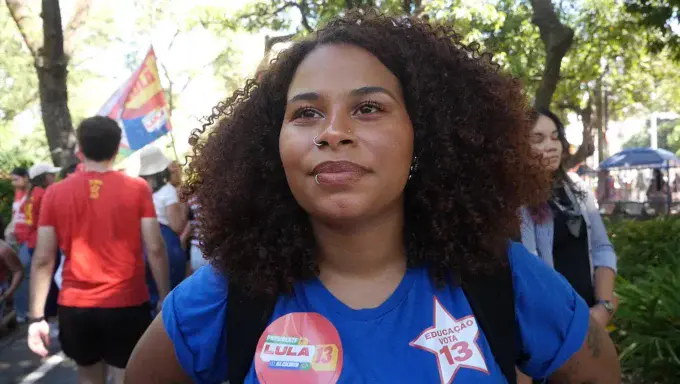
Mayllane da Silva. Photo: Brian Mier.
In Recife, Mayllane da Silva, a national director of UNE, the National University Students’ Union, said, “We are out on the streets today because we believe President Lula’s reelection is essential to defending education in our country. We can’t leave education in Flávio Bolsonaro’s hands, given that he wants to take our universities out from the jurisdiction of Education Ministry. He wants to tear down education in our country. That’s why UNE isn’t just out on the streets here in Pernambuco, but all across Brazil, to say: We need Lula reelected president so we can defend our right to education.”
In a rally organized by São Paulo’s city workers and state theater workers unions, actress Flora Sandya said, “I think it’s important that we young people who work in the cultural industry take a side, because we are in a very delicate political moment in Brazil. We have to defend our rare earth minerals, and we have to keep Brazil out of the hands of the United States.”
In the historic rally on Paulista Avenue, which brought more people to the streets than the entire population of Philadelphia, a young subway system worker named Ricardo Senese told me, “Considering the entire history of the Bolsonaros, they can be viewed as a family that fights against democratic rights. They attempted to stage a coup on Jan. 8, 2023. They nominated top-ranking military commanders to head their ministries. We support Lula because we want to strengthen democracy in our country. We are defending democratic freedom.”
Many people were worried about dirty electoral tricks, and it didn’t take long for news of them to come to the surface. In São Paulo, Bolsonaro-aligned Mayor Ricardo Nunes ignored a court order requiring the buses to run at full capacity and had 40% of his fleet parked in city garages, primarily for lines going through the poor neighborhoods on the city periphery where Lula had gotten the most votes in the first round. Similar complaints began to come in from cities like Salvador, Brazil’s sixth-largest metro area, and Petrolina, Pernambuco, population 440,000.
After both the Bolsonaro and Lula campaigns issued complaints requesting voting hours to be extended, Supreme Court Justice Cristiano Zanin issued an order for the polling stations to stay open for another two hours. At this exact moment, I was in a São Paulo polling station at FAM, the College of the Americas, and this is what I saw.
The entrance gates to the college were closed at 5 p.m., leaving a middle aged woman in tears because she had just spent one hour and 40 minutes on public transportation after leaving her job as a supermarket cashier on the other side of the city so that she could exercise her democratic right to vote. Fifty minutes later, a guard came out and reopened the gate. Unfortunately, by this time the woman was long gone.
“This isn’t just happening in São Paulo,” the guard said. “It’s happening in several other states. There have been problems with public transportation. There were several locations where people did not have good access to mobility, so both candidates agreed to extend the voting deadline. And they are telling us it has been extended to 7 p.m.”
Heading back into the building, I saw election observers arguing with officials.
“The Workers Party and its coalition partners filed a court request to extend the voting deadline by two hours across the entire country due to problems with public transportation,” a university professor and election observer named Maria Carlotta told me. “The electoral court took a long time to respond, so the Federal Supreme Court intervened and issued the extension, but many voting centers in São Paulo are ignoring the order due to instructions from the [conservative] São Paulo regional electoral court.”
A few minutes later, the front gate was closed again. An election official told me that the problem was that the order from the Supreme Court came too late and that all the electronic voting machines had been turned off. Once that happens, he said, they cannot be turned on again.
Another election observer came up to me and contradicted the official. “My name is Marilda Taffarel, and I am an observer from the Workers Party for section 197 on the fifth floor of this voting center. The ballot machines were not all turned off there. Several ballot boxes were still open. On the other floors they were closed very quickly. It was only after a lot of insisting that the gate for voters to enter was reopened at 5:50 p.m. And the issue of one voter who arrived at 5:10 p.m. is still being resolved. They still haven’t let him vote, and he’s here complaining, and they are trying to send him to the notary public’s office.”
As I was getting ready to leave, the front gate was reopened, and I saw three voters enter the building being told that they would only be able to vote if they were registered for the voting section on the fifth floor.
In the end, it didn’t make any difference. Lula won by 4.4 million votes, and the total number of votes tallied nationwide between 5 p.m. and 7 p.m. was only 35,000.
I waited for the results with a friend in a restaurant during the tallying. When the count hit 80% with Lula still in the lead, the streets broke out with cheers, singing and shouting for Lula. We got onto subway train at República station that was already jam packed with people in red singing and shouting. Our short trip up to Paulista Avenue was like a carnival ride, and when we came up to street level, we were greeted by a crowd of red that stretched as far as the eye could see.
How did Lula stage his comeback?
If it weren’t for Meta and other social media company manipulation, plus the U.S. government using tariffs and sanctions to try to scare and extort voters into supporting their candidate as they did in countries like Honduras, Peru and Colombia, I believe that Lula would have won by at least 10 million votes.
The fact that he managed to double his lead over Jair Bolsonaro from the 2022 election is a testimony to the support he has from Brazil’s working class, which voted for him by a nearly 2 to 1 ratio over Bolsonaro.
Formed by a coalition of working-class labor unions and social movements with middle class intellectuals like Paulo Freire, the PT has always relied on grassroots organizing. This has been put to the test in the age of heavily manipulated algorithmic reach pushed by the social media corporations.
It’s also led to bad analysis about the left not knowing how to use social media, as if these Zionist corporations were a democratic commons where everyone had equal freedom to express their ideas, not a field where wealthy elites can pay for reach and build bot armies to advance dystopian fantasies about things like “scientific racism,” “the joys of being a trad wife” and “the climate change hoax.”
After losing the first round, party activists doubled down on the PT’s traditional mobilization techniques of knocking on doors, talking to people on the street and in the workplace, and organizing street rallies. The instructions were to focus on the 33 million people who abstained during the first round election. The party’s logic was that it would be easier to convince people to come out to vote than it would be to convince Bolsonaro supporters to change their votes. The analysis turned out to be correct. Fourteen million people who abstained or cast blank ballots in the first round election voted in the runoff. Of those 14 million, 10.3 million voted for Lula and 3.7 million voted for Flávio Bolsonaro.
Although social media is not an even playing field, successful strategies were employed that made a difference in the election. First of all, from the moment Amnesty International and Eko first published their reports, pressure began to build against Meta. After more reporting by Brazilian journalists exposed Meta’s fraud, protests in front of corporate headquarters kicked off in three countries, and Meta announced that its global policy director and main point man with the Trump administration, Joel Kaplan, was leaving the company.
This pressure on Meta seems to have made a difference in reach for both candidates on the final election day, after the debacle of the first round, where, 12 hours before the voting started, Flávio suddenly had multiple times more engagement than Lula.
Another clear factor that contributed to Lula’s victory was concocted by Minas Gerais congressman André Janones, from the center-left REDE party. He successfully built a WhatsApp group called “Lula’s Troops,” which amassed over 10 million followers in less than two weeks. Janones has a lot of charisma, and his hourly pep talks with instructions for online behavior for Lula supporters certainly built momentum for the election.
Right wing journalist and politician Joice Hasselmann, who has a huge social media following, was the bolsonarista liberal party’s first leader in Congress during the Jair Bolsonaro administration. She generated a lot of waves when she announced that even though she dislikes the Workers Party’s policies and will continue arguing with them, she was voting for Lula because of the importance of democracy and sovereignty.
Another factor in Lula’s victory was the Catholic vote. Despite misunderstandings about this in the Global North, there are twice as many Catholics as evangelicals in Brazil. Jair Bolsonaro’s presidency was ushered in in part through a Reaganesque coalition of right wing Catholics, like Jair himself, and conservative evangelical Christians. But when it came out that the pastor who converted Flávio from Catholicism to prosperity gospel evangelism wrote an entire book chapter comparing Brazil’s patron saint, Our Lady of Aparecida, to Satan, and that a large number of Bolsonaro supporters were working to try to have her removed as the patron saint of Brazil, there was a backlash among a significant number of conservative Catholics that certainly made a difference on election day.
What happens now?
Historically, when a U.S.-backed candidate loses an election in Latin America, the next step is to begin working on a coup. This happened most recently in Brazil after the DNC’s beloved and corrupt candidate Aécio Neves lost to Dilma Rousseff.
Flávio Bolsonaro has already fled to Miami. His parliamentary immunity ends in February with the formation of the new Senate, and he is currently under investigation for a series of crimes. There are mountains of material evidence including audio recordings showing tax evasion and money laundering of a $12 million gift from jailed banking fraudster Daniel Vorcaro – a crime that has been admitted by Flávio himself. In other words it was a reasonable assumption that sooner or later, he would be arrested in Brazil. This probably explains why, with Javier Milei and Trump’s help, he snuck out of the country after the Federal Police requested his passport, correctly assessing him as a flight risk.
After Bolsonaro released a statement yesterday declaring himself the “legitimate president of Brazil,” however, his family’s closest allies have begun to distance themselves from him. São Paulo Gov. Tarcísio Freitas said that he knows it must be tough but that Flávio has to accept the election results and move forward. Bolsonaro’s Liberal Party (PL) leadership has issued a statement officially recognizing the election results. Pastor Silas Malafaia, one of the most powerful right wing evangelical leaders in Brazil, has not only recognized the election results but also labeled the Bolsonaro children as a group of “jackasses.”
Actors on the international far right continue to push an “authoritarian Brazil” narrative. This might work in the parallel universe of QAnon, flat earthers and the great replacement theory, but does not hold up to any rational analysis. If Brazil is so authoritarian, how did Bolsonaro’s Liberal Party just elect the highest number of congressmen and senators? How did Jair Bolsonaro’s wife, Michelle, just get elected to the Senate? How did the fraudulent U.S.-trained judge who oversaw kangaroo court proceedings that led to Lula’s arbitrary imprisonment just get elected governor of Paraná? How did Flávio’s own brother Carlos just get elected to the Senate?
There is no doubt in my mind that the Silicon Valley tech giants want to destroy Brazil’s democracy. There is also no doubt in my mind that Secretary of State Marco Rubio and Trump want to transform Brazil into a neocolonial protectorate, as they are trying to do with Venezuela.
The questions at this point are:
1) How high is this on their priority list?
2) How will a possible Democratic victory in the U.S. midterms change their power dynamic?
At this point in the conjuncture, it seems that any future regime change plans coming from the U.S. will be made without the Bolsonaros, who are now, like Maria Corina Machado, firmly placed in the “loser” column on Trump’s mental list of winners and losers.
This first ran on De-linking Brazil.
How Lula Turned the Tables on the Right in Brazil and the US
October 30, 2026

Photograph Source: Lula Oficial – CC BY-SA 4.0
A leader who stood up to U.S. President Donald Trump just won an election in Latin America’s biggest country, reversing a trend of new right-wing governments in the region over the past two years.
Incumbent Luiz Inácio Lula da Silva, having narrowly lost to Flávio Bolsonaro in the first round of voting on Oct. 5, 2026, staged a remarkable comeback on Oct. 25. He erased the deficit and won the all-important runoff election by more than 3.5 percentage points – more than 4 million votes.
It was a stunning result for the leader who proved to be the first Brazilian candidate to win a presidential election after not winning the first round, and who had been all but written off for a possible win. As a professor of Latin American politics, I believe the result offers a number of key political lessons for Brazil, Latin America – and even the United States.
A contest of worldviews — and social media
The choice in the second-round election was stark. Lula offered measures to ameliorate steep income inequalities and an economy built on a transition to clean energy, environmental protection and increased access to higher education and technical training. On international matters, Lula balanced defending Brazilian sovereignty from a Trump administration keen on meddling in Latin America, and maintaining good relations with an array of nations and blocs, including the European Union and China.
Bolsonaro, meanwhile, promised sweeping cuts to government spending, more militarized policing and eager support for the Trump administration’s campaign against drug violence. His pitch also came with offers to U.S. investors of access to critical minerals in Brazil.
Such right-wing populism has been ascendant in Latin America of late, and Lula also had to overcome an anti-incumbent mood, brought on by high prices, stagnant salaries, steep interest rates and a massive corruption scandal involving Brazilian elites. That banking probe directly ensnared Bolsonaro himself, as well as powerful Supreme Court justice Alexandre de Moraes, whom Bolsonaro’s supporters had tried to link to Lula.
Lula also had to neuter a social media landscape that has been dominated by images and narratives disparaging the president and his Workers’ Party.
Right-wing dominance of that online ecosystem helped carry Jair Bolsonaro, the 2026 hopeful’s father, to power in 2018 and got him close to reelection in 2022.
Especially after the first-round results in the 2026 vote, many analysts assumed the same pro-Bolsonaro social media presence would once again be hegemonic.
Instead, after the first round, a network of young, tech-savvy pro-Lula communicators created and shared effective, often amusing videos on WhatsApp and Instagram.
And they appealed to the center and even some of the right. All told, Lula easily made up more than 2 million votes by which he lost in the first round. He didn’t just increase turnout by millions and lower abstention rates; he also saw the state with the country’s second-largest electorate, Minas Gerais, flip to his side entirely – a swing of nearly 700,000 votes.
Emblematic of the strength of the campaign was the growth in subscribers to the WhatsApp channel Lula’s Army, which grew from 50,000 on Oct. 5 to more than 10 million by the night of the historic election.
The creator of the channel, André Janones, is a federal deputy for the Rede Party, an ally of the Workers’ Party, and a rising star in the circle around Lula. Likewise, Ana Elisa Santos Silva, a 21-year-old digital influencer and law student in the Workers’ Party, got the most votes of any federal deputy in the swing state of Minas Gerais.
Cracks in the ‘Americanization’ theory of politics
A prevalent narrative of Brazilian politics has held that the country’s divisions increasingly mirror those of the United States.
Part of that idea is due to Trump’s loss in the 2020 election and the resulting attack on the U.S. Capitol on Jan. 6, 2021, which eerily presaged events following Jair Bolsanaro’s 2022 loss.
Like in the U.S., there has also been a rapid rise of a politically active evangelical right in Brazil.
More fundamentally, proponents of the Americanization thesis hold that U.S.-style deindustrialization and “Uberization” of the Brazilian economy have led to a decline of the unionized working class – a core support base for the left – and its replacement by an army of gig employees dreaming of owning their own businesses and throwing off the shackles of the taxing and regulating state.
Yet similarities between the two countries shouldn’t be confused for politics always moving on parallel tracks.
Survey research suggests that many Brazilians see the state as responsible for the realization of their constitutionally protected social rights, including healthcare, education and pensions. Many also regard government employment as inherently more stable and dignified than the harsh labor markets of the private sector, especially for the relatively unskilled.
For all of the apparent rise in American-style libertarian politics in Brazil, the reality is that such a viewpoint remains much smaller in the country. Flávio Bolsonaro’s bet, like his father’s before him, was that this strain of libertarian right-wing politics could nonetheless propel him to victory, much as it apparently had for Javier Milei in Argentina in 2023. But it was not enough.
One election can’t fix deep polarization
Even with Lula’s win, Flávio Bolsonaro’s Liberal Party did exceptionally well at the legislative level.
When the next Brazilian Congress convenes on Feb. 1, 2027, the Liberal Party will control 28 seats in the Senate – 35% of the total; and 121 seats in the lower house – 24% of the total (as well as five governorships, which are 19% of the total).
When factoring in expected Liberal Party allies, it is clear that the right will have bigger majorities in both houses for Lula’s next administration. That will help Congress solidify control vis-a-vis the executive branch in terms of legislation and, crucially, the budget.
A series of unknowns facing Lula
The election raises several questions.
First, it is unclear how Lula, who will turn 81 on Oct. 27, will be able to effectively govern. The president will have to make major concessions to a Congress with little capacity for responsibly delivering coherent policy.
The federal Supreme Court is also seen as politicized, fragmented and tainted by scandals. On the other hand, Lula could appoint four new Supreme Court justices because of upcoming retirements, meaning that he could shape the country’s highest judicial body in a way that enhances his ability to manage Congress.
Yet it might be difficult for Lula to simultaneously meet the demands coming from Congress and those from the business community. For example, many will push the government to curb the fiscal deficit, currently running at a very high annual level of close to 8% of gross domestic product.
A second question is whether Bolsonaro’s loss will splinter the right. One interpretation of the 2026 election is that to be competitive, the right will want to move on from the Bolsonaro family. One potential figure is Tarcísio de Freitas, a former cabinet member in the Jair Bolsonaro government and popular governor of São Paulo. Yet there are nonetheless five members of the Bolsonaro family in the new Congress, and they are likely to try to keep together the coalition that fought for Flávio Bolsonaro’s campaign.
Finally, it’s not clear how the Trump administration, which interfered decisively against Lula’s agenda, will react to his win – and to what extent it will support Bolsonaro’s denial of his election loss even though it was bigger than his father’s in 2022.
Whatever the extent of any interference, the Trump administration’s right-wing Latin American vision invariably sets up conflict with Lula. Yet while the Trump preference was always for Flávio Bolsonaro, that doesn’t mean his administration won’t pragmatically engage with Lula even as it pressures his government. For his part, Lula continues to hold his own leverage, including through Brazil’s large deposits of rare earth elements that the Trump administration covets.
If the past eight years of Brazilian politics are any guide, Lula’s next administration is likely to be a turbulent one in which enduring divisions at home and abroad are continually tested.
This article is republished from The Conversation under a Creative Commons license. Read the original article.
The leftist leader Luiz Inácio Lula da Silva secured a historic victory in Brazil’s presidential election on 25 October 2026. The result came amid intense political and social polarization and the growing influence of the far right in Brazil and across Latin America, backed by the U.S. far right led by Donald Trump.
The significance of this electoral victory extends beyond Lula securing a fourth term. It also lies in the political and organizational experience that helped make it possible, above all the ability of diverse left-wing and progressive forces, with different programs and ideological outlooks, to forge a broad electoral alliance around common ground in confronting the far right.
A Broad Left-Wing and Progressive Alliance Despite Differences
Lula contested the election with the support of the ‘Brazil Ready for More’ alliance, comprising seven left-wing and progressive parties organized into two party federations and two separate parties. The ‘Brazil of Hope’ federation brought together Lula’s Workers’ Party, the Communist Party of Brazil, and the Green Party. The second federation united the Socialism and Liberty Party, which includes socialist and radical-left currents, with the Sustainability Network. The Brazilian Socialist Party and the Democratic Labour Party also joined the alliance, alongside supportive social movements and trade unions. Lula ran with Geraldo Alckmin of the Brazilian Socialist Party as his vice-presidential candidate.
The importance of this alliance lies in its ability to bring together communists, socialists, the radical left, social democrats, and Greens despite their disagreements over capitalism, the role of the state, and the limits of social reform. These forces agreed on common electoral objectives while preserving their identities and organizational autonomy.
This is one of the most important lessons of the Brazilian experience. Left unity does not require ideological or organizational uniformity. It means being able to work together on common ground while respecting pluralism and differences. Disagreements over Lula’s economic and social policies will naturally persist, including among the forces that supported him at the ballot box.
Unity Does Not Mean Abandoning Criticism or Autonomy
The Brazilian experience raises an important question for left-wing forces around the world. Why do ideological and organizational differences become barriers to cooperation, despite so much common ground, even when these forces face shared political and class challenges?
Pluralism among communists, social democrats, the radical left, environmentalist and feminist currents, and independent leftists can be a source of strength and intellectual and political richness, provided it is managed democratically and constructively, without monopolization, exclusion, or claims to possess the absolute truth. Unity does not require abandoning criticism or offering unconditional acceptance of the policies of governments led by left-wing and progressive alliances.
Confronting Capitalism and the Far Right Requires a Broad Social Front
The victory demonstrated the importance of connecting the defence of democracy, rights, and freedoms with the economic and social demands of working classes and poor and marginalized communities.
Lula drew broad support from lower-income groups and proposed expanding social assistance, improving living conditions, and defending democratic institutions.
Confronting capitalism and the far right therefore cannot be confined to elections and party alliances. It requires sustained mass organizations in workplaces, neighbourhoods, universities, trade unions, and social movements, together with policies that tackle class inequality and improve the lives of the majority.
Digital Autonomy: The Fifth Pillar of the Left’s Independence
The Brazilian election revealed the growing importance of the digital sphere in political struggle. Social media platforms, algorithms, and artificial intelligence have become powerful tools in the hands of capitalist interests for shaping public consciousness and steering political debate.
During the campaign, Lula’s supporters submitted complaints and evidence supporting allegations that Meta, the company that owns Facebook, Instagram, and other platforms, showed digital bias in favour of his opponent. The company acknowledged ‘technical problems.’ The dispute reached Brazil’s electoral court, which issued a ruling requiring Meta to apply equal standards to the candidates.
The problem is not confined to Brazil. During Colombia’s most recent presidential election in 2026, journalistic investigations uncovered coordinated accounts and AI-generated fake videos targeting the left-wing camp, as well as shortcomings and bias in the platforms’ oversight of political advertising and content.
In Germany, Elon Musk, the owner of X, publicly endorsed the far-right Alternative for Germany (AfD) during the 2025 election. He used his platform to promote the party’s positions and host its leaders, while several studies found a clear bias in the reach of the party’s content on the platform.
Proving deliberate algorithmic bias is difficult because proprietary algorithms give capitalist corporations exclusive control over information about how they work and how content is ranked, amplified, or restricted. Without transparency, independent public and legal oversight, and access to the data needed for investigation, it is difficult to determine whether bias arises from algorithm design or deliberate intervention. Companies can easily attribute such problems to a ‘technical glitch’!
The Brazilian experience also highlighted the importance of combining three interconnected arenas of struggle: mass struggle on the ground, legal action to hold digital platforms accountable and regulate their operations and organized digital activism. Mass mobilization in the streets was accompanied by legal challenges against Meta and the development of a wide-ranging digital campaign that used social media effectively to reach millions of voters. This experience shows that the digital left’s struggle cannot replace grassroots struggle. It can reinforce and complement it.
This is where digital autonomy emerges as the fifth pillar of the left’s independence, alongside ideological, organizational, financial, and media autonomy. Genuine political independence is no longer possible without a meaningful degree of autonomy over digital tools, platforms, and infrastructure, the protection of data, and the capacity for mass communication and organization free from the monopolistic control of capitalist corporations and major powers.
Digital autonomy does not mean withdrawing from digital platforms. It means using them today with a critical, progressive awareness while working to develop open-source, democratically governed digital alternatives and to build and strengthen independent technical capacities within the left.
A left that fails to develop its digital autonomy and technological tools will remain at the mercy of its class adversaries in one of the most important arenas of contemporary political and social struggle.
Lessons for the Left Worldwide
The Brazilian experience cannot be reproduced mechanically. Every society has its own conditions and balance of class and political forces. The Brazilian approach to building alliances and working together can nevertheless offer valuable lessons.
The unity the left needs is neither a single party nor a centralized leadership imposing its vision on everyone. It is flexible, democratic cooperation among diverse forces, grounded in common programs, respect for autonomy and pluralism, and meaningful participation by the grassroots, young people, and women.
Such cooperation can be developed locally, regionally, and globally through different left-wing fronts and alliances on the ground, as well as digital left networks and internationals that contribute to the exchange of experience, coordinate shared initiatives and struggles, and work toward progressive digital alternatives.
Lula’s victory offers an experience worth studying and learning from. It demonstrates the possibility of cooperation among left-wing forces despite their differences, while recognizing the other factors that contributed to the result.
The left does not need to erase its diversity to unite. It needs to turn that diversity into an organized and effective force, strengthen its independence across all five pillars, and pursue the struggle for freedom, equality, and social justice while developing democratic, humanist socialist alternatives to capitalism.
This article was produced by Globetrott
Lula’s Victory Hinders Trump and Tech Bro Dreams
October 30, 2026
In a normal presidential race, a candidate who defended a corrupt police officer on trial for murdering a 5-year-old girl wouldn’t even be in the running. The only member of Rio de Janeiro’s state legislature to vote against extending maternity leave, who had hired the girlfriend and mother of one of the state’s most notorious death squad leaders, Adriano da Nóbrega, as ghost employees in his state congressional cabinet for more than a decade, and who was under investigation for laundering millions of dollars, would have a hard time reaching double digits in the polls. A man who chose a vice presidential running-mate who was under investigation for raping a 13 year-old girl would never emerge as a front runner in a Brazilian presidential race. This was not a normal election.
It was an election that saw flagrant interference from the U.S. government in the form of tariffs and sanctions, with President Donald Trump personally meeting with a candidate in the White House. It saw massive intervention from Meta, whose owner was one of Trump’s largest campaign donors, and a secret deal for rare earth minerals struck between Vice President J.D. Vance’s Rockbridge Network and the Bolsonaro campaign. It was the first election in Brazilian history in which a candidate, Flávio Bolsonaro, offered to turn supervision of his transition team over to the U.S. government if elected.
The U.S. intervention was so obvious that a group of 31 U.S. lawmakers sent a letter to the State Department officially complaining about it, an act further supported by a public declaration denouncing U.S. intervention signed by 39 British members of Parliament.
Meta manipulation was so flagrant that on two different occasions it was denounced by its own employees. Its failure to obey Brazil’s electoral laws and bar foreign campaign advertising was exposed by Amnesty International, Eko and the Brazilian Supreme Court. Nadia Beller, former girlfriend of international far right bagman Fernando Cerimedo, who is rotting in a Bolivian prison after attempting to murder her, told Mexico’s Channel 14 that Eduardo Bolsonaro had visited Meta headquarters in California with Cerimedo to strike a deal to favor Flávio in the elections. And Meta corporation is now the subject of a Federal Police investigation for election interference in Brazil.
None of this was enough to guarantee a Bolsonaro victory and the dystopian hellscape that would have followed.
Massive grassroots organizing leads to biggest rallies in Brazilian history
Across Brazil, in thousands of towns and cities, millions of people took to the streets to rally for Lula. I witnessed a Lula rally in the small town of Paudalho, Pernambuco (population 55,000), in which over half of the entire population took to the streets to show their support for Lula. I saw 200,000 show up for a Lula rally in Recife, center of a metro area of 3.4 million, and was present at the largest rally in São Paulo’s history, which saw a crowd of 2 million people show up on Paulista Avenue the afternoon before election day.
The one thing these crowds had in common was that, in addition to the legions of first generation PT supporters in their 60s and 70s who fought against the military dictatorship and have never given up on the party, the streets were full of working class youth, including huge numbers of Afro-Brazilians who now make up 52% of Brazil’s public university student body.
João do Boi, a man in his 70s who leads a local Carnival group in Paudalho, told me, “I worked as a street vendor to pay my way through high school. Today these young people, some of whom are still voting for the other side, don’t know anything about our suffering and struggle for these rights that they take for granted. They think they’ve always existed. People gave their sweat and blood and their lives – a lot of people died fighting for these rights.”
Mayllane da Silva. Photo: Brian Mier.
In Recife, Mayllane da Silva, a national director of UNE, the National University Students’ Union, said, “We are out on the streets today because we believe President Lula’s reelection is essential to defending education in our country. We can’t leave education in Flávio Bolsonaro’s hands, given that he wants to take our universities out from the jurisdiction of Education Ministry. He wants to tear down education in our country. That’s why UNE isn’t just out on the streets here in Pernambuco, but all across Brazil, to say: We need Lula reelected president so we can defend our right to education.”
In a rally organized by São Paulo’s city workers and state theater workers unions, actress Flora Sandya said, “I think it’s important that we young people who work in the cultural industry take a side, because we are in a very delicate political moment in Brazil. We have to defend our rare earth minerals, and we have to keep Brazil out of the hands of the United States.”
In the historic rally on Paulista Avenue, which brought more people to the streets than the entire population of Philadelphia, a young subway system worker named Ricardo Senese told me, “Considering the entire history of the Bolsonaros, they can be viewed as a family that fights against democratic rights. They attempted to stage a coup on Jan. 8, 2023. They nominated top-ranking military commanders to head their ministries. We support Lula because we want to strengthen democracy in our country. We are defending democratic freedom.”
Many people were worried about dirty electoral tricks, and it didn’t take long for news of them to come to the surface. In São Paulo, Bolsonaro-aligned Mayor Ricardo Nunes ignored a court order requiring the buses to run at full capacity and had 40% of his fleet parked in city garages, primarily for lines going through the poor neighborhoods on the city periphery where Lula had gotten the most votes in the first round. Similar complaints began to come in from cities like Salvador, Brazil’s sixth-largest metro area, and Petrolina, Pernambuco, population 440,000.
After both the Bolsonaro and Lula campaigns issued complaints requesting voting hours to be extended, Supreme Court Justice Cristiano Zanin issued an order for the polling stations to stay open for another two hours. At this exact moment, I was in a São Paulo polling station at FAM, the College of the Americas, and this is what I saw.
The entrance gates to the college were closed at 5 p.m., leaving a middle aged woman in tears because she had just spent one hour and 40 minutes on public transportation after leaving her job as a supermarket cashier on the other side of the city so that she could exercise her democratic right to vote. Fifty minutes later, a guard came out and reopened the gate. Unfortunately, by this time the woman was long gone.
“This isn’t just happening in São Paulo,” the guard said. “It’s happening in several other states. There have been problems with public transportation. There were several locations where people did not have good access to mobility, so both candidates agreed to extend the voting deadline. And they are telling us it has been extended to 7 p.m.”
Heading back into the building, I saw election observers arguing with officials.
“The Workers Party and its coalition partners filed a court request to extend the voting deadline by two hours across the entire country due to problems with public transportation,” a university professor and election observer named Maria Carlotta told me. “The electoral court took a long time to respond, so the Federal Supreme Court intervened and issued the extension, but many voting centers in São Paulo are ignoring the order due to instructions from the [conservative] São Paulo regional electoral court.”
A few minutes later, the front gate was closed again. An election official told me that the problem was that the order from the Supreme Court came too late and that all the electronic voting machines had been turned off. Once that happens, he said, they cannot be turned on again.
Another election observer came up to me and contradicted the official. “My name is Marilda Taffarel, and I am an observer from the Workers Party for section 197 on the fifth floor of this voting center. The ballot machines were not all turned off there. Several ballot boxes were still open. On the other floors they were closed very quickly. It was only after a lot of insisting that the gate for voters to enter was reopened at 5:50 p.m. And the issue of one voter who arrived at 5:10 p.m. is still being resolved. They still haven’t let him vote, and he’s here complaining, and they are trying to send him to the notary public’s office.”
As I was getting ready to leave, the front gate was reopened, and I saw three voters enter the building being told that they would only be able to vote if they were registered for the voting section on the fifth floor.
In the end, it didn’t make any difference. Lula won by 4.4 million votes, and the total number of votes tallied nationwide between 5 p.m. and 7 p.m. was only 35,000.
I waited for the results with a friend in a restaurant during the tallying. When the count hit 80% with Lula still in the lead, the streets broke out with cheers, singing and shouting for Lula. We got onto subway train at República station that was already jam packed with people in red singing and shouting. Our short trip up to Paulista Avenue was like a carnival ride, and when we came up to street level, we were greeted by a crowd of red that stretched as far as the eye could see.
How did Lula stage his comeback?
If it weren’t for Meta and other social media company manipulation, plus the U.S. government using tariffs and sanctions to try to scare and extort voters into supporting their candidate as they did in countries like Honduras, Peru and Colombia, I believe that Lula would have won by at least 10 million votes.
The fact that he managed to double his lead over Jair Bolsonaro from the 2022 election is a testimony to the support he has from Brazil’s working class, which voted for him by a nearly 2 to 1 ratio over Bolsonaro.
Formed by a coalition of working-class labor unions and social movements with middle class intellectuals like Paulo Freire, the PT has always relied on grassroots organizing. This has been put to the test in the age of heavily manipulated algorithmic reach pushed by the social media corporations.
It’s also led to bad analysis about the left not knowing how to use social media, as if these Zionist corporations were a democratic commons where everyone had equal freedom to express their ideas, not a field where wealthy elites can pay for reach and build bot armies to advance dystopian fantasies about things like “scientific racism,” “the joys of being a trad wife” and “the climate change hoax.”
After losing the first round, party activists doubled down on the PT’s traditional mobilization techniques of knocking on doors, talking to people on the street and in the workplace, and organizing street rallies. The instructions were to focus on the 33 million people who abstained during the first round election. The party’s logic was that it would be easier to convince people to come out to vote than it would be to convince Bolsonaro supporters to change their votes. The analysis turned out to be correct. Fourteen million people who abstained or cast blank ballots in the first round election voted in the runoff. Of those 14 million, 10.3 million voted for Lula and 3.7 million voted for Flávio Bolsonaro.
Although social media is not an even playing field, successful strategies were employed that made a difference in the election. First of all, from the moment Amnesty International and Eko first published their reports, pressure began to build against Meta. After more reporting by Brazilian journalists exposed Meta’s fraud, protests in front of corporate headquarters kicked off in three countries, and Meta announced that its global policy director and main point man with the Trump administration, Joel Kaplan, was leaving the company.
This pressure on Meta seems to have made a difference in reach for both candidates on the final election day, after the debacle of the first round, where, 12 hours before the voting started, Flávio suddenly had multiple times more engagement than Lula.
Another clear factor that contributed to Lula’s victory was concocted by Minas Gerais congressman André Janones, from the center-left REDE party. He successfully built a WhatsApp group called “Lula’s Troops,” which amassed over 10 million followers in less than two weeks. Janones has a lot of charisma, and his hourly pep talks with instructions for online behavior for Lula supporters certainly built momentum for the election.
Right wing journalist and politician Joice Hasselmann, who has a huge social media following, was the bolsonarista liberal party’s first leader in Congress during the Jair Bolsonaro administration. She generated a lot of waves when she announced that even though she dislikes the Workers Party’s policies and will continue arguing with them, she was voting for Lula because of the importance of democracy and sovereignty.
Another factor in Lula’s victory was the Catholic vote. Despite misunderstandings about this in the Global North, there are twice as many Catholics as evangelicals in Brazil. Jair Bolsonaro’s presidency was ushered in in part through a Reaganesque coalition of right wing Catholics, like Jair himself, and conservative evangelical Christians. But when it came out that the pastor who converted Flávio from Catholicism to prosperity gospel evangelism wrote an entire book chapter comparing Brazil’s patron saint, Our Lady of Aparecida, to Satan, and that a large number of Bolsonaro supporters were working to try to have her removed as the patron saint of Brazil, there was a backlash among a significant number of conservative Catholics that certainly made a difference on election day.
What happens now?
Historically, when a U.S.-backed candidate loses an election in Latin America, the next step is to begin working on a coup. This happened most recently in Brazil after the DNC’s beloved and corrupt candidate Aécio Neves lost to Dilma Rousseff.
Flávio Bolsonaro has already fled to Miami. His parliamentary immunity ends in February with the formation of the new Senate, and he is currently under investigation for a series of crimes. There are mountains of material evidence including audio recordings showing tax evasion and money laundering of a $12 million gift from jailed banking fraudster Daniel Vorcaro – a crime that has been admitted by Flávio himself. In other words it was a reasonable assumption that sooner or later, he would be arrested in Brazil. This probably explains why, with Javier Milei and Trump’s help, he snuck out of the country after the Federal Police requested his passport, correctly assessing him as a flight risk.
After Bolsonaro released a statement yesterday declaring himself the “legitimate president of Brazil,” however, his family’s closest allies have begun to distance themselves from him. São Paulo Gov. Tarcísio Freitas said that he knows it must be tough but that Flávio has to accept the election results and move forward. Bolsonaro’s Liberal Party (PL) leadership has issued a statement officially recognizing the election results. Pastor Silas Malafaia, one of the most powerful right wing evangelical leaders in Brazil, has not only recognized the election results but also labeled the Bolsonaro children as a group of “jackasses.”
Actors on the international far right continue to push an “authoritarian Brazil” narrative. This might work in the parallel universe of QAnon, flat earthers and the great replacement theory, but does not hold up to any rational analysis. If Brazil is so authoritarian, how did Bolsonaro’s Liberal Party just elect the highest number of congressmen and senators? How did Jair Bolsonaro’s wife, Michelle, just get elected to the Senate? How did the fraudulent U.S.-trained judge who oversaw kangaroo court proceedings that led to Lula’s arbitrary imprisonment just get elected governor of Paraná? How did Flávio’s own brother Carlos just get elected to the Senate?
There is no doubt in my mind that the Silicon Valley tech giants want to destroy Brazil’s democracy. There is also no doubt in my mind that Secretary of State Marco Rubio and Trump want to transform Brazil into a neocolonial protectorate, as they are trying to do with Venezuela.
The questions at this point are:
1) How high is this on their priority list?
2) How will a possible Democratic victory in the U.S. midterms change their power dynamic?
At this point in the conjuncture, it seems that any future regime change plans coming from the U.S. will be made without the Bolsonaros, who are now, like Maria Corina Machado, firmly placed in the “loser” column on Trump’s mental list of winners and losers.
This first ran on De-linking Brazil.
How Lula Turned the Tables on the Right in Brazil and the US
October 30, 2026

Photograph Source: Lula Oficial – CC BY-SA 4.0
A leader who stood up to U.S. President Donald Trump just won an election in Latin America’s biggest country, reversing a trend of new right-wing governments in the region over the past two years.
Incumbent Luiz Inácio Lula da Silva, having narrowly lost to Flávio Bolsonaro in the first round of voting on Oct. 5, 2026, staged a remarkable comeback on Oct. 25. He erased the deficit and won the all-important runoff election by more than 3.5 percentage points – more than 4 million votes.
It was a stunning result for the leader who proved to be the first Brazilian candidate to win a presidential election after not winning the first round, and who had been all but written off for a possible win. As a professor of Latin American politics, I believe the result offers a number of key political lessons for Brazil, Latin America – and even the United States.
A contest of worldviews — and social media
The choice in the second-round election was stark. Lula offered measures to ameliorate steep income inequalities and an economy built on a transition to clean energy, environmental protection and increased access to higher education and technical training. On international matters, Lula balanced defending Brazilian sovereignty from a Trump administration keen on meddling in Latin America, and maintaining good relations with an array of nations and blocs, including the European Union and China.
Bolsonaro, meanwhile, promised sweeping cuts to government spending, more militarized policing and eager support for the Trump administration’s campaign against drug violence. His pitch also came with offers to U.S. investors of access to critical minerals in Brazil.
Such right-wing populism has been ascendant in Latin America of late, and Lula also had to overcome an anti-incumbent mood, brought on by high prices, stagnant salaries, steep interest rates and a massive corruption scandal involving Brazilian elites. That banking probe directly ensnared Bolsonaro himself, as well as powerful Supreme Court justice Alexandre de Moraes, whom Bolsonaro’s supporters had tried to link to Lula.
Lula also had to neuter a social media landscape that has been dominated by images and narratives disparaging the president and his Workers’ Party.
Right-wing dominance of that online ecosystem helped carry Jair Bolsonaro, the 2026 hopeful’s father, to power in 2018 and got him close to reelection in 2022.
Especially after the first-round results in the 2026 vote, many analysts assumed the same pro-Bolsonaro social media presence would once again be hegemonic.
Instead, after the first round, a network of young, tech-savvy pro-Lula communicators created and shared effective, often amusing videos on WhatsApp and Instagram.
And they appealed to the center and even some of the right. All told, Lula easily made up more than 2 million votes by which he lost in the first round. He didn’t just increase turnout by millions and lower abstention rates; he also saw the state with the country’s second-largest electorate, Minas Gerais, flip to his side entirely – a swing of nearly 700,000 votes.
Emblematic of the strength of the campaign was the growth in subscribers to the WhatsApp channel Lula’s Army, which grew from 50,000 on Oct. 5 to more than 10 million by the night of the historic election.
The creator of the channel, André Janones, is a federal deputy for the Rede Party, an ally of the Workers’ Party, and a rising star in the circle around Lula. Likewise, Ana Elisa Santos Silva, a 21-year-old digital influencer and law student in the Workers’ Party, got the most votes of any federal deputy in the swing state of Minas Gerais.
Cracks in the ‘Americanization’ theory of politics
A prevalent narrative of Brazilian politics has held that the country’s divisions increasingly mirror those of the United States.
Part of that idea is due to Trump’s loss in the 2020 election and the resulting attack on the U.S. Capitol on Jan. 6, 2021, which eerily presaged events following Jair Bolsanaro’s 2022 loss.
Like in the U.S., there has also been a rapid rise of a politically active evangelical right in Brazil.
More fundamentally, proponents of the Americanization thesis hold that U.S.-style deindustrialization and “Uberization” of the Brazilian economy have led to a decline of the unionized working class – a core support base for the left – and its replacement by an army of gig employees dreaming of owning their own businesses and throwing off the shackles of the taxing and regulating state.
Yet similarities between the two countries shouldn’t be confused for politics always moving on parallel tracks.
Survey research suggests that many Brazilians see the state as responsible for the realization of their constitutionally protected social rights, including healthcare, education and pensions. Many also regard government employment as inherently more stable and dignified than the harsh labor markets of the private sector, especially for the relatively unskilled.
For all of the apparent rise in American-style libertarian politics in Brazil, the reality is that such a viewpoint remains much smaller in the country. Flávio Bolsonaro’s bet, like his father’s before him, was that this strain of libertarian right-wing politics could nonetheless propel him to victory, much as it apparently had for Javier Milei in Argentina in 2023. But it was not enough.
One election can’t fix deep polarization
Even with Lula’s win, Flávio Bolsonaro’s Liberal Party did exceptionally well at the legislative level.
When the next Brazilian Congress convenes on Feb. 1, 2027, the Liberal Party will control 28 seats in the Senate – 35% of the total; and 121 seats in the lower house – 24% of the total (as well as five governorships, which are 19% of the total).
When factoring in expected Liberal Party allies, it is clear that the right will have bigger majorities in both houses for Lula’s next administration. That will help Congress solidify control vis-a-vis the executive branch in terms of legislation and, crucially, the budget.
A series of unknowns facing Lula
The election raises several questions.
First, it is unclear how Lula, who will turn 81 on Oct. 27, will be able to effectively govern. The president will have to make major concessions to a Congress with little capacity for responsibly delivering coherent policy.
The federal Supreme Court is also seen as politicized, fragmented and tainted by scandals. On the other hand, Lula could appoint four new Supreme Court justices because of upcoming retirements, meaning that he could shape the country’s highest judicial body in a way that enhances his ability to manage Congress.
Yet it might be difficult for Lula to simultaneously meet the demands coming from Congress and those from the business community. For example, many will push the government to curb the fiscal deficit, currently running at a very high annual level of close to 8% of gross domestic product.
A second question is whether Bolsonaro’s loss will splinter the right. One interpretation of the 2026 election is that to be competitive, the right will want to move on from the Bolsonaro family. One potential figure is Tarcísio de Freitas, a former cabinet member in the Jair Bolsonaro government and popular governor of São Paulo. Yet there are nonetheless five members of the Bolsonaro family in the new Congress, and they are likely to try to keep together the coalition that fought for Flávio Bolsonaro’s campaign.
Finally, it’s not clear how the Trump administration, which interfered decisively against Lula’s agenda, will react to his win – and to what extent it will support Bolsonaro’s denial of his election loss even though it was bigger than his father’s in 2022.
Whatever the extent of any interference, the Trump administration’s right-wing Latin American vision invariably sets up conflict with Lula. Yet while the Trump preference was always for Flávio Bolsonaro, that doesn’t mean his administration won’t pragmatically engage with Lula even as it pressures his government. For his part, Lula continues to hold his own leverage, including through Brazil’s large deposits of rare earth elements that the Trump administration covets.
If the past eight years of Brazilian politics are any guide, Lula’s next administration is likely to be a turbulent one in which enduring divisions at home and abroad are continually tested.
This article is republished from The Conversation under a Creative Commons license. Read the original article.
Lula’s comeback: A popular victory that marks the start of a new chapter
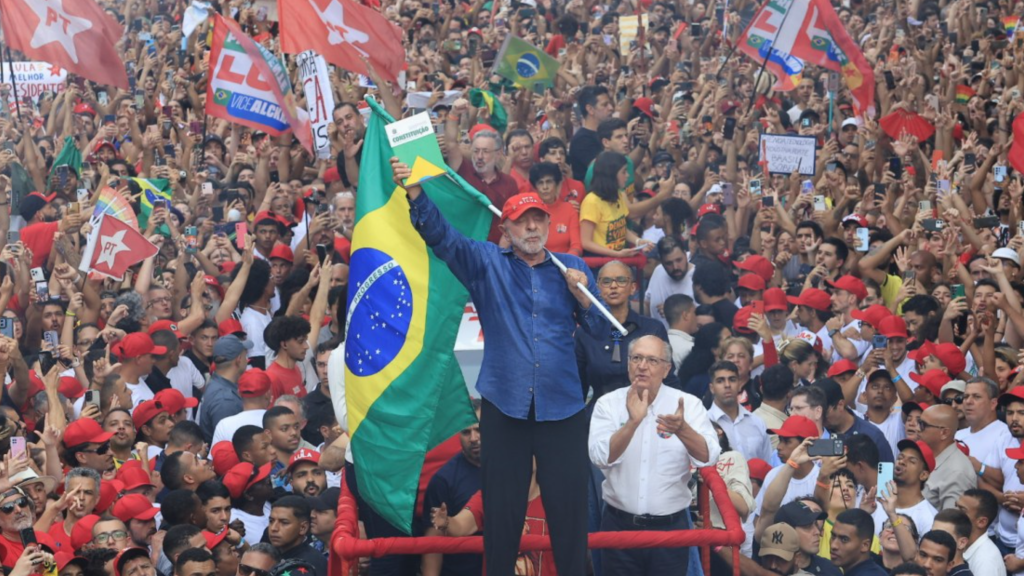
First published in Portuguese at Esquerda en Movimento. Translation by Federico Fuentes for LINKS International Journal of Socialist Renewal.
The greatest comeback in electoral history. What seemed impossible became inevitable on October 25, a night that will go down in history. Lula da Silva defeated the miliciano (far-right militiaman) Flávio Bolsonaro by 51.79% to 48.21% of the valid votes. A record turnout and stunning comeback that involved securing 10 million new votes and reducing abstentions and invalid votes. A rising tide of popular and democratic sentiment defeated the concerted efforts of the far right, most of the Brazilian bourgeoisie, imperialism, Big Tech, and the “coalition of backwardness” that Flávio represents. Lula’s election expressed, in a particular way, a condensed and unique form of class struggle with international implications.
It was a hard-fought, unbelievable victory that overcame powerful enemies who, in desperation, resorted to boycotts and fraud, partially suspended public transport in capitals such as Salvador and São Paulo, and sought to create a climate of uncertainty and revolt.
This statement offers our preliminary assessment, with initial considerations, to stimulate debate among activists and set out clear tasks, especially regarding the need to position the Socialism and Liberty Party (PSOL) — which has gained the support of millions — for this new and acute stage of class struggle in Brazil.
Victory of a popular and democratic uprising
Lula’s victory was a victory for the entire Brazilian people, for the democratic forces, the working class, young people, women, the Black community and the people of the Northeast; it was an expression of the fact that those “at the bottom” no longer accept the living and political conditions that the Brazilian elite seek to impose. It was a democratic victory that thwarts US President Donald Trump’s neo-colonialist rampage and serves to halt the far right’s advance, which had been securing electoral victories in the region. It shifts the balance of forces, with Trump now on the defensive and threatened with defeat in the upcoming mid-term elections, amid the major social struggles unfolding across Europe.
It combined a genuine popular uprising — centred on the youth — with a broader democratic movement in support of Lula for the second round. It was the most polarised and politicised election campaign ever, surpassing even the epic 1989 campaign. A mass movement, of a political and electoral nature, featuring diverse mass actions across Brazil’s five regions, which stands on a par with the 1963–64 mobilisation for general reforms, the 1978–79 strike movement that shook the dictatorship, the 1983–84 “Diretas Já” (Direct Elections Now) democratic and civic uprising, the 1992 “Fora Collor” (Fernando Collor de Mello Out) protests, and the June 2013 protests.
This combination was possible due to a series of factors, most notably a narrow window of opportunity that opened at the start of the second round when UFF (Fluminense Federal University) students provided the spark that ignited the mobilisation. This was further fuelled by the “whip” of Flávio’s reactionary statements, made amid the euphoria of his victory, suggesting that he could change the constitution, triggering an even greater response. From then on, the growing scale of mobilisation took an unprecedented turn, leading to the mobilisation of millions through street protests, online campaigns, activism and civic engagement. We witnessed the largest demonstrations in history, ranging from marches and election rallies to urban gatherings, culminating in the two demonstrations on Avenida Paulista that drew crowds numbering in the millions (some estimate between 1.2 and 1.5 million people). This was replicated in Brazil’s major capital cities, including Porto Alegre, Curitiba, Rio de Janeiro, Belo Horizonte, Vitória, Recife, Brasília, Belém, Teresina, Salvador, Fortaleza, Macapá, Natal and São Luís, among many others.
This mass movement expressed itself through practical demands, above all the call to end the 6x1 workweek schedule (six days on, one day off), with even Flávio Bolsonaro changing his vote in Congress. This major working class victory energised and instilled confidence in millions of people working in retail, telemarketing, fast-food restaurants and pharmacies across more than 5000 Brazilian municipalities.
The mass movement ran ahead of the leaders of the first round campaign — defeated due to erroneous forecasts and a moderate, bureaucratic line — and unleashed a new dynamic. Criticised for a lack of initiative, ineffective leadership and a shortage of resources, in practice the second round saw the start of a new campaign.
Lula, with his political acumen, was able to assess the situation and realign his strategy, stepping up his contestatory tone against Flávio, finding in young people and women his main base for mobilisation, and deepening effective measures to win over the majority of the people.
Lula's influence was central. Reflecting Brazil’s history and working class, and a key actor and statesman on the Brazilian stage, Lula reinvented himself at the age of 80 to capture the sentiment for change. He was aided by Andre Janones (Sustainability Network REDE federal deputy for Minas Gerais) with his “combat”-oriented focus, who understood the nature of the “war” being waged in the political and digital spheres, and operated as a true ‘“collective organiser” of this energy with his so-called “Exército de Lula” (Lula’s Army), fulfilling the role of a centralised digital party — the only one capable of countering the forces of Bolsonarism and Meta on social media and in public opinion.
It was the largest vote in Brazil’s history, with Lula receiving more than 64 million votes. To put this into perspective, Lula was elected in 2022 with about 60 million votes, while Jair Bolsonaro received more than 57 million in 2018. In his first successful presidential election in 2002, Lula secured almost 53 million votes, demonstrating the objective and absolute growth in the number of Brazilians voting for Lula.
Comeback possible due to mobilisation and a program
Lula’s strength and talent galvanised the political engagement of millions based on two key elements: mobilisation and championing a program to improve people’s lives.
The electoral and political struggle was tireless among young people and the elderly; the scenes of elderly people, with limited mobility, making their way to the polls were deeply moving. The result was flipped in 212 towns and cities. Notably were the distance covered and mobilisations undertaken in the Northeast; the spectacular turnaround in the Southeast where the tide turned the state of Minas Gerais and the capital, Rio de Janeiro; the incredible mobilisation in the state of São Paulo; and the comeback in swing regions such as the Porto Alegre metropolitan area (Alvorada, Esteio, Sapucaia), Osasco and the western region of São Paulo, Ribeirão das Neves, Nova Lima and others in Minas Gerais, and Ananindeua in the Belém metropolitan area. These are all testament to the scale of what took place.
Entire rural communities, quilombolas (Afro-Brazilian settlements), riverside communities and indigenous peoples turned out to vote, overcoming transport difficulties. Bus stations in the Northeast were packed from Saturday night to seal Lula’s victory.
The comeback was also made possible by the sudden realisation among millions of what it would mean if the Bolsonaro clan returned to power. Flávio embodies an anti-people elite, which attacked and slandered entire cities and regions during the televised debates, while Lula stood up and fearlessly exposed Flávio for what he is: an agent of the elite, a traitor to the nation, and a corrupt, violent figure with ties to paramilitaries. Against this “coalition of backwardness” — which involved Paulo Skaf (entrepreneur and right-wing politician), Ronaldo Caiado (landowner and right-wing politician) and other representatives of the regional oligarchies, baring the teeth of the same elite that inherited the violence of the slave-owning class — the majority of Brazilians rose up in the streets, on social media and at the ballot box.
The country’s two major political blocs came into visible confrontation. On one side stood Lula, expressing the democratic momentum of the streets, with broad support from the most politically aware sections of the working class and youth (in all their diversity); relying on minority sectors of the elites and business community, such as Geraldo Alckmin, the political representatives of the Centrão (Centre bloc) parties in the Northeast and Omar Aziz in Amazonas; as well as support from sections of the media and even non-Bolsonarist factions of the bourgeoisie, such as José Aníbal, José Sarney and others.
Flávio, on the other hand, primarily represented the core of the agribusiness sector with influence in the Central-West and North; the financial sector; the BBB bloc (Bullets, Beef and Bible or Bankers, Betting companies and Billionaires); part of the leadership of neo-Pentecostal churches; sections of the public security forces; as well as already established links with the paramilitaries in Rio de Janeiro and other states.
The program that Lula championed during this “spontaneous” campaign centred on reducing working hours, defending pay rises and pension increases, renegotiating the debts of households and small businesses, free public transport on weekends, support for investment in the SUS (Unified Health System), support for state education, the fight against gender violence, the fight against organised crime and state corruption, and, most forcefully, the issue of national sovereignty.
A turning point with international implications
The eyes of the world were on Brazil. A victory for Flávio would have bolstered Trump and Israeli Prime Minister Benjamin Netanyahu. It would have been a step towards strengthening Trump’s neo-colonialist Shield of the Americas project. The people, however, rejected Trump in an election that was also a referendum on Brazilian sovereignty. Peter Thiel, Palantir, Meta and other actors worked hard to tip the balance in favour of the far right.
The significance of Brazil’s natural resources — from its rare earths and critical minerals to its oil, water, environmental reserves, transport routes and waterways — will be central to the next round of global geopolitical contestation.
Lula’s victory puts a brake on neo-fascism and may usher in a new electoral cycle: all eyes are now on the US midterm elections, where a potential defeat for Trump could reverse the international balance of force. The efforts of Brazilian youth was a reflection of the Gen Z mobilisations across the globe, fighting for rights such as housing and education. All this against the backdrop of the largest demonstrations seen in many years in France, Albania, Portugal, Spain, Belgium and Italy, converging towards an alliance with workers in the form of potential general strikes in these countries.
The US elections point to global polarisation, with growing rejection of Trump as a despot and a sense of hope for political renewal among young people. The Democratic Socialists of America are playing a leading role in this process. The party of New York Mayor Zohran Mandami is part of the wave of “renewal” sweeping across the US, with 43% of young people declaring themselves sympathetic to “socialism”. In the face of this enormous challenge, we greatly value our relationship with the DSA, in particular with our comrades from Bread & Roses, who were present to observe the Brazilian electoral process.
Neo-fascism’s defeat in Brazil paves the way for the defence of national sovereignty and the necessary alliance between peoples, reviving the banner of Latin American unity. We must support the Argentine people in their struggle to defeat President Javier Milei, whom Flávio sought to imitate with his pathetic “austerity cuts” but who ended up demoralised by the result.
Lula’s electoral victory paves the way for new conditions in the international struggle.
The enemies of the people continue to act
This resounding popular victory paves the way for a more polarised, yet no less complex, new stage. Although the scale of the victory forced political parties and institutional authorities to promptly recognise the result — even the Bolsonarists’ arguments questioning the election outcome quickly lost credibility — pressure on the government will be considerable, whether this stems from genuine “market terrorism” — as evidenced by movements in the stock market and the dollar on the morning after the election victory — or the far right, which has entrenched itself within society and its institutions.
Even though the hard core of Bolsonarism, having been defeated, finds itself on the defensive, the role of the PL and the far right will be significant: their electoral showing in the first round was strong, achieving a record presence in both chambers of Congress, hegemony in most state governments, and a presence in the media and in shaping public opinion. We must not lose sight of the fact that the far right has mass appeal and support in Brazil, with almost half the electorate — including broad sections of the working class and middle classes — defending and voting for candidates who vocally champion a far-right agenda.
This will lead to fiercer contestation, both within society and in Congress — one that will be even more “hostile” and “anti-people” — with the Centrão playing the role of pragmatic negotiator. The PSOL parliamentary group will be in a position to push for and voice popular demands, ensuring the streets have the final say.
There will also be pressure on the government to implement fiscal austerity, precisely to cut back on the areas and demands that formed part of Lula’s central promises and commitments to change and improve people’s lives. Memory of the frustration experienced in 2015, when Dilma Rousseff implemented a plan that went contrary to what she had promised, must be kept in mind, lest it pave the way for further working class defeats.
New era, new challenges
This is still only the beginning of a new era. Lula’s mobilisation and speech at the public celebration on Avenida Paulista on the night of his victory point to a new stage in the political struggle. Lula stated that there will be more democratic channels for participation, suggesting he intends to “govern differently.” It is worth noting that Lula’s statements do not, in themselves, indicate structural changes, which we must continue to fight for from the streets. Lula will be under pressure, on the one hand, from the streets and, on the other hand, from commitments made to implement austerity, as he did during his third term when prioritising a budget surplus.
We will need to fight on multiple fronts.
First, we must defend the election result and ensure that the Bolsonaro clan criminals and their direct collaborators are held to account. We must prevent any attempt at a repeat of January 8, 2023 (when Bolsonaro’s supporters attacked Brazil's federal government buildings in the capital, Brasília) by reinforcing defence of the election result and meting out exemplary punishment for any coupmongering outbursts. We must drive Bolsonarism into proscription and illegality.
Second, we must remain mobilised around the people’s most pressing demands: defence of the “second-round program”, with an emphasis on securing substantial public investment for the SUS and for education throughout Brazil — whether university, higher education institutions, or basic education; extension of free travel to the entire public transport network; a real reduction in working hours and enshrining rights for the entire working class, whether through wage rises or adjustments to pensions and social benefits; the abolition of BETS (online betting houses) and increased taxes on billionaires; an effective debt relief program for millions of working people; investment to put an end to femicides; and an emergency plan to tackle climate disasters, among other measures. To this end, we must draw on the strength of the youth as the vanguard, while broadening our base to include the large section of the working class that voted for Flávio for a variety of reasons — a section we must engage with to reconnect them with class consciousness and a democratic, collective outlook.
Third, we must seize this window of opportunity to build a different model for Brazil — a sovereign country capable of achieving an energy and environmental transition, guaranteeing digital and technological sovereignty, and pursuing a different kind of industrialisation that breaks with the agro-export model, marking a genuine leap forward in the genuine sense of the Brazilian “nation”. We need a country that makes progress in international relations by tackling the bottlenecks of extreme inequality and dependence that characterise our current model.
Fourth, we have to build grassroots tools for action, participation and awareness that can overcome the pacts of the New Republic and class conciliation, of which the Centrão’ and Daniel Vorcaro (business owner involved in numerous frauds) are illegitimate heirs. We need to defend a new model of radicalising democracy, with radical political reform, an end to parliamentary amendments and the secret budget, changes to decision-making forums, attack the privileges of the elites in the three branches of government, and new parameters for the composition and oversight of courts. This is so that society, which organised itself during the second round of the election, can have effective channels for transparency, holding elected representatives to account, managing priorities and defending rights.
These are just a few initial measures, where society needs to be mobilised and organised to achieve its demands, given the failure of the strategy of inaction and the influence of the far right in Congress and regional governments.
PSOL as a collective force in the battle for the future
We need to position PSOL in this context. Our role must be to champion the people’s demands, affirming that only with the people on the streets will we be able to assert our rights. It is only on the streets that we can achieve victories and shift the balance of forces. We can draw on the example of the second round to remain mobilised. This is the central challenge.
Faced with this enormous battle, PSOL positioned itself at the forefront of the struggle. During the 21 intense days of the second round, our activists, leading members and parliamentarians worked tirelessly, acting in a united front manner with other movements and parties to support and organise the social energy sparked by the youth that took centre stage.
We received thousands of applications for membership from all over the country, with our leaders being warmly recognised for their fighting spirit and desire for political renewal — a sentiment already expressed by the electorate in the first round vote.
PSOL is fighting to remove the electoral threshold, an anti-democratic measure that seeks to restrict the activities of ideological parties and runs counter to the will of the people on the streets, who want to expand popular participation. There are millions who support us and bear witness to the fact that “PSOL is a necessary party”, because of its role in society, its program, its commitment to collective strength and its vision for the future. A party that affirms its core principles centred on: the centrality of the working class in all its many facets, defence of democratic and social rights, and an eco-socialist strategy.
PSOL’s difficulties are not limited to the draconian problem of the electoral threshold. The party needs to move beyond its federative and disorganised structure to forge syntheses and build a leadership capable of engaging with sectors of the mass movement.
We, as the Socialist Left Movement (MES), are aware of PSOL’s political, programmatic and leadership difficulties — difficulties which are also our own. One of the greatest difficulties, however, is reconnecting with and strengthening the organisational capacity of the mass movement, through a return to grassroots work, politicisation and the training of cadres. We will continue to emphasise the dialectic between the unity required to confront the far right and building a critical, anti-capitalist and radical pole to organise the most militant sectors of the mass movement in the face of the enormous struggles we face and those yet to come.
We stand for the defence of Socialism and Liberty, for the united front against neofascism, for the centrality of the streets and extra-parliamentary struggle independent of the bourgeoisie and the Centrão. We defend ecosocialism as a means of pulling the emergency brake in the face of the catastrophe into which the billionaires wish to plunge humanity. We want to organise thousands of new activists under these banners and in the struggle for a transitional program towards a fairer and more egalitarian Brazil.
Lula’s historic upset
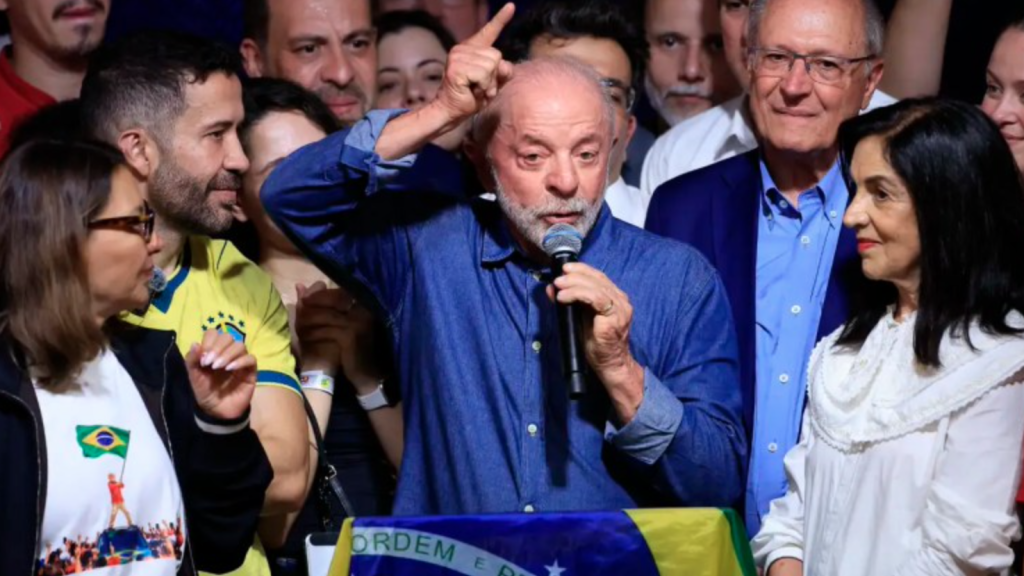
First published in Portuguese at Esquerda en Movimento. Translation by Federico Fuentes for LINKS International Journal of Socialist Renewal.
The re-election of Luiz Inácio Lula da Silva (Workers Party, PT) on October 25 marks an unprecedented turnaround in Brazilian presidential elections. After finishing the first round behind Flávio Bolsonaro (Liberal Party, PL), the president won 51.78% of the valid votes, against 48.22% for his opponent, according to results published in the Brazilian media. The victory, which guarantees Lula a fourth presidential term, was achieved amid a contest marked by political polarisation, popular mobilisation and intensified social media battles.
The result cannot be explained by a single factor. The progressive camp’s reaction in the final stretch, the higher voter turnout, reorganised campaign strategies, and the ability to mobilise voters concerned about another Bolsonaro family presidency all contributed to reversing the far right’s advantage from the first round.
The victory, however, has not resolved the country's political contradictions. Although Lula gathered enough votes to win, the new Congress continues to be predominantly conservative, and will likely hinder any social, economic and environmental measures or partial implementation of Lula’s program.
Reaction on the streets and social media changed the game
Social mobilisation was key to the turnaround. Lula supporters reacted strongly to the first round result, with part of the left beginning to compete more intensely for votes, combat misinformation, and prevent a Flávio Bolsonaro's victory. The size of the large demonstrations in cities such as São Paulo and Rio de Janeiro surprised even members of the PT campaign.
On social media, the WhatsApp channel “Exército do Lula” (Lula’s Army), coordinated by Minas Gerais federal deputy André Janones (REDE, Sustainability Network), became a symbol of this mobilisation. According to Agência Pública, the initiative brought together almost 11 million participants and relied on circulating messages and content shared directly between users, expanding the campaign’s reach beyond official channels.
Researcher Raquel Recuero, coordinator of the MIDIARS Research Laboratory at the Federal University of Pelotas (UFPel), highlighted the importance of this dynamic. “The painstaking work of individuals for their groups, of individuals for their networks, is very important,” she told Agência Pública.
The researcher also assessed that fear of the PL candidate winning played a significant role in engagement. “What mobilised voters was emotion, the fear of a Flávio Bolsonaro victory. There is no comparison with the first-round campaign. It was a much more comprehensive, digital campaign that reached far more people,” she said.
Digital mobilisation was combined with street presence, public campaigning by political leaders, and engaging activists, young people and sectors of civil society. The campaign also modified its strategy, opening up space for interlocutors such as Camilo Santana (PT Senator) and Rafael Fonteles (PT governor of Piauí), and giving greater importance to directly confronting Flávio Bolsonaro.
In the second round, Lula began to emphasise the risks of his opponent’s economic proposals, especially the potential effects of cutting spending on social rights, as well as exploiting opposition to the Bolsonaro family. This strategy helped transform the contest into a mobilisation that went beyond formal campaign structures.
Fewer abstentions, greater voter participation
Another important piece of data was the significant fall in abstention. The rate fell from 21.08% in the first round to 19.22% in the second, the lowest percentage recorded in a presidential runoff election since 2006. About three million people who had not voted in the first round went to the polls on October 25.
More than 128.1 million Brazilians voted in the second round. Blank and null votes also decreased: they totalled 3.24%, compared to 4.77% in the first round. The simultaneous reduction in abstentions and invalid votes increased effective participation in the presidential decider.
The mobilisation was especially significant in northeastern states. In Bahia, abstention fell from 19.97% to 16.71%; in Pernambuco, it dropped from 18.17% to 15.18%. Lula won in both states with 71.31% and 69.2% of the valid votes, respectively. However, the fall in abstention was not uniform: the rate rose in nine states while falling in 18.
The numbers mean we cannot attribute all the new voters to a single political camp. Even so, the coincidence between the rise in participation, the mobilisation in the final stretch, and Lula’s victory reinforces the importance of convincing voters to go to the polls.
The operation to encourage voter turnout faced concrete difficulties. Problems with public transportation in municipalities across different states, as well as heavy rains in some regions, hampered voters’ travel. Voting hours were even extended until 7pm by court order, following requests related to logistical difficulties.
Lula promises to expand popular participation
During the victory celebration on Paulista Avenue in São Paulo, Lula acknowledged the importance of social mobilisation and especially thanked young people, women, educators, and labour rights advocates.
“I owe this victory to the rebellious youth who rose up in defence of democracy. I owe this victory to the women who rebelled against femicide. I owe it to the people who believe that ending the 6x1 workweek schedule [six days work, one day off] is a benefit to Brazilian society,” declared the re-elected president.
The speech addressed issues that mobilised progressives, including reducing the workweek, defence of public education and the fight against gender violence. In mentioning the end of the 6x1 workweek, Lula acknowledged the importance of a demand that gained traction on the national agenda due to the actions of social movements and parliamentarians, including those of the Socialism and Liberty Party (PSOL).
The president promised changes in the way his government would be run and greater public participation in decision-making. “I can guarantee you that we are going to change the way we govern this country. We are going to allow people to participate more in our decisions,” he stated. He also announced that digital communication will have a greater role in the relationship between government and society.
Lula also defended regulating digital platforms, arguing that the actions of these companies need to be subject to democratic rules. “This was an election in which we had to overcome interference from the outside via digital platforms, which we will have to regulate,” he declared, according to Agência Brasil.
The statement points to one of the challenges of his next term: tackling the spread of misinformation and discussing the role of Big Tech companies without compromising freedom of expression and public debate.
A fourth term under pressure from a more right-wing Congress
Victory at the polls did not automatically translate into parliamentary strength. Lula will assume his new term facing an even more right-wing Congress, with the PL party expanding its presence in the Chamber of Deputies and the Senate.
PL gained 23 seats in the Chamber of Deputies and 13 in the Senate. The PT, PSOL and Communist Party of Brazil (PCdoB) maintained their seats or registered moderate growth.
The new configuration is likely to make it more difficult to approve proposals to expand social rights, tax the wealthiest, protect the environment, and strengthen public services. The government will also have to deal with disputes over the budget, parliamentary amendments and positions, as well as resistance from conservative sectors to changes in labour legislation and minority rights.
Political scientist Juliano Corbellini, interviewed by Correio do Povo, summarised the problem: “Lula will have difficulty dealing with this Congress and Senate, which seem to have a more pronounced right-wing ideological cohesion.” The expert also highlighted the role of the Centrão (Center bloc), whose position could be decisive for governability.
The electoral victory, therefore, does not end the political contest. To approve its proposals, the government will need to negotiate with forces that do not fully share its program and, at the same time, maintain a social base capable of defending popular measures.
In this context, the second round mobilisation could have importance beyond the election. The challenge will be to transform the engagement obtained in the campaign into continuous political participation, capable of pressuring Congress on social demands.
Political Science and International Relations expert Gabriel Adam, also interviewed by Correio do Povo, emphasised that popular mobilisation can influence parliamentary decisions. “When the population understands the context of the dispute, what is at stake, they are able to exert a great deal of pressure,” he stated.
Victory opens a new stage in the political contest
Lula’s re-election demonstrates that the advantage gained in the first round was not irreversible. The combination of in-person mobilisation, digital organisation, a change in strategy, and greater voter turnout allowed the president to overcome the initial disadvantage and win another term.
The result also highlights the limitations of a presidential contest isolated from the composition of the legislature. The left won the national election, but will have to face a strengthened parliamentary opposition and a society that remains politically divided.
The next term will therefore be marked by a dual requirement: to transform the commitments made during the campaign into concrete policies, and to preserve the mobilisation capacity that helped produce the electoral turnaround. The strength demonstrated in the streets and on social media will be an important political asset, but its influence will depend on the continuity of popular organisation and the ability to convert social support into effective achievements.
The Brazilian pendulum
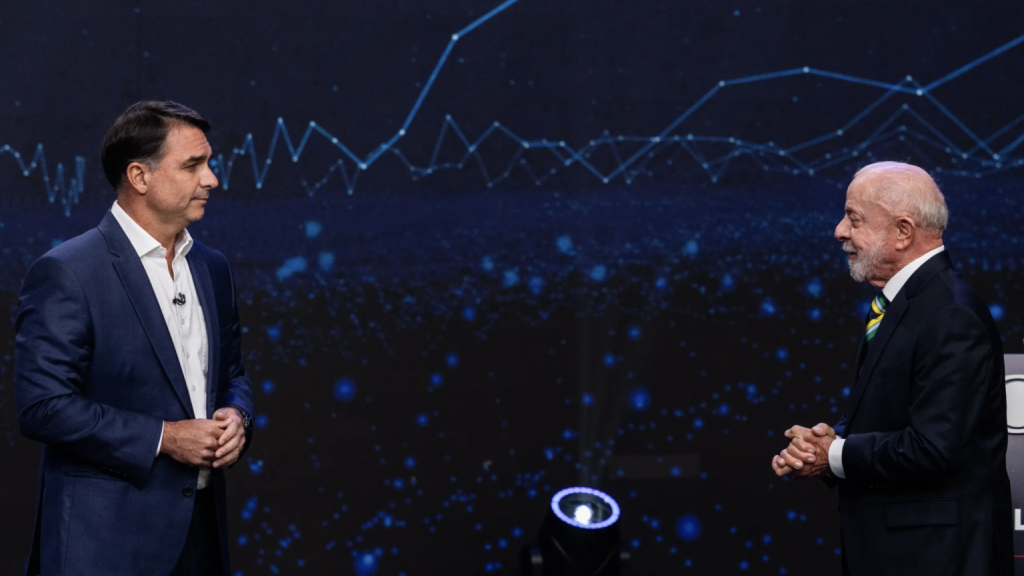
First published at Phenomenal World.
Recent years in Brazilian politics have been marked by extreme turbulence and polarization. After nearly two decades in which the national political scene was organized around President Luiz Inácio Lula da Silva and the Workers’ Party (PT), the future of the country hangs in the balance between the rising far-right bolsonarismo movement and the greatly weakened pro-democracy coalition led by Lula.
To understand the fragile state of Brazilian democracy, it is necessary to see the dramatic swings of contemporary politics in the longer view of the Brazilian political economy. To do so, Hugo Fanton and Daniel Pavan spoke to André Singer, renowned author of pathbreaking books on Lula and the Worker’s Party, professor of political science at the University of São Paulo, and the former Press Secretary for President Lula in his first term.
Singer’s analysis of the Worker’s Party provides the most comprehensive and detailed account of the development of the party’s political program in its first decade in power — characterized by broad and deep support among the majority at the bottom of Brazil’s deeply unequal economy, and a gradual reform project constrained by the extreme concentration of wealth and power at the top. In his new book, Impasse, Singer revisits classic thinkers from Brazilian political theory to examine the behavior of Brazilian elites — whose politics have swung between the poles of progressive democracy and revanchist authoritarianism.
Ahead of the runoff election between Lula and Bolsonaro — between lulismo and bolsonarismo — the interview looks at the political landscape of the largest country in Latin America, the major voting coalitions that will determine the election, the emergence of a Brazilian “Bible Belt,” the impact of the cost of living on electoral behavior, and the competing political tendencies that define the 2026 elections and the future of the country.
Hugo Fanton: Your new book takes up former President and sociologist Fernando Henrique Cardoso’s metaphor for understanding the Brazilian ruling class: a pendulum that oscillates between stagnation and social change. As we near the runoff between President Luiz Lula Inacio da Silva and Flavío Bolsonaro, how should we understand the relationship between Brazil’s ruling class and politics? Where are we in the pendulum swing?
Why do Brazilian elites sometimes support democracy, and sometimes authoritarianism? Fernando Henrique Cardoso’s image of the Brazilian bourgeoisie moving on a “pendulum” between these two poles helps us understand that this behavior has a material basis: the interests of the Brazilian ruling class are contradictory, and so its political action is also contradictory.
If we look at the impeachment process that ousted President Dilma Rousseff and the Workers’ Party (PT) from power in 2016 this pattern becomes evident. Already in late 2014, elements of the bourgeoisie that had played an important role in ending the military dictatorship and returning to democracy began to shift course. That year, the Brazilian Social Democracy Party (PSDB) formally challenged the results of the election that brought Rousseff to the presidency. This shift ultimately culminated in the rise of Bolsonaro and bolsonarismo in 2018.
In the 2018 election, the more cosmopolitan faction of the ruling class, including finance and banking, remained relatively neutral, while the non-cosmopolitan sector, including the extractive industries and agribusiness, immediately supported Bolsonaro. The neutrality of the former paved the way for Bolsonaro’s victory. But just a few years later, during the Covid-19 pandemic, the cosmopolitan faction broke with the Bolsonaro government and allied itself with the defense of democracy and Lula’s winning 2022 campaign for the presidency.
Their shift back in favor of democracy was accelerated by the revelations of an attempted military coup, coordinated from the heights of the Bolsonaro administration and involving assassination plans against Lula, Vice President-elect Geraldo Alckmin, and Supreme Court Justice Alexandre de Moraes. The rejection of the coup plotters by the cosmopolitan elites — marked by a protest organized at the most important law school in Brazil, which was attended by prominent figures from the Brazilian elite, and bolstered by Washington having signaled its opposition to electoral meddling — was decisive in thwarting an attempted military coup. (It is worth emphasizing that, of all the countries experiencing growing far-right movements in recent years, Brazil is the only one where a classic military coup attempt actually took place.)
So there was indeed a shift. First, in favor of the parliamentary coup in 2016; and then, six years later, in defense of democracy against an autocratic coup. This is why the “pendulum” hypothesis, fifty years on, remains a very useful framework for understanding these dramatic and sometimes rapid shifts of elites from democracy to authoritarianism. When democracy threatens its objective interests, the bourgeoisie resorts to authoritarianism, but authoritarianism exacts a high price on freedom and order that can in turn become intolerable. In the 2026 elections, it is still unclear what stance this more modern sector of the bourgeoisies will take, and which way the pendulum will swing.
Daniel Pavan: How does democracy threaten the interests of these elites? Why do their interests produce contradictory reactions?
Historically, the more modern sectors of the economy have a natural interest in development and modernization — state capacity, infrastructure, and so on, which support the growth of their industries. To that end, capitalists in these sectors ally themselves with the state to promote such reforms. But it so happens that some such reforms — such as land reform, the hallmark of modern capitalist economic development — can also strengthen the position of the working classes. Brazilian capitalism, however, is subordinated both to the dynamics of the world market, and, as a primary-sector exporter, to the domestic dynamics of labor exploitation, which presuppose social exclusion and the maintenance of a large reserve army of labor. In Brazil in 1964, prior to the military coup, the state was on a path to advance reforms that would have exceeded the limits of what the bourgeoisie considers acceptable for its objective interests — in that case, land and labor reform.
This is the contradiction: the bourgeoisie pushes the state in a certain direction and then, when a “red line” is crossed, withdraws its support, causing the downfall of the political leadership that is driving the reforms. This dynamic unfolded during Dilma’s administration, and ultimately led to the parliamentary coup that ousted her.
DP: Turning to the present, you analyze the ruling class’s relationship to politics through the existence of two cross-class coalitions: the pro-Bolsonaro “confederacy” and the pro-Lula “concertación.” What is the composition of these two coalitions?
I developed the idea of the “confederacy” while analyzing the 2022 elections, and trying to understand which coalition of forces still supported Bolsonaro at the end of his disastrous term, allowing him to come so close to victory. It is a heterogenous arrangement, bringing together widely divergent class factions and corporate sectors. Of course, agribusiness stands out.
The 2022 electoral map shows a continuous corridor of Bolsonaro support stretching from northern Rio Grande do Sul, through Santa Catarina, Paraná, and the interior of São Paulo and Minas Gerais, widening in the Midwest and reaching the southern part of the North region. This corridor is heavily populated by the extractive industries and small-scale miners, who have benefited from relaxed environmental regulation and weakened protections for indigenous peoples. Alongside this bloc are the service sector and small- and medium-sized business owners — part of a transformative new wave of entrepreneurship in the country.
On the corporate and social front, the “confederacy” rests on two fundamental pillars: evangelicals and security forces. Where Lula and the PT dominate in the poor northeastern states of the country, evangelicals function as the “Northeast of bolsonarismo”: a population representing about 30 percent of the electorate, about 70 percent of whom support the far right. This constitutes something like the Brazilian Bible Belt — a very solid base for bolsonarismo. Security forces, meanwhile, include not only the military but also civilian police, parts of the federal police, and a vast private security sector, all of whom have aligned themselves with Bolsonaro’s typical far-right public safety platform.
I’ve called this far-right bloc the “confederacy” in reference to the US American South during the Civil War, both as a political provocation and because it implies a very stark geographical and cultural divide — of the kind that was, until recently, unprecedented in Brazil.
On the other hand, the “concertación” represents the broad front organized to halt the rise of autocracy. This group consists of the PT, supporters of lulismo, and sectors of the former PSDB, along with the cosmopolitan faction of the bourgeoisie. The PT remains the most organized and far-reaching party in the country, with more support from the electorate than any other party, at 30 percent. Support for lulismo, in turn, extends beyond the ranks of the PT and advocates a program to overcome poverty without direct confrontation with capital — it is the heir to the “popular camp” (campo popular), a segment of the electorate created by the advent of mass democracy under Getúlio Vargas in 1945.
Brazil is a highly unequal country, in which approximately 85 percent of the electorate is in households that earn less than five times the minimum wage. Lulismo, therefore, has enormous electoral potential, demonstrated by its four consecutive victories between 2002 and 2014. However, to secure his return to the presidency in 2022, and to halt the growth of authoritarianism, Lula formed a coalition with the remnants of the former PSDB.
The latter strand is symbolized by Vice President Geraldo Alckmin and enjoys the support of the more modern financial and industrial sectors — precisely those that had rivaled the PT until 2014. The breadth and composition of this coalition is why I refer to it using the name of the Chilean concertación, which united socialists and Christian Democrats to defeat the right and turn the page on the Pinochet dictatorship.
HF: The essayist Roberto Schwarz has argued that Bolsonaro’s first victory was due to having stitched together an openly pro-business agenda with an ideologically “regressive segment” of Brazilian society. In your book, you show that, in 2022, 47 percent of the electorate identified with the right on the ideological spectrum — curiously, the same percentage obtained by Flávio Bolsonaro in the first round earlier this month. How do you understand the force of ideology alongside material circumstances like the cost of living, and in particular rising food prices?
Ideology as a factor in politics works over the long-term. It becomes entrenched in the formation of political identity and then remains a lasting foundation — a resource that can be drawn on differently in different political moments. For this reason, I don’t believe it is a sufficient explanation for variations within a given political context. The question is: how are ideological commitments activated by political actors from one context to another?
In Brazil, studies indicate that the electorate has historically leaned conservative or right-wing. But during the period of polarization between the PT and the PSDB, direct ideological language along the axis of left-versus-right was deemphasized. The PSDB was interested in capturing right-wing votes without identifying itself as such, and the movement around Lula was interested in attracting conservative segments of the working class.
Starting in 2014, particularly during Dilma’s impeachment process, the far right broke through this buffer, and started openly reactivating ideological political discourse. The far right represents only 15 percent of the electorate, but they successfully revived this strong ideological polarization and drew the right side of the spectrum along with it. Jair Bolsonaro, previously irrelevant in Brazilian politics, benefitted tremendously from this situation, as he was prepared to speak the language of ideology. Bolsonarismo tapped into the diffuse conservative sentiment present among a large portion of the electorate and gave it a political voice.
What does this mean for our situation now, in 2026? We can say with considerable confidence that Bolsonarism will persist, despite the former President’s isolation. His core supporters remain a minority within the electorate, but their political potential extends far beyond his base. This became particularly clear when São Paulo Governor Tarcísio de Freitas, a natural conservative candidate for the presidency, was simply sidelined by the nomination of Jair Bolsonaro’s son, Flávio, who had no support other than that of his own father. This is a formidable display of strength, and it portends an electoral realignment of the country similar to that of 2006, when the working classes — and in particular the lowest-income households in Brazil — shifted towards Lula, while the rest moved to the PSDB. The outlines are not yet defined, but such a polarized realignment may be underway.
What of the material factor? Between the polarized blocs with distinct ideological commitments, the third segment of the electorate swings back and forth, guided primarily by the concrete material benefits it may have received during the previous term, or expects to receive during the next. These are votes governed by the concrete realities of voters’ daily lives: inflation, the cost of living, and food prices.
To compete for this pragmatic electorate, the Lula administration developed a series of policies directly aimed at the population’s material conditions: income tax exemptions, the regulation and subsequent ban on online gambling, which has driven countless families into debt, the initiative to reduce the workweek from forty-four to forty hours and end the “6-on-1” norm for shift schedules in favor of two days off per week, the provision of weight-loss pens through the public healthcare system, the increase in Bolsa Família benefits, and the Desenrola 3 program to aid families struggling with consumer debt repayments. Through these policies, the government seeks to demonstrate concretely what it has done for these segments of the population. On the other hand, the opposition candidate freely promises comprehensive solutions to the cost-of-living crisis that he has no intention of enacting — lower interest rates, lower living costs, and not having to pay any debt for a year, and so on.
HF: A much-discussed component of the ideological map of Brazilian politics today is the relationship between Pentecostalism and the far right, a coalition which you suggest functions similarly to the “Bible Belt” of socially conservative evangelical states in the United States. Can you elaborate on this argument?
It is hard to overstate the significance of the transformation of religious identification over recent decades on Brazilian life. Catholicism was once a defining feature of the country, deeply embedded throughout society and an important aspect of the national identity. The vast majority of the population was Catholic. That homogeneity has been disrupted by the rapid growth of the evangelical church.
On a political level, however, the evangelical vote was initially not unified, and various evangelical leaders were a part of Lula and Dilma’s governing coalitions. It remained fractured, until a qualitative leap was taken by Jair Bolsonaro, who organized a large part of this vote around his ideological project, in part by promoting institutional ties between the state and the church, through the appointment of ministers, nominations to the Supreme Federal Court, and the reception of bishops at the Planalto Palace.
The formation of this “Bible Belt” creates a cohesive electoral bloc. Even in the face of fluctuations surrounding the candidates — such as in the debate over Flávio Bolsonaro’s nomination — polls indicate that about 70 percent of this segment remains inclined to vote for Bolsonaro. The evangelical vote was central to the consolidation of Bolsonarism as a movement and concept, which finds one of its most enduring foundations in the Bible Belt. Bolsonarismo‘s deeply rooted strength in this religious community means that it will continue to be a feature of Brazilian politics.
DP: You argue there are three competing political regimes in Brazil in 2026: the democratic; the parliamentary or semi-presidential (which has become anti-democratic, as it represents the Centrao’s control); and the autocratic with fascist characteristics, represented above all by the Bolsonaro family. How do you characterize these three competing political regimes?
Presidential elections in Brazil are the moment when the working classes express what they expect from the state: it is the single moment in which the working class intervenes in Brazilian politics on an institutional level. Legislative elections, meanwhile, are heavily influenced by local oligarchic political machines. This is why we have the elected government in the Chamber of Deputies that we do, which in practice in Brazil consistently undermines the working class’ political participation. “Semi-presidentialism” is a milder form of parliamentary government, and we could see the ruling class forces that control the Chamber of Deputies moving towards it already, in the process of impeaching President Dilma. The notion of a semi-presidential system in which the management of economic policy is transferred to the Congress is of great interest to these forces, and I believe we will see such proposals resurface.
Given this distribution of power, presidential elections can be seen, to a certain extent, as a reflection of the state of the class struggle. When that struggle reaches a breaking point — as it did with the crossing of the “red line” discussed earlier, in which a reform program of a government goes beyond what the middle classes and elites will endure — new competition between political regimes emerges, seeking a new resolution.
Thus we are now facing competition between these three systems: democracy; a semi-presidential system that undermines the presidential elections; and open authoritarianism, which may take the form of a military dictatorship. The latter, bolsonarismo, has fully solidified itself as an organized force in Brazil, and is what I call authoritarianism with a fascist bias. Is it fascist? This is a political party which is not militarized — despite the aforementioned presence of law enforcement officers in its ranks, it is not organized around the formation of militias, a characteristic element of classical European fascism. But it is an extreme far-right formation, more closely tied to international Trumpism than ever before, and it has established itself to the point where it competes with the PT, and even surpasses it.
Monday 26 October 2026, by Iain Bruce
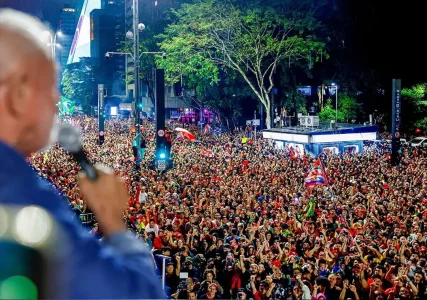
Re-elected on 25 October with 51.8 per cent of the vote against the far-right senator Flávio Bolsonaro, Lula achieved a comeback unprecedented since Brazil’s return to democracy: never before had a candidate who had been defeated in the first round gone on to win the second. This victory was decided on the streets and on social media.
This is the most important defeat for the far right we have seen anywhere in the world in recent times, and its impact will be felt worldwide. Seeing those millions and millions of people pour onto the streets across this vast country to celebrate was enough to make you weep.
The seemingly impossible turnaround in the second round is not a simple electoral victory. It was won in the streets and on socials. Immediately after the far-right candidate, Flavio Bolsonaro, won in the first round, thousands of mainly very young people took to streets in Niteroi, across the bay from Rio de Janeiro, to demonstrate against the likelihood of a neo-fascist government in Brazil. The same thing happened in cities in the Northeast, the most impoverished region. This was repeated throughout the country in the three weeks between the rounds.
In parallel, younger members of congress from a smaller party supporting Lula’s Workers Party, completely revamped the campaign’s lacklustre social media presence. ‘Lula’s Army’, a Whatsapp channel launched by Janones of the Rede party, went from 50,000 followers to a million in two days. Now it has 10 million.
The next stage will be difficult, and possibly violent. As I write, Flavio Bolsonaro is refusing to recognise the results and calling on his supporters not to either. He’s promising a legal challenge, but last time, when his father, Jair Bolsonaro lost, they invaded the congress and presidential palace. President Trump looks ready to back him.
Even if the immediate threat recedes, Lula’s presidency will confront big far-right and traditional right majorities in both houses of congress. If he is not to capitulate completely, he will have to govern with the streets, and with his new found digital army.
This in turn is likely to lead to confrontation. The far right is deeply embedded in large sections of society. And it could draw on the sympathies of at least parts of the armed forces.
What the Brazilian people have achieved can be a huge inspiration for all of us facing resurgent varieties of neo-fascism and the far right in different parts of the world. But they will also need support. We should be thinking now about how to organise that solidarity. The Scottish working class has a proud tradition in this area. ‘Nae pasaran.’
But developing our own struggles is also part of building solidarity.
There is little doubt that the kids on the streets in Brazil have been encouraged by what they see in France and the Spanish state. No doubt the Serbian students who just defeated Vucic have been too. A new form of internationalism appears to be taking shape and we need to be part of that.
We live in interesting, if dangerous, times.
26 October 2026


No comments:
Post a Comment