
IntelliNews summary:
• Nvidia's board said US government input left it confident Huang's return poses no national security risk; he faces a closed-door House interview on December 1.
• Megaspeed has been under US investigation since 2024, and the Justice Department now leads a criminal inquiry; no charges have been announced.
• Taiwan's Taiex fell 17.5% in the week to November 20, against 1.6% for Malaysia's FBM KLCI.
• Indonesia has no dedicated law on strategic trade controls, while its chip exports rose to about $4.1bn in 2025 from $1.5bn in 2024.
____________________
The US put Singapore's Megaspeed and six other firms in Malaysia, Singapore and Thailand on its trade blacklist on November 23, the day Nvidia reinstated Jensen Huang as chief executive, BBC reports.
The Bureau of Industry and Security's Entity List rule, filed on November 23 and due for formal publication on November 25, names Megaspeed International, its Malaysian affiliate Speedmatrix and a Thai unit among the seven. License applications to supply any of them with goods covered by US export rules face a presumption of denial, because of "the significant risk of these entities being or becoming involved in the diversion of advanced computing commodities to unauthorised end uses or end users".
The US has forgiven the head of the company that designs the chips, however, with President Donald Trump telling CNBC: "I made the deal", while cutting off the regional intermediaries that buy and host the hardware. That puts the burden of proving clean hands on Southeast Asia's data-centre hosts, and Indonesia has the least machinery in place to carry it.
The Commerce Department first opened its inquiry into Megaspeed in 2024 after spotting suspicious activity, asked Nvidia for its sales records in May 2025 and, with Singaporean law enforcement officials, inspected the company and interviewed its then chief executive Alice Huang a month later, according to a joint statement with the Justice Department on November 16. Nvidia put Megaspeed on its "no sell" list in June 2025, and the Justice Department now leads a criminal investigation. No charges have been announced, and Megaspeed has said it complies with US export rules.
Alice Huang, whom US officials reportedly suspect of working for Chinese intelligence, is the woman with whom Jensen Huang had an affair, and it was the scandal around that relationship that led him to resign on November 12. Beijing called the spying allegations "baseless and purely slanderous smears against China", ABC News reports. Foreign ministry spokesperson Mao Ning accused the US on November 12 of inventing spy stories as a pretext for a technology blockade.
Nvidia's board voted unanimously to reinstate him after taking input from senior levels of the United States government, and said it was confident that Mr. Huang's reinstatement poses no national security risk, according to the company's statement filed with the SEC. An independent inquiry into a foreign intelligence effort aimed at Huang will continue, and a new board committee will oversee export controls. Huang is due to give a closed-door interview to three House committees on December 1.
Nvidia's shares rose 31.5% to $165.05 on the news, Nasdaq closing data show, after a 14% one-day fall to $125.53 on November 20. They remain 26% below their close of October 21. "The return of Jensen Huang at the helm of Nvidia is almost as big a shock as his departure," Lindsey Stewart of Morningstar told ABC News.
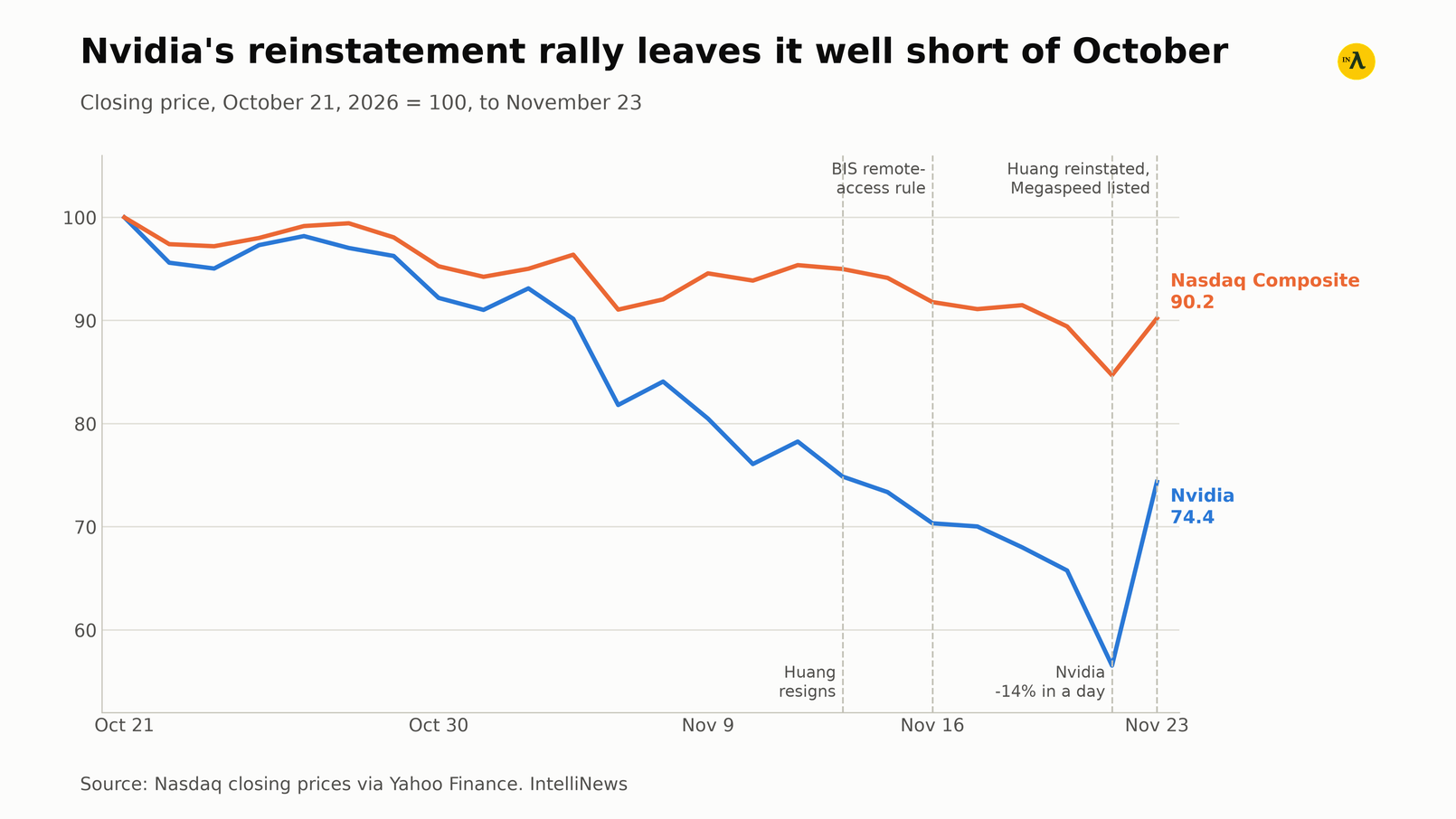
Nvidia and the Nasdaq Composite, closing level, October 21, 2026 = 100, to November 23. Source: Nasdaq closing prices via Yahoo Finance. IntelliNews
Asia's markets priced the episode as a hardware problem. Over the week to November 20 the Taiex fell 17.5% and the Kospi 7.9%, while Singapore's Straits Times index lost 4.9%, the Jakarta Composite 3.7% and Malaysia's FBM KLCI 1.6%. Southeast Asia's exposure sits in privately financed server halls, not listed chipmakers.
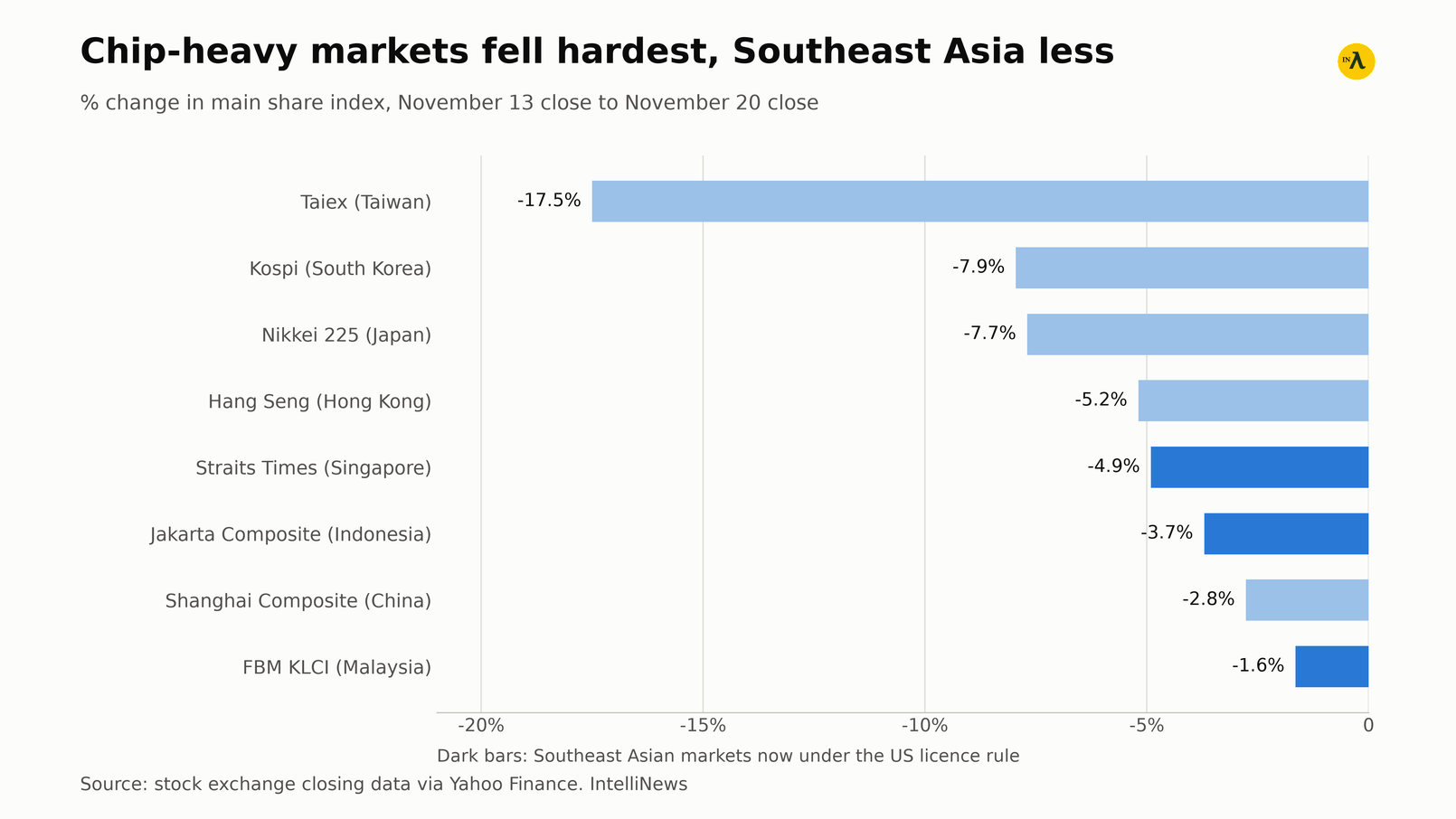
Change in main share indices, November 13 close to November 20 close, %. Source: stock exchange closing data via Yahoo Finance. IntelliNews
Five countries under license
That exposure became a legal one on November 16, when the bureau announced that advanced chip exports to Indonesia, Malaysia, Singapore, Thailand and Brazil would need a license, closing the route by which Chinese developers rented top-end computing power in third countries. Malaysia's trade ministry said on November 13 that it had never cleared Megaspeed or Speedmatrix, and that verification visits to the data centres where Speedmatrix is a tenant were routine monitoring, Malay Mail reports. Kuala Lumpur had already told data-centre applicants to disclose the operator, the site and the number of GPUs they plan to import.
Indonesia's thin rulebook
Indonesia's Government Communications Agency said on November 18 that the government was reviewing the US measure, was open to technical dialogue and was drafting rules to curb diversion of sensitive goods, JournalArta reports. Indonesia has no dedicated law on strategic trade controls and relies on customs, import-export and sector rules, while Singapore and Malaysia have export-control laws, according to Maria Monica Wihardja of the ISEAS-Yusof Ishak Institute.
The agency put Indonesia's exports of semiconductor devices and integrated circuits at about $4.1bn in 2025, up from $1.5bn in 2024. Indosat's AI arm Zankore has borrowed $3.1bn to buy Nvidia systems on the way to a 1 GW target, and Singapore's BDx broke ground on a 640 MW campus in West Java in September. Advanced chips bound for those projects now need a US license unless the buyer is headquartered in the US.
The blacklist also brushes Indonesia directly. One of the seven entries, PT Megaspeed International, carries the prefix of an Indonesian limited company but is listed at addresses in Johor and Selangor. Indonesian police have confirmed an FBI request to investigate suspected smuggling linked to Megaspeed but said they had carried out no search, Katadata reports.
Indonesia cannot control how suspicious the US chooses to be, but it can control what US licencing officers see: published ownership of data-centre operators, verified tenants and checks on who logs in remotely. Malaysia, whose data-centre billions face local resistance as well as US scrutiny, has started down that road. Hosts that cannot show the same paperwork will wait longer for every shipment.
This article was produced with the help of the IntelliNews Lambda analytical tool

No comments:
Post a Comment