US overcapacity ruling puts South Korea's chip boom under a 25% tariff threat
IntelliNews summary:
- The new duty adds at most 2.5 percentage points to Korea's existing 12.5% Section 301 tariff, and chips are exempt for now.
- Korea and Taiwan face a 25% fallback rate; Japan, the EU and Switzerland face 20%.
- The US report singles out the KRW800 trillion ($597bn) Gwangju memory hub and President Lee Jae Myung's chip drive.
- The US goods deficit with Korea rose 51% to $67.3bn in January-September.
____________________
The US will hold tariffs on Korean goods at 15% only while satisfied with Seoul's trade commitments, under overcapacity findings issued on November 25 that target chipmaking.
The Office of the US Trade Representative (USTR) ruled that the industrial policies of 14 economies, South Korea among them, are unreasonable and burden US commerce, concluding the Section 301 investigations into structural excess capacity it opened in March. Its notice on Korea proposes a duty of up to 15% on all Korean goods, net of most-favoured-nation rates and existing Section 301 tariffs, rising to as much as 25% if the trade representative finds ongoing consultations and existing commitments unsatisfactory. Written comments are due by January 5 and public hearings open on January 25.
Korean goods have paid a 12.5% Section 301 duty since July 24 after a separate forced-labour probe, so the overcapacity levy adds at most 2.5 percentage points and brings Korea back to the 15% it was promised in return for $350bn of US investment, the Seoul Economic Daily calculated. The headline rate settles little. The 25% fallback, and the dossier on Korean chipmaking behind it, give Washington a lever for every stage of the investment talks.
The report published with the notice names autos, semiconductors and petrochemicals as the problem sectors and dwells longest on memory chips. Samsung Electronics and SK hynix hold more than 70% of the global DRAM market and 51% of NAND flash, it says, and Korea will add 2.36mn wafer starts a month of memory capacity on OECD projections, more than the US, China, Taiwan, Japan and Germany combined. It faults the 2021 K-Semiconductor Belt strategy's goal of doubling chip exports to $200bn by 2030 from $100bn in 2020 and a $530bn, 20-year government spending commitment.
In late June the government named Jeonnam-Gwangju in the south-west as the country's second chip production hub, where Samsung and SK hynix plan four memory fabs backed by KRW800 trillion of investment pledges, on land freed by moving a military airbase. The report casts President Lee Jae Myung as the driving force, saying he "views semiconductors as an opportunity to develop the economies of Korea's less-developed regions" and has told his government to give chipmakers "all the water, power and land they need".
"These are the types of things that are not responding to actual demand. They are government interventions and they are increasing supply overseas without actually increasing consumption overseas," US Trade Representative Jamieson Greer told CNBC.
Buyers of memory are queueing for supply. SK hynix said in October that virtually all its DRAM and HBM capacity through 2029 was already sold, and inventories at both Korean chipmakers fell below ten days of supply in the third quarter, KB Securities estimated. The report anticipates the objection: "Even if demand remains high, oversupply could arrive as soon as the new capacity comes online." It cites a projection that memory prices, up nearly ten-fold in a year, will peak next year and cut SK hynix's sales by 45% in 2028. That is a forecast of a glut, offered as proof of one.
Semiconductor articles already subject to Section 232 tariffs are exempt from the proposed duty, along with steel, aluminium and copper goods, passenger vehicles and parts, and patented medicines. Korean economists read the exercise as a push for more American factories. "The US has consistently applied pressure for the same reason: It wants more investment in semiconductor production facilities on its soil," Lee Jong-hwan, a professor of system semiconductor engineering at Sangmyung University, told the Korea Times.
A conduit for Beijing
Washington also accuses Seoul of letting cheap Chinese inputs flow through its factories. China's share of Korea's imports of intermediate goods rose to 23% in 2025 from 20% in 2017, while its share of US intermediate imports halved to 7%, the report says. "By relying more heavily on Chinese inputs, Korea has created vulnerabilities that expose both Korea and the United States to economic security risks of supply chain disruption, and possible coercion," it says.
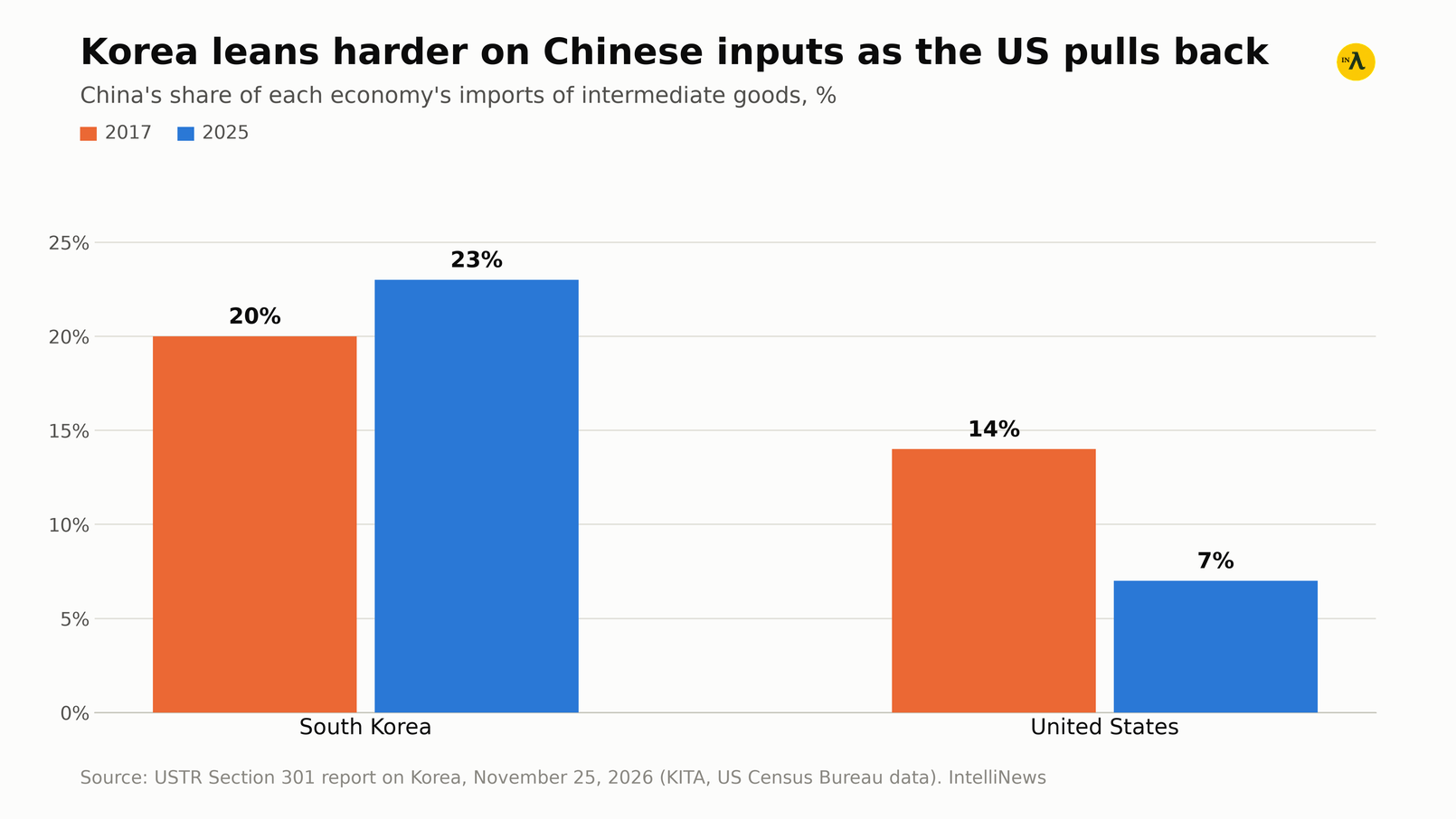
China's share of South Korean and US imports of intermediate goods, 2017 and 2025. Source: USTR Section 301 report on Korea, November 25, 2026. IntelliNews
The report treats Korea's dominance in memory as a security risk in its own right, warning that the concentration "could become a chokepoint in the event of natural disasters or other disruptions to production or logistics". Petrochemical makers, it says, "failed to undertake meaningful restructuring efforts, allowing excess capacity to persist until recently".
Two chip powers, one fallback
The 25% fallback sets Korea apart from most economies with US trade deals. Japan, the EU and Switzerland face the same 15% ceiling with a fallback of 20%, while Taiwan, the other Asian chip power on the list, shares Korea's 25%. The notices give no reason for the gap.
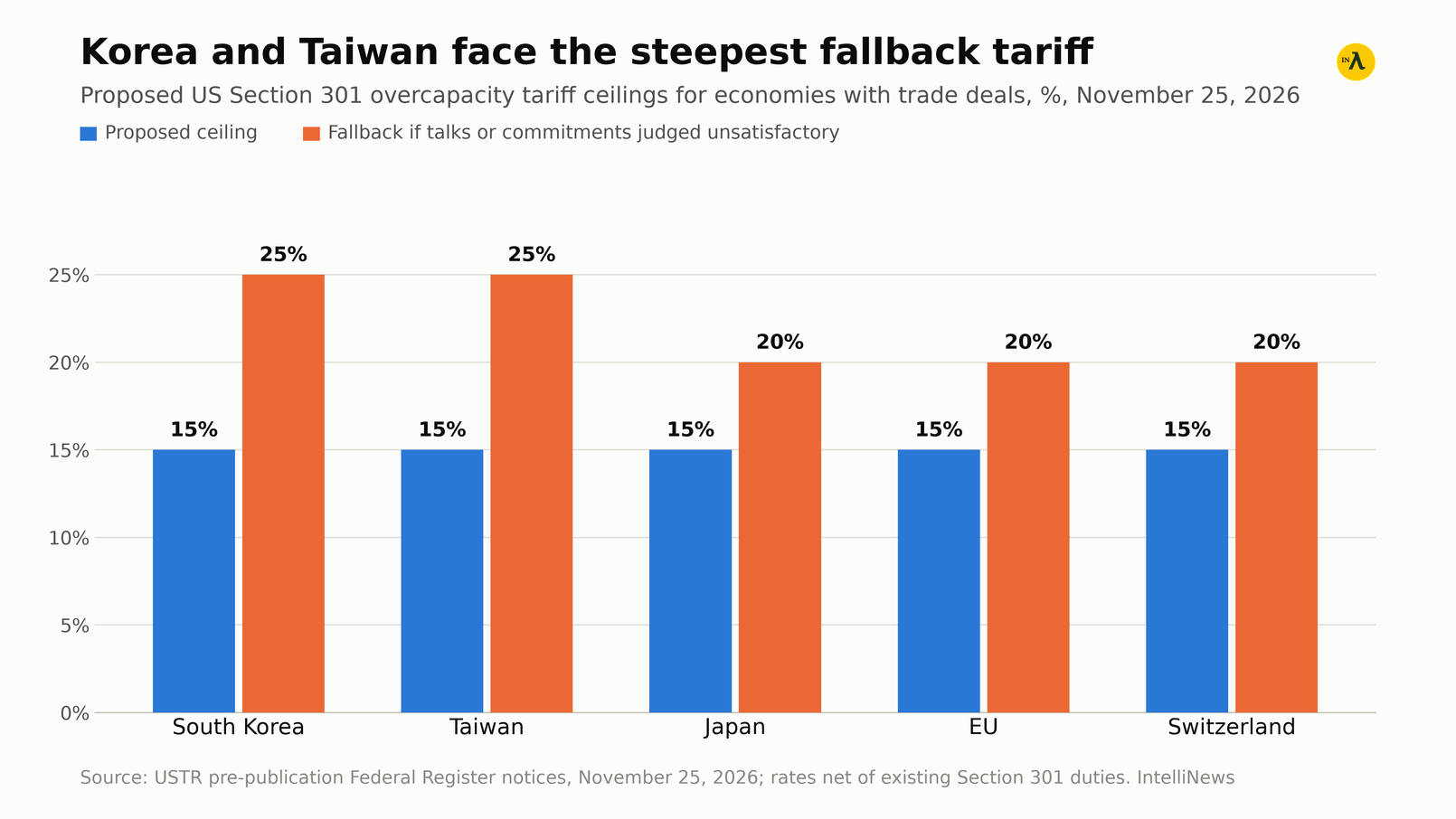
Proposed Section 301 overcapacity tariff ceilings and fallback rates for economies with US trade deals, November 25, 2026. Source: USTR pre-publication Federal Register notices. IntelliNews
"There are substantial parts of the report cited by the USTR that we cannot agree with," a trade ministry official said, arguing that Korea's industrial policy follows companies' investment demand. No major policy change is planned. Industry Minister Kim Jung-kwan said Washington had reaffirmed before the announcement that it would respect the bilateral tariff deal. "If we can ultimately maintain the 15% rate, I think that would be more than a good result," he said.
Paying in Texas
The US goods deficit with Korea reached $67.3bn in January-September, up 51% on a year earlier and already above the $56.5bn recorded for the whole of 2025, US Census Bureau figures show. September alone came to $12.2bn.
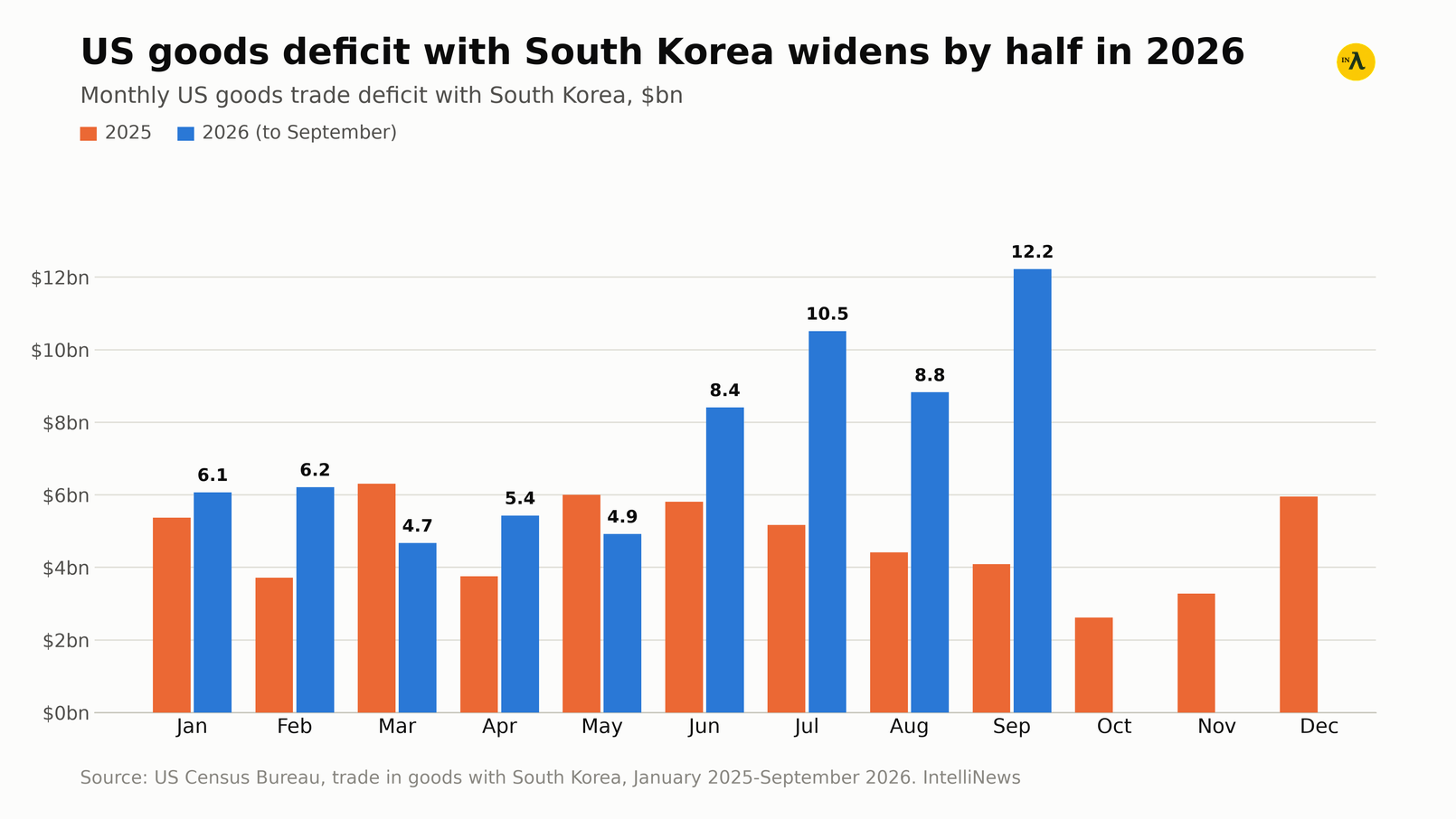
Monthly US goods trade deficit with South Korea, January 2025-September 2026, $bn. Source: US Census Bureau. IntelliNews
Under the joint fact sheet issued after the two presidents met in Gyeongju, $200bn of the $350bn package is strategic investment, and delivering it is Seoul's strongest card. At the end of September the two governments unveiled the first three projects: a $22.3bn, 6.5GW gas-fired power plant for AI data centres in Encinal, Texas, funded entirely by Korea, alongside a nuclear reactor framework and a review of Alaska LNG, the Korea Times reported. The Texas plant had been costed at $19.8bn in July.
The pressure has been building since the summer, when Korea's chip spending plans first raised fears of US tariffs, and it sharpened in October when President Donald Trump threatened duties of up to 300% on companies that do not build in the US. Korea can keep building fabs in Gwangju, so long as the money keeps arriving in Texas.
IntelliNews summary:
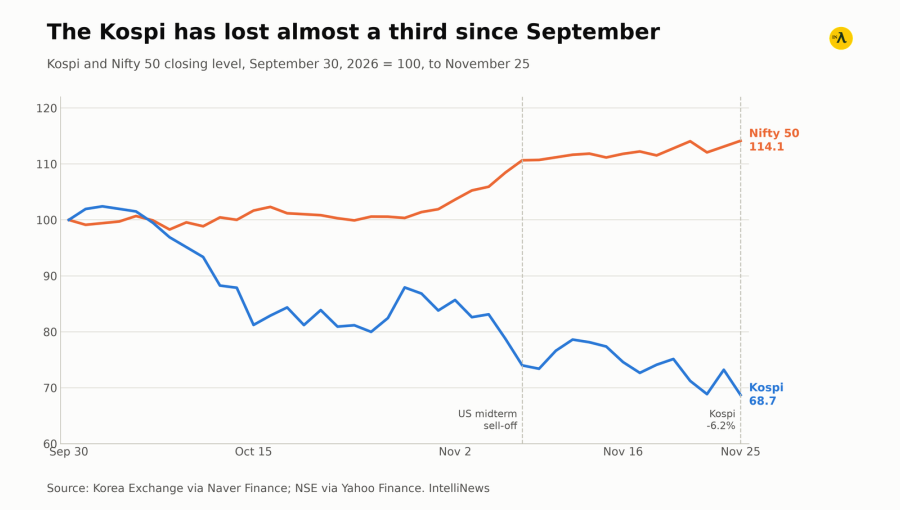
- Foreigners net sold KRW222.03 trillion ($165.3bn) of Kospi shares from January to November 17, 85.5% of it in SK hynix and Samsung Electronics.
- November FPI buying of Indian equities is more than double the previous monthly record, set in December 2023.
- The rupee has gained almost 3% against the dollar this month while the won has slipped.
- FPIs are still net sellers of Indian shares for 2026 as a whole, and Goldman Sachs sees the rupee weakening again.
____________________
Foreign investors are selling South Korea's memory-chip giants while buying Indian equities at a record pace, setting two big Asian markets on opposite sides of the artificial intelligence trade.
Foreign portfolio investors (FPIs) put a net INR1.42 trillion ($15.4bn) into Indian shares between November 2 and November 25, according to NSDL data. That is more than double the previous monthly high of INR661bn, set in December 2023, and every reporting day this month has shown net buying.
In Seoul the money is moving the other way. Foreigners sold a net KRW222.03 trillion of Kospi shares between January and November 17, according to Korea Exchange figures compiled by The Korea Herald. SK hynix accounted for KRW99.56 trillion of that and Samsung Electronics for KRW90.2 trillion ($67.0bn), together 85.5% of the total. In the whole of 2025 foreigners were net sellers of just KRW4.66 trillion ($3.5bn).
The contrasting flows point to different bets on the same global investment themes, though the figures do not show that the same investors are moving money directly from one market to the other. Seoul's bourse has become a concentrated wager on the memory chips that go into AI servers, so doubts about AI spending can weigh heavily on two stocks. India offers growth tied to domestic consumption and credit, with little chip hardware in its benchmark, giving investors a way to retain emerging-market exposure while reducing their AI concentration.
South Korea and India: foreign equity flows in 2026. Source: Korea Exchange data via The Korea Herald (January 1-November 17); NSDL (November 2-25). Boundaries: Natural Earth. IntelliNews
Two stocks, one exit
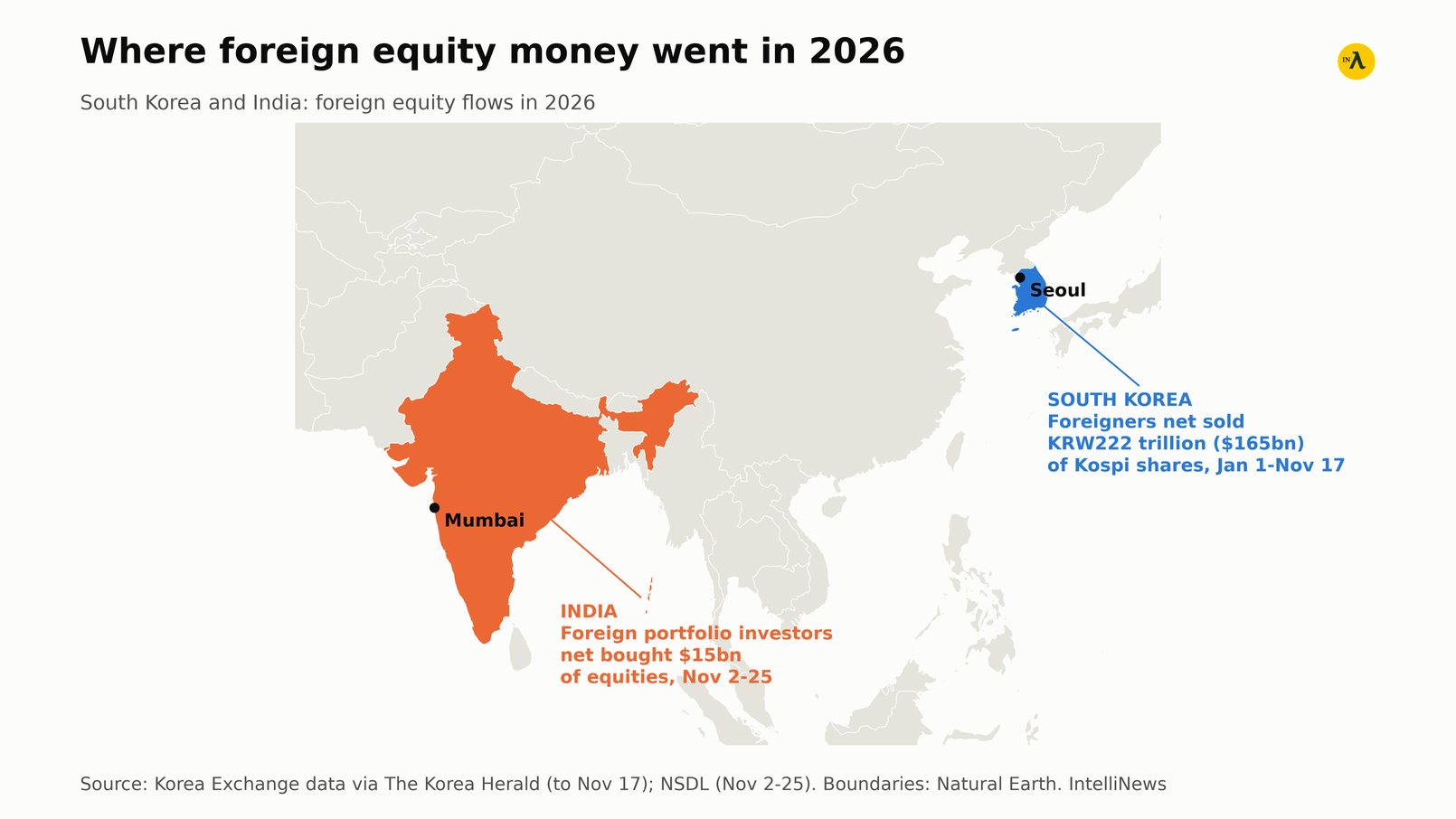
The Kospi closed at 4,697.51 on November 25, down 6.16% on the day, according to Korea Exchange data. The fall erased the previous session's 6.32% jump, when Jensen Huang's return to Nvidia sent SK hynix and Samsung sharply higher. The index is now 48.5% below its record close of 9,114.55 on June 22, and on November 6 it sank more than 8% in early trade, forcing a trading halt, after the US midterm results hit AI shares on Wall Street. Finance Minister Lee Hyoung-il promised that day to draw up steps to steady the market. The index has since lost a further 7.2%.
Local buyers have taken the other side. Korean retail investors bought a net KRW99.6 trillion this year and institutions KRW47.67 trillion, the Korea Exchange figures show.
"We are seeing record net selling that cannot be explained by any conventional yardstick," Ha Jang-kwon of Hanwha Investment & Securities told the paper.
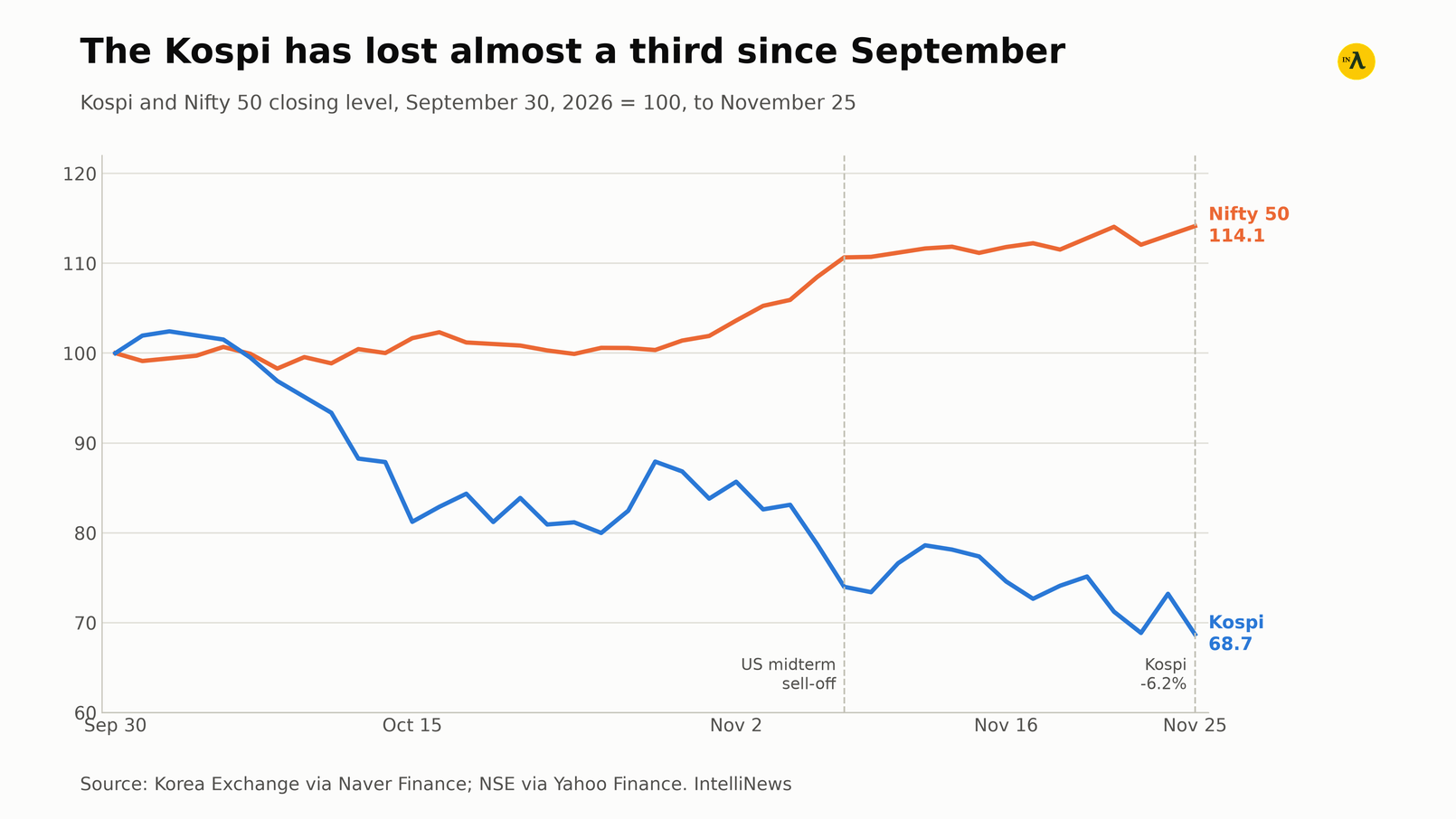
Kospi and Nifty 50 closing level, September 30, 2026 = 100, to November 25. Source: Korea Exchange via Naver Finance; NSE via Yahoo Finance. IntelliNews
A stronger rupee, with strings
The Nifty 50 closed at 25,819.25 on November 25, up 1.9% on the day and within 2% of its record close of 26,328.55 on January 2. The rupee firmed to INR92.24 per dollar on the European Central Bank's reference cross that day, almost 3% stronger than at the end of October and its firmest since early April. The won slipped 0.7% over the same weeks. Since the end of September the Nifty has gained 14.1% while the Kospi has lost 31.3%.
Cheaper oil has done as much for the currency as the share buying. Brent crude fell 24% between October 30 and November 10, easing the dollar bill India pays for imported energy.
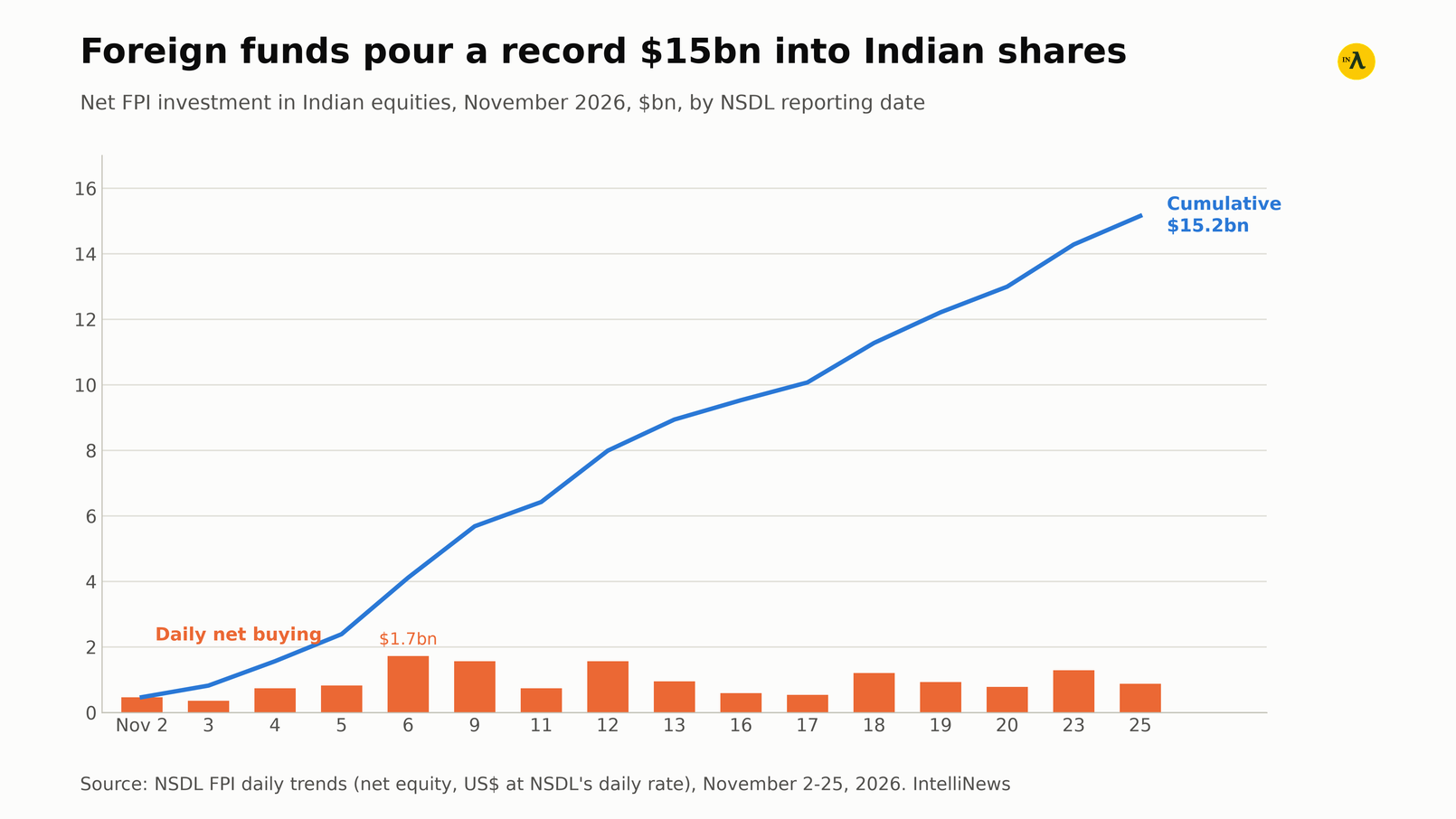
Net FPI investment in Indian equities, November 2026, $bn, daily and cumulative, by NSDL reporting date. Source: NSDL FPI daily trends, November 2-25, 2026. IntelliNews
For the Reserve Bank of India (RBI) a firmer currency arrives at a convenient moment. It raised the repo rate by 25 basis points to 5.50% in October to fight food and fuel inflation, and bond markets have fully priced in another 25-point rise on December 4. Cheaper imports in rupee terms ease part of that pressure.
Exporters see it differently. Garment makers that lost US orders to Washington's tariff increases have spent the year shifting sales to Britain, Europe and the home market, and Indian goods still face a 10% Section 301 levy on top of base US duties. Each step up in the rupee trims what their dollar invoices are worth at home.
How long it lasts
One month does not undo a year of selling. Even after November's record, FPIs remain net sellers of INR1.53 trillion of Indian equities in 2026, according to NSDL, and the RBI's figures showed portfolio outflows of $6.7bn in September alone. Goldman Sachs expects the rupee to settle near INR96 per dollar over the next 12 months.
The rotation also depends on Seoul staying out of favour. The November 24 rally showed how quickly buying returned to SK hynix and Samsung on good AI news, and the next day's slump showed how quickly sentiment can turn. India's relative strength has coincided with limited exposure to AI hardware; whether it persists will depend on oil, the RBI's December decision and whether Washington and New Delhi close their trade talks.

No comments:
Post a Comment