Friday, November 27, 2026

Under-attack Palestinians find unlikely ally in Israeli retired general

As Sawiyah (Palestinian Territories) (AFP) – The four Israeli soldiers stepped out of their car in the occupied West Bank, their faces masked, their uniforms unmarked and automatic weapons strapped across their shoulders.


Issued on: 27/11/2026 - 

Israeli ex-military personnel help Palestinians harvest olives in the Israeli-occupied West Bank village of As Sawiyah, on November 12, 2026 © Ilia YEFIMOVICH / AFP

They had entered a Palestinian olive grove but, little did they expect, the person there planning to tell them to leave could have once been issuing them orders.

A retired Israeli general, Eyal Ben Reuven, had come that day to the Palestinian town of As Sawiyah, on a mission to prevent some of the rampant violence against Palestinians by extremist Israeli settlers.

For the 72-year-old, joined by fellow battle-hardened veterans of the Israeli military, the violence is a stain on the institution in which they once served.

"I've fought in a number of wars. And unfortunately, I have reached the point where I have seen an evolution," said the former military man with piercing eyes, who spent much of his career driving tanks.

The army is failing to act, he said, even when the violence has reached a level "I never could have imagined".

Unrest has soared in the West Bank since the unprecedented October 7, 2023 attack by Hamas on Israel, which responded with a massive military campaign in the Gaza Strip.

Activists from an Israeli movement of ex-military personnel help Palestinians harvest olives in the Israeli-occupied West Bank village of As Sawiyah on November 12, 2026 © Ilia YEFIMOVICH / AFP

More than 1,100 Palestinians have been killed by the army or settlers in the West Bank since then. More than 50 Israelis have died in the same time in the territory, which Israel captured in 1967.

The olive harvest has become a flashpoint, with settlers attacking or stealing from Palestinian farmers on a nearly daily basis.

With the other former soldiers, Ben Reuven has set up a protective presence, a tactic more common among leftist activists who put themselves in the way in a bid to stop attacks against Palestinians.
Army intervenes in harvest

Clad in comfortable hiking attire and carrying walking sticks, it is difficult to imagine that some of the greying volunteers fought in intense combat.

Like good soldiers, they review instructions upon going out -- they are there to assist the olive harvest, not to confront the settlers, and they will obey the army's instructions.

Activists from an Israeli movement of ex-military personnel help Palestinians to harvest olives in the Israeli-occupied West Bank village of As Sawiyah on November 12, 2026 © Ilia YEFIMOVICH / AFP

A Palestinian human rights activist, Arafat Abu Ras, led the military men to a small olive grove. An old Palestinian woman was waiting to guide them and the soldiers, more accustomed to the battlefield than to farming, used sticks and small rakes to start knocking the olives off the trees, volunteering to do the work on the Palestinians' behalf.

Almost immediately a military vehicle arrived. Under the humming of a drone, one of the serving soldiers shoved aside an AFP team to prevent filming, while another checked Abu Ras's identity papers and ordered everyone to leave.

Abu Ras said that the olive farmers had coordinated with the army, which insists that Palestinians receive approval for their harvests in the occupied West Bank, arguing that it is for safety reasons.

"They say, 'yes, yes', and then the next day they come and force us to leave," Abu Ras said.

After the serving soldiers arrived, a second vehicle came, this time with Israeli settlers. An official from a neighbouring settlement also ordered the olive pickers out, with troops saying it was a "closed military zone".

The Israeli veterans, in line with their guidance, complied. They instead moved elsewhere with the farmers, hoping to prevent attacks on them.

"Our army is a joke," fumed Yoel Feldschuh, a 77-year-old former air force brigadier general.

"Is it its role to shut an olive grove? What does the military have to do with that?"

Feldschuh made headlines when he was handcuffed and taken away by police in a similar action a month earlier.

Changing the behaviour of the military, he said, "will take a generation".
Rampant violence

COGAT, the Israeli body responsible for civil affairs in the Palestinian territories, maintains that "security forces are deployed to ensure a safe olive harvest".

But since September, the harvest has been marked by nearly 500 attacks, some of them fatal, according to the Israeli human rights organisation Yesh Din.

An Israeli military drone flies above the farmland of olives in the Israeli-occupied West Bank village of As Sawiyah on November 12, 2026 © Ilia YEFIMOVICH / AFP

Amram Mitzna, an 81-year-old retired general, attributes the army's inaction to the young ages of the soldiers, who have grown up under now-caretaker Prime Minister Benjamin Netanyahu, Israel's longest-serving leader.

"They consider every Arab an enemy who must be treated as such," said Mitzna, who has also served as mayor of Haifa, Israel's third largest city.

Netanyahu has allied himself with the far-right and championed a rapid growth of West Bank settlements, which are considered illegal under international law.

Netanyahu is fighting for political survival after losing ground in elections. Gadi Eisenkot, a former general seeking to succeed him, supports many of Netanyahu's security policies but accuses him of yielding to "Jewish terrorism" in the West Bank and vowed to crack down on extremist settlers.

In As Sawiyah, the former soldiers eventually finished harvesting the olives in a nearby area alongside a school, putting them in bags to be taken by Palestinian villagers.

While no one was injured, Ben Reuven remained deeply disturbed by how the young soldier acted during the altercation.

"When I saw him arrive, masked, shouting, kicking sacks of olives, I was ashamed."

© 2026 AFP
FASCIST ZIONIST SLANDER

Costa Rica bars entry to UN rapporteur over 'links to terrorist acts'


San José (AFP) – Costa Rica's government said Thursday it had denied entry to UN rapporteur Francesca Albanese, who has accused Israel of genocide, because she was the subject of an "international alert over links to terrorist acts".


Issued on: 27/11/2026 - RFI

Albanese was appointed by the UN Human Rights Council in 2022 and like other independent experts, does not speak on behalf of the United Nations. 
© Fabrice COFFRINI / AFP

Albanese, the UN special rapporteur on the Palestinian territories, arrived Thursday at the airport serving the capital San Jose to receive an honorary degree from the University of Costa Rica, a public university.

The Italian independent expert has faced harsh pushback from Israel and some of its allies over her longstanding accusations that Israel has committed genocide and other war crimes against Palestinians in Gaza and the occupied West Bank.

Albanese "is the subject of an international alert over links to terrorist acts," Omer Badilla, director general of Costa Rica's immigration authority, which falls under the interior ministry, said in a video posted on social media.

"I hope this clears up any doubts and makes clear the threat this woman poses to national security," he added.

Albanese branded the entry refusal "a disgrace," while speaking to a radio station at the country's leading university while at the airport which she remained Thursday.

"What happened is very regrettable," she added.

The rector's office at the university, the country's most important and prestigious, said immigration authorities were "blocking" Albanese's entry and asked the government to explain the decision.

The government of Costa Rican President Laura Fernandez is a close ally of US President Donald Trump and has pursued closer trade ties with Israel since she took office in May.

Albanese had condemned a free trade agreement between Costa Rica and Israel last December and called for its ratification to be put on hold, prompting a rebuke from the government, which accused her of interfering in domestic affairs.
'Face consequences'

The United States, Israel's main ally, imposed sanctions on Albanese after she criticized Washington's policy on Gaza.

"You see the face of empire the day you touch a nerve or cross its boundaries," Albanese wrote from the airport earlier.

The university said it was awarding the honorary doctorate, which it grants annually to a prominent figure, in recognition of her "solid academic background, experience, publications and work exposing wrongdoing."

Israel's ambassador to the United Nations, Danny Danon, welcomed Costa Rica's decision.

"Those who exploit their UN mandate to spread vile propaganda, legitimize terrorist organizations, desecrate the memory of the six million Jews murdered in the Holocaust, and relentlessly vilify the US and Israel should face consequences," Danon wrote.

The Gaza war – triggered by Hamas' October 2023 attack on Israel – has killed more than 73,000 Palestinians, according to Gaza's health ministry, which is controlled by Hamas. Many of the Palestinians killed in Gaza are women and children.

The October 7 attack killed 1,221 people, according to an AFP tally based on official Israeli figures.

Albanese was appointed by the UN Human Rights Council in 2022 and like other independent experts, does not speak on behalf of the United Nations.


EXPLAINER

Why France and Vanuatu are fighting over two uninhabited volcanic islands

Vanuatu is challenging France on two legal fronts over Matthew and Hunter, two uninhabited volcanic islands near the French Pacific territory of New Caledonia. Both countries claim the islands, where people from what is now Vanuatu once travelled to fish and perform ceremonies. The latest challenge asks whether the islands can give France rights over roughly 350,000 square kilometres of ocean.


Issued on: 26/11/2026 - RFI

An aerial view of Matthew Island, one of two uninhabited volcanic islands in the South Pacific claimed by both France and Vanuatu. © Wikimedia Commons / JD Girard

Matthew is known in Vanuatu as Umaenupne and Hunter as Umaeneg or Leka.

They lie roughly 280 kilometres south-east of Vanuatu and 445 kilometres east of Grande Terre, New Caledonia’s main island. Each island covers less than a square kilometre and is difficult to reach.

“Even scientists rarely go there. You can get there by boat, but when French soldiers put up a plaque, they were flown in by helicopter,” Géraldine Giraudeau, a professor of international law at Paris-Saclay University who specialises in island territories, told RFI.

In October, Vanuatu began arbitration under the United Nations Convention on the Law of the Sea, asking an international tribunal to decide whether the two islands are legally classed as rocks.

That would limit the rights France could claim over the waters around them. Under the convention, rocks that cannot support people living there or sustain economic activity of their own do not constitute an exclusive economic zone – an area where a country has rights over fish and seabed resources.

If the tribunal rules in Vanuatu’s favour, France could no longer base its claim to those rights on Matthew and Hunter.

The arbitration also covers several reefs and atolls as well as Walpole Island, which is part of New Caledonia. Vanuatu’s announcement challenged France’s rights over the waters around Walpole and made no claim to the island itself.

New Caledonia’s government has made Matthew and Hunter part of the Coral Sea Natural Park, one of the world’s largest marine protected areas.

In Giraudeau’s view, there is a case for classing Matthew and Hunter as rocks under international law.

“That point hasn’t come up in the negotiations because both countries have every interest in treating the islands as having an exclusive economic zone around them,” she said.

A court case on hold

On 31 August, Vanuatu asked the International Court of Justice (ICJ), the United Nations’ highest court, to decide who owns Matthew and Hunter and where the maritime boundary between Vanuatu and New Caledonia should run.

The court can hear the case only with France’s consent. Paris had yet to give it, Vanuatu’s deputy prime minister, Johnny Koanapo, told parliament earlier this month. However, Vanuatu was able to start the separate arbitration in October without French consent.

France withdrew its general acceptance of the court’s authority in 1974 after opposition to its nuclear tests. It has since decided whether to accept the court’s authority case by case.

France reaffirmed its claim to the islands in September at the Pacific Islands Forum, an annual summit of Pacific leaders, in Palau. Éléonore Caroit, France’s junior minister for the French-speaking world and international partnerships, said Paris would respond “in due course” to Vanuatu’s application, including on whether it would let the court hear the case.

Caroit added that France was ready to “discuss, negotiate and try to find solutions without giving up sovereignty”. Giving it up had “never been on the table”.


Hunter Island, east of New Caledonia, and south-east of Vanuatu, in the Pacific. Matthew and Hunter Islands are disputed between France and Vanuatu. © Befa34 via Wikimedia Commons

Talks between France and Vanuatu had failed to resolve the dispute before Vanuatu went to court.

Negotiations resumed after French President Emmanuel Macron visited Vanuatu in 2023 and continued after Vanuatu Prime Minister Jotham Napat visited Paris in July 2025. The two sides have yet to agree on a solution, such as managing the islands jointly.

“France is one of the leading defenders of international law and of the rules-based international order,” Koanapo said in September. “Agreeing to take part in the proceedings before the ICJ will demonstrate its long-standing commitment to these principles.”

But giving up territory, however far from mainland France, would be “an admission of weakness that could set a dangerous precedent”, Marine Le Pen and other lawmakers from the far-right National Rally have warned.

China’s growing influence has also been cited as a factor in the dispute.

Two islands and a colonial legacy

France and the United Kingdom jointly ruled the New Hebrides, now Vanuatu, until it gained independence in 1980.


While neither Matthew nor Hunter has ever had permanent residents, “accounts indicate that in the past, people from the New Hebrides, especially from the south of the archipelago, often travelled there by canoe to fish”, Vanuatu legal scholar Morsen Mosses wrote in a 2019 research paper. The work also describes visits to perform ceremonies.

In 1962, two pilots, Bob Paul and Henri Martinet, filed a claim to Matthew with the joint French-British court in Port Vila, now Vanuatu’s capital. France and the UK later agreed to make Matthew and Hunter part of New Caledonia.

As Vanuatu approached independence, the future of other islands in the New Hebrides was also at stake.

France tried “to separate a number of French-speaking islands before independence”, Mathias Chauchat, emeritus professor of public law at the University of New Caledonia, told RFI. That included efforts to create “liberation movements” on Santo in the north and Tanna in the south, two mainly French-speaking islands.

In 1980, Vanuatu’s provisional government appealed for military support from Australia and Papua New Guinea, both of which recognised it. France then granted independence to the New Hebrides while keeping Matthew and Hunter.

Vanuatu has claimed both islands ever since.


'Unfinished decolonisation'

Local communities were never consulted about the future of Matthew and Hunter in the 1960s.

A similar question arose in the Chagos Archipelago, in the Indian Ocean. The UK separated Chagos from Mauritius before Mauritius gained independence in 1968. In 2019, the ICJ concluded that Mauritius’s decolonisation had not been lawfully completed and that the UK should end its administration of Chagos as soon as possible.

Joint management has also been proposed for Matthew and Hunter. New Caledonia’s government floated the idea of a “peace park”, modelled on a plan for Tromelin, an Indian Ocean island that France administers and Mauritius also claims.

The plan would have put the island and its surrounding waters under joint management, but it was “never implemented because of regrettable parliamentary obstacles”, Giraudeau said.

The Kanak and Socialist National Liberation Front, a pro-independence alliance in New Caledonia, has backed Vanuatu’s claim since 2009. In a declaration that year, the alliance pledged that an independent New Caledonia would respect Vanuatu’s position on the islands, including its claim based on local custom.

Some in New Caledonia portray that as handing over part of the territory in return for Vanuatu’s support for decolonisation. The alliance’s position also has a basis in international law, Chauchat said.

If France declines to let the ICJ hear the case, Vanuatu could ask the UN General Assembly to request an advisory opinion from the court – a route it has used before. In July last year, an opinion sought by Vanuatu set out countries’ legal duties to tackle climate change and said they could owe compensation if a breach of those duties caused harm.

For Matthew and Hunter, the question goes back to what happened when Vanuatu gained independence in 1980, Chauchat said.

“These two islets are of no great importance, but behind them lies our unfinished decolonisation.”

This story was adapted from the original version in French by Igor Gauquelin.
France's cost of living crisis: why working is no longer enough

Surveys show the rising cost of living is the leading concern for French voters ahead of next year's presidential election, with price hikes and low wages driving recent protests. But while a growing number of people say their salaries are no longer enough to provide a decent standard of living, France's cash-strapped government has little room for manoeuvre.


Issued on: 26/11/2026 - RFI

Cover image: Protesters carry a placard bearing the words “SOS. Life is Expensive” at a protest in Paris on 7 November. REUTERS - Stephanie Lecocq
01:12


By: Alison Hird

France's cost of living crisis has become a major political issue, as wages fail to keep pace with inflation – 3.4 percent in October – and working people find it increasingly difficult to make ends meet.

Xavier Chiarelli, a postal worker at France's state-owned La Poste for 18 years, has a take-home pay of €1,650 a month – just €150 above the minimum wage.

"Every month I'm overdrawn by between €200 and €400," he said, while taking part in a day of strike action in Paris last week.

He lives in the suburbs of Paris with his partner, who earns a similar salary, and their child. With rent of €1,100 a month to pay, the couple have had to rethink their weekly shopping list, as some of the food they once took for granted has become too expensive.

"Certain cheeses – I no longer buy Comté, I buy a cheaper cheese," Chiarelli says. "For my kid, I don't buy chocolate spread or cakes any more. My wife and I make cakes ourselves. It's cheaper."

He has also given up holidays, entertainment and buying books and clothes.

"We're in an increasingly wealthy society, but the people who make everything work – who fly planes, produce energy, deliver the post, keep factories running – they're barely surviving.

"I would say my spending power since I started at La Poste 18 years ago has dropped by between 40 and 50 percent."

Longer-term decline


The crisis in the Middle East has pushed up energy prices in France by 24 percent over the last year, directly impacting the 69 percent of workers who mainly commute by car.

Higher fuel prices have also increased the cost of delivering food to supermarkets, while this summer's drought and heatwaves had already led to price hikes on fresh food in particular.

According to France's national statistic institute, Insee, low-income households are hardest hit by price increases because essential expenditure on basics such as food, transport, housing and heating accounts for a disproportionately large share of their budget.

"On average, 16.8 percent of income is spent on housing. This figure rises to 32 percent for the lowest-income quarter of households in France," Fabrice Lenglart, Insee's director-general told L'Express newspaper. "This proportion likely explains, at least in part, the current anger."

For François Geerolf, an economist at the Institut français d'économie (IFE), the problem has been building for years.

"It isn't sudden or particularly severe this time," he says. "It's more part of a long-term trend, with spending power gains indeed slowing, or even falling, depending on which indicators you use."

He traces the deterioration back to the 2008 financial crisis, with further pressure from the inflation spikes of 2022 and 2023, following Russia's invasion of Ukraine, and the latest rise in oil prices.

However, he says the bottom line is that wages are not keeping up with inflation.

"Real wages have fallen by around 8 percent in the public sector and 5 percent in the private sector over the past 15 to 20 years."

Listen to a report on the cost of living crisis on the Spotlight on France podcast:


Squeeze on workers

France's minimum wage, known as the SMIC, will rise by 1.6 percent on 1 December, taking monthly take-home pay to around €1,502 – an increase of approximately €24.

The government is hoping the measure will help ease anger on the streets after weeks of demonstrations. But unions say it does little to address the wider problem of low wages.

Around 2.1 million private-sector employees were earning the minimum wage in January 2026, representing around 12 percent of the workforce. A further 862,000 public-sector workers receive supplements to bring their pay up to the legal minimum.

Medef, France’s main employers’ federation, rejects the increase, calling it a “bad response to a real problem” rather than an effective answer to falling purchasing power. Its president, Patrick Martin, has warned that the increase, combined with the government’s 2027 budget effort, could progressively lead to the loss of about 250,000 jobs.

Among France's 5.8 million public sector workers, even those on higher salaries say they're struggling.

Anne Bonneau, a 60-year-old French teacher in Paris, earns €2,500 net a month while working a 70 percent contract. With rent taking up more than half her salary, she says she can no longer afford to go on holiday.

"I'm on strike because even at the end of my career, it's hard to make ends meet. I'm having to save up for dental treatment, which has become increasingly expensive as social security reimburses less."

Bonneau is also worried about her younger colleagues entering the profession. "Some start on around €1,800 a month, even though they have master's degrees," she says. "They're qualified people, and they're paid barely above the minimum wage. It's scandalous."

A hospital social worker with 12 years' experience, Blandine Chauvel earns around €2,000 net a month. But she says she is also witnessing the consequences of the crisis among the people she works with.

"We're on the front line of the social crisis," she says. "I see people going hungry every day, and we have no means of helping them. It's just not acceptable."

The Secours Populaire charity estimates that 6 percent of the people it helps are in work. Its latest barometer found that 40 percent of working people believe their job does not allow them to cover their expenses.

Little progression in public sector


The situation is particularly acute in the public sector, where salaries are calculated using a system of pay scales and an "index point" that has not been increased for more than three years.

As the minimum wage has risen with inflation, some public sector workers have seen their basic salaries fall below the legal minimum. The state makes up the difference through additional payments, but this does not necessarily improve their baseline salary or pension entitlements.

"Some employees can spend their entire careers on or near the minimum wage," says Christophe Bonnet of the CFDT trade union's education and research federation.

Even some managers in the lowest public-sector grade are now being caught up by it, he notes.

"They say teachers need to be encouraged to enter the profession, well how about raising their wages?"

Bonnet denies that the job security offered by the public sector is sufficient compensation.

"If you have job security, but your job is not paying enough for a decent living, then that's not security."


Middle classes hit

Geerolf acknowledges that the 1.6 percent increase is "not insignificant" for someone on the minimum wage, but argues that it will not resolve the wider problem.

"The purchasing power crisis isn't only affecting people on the minimum wage. It's the whole middle class that feels it's struggling to make ends meet," he says.

People earning France's median wage, around €2,200, increasingly find their living standards resembling those of workers on the minimum wage, despite often having higher qualifications and greater responsibilities.

In addition, people on the minimum wage are eligible for in-work benefit to supplement their income.

In the third quarter of 2025, that amounted to 8.7 million people.

"The difference between someone on welfare who does not work at all and someone working full time on the minimum wage and receiving the in-work benefit is around €27 a day," Antoine Foucher, head of the consultancy Quintet, told La Croix newspaper.

"€27 is a lot when you're living on the minimum wage, but it's also very little when you consider that a worker has commuting costs and that someone on welfare can earn almost the same amount by doing two hours of undeclared work."

For him, it proves that work does not pay enough in France.

Unions are calling for broader wage increases, including an increase in the value of the index point and a revision of public-sector pay scales. They also want salaries to be linked more closely to inflation.

Further decline ahead

The minimum wage increase will benefit around 1.35 million public sector employees, with an average annual gain of €350 gross.

And yet the increase, combined with measures to raise the lowest public sector salaries, will cost the state just over €1 billion, Public Accounts Minister David Amiel has admitted.

France's public deficit is running at 5.4 percent of GDP and it needs to bring it back down to 3 percent of GDP by 2029.

Geerolf points out that France's fiscal adjustment plan requires around €120 billion in savings or additional tax revenue over four years – approximately €30 billion annually.

This will likely mean weaker public services, fewer social benefits, higher healthcare costs and additional taxes, he notes, adding that France is teetering on the brink of recession.

"What's really worrying is that, given what the government has planned, I think we're heading towards a further decline in purchasing power in the years ahead."

This story first appeared in the Spotlight on France podcast. Listen here.
EU rejects new US tariffs targeting industrial overcapacity

The European Union has rejected the rationale behind new tariffs proposed by the United States on several trading partners, to fight what Washington describes as excess industrial capacity, and said it expects the US to honour its existing trade deal with the bloc.


Issued on: 26/11/2026 - RFI

An assembly line for SEB household appliances in Is-sur-Tille, France. New US tariffs target what it says is overcapacity, impacting a range of sectors, from batteries to cement and chemicals to processed food. © Arnaud Finistre/AFP

The Office of the US Trade Representative on Wednesday announced tariffs of up to 20 percent on 14 of the 16 major trading partners it had been investigating for unfair trading practices.

The highest rates target China, which Washington accuses of flooding markets with cheap exports, but the proposed tariffs also impact close US allies, including Japan, South Korea and the European Union.

The EU said it rejected the premise of new tariffs and expected the US to honour the terms of the trade deal they negotiated last year.

"The EU and the US share a real concern about global overcapacity, much of it state-driven and concentrated in third countries. We regret the lack of joint action," European Commission spokesman Olof Gill said.

The Commission said it expected the US to respect the 15 percent tariff cap previously negotiated.

The new duties would not be added to existing sector-specific tariffs on items including automobiles and steel, a senior US official said.

In July, US President Donald Trump imposed a separate series of tariffs on 60 economies, accusing them of taking insufficient action against forced labour.

Both those measures and the tariffs announced on Wednesday are based on new legal grounds that the Trump administration considers more robust, following a Supreme Court ruling earlier this year that struck down previous duties.

The proposed tariffs will be subject to a public consultation period, with a hearing scheduled before they go into effect that could push their implementation back until January.
French media reveal more anti-Semitic messages allegedly sent by Jordan Bardella

French media on Thursday revealed what was described as new evidence that the president of the far-right National Rally party, Jordan Bardella, wrote anti-Semitic messages over Facebook as a teenager. Two months after investigative site Mediapart first revealed conspiracist remarks about Jewish people allegedly sent by Bardella, the outlet and newspaper Le Monde published extracts from a 2013 conversation which they said contained further anti-Semitic comments.

Issued on: 26/11/2026 - RFI

Jordan Bardella and Marine Le Pen, the leaders of the far-right National Rally party (RN), outside the prime minister's office in Paris, 2 September 2025. © AFP - BERTRAND GUAY

Bardella has denied writing any of the messages, including the ones published this week. In a statement via his lawyer, he denounced the accusations as "an unacceptable intent to cause harm".

After a series of denials and legal counterattacks, the National Rally (RN) appeared to have moved on from the controversy after Mediapart in September published antisemitic writings allegedly made by Bardella between 2013 and 2015 at the beginning of his political career.

But the issue is back in the spotlight after a former schoolmate of Bardella allowed Mediapart and Le Monde to publish further extracts from a private conversation on Facebook Messenger.

The newly released exchanges include remarks alleging Jewish control of banks and linking political figures to Israel and Jewish bankers.

Bardella's former classmate came forward after the politician denied writing the earlier messages, Mediapart and Le Monde reported.

"I cannot let Jordan lie to the whole of France," said the source, who authorised the two media organisations to ask Meta to retrieve the conversation, with the process witnessed by a court bailiff.

The two publications also point to several details which they say link the account and the comments to Bardella, including comments about his teachers at the time and details about his parents.

Repeated denials

Bardella denounced what he described as a "witch hunt".

In a statement on Thursday seen by RFI's sister station France 24, he said: "I reiterate my categorical rejection of the statements attributed to me by Mediapart, Le Monde, and the media outlets that have echoed these accusations."

He added: "These statements reflect neither my ideas, nor my values, nor my convictions, either then or now."

Bardella's lawyer, Pascal-Pierre Garbarini, said his client "reserves the right to take any legal action he considers necessary". He said Bardella had already filed two complaints against Mediapart, one for defamation and another for "forgery and use of forged documents".

RN presidential candidate Marine Le Pen, currently leading the polls ahead of elections in April-May 2027, has blamed opponents for trying to derail her campaign with the controversy.

Her allies strongly rejected the new allegations on Thursday.

Right-wing lawmaker Charles Alloncle, a spokesperson for Le Pen's campaign team, described the reports as "defamatory" and accused the media of "a form of relentless persecution" in an interview with public broadcaster France 2.

RN MP Laurent Jacobelli, speaking to broadcasters Europe 1 and CNews, said he could not understand why "some respected newspapers, such as Le Monde, would engage in such tactics".

The allegations are damaging to the RN's long-running effort to distance itself from its anti-Semitic past under the movement's co-founder Jean-Marie Le Pen, who was convicted of racist and anti-Semitic offences.

Marine Le Pen took over the party – then known as the National Front – in 2011 and expelled her father, going on to rebrand the party and launch a strategy of "de-demonisation" in a bid to win over more mainstream voters.


Czech journalists discover neo-Nazi boxing club has links to ruling rightwing parties

Czech journalists discover neo-Nazi boxing club has links to ruling rightwing parties
Active Club serves as a front for neo-Nazi activity. / Czech Anarchist Federation via FacebookFacebook
By Albin Sybera in Prague November 27, 2026

Czech investigative journalists have infiltrated and mapped the neo-Nazi network concentrated around Active Club, a boxing club that serves as a front for neo-Nazi activity, and has links to the country’s ruling rightwing parties.

One of the Active Club’s members, David Štafl, was a member of the rightwing libertarian Svobodní (Free) party before Svobodní ejected Štafl from its ranks in response to the investigation into Active Club published by online news outlet Seznam Zprávy (SZ).

“I am a national socialist. For a long-time already,” Štafl was quoted as saying by SZ, one of whose reporters joined Active Club under a hidden identity and spent two months in the group.

Štafl is reported to have made the comments during a recruitment interview to join Active Club, but he declined to comment on his affiliations to Active Club to SZ.

Chairman of the Svobodní party and MP Libor Vondráček, who is understood to be friends with Štafl, told SZ that he was not aware of Štafl’s links to Active Club.

“I hear this for the first time and there are certainly no national socialists in the Svobodní [party],” Vondráček told SZ, arguing misleadingly that “national socialism”, or Nazism, “is leftwing ideology” and that “we are a right wing party”.

Vondráček is one of the two Svobodní legislators, along with Markéta Šichtařová, who was elected to the country’s parliament last October on the joint list led by far-right Freedom and Direct Democracy (SPD) party which then joined forces with populist Ano party led by billionaire Prime Minister Andrej Babiš to form the sitting cabinet.

Svobodní’s founder Petr Mach, who rose in national politics as an aide to Eurosceptic ex-president Václav Klaus, was elected to the European Parliament, and served as MEP in the years 2014-2017, before joining SPD in 2023 and becoming deputy minister of finance earlier this year.

Štafl is not the only Active Club member with links to Czech politics, SZ reported in the second part of its investigative series on Active Club published on November 24.

Another member of Active Club, Štěpán Rataj, is also a member of Motorgen, the youth organisation of the anti-green and Eurosceptic Motorists for Themselves party, which is also part of the Ano-led cabinet.

SZ documented photographs circulated on social media in which Rataj poses in the company of Motorists MP Gabriela Sedláčková, who prior to being elected to the parliament last year worked as an aide to Motorists honorary chairman Filip Turek.

Turek made international headlines last year for his collection of Nazi memorabilia and for raising his arm in a Nazi-like salute.

Sedláčková also backed Motorists leader and Minister of Foreign of Affairs Petr Macinka in his conflict with the country’s liberal President Petr Pavel.

Pavel accused Macinka of blackmailing him after Pavel refused to appoint Turek as minister of environment following a scandal over Turek’s racist, sexist and homophobic online comments.

Macinka previously worked as secretary at the climate-sceptic IVK think-tank founded by Klaus.


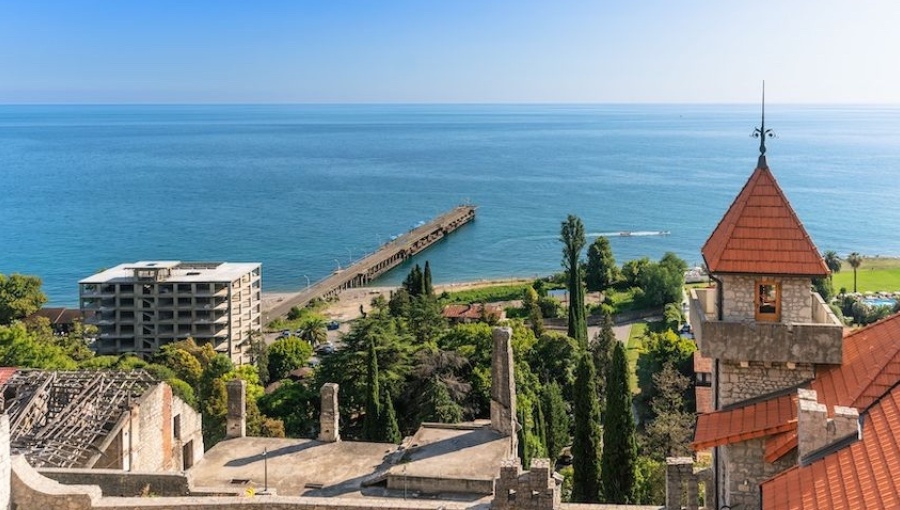
Georgian intelligence says Russia is preparing to annex Abkhazia and South Ossetia

Georgian intelligence says Russia is preparing to annex Abkhazia and South Ossetia
The EU said last week it was concerned by Russian moves to create a permanent naval base in Abkhazia. / Siarhei Nester via PexelsFacebook
By bne IntelliNews November 26, 2026

Georgia's State Security Service (SSSG) has named Russia's occupation of Abkhazia and South Ossetia as the main threat to national security and accused Moscow of preparing to annex both territories, The Insider reported.

Deputy SSSG head Davit Archvadze presented the agency's annual report in parliament. He said Russian policy aims to keep control of the territories and to prepare "fertile ground for annexation in local moods and perceptions", using financial and economic levers and propaganda. The SSSG estimates that Russian construction and reinforcement of occupation infrastructure rose by 26% in 2025.

According to the 2025 report, reviewed by The Insider, Moscow simplified the issuing of Russian passports and driver's licences, sent its own traffic police to the territories, expanded transport links and subsidised flights to Sukhumi. The SSSG sees educational and youth projects involving Rossotrudnichestvo and Russian universities as tools of linguistic, cultural and ideological indoctrination. It says Russia also prosecuted local journalists who opposed annexation, stripped them of Russian citizenship and put them on its register of "foreign agents".

Kremlin deputy chief of staff Sergei Kiriyenko, who oversees the territories, visited Abkhazia seven times in 2025 and South Ossetia twice. The SSSG links his appointment to anti-Russian protests in Abkhazia in November 2024 and Moscow's dissatisfaction with South Ossetia's authorities.

The Insider compared the 2024 and 2025 reports. Cases of "borderization" rose from 46 to 58, in South Ossetia from 45 to 55 and in Abkhazia from one to three. Detentions Georgia considers illegal stayed almost level at 73 and 74.

Russia provided about 80% of South Ossetia's budget and 38% of Abkhazia's in 2025, about $192mn in total, the report says.

The EU said last week it was concerned by Russian moves to create a permanent naval base in Abkhazia.

Zelensky defends attacks on Russian ships outside combat zone

27.11.2026, 

Photo: Sven Kaeuler/dpa

By Friedemann Kohler, dpa

Ukraine coordinates with countries that may be affected before attacks on Russian ships in other parts of the world, President Volodymyr Zelensky said in an interview published on Friday.

The Ukrainian armed forces have never attacked without coordinating with other partners, he said in an interview with the British broadcaster BBC. He said there were diplomatic contacts.

Ukraine recently sank the Russian warship Merkury with sea drones in the Libyan Mediterranean port of Benghazi, raising questions under international law.

Italy criticized the attack as a violation of the sovereignty of the North African country, which has been weakened by civil war.

Zelensky, however, justified operations outside the actual combat zone. He called the Merkury an "absolutely fair goal."

He said Ukraine could not allow Russian ships to attack or transport weapons and similar items, according to BBC News Ukraine's account of the interview published in Ukrainian.

Zelensky: Without Kiev there is no Ukraine

The Ukrainian president accused Russia of trying to divide the country by attacking bridges over the Dnipro River. He said the capital, Kiev, faced a harsh winter. Ukraine would defend the city by all means.

"We need our capital. Without a capital, you don't have a country," he said.

Satellite internet partly working again

Zelensky said the throttling of Starshield satellite internet had been partly lifted. It works at full speed over Ukrainian-controlled territory, but not in Russian-occupied areas, where Ukraine could not shoot down incoming Russian jet drones.

Starshield is the military version of the Starlink satellite internet service of US tech entrepreneur Elon Musk. While the exact background to the repeated throttling is unclear, it is considered a means for the US to put pressure on Ukraine to make possible concessions.

Zelensky questioned the stance of US President Donald Trump, who sees himself as a mediator in Russia's war. He said the US, as a strong and respected country, should put pressure on Russia.

Five countries bordering Russia withdraw from global landmine ban treaty

Five European countries have withdrawn from the international treaty banning anti-personnel landmines over security fears linked to Russia, with two preparing to reintroduce the weapons, a report by the International Campaign to Ban Landmines and the Cluster Munition Coalition has said.


Issued on: 26/11/2026 - RFI

Security concerns linked to Russia's war in Ukraine have prompted five European countries to withdraw from the international treaty banning anti-personnel landmines. AP - Oleg Petrasiuk

The withdrawals have left the global ban facing what the report called its greatest test, as the number of people killed or injured by mines and explosive remnants continues to rise.

Estonia, Finland, Latvia, Lithuania and Poland – all of which border Russia – pulled out in 2025 and 2026, with Moscow now in the fifth year of its war in Ukraine.

The five countries are the first to leave the landmark treaty, known as the Ottawa Convention, which was agreed in 1997 and came into force in 1999. It defines anti-personnel mines as explosive devices designed to kill or injure people who come into contact with them or pass nearby.

Poland and Finland are taking steps to bring the weapons back into their arsenals, the Landmine Monitor 2026 report, published on Tuesday, said.

"The withdrawals, new use and new production are dangerous steps backward for the ban, but they do not define the treaty," said Tamar Gabelnick, the campaign's director.

Some 162 countries are now bound by the treaty, with Lebanon joining this year and the Marshall Islands and Tonga in 2025.

Poland prepares to lay mines to defend eastern borders from Russian threat


Mines across Ukraine

Russia, Ukraine, Iran, Myanmar and North Korea used anti-personnel mines during the reporting period, and the United States may have done so too, the monitor said.

Ukraine, which is a party to the treaty, says it has suspended the agreement during Russia's invasion.

The report, however, states: "Ukraine remains fully bound by all the treaty's provisions. Russia has used antipersonnel landmines extensively in Ukraine since its full-scale invasion."

Ukraine's production and use of mines, including 3D-printed and drone-dropped devices, were documented in the report.

At least 65 territories were confirmed as, or suspected to be, contaminated by mines, as of November 2026. Ukraine, where 275 casualties were recorded last year, is one of eight countries assessed to have more than 100 square kilometres of land affected.

The scale of the problem there represents the most widespread use of landmines in decades, the monitor said.

Clearing landmines in eastern Ukraine, Part 1


Mounting civilian toll


Landmines and explosive remnants of war caused at least 6,929 casualties across 54 countries in 2025 – the highest number since 2020 and the third consecutive annual increase, the report said.

Of those, 1,955 were killed and 4,930 injured. It was not known whether the remaining 44 survived.

Civilians accounted for 84 percent of victims whose status was known. Children made up half of those whose age was recorded.

Myanmar had the highest number of casualties for the third year running, with 1,891. In Syria, the figure rose by 50 percent to 1,602 as large numbers of people who had fled their homes returned following the overthrow of president Bashar al-Assad.

Croatia completed mine clearance this year, becoming one of 32 countries to do so since the convention came into force.

(with newswires)
INTERVIEW

Mali remains strategic for Russia despite heavy losses, investigator says

Russia is unlikely to pull out of Mali despite losing more than 10 percent of its forces there, an investigator who tracks Russian military deployments told RFI. Lou Osbourn co-founded All Eyes On Wagner, a collective of journalists and cybersecurity analysts. She said the losses prove that Russian fighters are taking part in operations alongside Malian troops and that "Africa remains an area of interest for Moscow".


Issued on: 27/11/2026 - RFI

Three Russian mercenaries in northern Mali, in an undated photograph provided by the French military. AP

The United Kingdom's The Guardian newspaper – which had access to the leaked records through a media consortium that includes RFI – reported on Tuesday that 349 Russian fighters were killed in Mali between September 2023 and September 2026.

It based its tally on death certificates held by Russia’s national statistics agency, Rosstat, but said that the real figure was probably higher because deaths can take time to be registered.

Two hacking groups obtained the records: Cyber Partisans, which is linked to the Belarusian opposition, and Ukraine’s Silent Crow. Moscow does not publish its military losses in Africa.

Russian mercenaries from the Wagner group arrived in Mali in late 2021 to support the country’s military rulers. In June 2025, Wagner handed over its operations there to the Africa Corps, a unit under Russia’s defence ministry.


The Guardian linked most of the 349 deaths to fighting with armed groups. The records list 70 Russians who died on 27 July, 2024, when Tuareg separatists and fighters from JNIM, a group linked to al-Qaeda, ambushed Malian troops and Wagner fighters near Tinzaouaten, close to the border with Algeria.

Another 43 Russians died on 25 April, 2026, when JNIM and the Tuareg-led Azawad Liberation Front launched coordinated attacks across Mali. General Sadio Camara, Mali’s defence minister, was killed in the offensive.

Russian forces withdrew from the northern city of Kidal by the following morning, and Malian troops and the Africa Corps retook it on 6 October.

Osbourn tells RFI why she trusts the leaked figures and what they reveal about Russia’s role in Mali.

RFI: The leaked records list 349 Russian fighters from Wagner and then the Africa Corps killed in Mali over three years. Is that a significant toll?

Lou Osbourn: Yes, it’s quite high. It’s more than 10 percent of their force. The deaths also line up with specific events – the battle of Tinzaouaten and the more recent fighting.

RFI: You're talking about the coordinated attacks of 25 April, when several places were hit at once and Mali’s defence minister, General Sadio Camara, was killed?

LO: Yes, that’s right. It shows they suffered heavy losses. The figures are particularly interesting because the Russian authorities revealed so little about the deaths of Wagner fighters and later Africa Corps fighters. We looked into this ourselves, especially around the time of Tinzaouaten.

RFI: That was in July 2024, when Tuareg separatists and jihadists from JNIM laid an ambush...

LO: Exactly. Even the fighters’ families weren’t told at the time. There was a blackout on the information. What’s interesting about these figures is that they show Russia did record the deaths.

RFI: The leaked figures put the toll at 70. That’s also how many the armed groups claimed to have killed at the time.

LO: Yes, absolutely. It was a traumatic experience for Wagner.

RFI: The group’s biggest defeat in Africa?

LO: Absolutely, the group’s biggest defeat. What’s very interesting is that the official records amount to a kind of acknowledgement of the defeat. But that acknowledgement was never made public.

Why Russia remains dependent on medicines made by the West

RFI: These figures come from Rosstat, Russia’s national statistics agency, which was hacked by two groups, Cyber Partisans and Silent Crow. Do you have any doubts about how reliable the figures are?

LO: We have few doubts, for two reasons. We know one of the hacking groups and it generally doesn’t tamper with the documents it obtains. That gives us some confidence in the source.

The numbers also fit what’s happening in the countries concerned. There’s been a lot of talk about Mali, but the records list deaths in many African countries. In Niger, for example, there were very few – two, if I remember rightly. Russia’s involvement there is very limited. Our estimate was around 200 people.

RFI: Two hundred fighters?

LO: Two hundred Africa Corps fighters. When you compare the number of deaths with what we know about how many fighters are deployed, the figures look realistic and consistent.

RFI: You’ve said 349 Russian deaths in Mali is a high figure. Does it also show how involved Russia is alongside Malian forces?

LO: Yes. It shows they take part in military operations and that their role goes beyond training.

RFI: Which is something we knew...

LO: We did, but this gives us another concrete piece of evidence. It shows they’re operating alongside the Malian army.

RFI: The leak gives no figures for Malian soldiers killed in recent years. If nearly 350 Russian fighters were killed, how many Malian soldiers might have died? Thousands?

LO: I think the toll is probably two or even three times as high. We know there are usually only a handful of Russian fighters embedded in small Malian army units. Sometimes there’s one Russian fighter for every five Malian soldiers. So the Malian army’s losses are probably much higher than Russia’s.

RFI: The hack of Russia’s statistics agency revealed that at least 500,000 Russian soldiers were killed on the front in Ukraine between February 2022 and August 2026, or 700,000 if those reported missing are included. Could those losses put Russia’s presence in Africa in doubt?

LO: I don’t think so. Russia sends far fewer people to Africa and its troop numbers there are fairly stable. In countries where it’s establishing a presence, it has only around 100 people. The Africa Corps runs operations in both Africa and Ukraine and rotates its troops.

Africa also matters politically to Russia. It helps Moscow win allies and gives it a way to try to stretch Western military resources in Ukraine and elsewhere. So Africa remains an area of interest for Moscow, and I doubt the release of these figures will lead to a withdrawal.

RFI: After the 25 April attacks in Mali, which killed 43 Russian Africa Corps fighters, Russia seems to be getting even more involved. Despite the cost in lives, the deployment still seems strategically important to Moscow, especially in Mali.

LO: Mali remains strategic because Russia uses it as a base for some of its activities. It was from Mali that Russian forces went into Burkina Faso and Niger. Resources are also at stake, and Mali matters to Russia politically.

For a year now, we’ve heard every three months that Russia is going to pull out. It’s still there, and I find it hard to see why it would leave now. I don’t think it will.

This interview was adapted from the original audio in French by David Baché.