Saturday, November 28, 2026


COMMENT: Philippine top court sidesteps legality of Duterte surrender days before Hague trial

COMMENT: Philippine top court sidesteps legality of Duterte surrender days before Hague trial
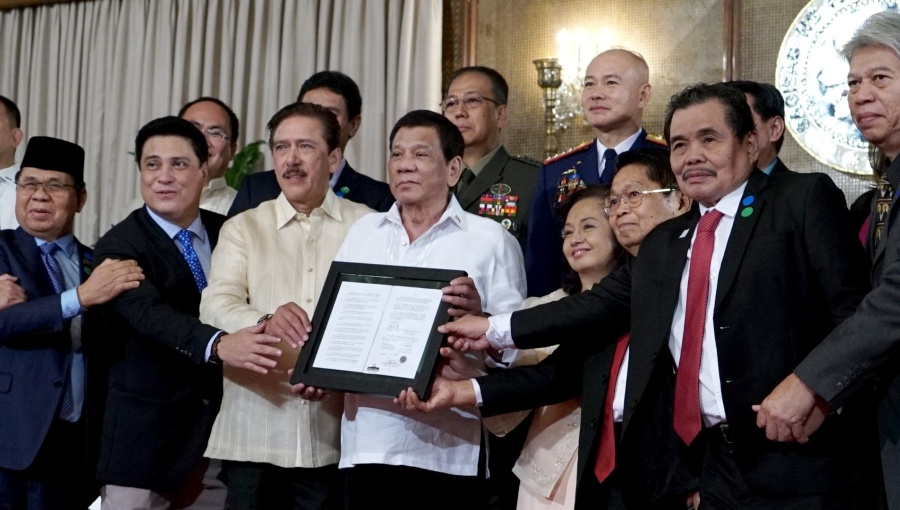
Nine justices found the habeas corpus petitions moot. Four disagreed, and their opinions could help the former president's defence at the ICC.               / Duterte - centre - PNA - PDFacebook
By IntelliNews - Jakarta Bureau November 28, 2026

IntelliNews summary:

  • The decision is dated November 11; Justice Gaerlan did not take part.

  • Justices Kho and Hernando called the surrender, or the law behind it, unconstitutional; Justice Inting said a ruling could matter at the ICC.

  • Duterte's own petition against cooperating with the ICC, G.R. No. 278747, is still pending, and his family will seek reconsideration.

  • At the ICC the defence accepts pseudonyms in principle but opposes fully closed sessions for 22 of the 69 prosecution witnesses.

____________________

The Philippine Supreme Court has thrown out the Duterte family's bid to free the former president from The Hague, but refused to say whether handing him over was lawful.

The en banc court split nine to four, with Associate Justice Samuel Gaerlan away on official business. In a decision dated November 11 and released on November 24, Associate Justice Japar Dimaampao held that the petitions filed by Rodrigo Duterte's children Sebastian, Veronica and Paolo had become moot, because a Philippine writ stops at the border and their father now sits in the custody of the International Criminal Court (ICC). Duterte "is not just beyond the Court's coercive powers, but also stands accused before an international tribunal that has assumed jurisdiction over his person," the court said.

Just days before his trial opens, the most divisive question in Philippine politics stays formally open. That suits the Marcos administration, which carried out the arrest, better than the Dutertes, yet the dissents hand the former president's lawyers arguments that could travel to The Hague.

Dismissal, the majority stressed, does not mean the arrest and transfer were "necessarily lawful or that his constitutional rights were not violated". Claims for damages belong elsewhere, and Duterte's own petition against cooperation with the ICC, filed hours before his flight on March 11, 2025, remains pending as G.R. No. 278747.

Associate Justice Antonio Kho Jr. went furthest, writing that surrendering a Filipino to a foreign tribunal without a domestic law and prior court authority amounted to an "extraordinary rendition" and was unconstitutional, warning that officials could dodge review in future simply by moving fast. Associate Justice Ramon Paul Hernando found Section 17 of Republic Act No. 9851, the provision the government relied on, unconstitutional for failing to say who decides on a surrender or how. Even Senior Associate Justice Marvic Leonen, who agreed the petitions should be dismissed, held that no international warrant can be enforced without Philippine judicial intervention.

Associate Justice Henri Jean Paul Inting made the point that matters most for what comes next. A Supreme Court ruling, he wrote, could carry weight at the ICC under the abuse-of-process doctrine, which allows judges in The Hague to halt a case if an otherwise lawful warrant was carried out by improper means. The defence's earlier jurisdictional push, a 2025 bid to remove two judges, went nowhere; a domestic finding that the surrender broke Philippine law would be a far stronger card.

"With respect, that is precisely why the court should have ruled on the merits," said Israelito Torreon, counsel for the Duterte camp, the BusinessWorld newspaper reported. "A grave constitutional question was raised, and it was left unanswered." Salvador Paolo Panelo Jr., who represents Veronica Duterte, said a motion for reconsideration would be filed, GMA News reported on November 25.

Malacanang chose to read the same text as a clean bill of health. "The Supreme Court did not declare any human rights violation committed by the administration against anyone," said Palace Press Officer Clarissa Castro, who maintained that the government had acted under Republic Act No. 9851 "without any abuse of power".

President Ferdinand Marcos Jr's decision to let police arrest Duterte at Manila's airport and put him on a chartered flight to the Netherlands the same night finished off an alliance that had already cracked when Vice President Sara Duterte said in November 2024 that she had hired an assassin to kill him should she herself be killed. The detained patriarch answered at the ballot box, winning the Davao mayoralty two months later. His daughter now faces a Senate impeachment trial that could bar her from the 2028 presidential race.

Trial Chamber III, presided over by Judge Joanna Korner, opens the trial on November 30 on three counts of crimes against humanity that pre-trial judges confirmed in April. In October the court found the 81-year-old fit to stand trial. Prosecutors want 55 witnesses out of 69 to testify under pseudonyms and 22 to give evidence entirely in closed session.

The defence, led by Peter Haynes, has told the chamber it will leave pseudonyms and face and voice distortion to the judges but objects outright to the closed sessions, according to a filing made public on November 23. "The use of fully closed sessions, particularly to this extent, unjustifiably infringes upon the public nature of the proceedings and Mr Duterte's right to a public trial," it said, adding that public trust is not built "when in-court evidence is given behind closed doors or by faceless witnesses with distorted voices". It wants private sessions decided witness by witness.

In both courts the Dutertes are asking for the same thing: daylight. Manila's justices have declined to provide it on the arrest, and the four who wanted to may yet prove more useful to the defence than the nine who did not.

 

Taiwan, South Korea share chip whiplash but not the factory boom


The Taiex and the Kospi swung together on Nvidia's leadership drama, but Taiwan's industrial output is up 29.8% y/y while South Korea's barely grows. / bne IntelliNewsFacebook
By Mark Buckton in New Taipei November 28, 2026

IntelliNews summary:

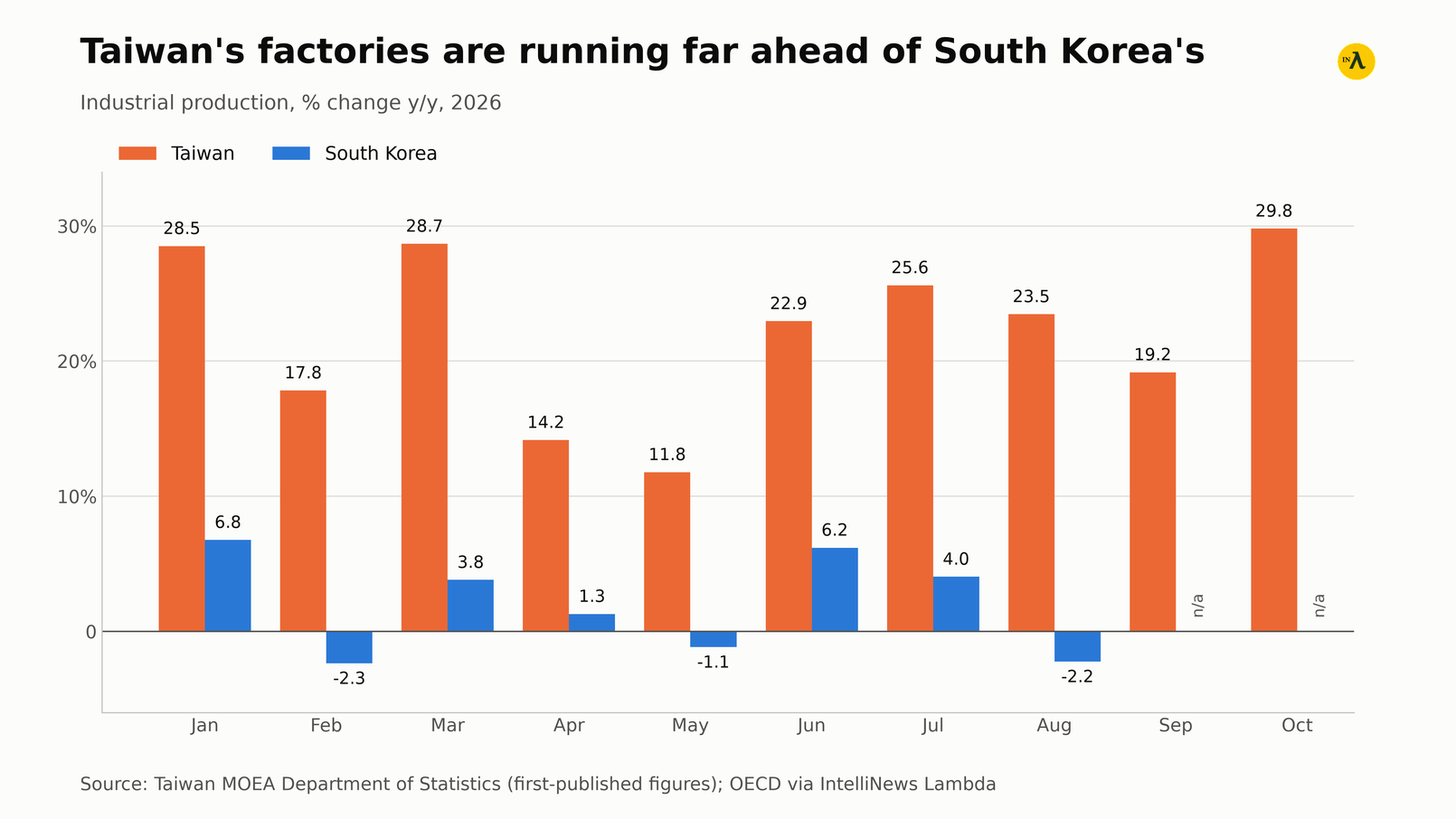
  • Taiwan's October industrial output rose 29.8% y/y to a record, with computers, electronic and optical products up 130.57%.
  • South Korea's output excluding construction moved between -2.3% and +6.8% y/y in January-August, while chip export values more than quadrupled.
  • Goldman Sachs sees conventional DRAM and NAND prices falling about 20% in 2028.
  • Taiwan's central bank sits at 2% with a TWD500bn ($15bn) fund in the market; the Bank of Korea is tightening at 3%.

____________________

Taiwan's and South Korea's stock markets soared and slumped almost in step over 48 hours, but only Taiwan's factories are turning out the boom both sets of share prices imply.

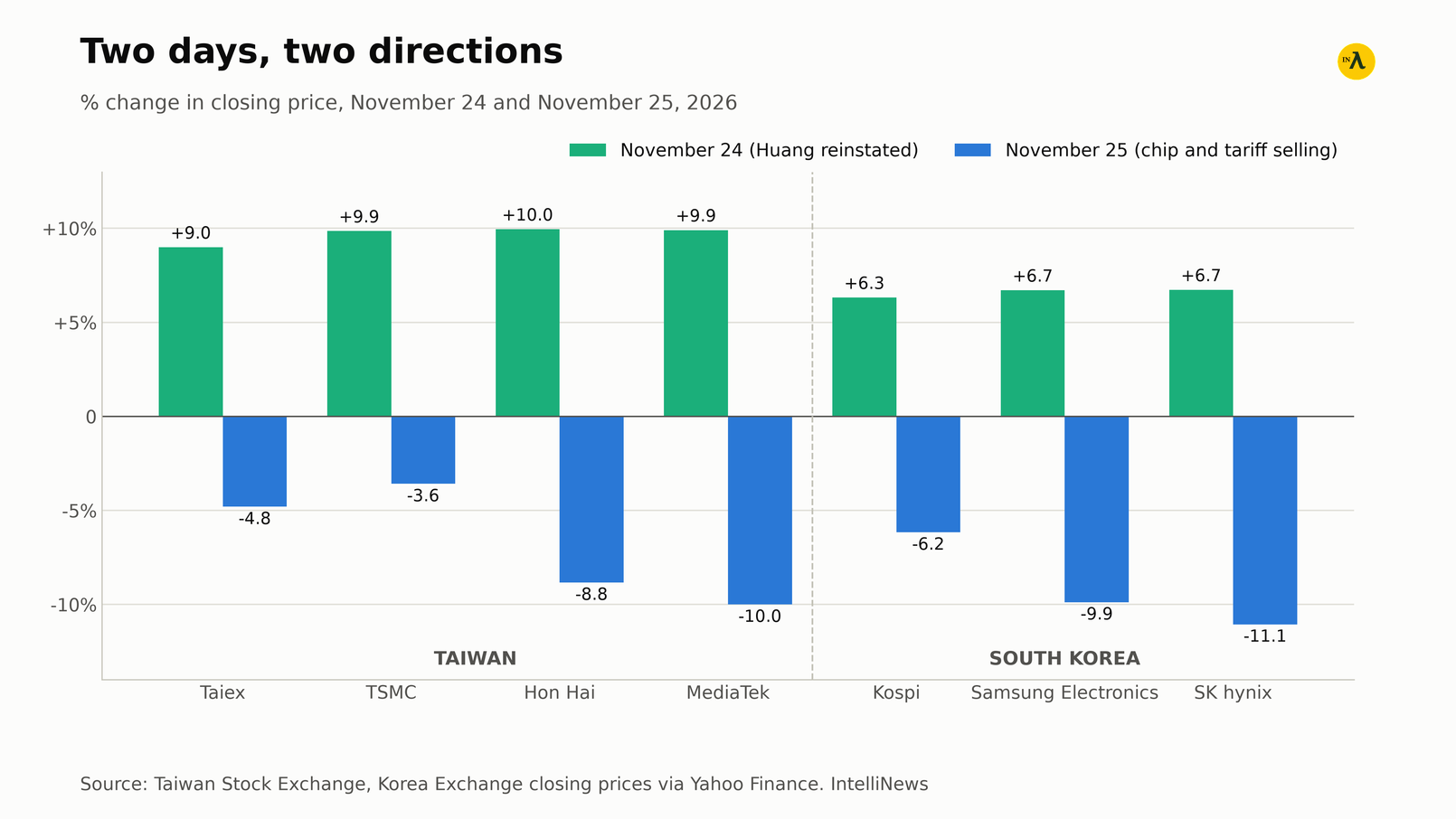
The Taiex jumped 8.99% to 40,122.35 on November 24, the day Nvidia's board reinstated Jensen Huang as chief executive, and the Kospi gained 6.32% to 5,006.03 as Samsung Electronics and SK hynix each added 6.7%. In Taipei, TSMC, Hon Hai and MediaTek all closed within a whisker of their 10% daily limits. By the next afternoon most of that was gone. The Kospi lost 6.16% to 4,697.51 on November 25, with Samsung down 9.87% and SK hynix 11.05%, the Korea Times reported. The Taiex closed 4.80% lower after shedding as much as 3,440 points during the session, according to Focus Taiwan.

Investors treat the two bourses as one AI trade, and both indices are top-heavy. TSMC alone accounts for more than 40% of Taiwan's market capitalisation, while Samsung and SK hynix make up roughly half of the Kospi, the Financial Times reported. Below the share prices the economies diverge. Taiwan's chip boom shows up in factory output across servers, foundries and machinery makers; South Korea's shows up mainly in export values and in two stocks.

The reversal on November 25 followed a 7.88% fall in the Philadelphia Semiconductor Index overnight. Traders in Taipei also pointed to reports of new US tariffs under a Section 301 investigation, and in Seoul to talk of a fresh round of US levies on trading partners over industrial subsidies and overcapacity. Goldman Sachs had already cut its SK hynix target price to KRW2mn ($1,494) from KRW3.5mn.

"Foreign investors turned net sellers, while Trump's remarks and uncertainty over tariffs also weighed on the market," Lee Kyung-min, an analyst at Daishin Securities, told the Korea Times.

Taiwan's factories at full stretch

Taiwan's industrial production index rose 29.8% y/y to a record 151.3 in October, its 32nd consecutive month of growth, the Department of Statistics at the Ministry of Economic Affairs (MOEA) said on November 24. The manufacturing subindex rose 31.63%. Output of computers, electronic and optical products, mostly servers, switches and chip inspection equipment, rose 130.57%, electronic components 25.39% and machinery 26.85% as chip suppliers installed new equipment.

Chemical materials output fell 2.8% and cars and parts 3.92%, and only four of the six main manufacturing industries grew. Production rose 21.52% in the first ten months, and the ministry expects manufacturing to grow by 22.2-26% y/y in November. In September the central bank raised its forecast for 2026 GDP growth to 11.48% in its third-quarter policy statement.

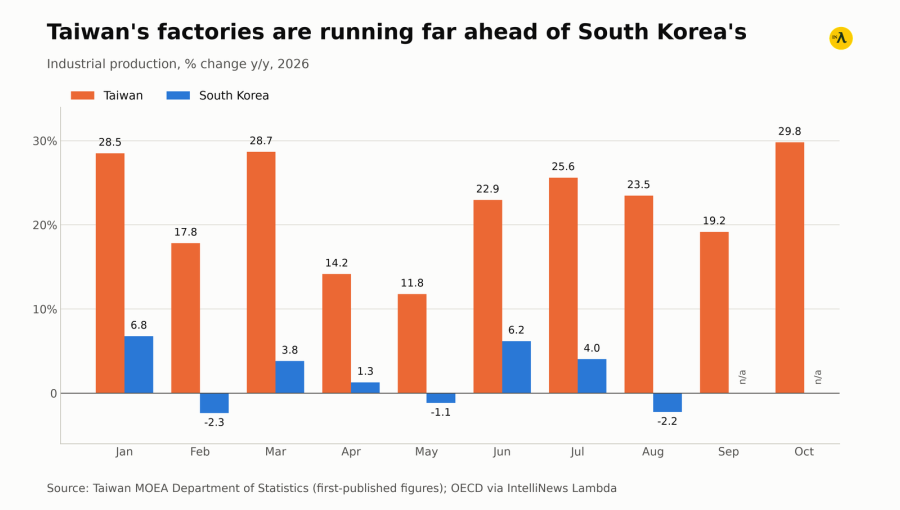
Industrial production, % change y/y, January-October 2026. Taiwan: first-published monthly figures; South Korea: industry excluding construction, to August. Source: Taiwan MOEA Department of Statistics; OECD via IntelliNews Lambda

Korea's boom runs through prices

South Korea's industrial output, excluding construction, moved between a 2.3% y/y fall and a 6.8% rise from January to August, OECD figures show. September brought a jump: mining and manufacturing output rose 9% m/m and chip production 19.2%, the Ministry of Data and Statistics said on October 30. Its October figures are due on November 30.

Exports grew far faster. Chip exports rose 331.2% y/y to $16.6bn in the first ten days of November, almost half of all shipments, and annual exports have passed $1 trillion for the first time. When export values race ahead of production volumes, prices are doing much of the lifting, and memory prices are exactly what Goldman Sachs expects to fall. Its latest note sees conventional DRAM and NAND prices each dropping by about 20% in 2028 as China's CXMT adds capacity.

That makes the Kospi a leveraged bet on the memory cycle. Samsung's market value closed at KRW998 trillion on November 25, its first close below KRW1 quadrillion since March 31, Korea JoongAng Daily reported.

% change in closing price on November 24 and November 25, 2026. Source: Taiwan Stock Exchange, Korea Exchange closing prices via Yahoo Finance. IntelliNews

Who has room to respond

Taiwan has more slack. Its central bank kept the discount rate at 2% in September while forecasting 2026 inflation of 2.03%, and the TWD500bn National Financial Stabilisation Fund has been cleared to buy shares since November 6. The regulator has also banned short-selling of stocks that fell in the previous session. The weak point is the currency: foreign institutions pulled about $10bn in the first ten days of November, and reserves slipped to $596.44bn at the end of October as the central bank defended the Taiwan dollar.

The Bank of Korea is in the middle of a tightening cycle. It held its base rate at 3% on October 22 after raising it in July and August, with inflation at 2.9% in September, and its board meets again on November 26. An economy that grew 1% q/q in 3Q26 on chip exports leaves the central bank little reason to ease for the sake of the stock market.

Taiwan's exposure runs through an entire hardware supply chain that is still adding output; South Korea's runs through two memory makers whose earnings rest on prices. If the AI trade turns, both indices will fall together again, but only Seoul's has so little factory growth beneath it.

This article was produced with the help of the IntelliNews Lambda analytical tool