Wednesday, September 24, 2025

The “Hotel California Effect” of Fealty to the US


For Noam Chomsky, the Thucydidean dictum ‘the strong do what they can and the weak suffer what they must’ is one of the most valid and important principles of international relations, which can be expressed in different ways.

In general, the principle implies that to keep the prevailing system of control exercised by those in power intact, it is necessary to make sure that none of the weak gets out of hand, meaning that they should all behave according to direction by the strong and not independently. They must follow orders because, if independent thinking and action are seen to work in one place, others might try to do the same, and the system of domination would unravel.

The Mafia Doctrine

Chomsky (2013) refers to his application of this principle to US foreign policy as ‘the Mafia Doctrine’:

In the Mafia system, if some small storekeeper decides not to pay protection money, the money may not mean anything to the godfather, but he’s not going to let him get away with it. And, in fact, he’s not just going to go in and send his goons to get the money; he’s also going to beat him to a pulp, because others have to understand that disobedience is not tolerated. In international affairs, that’s called “credibility.”

No need here to set out the many countries, and the wide variety of ways, in which the US has firmly established its ‘credibility’.

In this short essay, we argue that countries that belong to the US-led ‘mafia’ – and therefore owe fealty to the don in Washington DC (at present, Donald Trump) – will be subject to what we call ‘the Hotel California effect’.

Roles and Responsibilities of Gang Membership

As a member of a mafia gang (or family), your role is subordinate, ranked strictly according to how willing you are to do nasty jobs effectively and efficiently for the boss without question, or how much loot you can deliver, and your reliability in these respects.

There is no participative management; no possibility of a primus inter pares arrangement; not even any meaningful consultation.

The imperious and unreflectively self-assured and authoritarian current godfather in Washington DC would entertain none of these encroachments on his absolute power, no matter how grovelling or politely expressed a request for some decision-making involvement might be, even if it came from his underboss (sottocapo).

So, for example, following a recent visit to the UK by President Trump and his ‘royal’ treatment there, ‘the president’s chief-of-staff [Susie Wiles, was asked] how much difference the visit [would] make to Britain’s ability to influence US policy on trade, tariffs and international affairs. Her response was frank – “none at all”.’

What chance then lesser gang members like Australia?

Clearly, gang members must simply to do as they are told – ‘if the don gives you orders, the guy down below doesn’t kid around’ (Chomsky, 2011). The rules are straightforward. Obey. Be in awe of your don (Donald). And every time he says or does something, make sure that you are seen to participate enthusiastically in the phocine clapping and honking of approval.

But perhaps the most important part of your job is to extract ‘rents’ and to kill people who have done you no harm (or help others to kill them) – sometimes in very large numbers that include women and children.

The reasons for doing so have solely to do with disobedience. The pretexts given are usually silly and/or spurious.

But you cannot object to any of this or concern yourself with it.

Your duties can also include inflicting less than deadly harm on others, that is, harm that is not immediately lethal but frequently leads to that end over a longer period – a form of torture, like economic sanctions.

And then of course there is actual torture, which you are also expected to carry out as instructed.

It’s all illegal of course and the killings therefore amount to murder and crimes against humanity and sometimes genocide. Collective guilt of this sort strengthens the commitment of gang members.

You are also expected not to blab about any of this to anyone and to help cover it up and stop people from talking or complaining about it (not because the don pays any attention to the law, but because he doesn’t like the disrespect it implies). This ‘code of silence’ (omerta) – behaving as if nothing untoward ever happens – must never be broken, usually on pain of death.

You can see that the analogy with the US and its allies is not at all far-fetched. Examples are easy to come by and include Australia’s and the UK’s contributions to the invasion of Iraq (as members of the ‘Coalition of the Willing’), which resulted in the deaths of up to 2.4 million Iraqis; their contributions to the US-led invasion of Afghanistan where about 241,000 people were killed (mostly civilians); and the various types of support rendered by them to the US-backed genocide in Palestine.

There are many more examples, some of which we have discussed elsewhere.

‘Rewards’ and Punishments

The disobedience rule applies equally to gang members, friends and foes.

With respect to ‘rewards’, when, as a gang member, you do as you are told, you are allowed to get on with your life (always within very strictly defined limits) and from time-to-time crumbs from the master’s table might be bestowed upon you.

He might, for example, allow you to play golf with him at Mar-a-Lago (so long as you lose, pay the green fees, and buy the drinks); or purchase nuclear submarines from him at extortionist prices; or condescend to build his military bases all over your territory, some of which incorporate highly sophisticated eavesdropping devices that supply intelligence to countries unknown for nefarious purposes that are kept secret from you.

Other examples will come readily to mind.

And that’s the good news.

To reiterate, the trouble, though, with being a member of a mafia gang, particularly the biggest and baddest one around, is that disobedience by you is not tolerated either, perhaps even less than disobedience by non-gang members.

Other mortal sins include disloyalty, disrespect, and weakness.

All of which makes you wonder how many prime ministers and foreign ministers in how many ‘international community’ countries have lain awake at night worrying that they might have said or done something that could be taken to construe any of these things.

Having inflicted so much pain and suffering on countries that have broken the rules, they will know all too well what the don’s reactions to real or perceived transgressions by gang members will be.

So, for example, on questions of human rights, this means that even in your wildest dreams you would never say to the (richly deserving) US anything remotely like what you might say – for example – to China.

It also means of course that you cannot wake up one morning feeling bright and sparky in the refulgence of a new dawn and suddenly decide that ‘all this murder and mayhem are not for me, I’m out of here’ – that is, unless you are prepared to incur the Godfather’s wrath (note that the hypocrisy of a sudden change of heart would not matter as you have become inured to all of the double dealing).

The ‘Hotel California Effect’

We are all just prisoners here of our own device…You can check out any time you like but you can never leave’.

When it comes to discussions of Australian foreign policy, much of what is written seems to assume that the degree to which we should follow the US lead or do as we are told is a matter of choice.

The Mafia Doctrine that we have outlined clearly indicates that the ‘choices’ that Australian and other gang members can make about what are supposedly their own foreign affairs are highly circumscribed.

Accordingly, exhortations to our foreign minister and prime minister to ‘break a leg’ and make policy changes – such as ‘disengaging’ from the Godfather in Washington or ploughing a different furrow from the one he has told us to plough, in the Pacific or anywhere else – could well turn out to be (to mix my metaphors) much too close to the bone for comfort.

Peter Blunt is Honorary Professor, School of Business, University of New South Wales (Canberra), Australia. He has held tenured full professorships of management in universities in Australia, Norway, and the UK, and has worked as a consultant in development assistance in 40 countries, including more than three years with the World Bank in Jakarta, Indonesia. His commissioned publications on governance and public sector management informed UNDP policy on these matters and his books include the standard works on organisation and management in Africa and, most recently, (with Cecilia Escobar and Vlassis Missos) The Political Economy of Bilateral Aid: Implications for Global Development (Routledge, 2023) and The Political Economy of Dissent: A Research Companion (Routledge, forthcoming 2026). Read other articles by Peter.
\

Symbolic Declarations: Palestinian Recognition at the UN General Assembly

“True to the historic commitment of my country to the Middle East, to peace between the Israelis and Palestinians, this is why I declare today, France recognises the state of Palestine.” So stated President Emmanuel Macron to more than 140 leaders in attendance at the United Nations General Assembly on September 22. He further declared that “we must do everything in our power to preserve the possibility of a two-state solution”.

On September 21, the United Kingdom, Canada, Australia and Portugal had similarly recognised Palestinian statehood. The intention was clear: to resuscitate the moribund two-state solution, long confined to diplomacy’s morticians. For UK Prime Minister Sir Keir Starmer, the decision had been prompted, to a large degree, by, “The Israeli government’s relentless and increasing bombardment of Gaza, the offensive of recent weeks” and continued starvation and devastation.

Canadian Prime Minister Mark Carney had high hopes for his country’s gesture. “Canada recognises the State of Palestine and offers our partnership in building the promise of a peaceful future for both the State of Palestine and the State of Israel.”

joint statement from Australian Prime Minister Anthony Albanese and Foreign Minister Penny Wong reiterated the country’s “longstanding commitment to a two-state solution, which has always been the only path to enduring peace and security for the Israeli and Palestinian peoples.”

While most countries in Africa, Asia and South America recognise a Palestinian state, Western states, for the most part, have gone slow on the issue, holding to the long-standing assumption that Palestinians should patiently wait their turn once Israel gave consent. The attacks of October 7, 2023 by Hamas on Israel, and the retributive, vengeful war of annihilation being waged in Gaza, turned matters. Recognising Palestine became a matter of considered calculation, a potential incentive to convince Israel about the merits of a ceasefire and a return to talks that would lead to conditions of tolerable co-existence. But conditions would also be imposed on Palestinian statehood. The habits of former colonial powers resurfaced: a Palestinian state would be declared, but only on their terms.

Central to the new rollcall of states recognising Palestine are various undertakings, some of them more realistic than others. The Palestinian Authority, for instance, has given assurances that elections will be held in a timely fashion, and reforms made to a worn and corrupt administration in the West Bank. The assurance given by the Palestinian Authority leader, Mahmoud Abbas, on ensuring the disarming of the militants and the demilitarisation of the Gaza Strip is something he is in no position to give, seeing that any such decision will lie with Hamas.

Abbas, in his video address (his travel visa to the US had been revoked), again performed the necessary rites of sorrow and condemnation involving the “killing and detention of civilians, including Hamas’ actions on October 7, 2023.” He warned that “peaceful, popular resistance of this brutal occupation” would continue till it was defeated. He advertised the fact that local elections and elections for institutions, federations and unions had been conducted, with tepid acknowledgement of “a specialised committee to develop the justice sector in Palestine.” As for holding “democratic general elections,” that was a matter for Israel, blamed for obstructing and preventing them from taking place in East Jerusalem.

The antics of recognition have done nothing to halt the methodical destruction of Gaza City, nor restore regular channels of humanitarian aid. In Israel, Prime Minister Benjamin Netanyahu holds to the idea that Palestinian statehood must never be allowed to eventuate. “It will not happen,” he thundered, arguing that recognising such an entity was a gift to terrorism. “A Palestinian state will not be established west of the Jordan River.” In keeping with previous isolated states in history – apartheid South Africa, Nazi Germany and fascist Italy – he hopes that Israel can develop an economy with “autarkic characteristics” and become a “super Sparta”.

Israeli opposition leader Yair Lapid is less sure. While condemning unilateral recognition of a Palestinian state as undue reward for terroristic acts, he is convinced that sober and sensible diplomacy could have averted the issue. “The government that brought upon us the worst security disaster in our history is now also bringing upon us the most severe diplomatic crisis,” he opined in a seething post on X.

Unfortunately for the Palestinian cause, what is left in Gaza City is being levelled even as the diplomats and politicians congratulate themselves in New York. Israel’s odious ambassador to the UN, Danny Danon, is partially right in calling the recent clutch of declarations “empty” in character. Israeli Finance Minister Bezalel Smotrich captures the sneering mood: “The days when Britain and other countries would determine our future are over, the mandate is over, and the only answer to the anti-Israeli move is sovereignty over the homeland in Judea and Samaria and removing the foolish idea of a Palestinian state from the agenda forever.”

Binoy Kampmark was a Commonwealth Scholar at Selwyn College, Cambridge. He lectures at RMIT University, Melbourne. Email: bkampmark@gmail.comRead other articles by Binoy.


Recognize Hamas


Today's symbolic actions make no difference, but there are symbolic actions that could''


Meaningless gestures

Israel’s most genocidal Western supporters are planning to “recognize” a “Palestinian state”. France, Britain, maybe even Canada if the Palestinian state meets the Canadian Prime Minister’s novel criterion (the Canadian PM said he thinks there needs to be a “Zionist Palestinian State”).

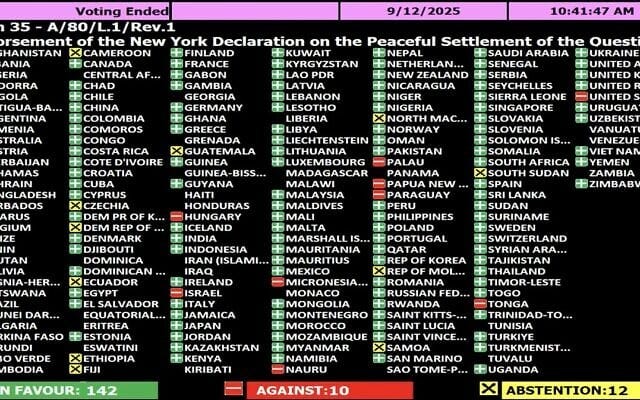
This “Palestinian State” will be run by the “Palestinian Authority” and will derive its authority not from its arms or the electoral legitimacy of its people, but from an agreement with Israel signed in Oslo in 1993 under American auspices, one that binds the Palestinian Authority but not Israel. For this agreement, the Palestinian Authority imprisons, tortures, and kills Palestinians, while the Israelis enthusiastically break every obligation and provision that is supposed to compel their side.The UN General Assembly adopts a resolution endorsing the New York Declaration on the Peaceful Settlement of the Question of Palestine and the Implementation of the Two-State Solution, September 12, 2025 (UN)

Meanwhile, some United Nations committee, following some group of something called “genocide scholars”, has decided two years and hundreds of thousands of deaths later, that Israel is, indeed, committing genocide in Gaza.

Genocidal politicians like Bernie Sanders followed – they too, discovered that there’s a genocide in Gaza.

Do not find hope in these gestures.

That’s not because they are symbolic. The US / Israel and Western allies are more dependent on propaganda than any other tool. Symbolism is extremely important to them. If they were deprived of their symbols, they would have a far harder time committing this genocide.

But these gestures do not do that. These gestures are meaningless.

The Heated Exchange

What is a sort of symbolic gesture that would have an effect on the genocide?

There’s a clue to be found in the viral video of a Chinese academic confronting an Israeli official. The Chinese academic states a figure (probably one tenth of the actual death toll) of 70,000 killed, and says that Israel lost legitimacy when they killed so many women and children. The Israeli official says that is not factual. Prof. Xuetong rejoins that Israel does not get to determine what is factual and what isn’t.

Prof. Xuetong gets right to the heart of Israel’s symbolic power: it is to determine what is factual and what isn’t.

But the truth is that even Prof. Xuetong accepts much, far too much, of Israel’s “facts”.

Through its disciplined spokesman, Israel tells the professor that “the terror organisation Hamas is still holding our hostages”.

Prof. Xuetong replies: “Your military people should [have shot] the terrorists. Not the children! Not the women! When [you] shot the women and the children, you lost the legitimacy to carry out any actions [for] that reason.”

You agree they’re genociding. Why do you still believe them?

But if it’s the case that Israel is committing genocide, why is the “international community” that decides the facts accepting Israel’s claim that Palestine is full of terrorists that are to be killed?

Why is the “international community” accepting Israel’s claim that Hamas is a terrorist organization at all?

Why is the “international community” accepting Israel’s lies about what happened on October 7, 2023?

It’s been two years. Official bodies now accept that Israel’s committing genocide. Now how about some skepticism about the claims Israel made to justify that genocide?

Reject both Israeli facts and Israeli logic

The international community to which Prof. Xuetong refers has some serious rethinking to do. It is not solely the acceptance of Israeli facts, but the acceptance of Israeli logic that must stop.

If the international community accepts that terrorists are simply to be eliminated, there is a lot more genocide in our future. What is the definition of terrorism? Israelis and their followers would say, “a terrorist is whoever we say it is”, but to try to apply any non-racist logic, the only viable definition of terrorism is something like the “killing of noncombatants for political objectives”. Israeli logic is that everyone involved in the entire chain is a terrorist: those who fire the weapons, those who make the weapons, those who transport them, those who manufacture them, those who finance them, and those who justify their use. And furthermore, Israelis state that eliminating terrorists is so important that it’s acceptable to kill 2-10 others per terrorist if they are “human shields”. This is the declared, accepted doctrine (Israeli practice, which includes rape, torture, and infrastructure destruction, is much worse) which Israeli lawyers defend in public and under which they are committing this genocide.

Imagine if the “international community” applied this logic about eliminating terrorists consistently. The Israelis are, after all, killing people all over the world, and especially Palestinians, for political objectives – terrorism. There are hundreds of thousands of people in their army, navy and air force firing these weapons. Between Israel, Europe, the US and beyond, there are millions of people involved in the production and distribution of these weapons and in the ideological and media terrorist apparatus of rationalization and justification.

If the “international community” wishes to apply Israel’s logic about terrorism, it has three choices:

  1. Accept racism. Accept that the US / Israel has a right to label terrorists, commit genocide, and the rest of the world can just hope not to be on the list.
  2. Commit a counter-genocide. Start drawing up their own list of millions of people in the US, Israel, and Europe, who, by way of their participation in the production, distribution, and justification of bombing and famine in Gaza, meet the Israeli definition of terrorists, to be eliminated.

The third choice is to discard this logic altogether, get out of the genocidal Israeli mentality, and focus on what will stop genocide, not proliferate it.

Symbolic gestures

Symbolic gestures should attack Israel’s symbolic powers:

  • Israel’s lies about October 7th.
  • Israel’s ability to label the Palestinian people – and the people of the whole world, increasingly – as “terrorists” or “human shields”, who Israel has the right to kill.
  • Israel’s ability to label anyone resisting them as illegitimate, as outside of politics, and as people who Israel is allowed to kill. Yesterday it was the PLO. Today it’s Hamas. Symbolic demons, symbolic targets when the real target is the entire Palestinian people and especially their children.

If the Israelis succeed in their genocide and “wipe out Amalek”, tomorrow there will be a new Amalek – and the Israelis will be there to extract the world’s condemnations of Amalek one way or another. Israel conjures up enemies to continue its supremacist and colonialist aims.

A Meaningful Gesture: Recognize Hamas

Imagine if the “international community”, instead of “you should have killed the terrorists and spared the children,” were to say “We don’t give a damn if you call them terrorists, you have no right to kill anybody anywhere.

Imagine if the “international community” were to say, “we have investigated your claims and we don’t believe your lies about October 7th.

Imagine if the “international community” were to say, “the military actions taken by Palestinian armed organizations against the Israeli army are legitimate, but the genocidal actions taken by Israel, including mass Hannibal actions killing hundreds of Israelis on October 7, are not. We recognize the Palestinian resistance, but Israel has lost its right to be recognized.”

Imagine if the “international community” were to say, “none of the things Israel has said about them can disqualify the Palestinian resistance, but Israel’s genocidal actions and statements have disqualified Israel.”

Imagine if the “international community” were to say, “after your long record of atrocities, the only sensible conclusion is not that the future Palestinian state must be disarmed, but that Israel must be disarmed.

Imagine if the “international community,” instead of making a fantastical distinction between “offensive” weapons and “defensive” weapons, were to say, “with no sign of a halt to the genocide on the horizon, we are going to work towards ensuring parity of weapons between the Palestinians and the Israelis, so there is meaningful deterrence from genocide now and in the future.”

Yes, today’s symbolic gestures are meaningless. But symbolic gestures are not inherently meaningless.

If the “international community” wants to take meaningful, purely symbolic action, the thing to do isn’t to recognize a disarmed, Zionist, Palestinian statelet. It isn’t to attend to Israel’s chosen collaborators. It’s to begin negotiating the future of the region directly with the people that Israel wants to kill. It’s to recognize that resistance to genocide is legitimate by recognizing the people resisting. It’s to say, yes, people resisting now will indeed have a say in the future of Palestine, while the people committing genocide now will not.

It’s to recognize Hamas.

Anti Empire Project: Our numbers grow and ebb, but as long as there is an empire we will also be here. Some of us. We put these words out into the world to feel less isolated and atomized as we fight the struggle for our own minds. Read other articles by Anti Empire Project, or visit Anti Empire Project's website.'


Israeli Overreach in Palestine and West Asia


In an extraordinary televised statement, Israeli Prime Minister Benjamin Netanyahu has told the Zionist faithful that the state of Israel will curtail its current ambitions as part of a longer term strategy. The statement is short on specifics, but it comes on the heels of several apparent major failures of Israeli policy.

The most recent is the attack on Qatar, which has probably robbed both Israel and the US of the vaunted Abraham Accords, which had been a cornerstone in Israeli, US and Western policy in the region. Although Israel, the UAE and Bahrain are the only official signers, Qatar, Saudi Arabia, Oman, Bahrain and Kuwait assumed (or gained assurances) that by “normalizing” relations with Israel and cooperating with the US and NATO countries, they could come under a protective American umbrella that would assure their security from common enemies, in much the same way as Jordan and Egypt, if not better. The bombing of Qatar was a message that not only can they not trust Israel to honor the arrangement, but that US protection – a supposedly rock solid foundation – was essentially worthless, even for a small, compliant country housing the largest US military base in West Asia to protect it. The fact that the Israeli bombings took place in the capital of Qatar, less than 20 miles from al-Udeid airbase leased to the US and heaquarters of the US Central Command, was not lost on the Qataris or the other Gulf monarchies. It was a grave shock to US interests in the region. Even if the US had taken pains to assure the Arab monarchies after the fact that it had been a foolish error of judgment that would not be repeated, these conservative and sensitive partners are not likely to take such assurances for granted anymore, and will be more open to offers from more reliable protectors.

The US does not often rebuff or chastise Israel, and even less under a Trump administration so beholden to Israel and its US supporters for delivering the White House to him. But in this case even the threat of releasing Epstein files – which the Mossad is thought to hold – might not be enough to coerce such assistance to Israel for a second such episode. (You can only divulge the files once, after which they no longer have value.)

This brings us to the threat of a US-Israeli attack on Iran. This, too, is probably receding, partly as an effect of the Israeli and US miscalculation in Qatar. Instead, the US is more likely to settle for the recent UN imposition of “snapback” economic sanctions on Iran, which were probably inevitable in any case. Even Iran and the rest of the world might prefer such sanctions as an alternative to a major regional war with unknown consequences. In addition, the Pentagon has expressed concern about the depletion of US weaponry through transfer to Israel and Ukraine. Netanyahu’s speech indicates that Israel might also be having second thoughts, related more to the effect of such a war upon an Israeli public already demoralized and by what seems like endless sacrifices to them. Another exodus of Israel’s population could have major long term consequences.

For these reasons and others, it is possible that Israel is also trimming its ambitions with respect to Gaza. Already, Netanyahu has stepped back from his recent goal of depopulating all of Gaza. His military commanders have told him that they would need six infantry divisions to do that, while the current under-strength units amount to little more than one. Netanyahu has therefore adjusted the goal to ethnically cleansing just the northern third of the territory, consisting mostly of Gaza City. Nevertheless, this task is more difficult because few Palestinians in northern Gaza consider southern Gaza safer or more livable than Gaza City, even under attack. Netanyahu knows how to change that equation, but he won’t. Furthermore, the longer he pursues this objective, the less patient the Israeli population – including the military – will become, and the more casualties it will take from the literally underground resistance of Hamas and its allies. Israeli society is substantially exhausted and perhaps unwilling to stay the course.

Of course, Israel is by no means throwing in the towel on all of its actual and potential occupied territories. It has captured substantial amounts of Syrian territory with relatively little opposition since the defeat of the Syrian army. Its military is also active in Lebanon, with the long term purpose of capturing, depopulating and annexing south Lebanon. Resistance there has been subdued since a ceasefire was negotiated November 27, 2024, despite thousands of Israeli violations, but Israel may decide that this is where it can advance its expansionist agenda more successfully than on other fronts. Nevertheless, Israel has failed at least six times at capturing south Lebanon since 1967, and it may prove beyond their means this time, as well. Hezbollah will undoubtedly have a say in the matter.

Meanwhile, the rest of the world is becoming more activist in isolating and ostracizing Israel. Israel can survive even if its only lifeline is the US, but it could potentially become a caged existence that will last only as long as its support in the US, where the Jewish community seems to be growing at roughly the same rate that Israel’s shrinks, but where there is increasing concern that Israel is committing a genocide.

These trends are reflected in Netanyahu’s speech and in the frustration and division within Israeli society itself. Is the Zionist experiment finally starting to fail? We know that it cannot survive without massive support and protection from the United States and its powerful Zionist lobby. But is this lobby reaching the limits of its power, as it seeks to circumscribe free speech, academia, the media and other aspects of American society, using antisemitism as a bludgeon? It is not clear that Americans, especially the younger generation, will tolerate such invasion upon their lives and freedoms.

Paul Larudee is a retired academic and current administrator of a nonprofit human rights and humanitarian aid organization. Read other articles by Paul.

Beyond Time to Say Who the Real 

Terrorists Are


In George Orwell’s book, 1984, the dominant force was able to determine what was true and what was false – hence 2+2=5. Today, those remaining in Gaza, who have survived the intensive bombing of almost all of Gaza’s infrastructure, sniper shootings, and starvation, are hanging onto life by a thread. Yet, it is the Palestinians who are proscribed as the terrorists and their genocidal oppressors who are the victims. Palestinians are labelled as terrorist because they are not willing to bow down to Zionist Israeli despotism. After more than a hundred years of theft and a creeping dispossession of their land, they have formed resistance movements in an attempt to protect their lives and their homes. From the Zionist Israeli perspective even a child, or an unborn Palestinian, is a terrorist because that child could and often does grow up and join his brothers and sisters in resistance against them.

An individual in the U.K. can receive a custodial sentence for pointing out that; ‘not only under international law, but also under any kind of natural moral law, armed resistance to occupation and genocidal oppression, is not only a right but a duty. How have we reached such a perverse and twisted understanding of natural justice where speaking out about an obvious truth, has become a crime. With the twelve man/woman jury and presumption of innocence before the Law, the British judicial system was once seen as a model of justice and democracy around the world.

The influence of Zionist fascist ideology didn’t appear overnight. It was a step by step insidious capture that has taken decades to gain hold over all of our institutions, media and government. It is an ideology, created by those who thrive on power and wealth, with a track record of exploiting the divisions that naturally occur between groups of people.

Syria, a secular country under Assad, had defied Israel and the US by staying loyal to the Palestinian cause. They had been a pivotal part of the resistance movement by facilitating the transfer of weapons from Iran to Hezbollah in Lebanon. Secular Syria no longer exists under the, Al-Julani , HTS (ISIS/al-Qaeda) led regime. Regardless of what one thought about Syria under Assad, Syria today is a place where kidnapping, rape and murder have taken place over the whole of the country with terrifying uniformity.

Today, apart from evidence of bombed areas, Lebanon on the surface seems to function as it always has, with a stoicism born of adversity. The shops and the cafes are still there where people gather together and talk. However, look deeper and the wounds are apparent under the surface. Just a year ago the Israeli pager attacks, the bombings and the assassination of Lebanon’s revered leaders in the resistance, are wounds where the blood has not yet dried. The ongoing genocide in Gaza reminds the Lebanese and Palestinians of the savagery of Zionist Israel’s intentions of further killings and land grabs. There is a fear that the divisions between the different factions could be exploited. Clearly, exploiting these cracks are the aims of Israel, the US and their Saudi allies.

One needs to look no further for evidence of this than the monstrosity of the 40 acre US Embassy, cut from a mountain and overlooking the Bay of Beirut, to understand the symbolism of a dominant power. The US and Saudi Arabia, on behalf of the Zionist Israeli entity, are insisting that the Lebanese Parliament disarm Hezbollah, the Lebanese resistance movement’s only real defence against Israel’s further expansion into their sovereign territory. Never before has Lebanese unity been more essential.

As the local currency in Lebanon continues to plummet the US have proposed an investment of some $72 million to pay the majority of the salaries of the Lebanese army in dollars.
(‘Beirut and the Birth of the Fortress Embassy’, Habib Battah, Middle East Research)

‘Who pays the Piper Calls the tune’. Neither the US nor Israel have a track record of standing by previous agreements. In fact, the absence of being trustworthy would clearly suggest this is a power not to be trusted. The disarming of the PLO in 1982 with the promise of international forces protecting Palestinian women and children, is a glaring example of how catastrophic it can be when agreements are not kept. Zionist Israel is the birth child of the US and under Trump, relations have never been closer. It is not unreasonable to conclude that this is a move to break any resistance from within Lebanon to defend itself against Israel.

Winston Smith, the protagonist in Orwell’s 1984, was reduced to defying the totalitarian Party’s attempts to crush him of his identity by repeatedly stating his name. Palestinians are being told that they are not Palestinians but Arabs who do not belong on the land of their ancestors. The heavy price they are paying for their commitment to home and to their resistance to the juggernaut powers that oppress them, is starvation and death.

For those of us in the West, who are not facing this genocide on the front line, the least we can do is to be clear in our minds, in our hearts and in our speech, as to who the terrorist is and who the terrorist is not. Truth cannot be crushed by threats and bombs.

To quote from someone speaking on behalf of the Lebanese right of resistance; ‘We are all created from the one human soul. The murder of one is the murder of all.’ The resistance movements are not just fighting for the lives of the Palestinians, the lives of the Lebanese, or even just the lives of those in the Middle East, they are fighting for the liberation of all people around the world.

Let us, in the ‘supposed free world’, speak the truth with a clear strong voice and not join with their persecutors in condemning them.

Heather Stroud, the author of The Ghost Locust and Abraham's Children, has been involved in human rights issues for a number of years. She lives in Ryedale where she is increasingly drawn into campaigns to keep the environment free from the industrialization and contamination of fracking. Read other articles by Heather.

(WOTD)WORD OF THE DAY 

Aporophobia


Aporophobia is a negative attitude toward poverty that often culminates in an irrational fear of very poor people. It is the plight of being terrified by physical destitution when having to walk by a boozed-up bum. The word comes from the ancient Greek Ã¡poros (without resources). It sums up the horror the well-meaning citizen experiences seeing clear evidence that the system doesn’t work for all.

The roots of aporophobia are difficult to pin down. Most people, living in a safe comfortable home and regularly eating nice square meals, cross the street without thinking twice at the sight of a lunatic panhandler, or reflexively clutch their pearls. They try to avoid eye contact as if their lives depended on it. There’s an unenunciated belief that poverty is contagious if you brush against it, even ever so lightly.

If severe, aporophobia can interfere with daily activities such as making loads of cash or going on luxury vacations.

Cognitive behavioral therapy is the most commonly used treatment, although sometimes medication has to be prescribed to alleviate anxiety attacks.

Final note on aporophobia: Next time you bump into a deranged derelict, say a prayer for his soul, and also thank somebody up there that you’ve survived the encounter. Let’s call it what it is, the compassion of the Twenty-First Century.

J.S. O’Keefe’s short stories, essays and poems have been published in Everyday Fiction, WENSUM, Roi Faineant, 101 Words, Spillwords, AntipodeanSF, 50WS, Friday Flash Fiction, etc. Read other articles by J.S., or visit J.S.'s website.

Might May Rule the Moment, but Right Prevails Forever


Zainul Abedin (Bangladesh), Untitled, 1944.

On 28 November 1924, Sun Yat-sen delivered a speech in Kobe, Japan titled China and Japan: Natural Friends, Unnatural Enemies. Here, he outlined his progressive vision for Pan-Asianism – a world where the ‘rule of right’ would triumph over the ‘rule of might’, where the multitudes of oppressed peoples in Asia would unite to ‘terminate the sufferings of the Asiatic peoples’ and ‘resist the aggression of the powerful European countries’.

Sun Yat-sen traced Asia’s regeneration to the rise and modernisation of Japan, which had abolished unequal treaties with the West, developed its scientific and military prowess, and successfully defended itself in a war against the Russian Empire in 1905. He ended his speech with a grave warning:

‘Japan today has become acquainted with the Western civilisation of the rule of might, but retains the characteristics of the Oriental civilisation of the rule of right. Now the question remains whether Japan will be the hawk of the Western civilisation of the rule of might, or the tower of strength of the Orient. This is the choice which lies before the people of Japan’.

Chittoprosad (India), Halisahar, 1944.

Western mainstream narratives of World War II (or what we prefer to call the World Anti-Fascist War) often begin with the Nazi invasion of Poland in 1939 or the attack on Pearl Harbour in 1941. But for millions across Asia, the war began much earlier. On 18 September 1931, Imperial Japan – gripped by the vicious logic of capitalism, fascism, and racism – staged a false-flag attack near Mukden (Shenyang). This date, known in China as the 9.18 Incident, marked the start of a brutal occupation of China and set the stage for Japan’s wider war of aggression across Asia. On 7 July 1937, Japan launched a full-scale invasion of Manchuria in northeast China. For the next eight years, the Chinese people fought an existential War of Resistance against Japanese Aggression. By the conclusion of this war on 2 September 1945, 23.6 million Chinese people had been killed (considering the years 1937 to 1945 alone) – 20.6 million direct deaths from combat and massacres, plus 3 million dead from the 1942 Henan famine caused by the Japanese invasion. With wounded included, total casualties rise to a staggering 35 million.

Li Hua (China), Raging Tide I: Struggle, 1947.

Imperial Japan’s rampage extended from northeast China to Korea, Vietnam, Cambodia, Laos, Thailand, Malaysia, the Philippines, the Dutch East Indies (Indonesia), Singapore, and Burma (Myanmar). According to new research by Tricontinental, 8.7 million colonial subjects died during the World Anti-Fascist War – ten times the Anglo-American death toll. Among these were 3.4 million people killed in the Dutch East Indies (nearly 5% of its population), 1.5 million in Indochina (6.1% of its population), and 345 thousand in Burma.

It wasn’t just the brutality of Japanese militarism that led to the deaths of colonial subjects – the policies of British Prime Minister Winston Churchill directly led to the Bengal famine which killed 3 million Indians. Colonial subjects were also on the frontlines of the battle against fascism. Around 2.5 million Indians fought under British command during the war, out of whom 89 thousand died in battle. These soldiers were subject to racial discrimination, segregation, and lower pay, even as they risked their lives for Britain’s sovereignty.

The horrors of war destroyed Sun Yat-sen’s dreams of pan-Asian unity, leaving the region scarred and divided. On 6 and 9 August 1945, the US dropped a nuclear bomb on Hiroshima and Nagasaki, killing over 400,000 people, mainly citizens, and seemingly ending the war. But wars in Asia did not stop there; the region would remain a theatre of death – from the British Partition of India (1949) to the US war on Korea (1950–52) and then Vietnam (1955–1975) to the US-backed anti-communist killings in Indonesia (1965–66). On and on it went, imperialism’s bloodthirst insatiable. Sun Yat-sen called Japan and Türkiye the eastern and western barricades of Asia – according to data from a 2024 US congressional report, there are around 115 overseas US military bases between these two barricades.

Li Hua (China), Pursuit of Light, 1944.

On 3 September, China commemorated the eightieth anniversary of its victory in the Chinese People’s War of Resistance Against Japanese Aggression and the World Anti-Fascist War with a massive parade in Beijing. ‘Serve the people!’ roared the over 10,000 military personnel as President Xi Jinping made his rounds in the Hongqi convoy, followed by a display of the People’s Liberation Army’s modernised system of military arms and services. The celebrations were attended by twenty-six foreign leaders, including Russia’s President Vladimir Putin and Kim Jong Un of the Democratic People’s Republic of Korea. This was followed by a series of high-level discussions, including with Cuba’s President Miguel Díaz-Canel, in which China affirmed its continued support for Cuba and its fight for sovereignty and dignity.

‘Might may rule the moment, but right prevails forever. Justice, light, and progress will inevitably triumph over evil, darkness, and regression’, Xi said in his speech at the event. ‘At all times, we must always commit to the path of peaceful development, stay resolved to safeguard global peace and tranquillity, and work together to build a community with a shared future for humanity’.

On 17 September, Tricontinental Asia organised a webinar to reflect on the anniversary of the 9.18 incident – an often-overlooked origin of the World Anti-Fascist War. We centre the experiences of Asian peoples and their resistance struggles – from Chinese anti-Japanese fighters to Korean and Southeast Asian anti-colonial movements – as essential parts of the international struggle against fascism and imperialism.

At a time when the world is experiencing an insurgent far right of a special type, growing militarisation, and a dangerous New Cold War targeting China and the Global South, the need to revisit fascism’s historical and ideological roots is urgent. This event is jointly organised with the Global South Academic Forum, with whom Tricontinental is partnering for this year’s conference on the theme, ‘The Victory of the World Anti-Fascist War and the Postwar International Order: Past and Future’.

Yun Dong-ju (1917–1945) was a Korean poet born in Northeast China. Much of his work was inspired by Korea’s independence movement against Japanese colonialism. Four years before his death in a Japanese prison, he wrote Prologue:

Until the day I die
I long to have no speck of shame
when I gaze up toward heaven,
so I have tormented myself,
even when the wind stirs the leaves.
With a heart that sings the stars,
I will love all dying things.
And I will walk the way
that has been given to me.
Tonight, again, the wind brushes the stars.

Warmly,

Tings Chak and Shiran Illanperuma

Tings is an artist, writer, and organiser whose work contributes to popular struggles across the Global South. Her current research focuses on the art of national liberation struggles. She received her Master of Architecture from the University of Toronto and is the author and illustrator of Undocumented: The Architecture of Migrant Detention (2017).
Shiran is a journalist and political economist based in Sri Lanka. His research focuses on industrial policy and the importance of industrialisation to national liberation and socialist construction. He has an MSc in Economic Policy from SOAS University of London.
Tricontinental: Institute for Social Research seeks to build a bridge between academic production and political and social movements to promote critical critical thinking and stimulate debates. Read other articles by Tricontinental Asia.