Thursday, May 07, 2026

Canada Is Quietly Putting War Into Your Portfolio


 May 6, 2026

Image by Hal Gatewood.

Canada is set to host the headquarters of the proposed Defence, Security and Resilience Bank (DSRB), a new multinational institution designed to mobilize tens of billions in financing for military and security projects among allied nations. In short, what we are seeing is the quiet normalization of something far more consequential: the permanent financialization of war. The structure being envisioned for DSRB closely resembles other multilateral financial institutions. It would raise capital on global markets, issue bonds, and extend loans to governments and defense companies. That means funding for military supply chains, weapons systems, and defense infrastructure would increasingly flow through financial markets rather than direct public expenditure. In doing so, war itself risks being transformed from a political decision subject to public scrutiny into a financial product embedded in portfolios.

And so, with remarkable efficiency, we may be arriving at a point where, whether you like it or not, you are investing in war. Not because you consciously chose to, but because modern finance rarely asks for permission. It integrates. It diffuses. It embeds. Just as complex mortgage-backed securities seeped into pension funds and retirement portfolios before the 2008 Financial Crisis, instruments tied to defense financing could quietly become part of the same financial plumbing that underpins everyday savings. Deposits in major banks, such as Royal Bank of Canada or Toronto-Dominion Bank, feed into broader lending and investment pools. If those banks help underwrite DSRB bonds or finance defense projects, then ordinary savings are, at least indirectly, part of the system. You won’t need to opt in. The system will do it for you.

Once you are in that system, try opting out. Go ahead — divest. In theory, it sounds simple. In practice, it is anything but. Large pension funds, such as the Canada Pension Plan Investment Board or the Ontario Teachers’ Pension Plan, operate within a web of financial relationships that makes complete divestment extraordinarily complex. If DSRB bonds are rated as safe, investment-grade assets, they could easily find their way into fixed-income portfolios. Even if funds choose to avoid them directly, indirect exposure remains: through banks that underwrite the bonds, through ETFs that bundle defense assets, and through lending syndicates that finance defense contractors. “All the king’s horses and all the king’s men” of global finance, institutions like JPMorgan Chase and Deutsche Bank, are already lining up behind this model. When the entire financial stack aligns like this, divestment becomes less a matter of choice and more a question of how far you are willing, or even able, to disentangle yourself from the system.

What emerges is not just a new bank, but a new layer of abstraction between citizens and the consequences of war. Traditionally, military spending is debated, however imperfectly, through parliaments and public scrutiny. A financialized model shifts that process into capital markets, where decisions are driven less by voters and more by risk assessments, yield expectations, and institutional incentives. Over time, this risks normalizing war as an investable asset class, something to be priced, traded, and held in portfolios rather than questioned in public forums.

That transformation carries consequences. One of the most immediate concerns is that such a bank could normalize or even facilitate controversial military interventions. If borrowing costs for defense spending are lowered, the financial barriers to launching military operations also fall. History offers a sobering precedent. The Iraq War was widely condemned after the central justification, claims of weapons of mass destruction, collapsed under scrutiny. Yet the war had already been financed, executed, and justified through institutional momentum. A system like DSRB could make such momentum easier to sustain, not harder. When capital is readily available, restraint becomes less likely.

Over time, this could make war financing a permanent feature of the global system. What used to be occasional becomes routine, and what was once debated becomes taken for granted. In that sense, the DSRB starts to look like a ‘World Bank for Warfare.’

Equally concerning is the question of democratic oversight. Traditional military spending must pass through national parliaments, where budgets are debated by elected representatives. A multilateral financial institution operates differently. By raising funds on global capital markets and deploying them through loans and financial instruments, DSRB could create a layer of decision-making that sits at arm’s length from voters. The result is a subtle but significant shift from public accountability to financial abstraction. Decisions about long-term military financing could become less visible, less contested, and ultimately less democratic.

What makes this shift particularly jarring is where it is happening. Canada has long cultivated an image of a country that prioritizes diplomacy, multilateralism, and peacekeeping. Yet by stepping forward to host the DSRB, it is positioning itself not just as a participant in global security, but as a financial hub for its expansion. The very country that has emphasized de-escalation is now spearheading an ecosystem designed to sustain long-term militarization.

The implications extend beyond symbolism. By helping institutionalize a system capable of mobilizing upwards of $100–135 billion in defense financing, Canada is effectively tying part of its economic future to the expansion of military spending. That alignment carries risks. When financial systems are built around a particular sector, they begin to depend on its growth. We have seen this dynamic before, most notably in the housing market prior to the 2008 Financial Crisis, when an entire economic ecosystem became reliant on ever-expanding real estate values.

Apply that same logic to the realm of defense, and the parallels become difficult to ignore. A system that depends on continuous military spending creates subtle but powerful incentives: to maintain high levels of defense budgets, to expand procurement programs, and to sustain the geopolitical tensions that justify both. Over time, what begins as risk management can evolve into dependence. A system built to finance war risks becoming a system that depends on it.

Then comes the uncomfortable question: what happens if the wars actually stop?

In a world where defense financing is deeply embedded in financial markets, peace does not simply reduce risk; it disrupts revenue. If the assumptions underpinning defense-linked investments are built on sustained spending and ongoing tension, then de-escalation could trigger a recalibration across portfolios, institutions, and markets. The consequences would not remain confined to defense companies or financiers. They would ripple outward to pension funds, public investment vehicles, and the everyday savings of millions who never consciously chose to participate in this system.

This is where the analogy to the 2008 Financial Crisis becomes more than rhetorical. Before that collapse, housing was treated as a permanently expanding asset class. Financial innovation spread exposure across the system, embedding risk in places few fully understood. When the underlying assumptions failed, the fallout was systemic. Homes were lost. Savings evaporated. Institutions faltered.

Now imagine a similar architecture built around militarization. A world in which conflict is not just a geopolitical reality, but a financial dependency. Where instability is quietly priced into the system as a driver of returns. And where, if that instability recedes, the economic consequences are felt far beyond the battlefield.

At that point, the challenge will not just be moral or political, it will be structural. Governments may find themselves trying to stabilize a system that has grown dependent on the very thing it claims to minimize: war. And there may come a moment when the system simply breaks, and it becomes impossible to put Humpty Dumpty back together again.

Umer Azad is a software engineer by profession and a volunteer with CODEPINK and the Palestinian Youth Movement (PYM). He previously served as the Regional Social Media Expert for Pakistan Tehreek-e-Insaf (PTI), where he worked on digital outreach, exposing voter fraud, and documenting human rights violations.

Purdue Pharma Bites the Dust: Can We Learn Anything?

 May 6, 2026

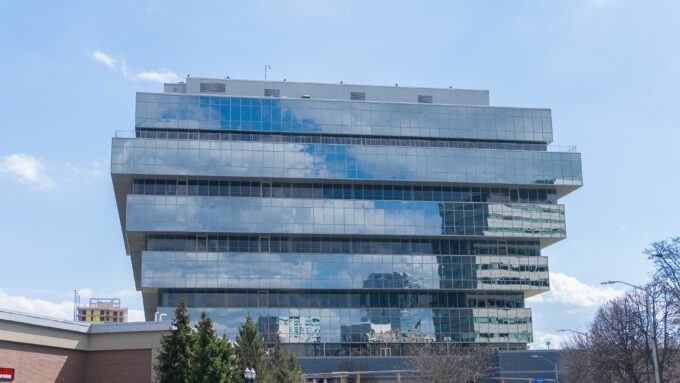
Purdue Pharma building in Stamford CT. Photograph Source: WikileaksIntern – CC0

Suppose there was an explosion at an oil refinery that killed hundreds of people. Presumably, there would be a major investigation to determine what went wrong and how to prevent a similar accident in the future.

But it’s different with the pharmaceutical industry. Purdue Pharma, one of the drug companies at the center of the opioid crisis, was finally put to death as the result of lawsuits over its pushing of OxyContin. The allegation is that the company misrepresented the addictiveness of the drug in order to have it promoted more widely.

The money paid to the families of victims cannot compensate for the deaths of loved ones, but the other part of the story is that no one is asking how to make sure this sort of disaster does not happen again. And unlike the example I gave of an exploding oil refinery, we are talking about the death of hundreds of thousands, not hundreds.

The key issue is the incentives the government gave to Purdue Pharma and the other opioid manufacturers. It gave them patent monopolies that allowed them to markup the price of their drugs by several thousand percent, selling them at prices that were twenty or thirty times what they would sell for in a free market.

This sort of extraordinary profit gives drug companies an incentive to lie about the safety and effectiveness of their drugs, which they do routinely. The consequences generally are not as disastrous as with the opioid crisis, but patients often end up taking drugs that are not best for them because drug companies misrepresented their products to researchers, doctors, and the public at large.

To be clear, companies always have incentive to sell their products widely. That’s the point of advertising. But they won’t go to the same length to sell a plastic cup or shovel, where they expect a profit of a dollar or two, as they will in selling a prescription on a patent-protected drug, where the profits can be hundreds or even thousands of dollars.

Patent monopolies are also the reason for high drug prices. Drugs are almost always cheap to manufacture and distribute; the reason they are expensive is the monopolies the government gives the drug companies.

This is the whole story of people struggling to raise the thousands or tens of thousands needed to pay for drugs to treat cancer or other serious illnesses. If these drugs were sold in a free market, paying twenty or thirty dollars for a prescription would not be a big deal, except for low-income people. And the government could afford to pick up the tab for them.

And patent monopolies are a big part of the story in redistributing income upward. While this is true in many areas, it is very striking in the case of pharmaceuticals. We will pay around $750 billion this year for drugs that would cost in the range of $150 billion in a free market. The savings of $600 billion comes to almost $5,000 per household.

That $600 billion is money that goes to drug companies and their shareholders. It has created many billionaires. In the case of the Covid vaccine alone, we created 5 Moderna billionaires.

Patent monopolies do provide an incentive for developing new drugs, but there are other ways to provide this incentive, most obviously paying people. If that sounds bizarre, the government already spends around $50 billion a year supporting biomedical research through the National Institutes of Health and other government agencies. We would have to triple or quadruple this sum to replace the patent-supported research, but we would still come out way ahead and wouldn’t have to worry about drug companies lying to us to push their drugs.

It is more than a bit bizarre that we have a large contingent of progressives focused on ways to tax back the wealth of the very rich, but who have no interest in restructuring the system in ways that don’t make them so rich in the first place. Just as a refinery explosion would be expected to lead to a renewed focus on industry safety, we might have expected the opioid crisis to lead to new thinking on the way we finance the development of drugs. But that has not been the case.

There is a bill put forward by Michigan Representative Rashida Tlaib that would be a big step in this direction, but unfortunately, it has gotten little attention to date. It would be great if something positive could come out of the opioid crisis, but that can’t happen until people at least can see the issue clearly. For whatever reason, that has not yet happened.

This first appeared on Dean Baker’s Beat the Press blog.

Dean Baker is the senior economist at the Center for Economic and Policy Research in Washington, DC. 


World today

The tortuous paths of resistance


Wednesday 6 May 2026, by Antoine Larrache


Iran, Lebanon, Ukraine, Palestine, Mali, Congo, Sudan... The warlike hotbeds seem to be ever more numerous, embodying the extent of the capitalist crisis and also giving the measure of the stakes in facing it.

Originally scheduled for 2024, the Anti-Fascist Conference for the Sovereignty of the Peoples in Porto Alegre was postponed following the terrible floods that hit the city – a direct consequence of the acceleration of the climate crisis. The Conference brought together several thousand participants from all over the world against the rise of fascism, authoritarian regimes and wars. This is an undeniable achievement – it has been more than 20 years since we have seen such an international and pluralistic event bring together social movements, trade unions and parties from all over the world to reflect and try to act.

A little humanity in a world at war

For the activists who went there, it was a breath of fresh air. African activists, Ukrainians with their Russian allies opposed to Putin, delegations from the United States, Canada, Europe, Latin America and Asia were present. This created an extremely positive emulation, networks of exchange and a common understanding that must contribute to rebuilding a concrete in-ternationalism.

But the conference also has its limits, whether it is the insufficient participation of the major reformist social movements (trade unions, associations as well as parties, and so on) or po-litical confusion linked to the situation we are experiencing.

Thus, it was not possible for the conference to adopt a position of support for the Ukrainian resistance against the invasion, due to the presence of currents which were pro-Russian – or at least relaying some of its anti-Ukrainian propaganda under the pretext of an intransigent fight against NATO. Worse, an (indirect) representative of the Iranian regime intervened in the forums, masking behind a muted anti-imperialist discourse the bloodthirsty nature of the regime in power in Tehran, responsible for a repression that has caused the death of tens of thousands of people. It is a strong contradiction, at an anti-fascist conference, that the rep-resentative of the country that undoubtedly most corresponds to the characteristics of fascism was able to speak.

Urgency and frustrations

The temptation is great, including in the internationalist left, to turn our backs on the con-ference for these reasons, and to erase all the positive things it produces, the contribution it makes to the construction of concrete international actions.

Struggles against wars, flotillas (for Gaza or Cuba...), for the climate, for wages, feminist mobilizations, there is no shortage of battles. But, paradoxically, the multiplicity of issues seems to make convergences more difficult. From an analytical point of view, the capitalist polycrisis highlighted by the congress of the Fourth International connects all the dynamics: economic crisis, accelerated ecological crisis, imperialist wars and inter-imperialist tensions, the rise of the far right and the strengthening of reactionary violence against women, LGBTI people or racialized people. All this is very coherent and reinforces the conviction of the need for a world social revolution. But, as Martín Lallana and Júlia Martí point out in their article in this issue of International Viewpoint, “Power and urgency in the ecological crisis”, the seriousness of the situation, in each of the fields, convinces very broad activist sectors of the need for a partial response, believing that they can identify the possibility of resolving one struggle, if not all.

Thus, some hope to find objective allies for Palestine in the “axis of resistance” of Iran, Hezbollah and Hamas, secreting illusions both about their military capabilities and about the nature of their political project. This impasse is all the greater because national projects – from Algeria to Venezuela via Brazil – seem more and more futile in a situation of exacerbated global crisis.

Others hope to weaken NATO through Putin’s Russia. Some believe that a solution to the crisis is in Chinese planning. Still others sing the praises of Western democratic achievements, forgetting what they cost oppressed peoples and how quickly the ruling classes abandon even the idea of them. Finally, some, seeing fascism everywhere, are ready to compromise, losing sight of the need, in the face of real fascism – that which responds to the crisis by the physical destruction of the workers’ movement and the freedoms acquired by the oppressed – to strengthen a left ready to confront the dominant classes.

Analyse to act

This is where the question and the difficulties lie: what alliances are inevitable, and which independent political project must be defended. Alliances make it possible to act in a unitary way at a given moment on a specific point. But not only that: in a period of retreat of the organizations of the working class, they also represent the crystallization at a given moment of social forces, whether they are inter-class (for democratic or anti-imperialist struggles for example) or the concretization of the class for itself.

They must also be considered not only as one-off actions, but also in terms of what they produce dynamically: paths in the right direction or dead ends, gains in confidence or loss of energy. It is the analysis of a concrete situation and its inclusion in the more general context that should give us indications as to the necessary and relevant choices.

Thus, there may be a tendency to isolate the wars waged by the United States and its allies from those waged by Russia or the defence of European or Chinese interests in the world. Or even to include all this in the supposed common aims of a “fascist international”. Such a vision quickly reaches its limits, in the context of the reorganization of the world, both in terms of the balance of power and the economic upheavals. On the one hand, because the conflicts between the “Iranian fascists” and the “fascist Trump” are not explained thus. On the other hand, be-cause the current moment, which has the appearance of a division of spheres of influence between Trump and Putin, is probably a short-lived phase. Finally, because an oppressed nation, even one led by a very reactionary regime, is not on the same level in global contra-dictions as an imperialist power.

The biggest confrontations are ahead of us

“Crises, riots and mass demonstrations are three phenomena that will occur in the years to come,” Martín Lallana and Júlia Martí tell us. There is nothing to say that these actions will produce convergences in the short term. On the contrary, each battle, noting its partial ur-gency, could fear that it would be weakened by the others. The comrades continue: “These are events that will fracture political time. [...] Preparing to intervene in crises and uprisings requires broadening our base, strengthening our alliances.” Indeed, each of these struggles possesses, for us who re-inscribe it in a global understanding of the system, a subversive potential within the framework of an already extremely unstable capitalism: who could predict the potential of a revolution in Iran on the region and the whole world? Or even the retreat of the United States in the face of the anti-imperialist resistance of several forces in the region? What hope would this create in neighbouring countries?

Moreover, what form would a new global climate movement take today? What would the fall of Putin following a defeat in Ukraine lead to? These questions tend to reinforce the idea that waiting for the objectives of anti-imperialist struggles or other sectoral struggles could upset the balance of forces and certainties. Especially in a world where, more than ever in history, everything is connected. And even if for this to happen, we have to accept allies of circum-stance, reactionary or reformist, to whom “we do not attribute [...] all sorts of revolutionary virtues”. [1]

Faced with the discordance of the times

The situation is reminiscent in many ways of the “discordance of the times” noted by Daniel Bensaïd in the 2000s and to which he tried to respond: “How can a multiplicity of actors who can be brought together by a common negative interest (of resistance to the commodification and privatization of the world) make a strategic force of transformation without resorting to this dubious metaphysics of the subject? However, I would like to point out that, for me, the class struggle is not a form of conflict among others, but the vector that can cross other antagonisms and overcome the closure of clans, chapels, races, etc.” [2]

To be at the forefront of partial struggles, to build alliances and to assume their contradictions, while maintaining political independence – class independence as well as the independence of an eco-socialist revolutionary project – is undoubtedly the key, concerning the major inter-national gatherings that seem to be resurfacing, in Porto Alegre yesterday, tomorrow on the flotillas to Gaza, in front of the G7 in Evian in June, at the anti-NATO summit in July in Turkey, at the World Social Forum in Cotonou in Benin in August. And concerning the great social struggles that will inevitably take place in the next period.

28 April 2026

Translated by International Viewpoint.

P.S.

If you like this article or have found it useful, please consider donating towards the work of International Viewpoint. Simply follow this link: Donate then enter an amount of your choice. One-off donations are very welcome. But regular donations by standing order are also vital to our continuing functioning. See the last paragraph of this article for our bank account details and take out a standing order. Thanks.

Footnotes

[1“Iran: The Contradictions of a Bourgeois Nationalist Leadership”, Michel Rovère, Intercontinental Press, 25 August 1980.

[2Interview in the Argentine journal Praxis in 2006, republished in Contretemps, January 2018.