Wednesday, May 20, 2026

Bolivia shuns emergency rule as Morales-backed protests tighten grip on La Paz


Authorities reported more than 95 arrests following clashes in which protesters used dynamite charges, fireworks and stones against riot police, who responded with tear gas and chemical agents.

By Mateo Palacios May 20, 2026

Bolivia’s government rejected calls for a state of emergency on May 19 even as escalating protests led by supporters of former president Evo Morales paralysed key transport routes, triggered violent clashes in La Paz and deepened fears of economic collapse.

President Rodrigo Paz instead ordered a reinforced police and military deployment around the capital while insisting security forces would continue operating in a “deterrent” role without lethal weaponry.

"Those seeking to destroy democracy will go to jail," Paz warned last week.

The unrest entered its third week after thousands of demonstrators descended from El Alto into central La Paz demanding Paz’s resignation and fresh elections within 90 days. Protesters linked to Morales’ hard-left political movement Evo Pueblo, alongside miners, coca growers and labour activists from the Central Obrera Boliviana (COB), attempted to breach police cordons protecting Plaza Murillo, home to the presidential palace and congress.

Authorities reported more than 95 arrests following clashes in which protesters used dynamite charges, fireworks and stones against riot police, who responded with tear gas and chemical agents. Public buildings and private businesses suffered extensive damage, while several commercial premises were looted and burned.

Speaking during a rally in El Alto, Cochabamba peasant leader Nelson Virreira warned Paz he would face “social convulsion” if he refused to resign voluntarily.

“We are offering Rodrigo Paz a peaceful exit,” Virreira said in remarks broadcast by coca growers’ radio station Kawsachun Coca. “Otherwise, he will leave through the roof with the rebellion of the people.”

The government accused Morales' loyalists of attempting to force a change of power through anti-democratic means. Presidential spokesman José Luis Gálvez said officials had identified armed groups infiltrating demonstrations and circulated footage allegedly showing members of the indigenous activist group Ponchos Rojos carrying weapons and calling for civil war.

Interior vice-minister Hernán Paredes said anyone carrying firearms or dynamite would be arrested. He confirmed police detained a former electoral candidate carrying explosives and fuses in a backpack near protest zones in La Paz.

Authorities are also investigating the movement of large sums of money allegedly arriving from Chapare, Morales’ coca-growing stronghold, to finance road blockades around the capital.

The protests have exposed the fragility of Paz's centrist administration only months after he ended nearly two decades of MAS rule, which collapsed at last year's election amid an internal feud between Morales and former president Luis Arce. Paz took office in November without a congressional majority and inherited a severe economic downturn marked by fuel shortages, inflationary pressure and declining foreign reserves.

His government axed fuel subsidies shortly after taking office, pushing up transport and consumer costs across the country. Analysts say the administration has struggled to implement broader reforms needed to stabilise Bolivia’s worst economic crisis in four decades.

Road blockades have intensified shortages. Bolivia’s highway authority said more than 40 blockade points were active across six departments, including La Paz, Oruro, Cochabamba, Chuquisaca, Potosí and Santa Cruz.

More than 130 fuel tanker lorries remained stranded on highways as diesel and petrol shortages worsened nationwide. Hospitals in La Paz declared emergency conditions after reporting shortages of oxygen and medical supplies.

Business groups warned the country was approaching institutional and economic paralysis. The National Chamber of Commerce estimated losses above $50mn per day, while the Bolivian Institute of Foreign Trade (IBCE) said cumulative damage from the blockades had already surpassed $500mn.

Rather than imposing emergency powers, the government opted to establish humanitarian corridors coordinated with neighbouring countries including Argentina, Chile and Ecuador to secure food and fuel deliveries into major urban centres.

“There is no possibility of a state of emergency,” Government Minister Marco Antonio Oviedo said in a radio interview. “We will instead take tough and strict measures with greater police and military presence.”

Vice-President Edmand Lara called for unconditional national dialogue to prevent shortages from evolving into a humanitarian crisis.

The violence has already left at least four people dead since the blockades began. Among them was Alberto Cruz Chinche, an indigenous community leader associated with the Ponchos Rojos movement. According to Gálvez, Cruz Chinche died after falling into a trench dug by protesters themselves near a blockade point.

Other victims included two women unable to access timely medical treatment because of road closures and a 20-year-old woman whose death was reported in El Alto on May 14.

Morales, who governed Bolivia between 2006 and 2019, has continued encouraging demonstrations from Chapare, where he has avoided arrest since 2024 over allegations involving the abuse of a minor in 2016. A second detention request related to the same case was issued earlier this month.

Supporters of the controversial former president have reportedly secured an unused airstrip in Chapare amid fears authorities could attempt to detain him.

The crisis has also generated diplomatic tensions. While receiving support from the United States and several Latin American governments, Paz's administration pushed back against comments by Colombian President Gustavo Petro, who described events in Bolivia as a "popular insurrection." On May 20, the government ordered Colombia's ambassador to leave the country, citing sovereignty concerns and non-interference in internal affairs.

Meanwhile, Morales' allies continue mobilising supporters in rural and indigenous communities, framing the protests as a response to economic hardship and alleged government repression.

Despite mounting pressure, Paz has refused to negotiate directly with Morales’ faction, insisting his administration will preserve constitutional order while avoiding measures that could deepen political polarisation.


 Bolivia: Paz Government Using Lawfare Against Protesters, “Terrorists” and “Drug Traffickers”
 May 20, 2026

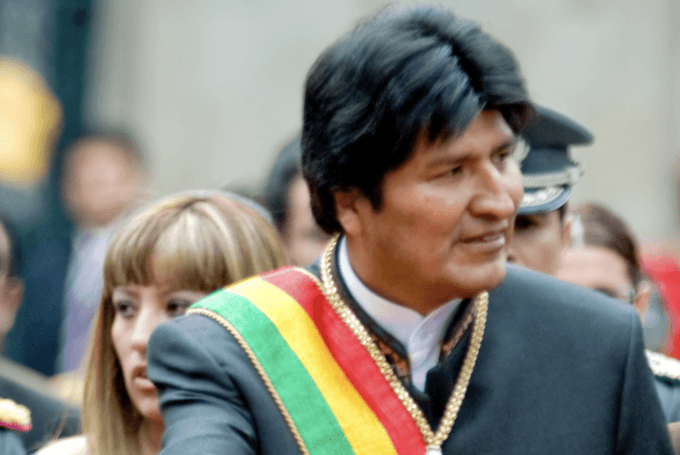
Image by Wikipedia.

In Bolivia, after weeks of protests against the proposed privatization of indigenous lands, the Rodrigo Paz government is setting the stage for mass repression against political opponents. The president, who calls himself a democratic centrist, has unleashed a systematic campaign of criminalization and stigmatization against Bolivia’s indigenous and popular movements.

What we are witnessing is the deliberate rhetorical construction of an enemy within, designed to legally and politically justify the dismantling of democracy, the Plurinational State, and the rights of indigenous peoples along with them.

From the highest levels of government, there has been a highly coordinated narrative that the protesters are not legitimate, organic, peaceful citizens exercising their constitutional rights, but rather, in rather Orwellian terms, threats to the democratic order and progress.

In an interview at the Casa del Pueblo, Vice Minister of Indigenous Justice and Coordination with Social Movements, Jorge García, laid out the administration’s line with striking candor. He accused the blockade leaders of being “completely radicalized, identified with the movement of Evo Morales,” and claimed they are subsidized by the former president’s political machinery.

García suggested using the State’s legal apparatus to pursue these social movements, which he linked directly to “narcotrafficking.” He accused the MAS of having “kidnapped Bolivia, isolated us from the world so we couldn’t know the truth of what was happening here; they have destroyed Bolivia.”

President Paz himself has dismissed the protesters with contempt. “Under ideological arguments, they want to generate tribune arguments because they have neither sociological nor philosophical density.”

Minister of Public Works Mauricio Zamora has accused the movements of being financed by Evo Morales, who is tied to drug trafficking, saying “the blockades have always brought death and been used for social convulsion.” The Minister of the Presidency, Jose Luis Lupo, has said the protests are used to destabilize Bolivia, faced with a “Black May.”

The Ministry of Productive Development issued statements blaming blockades for price hikes, referring to “so-called protesters,” while painting them as illegitimate. Representatives of the state security apparatus have said they will use “progressive and proportional force,” with rumors they will use live ammunition against blockaders.

Former president Carlos Mesa and right-wing leader Tuto Quiroga have joined the chorus, calling protesters “violent minorities,” with their supporters referring to protesters as “dirty” and “uncivilized” “Indians” — a racial slur that has been lobbed at the indigenous resistance since the colonial era. On social media, thousands of comments label demonstrators “terrorists,” “authoritarians,” “drug traffickers,” “fraudsters,” and a wide range of racist and classist slurs.

The protests, despite the government and right-wing opposition’s best efforts, are not marginal. The tens of thousands of Red Ponchos (an Aymara territorial defense force), the Bolivian Workers’ Union (COB), the Rural Teachers’ Union, mining unions, and indigenous communities from the Amazon (who walked all the way from there to La Paz) are blockading roads across La Paz, El Alto, Cochabamba, and Lake Titicaca. These are the largest protests since the Paz government took power.

The Bolivian Highway Administration (ABC) has reported at least 41 blockade points, paralyzing key routes and cutting access to the Peruvian border, Sucre, Oruro, Potosí, and Santa Cruz. Access to critical supplies have been affected by the blockades.

The government’s response has been swift and brutal. On the morning of May 16, a contingent of 3,500 military police intervened at Río Seco in El Alto with tear gas, riot gear, and rubber bullets, apprehending dozens, including journalists. Some protesters were brutalized by police. On May 18th, the police put up barricades across downtown La Paz, and evacuated key government buildings. I witnessed a standstill attack between the Red Ponchos and security forces at the Judiciary building, one block from the Casa del Pueblo.

Similar operations followed in other areas, a continuation of the repression from days prior, that is almost certain to escalate. One protester nearly lost an eye, while another has reportedly died. Journalists have also been harrassed by police, tear gassed, and pushed out. Over 100 protesters and journalists have been arrested.

The Wiphala, the indigenous flag that symbolizes the Plurnational State and pro-indigenous democracy, has been quietly removed from public spaces, including the Plurinational Assembly and the Casa del Pueblo, the seat of the executive. The government no longer defends the rights of indigenous peoples. Counter-protesters are openly calling the Wiphala a “terrorist symbol,” with some stepping on it in public squares. One group of counter-protesters on May 18th burned the Wiphala in front of indigenous protesters.

Vice President Edmand Lara, a populist anti-corruption crusader and former police officer whom social movements have embraced as an ally (which, according to all accounts, immensely helped Paz win the presidential election last year), issued two powerful statements breaking with Paz. The statements are part of a series of direct rebukes and insults from “Captain Lara” against Paz.

Lara condemned “the indiscriminate use of chemical agents and any action that violates the integrity and fundamental rights of citizens, particularly elderly persons, pregnant women, children and girls.” He exhorted police and armed forces to act with “responsibility, professionalism, and strict adherence to protocols on the rational and proportional use of force.”

He condemned the intimidation of press workers. And he made a direct call to Paz: “Prioritize dialogue and conciliation as fundamental mechanisms for the peaceful resolution of social conflicts.”

Most significantly, Lara invited the Inter-American Commission on Human Rights to monitor the situation.

The COB has already stated that protests will not stop, despite the COR El Alto signing a deal with the government and being accused by protesters of selling out. The government has been signing deals with certain social movement factions to get them to defect, in a “divide and conquer” strategy, buying them off while jailing opposition leaders and repressing remaining blocks.

The Paz administration has systematically dismantled the legal and institutional framework that once protected Bolivia’s plurinational democratic character. They have dismantled the Ministry of Justice, and practically annulled the results of the judicial elections from last year. They have jailed former president Luis Arce, taking away his rights to a lawyer and due process.

They have laid the groundwork to go after the COB, student unions, and other socialist organizations. Perhaps most chillingly, they have released the 2019 coup plotters — former interim president Jeanine Áñez and Santa Cruz governor Luis Fernando Camacho — figures convicted for sedition, terrorism, and crimes against humanity for their role in the illegal overthrow of Evo Morales, backed by the United States and the Organization of American States. The coup government employed death squads and the state to target and even kill opposition, while preventing the democratic will from being upheld.

Former indigenous-socialist president Evo Morales himself has issued warnings. In a statement, Morales alleged that the United States ordered the Paz government to execute a military operation, with the support of the DEA and SOUTHCOM, to detain or kill him. Among the architects, he named former right-wing minister Carlos “Zorro” Sánchez Berzaín, who fled to Miami after the 2003 Black October massacre, and Paz’s Vice Minister of Social Defense Ernesto Justiniano, currently in Washington. Justiniano has said “there will be a DEA office in Bolivia” this week.

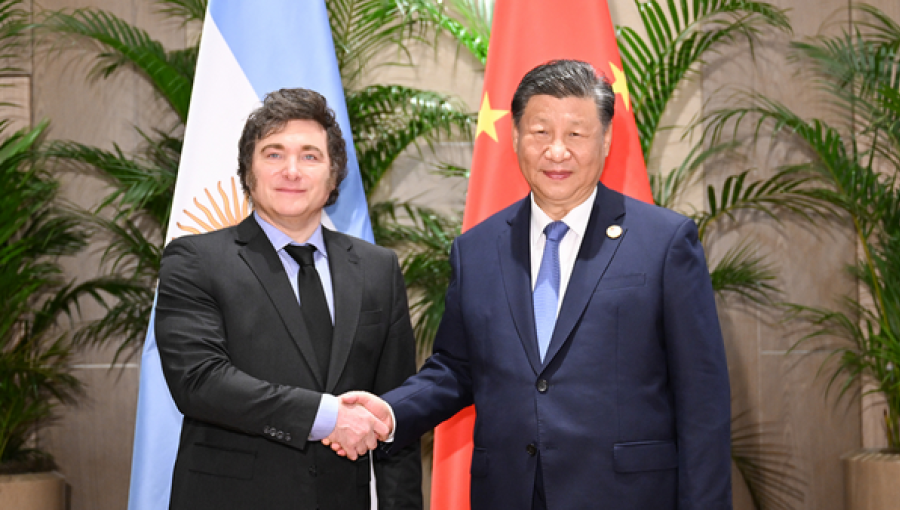
Meanwhile, Argentina has sent a Hercules aircraft reportedly carrying tear gas and police equipment, disguised as “humanitarian aid” with food and medicine shipments. Milei, who is fighting his own war on democracy at home, has expressed solidarity with Paz, arguing the protesters destabilize Bolivia and block “liberty and progress.”

Bolivia, as does Latin America in its autocratic shift, faces a dark moment in its short democratic history, where indigenous protesters are labeled by the state as illegitimate terrorists, drug-traffickers, and obstacles to progress to be crushed. Soon, with promised U.S. involvement against “narcoterrorism” and support from other Latin American autocracies, that moment may get even darker.


Bolivian Government Charges Labor Leader

With Terrorism as Police Crack Down on

Protests

The leader of the country’s main labor federation said officials were responding to protesters who have marched hundreds of miles in recent days with “militarization and repression instead of listening to the people.”
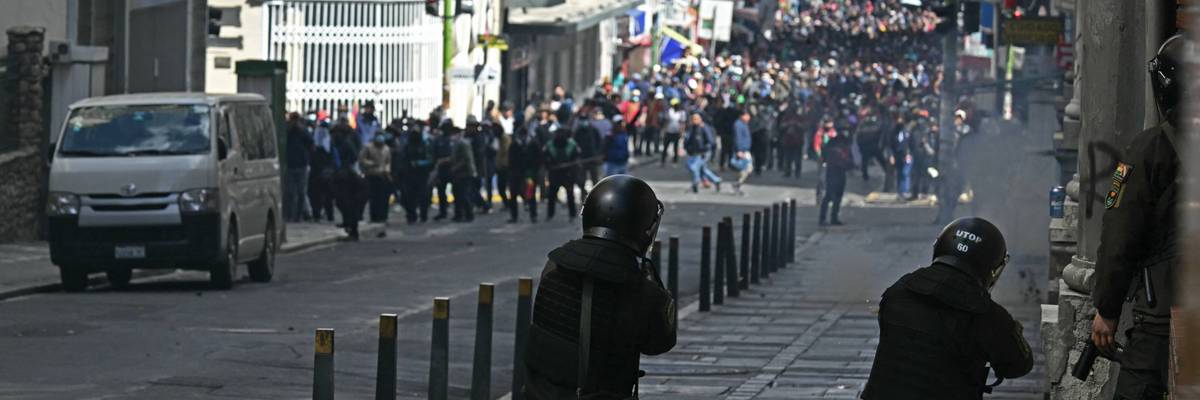


Riot police fire tear gas at demonstrators during a protest demanding the resignation of Bolivian President Rodrigo Paz, in La Paz, on May 18, 2026.

(Photo by Aizar Raldes/AFP via Getty Images)

Julia Conley
May 19, 2026

A leader of Bolivia’s main labor federation, the Bolivian Workers’ Union, said late Monday that the country’s public prosecutor is “trying to silence” mass protests that have included Indigenous communities, miners, peasants, and teachers in recent days, as the government issued arrest warrants for labor and grassroots organizers.

TeleSUR reported that State Attorney General Roger Mariaca confirmed his office was charging Mario Argollo, executive secretary of the union, known in Spanish as Central Obrera Boliviana (COB), with public instigation to commit crimes and terrorism.

“They will not subdue us in the struggle we have undertaken,” Argollo said in a statement. “They are trying to silence us as leaders with popular actions and criminal charges.”

Drop Site News also reported that the public prosecutor issued an arrest order targeting Justino Apaza Callisaya, a leader of the Federation of Neighborhood Councils of La Paz (FEJUVE), “an influential grassroots organization tied to urban protest movements and labor mobilizations.”


The office is also reportedly investigating “several individuals” following COB’s declaration of a general strike on May 1.

“The accused are being investigated for extremely serious offenses including: public incitement to commit crimes, criminal association, terrorism, financing terrorism, attacks on transportation security, [and] attacks on public services,” reported Drop Site.

The mass mobilization has included dozens of road blockades across the country as the union and other groups have demanded the resignation of President Rodrigo Paz, whose administration ended a fuel subsidy amid an economic crisis; higher wages; and an end to privatization, including through Law 1720, which opponents say would allow the transfer of Indigenous and peasant land to corporations.

Protesters have spent days marching from their communities to La Paz, where thousands were met by riot police armed with tear gas canisters on Monday.


Al Jazeera reported that some protesters brandished “dynamite sticks and slingshots” as they arrived in the capital city.

An unspecified number of protesters were injured Monday as the government deployed the police and the military to try to break the road blockades, Al Jazeera reported. TeleSUR said that at least four demonstrators were reportedly killed. About 90 arrests were made.

The US State Department said Sunday that it supported Paz’s efforts to “restore order for the peace, security, and stability of the Bolivian people.”

COB said the government was responding with “militarization and repression instead of listening to the people.”

“History will remember who defended the citizenry and who turned their backs. No force should be above the people or their rights,” said COB.

The arrest documents and government investigations, said Drop Site, showed that “the Bolivian government is escalating its response to the protests by describing parts of the strike movement not simply as civil unrest, but as potential terrorism and organized criminal activity.”

A student leader at the Public University of El Alto told Drop Site, “No matter what the Paz government attempts to do, repress the protesters or sanction us as terrorists... we will continue to uphold the sovereignty and rights of our peoples.”


An Indigenous leader told the outlet that Paz’s government “was clearly elected with a mandate from the social movements and from indigenous peoples—who have been stabbed in the back the minute they entered office. They have attempted to use the state to go after the very forces that got them to power.”


Mali’s Overreliance On Mercenary Forces Leads To Failure


By

Since inviting Russian mercenaries into Mali in 2021, the country’s ruling junta has focused its attention on subduing northern Tuareg rebels. Analysts believe the decision has let terror groups Jama’at Nusrat al-Islam wal-Muslimin (JNIM) and Islamic State Sahel expand their presence in the country and threaten Mali’s economy with blockades.

Aided by Russia’s Africa Corps, the Malian military’s heavy-handed approach has killed thousands of people suspected of being rebels or terrorists simply because of their ethnicity. Those killings — many of them summary executions — have, in turn, helped those same groups recruit new members.

“While they were concentrating their efforts against the rebels in small towns in the desert, JNIM was getting stronger and stronger around Bamako,” analyst Wassim Nasr told ADF in an interview. “They thought it would be a good idea to take back the north and feed propaganda. It backfired.”

The junta reopened hostilities against the Tuaregs in January 2024 when it abandoned the 2015 Algiers Accords, a peace agreement between Mali’s then-democratically elected government and what became the Azawad Liberation Front (FLA). Months before, in November 2023, the Malian military had retaken the Tuareg stronghold of Kidal with the help of mercenaries from Russia’s Wagner Group.

The campaign against Tuaregs and other groups in the north came even as terrorists with al-Qaida-backed JNIM and Islamic State Sahel gained ground in the central part of the country, ultimately surrounding the capital and blockading truck traffic entering from Senegal and Côte d’Ivoire.

The Malian junta invited Russian mercenaries into the country after ending Mali’s relationship with France, whose Barkhane and Serval counterterrorism operations lasted for more than a decade. Operation Barkhane had helped the government reestablish control over the northern provinces, laying the foundation for the Algiers Accords.

The junta also expelled a United Nations peacekeeper mission, MINUSMA, at the end of 2023. In its place, Russian mercenaries and Malian Soldiers launched brutal campaigns against suspected terrorists. The most high-profile of these was a three-day attack against the central Malian community of Moura, where Wagner Group fighters executed hundreds of Fulani men.

The Moura massacre and subsequent attacks on communities suspected of harboring terrorists turned the civilian population against both the junta and the Wagner Group, pushing more people to join JNIM, Islamic State Sahel and the FLA. Meanwhile, the junta is doing nothing to gain the public’s trust, Nasr said.

“They haven’t built a school,” he added. “They haven’t built a road. The sole project they have is ‘We hate France. We hate the West.’”

Wagner’s campaign of brutality ended in the northern community of Tinzouatin in July 2024, when Tuareg fighters ambushed a joint Malian-Wagner force, driving them into territory controlled by JNIM, who also attacked them. In the end, nearly 50 soldiers and more than 80 mercenaries were dead.

“This is when Wagner stopped being Wagner and the label changed,” Nasr said. In the weeks that followed, Wagner announced it was leaving Mali. The new Africa Corps, staffed by many Wagner veterans, took its place.

“While the long-term goals of FLA and JNIM are unclear, the partnership is, for now, effectively further weakening the government,” analysts with the Soufan Center wrote recently.

Mali continues to pay Africa Corps an estimated $10 million a month for its services. Those services, however, have become more limited. Africa Corps prefers to remain within its bases, operating drones in support of Malian patrols.

“They go out still, but they are less confident,” Nasr said.

In late April, when Africa Corps joined Malian soldiers in an attempt to hold Kidal against a joint JNIM-FLA assault, the mercenaries fled, leaving Kidal in the hands of the FLA. A separate assault on the same day killed Mali’s defense minister.

Facing defeat on the battleground, Africa Corps has shifted its primary purpose to protecting the junta as JNIM expands its control beyond Bamako, according to Nasr. That includes protecting Bamako’s international airport and getting fuel and other resources through JNIM’s blockades. The junta shows no signs of negotiating with JNIM or FLA. Instead, Mali’s leaders depend on mercenaries for their survival, Nasr noted.

“They don’t have a choice. They are at odds with everybody. They are cornered,” Nasr said. “They keep paying because Africa Corps is their life insurance.”


The Chance To Break ASEAN’s Glass Ceiling – OpEd


By

The next nomination for Association of Southeast Asian Nations (ASEAN) secretary-general in 2028 could determine whether the bloc remains strategically relevant—or continues drifting into institutional inertia.

For the first time in decades, Indonesia will be shaping how ASEAN responds to rising geopolitical rivalry, internal divisions, and declining public confidence. The question is not whether the nominee should be male or female, but what kind of leadership ASEAN now needs.

ASEAN is entering one of the most uncertain periods in its history. Rivalry between the United States and China continues to intensify, while regional tensions test the organization’s cohesion. At the same time, ASEAN faces a quieter challenge: growing doubts about its relevance among its own citizens.

Jakarta’s decision in 2028 must be understood in this context. A conventional appointment drawn from familiar diplomatic circles may preserve internal balance, but it will do little to address ASEAN’s deeper weaknesses.

The next secretary-general must offer more than administrative competence. The role now requires strategic vision, crisis management skills, and the ability to communicate ASEAN’s relevance to a wider public. The organization can no longer rely only on consensus to manage increasingly complex challenges.

Recent experience highlights the problem. Beyond its widely criticized handling of Myanmar, ASEAN has struggled to present a unified position on the South China Sea. Divisions among member states have repeatedly blocked strong joint responses to incidents involving Chinese vessels and Southeast Asian claimants. Negotiations with China on a binding Code of Conduct have dragged on for years with limited progress.

Economic integration has also moved unevenly. Despite the ASEAN Economic Community framework, implementation gaps and competing national priorities continue to slow deeper coordination. This shows ASEAN’s difficulty in turning plans into action.

These challenges are not new. Past secretaries-general, including Surin Pitsuwan, Le Luong Minh, and Lim Jock Hoi, helped raise ASEAN’s international profile and expand its partnerships. But their tenures also reflected the organization’s limits: constrained authority, dependence on consensus, and cautious diplomacy.

Those limits remain, but the environment has changed. ASEAN now faces pressures that demand more adaptive and visible leadership. This is why Indonesia’s 2028 nomination matters. It is a chance to redefine what ASEAN leadership should look like in the future.

Indonesia often presents itself as ASEAN’s natural leader—the region’s largest economy, its most populous democracy, and a central diplomatic actor. But leadership claims bring expectations. If Jakarta defaults to a safe, conventional nominee, it risks reinforcing the view that ASEAN’s talk of reform and inclusion lacks substance.

A more forward-looking approach would recognize that competence and institutional change are not mutually exclusive. For nearly six decades, ASEAN has never been led by a woman. That pattern now looks structural rather than accidental. Breaking it would carry strategic weight, not just symbolic value.

A qualified female secretary-general would meet the demands of merit-based selection while signaling that ASEAN can evolve with the societies it represents. Such a decision would strengthen the organization’s credibility on inclusion and project a more modern identity.

Indonesia does not lack capable candidates. Across diplomacy, government, and international organizations, Indonesian women have the experience needed for the role. The constraint is not capacity, but political will.

The next secretary-general will also inherit a region under strain. ASEAN’s difficulty responding to political crises, managing major power rivalry, and maintaining unity has exposed the limits of its traditional approach. Restoring confidence will require leadership that is diplomatic, visible and engaged.

ASEAN’s long-standing disconnect from its citizens makes this even more urgent. For many Southeast Asians, the organization remains distant and technocratic. A secretary-general who can engage younger generations, civil society, and the private sector could help change that perception.

Indonesia’s choice in 2028 will send a clear signal. A cautious nomination would suggest ASEAN remains comfortable with incremental change. A more ambitious choice would show a willingness to adapt.

The country has a rare opportunity to redefine ASEAN leadership—making it more inclusive, more strategic, and more responsive. Choosing a secretary-general who represents both professional excellence and institutional renewal would not just mark a historic first. It would show that ASEAN is capable of evolving instead of just enduring.

Russia’s Nuclear Drills In The Arctic: The New Geopolitics Of The Polar North – OpEd

From Moscow’s perspective, the Arctic is no longer a neutral frontier but a heavily contested military zone.


File photo of Russian Arctic Brigade soldiers riding a snowmobile. Photo Credit. Mil.ru


May 19, 2026 

By K.M. Seethi


Russia’s latest strategic nuclear exercise in the Arctic has once again drawn global attention to a region that was once seen mainly as a frozen frontier of scientific cooperation and controlled rivalry. From 19 to 21 May 2026, Moscow will carry out one of its largest nuclear exercises since the collapse of the Soviet Union. The drills involve more than 64,000 troops, around 200 missile systems, 73 naval vessels, 13 submarines, and long-range strategic bombers. Russia’s Northern Fleet, Strategic Missile Forces, and Pacific Fleet all will participate in the operation.

The exercise gets underway against the backdrop of the Ukraine war, rising NATO-Russia tensions, and growing competition in the Arctic. It also indicates how the polar region is steadily becoming one of the world’s most important geopolitical theatres.

The Arctic has always carried military significance. During the Cold War, the shortest route between the Soviet Union and the United States passed over the North Pole. Nuclear submarines operated beneath Arctic ice. Strategic bombers crossed polar routes. Radar stations, missile defence systems, and naval bases became central to deterrence strategies on both sides. But despite these tensions, the Arctic also remained an unusual zone of limited cooperation. Scientific exchanges, fisheries management, maritime coordination, and environmental agreements continued even during periods of deep hostility. That balance has gradually weakened.

The Ukraine war accelerated a major transformation in Arctic politics. Finland joined NATO in 2023. Sweden followed later. This changed the military map of northern Europe dramatically. Almost all Arctic Council member states, except Russia, are now NATO members. Moscow increasingly views this as strategic encirclement.

Russian officials argue that NATO has steadily militarised the Baltic and Arctic regions through expanded troop deployments, new military bases, large-scale exercises, and the integration of Finland and Sweden into NATO command structures. Russian Ambassador to Norway Nikolay Korchunov recently accused the alliance of shifting the region onto a “war footing” through initiatives such as Baltic Sentry, Eastern Sentry, and Arctic Sentry.


From Moscow’s perspective, the Arctic is no longer a neutral frontier but a heavily contested military zone.

Russia therefore presents its latest nuclear drills as a defensive response. Russian officials say the exercises were designed to rehearse the “preparation and use of nuclear forces under conditions of aggression.” Russian military analysts argue that Western statements about defeating Russia strategically, combined with NATO’s expanding military infrastructure near Russian borders, forced Moscow to demonstrate the credibility of its deterrence posture.

Colonel Levon Arzanov of the Officers of Russia organisation claimed that Russia is facing “unprecedented pressure” from the collective West and that nuclear exercises are an “appropriate response” to perceived invasion threats.

Russia also links these developments to its larger military modernisation programme. President Vladimir Putin stated in 2025 that nearly 95 percent of Russia’s nuclear forces had been modernised. The current exercise involved all three branches of the nuclear triad: land-based intercontinental ballistic missiles, submarine-launched ballistic missiles, and strategic bombers.

Particularly significant was the Arctic dimension of the operation. Several exclusion zones were imposed in the Barents Sea and around the Kola Peninsula. A Delta IV-class nuclear submarine, the Bryansk, launched a Sineva ballistic missile from Arctic waters. The Kola Peninsula remains one of Russia’s most strategic military regions because it hosts a large part of Moscow’s sea-based nuclear deterrent.

For Ukraine, however, these drills represent something far more dangerous. Kyiv argues that Russia’s deployment of tactical nuclear weapons in Belarus and joint nuclear exercises with Minsk weaken the global non-proliferation regime. Ukraine claims these actions contradict the spirit and provisions of the Nuclear Non-Proliferation Treaty (NPT), particularly provisions that prohibit the transfer of nuclear weapons and related control systems to non-nuclear states.

Ukraine also sees Russia’s nuclear posture as part of a larger strategy of intimidation aimed at NATO and Europe. Kyiv has called for stronger sanctions, greater military support, and expanded NATO deployments along the alliance’s eastern flank.

Western governments share these concerns. NATO countries increasingly see Russia’s Arctic military infrastructure as part of a bigger strategic challenge. Russian bases across the Arctic coast, new missile systems, submarine patrols, air defence networks, and military airfields are viewed in Europe and North America as indicators of long-term strategic preparation rather than temporary wartime signalling.

However, Arctic geopolitics is no longer influences by Russia and NATO alone. China has emerged as an important actor in the region. Beijing calls itself a “near-Arctic state” and has expanded investments in Arctic shipping routes, energy projects, scientific research, and infrastructure. Russia and China have strengthened cooperation in the polar region after Western sanctions isolated Moscow economically. This growing partnership has created fresh anxieties in Washington, Ottawa, and Nordic capitals.

The Arctic is becoming increasingly attractive because of climate change. Melting ice is opening new shipping lanes and access to untapped reserves of oil, gas, rare earth minerals, and fisheries. According to various geological estimates, the Arctic may hold around 13 percent of the world’s undiscovered oil and nearly 30 percent of its undiscovered natural gas reserves. These figures continue to influence strategic thinking among major powers.

The Northern Sea Route, which runs along Russia’s Arctic coast, has become especially important for Moscow. Russia sees it as a future commercial artery linking Europe and Asia while reducing dependence on traditional maritime chokepoints.

This explains why the Arctic occupies a central place in Russia’s national security doctrine.


Meanwhile, the region’s future became even more uncertain after Donald Trump renewed discussions about Greenland during his political comeback. Trump had earlier floated the idea of acquiring Greenland during his first presidency. His later remarks about strategic control over the island revived debates about great power rivalry in the Arctic.

Greenland matters because of its location, military value, mineral resources, and access to Arctic Sea routes. The island already hosts the American Pituffik Space Base, formerly known as Thule Air Base, which plays a major role in missile warning and Arctic surveillance.

Trump’s rhetoric generated strong reactions from Denmark and other European allies. It also reflected a deeper reality: the Arctic is no longer viewed as a distant frozen zone but as a core arena of future global competition.

The Arctic Council itself has weakened since the Ukraine war. Established in 1996, the council once symbolised cooperation among Arctic states on environmental, scientific, and indigenous issues. But after Russia’s invasion of Ukraine, Western members suspended many forms of engagement with Moscow. The council’s consensus-based structure now faces serious strain because Russia remains geographically central to the Arctic.

This institutional crisis may carry long-term consequences. Without functioning diplomatic mechanisms, military signalling may gradually replace political dialogue. The Arctic’s growing strategic importance increases the possibility of miscalculation, especially when nuclear forces, submarines, missile systems, and NATO deployments operate in close proximity.

The region therefore signals a larger transformation in global politics. The post-Cold War period created hopes that strategic rivalry in the Arctic could remain limited. That phase appears to be disappearing. The Ukraine war, NATO expansion, Russia’s military posture, China’s polar ambitions, and American strategic concerns have all pushed the Arctic back into the centre of global power politics.

Still, the situation remains more complex than a simple return to Cold War divisions. Russia insists its Arctic posture is defensive. NATO states argue they are responding to Russian aggression. Nordic countries point to security vulnerabilities after the Ukraine war. Ukraine sees Russian nuclear deployments as coercive diplomacy. China presents its Arctic involvement as economic and scientific cooperation. The United States increasingly frames the Arctic within broader competition with both Russia and China. These overlapping perspectives impact a region that is becoming strategically congested.


The Arctic’s future may therefore influence the global balance of power in the coming decades. It is a region where nuclear deterrence, energy competition, maritime access, climate change, technological rivalry, and military strategy now crisscross simultaneously.


Argentina in talks to extend China currency swap even as repayments near completion

Argentina in talks to extend China currency swap even as repayments near completion
The issue has become entangled in broader geopolitical tensions between United States and China.
By bnl editorial staff May 20, 2026

Argentina is negotiating an extension of its currency swap agreement with China even as it moves to repay most of the activated funds under the facility by mid-2026, according to statements from the country’s central bank and local media reports.

The remaining balance of the activated portion of the swap has fallen to about $675mn, down from a peak of around $5bn, while officials expect repayment to be completed by the middle of next year, South China Morning Post reported.

Banco Central de la República Argentina president Santiago Bausili said the government was in talks with Chinese authorities to renew the agreement, rejecting speculation that the administration planned to terminate the arrangement when it expires at the end of July.

“We are talking with them to extend it. There are no plans to eliminate it,” Bausili said during a press conference, Ámbito reported.

The swap framework, first signed in 2009 and renewed in 2023, provides a credit line of up to CNY130bn, equivalent to roughly $19bn, though only a portion has been activated by Argentina in recent years to bolster foreign reserves and facilitate trade with China.

According to the central bank’s 2025 financial statements, Argentina owed the equivalent of $3.1bn at the end of 2024. That figure declined to $1bn by late December and then to $675mn by mid-January after accelerated repayments.

The outstanding amount represents only the active tranche, while the broader agreement functions as a contingency line rather than a direct debt obligation. If the framework is not renewed, Argentina would lose access to that liquidity backstop rather than face immediate repayment of the full $19bn.

The issue has become entangled in broader geopolitical tensions between United States and China. SCMP reported that Washington pushed President Javier Milei during 2025 to reduce reliance on Beijing’s financial support as a condition for broader backing.

The report said US officials linked support for Argentina’s international financing efforts to a gradual unwinding of the Chinese credit line, while the US Treasury later signed a separate $20bn swap facility with Argentina’s central bank.

Bausili also said Argentina’s export outlook remained strong, citing market forecasts for record exports of $96bn this year, and downplayed risks from speculative foreign inflows, which he said amounted to between $2bn and $2.5bn.


Dangote plans major Atlantic port project in southwest Nigeria to support oil, fertiliser exports

Dangote plans major Atlantic port project in southwest Nigeria to support oil, fertiliser exports
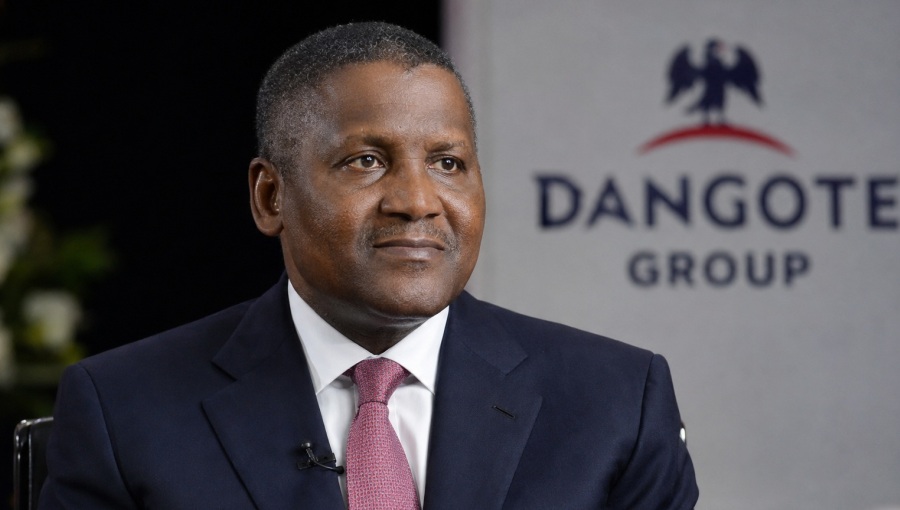
Aliko Dangote, Africa's richest man, is expanding his refining, fertiliser and cement businesses across the continent / Dangote GroupFacebook
By bne IntelliNews May 20, 2026

Dangote Industries Limited has begun preliminary work on a proposed deep-sea port project at the Olokola Free Trade Zone in southwestern Nigeria, as the conglomerate expands further into logistics and maritime infrastructure to support its other operations and export ambitions, The Punch reports.

The project, which spans more than 10,000 hectares across parts of Ogun and Ondo states, forms part of the group’s Vision 2030 strategy aimed at strengthening its position in manufacturing, logistics and export-led industrialisation.

The proposed port would be located in Ogun Waterside Local Government Area of Ogun State, extending towards Ilaje Local Government Area of Ondo State along the Atlantic coastline. Dangote Industries said the facility is intended to serve as a logistics and industrial hub for imports, exports and regional trade.

Dangote Industries, the parent company of the 650,000 barrels per day (bpd) Dangote Petroleum Refinery, as well as fertiliser and cement businesses, said the port would support exports of fertilisers, petrochemicals and refined petroleum products, while also facilitating imports of heavy industrial equipment and potentially future liquefied natural gas exports.

The Lagos refinery, which has been expanding exports of petrol, diesel and aviation fuel across African markets, is projected to double its output to 1.4mn bpd within 30 months. 

“The Olokola Port project is a major step in opening up Nigeria’s economic potential, strengthening trade, reducing pressure on existing ports, and supporting industrial growth,” said MD for Infrastructure and Logistics Capt Jamil Abubakar, as quoted by The Punch.

“With its strategic location, Olokola would serve as a key gateway for exports and imports, boosting Nigeria’s competitiveness in regional and global trade,” he added.

Abubakar said the proposed facility had been designed as part of an integrated industrial and logistics ecosystem intended to strengthen regional commerce and supply chains across Africa. He added that Dangote Industries would maintain engagement with host communities throughout implementation.

Apart from creating jobs and attracting foreign direct investment and, the company said it would support Nigeria’s export diversification strategy and strengthen participation in intra-African trade under the African Continental Free Trade Area (AfCFTA).

Nigerian billionaire Aliko Dangote, president of the conglomerate, said last week he is considering Kenya as the preferred location for a proposed 650,000 bpd refinery in East Africa, shifting focus away from an earlier plan centred on Tanzania.

Meanwhile, he is targeting a valuation of around $50bn for the Dangote Petroleum Refinery ahead of a planned stock market listing later in 2026, which could sell up to a 10% stake through the Nigerian Exchange (NGX).

South Korean labour minister to mediate talks as Samsung faces strike threat


South ​Korea's ​labour minister will personally mediate talks ​between ‌Samsung ⁠Electronics and ‌its South Korean ⁠union, the ministry announced Thursday after the union threatened a strike following the collapse of talks on bonus payouts.


Issued on: 20/05/2026 
By: FRANCE 24


A visitor walks past a Samsung Electronics logo at the Korea Electronics Show 2025 in Seoul on October 22, 2025. © Jung Yeon-je, AFP (File)


South Korea's labour minister is set to mediate talks between Samsung and its union, the labour ministry announced Wednesday in a bid to prevent a strike called for Thursday.

The threatened strike is expected to dwarf a 2024 walkout that drew about 6,000 workers at the world's top memory chipmaker.

The dispute centres on profit-sharing at a key player in the global semiconductor supply chain, with its chips widely used in artificial intelligence systems and consumer electronics.

The tech giant's shares have surged nearly 400 percent over the past year on the back of an AI boom, and saw its market capitalisation top $1 trillion for the first time in May.

The union had called for the scrapping of a bonus cap set at 50 percent of annual salaries and for 15 percent of operating profit to be allocated to bonuses.


"Around 10:00 pm on May 19, the labor union agreed to the mediation proposal put forward by the National Labor Relations Commission; however, management expressed its refusal," it said in a statement on Wednesday.

"The labour union will lawfully commence a general strike tomorrow as scheduled."

According to the union's lawyer, around 50,500 workers are set to walk off production lines for 18 days from Thursday following the breakdown of negotiations with management.

Samsung's management said the talks failed because "acceding to the labour union's excessive demands would risk undermining the fundamental principles of the company's management".

"Under no circumstances should a strike take place," it said.

Concerns are growing within the South Korean government that a prolonged union strike could hurt the export-driven economy, with chips making up about 35 percent of exports.

South Korea's presidential office voiced "deep regret" over the collapse of the talks, urging both sides to keep working toward an agreement given the strike's "potential repercussions for the Korean economy".

Some experts say even a partial halt in Samsung's operations could prove damaging – though the union argues that production stoppages have already occurred in the past for reasons related to maintenance and equipment inspections.

The government could invoke emergency mediation powers – a measure that could halt strikes or other industrial action and trigger mediation if they are deemed a threat to the national economy.

Limited impact?


But Tom Hsu, an analyst at Taipei-based research firm TrendForce, said the strike's potential impact may be limited.

"Due to the high level of automation in front-end facilities, TrendForce expects Samsung's DRAM and NAND Flash production to remain at full capacity," he told AFP.

"Any potential impact from the strike is likely to be confined to non-memory business segments."

A Suwon court this week granted Samsung Electronics an injunction requiring staffing and operations to be maintained at normal levels during any walkout.

Kim Sung-hee, director of Workers' Institute for the Industrial and Labour Policy, said that while the strike could cause losses, "they are unlikely to be irreversible".

The strike does not mean it would "automatically trigger an economic crisis", he told AFP.


AI boom

Samsung is a major producer of chips used in everything from artificial intelligence to consumer electronics, raising the prospect that the planned strike could cause severe disruption and losses.

The company said this year it had begun mass production of next-generation high-bandwidth memory chips, HBM4, seen as a key component for scaling up the vast data centres needed for AI development.

The dispute unfolds against the backdrop of an AI boom that is benefiting South Korean tech groups, boosting national growth and the stock market.

Both Samsung and its domestic rival SK hynix posted record profits in the first quarter, driven by global demand for AI chips.

Long staunchly anti-union, late founder Lee Byung-chul once vowed never to allow unions "until I have dirt over my eyes".

Samsung Electronics' first labour union was formed in the late 2010s.

(FRANCE 24 with AFP and Reuters)
Los Angeles World Cup workers vow strike if ICE deployed at stadium

VIDEO


Issued on: 20/05/2026 - FRANCE24


Workers at Los Angeles' SoFi Stadium vowed Monday to go on strike if federal immigration enforcement agents are deployed at the venue when it hosts World Cup matches next month. The UNITE HERE Local 11, representing around 2,000 hospitality employees, is demanding federal guarantees that Immigration and Customs Enforcement (ICE) will not be used in any of the eight WorldCup matches scheduled to take place at the stadium.


Tuesday, May 19, 2026

France to return bodies of Indigenous people exhibited in colonial ‘human zoos’

French senators have unanimously passed a bill allowing for the remains of people who were exhibited in colonial-era “human zoos” in Paris to be returned to their ancestral lands in French Guiana, on the northeast coast of South America. The draft law meets a long-standing demand of Indigenous communities in France’s overseas territories, acknowledging a dark chapter from the country’s past.


Issued on: 19/05/2026 - 
FRANCE24
By: Benjamin DODMAN

 A ritual ceremony featuring the remains of Indigenous Kalina community members who died in 19th-century "human zoos" at Paris's Musée de l'Homme, September 17, 2024. © JC Domenech, Muséum national d'Histoire naturelle

A leisure park with more than 150 years of history, the Jardin d’acclimatation in Paris owes its distinctive name to a 19th-century fascination for exotic species shipped in from across the French Empire and beyond.

But it was not only plants and animals that were “acclimatised” to grey skies and cold winters in this leafy corner of the French capital.

Between 1877 and 1931, the amusement park hosted numerous “ethnological shows” displaying Indigenous groups from colonised lands in “traditional” dress, which drew huge crowds of visitors from Paris and across Europe.

Among the “exhibits” were 33 children, teenagers and young adults from the Kalina and Arawak people of modern-day French Guiana and neighbouring Suriname, whose 1892 ordeal in the Paris amusement park was the subject of a solemn vote held in the French Senate on Monday.

A picture from the 1892 exhibition of indigenous Kalina and Arawak people at the Jardin d'acclimatation on the western edge of Paris. © Bonaparte Roland, Musée du quai Branly - Jacques Chirac


In a rare display of unity, the upper chamber of parliament voted unanimously to return the remains of six Kalina members who died of sickness contracted during the colonial exhibition, backing a bill sponsored by a trio of lawmakers from left, right and centre.

Several senators spoke of their “shame” at the horror inflicted on Indigenous communities from what is now a full-fledged overseas department of France located on the northeastern coast of South America.

“We are talking about men and women, human beings torn from their land, their people, and their dignity,” said centrist lawmaker Catherine Morin-Desailly, who co-authored the bill with colleagues from the Communist Party and the right-wing Les Républicains.
‘Restoring their humanity’

The Senate bill – which the lower-house National Assembly is expected to approve – concerns six sets of remains that were exhumed for anthropological purposes in the late 19th century and have remained in public collections ever since. They will be returned to the Kalina’s ancestral lands more than 7,000 kilometres away, along with eight casts of parts of the deceased’s bodies also held at the Muséum national d'Histoire naturelle, the Paris natural history museum.

Among the 33 Amerindians who were exhibited at the Jardin d’acclimatation in 1892 was 12-year-old Moliko, whose great-great-grand-daughter Corinne Toka-Devilliers has spearheaded efforts to repatriate the remains of those who never made it back. She spoke of her relief and joy at hearing the names of her ancestors ring out in the Senate chamber.

“Naming them restores their humanity,” she said. “It restores an identity to people who were kept in a museum for more than 130 years, nameless and unknown to all but their loved ones back home.”

Toka-Devilliers heads the association Moliko Alet+Po, which translates as "Moliko’s descendants" in the Kalina language. Its aim is to seek recognition and reparation for a colonial practice that stretched over multiple decades but has been largely silenced since.

Despite drawing condemnation from some quarters, including in Moliko’s day, "human zoos” continued in Europe well into the 1950s. Historians estimate that around 35,000 people from Africa, Asia, the Americas and Oceania were exhibited for the “education” and amusement of European and US citizens between the 19th and 20th centuries.

“Acknowledging this history and the fact that men and women from an overseas French territory were exhibited in this way is a major step forward for the French state – and for all those who have been colonised,” said Toka-Devilliers. She described the French government’s support for the bill voted in the Senate as a “victory for our ancestors and for Indigenous people”.

Legislative loophole

Addressing his Senate colleagues ahead of the vote, conservative lawmaker Max Brisson, another of the bill's co-authors, said the case of the Kalina remains underscored “the urgent need to recognise the dehumanisation that underpinned the creation of certain (museum) collections”.

Such efforts are well underway in many of France’s leading museums, said Toka-Devilliers, who thanked the Musée du quai Branly – Jacques Chirac and the Musée de l’Homme, part of the Muséum d’Histoire naturelle, for their help in identifying the remains.

Two years ago, the Musée de l’Homme hosted a group of shamans and other Indigenous leaders from French Guiana and Suriname, who gathered around their ancestors’ identified remains for a ritual ceremony designed to “appease their souls”.“Such museums have also evolved in recent years, coming to terms with their own history,” said Toka-Devilliers, who attended the ceremony. “It shows that a lot of work has been done to change attitudes towards France’s colonial past,” she added.

Representatives of the Kalina people gathered at the Musée de l'Homme in Paris, in September 2024. © J.-C. Domenech, Musée national d'Histoire naturelle

While France has recently stepped up its efforts to return artworks and other precious items plundered during colonial times, a legislative loophole has so far hindered groups like Moliko Alet+Po from obtaining redress.

A framework law passed in December 2023 allowed for the return of human remains by making an exception to the principle that public collections are inalienable. But this procedure is reserved for requests from foreign states and therefore does not apply to France's overseas territories.

As she welcomed the Senate vote on Monday, Culture Minister Catherine Pégard expressed support for new legislation to “facilitate the repatriation of human remains to overseas territories” and respond to future requests – a demand backed by Moliko Alet+Po.

“Our people are ready to return home – and our land is ready to welcome them,” said Toka-Devilliers. “But we need a law that works for everyone, because there are many others like us who are still waiting to lay their ancestors to rest.”