Wednesday 20 May 2026, by Sarah Selami
We publish here the transcript of the speech by Sarah Selami, an Iranian activist in Solidarité socialiste avec les travailleurs·euse d’Iran (Socialist Solidarity with the Workers of Iran (SSTI), in Rouen, France on 2 May 2026. In it, she explains the main reasons for the war unleashed on 28 February 28 by the United States and Israel against the Islamic Republic of Iran.
SSTI’s charter:
Most of the different currents of opposition to the Islamic Republic of Iran, which express their opposition from different angles, emphasize its dictatorial character without sufficiently addressing its capitalist nature, while these two characteristics are inseparable.
The capitalist regime of the Islamic Republic, which carries out the programs of international neoliberalism, has begun an all-out attack on the workers of Iran under such pretexts as “the reorganization of the economy,” or “increasing the productivity of labour,” and so on. The intensification of the exploitation of labour power, the reduction of wages, the closure of whole sections of production units are the direct consequences of these policies. This policy has provoked protests by workers, nurses, employees, teachers, and teachers. For several years, these protests and struggles in defence of their wages and living standards have been growing steadily. During these protests, workers and labourers are increasingly vocalizing their economic demands and their rights to create autonomous organizations.
Despite these truths, the problems of Iran’s workers do not find sufficient resonance outside the country. Expressing their problems; supporting their struggles; above all, raising awareness among the public, workers’ organizations and unions and international workers’ institutions about these struggles; and seeking support for their struggles is the unavoidable duty of all socialists and activists for workers’ causes.
In order to carry out these tasks well, we must bring together all the defenders of the workers’ movement and socialists of all tendencies who do not distinguish between the struggles for democracy and those for socialism. Fighting for unlimited freedom of expression, for freedom of opinion, for freedom of association, for the abolition of all kinds of discrimination against women, for the defence of the rights of the peoples of Iran to self-determination and so on are among our duties.
We, who are part of the world anti-capitalist movement, are firmly convinced that dialogue and active collaboration can and must develop within the framework of this broad gathering that includes all existing socialist tendencies taking into account the current forms of anti-capitalist struggles. Thus, throughout the world, it is possible to gather the widest possible range in defence of the workers’ movement in Iran and to found a real surge of support for the struggle and protests of the workers and other working strata of Iran.
The ceasefire currently in place remains fragile and its outcome is uncertain. In addition, a maritime blockade of Iranian ports is being implemented by the United States. Already, the consequences of this war—one of the most decisive capitalist confrontations of the 21st century—are weighing heavily on the lives of peoples, especially workers, in Iran, Lebanon, the entire Gulf and far beyond. This is not simply a regional military confrontation, but a lasting shock whose social, economic and political effects will be felt for many years to come.
Balance sheet of the war
From the beginning of this war, which began with the bombing of a primary school in Minab and the massacre of more than a hundred children, many workplaces have been targeted militarily. Refineries, steel and petrochemical plants, power plants, oil facilities, roads, bridges, ports, airports, hospitals, scientific research centres, schools, universities, historical monuments and residential neighbourhoods were hit. Nearly 2,000 civilians were killed and several thousand others injured. In addition to the direct deaths caused by the bombings, the closure of many production sites has led to massive unemployment and a sharp drop in incomes for millions of working families.
With this war, the purchasing power of the majority of the population has taken a big additional blow. While the supply of essential goods is generally maintained, prices, already unbearable before the war, have soared. The massive Internet shutdown imposed by the Islamic Republic has also caused a violent shock to the digital economy where 11 million people worked, the majority of whom are now out of work. Even if the situation returns to a more stable situation, the reconstruction of the country could take between 10 and 15 years, while about 2 million people are likely to remain permanently unemployed.
On the political and social level, the war has strengthened the repressive apparatus. The ultra-repressive climate created by the war has allowed the government to suspend or stifle social protests. The crackdown on trade unionists, political prisoners and social activists has intensified drastically. Executions have become almost daily, dozens of people are arrested every day. The war and the decapitation of power did not cause the collapse of the regime; on the contrary, it has enabled it to reconstitute a new internal cohesion and to further tighten its control over society.
In Lebanon, too, Israeli strikes have completely destroyed the south, much of Beirut itself, as well as civilian infrastructure. More than 2,500 people have been killed and the economic collapse, which has been underway for several years, has been accentuated. There, too, thousands of workers have lost their jobs. Massive population displacements have further weakened the living conditions of working-class families. Migrant workers in Lebanon, without social protection, often without the possibility of displacement or return, have borne the brunt of the consequences of the war. As in Iran, throughout the region, the war has served as a pretext to strengthen security control, limit social mobilizations, and further weaken workers; collective organizing capacities.
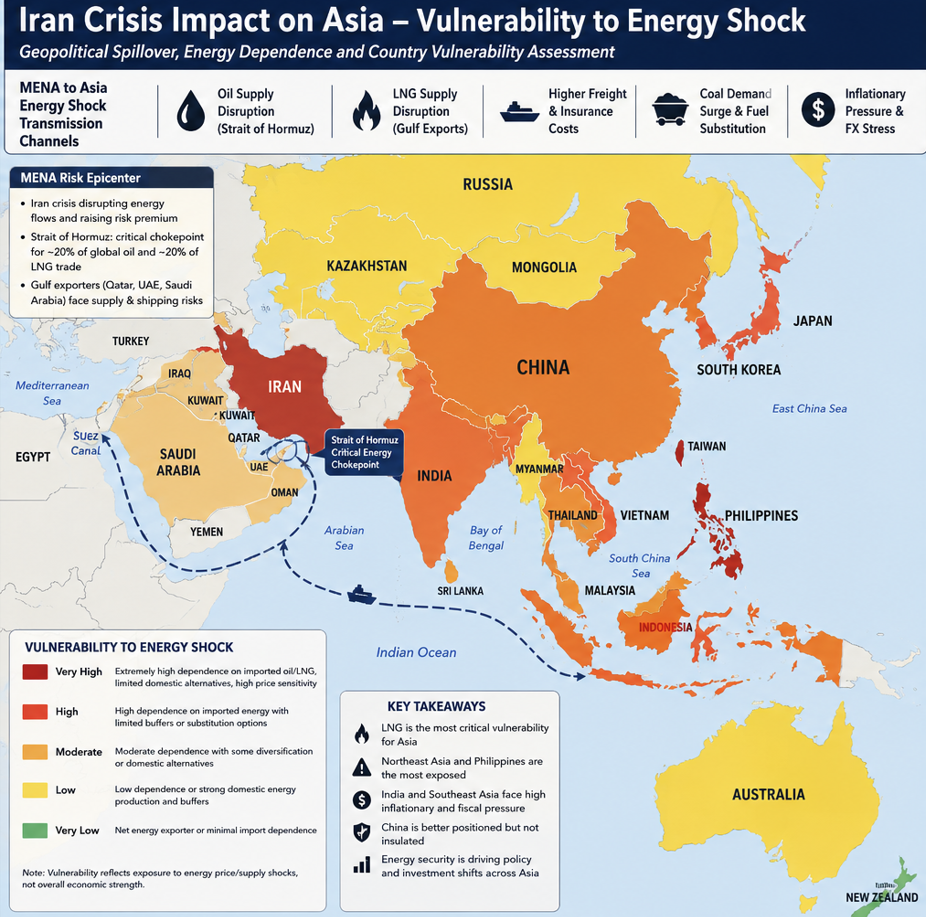
However, the destructive effects of this war go far beyond Iran and Lebanon. The extension of Iranian military strikes to the southern Gulf countries has plunged thousands of workers into precariousness. In addition to the deaths in the bombings, many migrants – already deprived of social and economic rights – have lost their jobs and been abandoned. On a global scale, this war has deepened the energy crisis and accelerated inflation. The closure of the Strait of Hormuz has produced significant paralysis. This is not only disrupting global oil and gas flows, but also trade in food and fertilizers. About a third of the world’s trade in agricultural commodities passes through Hormuz.
The World Food Programme has warned that if this situation continues, up to 45 million more people could be pushed into acute food insecurity. Nearly two-thirds of these people are in Africa and Asia, mainly in the poorest and most dependent countries. Countries such as Niger, Chad, Mali, Sudan, Somalia or Ethiopia. In Nigeria, for example, the price of fuel has risen by more than sixty percent, transport costs have almost doubled, which has directly caused food prices to rise. The United Nations Development Programme estimates that the war and the paralysis of the passage through Hormuz could plunge more than 30 million people back into extreme poverty.
The rise in energy prices is transmitted directly to the entire global economy. In countries such as India, Turkey, Egypt, Pakistan and Sri Lanka, people are already suffering from rising fuel prices, rising food prices, soaring transport costs and currency devaluation. In short, the consequences of this war are profoundly impoverishing the working class on a global scale.
Origins of the conflict between Israel and Iran
If we want to understand the origins of the Israeli-Iranian conflict, we must first avoid a fairly frequent confusion. Certainly, the massive destruction of civilian infrastructure in Iran is reminiscent of what we see in Lebanon, and even more so in Gaza. We find the same extreme violence, large-scale bombings, the destruction of industrial, medical, energy, logistical and housing infrastructures. But despite these similarities in the forms of destruction and slaughter of civilians, Israel’s war against Iran does not have the same political nature as its war against its neighbours.
The difference is not only in the role of the United States, although this role is central. In Lebanon and Palestine, the United States does not intervene directly militarily. They arm, finance and protect Israel, and let it act according to its own goals and desires. In the Iranian case, on the other hand, the American involvement is direct. It is the United States that sets the overall framework for the conflict, its priorities, its limits and its timetable, while Israel acts largely as a strategic partner and relay. I will come back to this American dimension of the conflict later.
The essential difference is above all of a political and historical nature. Israel’s wars in Palestine — and particularly in Gaza — are part of a long-term colonial and territorial logic. It is a settler-colonialism: land conquest, occupation, extension of borders, demographic transformation and ethnic cleansing up to and including genocide. In Lebanon, it is the territorial-security logic that operates, especially in the border areas. In the case of Iran, it is neither a colonial war nor a territorial occupation project. Iran and Israel do not share a common border and they do not dispute territory. It is a rivalry between competing regional powers. Each seeks to prevent the other from imposing its hegemony in the Middle East. The domination of one is necessarily to the detriment of the other. The logic of the conflict therefore concerns the place of each in the regional order, the ability to define the rules of the political, security and strategic game of the region.
Israel’s main objective vis-à-vis Iran is therefore the lasting weakening — or even the destruction — of the capabilities of a strategic rival. This requires the massive destruction of the country’s infrastructure: not only military capabilities, but also industrial, technological, scientific, logistical, and even medical, educational and residential infrastructure. It is a question of reducing the structural power of the opponent. Iran, for its part, also uses, within the limits of its own military capabilities, a logic of striking against not only military but above all civilian infrastructure. Here too, the objective is to wear down the opponent’s capacity. In other words, the Israeli war against Iran is aimed at neutralizing a regional power capable of influencing a Middle Eastern order dominated by the US-Israeli axis. It is this place claimed by Iran in the regional order that constitutes the real basis of the confrontation.
It must also be seen that the rivalry between Iran and Israel cannot be reduced to a succession of one-off military crises. It must be understood as a multidimensional structural rivalry. We can add that it is rooted in the geopolitical transformations of the post-Cold War era, in the collapse of the bipolar order and in the recompositions that followed in the Middle East, but that is another debate. It should be remembered that in the 1980s, during the war between Iran and Iraq, Iran and Israel collaborated. Israel was then selling arms to the Islamic Republic. The destruction of the Osirak – Iraq’s nuclear power plant – is said to have been the result of their collaboration in terms of military intelligence.
Since its creation, Israel has based its security on two pillars: permanent military superiority and strategic alliance with Western powers, especially the United States. Its “existential reason” depends on a regional environment where no rival can achieve a comparable level of power. Conversely, the Islamic Republic of Iran has gradually developed a policy aimed at building strategic depth in its regional environment. This involves a network of alliances, influences, and political relays in several countries in the region – the so-called “axis of resistance.”
Even without permanent direct confrontation, there is an enduring rivalry in which each side seeks to prevent the other from becoming the dominant power in the region. But this rivalry is not limited to the military or security dimension. It also has a deep economic and geopolitical dimension, often less visible but just as essential. One of the most important areas is the control of energy and trade routes. Thanks to its position in the Strait of Hormuz, Iran occupies a central place in global energy security. A decisive part of the world’s oil and gas passes through this space. This gives Iran considerable geopolitical leverage, as evidenced by its closure since the outbreak of the war.
Israel, for its part, has strengthened its position, thanks to the development of its gas fields in the Eastern Mediterranean, to become a leading regional energy player through new energy circuits between the Mediterranean, Europe and Arab countries. Two distinct but interdependent geopolitical spaces are thus drawn: on the one hand, the Persian Gulf and the oil routes linked to Iranian influence; on the other, the Eastern Mediterranean and the new energy axes associated with Israel. Energy here becomes an instrument of structural power.
The same logic exists for trade corridors. In recent years, projects to connect India, the Middle East and Europe have gained major geopolitical importance. These routes are not just economic: they are part of the competition to become the main hubs of world trade. Iran seeks to preserve its role as a strategic bridge between Central Asia, the Persian Gulf, the Caucasus and West Asia. Another example is the International North-South Transport Corridor (INSTC), which links India, Iran, Russia, and, more broadly, Northern Europe. In this system, Iran plays the role of a real land bridge between the Indian Ocean and the Caspian Sea, then to Russia and Europe.
Israel, on the other hand, is seeking to integrate into new transit networks through its cooperation with several Arab and Western countries (such as regional supply chains linking the Eastern Mediterranean to the Gulf, with projects for port cooperation, maritime transport and digital connectivity (Abraham Accords)). Or the IMEC corridor which would link India to the Gulf ports, then, via Saudi Arabia and Jordan, to Israeli ports such as Haifa, before reaching Europe via the Mediterranean. The competition for the trade card thus becomes a competition for regional power.
In addition, there is a fundamental difference: how they are integrated into the world economy. Israel is deeply integrated into the Western economy and the international financial system. It benefits fully from capital flows, technology transfers, innovation and global trade. Iran, on the other hand, is mainly operating under a sanctions regime. It is moving more towards non-Western economies (Global South), towards parallel trade circuits, alternative networks for circumventing sanctions, which is in itself a real business. The conflict is therefore not only about missiles, security or military influence. It also concerns the place of each in the global economic order.
Origins of the U.S.-Iran Conflict
When we talk about the US-Iran conflict, we must first remember that Iran — more precisely the Islamic Republic of Iran — is a regional power capable of exerting influence far beyond its immediate space, but its main objective is not only to exist as an autonomous power. It seeks to obtain a dominant, recognized and stable position in the regional power structure, on its own terms. In other words, the Iranian state—as the representative of Iranian capitalism—does not perceive itself as a mere peripheral power. The Iranian bourgeoisie has always been convinced that because of its territorial size, its demography, its geographical position, its natural resources, its industrial capacities and its long tradition of statehood, it is naturally up to Iran to occupy a central place in the regional order.
This perception does not date back to the Islamic Republic. It already existed during the reign of Shah, when Iran had the “honorific” title of gendarme of the region. The Islamic Republic did not invent this ambition; it has reformulated it in a transformed international context. It is therefore a question of a logic of hegemonic integration. Iran does not necessarily seek to overthrow the existing order, but to be recognized as a structuring power, without subordination, to obtain the lion’s share.
However, normalized access to this position remains largely closed to it. Because its rise to power directly affects several pillars of the existing regional order: the American security architecture in the Middle East, the monarchies allied with the United States, and above all, the centrality of Israel. This country benefits from a form of structural exception: guaranteed military superiority, permanent American and European protection, privileged integration into the Western order, as well as broad international tolerance for practices of colonial domination and crimes committed against the peoples of the region.
Faced with this lockdown, Iran is therefore looking for other ways to access this strategic recognition. Where the Shah’s Iran sought its ascent through a classic integration into the Western camp — according to a model that could recall that of South Korea — the Islamic Republic is moving more towards a logic comparable to that of India or South Africa during the apartheid era: nuclear power as an instrument of strategic recognition. In other words, nuclear capability becomes a means of imposing its place in an international environment that refuses to grant it normally. Added to this is the construction of regional strategic depth through its alliances, often referred to as the “axis of resistance”, as well as the development of the ballistic programme, intended to guarantee this desire for power militarily. It is therefore not only a question of defence, but of a global strategy of asserting power.
At the same time, the crisis of American hegemony has produced another important effect everywhere: the rise of other regional powers. In the Middle East, the assertiveness of Turkey and Saudi Arabia has multiplied the centres of rivalry and made the competition for regional hegemony more complex. Iran is therefore not facing a single adversary, but a regional system where several powers simultaneously seek to impose their centrality. In this context, the confrontation with the United States as the guarantor of the system that denies the Islamic Republic of Iran its claimed place becomes both lasting and almost inevitable.
It is an asymmetrical confrontation between a world power and a regional power. But its effects go far beyond the Middle East. The Iranian issue directly affects the credibility of American alliances, but also the relations between the United States, China and Russia. The American war against Iran is therefore never simply regional. It affects the overall balance of power. This global dimension is less visible in the Israeli-Iranian conflict, where Israel is fighting above all an immediate strategic rival, a direct regional competitor. For the United States, however, Iran represents something else: the possibility that a regional state will seek to integrate into the world order in its own way, by force. And this is precisely what the problem is.
If the Israeli objective is primarily the weakening — or even the destruction — of Iranian power, the American objective is a little different. It is less a question of totally destroying Iran’s power than of keeping it in a contained position, as far as possible: a power that is perhaps a little influential, but above all not structuring, not capable of redefining regional balances on its own terms. In both cases — Israeli and American — however, it is indeed a question of neutralizing a power capability.
The means employed by the Americans, like those used by the Israelis, are not limited to direct military pressure. They also include the destruction or weakening of all of Iran’s capabilities, as well as permanent economic warfare through structural sanctions. Sanctions, here, are not simply tools of punishment. They serve to prevent a state from transforming its potential power into real power. This is why the US-Iran conflict cannot be understood solely as a crisis, for example around the nuclear issue. It is a much deeper confrontation: a conflict over regional hierarchy, access to power, and the possibility for a regional power like Iran to become a structuring player in the international order without American authorization.
The Chinese factor
Moreover, when we look at the Chinese question in the context of the conflict over Iran, we must first start from a simple observation: with the rise of China and the possible return of Russia to the world stage, Iran is no longer just a regional problem. It is gradually becoming a potential player in a broader rebalancing of the international system. From China’s point of view, Iran is an important geo-economic partner. This can be seen first of all in terms of energy. China is heavily dependent on oil and gas imports from the Gulf, especially Iranian oil. So Iran is a key player in China’s energy security. China has a direct interest in avoiding, either the collapse of the Iranian state – whatever it may be, provided it remains a partner – or total American domination of this space.
Then there is the Eurasian dimension. Iran occupies a central geographical position between several major areas: the Persian Gulf, Central Asia, the Caucasus, the Indian Ocean and the major Eurasian land corridors. In the logic of the New Silk Roads, this position is essential. Without stability in Iran, a significant portion of these connections becomes fragile or uncertain. Finally, there is a more global political and strategic dimension. China does not necessarily seek to “defend” the Islamic Republic as such, but it refuses to allow regime change imposed from outside, especially by the United States, to become an international norm. For her, this would amount to strengthening the legitimacy of American interventionism in the world.
There is also an important paradox. A protracted war with Iran may, in some cases, indirectly weaken the U.S. position vis-à-vis China. Indeed, such a conflict consumes significant military resources, depletes stocks, diverts American attention to the Middle East and reduces the ability to concentrate on the Indo-Pacific scene, particularly in the face of the Taiwan issue. In this logic, striking or containing Iran can produce contradictory effects: it can weaken a regional rival, but also, indirectly, strengthen China’s strategic position. Basically, the management of the Iranian question goes far beyond the Middle East. It directly influences the balance between the United States and China itself.
Conclusions
In the end, the war against Iran cannot be understood as a mere one-off military confrontation, or even as a strictly regional crisis. It is part of a much broader set of structural rivalries that concern both the definition of the regional order in the Middle East and, beyond that, the evolution of the contemporary world order. The Israeli-Iranian conflict is first and foremost a struggle for regional hegemony. It is a clash between two powers that each seeks to prevent the other from becoming the organizing centre of the Middle East. In this logic, the destruction of civilian, industrial or scientific infrastructure is not simply aimed at an immediate military objective: it is part of a broader strategy of sustainable neutralization of a rival’s power capabilities.
At the same time, the US-Iran conflict goes even further beyond this regional dimension. It pits a world power that seeks to maintain a hierarchical international order against a regional power that tries to access it on its own terms. The Iranian question thus becomes a point where several dynamics converge: the crisis of American hegemony, the rise of new regional powers such as Turkey or Saudi Arabia, and the gradual emergence of a multipolar world marked by the growing role of China and the possible return of Russia to the game. In this configuration, the economy is not a separate domain from war. On the contrary, energy roads, trade corridors, sanctions, access to capital and technology become direct instruments of power. The struggle for Iran’s place in the regional order is therefore also a struggle for its position in the world economy.
But let’s get to the point: beyond the rivalries between states, it is above all the working class and the labouring classes that bear the main cost of these conflicts. In Iran, Lebanon, the Gulf countries, but also in Africa, Asia and far beyond, war means destruction, unemployment, inflation, shortage, repression and increased precariousness. Workers are the first victims: they lose their jobs, suffer from rising prices, are exposed to the direct violence of conflicts, and see their capacity for collective organization further reduced in a context of militarization and political control and reinforced repression.
This war thus highlights a constant reality of contemporary capitalism: clashes between powers are never just abstract geopolitical games. They always result in an intensification of social exploitation and misery for the working population. Behind the discourses of security, sovereignty or stability, it is in reality imperialist power relations that are redrawing the region at the cost of massive and lasting destruction. Understanding this war therefore implies placing it in the deep logic of competition for power, for hegemony and for the control of resources, while keeping at the centre a fundamental reality: it is the peoples, and first and foremost the workers, who pay the price.
Finally, it is important to remember that the Islamic Republic of Iran — and more broadly the Iranian capitalism it administers — is not a simple passive victim of this warlike configuration. It is a fully-fledged player, committed to its own logic of power, internal consolidation and regional influence. Its confrontation with Israel and the United States cannot therefore be reduced to mere “resistance” in the moral or political sense of the term. It is not only a reaction to an external injustice, to an imposed war, but also a state policy carried out by a ruling class that represses its own population, instrumentalizes external conflicts to strengthen its external position and internal control, and also seeks to impose its place in the regional and global hierarchy.
2 May 2026
Translated by International Viewpoint from Marx21.ch.