Sunlight and Extraction: Batteries, Phosphate, and the Contradictions of Decarbonization
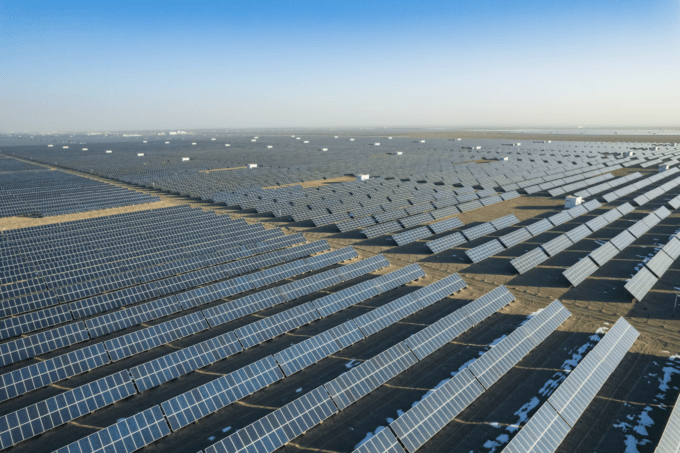
Photo by ダモ リ
A recent report by energy think tank Ember put forward a spot of good news: renewables surpassed one-third of global electricity generation in 2025, surpassing coal power for the first time in a century. Combined, low-carbon sources (renewables, nuclear) grew faster than demand, resulting in a small fall in fossil fuel generation. Solar alone met 75 percent of the increase in global electricity demand.
This was before the war in Iran, which would certainly seem to accelerate the transition. Of course, the Trump administration, through the Department of Defense, is holding back approval for about 165 onshore wind projects in the U.S.- approval is needed to ensure the projects don’t interfere with radar systems and flight paths (ironic a Republican administration using Big Government to stop landowners from using their property), not to mention reimbursing firms to the tune of $2 billion this year for abandoned offshore wind projects, but reports are that Europe, bitten twice in five years by a war related energy crunch, is buying up things like EVs and heat pumps. Even in cloudy Britain, orders for solar panels from Octopus Energy, the UK’s biggest energy firm, have spiked by 50 percent since the war started.
Pakistan has become an epicenter of solar power. After being locked out of the LNG spot market in the aftermath of the Russian invasion of Ukraine solar increased fivefold from 2.9 percent in 2020 to 32.3 percent in 2025, according to Ember. The government still closed schools for two weeks in March to conserve energy due to the Strait of Hormuz shutdown (though the blow has been softened, LNG is still a big factor), but the trend is undeniable.
It is the same story in Lebanon, where there has been about a tenfold increase in installed solar capacity the past few years, most prominently in rural Lebanon, where it has largely replaced a local diesel economy that was long endemic due to the state’s inability to supply consistent electricity. South Africa, long plagued by brownouts, has gone over 300 days without an interruption to its electricity supply. Coal still dominates the country’s energy production but it’s also the fastest-growing solar market in Africa.
There is plenty to work out as far as equality of access and the future of the grid. In all these places, the solar expansion has been less a result of state planning and more a matter of people understandably taking electricity in their own hands (Lebanon saw state collapse in 2021) but, again, the trend is clear. Solar is expected to remain the cheapest form of energy going forward.
EV sales are also spiking globally, with many developing countries such as Vietnam, Thailand, and Indonesia reaching higher EV sales shares than even the EU average. Norway has reached almost total EV adoption and sales in China are now a majority.
With electricity, it becomes a question of batteries. Solar needs battery storage or backup on the grid (hydro, nuclear, or geothermal). ‘Capacity Factor’ is defined by the percentage of the time an energy source can be expected to be available to the grid in relation to its potential maximum capacity. According to the International Energy Agency, on that mark, solar comes in at roughly 23 percent (wind slightly higher at 34 percent). Storage is still in its early days. Ember’s data shows battery additions in 2025 were enough to shift only about 14 percent of new solar generation.
According to the International Energy Agency (IEA), global lithium-ion battery deployment in 2025 was six times as high as in 2020, with EVs accounting for 70 percent of the total lithium-ion deployment. Energy storage followed at just 15 percent. Portable electronics, which had accounted for nearly half the demand in 2015, fell below five percent.
Given that Chinese companies are dominating EV sales, their main battery of choice, Lithium Iron Phosphate (LFP), has exploded in recent years. LFP has a lower price tag (it is also safer, though not as energy dense), and costs fell by 15 percent last year compared with 5 percent for Nickel Manganese Cobalt (NMC), the second most used battery. LFP accounts for just over half of EV batteries and over 90 percent of energy storage. NMC dominated EV battery production in the 2010s and is still used in plenty of EVs, including longer-range Tesla models and the Chevy Bolt. General Motors is planning to introduce lithium manganese-rich (LMR) battery cells in its largest electric vehicles starting sometime in 2028. Sodium-ion batteries are being explored as an alternative to lithium (lithium is quite abundant but sodium is everywhere- about 1000 times more abundant). Solid-state batteries hold the promise of being safer and far more energy-dense but have been plagued by cracking that causes short circuits. A majority of consumer electronics still use Lithium Cobalt Oxide (LCO).
LFP has been intriguing in some circles given that they are supposed to be less dependent on problematic materials such as cobalt, most of which comes from the Democratic Republic of Congo where conditions and artisanal child mining have drawn much scrutiny, and nickel, which is nasty to process. More than half the world’s nickel currently comes from Indonesia. In an understandable move toward resource nationalism that we’re bound to see more of, a few years ago, the Indonesian government mandated that all nickel mined in the country must be processed there. As production there has more than doubled in the past few years, waste from the industry,particularly on the island of Sulawesi, has decimated local fishing and deforestation has increased erosion and the risk of flash floods.
While energy has absorbed most of the attention from the Strait of Hormuz shutdown, fertilizer prices haven’t been far behind. Recently, U.S. Senator Roger Marshall of Kansas endorsed legislation to eliminate import tariffs on phosphate from Morocco. The tariffs were put in place five years ago, set at 19.97 percent (since lowered to 2.1 percent this past January) in response to a domestic fertilizer manufacturer’s complaint about unfair competition from subsidized, low-price imports. The proposed repeal has the backing of all the major farm lobbying groups.
Why Morocco? Because Morocco holds about 70 percent of global phosphate reserves and phosphate is a key ingredient in most fertilizers. Morocco is the world’s second biggest exporter behind only China. Morocco’s government has long been seen as decent, at least by Middle East standards, though King Mohammad VI holds plenty of power, but there is a place called Western Sahara. Back in 1975, as Spain’s colonial government was negotiating a withdrawal from the territory, Morocco moved in. King Hassan II sent 350,000 of his subjects across the border along with thousands of soldiers, against the local Sahrawi resistance. It was a lopsided fight as the Sahrawi numbered somewhere between fifty and one hundred thousand, half of whom fled for makeshift tent cities in Algeria. A low-intensity war burned through the 1980s, with 10,000-20,000 killed, until a UN-brokered ceasefire in 1991 left Morocco with two-thirds of the territory. A pending referendum never came and the UN still labels Western Sahara as a ‘non-self-governing territory in the process of decolonization.’
The occupied territory contains the Bou Craa Mine, which may hold up to 10 percent of Morocco’s phosphate production. The mine features the world’s longest conveyor belt, at 61 miles (large enough to see from space), that ships the mine’s phosphate out to sea. Activists, including Aminatou Haider, a Sahrawi who spent four years blindfolded in a Moroccan jail (she was nominated for the Nobel Peace Prize in 2007), have done a great job in lobbying many importers to boycott phosphate from Bou Craa (but not Morocco proper) but the point is we are a long way from clean supply chains. As we work to decarbonize our frontlines, we cannot overlook the underbelly of the energy transition.
The great science fiction writer Isaac Asimov may not have been completely prescient but he was still insightful when he wrote in 1974:
“Life can multiply until all the phosphorus is gone and then there is an inexorable halt which nothing can prevent…We may be able to substitute nuclear power for coal power, and plastics for wood, and yeast for meat, and friendliness for isolation- but for phosphorus there is neither substitute nor replacement.”
Well, at least minimizing single-use plastics would be nice. As for phosphate, it doesn’t appear to be running out any time soon. A few years ago, the U.S. Geological Survey put global phosphate reserves at 300 billion tons, sufficient for more than 1000 years at the current rate of extraction (other surveys have it at centuries’ worth). EV batteries, for now, are hardly putting a dent in phosphate supply.
Of course, there are plenty of other issues. In his book The Devil’s Element: Phosphorous and A World Out of Balance, Dan Egan gives a thorough account of the toxic blooms and dead zones in the world’s waterways. Vaclav Smil points out that the worldwide efficiency of nitrogen fertilizer uptake by crops has actually declined to less than 50 percent- meaning the rest is lost to the environment. This can be improved. Diets can be modified to eat less meat, policies that close agricultural exceptions in environmental regulations and impose taxes that force producers to internalize cost of production currently borne by society writ large would help. Meanwhile, more public funding can go into alternative proteins and scaling up lab-grown meat. We can’t forget that global warming is about more than just electricity. Even at a moment when the profits of Saudi Aramco and BP are sky-high, glimmers of hope are everywhere. There remains much to be done.