It’s possible that I shall make an ass of myself. But in that case one can always get out of it with a little dialectic. I have, of course, so worded my proposition as to be right either way (K.Marx, Letter to F.Engels on the Indian Mutiny)
Monday, November 09, 2026
Belgium Transfers Minehunter to Bulgaria to Increase Black Sea Security
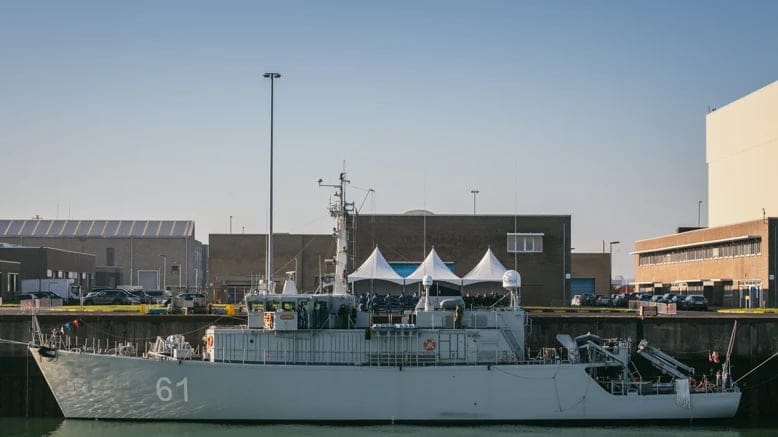
Bulgaria received the first of seven minehunters coming from Belgium and the Netherlands (Belgian Navy)
Belgium completed the official handover of one of its older minehunters to Bulgaria as part of a pact between Belgium, the Netherlands, and Bulgaria designed to increase security capabilities in the Black Sea. While the agreement dates to July 2026, the recent Russian attacks on commercial shipping have further raised awareness of the need to increase NATO capabilities in the Black Sea.
The three countries announced the Tripartite Agreement on July 8, 2026, calling for the transfer of a total of seven minehunters, mostly dating from the late 1980s, to Bulgaria. Belgium will be transferring a total of four vessels while the Netherlands will supply three. They follow three earlier vessels of the same class that went to Bulgaria between 2009 and 2011.
Bulgaria has been working alongside Romania and Turkey to control mines in the Black Sea since the start of the war in Ukraine. The three countries partnered for mine patrols and clearance in an effort that continues. Bulgarian officials highlighted that these new vessel transfers will strengthen the capabilities of its navy to detect and neutralize mine threats in the Black Sea region.
The first of the transfers took place on October 30 at the Naval Base in Zeebrugge, Belgium. The former Belgian Bellis (M916), commissioned in 1986, was officially handed over to Bulgaria. They conducted a transfer of flags ceremony, and Bulgaria renamed the vessel Briz. After the necessary preparations, the vessel will be based at the Burgas Naval Base in Bulgaria.
"By transferring the ship to Bulgaria, a proven capability remains operationally deployable within NATO," said Lieutenant General Bernard Phaleg, Director General of Material Resources and National Armaments Director for Belgium. "In this way, we strengthen an ally, support security in the Black Sea region, and ensure that the investments and expertise built up over decades continue to prove their value."
All seven of the vessels are from the Tripartite class, a shared design developed between France, Belgium, and the Netherlands in the 1980s. France continues to operate eight of the vessels known as the Éridan class, while the Bellis and three sisters, all going to Bulgaria, will be the last of the class for Belgium. It had previously transferred another one of the ships to Bulgaria, one to Ukraine, and sold one to Pakistan. The Netherlands will be sending its final three ships of the class to Bulgaria in 2027-2028 after having also sent vessels to Bulgaria, Ukraine, Pakistan, and Latvia.
The ships are approximately 600 tons displacement and measure approximately 52 meters (169 feet) in length. A total of 40 vessels were built in the class, and the remaining ones mostly had their systems upgraded in the early 2000s.
Belgium and the Netherlands are replacing the vessels with a new generation of mine countermeasure vessels. The new ships will incorporate systems including advanced unmanned capabilities and sensors.
RINA & Petrobras €11M Contract for Subsea Engineering & Decommissioning
Project strengthens the company’s role in asset integrity and lifecycle management studies for offshore infrastructure in Brazil.
RINA, the global inspection, certification and consulting engineering multinational group, has signed a three-year €11 million contract with Petrobras to support initiatives related to the integrity and decommissioning of subsea systems. The project will involve engineering analyses and technical assessments designed to support decision-making on the management and planning of interventions in offshore infrastructure.
The scope includes studies and analyses focused on the integrity, reliability and maintenance of subsea systems, supporting the evaluation of different operational scenarios throughout the lifecycle of these assets. Key activities include integrity assessments of pipelines and risers, reliability studies (such as FMEA/FMECA and RAM), asset life extension evaluations, and the development of technical studies for subsea decommissioning projects.
The project is aligned with Petrobras’ initiatives aimed at ensuring the safe and efficient lifecycle management of its offshore assets. The objective is to support both the safe continuation of operations in active units and the responsible planning of interventions and decommissioning activities for structures that have reached the end of their operational lifecycle.
“Projects related to the integrity and decommissioning of subsea systems require robust technical analysis and deep offshore engineering expertise. In this partnership with Petrobras, our role is to provide specialized assessments that support safe and well-informed decisions throughout the lifecycle of these assets,” said Marcell Chiarelli, LATAM Executive Commercial Management Director at RINA.
The initiative further strengthens collaboration between RINA and Petrobras in strategic offshore engineering areas. By supporting studies and analyses related to the lifecycle management of subsea infrastructure, the project also aligns with RINA’s strategy to expand its involvement in complex engineering initiatives in Brazil’s oil and gas sector.
The contract provides for the mobilization of up to 83 professionals, including engineers and specialized technicians, approximately 45 of whom are highly qualified specialists already part of RINA’s team. The workforce may be expanded over the course of the contract as project requirements evolve.
The products and services herein described in this press release are not endorsed by The Maritime Executive.
Singapore’s 7–8 major cable landing stations, linking roughly 26–28 subsea systems, underpin its role as a regional digital hub, with geographic diversity (Changi, Tuas, Tanah Merah) and the Digital Connectivity Blueprint designed to double landing capacity and reduce single-point risks.
Direct connections to hyperscale data-centre clusters and cross-border corridors in Johor and Batam (SIJORI) have driven rapid capacity growth, such as Johor’s contracted capacity rising from 400 MW to over 2.3 GW.
These links support ASEAN digital trade and integration while underscoring the need for stronger resilience of critical underwater infrastructure.
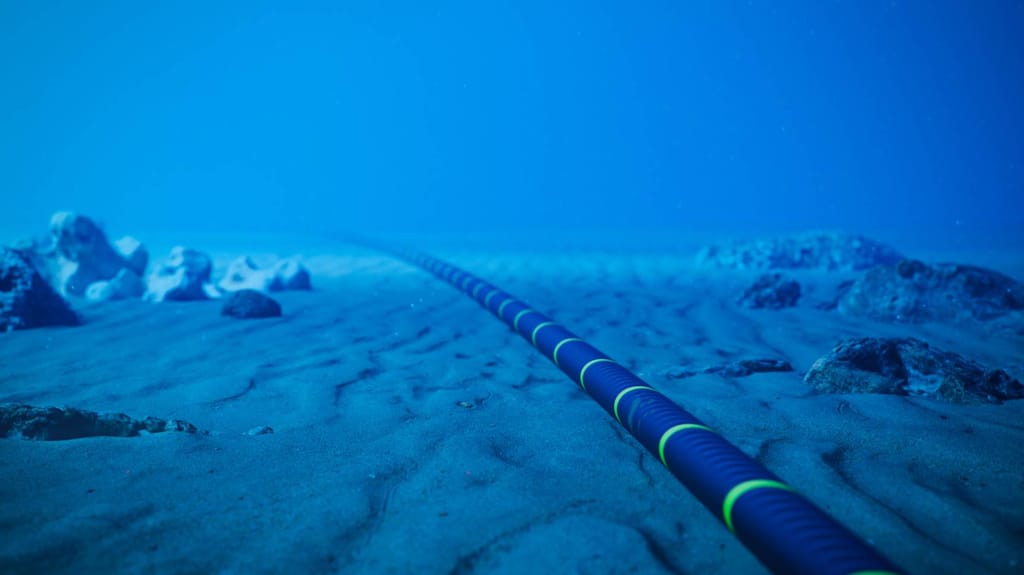
Unseen but critical for the global economy are the critical underwater infrastructure (CUI) consisting of subsea telecommunications cables, power grids, oil and gas pipelines. In particular, the digital economy is dependent on submarine telecommunication cables. With Singapore assuming the ASEAN Chairmanship from the Philippines in 2027, digital trade and regional economic integration will be key issues Singapore is likely pushing for in 2027.
Beyond its physical location as a transhipment hub, Singapore is also an information hub seen in the form of submarine cable landing stations in the city-state. These are hardened coastal facilities where underwater fibre-optic cables come ashore and connect to the city-state’s terrestrial telecommunications and data centre networks (DC connect website).
Singapore has around 7 to 8 major cable landing stations and connects to roughly 26 to 28 active subsea cable systems. This paper aims to highlight the key role of submarine cables as a driver of regional and global trade and their importance to Singapore, Malaysia, and Indonesia to enhance subregional trade and development in the digital economy. It also highlights the need to enhance resilience of these submarine cables.
The submarine cables landing stations (CLS) in Singapore serve several functions: First, it is an economic lifeline for Singapore’s international telecommunications traffic (including internet data, financial transactions, and cloud services) travels via submarine cables. Second, these submarine cables, support its massive ecosystem of regional data centres and multinational businesses. Third, Singapore acts as a global digital hub providing primary connectivity as a bridge linking East Asia, South Asia, the Middle East, Europe, Australia, and the United States as shown in table 1 below:
IGG (Indonesia Global Gateway), INSICA, Batam Singapore Cable System (BSCS), Matrix Cable System (MCS), Nongsa-Changi
Jakarta, Batam, and other Indonesian data/landing nodes
Singapore’s digital connectivity strategy leverages geographic diversity and rigorous regulatory frameworks to secure its status as a global data hub. By intentionally distributing infrastructure across different coastlines, the nation systematically mitigates risks associated with physical damage and geopolitical chokepoint (CSIS website, 24 September 2025).
The strategic blueprint reinforcing this digital infrastructure includes First, distributing cable landing sites across multiple locations such as Changi in the east facing the South China Sea, Tuas in the west facing the Strait of Malacca, and Tanah Merah. This wide physical spread prevents single-point-of-failure vulnerabilities, ensuring that if one corridor faces a localized maritime accident or disruption, traffic can be seamlessly rerouted.
Second, driven by the Digital Connectivity Blueprint (DCB) launched by the IMDA, Singapore aims to double its international subsea cable landing capacity. This expansion is specifically designed to manage the heavy bandwidth required for data-intensive operations, green data centres, and advanced artificial intelligence (AI) workloads.
Third, any entity intending to deploy networks or activate capacity must secure a Facilities-Based Operations (FBO) licence from IMDA. Operators are subject to stringent guidelines, including a mandate to report cable faults within one hour of detection and execute fast repair protocols.
Fourth, Singapore aligns its operations with global security standards, having endorsed the New York Joint Statement on the Security and Resilience of Undersea Cables (“New York Principles”). This framework emphasizes international cooperation, route redundancy, supply chain integrity, and the selection of reliable, trusted cable component providers.
In addition, Singapore’s submarine cable landing stations (CLS) are tethered directly to the nation’s key data centre clusters. Rather than relying on long, multi-hop terrestrial networks, Singapore’s networks are designed around an interconnection core and hyperscale edge campus strategy to achieve ultra-low regional latencies.
A shift is occurring where new data centres are moving to a “direct-to-facility” landing model, bypassing traditional standalone beach landing buildings entirely and bringing submarine fibre directly into the data centre colocation meet-me rooms (Techdirectory website, 18 July 2026).
The primary data centre clusters in Singapore link to specific subsea cable landing stations through three main geographical corridors: First, the Tuas CLS anchors the Western corridor, facing the Strait of Malacca and connecting toward South Asia, the Middle East, and Europe. This station feeds massive hyperscale data centres in the Tuas Industrial Estate and the Jurong Innovation District.
Singtel’s Nxera DC Tuas serves as the prime example of modern infrastructure convergence. Opened as an AI-ready facility, it is one of Singapore’s only multi-tenanted data centres fully integrated with a subsea cable landing station, giving tenants direct, millisecond-level access to international subsea pipes without terrestrial bottlenecks. This western cluster also directly manages systems like Bifrost, which integrates straight into the data centre campuses in the west rather than using a legacy beach landing station (Nxera website 9Feb 2026).
Second, the Changi North and Tanah Merah landing sites anchor the Eastern side of Singapore, facing the South China Sea and routing massive traffic toward East Asia and the United States. These landing sites plug directly into the heavy hyperscale hubs of Loyang and Changi Business Park. Data centres in this zone focus on massive throughput.
For example, Digital Realty’s SIN12 campus in Loyang links directly with short-haul systems like the Nongsa–Changi cable. This design places Indonesian and regional workloads just a single, ultra-low-latency fibre hop away from Singapore’s main network. Major Campuses: Other critical wholesale data centres, such as the sprawling AirTrunk Loyang campus, rely heavily on this eastern subsea corridor to feed massive cloud architectures.
Third, located further inland, Tai Seng and Ayer Rajah serve as the dense “Interconnection Cores” of Singapore. High-capacity, redundant terrestrial fibre rings connect the coastal Tuas and Changi landing stations directly back to these central facilities. While Tuas and Changi function as the coastal gateways, Singapore’s central and city-fringe industrial estates function as the country’s central nervous system, where all the cables meet. This cluster hosts carrier-dense meet-me rooms operated by companies like Equinix (SG1/SG3), Global Switch, and Keppel Data Centres.
While the coastal edges manage massive, raw cloud data storage, the Tai Seng cluster serves as the control plane. It is where major cloud providers (like AWS and Google), global financial networks, internet exchanges, and telecommunication carriers interconnect their traffic. Table 2 below shows the key elements of the interconnection cores.
Table 2: Key Elements of the Interconnection Cores.
Feature
Coastal Gateways (Tuas / Changi)
Interconnection Cores (Tai Seng / Ayer Rajah)
Primary Role
Direct submarine cable landings & raw cloud storage
Central network routing, peering, and control plane traffic
Cross border connections are also critical. For example, the cross-border data centre boom in the SIJORI (Singapore–Johor–Riau Islands) Growth Triangle represents one of the most aggressive digital infrastructure expansions globally. Following Singapore’s 2019 to 2022 data centre moratorium and subsequent tight, green-gated capacity releases, the market evolved from a simple “overflow scenario” into a mature, highly integrated cross-border AI and hyperscale corridor.
The Northern Axis corridor in Johor, Malaysia has also experienced a massive boomtown cycle, transitioning into Southeast Asia’s primary engine for massive hyperscale and AI facility rollouts. The total contracted capacity in Johor skyrocketed from 400MW in late 2023 to over 2.3GW, with pipeline projections climbing even higher.
Major campuses are key interconnections and are clustered around the Sedenak Tech Park (hosting K2 Data Centres), Cyberjaya, and Gelang Patah (hosting EDC Data Centre). Global operators like Equinix (JH1) and Princeton Digital Group also leverage massive land parcels here to build high-density compute spaces. To link with Singapore, the corridor relies on high-capacity terrestrial dark fibre bundles crossing the Causeway and the Second Link. Specialized networks, like Open DC’s Causeway Connect, route traffic directly into Singapore’s interconnection core at Paya Lebar and Tai Seng with negligible latency.
In addition, the Maritime Axis in Batam, Indonesia acts as a natural extension of Singapore’s eastern cloud hub, transforming the Riau Islands into a sovereign digital free zone. Driven by the Johor–Batam–Singapore data centre triangle, Batam has roughly 70MW of live capacity but has cleared massive grid commitments.
Major projects, including partnerships with tech giants like Nvidia, have driven committed and planned capacities toward 1.47GW. The epicentre of this growth is Nongsa Digital Park (NDP), which acts as a digital ferry bridge to Singapore. Major global joint ventures, such as the BW Digital NDP1 facility and massive AI factories, are built here. Rather than relying on legacy infrastructure, this axis uses direct data-centre-to-data-centre subsea links.
A prominent example is the 50km subsea fibre pipe landing directly into Digital Realty’s SIN12 facility in Loyang/Changi, meaning workloads in Batam are only one subsea cable hop away from Singapore’s core network exchanges as shown below in table 3.
In conclusion, as Singapore enhances its connectivity and submarine cables resilience, the benefits has accrued beyond its borders via the SIJORI Growth Triangle of Batam, Johor, and Singapore. It has enabled all three neighbours to develop and expand digital infrastructure for mutual economic benefit. This helps propel ASEAN’s economic integration drive and preparedness to ensure the region’s competitiveness in the digital economy.
About Dr. Faizal Yahya Dr. Faizal Yahya is a Senior Research Fellow with the Institute of Policy Studies, Lee Kuan Yew School of Public Policy at the National University of Singapore. He is in the Governance and Economy Department. His current research interests includes, business transformation, human capital development, state led development, industrial policy, connectivity, foreign trade and economic regionalisation among other themes. Prior to entering academia, he was working in the Ministry of Foreign Affairs and the Ministry of Sustainability and the Environment. View all posts by Dr. Faizal Yahya →
Ørsted Starts Commercial Operations on Its Second US Offshore Wind Farm
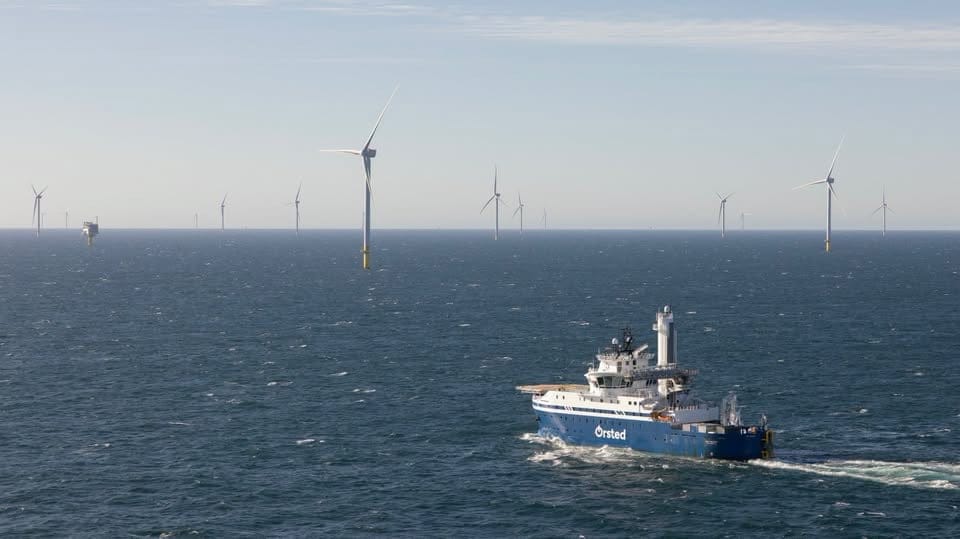
Orsted said Revolution Wind has completed commissioning and is now in commercial operations (Orsted US)
Revolution Wind, an offshore wind farm providing power to Connecticut and Rhode Island, has entered commercial operations, despite repeated challenges from the Trump administration. Developer Ørsted confirmed today that the wind farm entered commercial operations in October, while it is also making progress on another location for New York State.
Group President and CEO Rasmus Errboe reported the development during the company’s quarterly investor call on November 5, saying Revolution Wind began commercial operations under the PPAs, delivering power to Connecticut and Rhode Island. He called the development “a major milestone,” while also reporting they were making "solid progress" on the Sunrise Wind project off New York’s Long Island.
Construction started in 2023 for Revolution Wind, which is a 704 MW project located more than 15 miles south of the Rhode Island coast. Reports said the total investment was more than $6.2 billion and also included the development of facilities at ProvPort, Quonset, and State Pier to support the project. Revolution Wind is a partnership between Ørsted and Skyborn Renewables, which is owned by BlackRock’s Global Infrastructure Partners.
The project has 20-year power agreements, with media reports that it is delivering power to Rhode Island Energy, Eversource Energy, and United Illuminating. The project delivered its first power in March 2026.
Reaching this point comes after several challenges from the Trump administration. It issued a stop-work order for the project in August 2025, when it was already 80 percent complete. A court issued a preliminary injunction allowing construction to resume in late September, only to have the Department of the Interior issue a second stop-work order at the end of the year. A US federal court granted a second preliminary injunction, allowing construction to again resume in mid-January.
The project is still facing court challenges from environmental groups. Last month, the Department of Justice filed in the case, asking the court to remand the approval of the project's Construction & Operations Plan for further review. The administration has alleged the project’s review and approval was rushed and that it needs to reevaluate its compliance with the Outer Continental Shelf Lands Act.
The news that the project had entered commercial operations received strong statements of support from Connecticut and Rhode Island’s elected officials. In addition, Senator Chuck Schumer issued a statement, “Despite Donald Trump’s efforts to end offshore wind production, Revolution Wind is now fully operational! ... It’s great news for lower costs, union jobs, and a cleaner environment and it’s one of many victories to come in our ongoing fight to lower prices for Americans.”
Revolution Wind becomes the third large, commercial-scale offshore wind farm in full operation in the United States. Ørsted recently marked two years for the smaller 132 MW South Fork Wind off New York. The other large project in commercial operation is Vineyard Wind, owned by Copenhagen Infrastructure Partners (CIP) and Avangrid Renewables.
Boston public radio station WBUR reported that last Friday, October 30, wind power in New England peaked at 2,400 MW, breaking a record for the region.
Revolution Wind was one of the five offshore wind farms under construction in the United States. Errboe told investors today that the company’s other project, Sunrise Wind, is now nearly 60 percent complete and should commission its first turbine around the end of the year. He reported that installation has been completed for the foundations and that 31 turbines are installed. Ørsted expects the project to reach commercial operations in the second half of 2027.
India’s Adani Agrees to Buy Europe’s 2nd-Largest Liquid Storage Operator
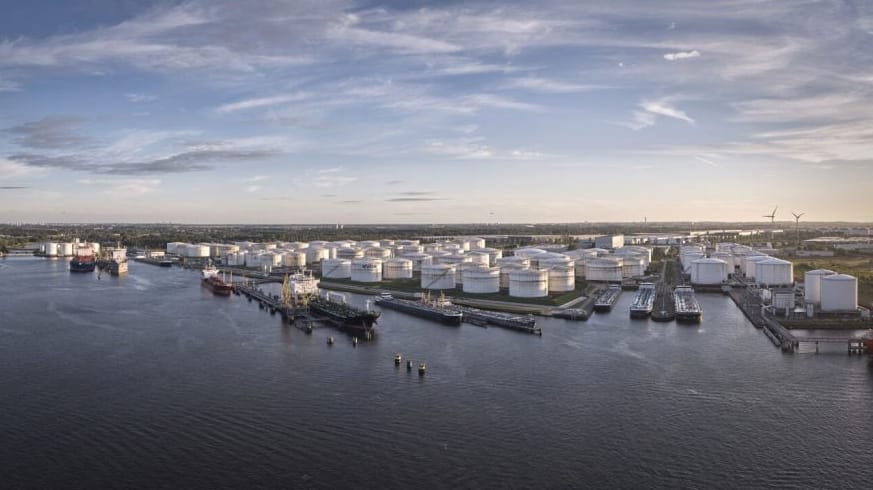
Evos will provide Adani its first foothold into European ports (Evos Amsterdam)
Adani Ports and Special Economic Zone Limited (APSEZ) agreed to acquire Netherlands-headquartered Evos B.V. from Igneo Infrastructure Partners in a deal with an enterprise value of €2.56 billion ($2.87 billion). Already India’s largest port terminal operator, Adani continues to seek opportunities to expand its international footprint and build a foothold in Europe.
Evos will be an important part of the corporate strategy, with Adani calling it a “strong strategic fit with its ambitions to build a globally diversified integrated transport platform.” It establishes a sizeable European presence for the company while also scaling the size and diversifying its liquids operations.
“Evos marks an important milestone in APSEZ’s trajectory towards handling 1 billion tons of cargo and building a truly global, integrated transport platform,” said Karan Adani, Managing Director of APSEZ.
Netherlands-based Evos is Europe’s second-largest independent liquid storage operator, with 6.3 mn cubic meters of storage capacity at eight port-based terminals across the Netherlands, Germany, Spain, Belgium, and Malta. Evos operates a diversified liquids platform spanning both conventional and transition fuels. Its product mix includes gasoline, gasoil, marine fuels and jet fuel, alongside transition fuels such as sustainable aviation fuel (SAF), biofuels, methanol, and bioethanol, positioning the business to participate in Europe’s evolving energy mix. Evos is an investment-grade rated issuer.
Adani highlights that the company is positioned in Europe’s most important energy and industrial hubs, including the Amsterdam-Rotterdam-Antwerp region, Hamburg, and the Mediterranean. The platform comprises 452 tanks, 63 vessels, and barge berths, and has several integrated pipeline connections, including with Schiphol Airport and the Central Europe Pipeline System.
Evos had 2025 revenues of €392 million and an EBITDA of €219 million. It handled 37 MMT of throughput in CY25.
Adani highlights that, with this acquisition, it will expand its footprint to 10 countries and a total of 28 ports. While it continues strong revenue and earnings growth, the company’s international portfolio has so far been limited to ports in Israel, Tanzania, Sri Lanka, and Australia. It had been linked to the early rounds of bidding for Associated British Ports, but was not named as a finalist. ABP was sold two weeks ago to an Australia-based fund manager.