Monday, November 09, 2026


MOSCOW BLOG: The Interregnum is here and this is what it looks like

MOSCOW BLOG: The Interregnum is here and this is what it looks like
/ bne IntelliNewsFacebook
By Ben Aris in Berlin November 6, 2026

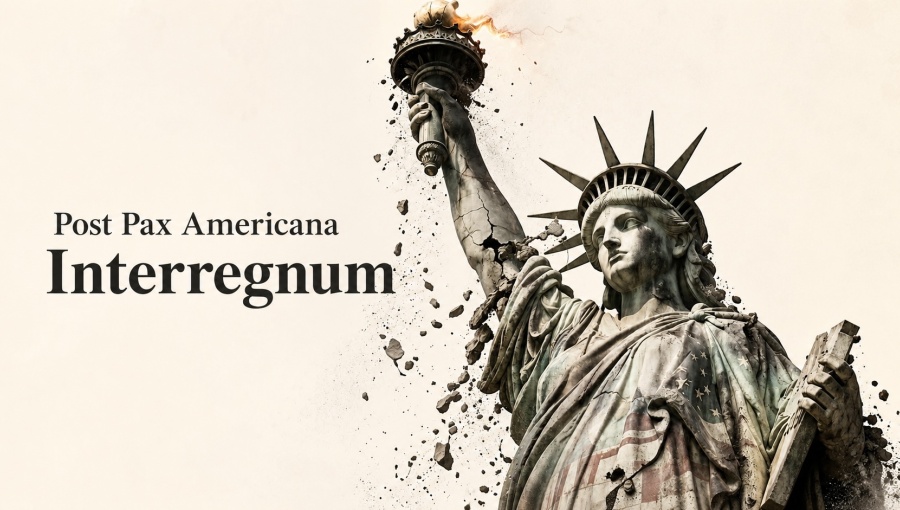
The post-Pax Americana Interregnum is here and it is starting to become clearer what it looks like.

We have been arguing this year that the result of the East-West clash and the “rise of the rest” from the Global South in general, and the Ukraine war in particular, has led to an end of the unipolar “rules-based” order and ushered in a multipolar world.

Just how badly those rules are being eroded in the West was demonstrated by Ukrainian President Volodymyr Zelenskiy decision to bring treason charges on November 4 against Iuliia Mendel, Zelenskiy’s former press secretary, while all of his best friends have been charged with stealing tens of millions of dollars – during a war – and remain untouched. Likewise, Latvia’s decision to PNG journalist and IntelliNews columnist Leonid Ragozin is a repressive move that Russian President Vladimir Putin would be proud of.

From this perspective Russian President Vladimir Putin and Chinese President Xi Jinping have already won in their face off with Washington and Brussels. Now Putin needs to get his war done, and with Kyiv now entirely blacked out as Russian missiles very effectively target substations to destroy the links to the three remaining nuclear power stations, that is looking increasingly likely. The upcoming meeting in Abu Dhabi will be very interesting indeed.

One of the classic features of an interregnum is political and trade chaos. But in this modern version it has a new dimension: hackers and greed.

Two big banks have gone bust in the last two weeks: Alta Banka collapsed in the days after the Serbian electoral revolution that ousted Serbian President Aleksander Vucic that held pretty much all the accounts of Russians living there. The owners tried to escape to Moscow, but authorities forced their plane to turn around and they are now in jail.

Then two days ago the Ueno bank in Paraguay blew up, holding 60% of all deposits in the country. The country is now on fire after demonstrations turned into riots. Some 3mn people don’t know how to pay for food today. And the pensioners are even worse off as with a $10,000 deposit insurance cap many will lose the bulk of their life savings.

However, even more worryingly, France's Credit Mutuel Arkea has confirmed that hackers used a supplier's platform to reach the bank and steal over a hundred million dollars. They got into the bank’s system and used its own system to transfer the money and turn it into crypto which immediately disappeared. This comes on top of North Korean hackers stealing a mind boggling $6bn from Binance, the world’s biggest crypto-exchange.

This is the downside from the AI revolution. Previously, hackers used their nous and superior knowledge of coding to get into your machine. Now they have a tool that can win a Fields Medal to solve never solved before Millenium Prize maths problems. Hybrid attacks as the tectonic geopolitical tension shifts so rapidly they are literally “earthquakes” in their own spheres has already seen a rapid rise in hybrid attacks that are a new feature of an interregnum. Bomb threats hit about 20 flights across Europe on November 5, the third wave in four days, forcing diversions to France, Bulgaria and Austria, but searches found no explosives. Multiple supermarket freezers were turned off this week, causing the food to spoil. And in a really bizarre one, hackers targeted blood banks in France, attempting to raise plasma freezer temperatures to a boiling 110°C – what freezer even has a 110°C setting?!

At IntelliNews, we have also seen the rise of AI bots explode this year, where bot hits have gone from hundreds to tens of thousands that overload the server as they try and steal our archive. We have had to spend thousands on beefing up our security but at the same time face a quandary as google searches are in rapid decline, a major source of traffic, as AI searches take over. That has left us (and all press) in a quandary: how do you distinguish between benign enquiries and malicious ones?

As part of the same interregnum story, democracy is falling apart. We have already written extensively about how the boomerang effect of sanctions is causing an economic crisis in Europe, that has led to the rise of the right, but it has also now wrecked the US and the consequences for the midterm rout of the Republicans will have big consequences for trade, the wars and geopolitical relations. As we have written before, the Washington consensus that underpinned the rules-based order, is giving away to the Moscow consensus, where government’s put the fate of the state ahead of individual freedoms. Serbia just went in the other direction, but across Europe it’s clearly headed right to a nationalist populist model that is fragmenting the EU – another classic interregnum phenomena.

I suspect that the US will now get bogged down in a warring deadlock between the Democrat Houses and a lame duck Trump, who will focus more on foreign policy as that is the only thing he still controls. He will also use his standard tactic of trying to overwhelm the checks and balances system by issuing so many executive orders (decrees) that Congress’ legal machine to counter them can’t keep up. This was how he defeated media scrutiny when he was campaigning: he said so many bonkers things the media didn’t have enough time to debunk them before he said something else equally outrageous.

Given the new team on the Capital doesn’t take over until January 3, Putin has one last window to leverage his hold over Trump to force Zelenskiy to capitulate. Ukraine is currently facing Zelenskiy’s worst nightmare and I don’t think the coverage is panicking enough. Putin threatened to open Pandora’s box after Ukraine hit the Wildberries warehouse in July and he has done just that with the snows about a month away or less. We always knew exactly what was going to happen – and now it's happening. To take one example, Kyiv is now in total darkness. Only a month ago the assessment was that thanks to Russian attacks there would be 8 hours of blackouts a day; currently there are 17 hours, just one hour away from the worst case scenario, and Kyiv’s mayor Klitschko said yesterday soon the blackouts will be “complete”. Without ammo there is nothing Zelenskiy can do to stop this; the US offer to sell 500 interceptors – that won’t begin to arrive until 2030 – is a joke, a piece of propaganda to appease the pro-Ukraine lobby.

Even in Ukraine the democratic project is falling to pieces. Zelenskiy has cut a Churchillian figure for most of the last four years, but ironically (on purpose?) The National Anti-Corruption Bureau of Ukraine (NABU) has chosen now to conclude its pre-trial Energoatom corruption scandal investigation results. And it also released details of Operation Carthage where top Ukrainian Security Service (SBU) officials were protecting 52 scam centres, drug running and murdering a journalist by dousing her with concentrated acid. The investigators are saying this has gone beyond “corruption” and they are treating it as “organized criminal group” investigations. The scale of this scandal is staggering as it's not a scam but institutional. Everyone in Bankova has now been implicated. There is now a very good chance that even Zelenskiy will go to jail as soon as he leaves office.

Again the western coverage has been pulling its punches. Brussels just released its EU accession progress report which is clearly fully aware of all these problems but dressed up its criticism in the mildest language possible. I recommend you have a look at the report, as it’s a classic example of obfuscation where no one in Brussels wants to undermine Bankova, but also can’t lie about the severity of the problems. Then there was the National Guard secret prison story this week that is just icing on the cake as a wrong-direction indicator.

In the meantime, China continues to build the high speed railways that are missing from Europe and the US, shaving nanometres off its chip sizes and expanding its ties within the Global South. The CRINK (China, Russia, Iran, and North Korea) technology swap is growing increasingly effected as aptly demonstrated by the military tech Iran now has access to in its war with America. And the evolving CRINK military alliance is something that should scare the bejesus out of Western military analysts. These relations are another classic feature of an interregnum, as those in the second tier club together to challenge the waning imperialists. The expanding BRICS+, G20 and the recent third Russia-Africa summit in October are all examples of how well this plan is going. In an interregnum, these are marriages of convenience until the new world order emerges, but currently they are very convenient indeed.

This article originally appeared in Editor’s Picks, a free daily email digest of bne IntelliNews’ best stories from the last 24 hours. Sign up for free here.

https://to989.infusionsoft.com/app/form/editors-picks-subscribers


COMMENT: Ukraine's NABU raids on the SBU put the anti-corruption agencies' survival at stake - EMPR

COMMENT: Ukraine's NABU raids on the SBU put the anti-corruption agencies' survival at stake - EMPR
Searches of senior security officers have opened a fight over who controls Ukraine's law enforcement, and the agencies running the case may not come through it unharmed. / bne IntelliNewsFacebook
By Ben Aris in Berlin November 6, 2026

Raids on senior Ukrainian security officers have turned a call-centre fraud case into a fight for the survival of the anti-corruption agencies, according to Olena Trybushna of EMPR's Ye Pytannia programme.

Which side comes out standing counts for more than any single arrest. "Whether NABU and SAPO themselves survive this investigation could, I fear, determine the overall direction of our country's development," Trybushna said in her November 4 episode.

Detectives of the National Anti-Corruption Bureau (NABU) searched homes and offices of senior Security Service of Ukraine (SBU) officers on November 4 in the second stage of Operation Carthage, which NABU and the Specialised Anti-Corruption Prosecutor's Office (SAPO) say concerns bribes paid to law enforcement officials to protect fraudulent call centres and other illegal businesses.

NABU said an unnamed senior SBU official threatened detectives with a firearm and blocked a court-authorised search, and that SBU special forces then arrived. Ukrainska Pravda, citing law enforcement sources, named him as Major General Serhii Duka of the Department for the Protection of National Statehood. NABU has not named him, and no response from him could be found.

The agencies said on November 5 they had served five suspicion notices: on the alleged organiser and an associate, a first deputy head of an SBU department and two police officers. The agencies did not name them in that announcement. All are presumed innocent. The High Anti-Corruption Court remanded Volodymyr Tsenov, a first deputy head of the National Police's Strategic Investigations Department, with bail of UAH15mn ($330,000), Interfax-Ukraine reported. SBU chief Oleksandr Poklad dismissed two senior officials implicated in the case, without naming them, and pledged co-operation.

The thread may have started with the phone of Andrii Osipov, described by the investigative outlet Slidstvo.Info as a crime figure, whom NABU and SAPO detained in the summer on suspicion of extorting $1mn from a Russian citizen to prevent his extradition. Prosecutors told a court that $200,000 was said to be meant for Vasyl Maliuk, then a top SBU official and later its head, though investigators never established that any money reached SBU staff. Ukrainska Pravda's sources in law enforcement said the question after his arrest was whether detectives could unlock his phone. Sources at Dzerkalo Tyzhnia said it led investigators to the senior officers.

Dzerkalo Tyzhnia had predicted the shape of the case in August. "There is a strong likelihood that a criminal clan-based system has taken shape within the state, with a significant part of the law enforcement sector serving not the institutions themselves, but the preservation of the existing power structure," wrote its domestic politics editor Inna Vedernikova.

Duka and Colonel Anton Kravchuk, head of the SBU's internal security directorate, whose premises were also searched according to Ukrainian media, are named in Ukrainian media as the men who led last July's operation against NABU and SAPO, which came as parliament voted to strip the agencies of their independence before backing down after street protests. The Anti-Corruption Action Centre, a watchdog, says both were in effect rewarded with promotion this year. NABU's own recordings add a sense of what the suspects thought of scrutiny: in one, a suspect codenamed Mexican proposes throwing acid on the investigative journalist Denys Bihus.

Former Prosecutor General Ruslan Kravchenko, who left Ukraine in September and has not been charged, called the raids political revenge on Telegram, and anonymous channels are repeating the charge that NABU is working against the state in wartime. "The people undermining the state are those who cannot stop stealing, not those who cannot stop investigating theft," Trybushna said. Dzerkalo Tyzhnia's sources also spoke of "a real physical threat to those who are now trying to unravel this web".

A theory circulating in Kyiv holds that the riot at an Azov unit's base in Petropavlivska Borshchahivka on November 2 was staged to distract from the coming raids. It remains speculation: Trybushna says there is no evidence beyond a distorted account amplified on Telegram channels she links to the SBU and the service's failure to stop the violence.

Democrats won both chambers of the US Congress in the midterms, and the new Congress sits from January 3. That is a blow to Putin's hope that Donald Trump's America would help press Kyiv into a settlement, and it means "our chances of surviving this war as a country have improved thanks to external factors", according to Trybushna.

The next tests are in court and in the Presidential Office. Notices for the other suspects are being prepared, and none of the first five is a prosecutor although NABU says officials of the Prosecutor General's Office were drawn in. "I believe Budanov will get to the bottom of what the hell is going on here," Trybushna said of Kyrylo Budanov, who heads the office. Other cases are pressing on the same institutions: the anti-corruption court has also ordered prosecutors to register a crime report on ruling party leader Davyd Arakhamia, and clean-up of high-level graft remains a condition of Ukraine's EU accession bid.

Leaked Rosstat records put Russia's war dead at 450,000

By Ben Aris in Berlin November 8, 2026

Russian civil registries have recorded 450,100 military deaths since February 2022, according to an analysis of death records that hackers say they stole from state statistics agency Rosstat.

The hacker group Silent Crow published the figure on November 7 in an interactive analysis of what it says is Rosstat's extract of medical death certificates, covering deaths registered up to August 28, 2026. The records have not been independently verified, and Rosstat has denied that its databases were compromised.

If genuine, the leak is the first count of Russia's war dead drawn from the state's own registers. Moscow has not disclosed its battlefield losses since September 2022. The data would make the war the fourth most common cause of death in Russia over the period, behind only chronic ischaemic heart disease, COVID-19 and other cerebrovascular diseases.

Of the total, 356,056 certificates carry the ICD-10 code Y36 for "operations of war" and 38,229 carry combat wording or code Y89.1. Silent Crow added 14,160 non-combat deaths of servicemen from illness, road accidents and suicide, 9,118 records with no stated cause and smaller groups flagged by other certificate fields. The count excludes the wounded, the missing and foreign fighters, whose deaths never enter Russian registries.

Code Y36 does not separate soldiers from civilians killed by shelling, but 99.4% of the dead are men, most often aged 35 to 44, according to the analysis.

The Belarusian Cyberpartisans, who claimed the attack on Rosstat jointly with Silent Crow, put the toll lower at 393,881, counting only deaths that the records tie explicitly to military operations, the Kyiv Independent reported on November 7. Both groups are banned in Russia as "extremist".

Rising every year

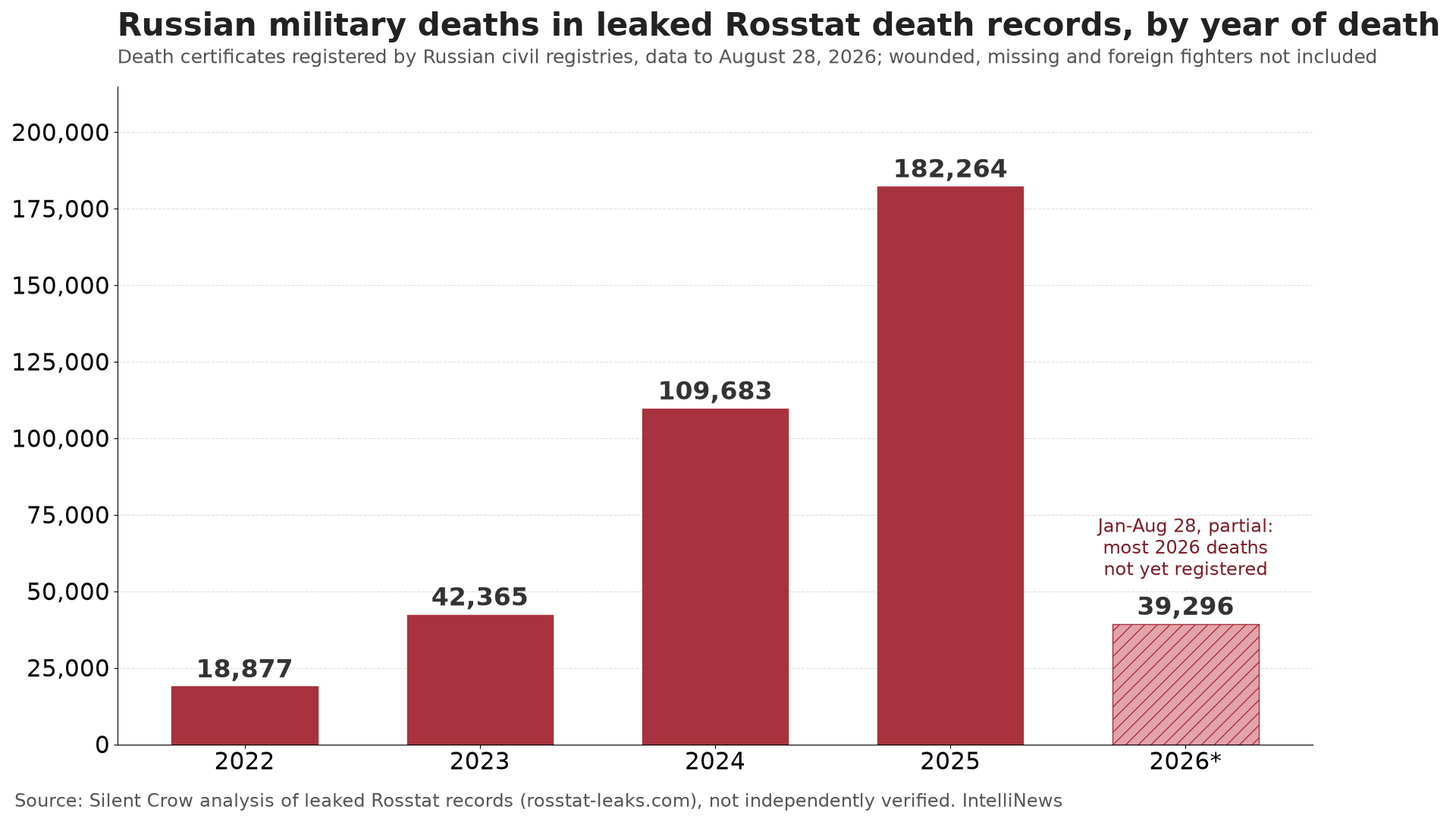
Deaths by year climbed from 18,877 in 2022 to 42,365 in 2023, 109,683 in 2024 and 182,264 in 2025, the dataset shows. The 39,296 logged for 2026 is far from complete: by Silent Crow's estimate only 26% of deaths reach the database within a month of death and 69% within six months. The listed yearly figures sum to 392,485, below the headline total of 450,100; the published analysis does not reconcile the difference.

Russian military deaths in leaked Rosstat death records by year of death; 2026 covers registrations to August 28 and is incomplete. Source: Silent Crow analysis of leaked Rosstat records, not independently verified. IntelliNews

New records arrived at 18,280 a month in the six months to late August, 1.26 times faster than a year earlier. Correcting for the registration lag, Silent Crow puts the real toll at about 504,280 by August 28 and at 562,979-596,888 by the end of 2026.

The records place 54.9% of deaths in the occupied Donetsk region, with no place of death given for 17%. By home address, the Volga federal district supplied 21.7% of the dead and the Central district 16.9%, while Siberia and the Far East, home to about a sixth of Russia's population, supplied 26.7%.

The Kremlin's recruitment policies amount to the "extermination of entire nations" for some of Russia's smallest ethnic groups, researcher Maria Vyushkova told The Moscow Times.

Other counts

The register total is well above the 285,881 Russian military dead identified by name as of November 6 by Mediazona and BBC Russian, a count both outlets say is incomplete. Britain's defence ministry said in early September that more than half a million people had died fighting for Russia, The Moscow Times reported. The Moscow Times cross-checked a random sample of 50 names from the Mediazona list against the leaked dataset but could not verify the data in its entirety.

Russia has so far replaced its dead with paid volunteers. Western intelligence estimates put recruitment at 25,000-35,000 a month, and Dmitry Medvedev, who oversees volunteer recruitment, said regions signed up about 200,000 contract soldiers in the first half of 2026. The money is getting tighter: at least 11 regions have cut or scrapped payments to the families of soldiers killed in Ukraine since 2025.

The hackers said they had been inside Rosstat's network for about six months before the attack, which came during a weekend of cyberattacks on Russian state systems. Rosstat acknowledged attacks between October 29 and November 1 but said no data had leaked, then reported disruption to some services and extended deadlines for submitting statistics.

"This represents around half a percent of Russia's working-age population of 80 million people," Janis Kluge, head of the Russia and Eurasia division at the German Institute for International and Security Affairs (SWP), told The Moscow Times, adding that the economic effect may be small.

"But the main significance is political," he said. "It's about who is winning this war and you cannot say Russia is winning this war if it is losing population at this rate."


Bangladesh garment strike hands India an opening it is ill-placed to seize

Bangladesh garment strike hands India an opening it is ill-placed to seize
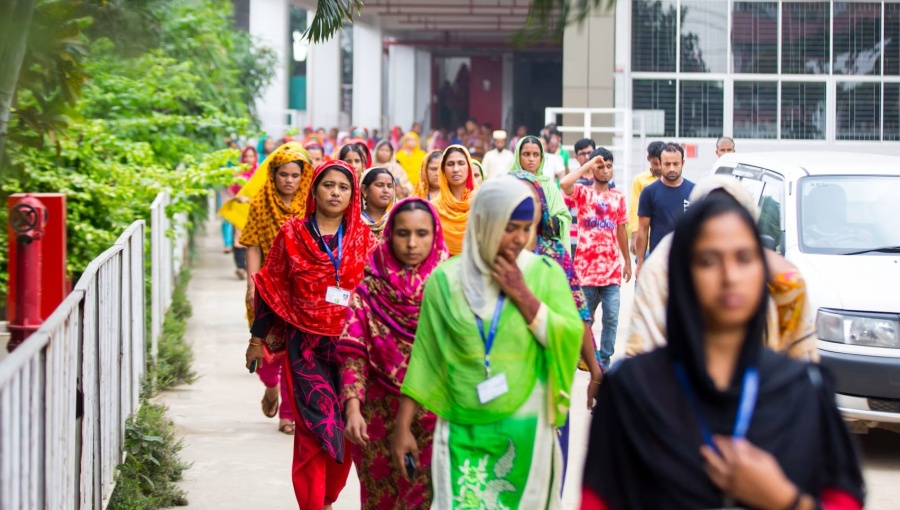
Garment workers leaving a factory in Bangladesh / Shanjir H | Photo4life AU - UnsplashFacebook
By Mark Buckton in New Taipei November 8, 2026

A week of wage strikes that stopped about 690 Bangladeshi garment factories in the peak ordering season has handed India's clothing exporters an opening in Western markets.

Workers walked out on October 31 to demand a monthly minimum wage of BDT30,000 ($241), against the BDT12,500 set in late 2023. Production had halted at about 690 factories by November 2, with industry sources putting the number of workers affected above 1.7mn. The protests carried on even after the government agreed on November 4 to bring in a new pay structure in December.

Buyers have reason to look elsewhere because of the timing. November and December are the months when Western retailers place their heaviest orders, and a factory that misses a delivery slot must either keep the goods or fly them out at a cost that "basically erases any profit margins", a former director of sourcing at Zara told the Indian Express on November 7. India, which grows its own cotton, spins its own yarn and has new trade deals with Europe and the UK, is the obvious beneficiary. Its record suggests it will pick up a slice of the business rather than the prize.

An industry Dhaka cannot afford to lose

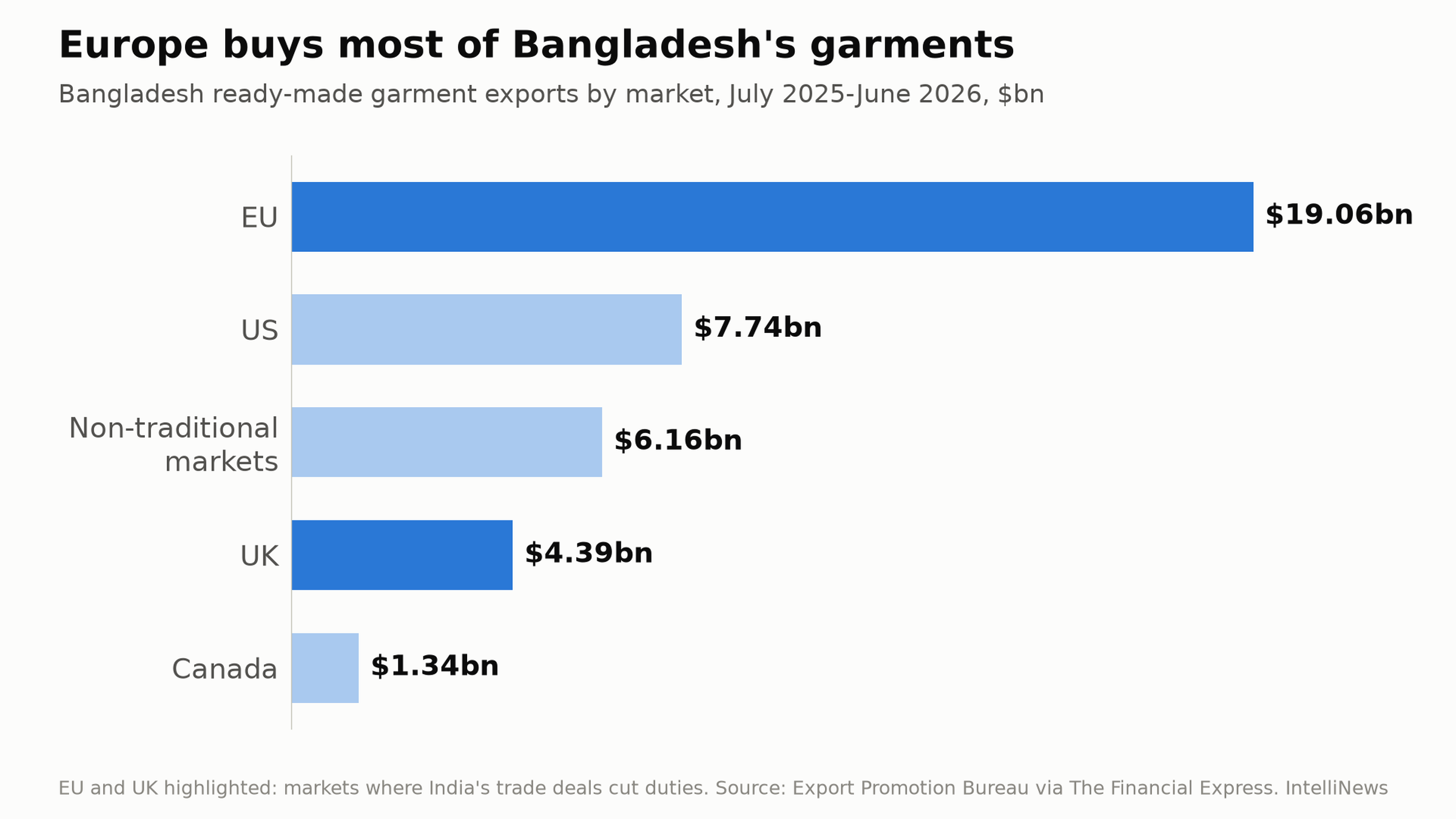
Garments brought Bangladesh $38.7bn in the year to June, down 1.64% on Export Promotion Bureau figures, or about four-fifths of all merchandise exports. The EU took $19.06bn of that, the US $7.74bn and the UK $4.39bn. The sector employs more than 4mn people, and every week of lost output feeds through to foreign exchange reserves of $34.85bn and to the taka.

Bangladesh ready-made garment exports by market, July 2025-June 2026, $bn. Source: Export Promotion Bureau via The Financial Express. IntelliNews

Bangladesh was already losing ground before the strike. Its share of EU clothing imports fell to 21.9% in January-April from 24.4% a year earlier on Eurostat data, and China moved back ahead of it among suppliers to the US over January-August. A summer gas shortage cut output by 30-40% in the main industrial districts, and the Bangladesh Garment Manufacturers and Exporters Association (BGMEA) had to ask buyers for shipment extensions.

Higher pay need not cost Bangladesh its edge, according to Selim Raihan, professor of economics at the University of Dhaka. "Treating cheap labour as the industry's permanent competitive strategy would be a mistake," he told Reuters. "They (Bangladesh) need to move increasingly toward productivity, reliability and higher-value products".

Where India has the edge

India's case rests on owning more of the supply chain. Bangladeshi mills buy in much of their yarn, and India is a leading supplier: imports of cotton yarn under bonded facilities rose 39% to 680mn kg in 2024 as Indian yarn undercut local spinners on price.

Trade policy is moving India's way in Europe. The agreement with the UK took effect on July 15, giving Indian clothing duty-free access on the same terms as Bangladesh. The deal with the EU, concluded in January and expected to enter into force in early 2027, will remove duties of up to 12% that Indian exporters pay while Bangladeshi goods enter free. Indian clothing sales to the EU reached a record $4.66bn in the year to March, government data reported by Apparel Resources show, a quarter of what Bangladesh ships there.

Why the gain may stay small

Scale counts against India. Its share of world apparel exports has stayed at about 3% for two decades while Bangladesh's has risen to 9-10%, according to research by 360 One Capital published in July, which named fragmented garment-making as the industry's biggest weakness. Fragmented production leaves Indian suppliers short of the scale needed to win the largest international orders, the research found.

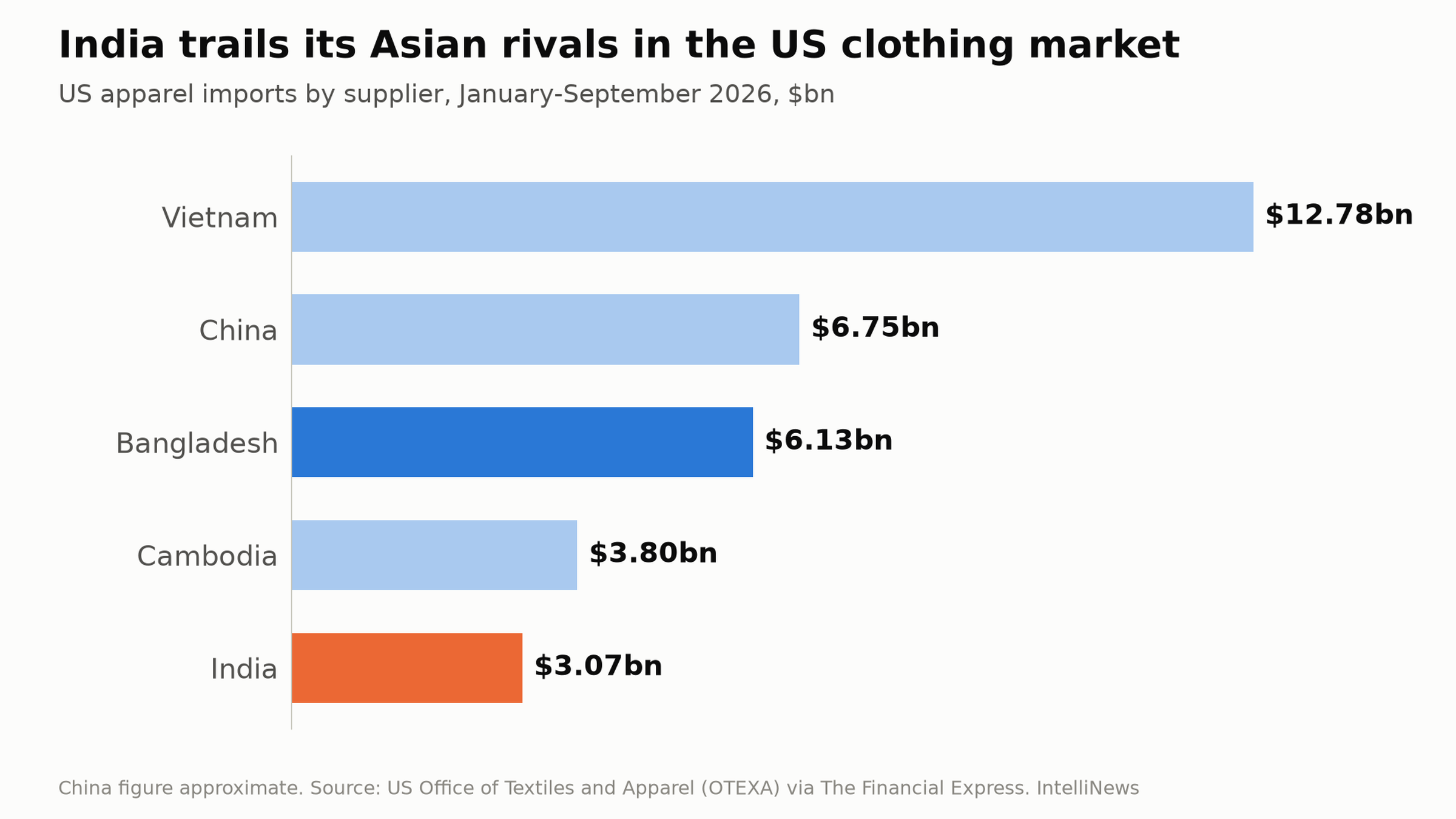
In the US, India's clothing sales fell by more than 25% to $3.07bn in January-September, on US Office of Textiles and Apparel (OTEXA) figures reported by The Financial Express, after authorities raised duties on any items produced in India in August last year. Bangladesh shipped twice as much over the same months, and Vietnam four times as much.

US apparel imports by supplier, January-September 2026, $bn. China figure approximate. Source: US Office of Textiles and Apparel (OTEXA) via The Financial Express. IntelliNews

Bangladesh's duty-free access to Europe rests on its status as a least developed country, which it was due to lose on November 24 this year. The UN General Assembly pushed that back to November 24, 2029, The Financial Express reported on October 30, which leaves the price gap in Dhaka's favour for three more years.

Relations between the neighbours have soured since Sheikh Hasina fled to India in 2024: New Delhi ended a transshipment facility for Bangladeshi cargo in April 2025 and restricted imports of Bangladeshi garments to two seaports a month later. Home Minister Salahuddin Ahmed blamed the banned Awami League and said some were trying to destabilise the country "at the behest of forces across the border". Indian External Affairs Ministry spokesman Randhir Jaiswal kept to a single line: "We have been following the situation in Bangladesh."

A rival's loss is also a customer's loss for India. Indian spinning mills that sell yarn to Bangladeshi factories gain nothing from idle Bangladeshi looms, and Vietnam, with a faster supply chain, is just as well placed to take the urgent orders.

The strike is the latest in a run of shocks to Bangladesh's biggest industry, from the wage board formed under pressure on November 1 to the gas shortage and the slide in Europe and the US, and each has sent buyers to test the alternatives. India can expect a hearing from those buyers. Turning it into orders depends on garment capacity it is only now building, and on a European deal that has yet to enter into force.


COMMENT: Is China pulling the strings behind Paraguay’s troubles to turn Asuncion against Taiwan?

COMMENT: Is China pulling the strings behind Paraguay’s troubles to turn Asuncion against Taiwan?
Nothing currently shows that Beijing brought down Santiago Peña, but the fall of Taiwan's most loyal friend in South America reopens a question China has spent three years preparing to answer. / Alan Martinez - UnsplashFacebook
By Mark Buckton in New Taipei November 9, 2026

Paraguay has lost Taiwan's most prominent champion in Latin America in a bank scandal, creating an opening China may seek to exploit.

The Senate removed President Santiago Peña on November 6, days after the central bank seized Ueno Bank, a digital lender whose owner, Grupo Vazquez, had counted Peña as a business partner until 2025. The bank's board had voted on November 2 to put Ueno into resolution once its solvency ratio fell below half the legal minimum.

The lower house voted 78-0 to impeach him moments after he offered to resign on November 5, and prosecutors have since questioned him on suspicion of breach of trust and influence peddling. Peña, who sold his stake in Ueno's holding company in 2025, has said he will co-operate with investigators.

Peña made three state visits to the island and told the UN General Assembly in September that Taiwan deserved "full and meaningful participation" in the United Nations. Paraguay has recognised Taipei since 1957 and is now its only diplomatic partner in South America and one of 12 worldwide. His removal does not end that relationship, but it leaves it in the hands of a ruling party reeling from scandal, with a general election due in 2028.

China has applied pressure over Paraguay’s Taiwan ties, but this is not evidence of involvement in Peña’s removal. Beijing sanctioned Paraguay's information technology minister, Gustavo Villate, in October over Taiwan, barring him from China and Chinese organisations from dealing with him. In December 2024 Asuncion expelled Xu Wei, a Chinese official in the country for a UNESCO meeting, for interfering in its internal affairs after he urged lawmakers to drop Taiwan; Beijing called the charge unfounded. Reuters counted at least 19 Paraguayan lawmakers and five journalists who had visited China since late 2023, on trips participants said came at the invitation of the Chinese consulate in Sao Paulo.

After Peña's visit to Taipei in May, Beijing's language turned personal.

"Relevant Paraguayan political figures not only turn a blind eye to it, but also blatantly visit Taiwan to endorse Lai Ching-te and his like in defiance of global criticism and willingly serve as chess pieces for" what it called "Taiwan independence" separatist forces, foreign ministry spokesperson Guo Jiakun said on May 12. "The wheels of history wait for no one."

Yet none of that shows Beijing brought Peña down. The rot at Ueno was exposed in Asuncion: the banking association demanded in October that the central bank disclose the solvency of lenders it had helped through mergers, and the first senators to ask hard questions about the bank were loyal to Peña's estranged mentor, former president Horacio Cartes, the Associated Press reported. The charges against Peña turn on public money parked at a connected lender, including about $355mn from the IPS state pension fund, and on his choice of Carlos Carvallo, who had run Ueno's predecessor finance company, as central bank governor. No investigator or lawmaker has alleged a Chinese role.

China is a beneficiary, not a demonstrable cause, and the economics explain why it can afford to wait. Chinese suppliers already provided 36% of Paraguay's imports in the first half of 2026, more than any other country, without any diplomatic relationship. What Paraguay cannot do is sell directly to China. Its beef, which earned $2.1bn in 2025, and its soy reach Chinese buyers only through third countries, while Taiwan bought $288mn of Paraguayan beef that year. Local research centre CADEP has found the Taiwan tie delivers only modest economic gains, Reuters reported in March.

Pedro Alliana, Peña's vice president, now serves out the term to August 2028 and has signalled no change. He called Paraguay and Taiwan "brotherly peoples" in October, ABC Color reported, and Taiwan's foreign ministry said on November 6 that the turmoil would not affect relations. But Alliana is himself under investigation over Ueno, and he paused his own bid for the Colorado nomination when the bank failed.

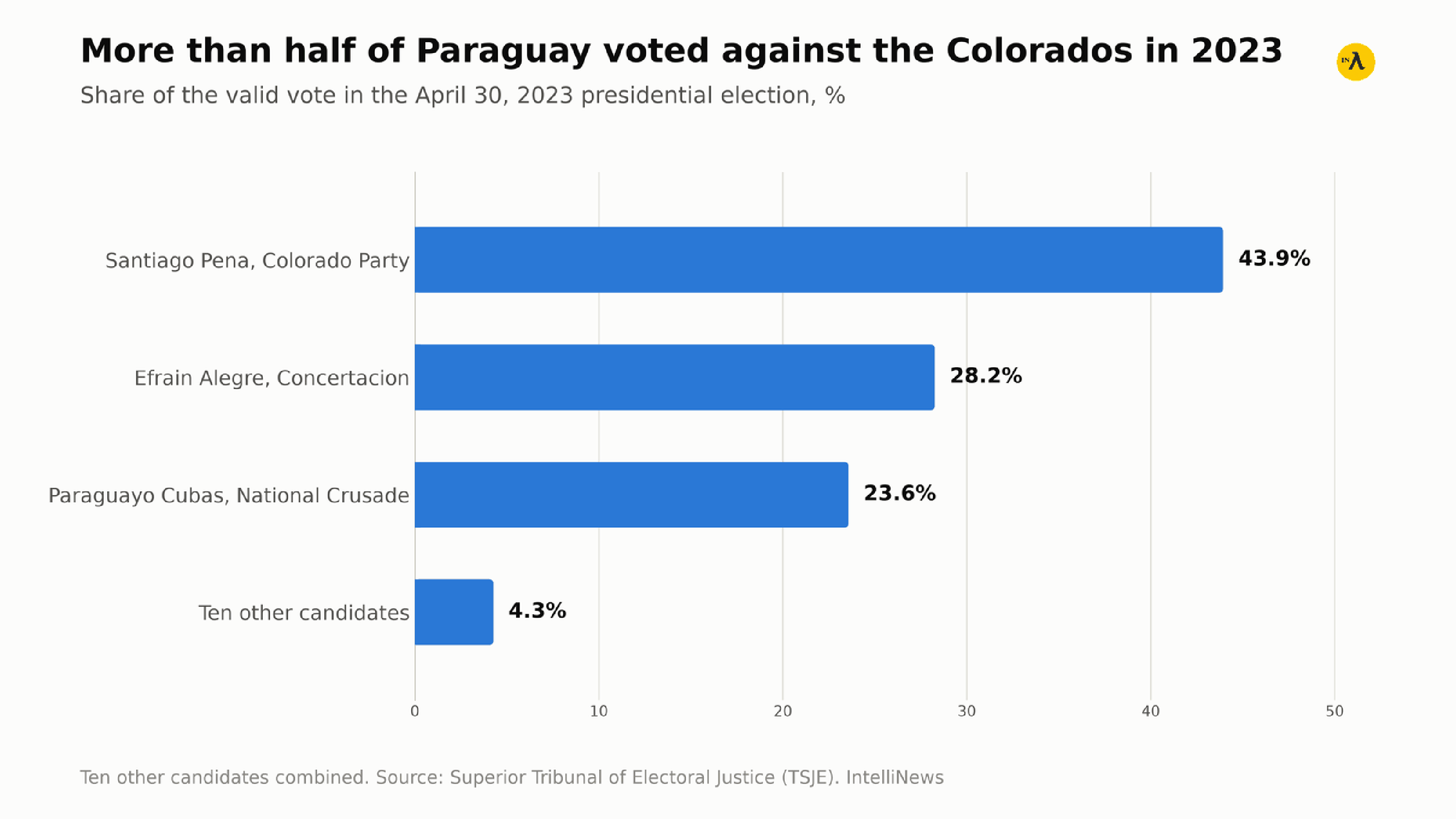
The opposition leans the other way. Efrain Alegre, runner-up in 2023 with 28% of the valid vote, campaigned on reassessing the Taiwan tie in favour of Beijing to open China to Paraguayan cattle and soy. Paraguayo Cubas, whose anti-establishment National Crusade took almost 24% on a campaign against corruption, has no clear public line on Taiwan. Between them, the challengers won more than half the vote.

Some opposition lawmakers who have toured China are blunter. "We must not miss our chance," Liberal deputy Billy Vaesken, who spent 15 days there in late 2024, told Reuters. Beijing, for its part, says nearly 90% of Paraguayans back ties with China, citing a poll it has not named.

Share of the valid vote in Paraguay's April 30, 2023 presidential election. Source: Superior Tribunal of Electoral Justice (TSJE). IntelliNews

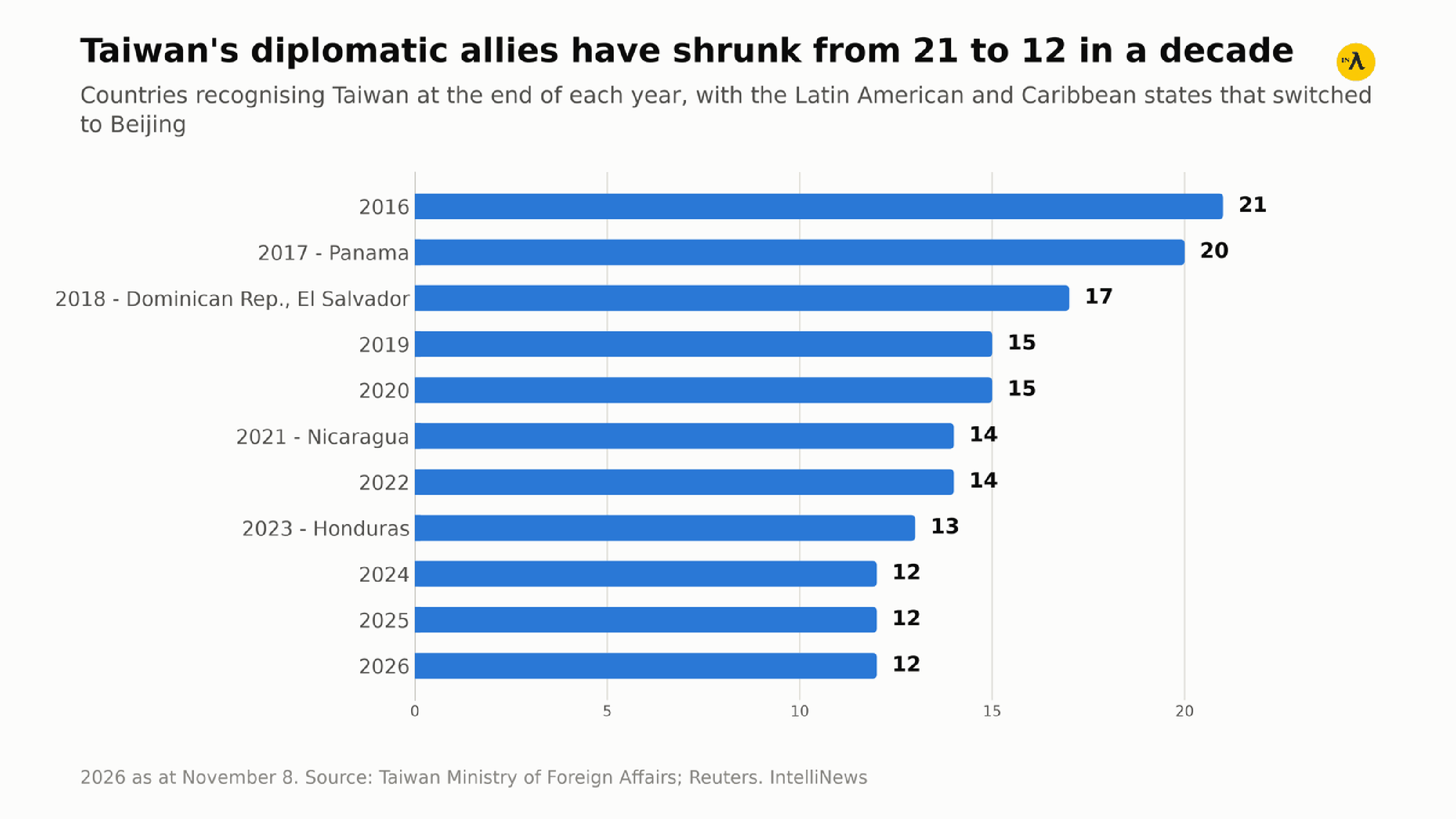
Paraguay would be following a well-worn path. Panama, the Dominican Republic, El Salvador, Nicaragua and Honduras all switched to Beijing after sustained courting, and Taiwan's allies worldwide have fallen from 21 at the end of 2016 to 12. The pattern invites the view that Latin America is being drawn into Beijing's orbit one capital at a time.

Countries recognising Taiwan at the end of each year, 2016-2026. Source: Taiwan Ministry of Foreign Affairs; Reuters. IntelliNews

That view overstates Beijing's grip. Paraguay signed a defence pact with the US in January, Honduras's new president, Nasry Asfura, has weighed reversing his predecessor's 2023 switch, and Asuncion's recognition of Taipei still blocks any China-Mercosur trade framework. Influence in the region is contested, not settled.

China did not need to engineer Peña's fall to gain from it. Its approach in Paraguay has been to make the case for switching to every politician, exporter and journalist who will listen, then wait for a government weak enough to act on it. If the Colorados go into the 2028 election as badly damaged as they look this week, the next government may be the one.

Paraguay crisis threatens emerging uranium ambitions

President Santiago Peña in his televised resignation speech. (Screenshot from France24 | YouTube.)

Paraguay’s emerging mining industry faces fresh political uncertainty after President Santiago Peña resigned Thursday amid a banking crisis, raising questions about the future of US-backed investments in the country’s largely untapped titanium and uranium resources.

Peña stepped down after the collapse of Ueno Bank, a major digital lender linked to his government, triggered widespread protests, froze millions of depositors’ savings and cost him the support of the long-ruling Colorado Party.

Minutes after his announcement, the lower house voted 78-0 to impeach him, sending the charges to the Senate. Lawmakers also moved to consider his resignation, opening a path for Vice-President Pedro Alliana to assume power without a Senate trial.

The upheaval comes as Paraguay seeks to transform its modest mining industry into a destination for foreign investment, particularly in minerals considered strategically important to the US. The leadership change introduces uncertainty over the implementation of recently announced bilateral agreements and the investment climate for exploration companies.

US minerals push

Paraguay has strengthened its minerals relationship with Washington this year, signing a memorandum of understanding on critical minerals followed by an agreement on civilian nuclear cooperation in August.

The diplomatic push continued in October when US Deputy Secretary of State Christopher Landau visited Paraguay with a trade delegation. The visit included announcements of new investments in uranium development and energy infrastructure, signalling growing US interest in the country’s mineral potential.

Among the companies with a foothold in Paraguay is Uranium Energy Corp. (NYSE-AM: UEC), which owns the Alto Paraná titanium project in the country’s east.

The project hosts an inferred resource of 3.58 billion tonnes grading 7.31% titanium dioxide (TiO₂), alongside an indicated resource of 70 million tonnes grading 7.6% TiO₂, according to the company’s technical disclosures.

A preliminary economic assessment outlined a base-case after-tax net present value of $419 million, using an 8% discount rate, and an internal rate of return of 21%. The proposed operation would produce high-titanium slag and high-purity pig iron, with access to nearby hydroelectric power potentially reducing operating costs and emissions.

Víctor Fernández, president of the Paraguayan Chamber of Mining (CAPAMI), described the country as a relatively unexplored mining frontier in an October interview with Global Americans.

Fernández, who also serves as UEC’s Paraguay country head, identified the Yuty and Coronel Oviedo uranium projects, alongside Alto Paraná, as significant developments in the country’s mining pipeline.

He said uranium, rare earth elements, nickel, niobium and gold are among the minerals that warrant further exploration, while lithium and platinum-group elements may also be present in favourable geological settings.

Investment challenges

Despite its geological potential, Paraguay remains a minor mining jurisdiction compared with established South American producers such as Chile, Peru and Argentina.

Fernández said the country needs regulatory reforms to translate geological discoveries into commercial production, particularly by simplifying permitting and improving legal certainty for investors.

A new mining code is being drafted to improve the investment climate. CAPAMI has advocated longer exploration periods, royalties based on profits and legal guarantees designed to support projects throughout their operating lives.

The country has considerable deficiencies in geological information, as only approximately 4% of its territory has been mapped in detail. This lack of detailed mapping restricts the information available to companies that are evaluating potential mineral deposits.

Gold mining is concentrated mainly in the Paso Yobai district of Guairá department, where artisanal and small-scale operations provide employment and income. The sector also faces environmental and public health challenges, including the use of toxic substances in mineral processing.

Paraguay has sought to attract exploration capital through a relatively low corporate tax rate and investment incentives, while its extensive waterways offer access to international markets.

Alto Paraná titanium project. (Screenshot from Uranium Energy Corp.)

The Paraguay and Paraná rivers connect the landlocked country to Atlantic ports, providing potential export routes for future mineral production.

Another advantage is its electricity supply, generated almost entirely from renewable sources, principally the Itaipú and Yacyretá hydroelectric dams. Access to low-emissions power could appeal to companies developing energy-intensive mineral processing operations.

Still, the country’s limited mining infrastructure, early-stage exploration sector and lack of an established large-scale production history present challenges independent of the political crisis.

The ongoing political crisis adds a further consideration for investors assessing long-term projects that require stable regulations, sustained financing and government support.

There is no indication of halted existing mining developments or suspended agreements with Washington. However, the transition leaves the incoming administration responsible for maintaining those relationships while restoring confidence in the country’s financial and political institutions.