Tuesday, November 10, 2026

Bangladesh: Insecure Minorities – Analysis


Hindu Dhakeshwari Temple in Dhaka, Bangladesh. Photo Credit: Kuruman, Wikipedia Commons


November 10, 2026

SATP

By Shivangi Sharma


Key Takeaways:

A series of October–November 2026 killings, temple vandalisms, looting and shrine attacks targeted Hindus, Sufis and Bauls across multiple Bangladeshi districts.

Human Rights Support Society data show attacks on religious minorities rising sharply in 2026, with 50 incidents in the first half of the year versus 10 in the same period of 2025.

The insecurity stems from overlapping political instability after the 2024 uprising, religious intolerance, disputed classifications of “communal” violence, and weak law-enforcement accountability.


On November 4, 2026, a 50-year-old man, Zahed Bepari, was hacked to death inside a Sufi Shrine in the Charkewar Union of the Munshiganj Sadar Upazila (Sub-District) in Munshiganj District.

On October 27, 2026, a Hindu barber, Rabindra Monirishi (43), was stabbed to death in the Noman Gate area of Jamirdia in the Bhaluka Upazila of Mymensingh District.


On October 26, 2026, three homes belonging to Hindu families were vandalised and looted in the Pirganj Upazila of Rangpur District over a Facebook post that purportedly hurt the religious sentiments of Muslims. The owners of the affected houses are Bishu Chandra Mohanta, 50; his elder brother Jagadish Chandra Mohanta, 60; and their younger brother Dinesh Chandra Mohanta, 46, all residents of Chak Karimpur Village. According to the Police, Bishu’s son, Saurav Chandra Mohanta, 22, who works at a garment factory in Gazipur, shared a video on Facebook several months ago, which allegedly hurt Muslim religious sentiments.

On October 25, 2026, a Hindu school teacher named Monoranjan Roy (55) was beaten to death while trying to resolve a dispute at a friend’s house in the Parbatipur Upazila of Dinajpur District.

On October 21, 2026, a domestic Baul song festival – scheduled for October 22, 2026 – was not allowed to be held, in Hatia Village of the Kulonj Union in the Dirai Upazila of Sunamganj District. Radicals raised objections that ‘obscenity’ could occur in the name of songs.


On October 19, 2026, Police recovered and defused an improvised explosive device (IED) from the premises of the Fakir Lalon Shah Shrine in the Kumarkhali Upazila of Kushtia District.

On October 11, 2026, a theft took place at the Hindu Radhamadhav Akhra Central Temple in the Akhaura Upazila of Brahmanbaria District. Unidentified miscreants broke into the temple, cutting the grill, and stole six idols as well as gold and silver ornaments.

On October 8, 2026, the Hindu Khayerchara Matri Temple in Ward No. 9 of the Kumarkhali Municipality in Kushtia District was vandalised. Artisans found the heads of the Ganesh and Lakshmi idols and some parts of Durga’s vehicle – the lion – broken. Police stated that the incident was being investigated in light of a dispute over the temple committee and a land dispute.

On October 6, 2026, Police recovered the burnt body of a Hindu businessman, Suprabhat Modak, from a turmeric field in Ward No. 6 of the Ahmedpur Union under the Aminpur Police Station in the Bera Upazila of Pabna District, a day after he went missing.


Human Rights Support Society (HRSS) data indicates that attacks and incidents affecting religious minorities increased in 2026, suggesting a deterioration in security. HRSS’ annual reports recorded 12 temples and 16 houses partially or fully destroyed, with 48 minority individuals injured in 28 incidents in 2022. In 2023, HRSS documented 27 attacks on minorities, 43 persons injured, damage to 17 temples and 31 idols, and attacks on 25 houses. Its 2024 report recorded 112 incidents targeting minority communities, with two people killed and 83 injured, alongside damage to 28 temples, 31 idols, 284 homes and 240 shops and business establishments. In 2025, HRSS reported 28 incidents involving religious and ethnic minorities, one death and 16 persons injured, while more than 56 shrines were reportedly attacked, vandalised or looted. The trend worsened in the first half of 2026: HRSS documented 50 attacks on religious minorities, compared with 10 during the corresponding period in 2025; persons injured increased from four to 56. The recent HRSS report covering July to September 2026, documented at least six attacks on minority communities, leaving six people injured, while two temples, five idols and four homes were vandalised.


Attacks on minorities surged during the political transition of 2024, blurring the distinction between communal violence and political retaliation. Following former Prime Minister Sheikh Hasina’s departure, attacks on minority homes, businesses and places of worship generated widespread concern, particularly because Hindus had often been perceived as politically aligned with the Awami League. On August 8, 2024, Meenakshi Ganguly, Deputy Asia Director, Human Rights Watch (HRW), stated,


Rioters burned down historical structures and targeted members of Hasina’s Awami League party. In several districts around the country, members of the Hindu community, which is generally considered to have largely backed the Awami League, were violently attacked, their homes torched, temples vandalised, and shops looted. There were also reports of attacks against the Ahmadiyya Muslim community and ethnic minorities.

The United States Commission on International Religious Freedom (USCIRF), in its annual report, 2026, noted


Bangladesh was the site of several concerning blasphemy cases in 2025. In February, authorities arrested poet Sohel Hasan Galib for “hurting religious sentiment.” Police arrested a Hindu man the following month for allegedly insulting the Prophet, leading to his conviction and sentencing to an indeterminate length of time in prison. Authorities arrested a university student in October on charges of desecrating a Qur’an; a mob surrounded his home after videos circulated on social media accusing him of the act. In November, police arrested a Baul singer on allegations of blasphemy and hurting religious sentiment during a musical performance. In December, a mob in Dhaka, Bangladesh, lynched a Hindu man, tied his body to a tree, and set it on fire following rumours he made blasphemous comments insulting the Prophet Muhammed.

On January 19, 2026, a Facebook post by the Chief Adviser’s Office stated that investigations identified 645 incidents involving minorities in 2025, but classified only 71 as communal, labelling the remaining 574 as non-communal. However, on January 28, 2026, the Bangladesh Hindu Buddhist Christian Unity Council (BHBCUC) challenged this classification, reporting 522 incidents of communal violence in 2025. This divergence between the figures published by the BHBCUC and those released by the Interim Government reflects a deeper lack of trust between minority rights organisations and state authorities over the assessment of communal violence. BHBCUC Acting General Secretary Monindra Kumar Nath observed, “The official definition of communal violence appears to exclude killings, rapes, arson attacks on homes, land grabbing and targeted assaults unless they occur inside temple premises.” Nath, however, added, “We still place our hope in the Election Commission and the government… but past experience has repeatedly disappointed us.”


In one of the major incidents this year, on August 22, 2026, a Hindu family of four, including retired Rangpur Zilla School teacher Ganapati Chakraborty, 65; his wife, Pritilata Chakraborty, 50; their daughter, Agami Chakraborty Prarthi, 23; and their son, Priyam Chakraborty, 12, were found murdered in their home in the Daspara area of Rangpur District. Police initially indicated that robbery might have been involved, but on August 26, 2026, Bangladesh National Hindu Mahajot Secretary General Govinda Chandra Pramanik alleged that the high-ranking figures in the administration were trying to cover up the killings in Rangpur by blaming the Hindu community for the incident.

On October 10, 2026, Police detained four persons identified as ANM Ayas (29), President of the Rashtra Sanglap Forum; Mohammad Sakibul Hasan (19); Mohammad Sujon Mia (18); and Marzia Khandaker Rimi (27), while they were attempting to smear black ink on a graffiti portrait of Rabindranath Tagore on a pavement wall in front of the Bangladesh Shilpakala Academy at Segunbagicha in Dhaka. Rimi asserted, “We have come to protest against Indian aggression.” This incident may not directly constitute an attack on religious minorities. However, according to the case documents, the case was filed under sections 120B, 153A and 295A of the Penal Code, relating to criminal conspiracy, promoting enmity between classes and inciting religious hatred. Further, the Police forwarding report submitted to the court noted,


On October 9, Ayas announced that he would erase the mural on the boundary wall by whitewashing it… The next day, Ayas and the other accused went to the spot. Accused Rimi smeared black ink over the mural depicting Nobel laureate poet Rabindranath. She also attempted to incite religious hatred in connection with the upcoming Durga Puja, thereby creating discord and undermining communal harmony.

On October 15, 2026, the Bangladesh Puja Udjapan Parishad reported 34 incidents of idol vandalism, attacks on temples and related violence ahead of Durga Puja, adding that arrests had been made in 11 of the cases. Santosh Sharma, General Secretary of the Parishad, noted, “Security cannot be a concern for only the five days of Puja. We must ensure security for all 365 days of the year.”

The insecurity faced by religious minorities in Bangladesh cannot be attributed to a single cause, but rather to overlapping dynamics of political instability, religious intolerance, competing narratives of national identity, local disputes and weaknesses in law enforcement, specifically after the July 2024 uprising. The fall of Sheikh Hasina’s government in August 2024 created a period of political uncertainty and a vacuum in which attacks on minority communities became a prominent concern. The uprising complicated the situation of minority communities, as they were linked to Awami League politics, leading to questions of national loyalty. The ambiguity highlighted in the data on attacks on minority communities adds to the insecurity of the minority community. Current trends underscore both the continuing vulnerability of these communities and the need for effective protection and accountability from the administration and law enforcement agencies.


About the author: 
Shivangi Sharma, Research Assistant, Institute for Conflict Management

Source: This article was published by SATP

About SATP
SATP, or the South Asia Terrorism Portal (SATP) publishes the South Asia Intelligence Review, and is a product of The Institute for Conflict Management, a non-Profit Society set up in 1997 in New Delhi, and which is committed to the continuous evaluation and resolution of problems of internal security in South Asia. The Institute was set up on the initiative of, and is presently headed by, its President, Mr. K.P.S. Gill, IPS (Retd).
View all posts by SATP →
Lebanon: Background And U.S. Relations – Analysis


US President Donald Trump welcomes Lebanon's President Joseph Aoun to the White House. Photo Credit: White House, X


By Clayton Thomas and Jim Zanotti


Key Takeaways:

The June 2026 U.S.-brokered Trilateral Framework for sequenced Hezbollah disarmament and Israeli withdrawal from Lebanon has stalled beyond two pilot zones, with talks ending inconclusively by late October.

Hezbollah remains weakened yet refuses to disarm while retaining residual capabilities and support; Israeli forces continue operations and hold a southern buffer zone covering about 5% of Lebanese territory.

Lebanon’s post-2025 government has advanced some IMF-linked financial reforms, but deep economic contraction, political risks of confronting Hezbollah, and ongoing conflict continue to limit recovery.


Lebanon, the second-smallest country in the Middle East by size, has at times attracted U.S. and international attention as an arena for regional competition and conflict involving Israel and Iran. Lebanon’s diverse and complex religious demographics have fueled domestic political contention and foreign military interventions. The Iran-backed Shia Islamist group Hezbollah, a powerful Lebanese militia and political party and U.S.-designated foreign terrorist organization, has for decades been one of the most prominent concerns of U.S. policy.

Clashes between Israel and Hezbollah since 2023 have impacted Lebanon’s society and its U.S.-supported government. That government took office in 2025 after Hezbollah suffered losses in armed clashes with Israel. U.S. officials have hailed some of the Lebanese government’s actions while pressing it to move more quickly and decisively to disarm Hezbollah. Hezbollah evidently retains some military capabilities and popular support, and it has refused to disarm as demanded by the Lebanese government.


In June 2026, Lebanon and Israel signed a U.S.-brokered Trilateral Framework in which they agreed to restore Lebanese government sovereignty “pending the verified disarmament of non-state armed groups … enabling the Israel Defense Forces (IDF) to progressively redeploy out of the Lebanese territory” beginning in designated pilot zones. As of late October 2026, the process appears to be at something of a standstill: implementation of the Framework has not expanded beyond the initial pilot zones, and an eighth round of Lebanon-Israel talks in October 2026 ended inconclusively.

Hezbollah’s refusal to disarm and its characterization of its weapons as necessary to defend Lebanon’s interests against Israel raise the prospect of further civil conflict and foreign intervention in Lebanon. Lebanon’s history has been marred by conflict, as it has struggled to define its national identity since its separation from Greater Syria and establishment as a French-controlled territory after the First World War. At that time, Lebanon’s population included Christian and Muslim communities of roughly comparable size with competing visions for the country. Seeking to avoid sectarian conflict, Lebanese leaders created a confessional system that allocated power among the country’s religious sects according to their percentages of the population. Since then, Lebanon’s demographics and political dynamics have shifted, exacerbating tensions among groups. Sectarian divisions have sometimes stoked violence, such as during the 1975-1990 civil war, as well as periods of stalemate regarding government formation and action. Lebanon’s divisive political dynamics have intensified with Iranian backing for Hezbollah and multiple Israeli military interventions.


Congress has, at times, helped to shape U.S. policy toward Lebanon, including through the authorization of sanctions and the appropriation of various forms of assistance. For two decades, the United States has sought to bolster the Lebanese Armed Forces (LAF), providing more than $3 billion in military assistance since 2006 with the aim of creating a national force strong enough to counter nonstate actors such as Hezbollah and to secure the country’s borders. The United States has sanctioned Hezbollah and its supporters, as well as other Lebanese actors (including several former Lebanese officials) engaged in activities deemed inimical to U.S. interests such as corruption and drug trafficking. Beyond sanctions and security assistance, the United States has also provided development and humanitarian assistance. Since 2019, Lebanon has undergone the worst economic crisis in its history, with a severe contraction in gross domestic product (GDP) and subsequent rise in poverty rates. Political paralysis after 2022 and recurrent conflict since 2023 have impaired economic recovery. The country’s post-2025 government has undertaken some financial reforms in efforts to secure international assistance, but progress on other International Monetary Fund–sought measures has been uneven.

Location of Lebanon. Credit: Wikipedia Commons

While U.S. officials have hailed direct Israel-Lebanon engagement, fundamental problems persist related to the sequencing and means of possibly disarming Hezbollah, which is weakened but apparently still formidable. Lebanese actors across the political spectrum, including some vociferously opposed to Hezbollah and supportive of its disarmament, have called for Israeli forces to cease operations and withdraw from the country. Those Lebanese actors charge that Israeli operations undermine the Lebanese government and bolster Hezbollah’s resistance narrative. Lebanese policymakers, however, appear to have less clarity on the specific actions, if any, the Lebanese government would take to disarm Hezbollah if Israeli forces were to withdraw, particularly given apparently widespread determination to avoid the civil strife that could be triggered by militarily confronting Hezbollah.

Overview

Lebanon, the second-smallest country in the Middle East by size, has at times attracted U.S. and international attention as an arena for regional competition and conflict involving Israel and Iran. Lebanon is among the most religiously diverse countries in the Middle East, and its complex religious demographics have fueled domestic political contention and foreign military intervention (including by the United States during the 1975-1990 Lebanese Civil War).
Area 10,230 sq. km (slightly larger than Vermont)
People Population: ~5.3 million (2024 est.)Religions: Muslim 69.3 (32.2% Shia, 31.2% Sunni, with smaller numbers of Alawites and Ismailis); Christian 30.5% (Maronites the largest denomination, with others including Greek Orthodox); Druze 5.5% (2023 est.)
Economy Gross Domestic Product (GDP): $34.5 billion in current prices (2025)GDP per capita: $5,897 in current prices (2025)Top exports / partners: cars, gold/jewelry, scrap iron / UAE, Egypt, United States, Turkey (2024)Unemployment rate: 11.5% (2025)Annual inflation rate: 14.6% (2025)GDP Growth Rate: 4.2% (2025), -6.4% (2026, projected)


In 2026, U.S. policy toward Lebanon has largely developed in response to the resumption of fighting between Israel and the Shia Islamist group Hezbollah (an Iran-backed U.S.-designated foreign terrorist organization, or FTO, and major political actor in Lebanon) in the context of the U.S./Israel-Iran conflict. Fighting between Israel and Hezbollah after October 2023 has resulted in the deaths of thousands of Lebanese and the displacement of hundreds of thousands, straining Lebanon’s already fragile social and political institutions.1

Congress has, at times, helped to shape U.S. policy toward Lebanon, including through the authorization of sanctions and the appropriation of various forms of assistance, some with conditions attached. Some Members have followed—and made public statements about—developments in the country in 2026. Issues of active or potential congressional engagement include U.S. assistance for the Lebanese Armed Forces (LAF); sanctions on Hezbollah or other Lebanese actors; and Lebanese government policies, including relations with Israel, Hezbollah disarmament, and putative or proposed economic reforms.
Background: History and Political System

Lebanon’s diverse population of 5.3 million people includes Christian, Sunni Muslim, and Shia Muslim communities of roughly comparable size.2 Political posts are divided among the country’s various religious groups, or “confessions,” to reflect each group’s share of the population—although no formal census has been conducted in the country since 1932.3 Per the 1943 National Pact, Lebanon’s unwritten governing agreement, the presidency is reserved for a Maronite Christian, the prime minister post for a Sunni Muslim, and the Parliament speakership for a Shia Muslim.


Since its independence from France in 1943, Lebanon has been frequently wracked by upheaval, including a devastating and complex civil war from 1975 to 1990, and military interventions by Syria (which occupied parts of Lebanon from 1976 to 2005) and Israel (which invaded in 1978 and again in 1982, ultimately withdrawing from southern Lebanon in 2000). The United States deployed troops at the request of different Lebanese governments in 1958 and 1982-1984 in efforts to bring greater stability to the country.

Since 2019, when Lebanon’s current economic crisis began (see “Economy” below), Lebanese politics have undergone a series of shifts. A protest movement that began in 2019 in response to tax hikes forced the resignation of the prime minister; his successor resigned following an August 2020 explosion at Beirut’s port (reportedly caused by the ignition of a large volume of improperly stored ammonium nitrate) that killed over 200 people and caused massive damage. Parliamentary elections in 2022 did not result in a clear majority for any political faction, contributing to paralysis on government formation. Then-President Michel Aoun’s term ended in October 2022, leaving the government in a caretaker capacity and the presidency vacant until January 2025.
2025 Presidential Election and Government Formation

After over two years of deadlock, and in the wake of the November 2024 ceasefire that halted fighting between Israel and Hezbollah (see below), Lebanon’s Parliament elected LAF chief Joseph Aoun (no relation to Michel) as president in January 2025. During his leadership of the LAF from 2017 until his election as president, Aoun generally garnered commendations from U.S. officials.4 Aoun is the fourth consecutive Lebanese president to have previously served as head of the LAF. Aoun’s election was seen as buttressing the influence of countries that reportedly supported him, including the United States, France, and Saudi Arabia.5

President Aoun appointed Nawaf Salam (formerly Lebanon’s ambassador to the United Nations and president of the International Court of Justice) to serve as prime minister after a majority of members of Parliament endorsed Salam; Hezbollah had backed another candidate. On February 8, 2025, Prime Minister Salam formed a cabinet, the first supported by an electoral mandate since 2022. For the first time in over a decade, Hezbollah does not appear to have the ability to block government decisions, a development that may reportedly be at least partly due to U.S. insistence.6 Nevertheless, some analysts speculate that Hezbollah could retain some “influence on major security and political decisions” through ministers (including the finance minister) that are associated with Hezbollah or Amal, a Shia party that has often allied with Hezbollah.7 In March 2026, as conflict between Israel and Hezbollah resumed (below), Parliament voted to postpone national elections scheduled for May 2026 until 2028.
Hezbollah-Israel Conflict

The escalation of the decades-old conflict between Hezbollah and Israel in 2026 has resulted in the deaths of thousands of Lebanese and displacement of hundreds of thousands, mostly from the predominantly Shia south of the country, straining Lebanon’s already fragile social and political institutions.14 Major combat operations largely ended in summer 2026, when Israel and Lebanon signed an agreement that envisioned the eventual withdrawal of Israeli forces from the country after the verified disarmament of all non-state armed groups, including Hezbollah. As of November 2026, progress toward implementation of the agreement has stalled.

Background

Opposition to Israel is a core tenet of Hezbollah’s founding ideology, and Hezbollah has regularly acted against Israel in solidarity with Palestinian militant groups in Lebanon.15 For nearly two decades, Hezbollah’s stated objective was to drive the Israel Defense Forces (IDF) from areas in southern Lebanon in which they operated after the 1982 Israeli invasion. In May 2000, Israel withdrew its forces from southern Lebanon, but Hezbollah used the remaining Israeli presence in disputed areas in the Lebanon-Syria-Israel tri-border region to justify its ongoing violence against Israel and its existence as a non-state armed militia.16

Hezbollah has repeatedly threatened and engaged in combat with Israel, including a 34-day war in 2006 in which at least 1,200 people in Lebanon and 158 in Israel were reportedly killed.17 Following that war, UN Security Council Resolution 1701 expanded the mandate of the UN Interim Force in Lebanon (UNIFIL, created in 1978 to confirm the withdrawal of Israeli forces after an earlier incursion into southern Lebanon and slated to cease operations at the end of 2026). UNIFIL’s mandate has included assisting the Lebanese government in establishing “an area free of any armed personnel, assets and weapons other than those of the Government of Lebanon and UNIFIL” between the Blue Line (the UN-demarcated Israel-Lebanon border, which the two countries have not formalized) and the Litani River.18

Nevertheless, Hezbollah continued to operate in this area of southern Lebanon after 2006 amid debates over UNIFIL’s effectiveness: the first Trump Administration argued that the force was “for years … overresourced given the limits on its freedom of movement and access” by Hezbollah, whereas the Biden Administration argued that UNIFIL’s “most effective functions, including its liaison mechanism and patrols along the Blue Line, will provide value even as Hizballah impedes the mission’s freedom of movement and restricts access, preventing full implementation of UNIFIL’s mandate.”19
Post-2023 Conflict and 2024 Ceasefire

In October 2023, Hezbollah began firing into Israel in stated solidarity with Hamas after Hamas led attacks on Israel.20 Hezbollah and Israeli exchanges of fire killed dozens and displaced tens of thousands in Israel and Lebanon.21 In September and October 2024, Israel’s cabinet added a goal of returning evacuated Israelis living in the north to its official war objectives, which had previously focused solely on Gaza; Israeli military activities in Lebanon then escalated significantly. Israeli air operations reportedly killed most of Hezbollah’s leadership, including longtime leader Hassan Nasrallah.22 Israel also orchestrated the explosion of thousands of electronic devices used by Hezbollah members and initiated ground operations in southern Lebanon, and Israeli forces destroyed many Hezbollah weapons caches and tunnel networks.23 Israeli military maneuvers and airstrikes displaced over a million people in Lebanon and left over 4,000 dead as of December 2024, according to Lebanon’s health minister.24 More than 100 Israelis died during the 2023-2024 conflict.25


In November 2024, President Joe Biden announced a ceasefire agreement, including commitments from the Lebanese government to prevent Hezbollah from carrying out attacks against Israel and to deploy 10,000 LAF soldiers in southern Lebanon; a commitment from the Israeli government to halt attacks on targets in Lebanon and withdraw forces from Lebanon within 60 days; and the establishment of a multilateral mechanism to monitor ceasefire implementation.26 A reported U.S. “side letter” to Israel may have expressed U.S. support for Israeli reconnaissance flights over Lebanon and Israeli military action in response to possible ceasefire breaches.27 While Hezbollah fire largely halted after November 2024, Israeli airstrikes and other military operations in Lebanon continued in parallel with a multisided debate over ceasefire compliance, while Israeli forces continued to hold five areas across the Lebanese border.

Even as Israeli operations continued, Lebanese and Israeli military officials convened regularly with U.S., French, and UNIFIL counterparts in “pentalateral” meetings throughout 2025 to review LAF “progress on maintaining the cessation of hostilities arrangements, and the advancing of disarmament efforts.”28

Lebanese officials insisted throughout 2025 that the Lebanese government would “hold the monopoly over weapons in the country.”29 In August 2025, the Lebanese cabinet ordered the LAF to present a plan to bring all arms under state control by the end of the year and endorsed various U.S.-proposed objectives, including “the gradual end of the armed presence of all non-governmental entities, including Hezbollah, in all Lebanese territory.”30 On January 8, 2026, the LAF announced that it had completed the first phase of its plan to bring all arms under state control by controlling all territory from the Litani to the Israeli border “with the exception of territory and positions still occupied by Israel.”31 Israeli Prime Minister Benjamin Netanyahu reacted by calling LAF disarmament efforts “an encouraging beginning, but … far from sufficient” given what he characterized as Hezbollah attempts to rearm.32 UNIFIL reported in December 2025 that it had not seen evidence of Hezbollah’s rearmament.33
Conflict Resumption and June 2026 Trilateral Framework

Citing the February 2026 onset of U.S and Israeli attacks on Iran as well as continued Israeli operations in Lebanon, Hezbollah restarted firing into Israel in early March 2026. In response, Israel launched a large-scale ground offensive that displaced over a million people—around 20% of the country’s population—mostly from the south and other predominantly Shia areas.34 As of October 2026, Lebanon’s health ministry reports over 4,300 people killed since March 2026.35

Days after Hezbollah restarted the conflict, the Lebanese government took the unprecedented step of banning Hezbollah’s military activities, though the LAF chief’s reported inability and/or unwillingness to enforce the decision sparked political contention both within Lebanon and between Lebanon and the United States.36 In early April, the United States and Iran agreed to a ceasefire but made contradictory public statements about its application to Lebanon. Prime Minister Netanyahu authorized direct negotiations with Lebanon days later; they began in Washington on April 14, led by the two countries’ ambassadors to the United States.


In mid-June 2026, the United States and Iran agreed to a memorandum of understanding which included a mutual commitment to ensure “the territorial integrity and sovereignty of Lebanon.”37 Apparently wary of Iran’s assertion of influence in Lebanon, the Lebanese government on June 26 signed a “Trilateral Framework” with Israel and the United States. In that agreement, Lebanon and Israel agreed to a “reciprocal, sequenced process, with clear conditions” to restore Lebanese government sovereignty “pending the verified disarmament of non-state armed groups … enabling the [IDF] to progressively redeploy out of the Lebanese territory” beginning in designated pilot zones; for its part, the United States committed to “rally international partners to actively support the Government of Lebanon in rebuilding the country, repairing infrastructure, restoring the economy, and creating opportunities for prosperity.”38 The first “pilot zone” operations began on July 20 in two areas that encompassed the villages of Froun, Srifa, and Zawtar al-Gharbiya. (The IDF had occupied neither Froun nor Srifa, and the LAF was reportedly already present there39.) Some residents began returning to Zawtar al-Gharbiya on July 24, but with around 85% of the town’s homes destroyed, only 16% of the town’s pre-war population of around 5,000 had resettled as of early September.40

An August 2026 Israel-Lebanon meeting in Rome ended without agreement on the future of pilot zones: Lebanon pressed to expand the pilot zones to new areas, while Israel reportedly insisted on the completion of unspecified verification measures in the initial zones.41 It remains unclear who could verify Hezbollah’s disarmament in the pilot zones (reportedly Britain, Italy, Switzerland, and Indonesia have been identified as potential contributors to a verification mechanism) and how they will do so amid disagreements over access to private homes.42

As of October 2026, the process appears to be at something of a standstill: implementation of the framework has not expanded beyond the two initial pilot zones, and the eighth round of talks in October ended inconclusively. U.S. and Israeli officials reportedly view Lebanese government actions as of September 2026 as “insufficient.”43
Current Assessment

As of November 2026, Israeli forces have continued to conduct operations throughout southern Lebanon and have established three new fortified positions there during 2026 fighting.44 Israeli objectives in the 2026 conflict apparently included the creation of a buffer zone in southern Lebanon to reduce Hezbollah threats to Israel (including cross-border anti-tank fire) and the exertion of pressure on Lebanon’s government and military to marginalize Hezbollah—both politically and militarily—and disrupt the group’s sources of weapons and funding. To date, the Israeli buffer zone comprises around 5% of Lebanon’s territory.45 Israeli Defense Minister Israel Katz claimed in October 2026 that the IDF had destroyed roughly 60 villages and 23,000 homes in southern Lebanon;46 the IDF reportedly discovered weapons caches in some homes.47 Following allusions by Katz in August to the razing of southern Lebanese villages and preparations for a “long-term” IDF presence in the area, Lebanese Prime Minister Salam termed Israeli actions “systematic destruction” that violates international law. At the same time, an unnamed State Department official was quoted as saying that a permanent Israeli military presence in southern Lebanon “is not consistent with the commitments made in the framework or the long-term peace and security of both states.”48


Hezbollah remains entrenched in parts of Lebanon and may be more capable in some respects than the LAF.49 It remains unclear how, if at all, the conflict has impacted the level of support for Hezbollah within the Shia community. During the 2026 conflict, a sign of Hezbollah’s resilience has been its use of drones featuring fiber optic cables resistant to electronic countermeasures, which have presented security challenges for Israeli troops and areas of Israel a few miles over the border.50 In early October 2026, Lebanese authorities seized hundreds of kilograms of explosives that a Hezbollah MP said belonged to the group and detained two of the group’s members while bringing charges against several more. In a November 5 joint statement, the several countries’ embassies in Beirut, including the United States, encouraged “a swift, independent judicial process, free from political interference.”51
Economy and Potential Reforms

Lebanon was once a relative economic success story, boasting a higher per capita gross domestic product (GDP) than any other non-oil-exporting Arab state in the Middle East as recently as 2019. That year, long periods of high government borrowing, slowing remittances from abroad, and a decline in foreign financial support culminated in a financial collapse as banks shuttered, the currency lost most of its value, and Lebanon defaulted on its foreign debt.52 A study by a UN special rapporteur stated, “The collapse of the Lebanese economy was avoidable.… [E]conomists and financial experts had warned about the impending crisis since at least 2015. Such warnings were willfully ignored by the political leadership.”53

Compounded by the COVID-19 pandemic, the crisis shrank nominal GDP from nearly $55 billion in 2018 to less than $20 billion in 2021, with a slight recovery in subsequent years. The government responded by reducing or eliminating subsidies on essential goods, and a lack of foreign exchange to finance imports triggered shortages of medicine, water, and fuel. According to the World Bank, the percentage of Lebanese experiencing multidimensional poverty (an index that includes non-monetary indicators such as access to clean water and electricity) increased from 42% in 2018/2019 to 73% in 2022/2023.54


The pressures associated with conflict and resulting displacement have exacerbated these conditions for many Lebanese since 2023. The World Bank estimates that GDP contracted by 7.1% in 2024, with Lebanon suffering $7.2 billion in economic losses and $6.8 billion in physical damage from conflict since October 2023.55 The economy rebounded by around 4% in 2025 but is again projected to contract by 6.4% in 2026 due to the resumption of conflict.56

Lebanon signed a staff-level agreement with the International Monetary Fund (IMF) in April 2022 to obtain $3 billion in support in exchange for certain reforms. Parliament pursued some reforms, but efforts largely stalled after the presidency went vacant in October 2022, leaving the government in a caretaker capacity until 2025. Lebanon’s current government has renewed work to obtain IMF assistance, with a focus on the following three pieces of legislation:1. Bank secrecy law. Passed by Parliament and signed by President Aoun in April 2025, this law reverses Lebanon’s previously expansive bank secrecy law, which had prohibited the release of banking information (including customer account names and transactions) to government authorities.57 This law is arguably the least controversial of the IMF-mandated reforms, with 87 of 128 legislators voting in favor and 13 against.58
2. Bank restructuring (or resolution) law. In August 2026, Parliament approved an amended bank restructuring law after adopting IMF-approved changes; President Aoun signed it into law in September but later filed an appeal challenging some of its provisions. The law reportedly “sets the legal framework for restructuring Lebanon’s banking sector and sets up the body in charge of making it happen,” namely the Higher Banking Authority.59 Disagreements between the central bank governor and the finance minister surfaced during Parliament’s consideration of the amended bill.60 Both the IMF and the U.S. embassy in Beirut welcomed passage of the law.61 An October 2026 judicial ruling upheld the president’s challenge, annulling part of the law and throwing its future into doubt.62
3. Financial gap law. Also known as the Financial Stabilization and Deposits Recovery Law, this measure is the most important and sensitive of the potential reforms, as it determines how to apportion the tens of billions of dollars in losses among depositors, commercial banks, the central bank, and the government given the reported “‘gap’ between what is owed by Lebanese banks to depositors and what the Lebanese financial system can pay out.”63 In December 2025, the cabinet approved a draft gap law and submitted it to Parliament, where it remains under consideration. The draft law would ensure repayment of up to $100,000 (over four years) per person to depositors who lost funds in the 2019 collapse. In a statement after a September 2026 visit to Lebanon, IMF staff wrote that the proposed gap law needs to “align … with international standards” to ensure “that the hierarchy of claims is respected and no depositors absorb losses before shareholder and junior creditors.”64

U.S. Policy and Issues for Congress

Congressional action regarding Lebanon over the past decade has sought to counter Iranian and violent extremist influence in the country through a variety of military and economic assistance programs and related certification requirements. Some Members have also sought to expand or refine U.S. sanctions related to Lebanon with a focus on Hezbollah.
U.S. Assistance to Lebanon

Most U.S. bilateral assistance to Lebanon has been in Foreign Military Financing (FMF). The United States has provided $3 billion in assistance to the LAF since 2006.65 Specific Trump Administration actions related to security assistance include:the reported approval in March 2025 of the reallocation of $95 million in FMF from Egypt to Lebanon (announced by the Biden Administration in January 2025)66 and
a September 2025 Presidential Drawdown Authority package valued at $14 million, including demolition charges and other materiel to remove and dispose of unexploded ordnance.67

For years, U.S. aid for the LAF has generated debate in Congress between those who support it and those who have argued that U.S. assistance to the LAF is either insufficiently effective or risks falling into the hands of U.S. adversaries.68 Successive appropriations bills69 have stated that funding for the Lebanese Internal Security Forces and the LAF may not be appropriated if either body is controlled by a U.S.-designated FTO. FMF assistance to the LAF may not be obligated until the Secretary of State submits to the appropriations committees a spend plan, including actions to be taken to ensure that equipment provided to the LAF is used only for intended purposes. Beyond State Department–funded FMF, Section 8034 of the Department of Defense Appropriations Act, 2026 (Division A of P.L. 119-75), makes available $50 million for the Secretary of Defense to assist the LAF. In the 119th Congress, H.R. 1844 would prohibit the appropriation of any funds for the LAF until the Secretary of State certifies that Hezbollah “no longer maintains any presence in Lebanon,” among other conditions. In July 2025, the House voted 76-355 not to agree to an amendment to the Department of Defense Appropriations Act, 2026 (H.R. 4016) that would have prohibited all assistance to the LAF.70

The United States has also provided assistance to Lebanon under the Economic Support Fund (ESF) account (whose function appears to have been replaced during the 119th Congress by the National Security Investment Programs account).71 The Trump Administration’s suspension in 2025 of most U.S. foreign assistance and the termination of some programs apparently affected the implementation of some U.S.-funded activities in Lebanon, according to 2025 media reports.72 The Trump Administration, in its FY2026 budget request, did not include country-specific funding levels. The explanatory statement accompanying the House-passed National Security, Department of State, and Related Programs Appropriations Act, 2026 (Division B of H.R. 7006), provides for $112.5 million for assistance to Lebanon, which is roughly even with past years. Successive appropriations bills73 have made economic assistance for Lebanon available notwithstanding Section 1224 of the FY2003 Foreign Relations Authorization Act (P.L. 107-228), which states that ESF funds for Lebanon may not be obligated until the President certifies to the appropriate congressional committees that the LAF has been deployed to the Israeli-Lebanese border and that the government of Lebanon is effectively asserting its authority in the area in which the LAF is deployed.


The United States has been the largest single donor of humanitarian assistance to Lebanon in recent years: as of 2022, the United States had provided more than $3 billion in humanitarian assistance for Lebanon since 2012.74 Through January 2025, the United States had provided over $70 million in humanitarian funding for Lebanon in FY2025, implemented through nongovernmental organizations and UN bodies.75 Lebanon was not included on the list of 17 countries to which the United States committed $2 billion in humanitarian assistance in a December 2025 agreement with the United Nations.
Sanctions

Though Lebanon is not subject to any state- or government-level sanctions, the United States has designated for sanctions over 300 individuals and entities in Lebanon. The vast majority are designated under Executive Order (EO) 13224 as specially designated global terrorist entities (SDGTs), generally for ties to Hezbollah. Hezbollah itself is designated as an SDGT as well as an FTO. Congress enacted additional measures in 2015 and 2018 (the Hizballah International Financing Prevention Act, P.L. 114-102, and the Hizballah International Financing Prevention Amendments Act, P.L. 115-272) to authorize sanctions on foreign financial institutions that conduct or facilitate significant transactions for Hezbollah. Other persons are designated under different authorities, including EO 13441, which provides for sanctions on persons determined to be undermining Lebanon’s democracy or sovereignty. In January 2026, the Administration designated the Lebanese Muslim Brotherhood as an FTO and SDGT.

The United States has on occasion designated Lebanese politicians and officials, including:Gibran Bassil (leader of the Free Patriotic Movement), pursuant to EO 13818, which implements the Global Magnitsky Human Rights Accountability Act;
two former cabinet ministers (Ali Hassan Khalil of Amal and Youssef Fenianos of the Marada Movement), pursuant to EO 13224, for providing material support to Hezbollah and engaging in corruption; and
Former Central Bank Governor Riad Salameh, pursuant to EO 13441, for corruption.

For years, some Members of Congress have called on successive Administrations to expand sanctions to target additional Lebanese officials they view as obstructing reform and/or Lebanon’s electoral process. Specifically, some Members have advocated for the designation of Nabih Berri, the speaker of Parliament since 1992 and the chairman of Amal.76

In the 119th Congress, S. 842 would direct the Administration to review whether any Latin American jurisdictions meet the definition of terrorist sanctuary under Title 22, Section 2656f, of the U.S. Code with respect to Hezbollah.
Outlook

Conflict between Israel and Hezbollah since 2023 has had economic and human costs and consequences in Lebanon. The Lebanese government’s tentative steps toward Hezbollah’s disarmament and its attempts at financial reforms could facilitate greater political stability and economic strength in Lebanon. Reform obstacles remain, along with the risk of internal conflict and potential escalation related to U.S./Israel-Iran confrontations.


Events in Lebanon have been a factor in conflict between the United States/Israel and Iran since 2023. In turn, this U.S./Israel-Iran conflict has contributed to additional fighting in Lebanon. Lebanon’s government has publicly rejected what President Aoun characterized as Iran’s strategy of using Lebanon as a “bargaining chip.”

Within Lebanon, the June 2026 Trilateral Framework appears subject to the same challenges that undermined the November 2024 ceasefire agreement, which was arguably fraying even before the resumption of major combat in March 2026. The most immediate obstacle remains how to sequence the potential withdrawal of Israel from Lebanese territory, the possible dismantlement of Hezbollah infrastructure, and prospective LAF movements into previous Hezbollah strongholds. The experience of the pilot zones since July 2026 suggests that those processes, if they move forward at all, are likely to be lengthy and difficult.

Israel has apparently sought to maintain a buffer zone in southern Lebanon to reduce Hezbollah threats to Israel and to pressure Lebanon’s government and military to marginalize Hezbollah politically and militarily. Continued Israeli military operations in Lebanon might impede Hezbollah’s recovery; they could also fuel domestic political support for the group and its calls to resist or oppose Israel. The history of Israeli involvement in Lebanon over several decades suggests that short-term gains for Israeli security could be followed by popular domestic resistance to prolonged Israeli presence in Lebanon and/or Lebanese political decisions deemed to be driven by Israeli demands.

More fundamentally, while U.S. officials hail direct Israel-Lebanon engagement, the problem of how to bring about the disarmament of Hezbollah persists, as does the sequencing question. The Iran-backed group is weakened but apparently still maintains some capabilities and popular support and refuses to discuss disarmament until Israel’s withdrawal. Lebanese actors from across the political spectrum, including some vociferously opposed to Hezbollah and supportive of its disarmament, have called for Israeli forces to cease operations and withdraw from the country.77 Those Lebanese actors charge that Israeli operations undermine the Lebanese government and bolster Hezbollah’s resistance narrative. However, Lebanese policymakers appear to have less clarity when it comes to the specific actions, if any, the Lebanese government would take to disarm Hezbollah if Israeli forces were to withdraw, particularly given apparently widespread determination to avoid the civil strife that could be triggered by militarily confronting Hezbollah.


For the endnotes see here

About the authors:

Clayton Thomas, Specialist in Middle Eastern Affairs
Jim Zanotti, Specialist in Middle Eastern Affairs

Source: This article was published by the Congressional Research Service (CRS).


About CRS
The Congressional Research Service (CRS) works exclusively for the United States Congress, providing policy and legal analysis to committees and Members of both the House and Senate, regardless of party affiliation. As a legislative branch agency within the Library of Congress, CRS has been a valued and respected resource on Capitol Hill for nearly a century.

View all posts by CRS →
Germany On Track For First Female President


Ilse Aigner. Photo Credit: @IlseAigner, X


November 10, 2026
Rapporteur
By Björn Stritzel


Key Takeaways:

Chancellor Friedrich Merz endorsed Bavaria’s Ilse Aigner, ending conservative infighting and putting her on track to become Germany’s first female president.

Aigner, president of the Bavarian parliament and a CSU member, won support from the SPD, Greens and key CDU figures after Merz delayed his decision.

The Federal Convention will elect the successor to Frank-Walter Steinmeier on 30 January; her nomination also reduces the chance that Bavarian premier Markus Söder becomes chancellor.

(Rapporteur) — Germany is on course to elect its first female president after Chancellor Friedrich Merz backed Bavaria’s Ilse Aigner, ending weeks of infighting among the country’s conservative Christian Democrats.

Aigner, president of the Bavarian state parliament and a member of the CSU, the Christian Democrat CDU’s sister party, was formally nominated at the party’s executive committee meeting on Monday morning.

A ‘Federal Convention’, a special body of parliamentarians from the Bundestag and regional assemblies, will elect the new head of state on 30 January, as incumbent Frank-Walter Steinmeier, a former Social Democrat, is barred from seeking a third consecutive term.

Merz had remained silent on Steinmeier’s succession until the last moment, fuelling considerable discontent within his own party.

The CSU had enthusiastically endorsed Aigner at its party conference a month earlier. However, Merz, who attended as a guest speaker, made no mention of her potential candidacy. Instead, CDU figures from other regional branches put forward Bundestag President Julia Klöckner as a possible candidate.

A CDU lawmaker told Rapporteur that Merz had probably been unwilling to let the smaller CSU dictate his choice.

Last week, however, pressure on Merz to back Aigner became impossible to ignore. His coalition partner, the Social Democrats and the Greens both backed her, followed by the three CDU state premiers in eastern Germany and Manuel Hagel, the party’s leader in Baden-Württemberg

Aigner served as agriculture minister under Chancellor Angela Merkel before returning to Bavarian politics in 2013. She has presided over the Bavarian state parliament since 2018.

Her appeal also extend beyond the conservative block with the SPD and Greens citing her ability to unite the country and bridge political divide.

For Merz, whose handling of the nomination process drew criticism, there is at least one consolation: his Bavarian rival, state premier Markus Söder, has effectively dashed his own hopes of becoming chancellor.

Having both the presidency and the chancellorship in the hands of the CSU would be difficult to imagine, a CDU lawmaker told Rapporteur.

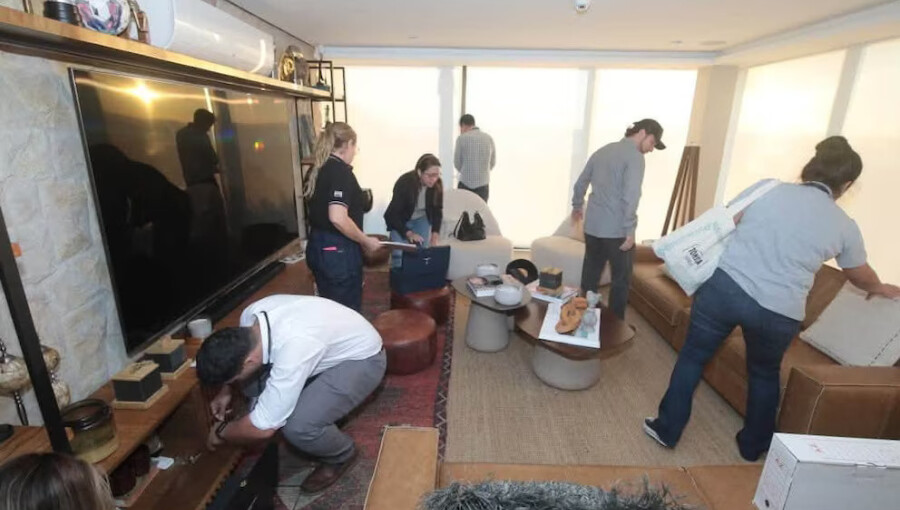
Paraguay prosecutors weigh blowing up vault in ousted president’s mansion

Paraguay prosecutors weigh blowing up vault in ousted president’s mansion
The search caps a week-long unravelling of one of South America’s more stable governments, triggered by the collapse of Ueno Bank, a lender with ties to the former president. / Fiscalia de Paraguay
By IntelliNews Latam desk November 9, 2026

Paraguayan prosecutors are weighing whether to dynamite their way into a high-security vault hidden behind a false wall in the country mansion of Santiago Peña, after failing to get past its biometric locks. The former president was jailed at the weekend over the spectacular collapse of Ueno Bank, a popular digital lender with links to him.

Christian Benítez, one of the prosecutors on the case, said on November 9 that investigators had opened the first door to the vault at the property in San Bernardino, about 50km from Asunción, but could not breach a second security barrier, according to the local daily ABC Color. He said the prosecutor’s office would do “everything possible” to get in and would ask specialists for the best method.

Benítez set out three options. Prosecutors could bring Peña’s wife, Leticia Ocampos, to the property to see whether her iris is registered in the recognition system. They could approach other relatives. Or they could force it.

“We are even analysing the possibility of carrying out a controlled detonation, if there is no other way to open it,” Benítez said. He acknowledged that an explosion could damage both the contents and the structure, since a large swimming pool sits above the vault. He said this was “just an analysis” and that experts would “tell us the best way to open it”.

Bringing Ocampos to the house was “an option we’re considering”, he said, describing it as “a slightly simpler possibility than a possible transfer to the former president’s location”. Taking Peña himself to the house to unlock the system “is not yet one of the options under consideration”. Relatives are not legally obliged to cooperate. “The only problem we have is that they are not required to help us. However, we are in discussions to see if that is a feasible possibility,” Benítez said.

Investigators are working on the theory that the chamber is a safe room. “It’s being argued that it could be a panic room,” he said.

The raid began shortly before 7pm on November 8 and resumed at 7am on the next day. According to ABC Color, the vault is protected by a security system of Israeli origin that requires access codes and several layers of verification, including an iris scan of the owner. Other Paraguayan outlets reported fingerprint readers, keys and a hidden passageway leading to an armoured door. The prosecutor’s office has not said what it expects to find. Its statement confirming the raid did not mention the vault, and Peña’s lawyers have not commented.

The house is at the centre of the case against him. Prosecutors allege that Peña paid for its construction in 2024 and 2025 with two simultaneous loans from Ueno totalling about PYG3.5bn (roughly $600,000), taken out while he was in office. According to prosecutors, building the house cost about PYG7.7bn (around $1.2mn) and the property is valued at $2mn. The monthly repayments of PYG239mn were six times his presidential salary. When the mansion drew criticism in January 2025, Peña said he had worked since the age of 18 and considered himself an honest and hardworking man, according to the newspaper Última Hora.

The search caps a week-long unravelling of one of South America’s more stable governments. The central bank put Ueno into resolution in a decision dated November 2 and announced in the early hours of November 3. The bank’s solvency ratio had fallen below half the legal minimum after its accounts were restated. Its app, cards and transfers stopped working, cutting off about 3mn customers. Ueno said those customers made up some 60% of Paraguay’s adult population. At the end of 2025 it was the country’s fifth-largest private lender, holding 8.9% of system deposits.

Regulators said their concerns began in June with lending to companies tied to Ueno’s owner, Grupo Vázquez, a practice that is tightly restricted for banks. Peña was a business partner of Grupo Vázquez until March 2025, and had dismissed earlier warnings about the bank as a “media campaign." Carlos Carvallo, who chaired Ueno until Peña made him central bank governor in August 2023, has signed his resignation. He said he had recused himself from all decisions involving the lender.

Public money made up about a quarter of Ueno’s deposits. That included roughly $355mn from the Social Security Institute, which manages private sector workers’ pensions, as well as funds from the state power utility ANDE and the Itaipú dam. Prosecutors have ordered the arrest of eight people, including Ueno’s president, Juan Manuel Gustale, and its chief executive, Federico Miguel Vázquez Villasanti. Fitch cut the bank to default on November 4, leaving holders of the $350mn of five-year notes Ueno sold in March facing losses.

Regulators estimate that the deposit guarantee fund, which pays up to about $38,000 per depositor, fully covers some 97% of Ueno’s customers. Payouts are due by November 17, a deadline that can be extended once.

The political fallout was swift. The Senate removed Peña on November 6 by 44 votes out of 45, with many members of the president's right-wing Colorado Party voting against him, and Vice-President Pedro Alliana was sworn in to serve until August 2028. On November 7, Judge Humberto Otazú ordered Peña held in pretrial detention at a military base in Asunción to "guarantee his compliance" with the anti-corruption probe. Peña faces charges of instigating breach of trust and of embezzlement, with prosecutors putting the damage at about $809mn, the total of state deposits in the bank rather than a proven loss. Peña denies the charges.

Prosecutors also seized Peña’s iPhone at the regiment, after its commander said he had been allowed to use a mobile phone.

The scandal is a major blow to a country that has sold itself to foreign investors on low taxes, light regulation and macroeconomic stability, a pitch that recently earned Paraguay its first investment-grade credit ratings.