Tuesday, November 10, 2026

France: Mélenchon Fires Up His Base For Le Pen Runoff

France's Jean-Luc Mélenchon. Photo Credit: @JLMelenchon, X video screenshot


Key Takeaways:

On Saturday Jean-Luc Mélenchon rallied 20,000 supporters near Paris, positioning France Unbowed for a presidential showdown with Marine Le Pen and urging youthful followers to convert parents and grandparents.

He reaffirmed radical positions—leaving NATO, supporting Donbas self-determination, escorting Gaza aid flotillas—while softening attacks on social democrats and omitting Europe.

With older voters decisive and current polls unfavourable among them, the campaign’s challenge is to broaden the enthusiastic youth base into a runoff coalition within six months.


(Rapporteur) — The 20,000 supporters cheering Jean-Luc Mélenchon at his political convention near Paris on Saturday had their marching orders: go home and convince your parents and grandparents.

The far-left leader’s France Unbowed (LFI) movement, which is rising in the polls, used the gathering to cement the prospect of a presidential showdown with far-right leader Marine Le Pen and galvanise his troops against their designated enemies.


LFI leaders portrayed Macronists and their “far-right allies” as part of the same establishment, vowing to campaign relentlessly to “bring the far right back to the dustbin of history, where it belongs”.

This came two weeks after Le Pen assembled 10,000 supporters in Orléans, courting conservatives as potential coalition partners.

Mélenchon, meanwhile, called for sweeping change. “I only have one reasonable thing to suggest: change everything,” he said during his hour-long speech.

His Le Bourget rally highlighted the 75-year-old’s central electoral challenge in his fourth presidential bid: how to turn an enthusiastic, youthful crowd into a coalition broad enough to reach the runoff, despite widespread opposition to his candidacy.
The whole menu

Mélenchon vowed not to “water down his wine” to please others, a French expression for moderating one’s stance, instead doubling down on policies that divide the social democrats and centrists he needs to win over.


He condemned Russia’s invasion of Ukraine while denouncing escalation by “warmongers” and calling for self-determination in the Donbas. He also said France would leave NATO and stay out of American wars.

On Israel, he promised action against what he described as genocide in Gaza and the gradual annexation of the West Bank. French ships, he pledged, would escort civilian aid flotillas if elected.

Calls to end the war in Gaza drew some of the loudest cheers from a crowd dotted with keffiyehs, also sold at the entrance of the convention. Environmental pledges drew less enthusiasm, although party officials said climate policy was now a central pillar.

The young, diverse crowd embodied the “new France” at the heart of Mélenchon’s strategy: a country he describes as positively transformed by immigration, women’s rights and the demands of younger generations.

“You either love France as it is or you don’t. We do,” he said. “You don’t pick and choose – it’s the whole menu,” he added, calling on the ‘New France’ to hold its chin up.

Rap performances and songs punctuated the speeches. One video featured a French flag marked with 93, the number of Seine-Saint-Denis, a poor Paris suburb and LFI stronghold. Speakers saluted single mothers, Uber drivers, teachers and protesting students.

“We’ve become much younger and diverse,” one party official said, adding that many attendees were first-time rally goers, motivated less by left-wing ideology than by opposition to discrimination.
Now convince grandma

The challenge is to turn enthusiasm into broader electoral support.


Short, Netflix-style films presented proposals from Mélenchon’s 212-page manifesto on education and work, complemented by theatrical performances. Purchasing power, housing and low-paid jobs featured heavily.

“We don’t want this to be a sad campaign,” said Antoine Léaument, an MP and France Unbowed’s communications director.

Supporters received a 100-page “victory notebook”, combining voter-registration checklists with arguments for dinner-table debates. A WhatsApp group distributes campaign material, while a gaming app rewards participation.

With older voters carrying considerable electoral weight, Mélenchon cannot rely on Gen Z alone.

“Convince your parents, convince your grandparents,” Mélenchon’s lieutenant Manuel Bompard urged.

Le Pen has a head start. She is courting conservative allies such as former Republican leader Éric Ciotti and cultivating a presidential image, pressuring EU leaders over budget negotiations as if already at the table.

Mélenchon’s rally offered little evidence of support beyond his existing camp, apart from overtures to Communists and Greens. Policies targeting older voters included home care, support for family caregivers and replacing commercial nursing homes with nonprofit providers.

Still, he struck a softer tone, making no mention of Europe and sparing social democrats from his attacks.

“Don’t ask yourselves whether you like me,” he said. “Ask whether you think the solutions we are proposing should be implemented.”

For now, polling suggests many older voters remain unconvinced. His young supporters have six months to change their minds.Nicoletta Ionta contributed reporting.


About Rapporteur
Rapporteur, formerly EurActiv, is Europe’s expert media organisation for policy and politics. Through deeply reported journalism, trusted expertise and a commitment to engagement with our audiences, we aim to help the people shaping Europe’s future make better decisions.
View all posts by Rapporteur →


Mélenchon bets on radical change as French presidential race takes shape

Leader of the hard-left France Unbowed party, Jean-Luc Mélenchon has vowed to pursue an uncompromising programme of radical change as he bids for the French presidency in 2027. This sets up a potentially decisive confrontation with far-right leader Marine Le Pen, despite warnings that his divisive politics could ultimately hand her victory.


Issued on: 09/11/2026 - RFI

Jean-Luc Mélenchon un-------- -  veils his manifesto for the 2027 presidential election in Le Bourget, Seine-Saint-Denis, on 7 November 2026. © KENZO TRIBOUILLARD / AFP

Addressing more than 20,000 supporters at Le Bourget, north of Paris, on Saturday, the 75-year-old leader of the hard-left France Unbowed (LFI) movement rejected calls to soften his message to appeal to a broader electorate.

“Other commentators advise me to water down my message to win people over and be less divisive. I will not do that,” he told a predominantly young crowd.

“I have only one sensible thing to propose to you: we must change everything.”

The rally showcased LFI's newly published presidential manifesto, L'Avenir en commun – A Shared Future – containing 1,069 proposals ranging from higher taxes on the wealthy and retirement at 60 to lowering the voting age to 16.


Central to his programme is replacing France's Fifth Republic, established in 1958, with a new constitution giving citizens greater power to challenge legislation and even remove elected leaders.

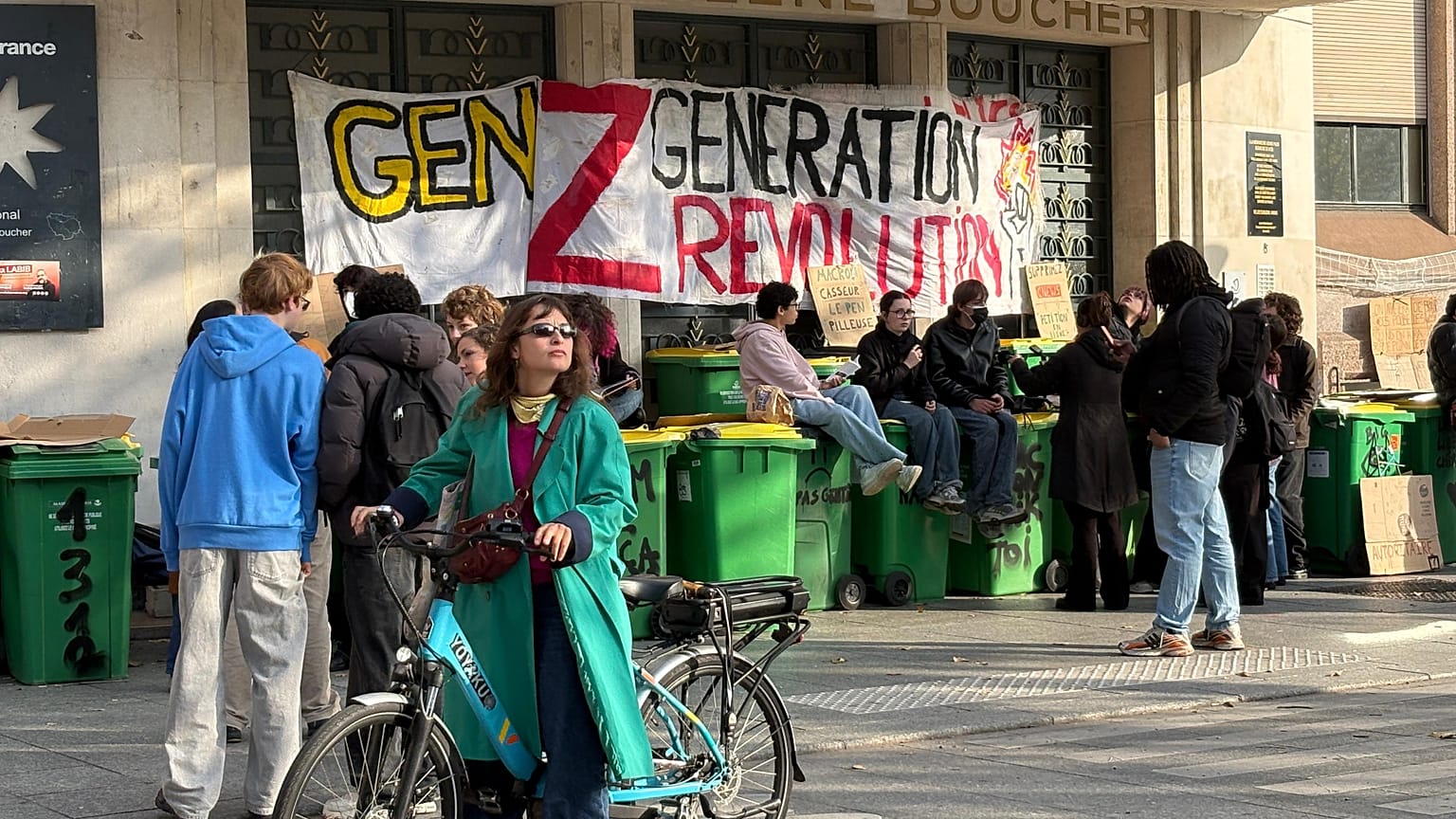
Mélenchon also attacked President Emmanuel Macron's decade in office, describing its final months as a period of “Macronist agony”, while accusing the government of responding to recent student and cost-of-living protests with excessive police force.

He reserved particular criticism for the far-right National Rally (RN), declaring: “They have no ideas, apart from racism.”

Jean-Luc Melenchon, leader of the French far-left opposition party France Unbowed (LFI) and candidate for the 2027 French presidential election, delivers a speech during a political rally to present LFI's government program for the presidential election, in Le Bourget near Paris, France, 7 November 2026. REUTERS - Tom Nicholson

Political backlash over Ukraine

But Mélenchon's foreign policy positions quickly overshadowed his domestic proposals, triggering accusations that he was echoing Russian propaganda over the war in Ukraine.

Speaking about a possible peace settlement, he argued that territorial concessions involving the Donbas region of eastern Ukraine should not be agreed without consulting local populations.

“It is for the people themselves to decide what they want,” he said.

On Sunday, Foreign Minister Jean-Noël Barrot accused Mélenchon of becoming “the Kremlin's spokesman”, arguing that his position disqualified him from holding the presidency.

Raphaël Glucksmann, his main rival on the left, similarly accused him of repeating talking points promoted by Russian President Vladimir Putin.

Critics argue that any referendum in Russian-occupied territory would be fundamentally compromised by the displacement of Ukrainian residents since the invasion.

Mélenchon rejected the accusations, countering that Barrot had misrepresented his position and pointing to previous discussions involving possible territorial exchanges.

The dispute comes ahead of planned US-mediated peace talks involving Moscow and Kyiv in Abu Dhabi, with Ukraine continuing to reject territorial concessions.

More broadly, Mélenchon's foreign policy agenda includes withdrawing France from NATO's military command and ultimately the alliance itself – a proposal that would have significant implications for European security.

Mobilising young voters


The stakes, however, extend well beyond foreign policy.

After three unsuccessful presidential campaigns, Mélenchon is polling strongly enough to make a second-round appearance a realistic prospect for the first time.

In 2022, he missed qualification for the runoff by just over 421,000 votes. Recent surveys suggest he could now face Le Pen in the decisive vote on 2 May 2027.

But those same polls indicate he would lose heavily to the RN leader.

His strategy relies on mobilising young voters, working-class communities and the ethnically diverse suburbs where LFI has established a formidable electoral base.

The weekend rally in Seine-Saint-Denis – one of France's poorest departments – was designed to demonstrate that strength, drawing heavily on the energy of recent student protests.

Yet his outspoken style, confrontations with political opponents and recurring accusations of antisemitism, which he denies, have made him deeply unpopular among sections of the wider electorate.

That presents a fundamental dilemma: while his radicalism energises supporters, it could also discourage moderate and centre-left voters from backing him against Le Pen.

Mélenchon also faces competition from Glucksmann on the left and former prime ministers Édouard Philippe and Gabriel Attal in the centre.

Reaching the runoff would mark a breakthrough after three unsuccessful presidential bids, but defeating Le Pen would require support well beyond his traditional electorate.


Ukrainian Foreign Affairs Ministry hits back at hard-left leader Jean-Luc Mélenchon over Donbas referendum
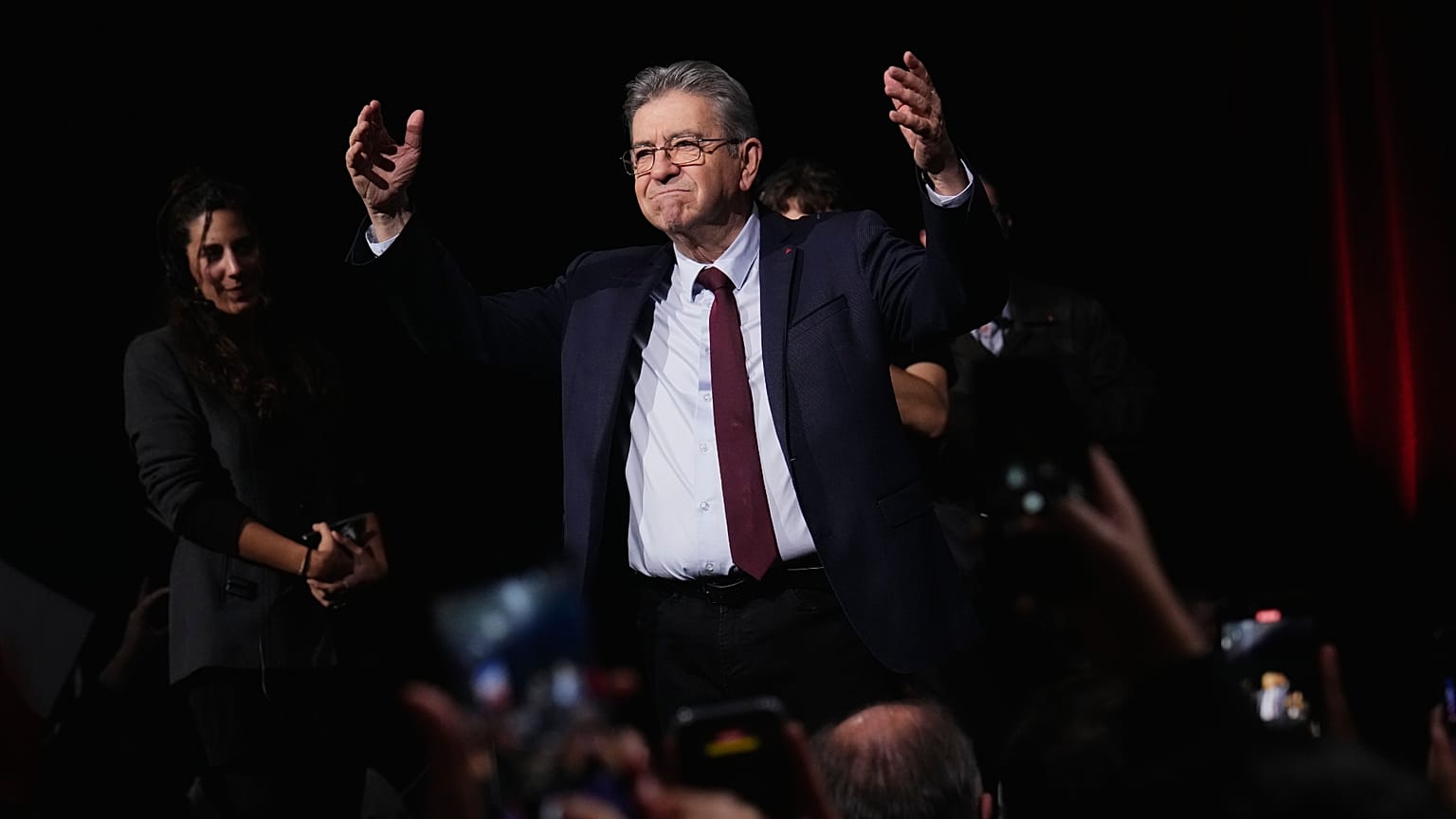
French left-wing party La France Insoumise (LFI) candidate, Jean-Luc Melenchon, gestures during a campaign rally in Le Bourget, 7 November 2026.
Copyright AP Photo

By Estelle Nilsson-Julien
Published on

The leader of the hard-left France Unbowed party declared that Ukrainians living in the Donbas should be "consulted' on their future.

Ukraine's spokesperson on Foreign Affairs Heorhii Tykhyi hit back at Jean-Luc Mélenchon on Monday, after the leader of the hard-left France Unbowed party, declared that Ukrainians living in the Donbas should be "consulted' on their future.

During a major campaign ally on Saturday, Mélenchon said that his party refused to "allow discussions about peace in Ukraine" to be headed by European leaders. This comes as France, Germany and the UK are set to take part in US mediated Russia-Ukraine talks in Abu Dhabi on Tuesday, alongside a joint EU team.

"We cannot accept the notion of a peace agreement that involves territorial concessions in Ukraine without first seeking the consent of the affected populations to live on either side of the border", said Mélenchon.

Responding to Mélenchon's remarks on X, Tykhyi declared that Ukrainians had "already settled the question of their country's border" during the country's 1991 independence referendum

Tykhyi said that Russia had chosen to "disregard the choice of Ukrainians" with its invasion of Ukraine, adding that "'referendums' under occupation are a tool of annexation, not an expression of the people's will."

"No civilised, democratic country would ever accept this for its own borders, so it should not be proposed to Ukrainians", he said.

Moscow has already staged sham consultations in annexed Crimea and in the four regions of south-eastern Ukraine it partially controls, procedures rejected by Kyiv and the international community.

France's Foreign Affairs Minister Jean-Noël Barrot also weighed in on the controversy Sunday, describing Mélenchon as a "mouthpiece of the Kremlin."

"All over the world the Kremlin is trying to convince heads of state and government that, basically, the Donbas is Russian and that the war of aggression is a war to liberate the Donbas", said Barrot.

"This is obviously of unprecedented seriousness and, in my view, definitively disqualifies him [Mélenchon] from holding the offices he aspires to", he added.

The France Unbowed party programme affords less space to the question of Russia's war against Ukraine in comparison with the Israeli-Palestinian conflict, which is featured more prominently.

The war in Ukraine has become an increasingly controversial topic over the course of France's presidential elections. The far-right candidate, Marine Le Pen, said in mid-October that she would end French financial aid to Ukraine, which she estimated at €6 billion a year, if she were to win the 2027 presidential election.

Ukrainian President Volodymyr Zelenskyy then responded that "Madame Le Pen does not have a very good grasp of certain details" of French-Ukrainian military cooperation, defending a "win-win" partnership that he said was also beneficial to France's security.

French PM's move to increase minimum wage fails to convince unions

The French government on Monday announced a 1.6 percent increase in the national minimum wage, alongside a series of measures aimed at easing cost-of-living pressures. However, the decision fell well short of the demands of trade unions, which have called for fresh protests in the coming days.


Issued on: 09/11/2026 - RFI

Protesters hold a sign that reads 'SOS high cost of living' during a demonstration in Paris, 7 November 2026. © Emma Da Silva/AP

Prime Minister Sébastien Lecornu announced the proposals following a meeting with trade unions and employers' organisations called in response to protests and strikes since mid-September over wages, purchasing power and employment.

Under pressure to address the discontent, the government has little room for manoeuvre, as the country is in debt and facing European deficit-reduction requirements, and the ruling party lacks a parliamentary majority to pass its 2027 budget.

The minimum wage, known as the Smic, will go up by around €24 per month, bringing take-home pay to approximately €1,502 from 1 December. The increase combines an early adjustment, linked to inflation, which would normally go into effect in January, along with an additional increase.

Lecornu described it as the second largest minimum wage increase in 20 years, arguing that it should not be dismissed as merely symbolic. It is the first increase initiated by the government that goes above the automatic inflation adjustment since July 2021.

He said it would help launch a new round of wage negotiations across sectors and individual companies, where decisions on pay increases are made by employers and unions.
Unions call increase 'crumbs'

Trade unions slammed the increase, saying it falls well short of what workers need.

The CFDT union had called for an additional €100 net per month, while the CGT demanded a 10 percent increase, equivalent to around €150.

"The government has only announced crumbs," CGT Secretary General Sophie Binet told reporters.

She argued that once the automatic inflation adjustment that would have come into force in January is taken into account, the additional increase amounts to just €5 - the cost of "a kilogramme of tomatoes".

"We didn't come here to beg for alms," she added, calling for new protests on 17 November.

Other proposals include raising the ceiling for tax-free overtime pay, from €7,500 to €10,000, extending tax exemptions for employee profit-sharing bonuses and introducing energy-related bonuses.

Economy Minister Roland Lescure also said the government would propose extending fuel allowances into 2027.

The government additionally plans to issue a decree requiring companies to disclose all public assistance they receive to employee representatives.

Lecornu also promised a review of employers' social security contributions, aimed at encouraging higher wages without adding additional labour costs to businesses.
Boost for salary negotiations?

The government hopes further negotiations between unions and employers will produce wage increases before December.

Public sector unions, which were not invited to Monday's meeting, are due to meet Lecornu on Friday. Several have already called for a public sector strike on 17 November over pay, particularly a freeze of the index used to calculate base salaries.

The index has not increased since July 2023, meaning civil servants have not received any general pay rises for more than three years, even as inflation has increased.

Lecornu was due to meet representatives of high school and university students on Monday afternoon, followed by the first meeting of a committee reviewing Parcoursup, the university admissions platform. The system has been a major focus of the protests, with students arguing it is opaque and unfair.

The protest movement began with high school students in September and has since spread to other sections of society. The wider union coalition was also due to discuss on Monday evening whether to continue the protest movement.

(with newswires)


Unions vow to keep pressure on French government after fourth wave of protests

Education union chiefs on Sunday vowed to maintain pressure on the government after student organisations called for another day of nationwide strikes and demonstrations on Tuesday.


Issued on: 08/11/2026 - RFI

Thousands of people took to the streets of France to protest over poor conditions in the country's schools and the rising cost of living. AP Photo/Emma Da Silva - Emma Da Silva

By: Paul Myers


Sophie Vénétitay, secretary-general of the SNES-FSU, said her union was angry to be excluded from talks on Monday between government ministers and private-sector employers and employees.

"It's as if public-sector salaries, and therefore those in education, were not a priority and could be put off until a few days later," Vénétitay told French broadcaster RMC.

"We have seen that the government is very responsive to pressure. It responded to pressure from secondary-school students.

"The objective is to maintain pressure on the government."

Ministers will meet secondary-school and university student representatives to discuss education and Parcoursup – the university entrance platform – in a separate meeting on Monday

Public-sector unions, including those representing teachers, are due to hold talks with the government on 13 November.

“The protest movement is in a position of strength, the government is in a position of weakness and is beginning to back down,” the inter-union alliance of the CGT, FSU, FO, SUD, USL, UNEF, Union étudiante, FAGE and FSE said in a statement on Saturday.

"Now is the time to step up the mobilisation by continuing to put pressure on the government."

The call for further demonstrations came as thousands of people took to the streets across the country on Saturday to complain about the poor conditions in schools and the rising cost of living.

Arrests during nationwide protests

The Interior Ministry said 360 people were arrested during the protests.

Saturday's rallies came 48 hours after a general strike over the same issues.

Some 70,000 police and gendarmes were deployed Saturday to prevent a repeat of the violence that marred the first protests on 17 October.

Authorities said they expected up to 170,000 people to demonstrate nationwide during the fourth consecutive Saturday of rallies including 60,000 in Paris.

But the interior ministry reported 146,000 people.

Unions march in Paris

Trade unions staged a march along a traditional route, from the Place de la Republique in central Paris to Place de la Nation in the east of the city.

But the Yellow Vests movement – a group whose protests shook Emmanuel Macron's government in 2018 – called for a rival demonstration at the Place de la Concorde in central Paris, near the president's official residence and the lower house of parliament. However, the protest was banned by the authorities.

In Lyon, south-eastern France, police fired tear gas to disperse several hundred people in the city centre blocking a road during an unauthorised gathering.
Investigations into police response

The police response to the high school pupil protests and at the Saturday demonstrations has faced criticism for being heavy-handed.

Interior Minister Laurent Nuñez told French MPs on the National Assembly's law committee last month that the national police inspectorate had launched 18 inquiries into police conduct during the demonstrations.

On Friday, the international news agency AFP called for protection for its journalists after it reported several instances of alleged police brutality against its reporters.

Press freedom watchdog Reporters Without Borders said it had recorded 40 cases of journalists being obstructed in their coverage of the demonstrations by members of the security forces, including 21 cases involving physical violence.

Local businesses are also feeling the pain. "All this can't go on, otherwise I think it will be a disaster before long," said Paris shop manager Jean-Emile Moulinier, whose store lies along the main protest route.


French pupils step up protests as government concessions fall flat

Students stand in front of a barricaded secondary school to protest against the lack of resources in schools, in Paris, Monday 2 November 2026.
Copyright AP Photo/Nicolas Garriga

By Nathan Joubioux
Published on

Unions walked out of talks with the prime minister’s office over the presence of the far right, while firework mortars have been set off inside schools as tensions rise.

Secondary school pupils in France are back on the streets on Tuesday. Nearly two months into their protest movement, the government’s concessions have failed to bring it to an end.

A coalition of trade unions and youth organisations has called a nationwide day of strikes and demonstrations. It is the latest escalation in a dispute that has seen sporadic violence at schools across the country.

Two weeks ago, Prime Minister Sébastien Lecornu’s government tried to calm things down. It promised to overhaul Parcoursup, France’s national online platform for allocating university places, from 2027 and to replace it completely in 2028. It also pledged more money for school buildings and extra resources for the most deprived schools.

Protesters were not won over. Relations got worse at a meeting on the Parcoursup reform at the prime minister’s office in Paris. Most of the pupil and student groups, along with education unions, walked out in protest at the presence of far-right and business representatives.

"We are calling on everyone who supports the legitimate demands of young people, but also those of workers, to be out on the streets," said Éloïse Lefebvre-Milon, co-leader of the Union étudiante student union, after leaving the talks.

The coalition includes some of France’s biggest labour unions, such as the CGT and FO, alongside pupil and student organisations. It said in a joint statement that now was the time "to step up the mobilisation by continuing to put pressure on the government".

"Giving fresh momentum to the mobilisation"

Pupil leaders say they have no intention of backing down. "The balance of power is in our favour, we have to keep going," said Ryad Rani, president of the Union syndicale lycéenne, a secondary school pupils’ union.

“We have to stay mobilised. We are not only fighting for ourselves. We are fighting for teachers, for their working conditions,” Rani said.

Sophie Vénétitay heads Snes-FSU, the largest union for secondary school teachers. She said Tuesday’s action would include “supervised and secure marches”, since tensions outside schools are rising.

Youth protests have a long history of putting pressure on French governments. Former president François Hollande faced mass demonstrations against his labour reforms in 2016. At the time, he privately compared a student movement to toothpaste: "You can get it out of the tube, but you cannot get it back in."

Violence reported in several secondary schools

Most of the protests have been peaceful, but there has been a string of violent incidents on the fringes.

On Monday, firework mortars were set off inside two secondary schools in Seine-et-Marne, in theeast of Paris. The regional council said two pupils were hurt at one of them. At the other, nobody was injured, but education officials said pupils were left "in shock".

Police arrested five people after trouble outside schools in Le Havre and Rouen in Normandy, according to France 3 Normandie (source in French). Fireworks were also set off outside a school in Angers in western France (source in French). Further incidents were reported in the north-eastern Meurthe-et-Moselle department, according to Ici (source in French).


French student protests continue amid


deadlock over education reforms

Students and teachers are planning a new day of strikes and demonstrations Tuesday, as talks with the government remain deadlocked, nearly two months after the start of protests by high school and university students.


Issued on: 10/11/2026 - RFI

High school and university students at a demonstration in Nantes, 15 October 2026. A new day of strikes and protests is being called for Tuesday as talks with the government remain deadlocked, nearly two months after the start of the movement. 
© Stephane Mahe/Reuters

“This is the time to step up the mobilisation and continue putting pressure on the government,” wrote a coalition of student organisations and teachers unions, calling for the strike, on Saturday.

Demonstrations are planned in most of France’s major cities. In Paris, a march will leave off from the Panthéon at 2pm and head towards Place d’Italie.

Some teachers are expected to be on strike, said Sophie Vénétitay, general secretary of the Snes-FSU teachers’ union, notably in some areas, though participation is expected to be lower than last week, on 5 November, when nearly 16 percent of teachers went on strike, according to the Education Ministry.

“The balance of power is on our side, and we must keep going. I am not saying we have won anything, but I am saying we are on the right track,” said Ryad Rani, president of the USL secondary school students’ union on Monday evening, after the first meeting of the committee set up to reform Parcoursup, the national university admissions platform.
Students walk out on Prime Minister

The meeting with the Prime Minister ended prematurely after a number of student and teachers’ organisations walked out in protest against the presence of right week representatives, far right lawmakers and employers’ organisations.

The groups criticised the attendance of student union UNI, which describes itself as the leading right wing student movement, as well as Thierry Tesson, a far right National Rally MP and Gaëlle Frontoni, a senator for the right wing UDR.

“We want to make it absolutely clear that we will never sit in a room with the far right, with people responsible for spreading racist, fascist and hateful ideas,” Manon Moret, General Secretary of Unef, the French national union of students, told reporters.

Student unions also objected to the influence given to employers’ organisations.

“We refuse to let higher education be reformed around the needs of businesses. Young people are the ones who need to be heard,” said Eloïse Lefebvre-Milon, co-general secretary of Union étudiante.

Parcoursup is at the heart of the protests, with students continuing to demand it be scrapped. The government announced a revision of the platform two weeks ago, ahead of its planned replacement in 2028.

Organisations representing schools also walked out of the meeting.

“The government is incapable of offering a new response to students and education staff,” said Vénétitay.

Making up missed lessons

Meanwhile, Education Minister Édouard Geffray said on Monday that students who have missed lessons because of the protests could be offered catch-up classes during school holidays,

Such classes already exist, but they will be expanded into school holidays in February and at Easter, to make up for teaching time lost during the student protests, Geffray said in an interview with public broadcaster France 2.

School representatives rejected the proposal, questioning how the government would recruit enough volunteer teachers to work during their holidays.

Geffray also confirmed that the dates of the baccalauréat examinations would remain unchanged.


A huge explosion at a steel factory in Western Turkey has left at least 17 people dead and 13 injure


By Anna Kirchheim with AP, AFP
Published on

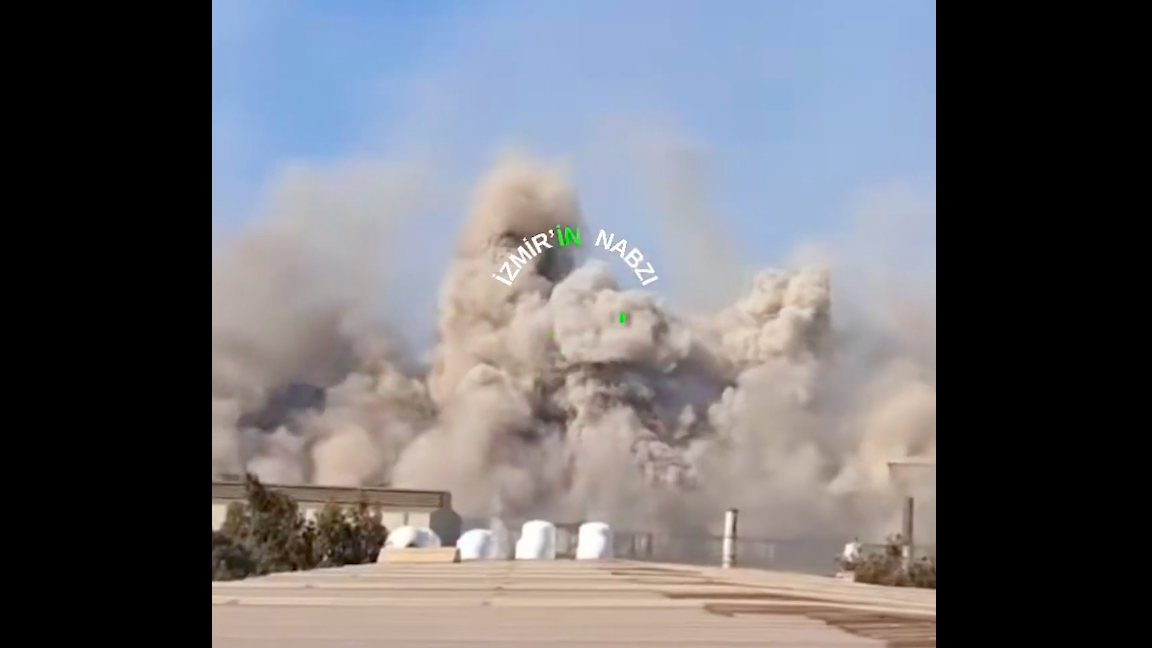
The explosion occurred when a crane lifting a boiler collapsed into a large industrial furnace, causing a huge fire.

The blast happened at midday local time, when a crane lifting a replacement boiler collapsed and fell into a furnace used during the liquid steel casting process.

The fire at the HABAS plant in Aliaga, Izmir province, claimed at least 17 people's lives and also injured 13 people, two of them critically, President Recep Tayyip Erdogan said in a televised address following a scheduled Cabinet meeting.

"The circumstances surrounding this tragic incident, which has deeply saddened our nation, including how and why it happened, whether there was any negligence and who bears responsibility, will be established," Erdogan said on television.

According to eye witnesses, the explosion "felt like an earthquake".

Izmir mayor Cemil Tugay said on X that rescue teams were "continuing their work to remove the collapsed platform" and that those affected were factory workers.

EU president Ursula van der Leyen has expressed her condolences

HABAS is a privately owned group and one of Turkey's top steel producers. The plant was established in 1987 and can produce 4.5 million tons of steel annually, according to the company’s website.

Workers' groups said there was a long record of safety issues at HABAS.


Major explosion at Turkish steelmaker Habas’ Aliaga plant kills at least six

Major explosion at Turkish steelmaker Habas’ Aliaga plant kills at least six
The noise and smoke caused by the explosion at the plant were observed across Izmir. / social media footageFacebook
By Akin Nazli in Belgrade November 9, 2026

At least six workers were killed, with dozens more injured or trapped, following a major explosion on November 9 that took place around noon (local time) at steelmaker Habas’ plant in western Turkey, the Izmir governorate said in a press release.

The incident occurred at the industrial group’s primary manufacturing complex in the Bozkoy neighborhood on the Aliaga peninsula, an industrial heartland and key shipping hub located north of Izmir on the Aegean coast.

According to preliminary assessments released by the governorate, the blast was triggered during a liquid steel casting operation when an overhead crane failed and plummeted directly into an electric arc furnace.

Initial reports from regional officials confirmed three fatalities at the scene and 14 injuries with several victims transferred to nearby medical facilities in a critical condition. In a subsequent statement issued later in the afternoon, the governorate updated the death toll to six after one critically injured worker succumbed to injuries in hospital and search-and-rescue teams recovered two additional bodies from wreckage.

Emergency crews remain deployed at the site where search-and-rescue efforts continued to reach workers feared trapped beneath heavy industrial debris.

Habas, one of Turkey’s biggest steel producers, also operates extensive production facilities for industrial gases and heavy manufacturing. Its Aliaga complex serves as a crucial node in the country's metal export supply chain, producing long products and billets for international markets.


\


‘We Could Have Waited’: Caesareans The Norm For Pregnant Women In Greece – Analysis
Graphic: Igor Vujcic/BIRN.


Key Takeaways:

Nearly 63% of births in Greece in 2025 were by caesarean section, one of the highest rates in the EU, driven by time pressures, staff shortages, limited midwife-led care and insufficient training in vaginal birth.

Many women reported feeling pressured into unnecessary C-sections, with poor informed consent and lasting trauma, while experts note rates above 10% do not reduce mortality and raise risks.

Proposed remedies include midwife-led care, natural-birth centres, Robson classification audits and hospital incentives, but implementation remains stalled amid resistance and no national oversight.


Five weeks before her due date, Mirela’s doctor told her the baby was in the breech position, lying bottom or feet down.

The doctor proposed a caesarean section, but Mirela, a 32-year-old electrical engineer from the island of Crete, was reluctant and asked why. Responding to a BIRN online questionnaire, Mirela recalled her doctor growing annoyed and telling her to “do what you want, at your own risk”.


Mirela asked about a non-invasive procedure in which the foetal position is manipulated, but, she said, the doctor insulted her and dismissed the procedure as dangerous. Eventually, the baby turned on its own, head down. Nevertheless, the doctor insisted on inducing labour, claiming that “the baby was big”.

Mirela tried unsuccessfully to find another doctor and eventually agreed to an induction. Thirteen hours passed without a contraction, during which time Mirela couldn’t eat and her water intake was rationed. Weak and worried, she underwent a C-section. This was January 2025.

Mirela said she suffered “nightmares for months” afterwards and had to seek psychological help.

According to the Hellenic Statistical Authority, ELSTAT, almost two-thirds [62.7 per cent] of births in Greece in 2025 were by C-section, up from 58.4 per cent in 2020.

In 2023, EU data placed Greece fifth in the bloc in terms of rates of C-sections, behind Turkey, Cyprus, Romania and Bulgaria.

Experts blame the rate on a desire among doctors as well as parents “to save time”, as well as shortages of midwives and anaesthesiologists, a lack of doctor training in natural childbirth, and not enough information for young couples.

Experts blame the rate on a desire among doctors as well as parents “to save time”, as well as shortages of midwives and anaesthesiologists, a lack of doctor training in natural childbirth, and not enough information for young couples.

C-sections “are not treated as a surgical procedure,” but rather as an “expected outcome of pregnancy,” said Kleanthi Gourounti, a professor in the Department of Midwifery at the University of West Attica and Vice President of the Midwives’ Association of Athens.

Obstetrician Ioannis Mouzalas, a vocal advocate of natural childbirth, told BIRN: “It is a solution for the obstetrician that used to save money, but now it saves time, unless you consider that time is money.” At his clinic, the C-section rate is between 18 and 22 per cent.

“I’ve come to believe that natural childbirth will remain the minority, not only because of doctors but also because of the mindset of just wanting to ‘get the birth over with’,” Mouzalas said. “Nevertheless, I think it’s worth trying to increase natural childbirth. Not for ideological reasons, but for scientific reasons.”
‘We could have waited’

Maria, a 37-year-old lawyer, gave birth to her first child in August at a public hospital in Athens via a C-section. The procedure was deemed medically necessary “due to the baby’s breech presentation and the umbilical cord being wrapped twice around its neck and shoulder”, she said.

Maria had preferred a vaginal birth, and her doctor, whom she had chosen because she trusted him, encouraged her to wait and try certain exercises to help the baby change position, but to no avail.


“I felt a bit disappointed,” Maria said, but “I accepted the decision, prioritising my child’s safety”.

Gourounti said it “goes without saying that a C-section can be lifesaving for both the woman and the foetus”.

“The issue, however, is that there must be documentation justifying the necessity of every C-section.”

The Hellenic Obstetrical and Gynaecological Society has set guidelines for performing C-sections.

But what happens in cases where a C-section is not necessary?

Another respondent to the questionnaire, Eftichia, quoted her doctor as saying: “When women reach their 39th week, I induce labour. I don’t let them go any longer.”

Eftichia, a 34-year-old police officer, had attended seminars led by independent midwives in Athens during her first trimester. While she preferred a vaginal birth, the seminars had prepared her for every eventuality.

During one of her check-ups, her doctor mentioned that there was low amniotic fluid and suggested that her waters might have broken without her realising; the very next day, he “announced that he was going to break my waters”.

The induction began at 9:00 a.m., but by 6:00 p.m., there was still no cervical dilation. She was told that the baby’s position was preventing pressure on the cervix, which is necessary for dilation to begin, so a C-section was performed.

“That is why I believe that if we had waited just one more week, I might have been able to give birth naturally, even with an induction,” Eftichia said. “The baby would have descended and moved into the proper position, something that didn’t happen because, for some reason, we were in such a rush.”

The cause of Greece’s high rate of C-sections is “multifactorial”, said Dimitra Kentrifylli, an independent midwife and lecturer in the obstetrics department at the Metropolitan College in Thessaloniki.

They begin with “the wrong prenatal care monitoring plan”.

“Normally, there should be midwife-led care for low-risk pregnancies,” said Kentrifylli, in “close collaboration with obstetricians”.

Research shows that midwife-led births are less likely to involve medical intervention as midwives are more likely to treat childbirth as a natural process and focus on psychological support and the position of the mother.

“When a woman in labour has a midwife continuously by her side, the likelihood of needing a Caesarean section decreases, and overall birth outcomes improve,” said Apostolos Athanasiadis, president of the Hellenic Society of Obstetrics and Gynaecology.

“This is because the care provided is truly personalised – essentially one-on-one – allowing a strong relationship of trust to develop between the midwife and the woman,” he added.


Other factors include a shortage of anaesthesiologists and midwives, a lack of public awareness, and a failure to conduct regular evaluations of the service provided by healthcare bodies.

According to the World Health Organisation, WHO, C-section rates above 10 per cent do not reduce mortality but instead increase health risks for both mother and baby.

Kentrifylli said that fear of childbirth drives many women to request C-sections, yet this fear remains “unrecognised”.

Of 14 women who told BIRN it was their wish to have a C-section, nine said they were afraid of a natural birth.

Likewise, Mouzalas said, some young obstetricians also turn to C-sections “out of fear or panic” because they don’t have enough experience of natural births.

According to Gourounti, when you have a high rate of C-sections, new resident doctors and midwives do not get to practice vaginal deliveries, and thus “the skill is lost”.
Are women given enough information?

Niki* was eight months gone when her doctor told her the baby was “too big”, that she had a “very narrow pelvis”, and that the baby would “tear her apart”.

Despite her partner’s objections, Niki agreed to a C-section.

“A doctor is someone to whom you entrust your body,” she said. “It is extremely difficult to shatter that trust; it’s like choosing to turn a blind eye – as if you don’t want to hear the truth.”

She describes the birth of her child as “an unforgettable, negative experience”.

“I didn’t see that, through this, I had gained a child. All I saw was that I had ended up with an incision on my abdomen.”

Almost half of respondents said they felt steered or pressured into undergoing a C-section.

Gourounti said the question is “to what extent the choice, the consent to all of this, is truly informed”.

More than two thirds of respondents said they did not receive any prenatal information about birth options from their midwife or doctor.

Angeliki, a 38-year-old teacher, said she underwent a C-section she now believes was not medically necessary.

In her response to the BIRN questionnaire, she cited “the importance of women being well-informed promptly, choosing appropriate healthcare professionals, and receiving support during childbirth and breastfeeding”.

Gourounti said women must also actively seek information: “We are currently living in an era where information is available online. We can access it. Furthermore, we should certainly press the professional we are consulting to discuss this with us. In other words, women themselves need to assert their rights”.


Ioanna Vasilaki, an independent midwife and president of the Association of Independent Midwives of Greece, EAMME, said doctors will sometimes suggest inducing labour so the baby can be delivered during his or her shift. Often this ends in a C-section.

A third of respondents said their labour was induced; a quarter of these women said they were not told why.

Half who underwent C-sections said it was conducted as an emergency procedure.

Gourounti said it was “quite strange that when you go to give birth, one in two women ends up having some kind of difficulty or medical issue that arises during labour, necessitating an emergency C-section”.

According to Giorgos Daskalakis, professor of obstetrics and gynaecology at the National and Kapodistrian University of Athens and director of the first obstetrics and gynaecology clinic at the public Alexandra Hospital, some doctors in public hospitals outside Greece’s main urban centres work too many shifts, “so it is extremely difficult for them to spend too much time performing normal deliveries on women”.

Midwives say that often epidurals are not provided to women giving birth vaginally because there aren’t enough anaesthesiologists in Greece.

According to a report in the Greek newspaper Kathimerini in 2024, there are roughly 1,000 anaesthesiologists in Greece. The Hellenic Society of Anaesthesiology puts the figure at 750, in a country of some 10.5 million people. That’s far fewer than global healthcare bodies recommend.

“If you pay,” said Kentrifylli, “if you find a hospital doctor and they see you privately in their office and take you to the emergency room without it being time for you to give birth and put you in a labour induction position, then you will have the option of an epidural.”

Daskalakis said that issues with the legal framework in the event of alleged malpractice are also driving doctors to err on the side of caution by recommending C-sections.

“Consequently, every time a complication arises, the simple question asked is: ‘If a C-section had been performed, would things have turned out differently? Would it have been better?’ And the inevitable answer is that a caesarean section would obviously have led to a better obstetric outcome. Terrified of legal repercussions, doctors are highly susceptible to performing a C-section just to get through the process easily.”

In mid-2024, a law was passed allowing for the creation of Natural Birth Centres within public hospitals and independent institutions, where midwives would oversee deliveries. Amid what midwives say is resistance from obstetricians, no such centre has been opened in the public health system. One private centre was opened, but it closed in January this year, citing financial constraints.

Daskalakis is not enthusiastic about such birth centres. Instead, to encourage natural childbirth, he says staffing should be approved, uniform protocols introduced, and public awareness raised.

Financial incentives?

Daskalakis also argues for bonuses for hospitals that cut their own rate of C-sections.

“The money won’t go into someone’s pocket,” he said. “It will go to the hospital, which will automatically have an incentive to monitor the process because it will receive a bonus.”

Mouzalas, however, said the way a birth is handled should have nothing to do with “economic or ideological” considerations. “It should be related exclusively to scientific reasons”.

In 2017, the WHO proposed the use of the Robson classification as the global standard for assessing and comparing C-section rates across healthcare facilities.

The Robson classification was applied for the first time in 2019 by scientists in Greece to identify trends in caesarean births by examining 8,572 women in a private health facility. Just under 61 per cent of births were caesareans, 34.6 per cent were induced, and 30.7 per cent were births after a previous C-section.

However, in Greece, there is a complete absence of any oversight mechanism for C-sections.

“There is no system in place to require every hospital and every physician to provide a substantiated explanation as to why they deemed a C-section necessary,” said Gourounti, who expressed doubts regarding the widespread application of the Robson classification system in Greece.

“Each hospital and each doctor must provide a substantiated explanation as to why they deemed the choice of a caesarean section necessary,” she said.


Professor Athanasiadis told BIRN that the Robson classification is used in all Obstetrics and Gynaecology departments of the Aristotle University of Thessaloniki, as well as at the Aretaieion and Alexandra public hospitals in Athens, though he stressed he cannot speak for all Ob-Gyn departments across Greece.

According to him, the Robson classification serves as an “internal audit” tool that helps refine clinical practice and reduce unnecessary C-sections. He also underlined that the Robson system can be implemented in public hospitals, but not in private ones, which do not have a departmental structure but instead rely on collaborating private physicians.
The role of the midwife

Gianna, a 33-year-old literature teacher in Athens, faced a number of complications during her pregnancy and, fearing something might go wrong, agreed to be induced.

When the induction didn’t work, a C-section was performed.

“For me, it was a traumatic experience that left me feeling like a failure and filled with guilt,” said Gianna*.

She was left with numbness in her abdomen, and difficulties with breastfeeding took an even greater toll on her emotional well-being.

Almost 40 per cent of respondents described their experience of childbirth as negative, saying it had left them traumatised.

“It is deeply concerning to see such high rates of C-sections, alongside a large proportion of women who return home after giving birth feeling that the entire experience was traumatic, all this in a country facing a severe demographic crisis,” said Gourounti.

For Mouzalas, the increasing number of C-sections is also due to the “distortion of the midwifery profession” in Greece, which is too often marginalised.

In Greece, prenatal care and pregnancy monitoring are usually carried out by obstetricians.

“About one per cent of pregnant women will turn to a midwife as their first healthcare professional,” said Kentrifylli, who, as an independent midwife, supports low-risk, at-home deliveries as well as in private hospitals.

Midwives’ associations have long demanded official job recognition that ensures their professional autonomy and reflects their full scope of competencies.


In February, the health ministry withdrew a draft job description, which midwives criticised as degrading “the scientific and autonomous role of the midwife”.

“The Ministry committed that the responsibility for childbirth would remain with the midwife within the primary healthcare setting,” said Gourounti. “They stated that they would review the text with legal experts and then sign it. Unfortunately, as we speak, this has not yet happened.”

Mouzalas told BIRN: “We need a model where doctors and midwives do not compete, but compete for a common goal.”

The Greek Ministry of Health has not responded to BIRN’s questions.

*Some names have been changed to allow interviewees to remain anonymous.


About Balkan Insight
The Balkan Insight (formerly the Balkin Investigative Reporting Network, BIRN) is a close group of editors and trainers that enables journalists in the region to produce in-depth analytical and investigative journalism on complex political, economic and social themes. BIRN emerged from the Balkan programme of the Institute for War & Peace Reporting, IWPR, in 2005. The original IWPR Balkans team was mandated to localise that programme and make it sustainable, in light of changing realities in the region and the maturity of the IWPR intervention. Since then, its work in publishing, media training and public debate activities has become synonymous with quality, reliability and impartiality. A fully-independent and local network, it is now developing as an efficient and self-sustainable regional institution to enhance the capacity for journalism that pushes for public debate on European-oriented political and economic reform.
View all posts by Balkan Insight →