Capitalism in Indonesia is not a younger version of European capitalism that will one day mature on its own. This liberal perspective views Indonesia as a weak state with a corrupt elite; a country that has not yet caught up with the West. The political conclusion is predictable: our task is to wait, help capitalism grow and support the progressive national bourgeoisie.
Historical materialism reads Indonesia differently.
European capitalism was born out off the bourgeois revolution. The bourgeois class destroyed the feudal order and built its own state and national market. Capitalism in Indonesia, however, was not born that way: it was grafted onto this archipelago through Dutch colonial violence. There was never a bourgeois revolution.
Indonesian capitalism
Capitalism entered in Indonesia through two paths:
- Concessions and forced labour, when in the nineteenth century the cultivation system forced Javanese peasants to plant export crops for the colonial state; and
- Small producers outside Java, who retained their land but were bound by world market prices they did not control.
Both paths produced the same result: a small, fragmented and weak local bourgeoisie. Dutch capital dominated the national market.
The bourgeois parties of the 1950s, from Masyumi (Council of Indonesian Muslim Associations) and Nahdlatul Ulama (NU, Revival of the Ulama) to the Partai Nasional Indonesia (PNI, Indonesian National Party) each had its own regional and religious base. The bourgeois class had no nationalising centre and possessed no power to lead the nation.
Conversely, labour and peasant movements grew rapidly. By the early 1960s, more than 20 million people were mobilised in peasant and trade unions, as well as women’s and youth organisations. The peasantry measured the land and planted their own stakes to execute the 1960 Basic Agrarian Law that landlords rejected.
Rise of the armed capitalists
A weak bourgeoisie could not defeat the labour and peasant movements through ideas or elections — it needed guns. This is where the armed capitalists were born. They are not the army as an institution. They are also not a state standing above classes. They are a fraction of the capitalist class itself: officers who use their command over weapons to become capitalists.
The process can be traced back to December 1957, when workers took over Dutch enterprises, only for the military to seized them from the workers and manage.
The Partai Komunis Indonesia (PKI, Communist Party of Indonesia) failed to read this danger. Their “two aspects of state power” theory — that argued the Indonesian state had a “pro-people” and an “anti-people” aspect — made it chase cabinet seats instead of building organs of popular power. While the PKI had its sights on the cabinet, they failed to see the military.
In 1965, the armed capitalists led a counterrevolution on behalf of the entire capitalist class. The Tentara Nasional Indonesia (TNI, Indonesian National Armed Forces) and its allies slaughtered hundreds of thousands of people and destroyed the organised labour and peasant movements.
In 1967, the Foreign Capital Investment Law was born. The first contract under that law was signed with Freeport to mine copper and gold in West Papua, barely two years after the massacres began.
Military rule
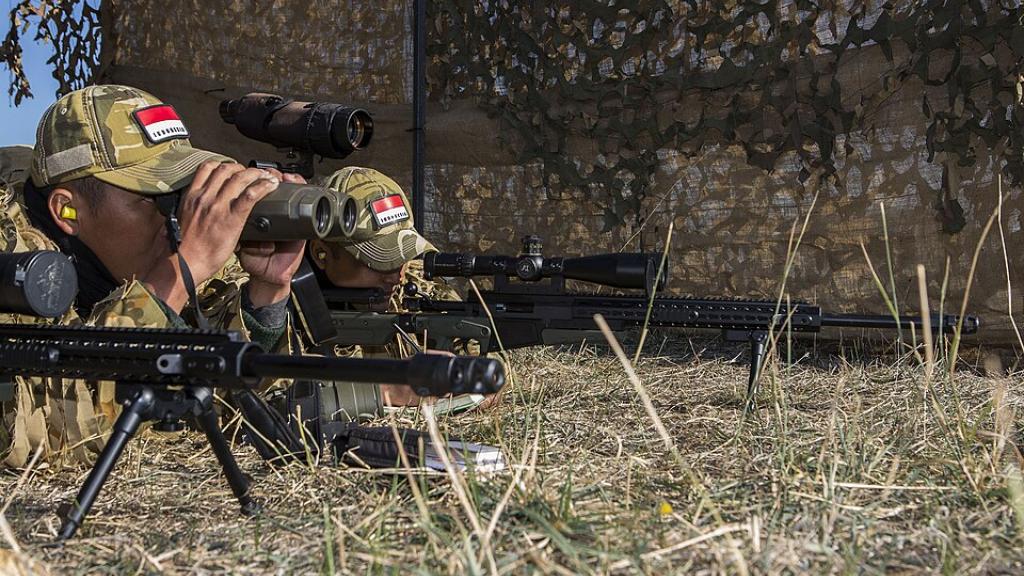
During the 32 years of the New Order military rule, Indonesia was rebuilt as a dependent economy: cheap labour, raw materials and assembly industries putting together components designed by other countries. The military became the tool for protecting all capitalists, armed or unarmed, from their own people. It guarded the mines, plantations and factories.
In 1998, students and youth toppled the Soeharto dictatorship through mass mobilisation. That was a real victory. But power merely shifted from one bourgeois faction to another. The military maintained its territorial command, businesses and impunity. The ban on Marxism and Leninism remains in place to this day.
The lesson is clear: a bourgeoisie too weak to rule by consent will rule by the gun. A movement without an independent organisation and its own party can replace a government but cannot replace the ruling class. That is what happened in 1965, and repeated in 1998, albeit in a different form.
Today, the armed capitalist faction holds the presidency. Prabowo Subianto is a former New Order Kopassus commander, involved in the 1998 activist kidnappings. His power is increasingly and openly military in nature.
Militarism in Indonesia is not a checklist of human rights violations. It is a system of capital accumulation propped up by weapons. Three tendencies mark this system:
- The military has moved into the state and economy — The March 2025 revision of the TNI Law expanded the ministries and agencies open to active soldiers from 10 to 14. New territorial battalions are being built. Barracks have been transformed into offices and businesses;
- Wealth is being centralised and guarded through violence — On September 22, the parliament passed the Agrarian Reform Regulation Law without a single faction rejecting it. Forestry concessions covering 40 million hectares remain untouched. Peasants defending their cultivated land are instead threatened with four years in prison; and
- The more the regime fails to meet the needs of the people, the more it rules through violence — Wages are lagging behind prices rises, but the answer to protests has been arrests. After the August 2025 Resistance, more than 5000 people were detained and branded as anarchists and criminals.
West Papua
West Papua is where this system appears most visibly. West Papua is also the most concrete proof that the democratic revolution in Indonesia remains unfinished.
West Papua was annexed in 1969 through the Act of Free Choice. Slightly more than 1000 state appointed representatives voted under military pressure. Two years earlier Freeport had signed its contract with the Indonesian state. Land for capital, troops to secure it and indigenous peoples treated as obstacles. What the armed capitalists do in West Papua is what they want to do everywhere.
Military operations have escalated this year. Human Rights Monitor recorded more than 125,931 people expelled from their villages as of June 30. From April to June security forces killed 26 civilians and injured 37 others. Armed drones are deployed over settlements in Puncak and Intan Jaya.
Our position takes Vladimir Lenin’s stance as our starting point. The oppressed nation has the right to self-determination, up to and including secession. Workers from the oppressed nation and the oppressor nation must unite on a class basis, not split into opposing nationalisms.
The people of West Papua have the right to determine their own future, including independence. For Indonesian revolutionaries, defending that right is an obligation. A socialist movement in Indonesia that dares not say this is not an internationalist movement; it is merely nationalism dressed in red.
Indonesia’s position towards the United States and China must be understood based on the facts.
On February 19, the Donald Trump and Prabowo administrations finalised a reciprocal trade agreement. US tariffs on Indonesian goods were set at 19%. In exchange, Indonesia removed tariff barriers on more than 99% of US goods and lifted export restrictions on all industrial commodities to the US, including critical minerals.
At the same time, Freeport signed a memorandum of understanding to extend the Grasberg mining permit in West Papua.
Meanwhile, in August, Chinese Foreign Minister Wang Yi came to Jakarta to open a new strategic dialogue.
Prabowo is not being attacked by US imperialism for being close to China. What he is doing is managing Indonesia’s position within the imperialist system. A dependent capitalist state bargains between camps for the best terms for its own capital. The land and mines of West Papua are its bargaining chips.
Prabowo is not an anti-imperialist. Pressure from Washington does not make a government progressive. We oppose US militarism in this region. That never means, however, defending Prabowo, from his involvement in the 1998 kidnappings to the use of armed drones in Intan Jaya today.
Growing resistance
Anger towards this system is real and growing. The August 2025 and June 2026 Resistance waves prove it. But large labour and student organisations still operate within a reformist horizon. They ask for better terms from the state. They do not attempt to replace it.
There is not yet a revolutionary party strong enough to lead this resistance to seize power. The still small revolutionary forces are working to build it.
Indonesia still has unfinished democratic tasks: freedom of organisation, land for the tillers, the military out of politics and economy with the territorial command dissolved, justice for the 1965 and 1998 victims, and the right of West Papua to determine its own fate.
The capitalist class will not resolve these. It lives off the non-resolution of those tasks. Armed capitalists hold power because the territorial command still stands. Concessions are secure because land is never distributed. Freeport mines Grasberg because West Papua was never given the right to choose.
Only the working class and oppressed people, organised and holding their own power, are capable of completing those tasks. Once working people hold power they will not stop at democracy. In Indonesia, the democratic struggle is the path to socialism.
Australia’s relationship with Indonesia
Internationalism has concrete demands, including for the movement in our neighbouring imperialist country: Australia.
On February 6, Prime Minister Anthony Albanese and Prabowo signed the Australia and Indonesia Joint Security Treaty in Jakarta. Australia will support the construction of joint military training facilities in Indonesia. A senior Indonesian officer will be embedded within the Australian Defence Force.
During the same visit, Canberra signed a memorandum of understanding with Danantara, the sovereign wealth fund directly responsible to the president.
This relationship has a history. In 1979, Australia became the only Western country to grant legal recognition to the annexation of East Timor. In 1995, then PM Paul Keating signed a security pact with Soeharto.
Australian capital wants Indonesian workers, West Papuan natural wealth and control over the sea lanes. Indonesian armed capitalists want training, weapons and legitimacy. That is basis of the alliance — it is a partnership of two ruling classes.
But Australia also has another history. In September 1945, a few weeks after the proclamation of independence, Indonesian sailors in Brisbane disembarked from Dutch ships transporting troops and weapons to recapture their former colony. They had already built their own Indonesian Independence Committee.
They then asked for the support of Australian workers — and Australian workers answered their call. Waterside workers refused to load ships. The boycott spread to Sydney, Melbourne and Fremantle, and across more than thirty unions. Over four years, 559 ships were blockaded. The event is known as the Black Armada.
During the New Order era, trade union and movement activists, together with Indonesian exiles in Australia, built campaigns for East Timor, for the 1965 victims and for the pro-democracy movement — and the Partai Rakyat Demokratik (PRD, People’s Democratic Party) especially — when the Australian government chose silence.
Solidarity
How do we build solidarity today?
First, the metric: In Australia, solidarity for Palestine has become a mass movement, while solidarity with Indonesia and West Papua remains small. But the size of the movement should not be the key metric.
The Palestinian movement is huge today because it was built over decades, during which time it was small. The principle that brings the masses to the streets for Palestine — the right of oppressed people to determine their own future — is the exact same principle when it comes to West Papua. Our metric is the objective need of the struggle of the oppressed nation.
What the struggles in Indonesia and West Papua need from Australia is clear: sever the alliance that arms the generals. That task cannot be executed by anyone except the Australian working class.
Second, who organises: The lesson of 1945 is incredibly clear. Indonesians organised themselves first in their own committees and then asked for Australian workers to support them. Independence was won by the Indonesian people, with Australian workers standing beside them — not replacing them.
That is the model of the Solidarity Committee for Rakyat Indonesia and Papua (SCRIP). This committee unites Indonesian, West Papuan and Australian organisations and individuals in Australia as equal members. It does not wait for a strike wave to begin working. The 1945 sailors did not wait either. Solidarity is the method to prepare that wave.
Third, address our solidarity: Workers do not fight as isolated individuals. They fight through organisations: unions, committees and parties.
Movements anywhere are never monochromatic. In Indonesia and among the diaspora there are many groups with different orientations. Some demand a more democratic and polite regime. Some work through research, advocacy or human rights campaigns. All of those have a place. Broad solidarity with the people of Indonesia and West Papua remains vital and must be constantly built.
But broad solidarity is not enough. It must be accompanied by concrete support for organisations fighting to fundamentally change the structural situation in Indonesia and West Papua: destroy militarism, return land to the people, recognise the right of West Papua to self-determination and bring the working class to power. The metric is not how many people are in a group; the metric is what it fights for, as well as its program, practice and track record under repression.
Lenin formulated this as a condition in the Draft Theses for the Second Congress of the Communist International in 1920. All Communist parties, he wrote, must render direct aid to the revolutionary movements among the dependent and subject nations and in the colonies. Without this condition the recognition of their right to secede is nothing but a false signboard. The Black Armada itself was built this way: Indonesian committees working with Australian trade unions, organisation working with organisation.
Fourth, educate and agitate: Solidarity does not grow from ignorance. The Australian mainstream media rarely reports on Indonesia, and almost never on West Papua. Most people do not know their government just signed a military treaty with a former Kopassus commander. They also do not know that hundreds of thousands of West Papuans live under military operations.
Therefore, educational and propaganda work is primary, not supplementary. Public discussions, leaflets, newspapers, posters and social media must bring the history and current situation of Indonesia and West Papua to campuses, trade unions and the streets. The people in Australia must know what their government is doing the moment it happens.
Anti-militarism
Anti-militarism is at the centre of our demands. Militarism is the backbone of this regime. Through militarism, the armed capitalists seize land, break strikes, imprison students and wage war in West Papua. In Indonesia, the demands are clear: return the military to the barracks, dissolve the territorial command, withdraw troops from West Papua.
In Australia, the pressure point is Canberra’s support. Every training course, every joint exercise, every embedded officer strengthens the regime’s backbone. This is not neutral aid to a neighbour; it is support for the class that shoots demonstrators and bombs West Papuan villages. The exact same military build up is also preparing Australia for its own war in this region.
From this objective basis arise demands that can be fought for in Australia and raised with trade unions:
- Stop all Australian military and police cooperation with Indonesia, cancel the military provisions of the 2026 Treaty;
- No weapons and military equipment for the TNI and POLRI (Indonesian National Police);
- Withdraw all troops from West Papua, open West Papua to humanitarian aid and journalists, recognise West Papua’s right to self-determination; and
- Free all political prisoners, stop the criminalisation and terrorising of activists.
The fourth demand is not merely a humanitarian issue. Following the August 2025 Resistance, hundreds were arrested; many among them are now political prisoners. Social media posts and books on shelves can be used as evidence.
In West Papua, the arrest of activists has long been part of military operations. The assassination of Munir Said Thalib in 2004 proved that this state is capable of murdering human rights defenders without a single general facing punishment.
Wherever they are, Indonesian and West Papuan activists face criminalisation, terror and threats to their lives. Protection will not come from the state that oppresses them. It can only come from collective power, both domestic and international. Every criminalisation and terror tactic must be exposed to the public and fought back collectively.
Indonesian history teaches us that a weak bourgeoisie rules by the gun. West Papua teaches us that a revolution leaving national oppression intact has not won.
The Indonesian and Australian ruling classes now sit inside the same treaty. Our answer must be the same on both sides of the ocean: unity of the working class and students. The West Papuan, Indonesian and Australian people are strong enough to break the alliance, marching toward independent working class power.
Dare to struggle, dare to win! Merdeka! Freedom!
This was a presentation delivered at the launch of the Solidarity Committee for Rakyat (the People) Indonesia and Papua-Brisbane, Australia. Dipo Negoro is a member of Perserikatan Sosialis (Socialist Union).