Friday, November 27, 2026


Data centres in space: Could SpaceX’s plans change our night sky?

27.11.2026

Photo: Patrick Pleul/dpa

US officials have authorized Elon Musk's plans to launch up to a million satellites into orbit for space-based data centres. Scientists see the project as a dangerous fantasy that could create endless space junk and destroy the night sky.

By Christoph Dernbach, dpa

Up to 1 million satellites could in future orbit Earth as a giant data centre for artificial intelligence (AI). US regulator the Federal Communications Commission (FCC) has granted Elon Musk's space company SpaceX approval for the project, called Starmind.

The idea - promising a solution to the problem of noisy terrestrial data centres that eat up resources - has been met with sharp opposition from many scientists.

What exactly has SpaceX been authorized to do?

For the first time in US history, the FCC has authorized SpaceX to build a constellation of space-based data centres. It approved up to 1 million orbital compute modules in low Earth orbit.

By comparison, only about 17,000 satellites are currently orbiting Earth in total - more than half of them already belong to SpaceX. In the space industry, however, it is common to apply initially for much higher limits to gain flexibility. SpaceX once planned 42,000 satellites for its Starlink satellite internet service; about 11,000 are currently in space.

When are the satellites supposed to be launched?

The FCC licence is valid until November 2040 and is tied to fixed milestones: SpaceX must put the first data centre satellite into operation by November 2033 at the latest. By November 2035, 10% of the approved fleet - 100,000 satellites - must be in orbit, and by November 2038, 50% (500,000 satellites).

Why does Elon Musk want to move data centres into space?

The AI boom is causing demand for computing power and energy to soar, while the construction of new data centres on Earth is increasingly running up against limits involving electricity grids, land and cooling water. The strong opposition to data centres in people's neighbourhoods has also begun to shape election outcomes, as the recent US midterms have shown.

In February, Musk merged his AI company xAI with SpaceX and made the Starmind concept a central part of SpaceX's initial public offering. The aim is to use continuously available solar energy in space without electricity costs. FCC Chairman Brendan Carr welcomed the project as a historic step towards expanding US leadership in "super intelligence."

How is the technology supposed to work in orbit?

The satellites are intended to fly close together, exchange data with one another and transmit it to Earth via the existing Starlink network. US chipmaker Nvidia is to supply specially hardened high-performance processors.

According to SpaceX, the planned scale is enormous: When unfolded, each satellite's solar arrays are to span 75 metres. At right angles to them, radiators containing coolant are to extend around 30 metres to dissipate waste heat.

What do scientists say about the project?

Researchers have voiced sharp criticism and fundamental doubts about its feasibility. Astrophysicist and author Adam Becker called the prospect of launching 1 million satellites into space for data centres a "fantasy" on the social media platform Bluesky.

"Data centers in space at scale aren't happening for many, many reasons," Becker writes.

He points to fundamental physical obstacles, particularly with cooling: Although space is cold, the vacuum traps heat inside objects - much like a thermos - meaning it would be difficult for a data center to shed its heat.

Although many smaller satellites could theoretically combine enough cooling surface area, this would be extremely expensive and technically difficult. The chips would also have to withstand high levels of cosmic radiation and micrometeorites.

What impact could it have on the night sky?

Thousands of data centres orbiting Earth would be visible to the naked eye, even outshining many stars, the UK Royal Astronomical Society (RAS) said in a previous statement, citing brightness estimates.

"The stars above us are a valued part of human heritage – deploying more than one million exceptionally bright satellites would utterly destroy this and permanently scar the natural landscape," Dr Robert Massey, deputy executive director at the RAS, said.

The latest plans from the tech mogul's space company come as aerospace rival Reflect Orbital has proposed sending 50,000 mirrors into space to reflect sunlight and provide night-time solar power.

Endeavours like these could make the night sky "three to four times brighter," with each beam of satellites likely to be "four times brighter than the full Moon" the RAS warned in March.

The RAS has been joined by the International Astronomical Union and the European Southern Observatory in formally opposing the proposals.

The American Astronomical Society (AAS) said it was "disheartened and dismayed" by the FCC's ruling, warning that it threatened the "ability of astronomers and the public to enjoy and study the night sky."

What risks do experts see for the environment?

Becker warns of considerable risks to Earth and near-Earth space, since frequent rocket launches and subsequent satellite re-entries would pollute the atmosphere.

There is also a risk of a chain reaction of space junk collisions in low Earth orbit, where countless weather and telecommunications satellites are also stationed.

The question of disposal has not been conclusively settled either. SpaceX had applied for permission, if necessary, to leave retired satellites in graveyard orbits or send them towards the sun rather than allowing them to burn up. The FCC initially deferred that decision due to insufficient information.

Are other companies also working on data centres in space?

Yes. The race to process data in orbit has long been under way. Alongside SpaceX, Google is pursuing its own plans with Project Suncatcher and has already sent the first test chips into space.

Blue Origin, the space company of Amazon founder Jeff Bezos, has also applied to the FCC for permission to operate a constellation of up to 51,600 satellites called Project Sunrise. Amazon itself, however, considers SpaceX's proposed scale unrealistic: The company estimates that building a fleet of 1 million satellites would take "centuries."


Israel's Eisenkot agrees to coalition deal with left-wing Democrats

Israel's former military chief Gadi Eisenkot on Thursday struck a coalition deal with Yair Golan's left-leaning Democrats, bringing the country's opposition closer to forming a government after no single bloc secured a majority in the October elections.


Issued on: 27/11/2026 
By: FRANCE 24

Cover image: Former military chief Gadi Eisenkot, leader of the Yashar party, arrives to speak at the Knesset, Israel's parliament in Jerusalem, November 23, 2026. © Ronen Zvulun, Reuters
01:37


The centrist party of former Israeli military chief Gadi Eisenkot, who is trying to form the next Israeli government, and an allied left-wing party on Thursday announced they had agreed on a coalition deal.

The left-leaning Democrats are the second party to agree to a coalition deal with Eisenkot's Yashar after the right-wing Israel Beiteinu party, headed by Avigdor Lieberman, did so on Tuesday, marking a further step towards forming a government.

Eisenkot has until December 6 – a deadline which can be extended by 14 days – to form a government to replace caretaker Prime Minister Benjamin Netanyahu after the October election failed to deliver a clear majority for either bloc.

"Gadi Eisenkot, chair of Yashar with Eisenkot, and Yair Golan, chair of the Democrats, have agreed to sign a coalition agreement between the two parties," a joint statement said on Thursday.

The Democrats said they would receive four ministerial portfolios as part of the coalition deal, including an expanded national security ministry which under Netanyahu's government is headed by the far-right Itamar Ben-Gvir.

The party will also receive the Ministry of Labour, Ministry of Communications, and Ministry of Culture and Sport, which will include a new directorate for democracy, the party said in a statement.

"We promised the people that we ​would replace Netanyahu and defend democracy. And that is what we will do," Golan said in ‌a post on X.

"I call on all parties to come together as soon as possible to finalise agreements and sign them, form a government, and lead Israel in a new direction. This is the mission of our lives."

Eisenkot, Lieberman and Golan have a combined total of 36 lawmakers – far short of the 61 needed for a parliamentary majority.

The bloc also includes the Beyachad party of former prime minister Naftali Bennett, which has 12 seats but is yet to sign a formal coalition agreement with Yashar.
Divided bloc

Eisenkot's wide-ranging anti-Netanyahu camp has faced divisions on whether to forge alliances with the ultra-Orthodox parties, or the Arab-majority lists, or whether to form a national unity government with Netanyahu's right-wing Likud.

The Democrats have been pushing Eisenkot for an alliance with two Arab-majority lists that achieved an unprecedented seat haul in the vote, in a bid to unseat Netanyahu.

The party disapproved of the four rounds of talks between Yashar and Likud in recent days exploring the possibility of a unity government. No breakthroughs on that front have ostensibly been reached.

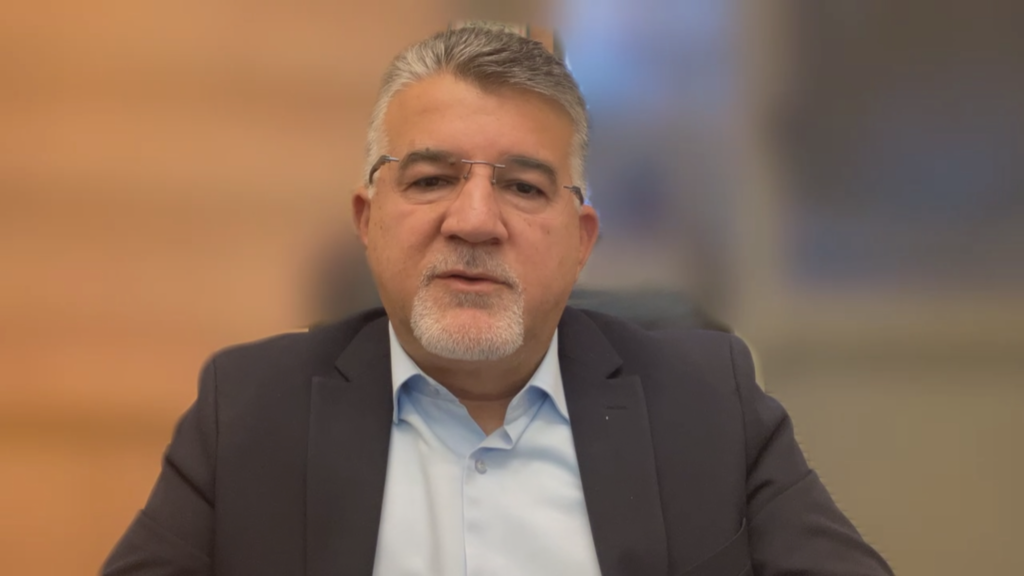
'We are ready to facilitate removal of Netanyahu': Head of Israel's Arab-majority Joint List
Cover image: Tête à Tête © FRANCE 24
11:46


Lieberman, on the other hand, has refused to serve in a government that relies on Arab-majority parties and has instead advocated an alliance with the two ultra-Orthodox parties, despite his years of criticism of the community and the fact that the issue of ultra-Orthodox military conscription remains a thorny one.

On Thursday, Lieberman warned that Netanyahu was trying to derail the government's formation.

"He will drag out negotiations over a 'unity' government until the last moment, look for a pretext to blow them up, and even if such a government is formed, he will try to engineer a crisis within a few months to drag Israel back to elections," added Lieberman, a hawkish former aide to Netanyahu who has become a strident critic.

Bennett, meanwhile, has been pushing for a unity government between Eisenkot's bloc and Likud that would exclude the ultra-Orthodox and Arab parties.

"Even at this time, I believe that by far the best alternative for the State of Israel and the serving public is a Zionist unity government led by Eisenkot first," he wrote on X, referring to a possible rotation agreement for the premiership.

(FRANCE 24 with AFP and Reuters)


Lithium Africa agrees conditional deal for control of DR Congo’s Manono West project, with Ganfeng and Glencore lined up to invest

Lithium Africa agrees conditional deal for control of DR Congo’s Manono West project, with Ganfeng and Glencore lined up to invest
/ IntelliNewsFacebook
By bne IntelliNews November 27, 2026

Lithium Africa (TSXV:LAF) has signed conditional agreements to acquire a controlling interest in Sandstone Worldwide, which holds 70% of United Cominière, the holder of the Manono West permits in the Democratic Republic of Congo, alongside a proposed investment by Ganfeng Lithium (SZSE:002460) and a $1mn investment by Glencore (LSE:GLEN), the explorer said on November 27.

Manono West comprises two permits covering about 781.6 sq km in the Manono and Malemba Nkulu territories of south-eastern DRC, adjoining the Manono-Kitotolo pegmatite district. No mineral resource has been estimated. The Lubule mine and TiTan plant on the project have produced about 94 tonnes of tin-tantalum concentrate in 2026 to date, according to the company, which said the output has not been verified by independent experts. Lithium has yet to be added as a permitted substance on the permits, according to the release’s risk disclosures.

Lithium Africa will pay about $8.15mn for newly issued shares giving it roughly 70% of Sandstone at closing, comprising $7.0mn in cash and $1.15mn through the conversion of Sandstone notes. It will then buy a further 33 Sandstone shares for $800,000 from TTX Metals, a subsidiary of Tantalex Lithium Resources, lifting its stake to about 77%. TTX Metals and investor Infra-X can also require Lithium Africa to buy their remaining Sandstone shares, for $1.7mn and $1mn respectively, within 36 months, in cash or shares.

State miner Cominière SA holds the remaining 30% of United Cominière and consented to the deal on October 12. Once United Cominière issues a non-dilutable 10% stake to the DRC state, Lithium Africa’s indirect interest in the project is expected to be about 44.1% at closing and 48.5% after the additional share purchase, and it will operate the project from closing.

Ganfeng, Lithium Africa’s 50/50 joint venture partner elsewhere in Africa and a 13.1% shareholder, has agreed in principle to invest up to $3.5mn at C$1.12 a share, subject to a definitive agreement, taking its holding to no more than 19.99%. Glencore will invest $1mn at closing, and Sandstone will assume $4.0mn of Tantalex’s debt to Glencore, which also holds a 1% gross revenue royalty on the project. Lithium Africa also plans a private placement of $5.5mn to $10.5mn, bringing total financing to between $10mn and $15mn if Ganfeng invests in full. The placement proceeds will be held in escrow and returned if the deal’s conditions are not met by May 24, 2027.

“Manono West sits a few kilometers along strike from one of the world’s largest spodumene deposits, on a trend we believe is among the most prospective places in the world for a large spodumene discovery,” said chief executive Thomas Benson.

Closing requires DRC ministerial approval of the change of control of Sandstone, the restructuring of the Sandstone notes, at least $10mn in financing and TSX Venture Exchange acceptance. Trading in Lithium Africa’s shares has been halted pending the exchange’s review. Closing is expected in the first quarter of 2027.


European investigators score a major success against money launderers

27.11.2026, 

Photo: Martin Schutt/dpa

European law-enforcement agencies have succeeded in uncovering an alleged criminal network, dealing a blow to money laundering, undeclared work and suspected organized tax evasion. 

Investigators coordinated 300 Europe-wide searches and 21 arrests in Germany, Estonia and Belgium, the authorities explained on Friday in the German city of Erfurt. Cash, luxury cars, gold, watches and jewellery were seized. 

The success was described as a major coup for the investigation team, which operated under the name Pecunia.

Dirk Löther, president of the Thuringian State Criminal Police Office, explained how several authorities in Germany and internationally worked in close coordination. "We have quite clearly broken new ground," he said. 

The investigation also involved the European Public Prosecutor's Office, customs, the tax investigation service, the German Federal Police and the German Financial Supervisory Authority (BaFin). Around 3,000 officers took part.

Löther said searches took place right across Germany, and in the state of North Rhine-Westphalia alone, one of the main focuses of the operation, there were nearly 100. 

The suspects are all male and aged between 29 and 57. 

The 21 people arrested are being held in a prison in the southern German state of Bavaria. The losses caused by the criminal activities are estimated at €18.9 million ($21 million), primarily in relation to evasion of value-added tax.


US and Europe in the WHO’s sights over the fight against measles

27.11.2026

]
Photo: Julian Stratenschulte/dpa

The World Health Organization (WHO) warned on Friday that measles could make a comeback despite a sharp decline in deaths from the disease since 2000.

In its annual measles report, the UN health agency pointed to waning immunity in the Americas and low vaccination rates in parts of Europe.

The WHO recorded 59 major measles outbreaks worldwide last year. It estimated that 9.8 million people were infected, down 74% from 2000, and that 72,000 died, down 91%.

In a statement, the WHO described the fact that the US, Mexico and Bolivia have recently lost their status as measles-free countries as worrying. 

Tedros Adhanom Ghebreyesus, WHO Director-General, said "Measles does not forgive complacency. Countries that had eliminated it are now losing that status. Elimination is not a finish line. It must be defended, with two doses of vaccine for every child, everywhere."

In the US, Health Secretary Robert F Kennedy Jr. has repeatedly cast doubt on vaccinations.

The WHO also highlighted extremely low measles vaccination rates in some European countries. A WHO database shows, for example, a first-dose vaccination rate of 13% for Montenegro - well below the global average of 84%.

Bosnia and Herzegovina, North Macedonia, Serbia and Romania are also significantly below average.

Medical associations in South-Eastern Europe complain that sections of the population are refusing to have their children vaccinated out of mistrust, fuelled by misinformation. 

The associations also highlight the role of social media in spreading conspiracy theories.


Capsized diesel tanker off Ibiza to be towed to Cartagena

28.11.2026

Photo: Dietmar Hasenpusch/Hasenpusch-Photo/dpa

 The diesel tanker Med Emre, which capsized off the Spanish Mediterranean island of Ibiza, is to be towed to the port of Cartagena, Spain's Transport Ministry said on Friday. 

The vessel is carrying around 8.2 million litres of diesel, which will be pumped out before the ship is secured.

The tanker is expected to arrive on Monday. Its cargo tanks remain intact and no major fuel spill has been detected so far, Elena Delgado, head of the relevant port authority, said after a briefing with maritime rescue officials.

The 120-metre vessel ran into trouble about 50 kilometres north-west of Ibiza early on Thursday. One of the 17 crew members died and the other 16 were rescued.

The tow will be carried out at very low speed as a precaution, the ministry said. A floating barrier will be placed around the tanker before unloading begins to contain any potential fuel leaks. Delgado stressed that Cartagena was the only suitable port option because of its water depth.

Built in 2019, the Med Emre has a double hull designed to prevent fuel from escaping if its outer structure is damaged. Its cargo is also divided among several separate tanks, reducing the risk of a major spill.

The tanker, which sails under the Maltese flag and is owned by a Turkish shipowner, was travelling from Algeciras to Barcelona. Authorities said the cause of the accident would be established through a full investigation.


Reports: Tesla plans to buy German manufacturing systems supplier EMAG

27.11.2026,

Photo: Patrick Pleul/dpa

Tesla has submitted plans to acquire German manufacturing systems supplier EMAG, according to a filing with Germany's antitrust authority, as reported by multiple media outlets including business newspaper Handelsblatt, broadcaster SWR and business magazine Wirtschaftswoche.

Headquartered near Stuttgart, EMAG manufactures machinery used to produce drive systems for humanoid robots. The company also supplies components for the emerging humanoid robotics sector, making the proposed acquisition potentially relevant to Tesla's robotics ambitions.

Details of the planned transaction, including its value and terms, were not immediately available, the reports on Friday noted.


Canada’s top court largely upholds Quebec religious symbols ban

27.11.2026

Photo: Patrick Pleul/dpa

Canada's Supreme Court on Friday largely upheld a Quebec law barring teachers, police officers and prosecutors from wearing religious symbols such as headscarves, turbans, kippahs and crosses at work.

The ruling exempts members of Quebec's National Assembly from the ban, which concerns public sector workers.

Quebec passed the law in 2019, invoking a provision of the Canadian Constitution known as the "notwithstanding clause." The legal loophole allows governments to temporarily override certain constitutional rights.

The Supreme Court ruled that Quebec had lawfully invoked the clause. It did not decide whether the ban itself violates constitutional rights.

Critics say the law, which sets Quebec apart from other Canadian provinces, discriminates against religious minorities, particularly Muslim women.


Convicted German satirist vows to keep making art criticizing Putin

27.11.2026

\
Photo: Federico Gambarini/dpa

German artist and satirist Jacques Tilly plans to keep creating works that are critical of Russian President Vladimir Putin at future Carnival events, despite having been convicted by a Russian court, he said on Friday ahead of an exhibition.

"We will, of course, continue to build floats critical of Russia and Putin," Tilly told dpa as a new exhibition of his work opens in Bonn. 

Parts of Germany celebrate Carnival with parades with some floats making fun of figures in power. Tilly makes large sculptures for the wagons and has created sculptures mocking Putin, slamming the Kremlin's war on Ukraine and criticizing Russian Orthodox Patriarch Kirill.

Earlier this year, a Russian court found Tilly guilty of offending religious feelings and spreading false information about the Russian armed forces through his displays in traditional Carnival parades in Dusseldorf. 

The Moscow court sentenced Tilly in absentia to eight and a half years' imprisonment in a labour camp. 

But Tilly told dpa he is still determined to continue his work. 

"I feel neither intimidated nor do I feel compelled to be afraid," he said. "Because that is, after all, the goal they want to achieve: that we are all somehow trembling here before Putin's power - and of course we cannot allow them to succeed in that."

The art museum in Bonn has now created a special exhibition dedicated to the satirist, called "Resistance on Parade," which is due to run until March 14, 2027.

The Kunstmuseum Bonn show features photographs, sketches and replicas of Tilly's themed floats, as almost all the originals were destroyed after the Carnival parades, in line with tradition. One exception is a float element from a work called "Putin's Bloodbath" (2022).


Russians now drink less than Germans as alcohol consumption falls by almost a third

Russians now drink less than Germans as alcohol consumption falls by almost a third
The average Russian adult drank 10.4 litres of pure alcohol in 2024, below Germany, France and Poland, as two decades of state curbs and changing tastes broke the vodka habit. / bne IntelliNewsFacebook
By Ben Aris in Berlin November 27, 2026

Russians, famous for their love of vodka, now drink less alcohol than Germans, Poles and the French, World Health Organization (WHO) estimates show.

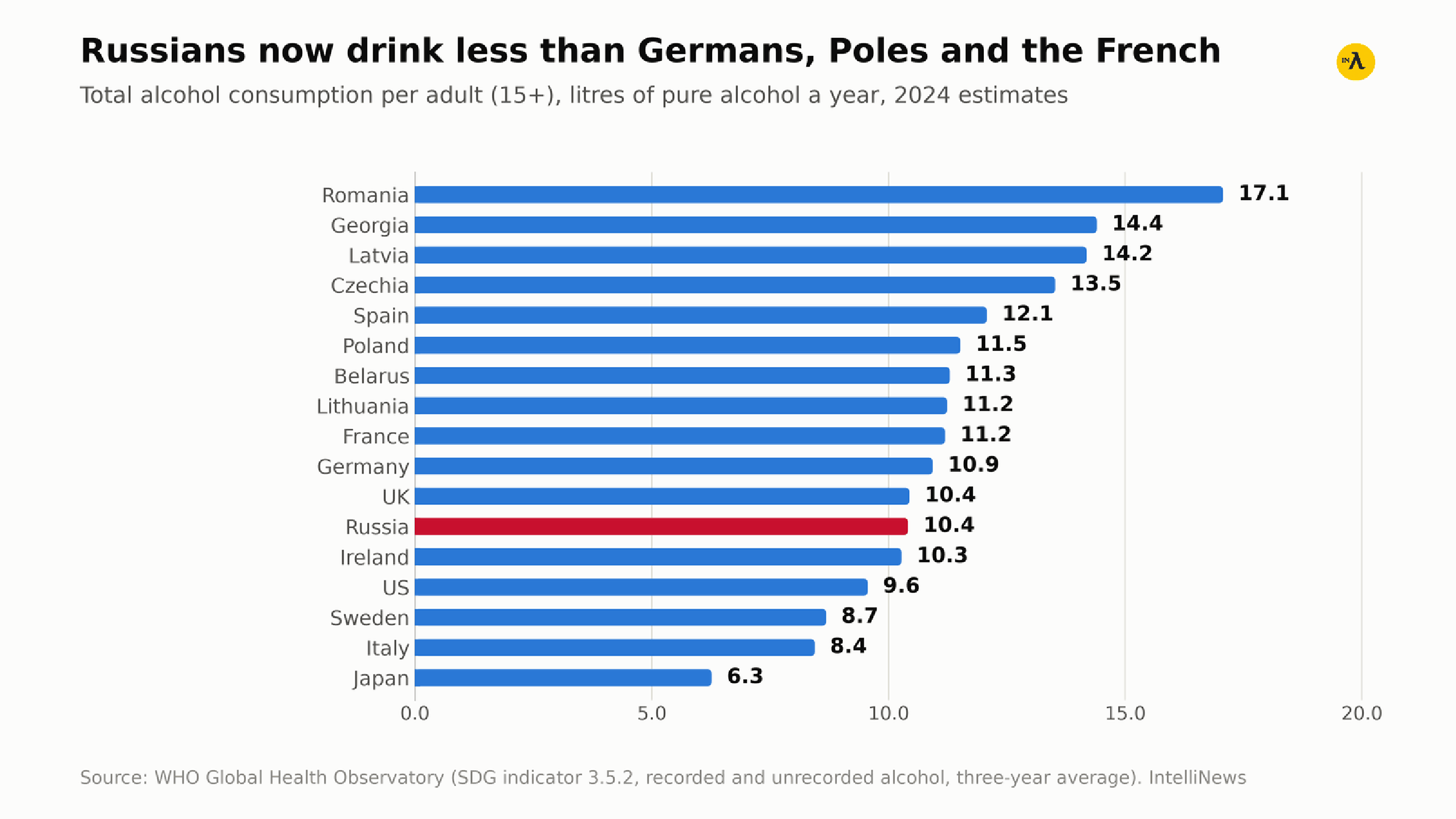
The average Russian adult drank 10.4 litres of pure alcohol in 2024, against 10.9 litres in Germany, 11.2 litres in France and 11.5 litres in Poland, according to the WHO's Global Health Observatory, which counts both recorded sales and home-made, smuggled and other unrecorded drink. That puts Russia 22nd of the 51 countries in the WHO's European region.

The comparison went round social media after the X account UBERSOY posted a chart of WHO figures on November 26 under the line "Russia cut its drinking by 43% in 13 years". The WHO's own data bear out its main point and overturn one of the most durable stereotypes about the country. Two decades ago Russia was among the heaviest-drinking nations in the world, and alcohol was a main driver of the mortality crisis among Russian men that followed the collapse of the Soviet Union.

The 43% comes from a 2019 WHO Europe report on the effects of alcohol control on mortality and life expectancy in Russia. It found that total consumption per head fell by 43% between 2003 and 2016, with recorded consumption down 40% and unrecorded alcohol, "produced and sold outside governmental control", down 48%. Over 2003-2018 all-cause mortality fell by 39% among men and 36% among women, and life expectancy reached a then record of almost 68 years for men and 78 for women in 2018.

The WHO put the fall down to policy: the government raised excise duties step by step, introduced a minimum price for vodka in 2003 and later extended it to other drinks, built a real-time system to track the production and sale of every bottle, and banned shop sales of alcohol at night across the country.

The WHO's current database, which revises its earlier estimates, shows a smaller but still steep decline. Russian consumption per adult peaked at 15.3 litres in 2007 and has fallen by almost a third since. Germany's has come down far more slowly, from 13.4 litres in 2000 to 10.9 litres, and Russian consumption fell below Germany's in 2016.

Total alcohol consumption per adult (15+), litres of pure alcohol a year, 2024 estimates. Source: WHO Global Health Observatory (SDG indicator 3.5.2). IntelliNews

Litres of pure alcohol per adult (15+)2000200320072010201620182024
Russia14.314.815.314.411.410.310.4
Germany13.413.012.512.011.811.710.9

Source: WHO Global Health Observatory, SDG indicator 3.5.2 (recorded plus unrecorded consumption, three-year average). IntelliNews

The old Russian pattern was the weekend binge, and it killed. A study of Moscow death certificates for 1993-1995, published in the Journal of Epidemiology and Community Health in 1998, found significant rises in deaths from alcohol poisoning, accidents, violence and heart disease on Saturdays, Sundays and Mondays, most marked for sudden deaths. A later study of 151,000 adults in the Siberian cities of Barnaul, Biysk and Tomsk, published in The Lancet in 2014, found that male smokers who reported drinking three or more bottles of vodka a week ran a 35% risk of dying between the ages of 35 and 54, against 16% for those who drank less than a bottle.

Vodka has lost its grip. Russians drank 215mn decalitres of it in 2000 and less than half that by 2021, and the fall has not stopped: retail vodka sales slipped a further 0.7% y/y to 59.8mn decalitres in the first ten months of 2026, while sparkling wine and cider gained. As long ago as 2017, 39% of Russians said they did not drink at all, up from a quarter in 2009, according to the state pollster VTsIOM.

On its own measure the health ministry says consumption per head halved from 18 litres in 2009 to 8.8 litres in 2020, and the government wants it down to 7.8 litres by 2030, with a ban on discounted alcohol and tighter curbs on home distilling among the measures in the pipeline.

The heaviest drinkers in Europe are now elsewhere. Romania tops the WHO's European table at 17.1 litres per adult, well ahead of Georgia at 14.4 litres and Latvia at 14.2 litres. Czechia comes fifth at 13.5 litres, just behind Portugal, and its people remain the world's biggest beer drinkers: Czechs drank 148.8 litres of beer a head in 2024, the 32nd year in a row they have topped Kirin Holdings' annual ranking.

Czechs are not Europe's heaviest smokers, though. WHO estimates put the share of Czech adults who smoked at 28.8% in 2022, 18th of 50 countries in the region and far behind Serbia and North Macedonia at 39.6% and Bulgaria at 39.1%. The figure was 25.6% in Russia and 22.8% in Germany.

This article was produced with the help of the IntelliNews Lambda analytical tool