Showing posts sorted by relevance for query RESIDENTIAL SCHOOLS. Sort by date Show all posts

Thursday, January 20, 2022

DID THE CANADIAN GOVERNMENT BUILD SCHOOLS TO MURDER CHILDREN?

THE WRONGS DONE AT INDIAN RESIDENTIAL SCHOOLS SHOULD BE ACKNOWLEDGED, BUT WHAT WE’RE TOLD BY THE MAINSTREAM MEDIA SEEMS INTENDED LESS TO INFORM THAN TO PROMOTE A PARTICULAR IDEOLOGY. THE GOVERNMENT SEEMS HAPPY TO SUPPORT SLANTED REPRESENTATIONS OF REALITY TO ADVANCE PROGRESSIVE CAUSES.

Lloyd Hawkeye Robertson 
December 15, 2021

I first learned of the Bryce Report in a doctoral dissertation about the Anglican Church’s involvement with Indian Residential Schools (Woods, 2012). The Report (Bryce, 1907) outlined tragic health conditions faced by indigenous students, and its publication resulted in the Anglican Church’s Canadian Synod recommending that the schools be closed. So when the Globe and Mail ran a commemorative story on Dr. Peter Bryce (Fraser et al., 2021), I eagerly anticipated more nuggets about this fine man’s career. I was left both disappointed and concerned.

With the collapse of the buffalo and the fur trade, the chiefs who were signatories of the treaties with Canada realized that a modern education was essential to survive in the new economy. The promise of education is included in every treaty they signed.

Bryce was a medical officer with the federal government who in 1907 reported that the 35 Indian Residential Schools he visited were often overcrowded, frequently lacked proper nutrition for students, and had substandard sanitation. He said that twenty-four percent of students who entered these residential schools died of tuberculosis before their 16th birthday – double the rate in their home communities.

This data is grim enough, but the article’s authors concluded in their first paragraph, “These effects of colonialism aren’t a dark chapter now being revealed, but rather the main plot in a narrative that defines Canada… The colonial attempts to assimilate were genocidal.” The word “genocide” refers to any attempt to eliminate a racial or ethnic group from the human gene pool, for example, by deliberately injecting people of a particular race with a lethal virus. In a later work, Bryce (1922) states that the sick aboriginal children were infected not in the schools themselves but in their home communities. Nonetheless, the authors of this memorial article accuse the federal government of criminally “turning a deaf ear” to Bryce’s report by not closing the schools. The phrase “deaf ear” implies the government of Wilfrid Laurier ignored it. In actual fact, in 1908 Frank Oliver, the Superintendent of Indian Affairs, tabled a proposal on behalf of the federal government to replace the residential schools with a system of day schools. With both the Anglican Synod and the federal government agreeing to close the Indian Residential Schools, what went wrong?

In defiance of their national synod, the Western Anglican Church joined with the Catholics, Presbyterians and Methodists lobbying to keep the residential schools open. This effort was crucially supported by such new organizations as “The Friends of the Indian and Half-Breed Population of Alberta” that included indigenous leaders. Bryce himself had not recommended the closure of these schools, just the opposite. He was concerned that school attendance in 1905-06 stood at only 52% of the school age population and he recommended that more Indian residential boarding schools be built.

He (Bryce, 1907) said that school attendance had been dropping since 1901 because :
the distance between the schools and the reserves made travel between them difficult
school staff were often poorly trained

pupils had little opportunity for practical success after graduation

the number of pupils at any given school was dependent on the abilities of principals to recruit students

Indian Agents frequently failed to support the schools, and

parents generally disliked having their children so far from home.

The authors of the Globe article offered another unsupported assertion with, “The Christian churches operated these schools for profit and their model supported the genocidal efforts of the federal government” (Fraser et al., 2021, para 6). In fact, no churches made a profit off these schools and some years the Anglican Synod spent half of its national revenue to subsidize them (Woods, 2012).

It is possible that the Globe and Mail authors were unaware of the 1907 attempt to close the schools, but one wonders why important points such as these contained in the Bryce Report were ignored by the scholars commemorating his legacy.

With the collapse of the buffalo and the fur trade, the chiefs who were signatories of the treaties with Canada realized that a modern education was essential to survive in the new economy. The promise of education is included in every treaty they signed. But residential schools were not the only solution. In 1910, after petitioning the federal government, Little Pine reserve in Saskatchewan got its own day school. Reverend Stan Cuthand later recalled, “Our parents had never had schools before, but they wanted us to learn English. When the school was built, there was so much cooperation between everyone that everyone on the reserve sent their kids there” (Donnelly, 1998, p. 7).

Schools on-reserve where children went home after each school day were not unique to Little Pine. According to the Bryce Report, during the1905-06 school year, 694 students attended 74 such day schools. By way of comparison, 1,739 attended 38 boarding schools; and, 693 students were in 8 industrial schools. The boarding and industrial schools are generally grouped together as “Indian Residential Schools” in today’s parlance, but historically the industrial schools were meant to pay for their operating costs through student labour while the boarding schools were dependent on a government per capita grant under a program that began in 1898. Bryce recommended the use of boarding schools because they were closer to reserves than industrial schools and the principals were generally more closely in touch with the parents. Day schools, he opined, generally offered lower quality education.

The authors of the Globe article offered another unsupported assertion with, “The Christian churches operated these schools for profit and their model supported the genocidal efforts of the federal government” (Fraser et al., 2021, para 6). In fact, no churches made a profit off these schools and some years the Anglican Synod spent half of its national revenue to subsidize them (Woods, 2012). In the initial deal brokered with the federal government, the churches would pay the operating costs of schools if the government paid the capital costs. The churches planned to pay for these costs through industrial activity such as farming, ranching, fishing or logging, with the students learning skills they could later use after graduation. When it became clear that these “industrial schools” would never become financially self-sufficient, the government began paying the per capita grant. The boarding schools were dependent on this grant and church donations, with the resulting financial incentive to accept any student, no matter how diseased. As I stated in my article on Residential School Syndrome (Robertson, 2006), the motivation of the churches was not financial but religious – they were in the business of saving souls.

The debates about the merits of different types of schools continued into the modern era. For example, despite having a new day school in their community by the 1970s, half the parents in Stanley Mission continued to send their children to the Indian Residential School in Prince Albert, Saskatchewan, some 240 kilometres distant. In the 1980s, I co-authored a paper (Robertson and Redman, 1988) to transfer the educational function of the Qu’Appelle Indian Residential School to a board made up of chiefs and councillors. Indian Residential Schools had been closed in most of the rest of Canada by 1969, but in Saskatchewan the schools remained open at the request of indigenous people, with boards consisting of chiefs and counsellors responsible for the physical plant and the Department of Indian Affairs responsible for instruction. In preparation for our report, we asked the chiefs why they wanted to keep these schools open. They told us that the quality of education was higher than was generally found in band day schools because the concentration of larger numbers of students allowed for better programming, including sports. In addition, they said, the residential schools were a place to send children from dysfunctional families.

During my forty years as a practicing psychologist, I have heard from clients who viewed their own residential schools as safe havens from their families. This child welfare function was underscored when I gave psycho-educational assessments to forty children at the Prince Albert Indian Residential School in 1999. It had officially closed as a residential school three years earlier, but was still open as a child welfare institution with the same staff and program.

During my forty years as a practicing psychologist, I have heard from clients who viewed their own residential schools as safe havens from their families.

We all abhor the conditions in which many aboriginal children were malnourished, beaten and sexually molested in residential schools, but conditions in these schools varied with time and place. For example, although tuberculosis was epidemic during Peter Bryce’s time, he found three schools where no children had died. He said the principals in these schools used modern methods including proper ventilation to combat the disease. That fact, neglected in the Globe and Mail article, is more damning of the government of the day than the generalization given because it shows the government could have done more. But was this genocide?

A problem with reducing history to a single political narrative and making the facts fit that narrative is that we then lose the lessons that history can teach. I knew Rev. Cuthand personally both as a child when visiting his reserve and as an adult at the Saskatchewan Indian Federated College. He reversed the usual stereotype by pushing education first and religion second. The education he commended included the technologies of mind that flowed from the European Enlightenment. It is those technologies of mind that drove the scientific, commercial and industrial revolutions, and he wanted aboriginal people to be part of that. Bryce agreed. By the time he wrote The Story of a National Disgrace (Bryce, 1922), the Indian Act had been amended making school attendance for children age 7 to 17 compulsory, but the federal government still had not forced the schools to implement the medical practices necessary to successfully combat tuberculosis.

Bryce’s recommendations in his new tract were that:
more Indian Residential Schools be built of the boarding school variety
the government take control of the administration of these schools
the school curricula used should be that of the provinces, and
the health of students should be guarded by proper medical inspections.

He was accusing the government of negligence, not genocide.

Both Bryce and Cuthand were arguing that aboriginal children should receive an education that was based on science and reason. In The Medicine Wheel Revisited (Robertson, 2021a), I suggest that while Enlightenment technologies transcend culture, they are tied to Europe through a process of historical descent. Each culture can better appropriate technologies by linking them to their own cultural antecedents. The Indian Residential Schools were not equipped to accomplish this, but cultures aboriginal to North America have the capacity to make such appropriations today. Leaving out facts that are inconvenient to a political narrative will not help us achieve this goal.


A problem with reducing history to a single political narrative and making the facts fit that narrative is that we then lose the lessons that history can teach.

While it is possible that Fraser, Logan and Oxford were ignorant of the history of indigenous schooling leading up to the Bryce report, they have no excuse for distorting the words that are actually in the report. Their stated purpose as outlined in the first paragraph of their article was to outline “the main plot in a narrative that defines Canada….” The main plot of Wokism, a political ideology that combines aspects of social justice, postmodernism, Marxism, and Fascism, without being true to any (Coughlin and Higgins, 2019; Pluckrose and Lindsay, 2020; Robertson, 2021b) is to undermine Western civilization and the Enlightenment concepts of science, reason, and humanism upon which that civilization is based. This is not what educational pioneers like Bryce and Cuthand fought for.

It was disappointing that the Globe and Mail chose to deny their readers the broader view by refusing to run an earlier version of this rebuttal. Even more disturbing is the federal government’s involvement in the construction of this Woke-friendly narrative. Two of the authors of the originating article (Fraser and Oxford) list their professional affiliation as “Defining Moments Canada,” a new federally funded organization whose website declares their purpose is to “model innovative commemorative digital methods to engage young Canadians with their history.” From this article it would appear this engagement is skewed in a political direction.


Bryce, P. H. (1907) Report on the Indian Residential Schools of Manitoba and the North West Territories. Ottawa
Bryce, P. H. (1922) The Story of a National Disgrace. James Hope & Sons.
Coughlin, S. and R. Higgins, R. (2019) Re-remembering the Mis-Remembered Left: The Left’s strategy and tactics to transform America. Unconstrained Analytics.
Donnelly, P. (1998) Scapegoating the Indian residential schools. Alberta Report, 25(6), 6-12.
Fraser, C., T. Logan, and N. Orford (2021, July 17). A doctor’s century-old warning on residential schools can help find justice for Canada’s crimes. Globe and Mail. https://www.theglobeandmail.com/opinion/article-a-doctors-century-old-warning-on-residential-schools-can-help-find/
Pluckrose, H. and J. Lindsay (2020) Cynical Theories: How activist scholarship made everything about race, gender, and identity and why this harms everybody. Pitchstone Publishing.
Robertson, L.H. (2006) The residential school experience: Syndrome or historic trauma. Pimatisiwin: A Journal of Aboriginal and Indigenous Community Health, 4(1), 1-28.
Robertson, L.H. (2021a) The Medicine Wheel Revisited: Reflections on indigenization in counseling and education. SAGE Open, 11(2), 1-11. https://doi.org/10.1177/21582440211015202
Robertson, L.H. (2021b) Year of the Virus: Understanding the contagion effects of Wokism. In-sight, 26(B). Retrieved March 1, from https://in-sightjournal.com/2021/02/22/wokism/
Robertson, L. H., & Redman, P. (1988). A Comprehensive Review of Educational Programs and Support Services of the Qu’Appelle Indian Residential School. Regina, SK: Qu’Appelle Indian Residential School
Woods, E.T. (2012) The Anglican Church of Canada and the Indian Residential Schools: A Meaning-Centred Analysis of the Long Road to Apology. London School of Economics and Political Science, London.


AUTHOR: LLOYD HAWKEYE ROBERTSON
Dr. Lloyd Hawkeye Robertson is President of the New Enlightenment Project: A Canadian Humanist Initiative. During his career he has been Director of Life Skills for the Saskatchewan Indian Federated College; Director of Health and Social Development for the Federation of Saskatchewan Indian Nations; Director of Mental Health for Northern Saskatchewan; Coordinator of Training and Program Development for Child and Family Services, Lac La Ronge Indian Band; and president of the Kikinahk Indian and Metis Friendship Centre. His book, The Evolved Self: Mapping an understanding of who we are, was published by the University of Ottawa Press.


Tuesday, February 23, 2021

CANADA

Egerton Ryerson: Racist philosophy of residential schools also shaped public education

Hunter Knight, PhD Candidate, Social Justice Education, Ontario Institute for Studies in Education, University of Toronto 


Conservative leader Erin O'Toole issued a public apology in December: “I said that the residential school system was intended to try and ‘provide education.’ It was not. The system was intended to remove children from the influence of their homes, families, traditions and cultures.” He was referring to comments he made in a meeting with a Conservative club at Ryerson University, where he defended Egerton Ryerson in response to substantial debate and protest surrounding Ryerson’s legacy.© THE CANADIAN PRESS/Carlos Osorio Black Lives Matter protesters threw pink paint on a statue of Egerton Ryerson at Ryerson University in Toronto on July 18, 2020.

O'Toole’s apology gives us an opportunity to think about Ryerson’s understanding of education and the purposes of schooling in a settler colonial society. As critics rightly noted, it is true that the primary objectives of residential schools were not to educate children. It is also true that these institutions were part of Ryerson’s broader conception of schooling as key to what he foresaw as the evolution of Canada into a “civilized” white and culturally British nation.

Ryerson designed a model for residential schools that was influential in shaping a system that amounted to cultural genocide. He is also credited for founding public schooling in Ontario.

These developments were not contradictory. As writer and cultural theorist Sylvia Wynter notes, western educational systems are inextricable from colonialism. The development of both residential schools and public schooling are the organic outcome of Ryerson’s educational philosophy.
Dramatic social shift

Schooling existed in a variety of forms in what would become Ontario before the middle of the 19th century, but the rise of mass public education in the latter half of the century marked a dramatic social shift.

As chief superintendent of schools in Canada West starting in 1844, Ryerson presided over this shift. He either wrote or directed many foundational educational laws over the next 30 years.

Ryerson promoted the development of mass public education by saying state-run schools were where every child belonged. The Common Schools Act, with the term “common” supposedly meaning universal, was passed in 1846. But the movement of “universal” education did not give rise to equality of opportunity in schooling.

What followed were proposals or legislation pertaining to the exclusion of at least four constructed categories of children.

In 1847, the Department of Indian Affairs asked for Ryerson’s suggestions for a model for industrial schools for Indigenous children. His recommendations would influence the development of residential schools throughout Canada.

In 1850, under the same act that established separate schools for Catholics and Protestants, he legislated separate schools for Black children. Black families were soon forced into separate schools even when they wished to attend common schools.

Read more: Black History: How racism in Ontario schools today is connected to a history of segregation

In 1862, he outlined plans for schools for the “vagrant and neglected” children of the poor. His plans describe many of the characteristics of what later developed as industrial schools, designed to divert working class children from an imagined future as criminals.

In 1868, he published a report on recommendations for schools for deaf or blind children.

These separate schooling systems had a long-reaching legacy. The last residential school in Canada was open until 1996. Segregated schools for Black students existed in Ontario until 1965. Industrial schools were phased out in the 1930s.

Today, racism in mainstream schooling is an ongoing urgent problem as is school equity or inclusion for Black, Indigenous, low-income and disabled people
© (Community Archives of Belleville and Hastings County/Flickr) A photograph of Common School No. 2 in Belleville, Ont., around 1900.

Project of national development

Before he passed any major legislation, Ryerson’s first initiative in his tenure was a report that served as a basis for the Common Schools Act of 1846. It illuminates the philosophy behind Ryerson’s vision.

Ryerson set up the project of schooling as one of national development. This vision was understood in deeply colonial, racialized and hierarchical terms. He wrote:


“We should judge, not by what has been, or is, but what ought to be, and what must be, if we are not to be distanced by other countries in the race of civilization.”

Public schooling was understood as a venue through which children could do necessary work for their country’s “forward development.”

The framework for development here was as an extension of Enlightenment European philosophies of the world and humanity, which were posited as universal while being structured by ideologies of pseudo-scientific racism and evolutionary thought. As Wynter explains, these philosophies emerged amidst efforts to rationalize and justify colonial practices and transatlantic slavery.

Through this lens, advocates of colonial expansion argued that individual humans and races of people progressively develop from irrational, malleable subjects towards higher rationality and advanced scientific capabilities. As such, the state is an ultimate reflection of how advanced, or “civilized,” its people are. In this pseudo-scientific evolutionary philosophy, the “rational, advanced, civilized” subjects who deserve more power — and are justified in inflicting colonial rule, violence and genocide on others — are white European men.
© (Government of Ontario Art Collection, AC622107/Archives of Ontario) The Rev. Dr. Adolphus Egerton Ryerson, DD, LL D (Chief Superintendent of Education, Canada West, Ont., 1844-76), portrait ca. 1850-51 by Theophile Hamel.

Justifying colonial violence, hierarchies


For Ryerson, creating a framework for public schooling and also for residential schools was part of the same project of furthering Canada’s development. The differentiated schooling he proposed was intended to serve those explicit aims, and the contrast in schooling methods and what Ryerson advocated (or did not advocate) for is stark.

Ryerson described education in common schools as a “charming passage,” in which students were inspired towards lifelong learning and growth.

In contrast, for industrial schools for Indigenous children, the model which the residential school system emerged from, Ryerson argued that “a state of civilization” could only be achieved with eight to 12 hours a day of heavy agricultural labour, starting at the age of four. He mused there would likely be little time for academics.

Read more: Residential school literature can teach the colonial present and imagine better futures

For deaf and/or blind children, he believed that only an intensive focus on manual trades would be able to combat what he saw as their natural idleness.

For segregated schools for Black students, he refused to support Black parents and advocates when school boards (that answered to him) denied them adequate funds, arguing he had no power to help.

And he suggested that industrial schools for “vagrant and neglected children” be structured similarly to prisons.

Ryerson’s legacy is rightly criticized for his role in creating the model for residential schools. How Canadians choose to memorialize him and understand the systems he developed has wide-ranging implications.

Let’s not ignore how the same racist and colonial philosophy behind residential schools was also foundational to mainstream public education.

This article is republished from The Conversation under a Creative Commons license. Read the original article.

Hunter Knight receives funding from the Social Sciences and Humanities Research Council of Canada.

Friday, November 25, 2022

'Witnesses to history': University makes 3D virtual replicas of residential schools


CALGARY — A new project from the University of Calgary is creating 3D digital records of some Alberta residential schools.

'Witnesses to history': University makes 3D virtual replicas of residential schools
© Provided by The Canadian Press

The Taylor Family Digital Library, in consultation with Indigenous communities in Alberta, has created accurate virtual and physical models of three former residential schools with plans for more in the future.

Prof. Peter Dawson, the project's leader, said it is important to preserve a dark part of Canada's history.

"Why preserve these buildings that are associated with so much tragedy and human trauma? It's for precisely that reason that we are working with (three groups) to preserve these schools. Because these schools really are witnesses to history and sites of conscience," said Dawson, head of the university's Department of Anthropology and Archaeology.

"They're the physical manifestation of an education system, in name only, that caused great harm and suffering to generations of Indigenous children."

An estimated 150,000 Indigenous children were forced to attend residential schools in Canada over a century. The Truth and Reconciliation Commission has detailed mistreatment at the schools, including emotional, physical and sexual abuse of children.

With the use of lidar technology and original building plans, three dimensional images of the Old Sun Indian Residential School at Siksika Nation, east of Calgary, Blue Quills school in St. Paul, Alta., and Poundmaker's Lodge Carriage House, which once formed part of the Edmonton Indian Residential School in St. Albert, Alta., have been created.

Stories from residential school survivors are to be embedded into each virtual replica.

"The sad reality is that many, many people don't know about this history. I thought it was important to preserve it digitally because the young people, as they heard more and more about the residential schools, were angry," said Vivian Ayoungman, 75, who spent nine years the at Old Sun school.

Related video: 'Brings to Light': exhibit on legacy of the residential school system opens in Winnipeg    Duration 3:25    View on Watch

"I thought we've really got to do some work. We can't be part of erasing our own history. We have to have the evidence. We want to preserve that building so that people know that it wasn't a figment of our imagination. That it really happened to us."

Ayoungman eventually became a teacher and now works at a community college located in the old residential school building where she attended as a child.

"We have really painful memories of those times when it was a residential school," she said.

"I got strapped for speaking my language at a very young age. I entered that school not speaking a word of English."

Ayoungman said those who survived residential schools are getting older, and having a digital record will ensure their history survives.

"There's no danger of it being forgotten. It's preserved how forever long digitization lasts," she said.

Her nephew Kent Ayoungman, 42, said both his parents and grandparents attended residential schools and he had no idea what they went through.

"Growing up, they never talked about their experiences, what they went through. So we didn't really know," he said.

"Who wants to hear about what they went through when they were in those places? It just changed the life of our people. We need to talk about it. Our people need to hear these stories of what they went through."

The project is entering a second phase, which is to digitally document the original grounds surrounding the three residential schools — a landscape that included hockey rinks, athletic grounds, gardens, and barns — to provide a more complete account of daily life at the schools.

The scans are eventually to be archived at each former school and the National Centre for Truth and Reconciliation.

This report by The Canadian Press was first published Nov. 24, 2022.

Bill Graveland, The Canadian Press

Friday, July 23, 2021

TEHRAN, Jul. 17 (MNA) – Questioning Trudeau's silence, Caesar-Chavannes says that residential schools were designed to eliminate indigenous culture, not just for land, but also for the belief that their culture was inferior to that of the Europeans.

Since May 28, more than 1,000 unmarked children's graves and remains have been identified at former Indigenous residential boarding schools in Canada. In addition to the Penelakut Island graves, unmarked burials at three more locations were detected by First Nations communities between May and July, using ground-penetrating radar scans at sites in British Columbia and Saskatchewan.

For almost 150 years in Canada — from 1863 to as recently as 1998 — more than 130 residential schools such as Kamloops, Marieval, St. Eugene's and Kuper Island were funded by the Canadian government, and until 1969 many of the schools were operated by Christian churches. These schools forcibly separated Indigenous children from their families and isolated them from their communities and cultures, according to Indigenous Foundations, a website for the First Nations Studies Program at the University of British Columbia.

The children were abused, malnourished and raped in these schools, and 3,200 indigenous children were reportedly killed in these schools.

Many Indigenous peoples blame the residential boarding schools that have played a major role in the lives of generations in Canada for social problems such as alcoholism, domestic violence and high suicide rates.

In 2008, Ottawa formally apologized to the survivors of those who had spent the residential boarding schools. The country's Truth and Reconciliation Commission in 2015 said they were victims of "cultural genocide."

To shed light on the issue, we reached out to Celina R. Caesar-Chavannes, a Canadian politician and former Member of Parliament for the riding of Whitby in the House of Commons of Canada from 2015 to 2019. 

Residential schools designed to eliminate indigenous culture
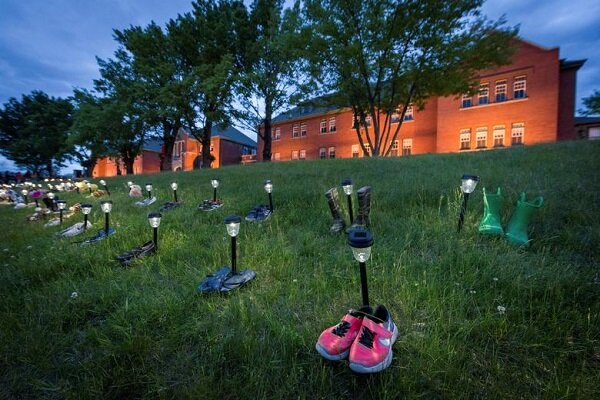
Pairs of children's shoes are seen at a memorial in front of the former Kamloops Indian Residential School in Kamloops, British Columbia, Canada, May 31, 2021

Following is the text of the interview with her:

According to reports and assessments, one of the aims of Canada with establishing residential schools is said to be the elimination of the indigenous culture in order to make more land and resources available to settlers. What is your take on this?

The removal of native people from their land, source of energy and livelihood for the perpetuation of the idea of “white supremacy”There is no doubt that residential schools were designed to eliminate Indigenous culture, not just for land, but also for the belief that their culture was inferior to that of the European settlers on the land. It is the entire foundation on which colonialism is built. The removal of native people from their land, source of energy and livelihood for the perpetuation of the idea of “white supremacy”. This removal manifests in the form of genocide, sexual and gender-based violence, disease, enslavement, control (the Indian Act, in place since 1876, still governs First Nations, Metis and Inuit in Canada) and elimination of any trace of identity (residential schools in Canada or the renaming of enslaved people). Additionally, Treaties with Indigenous people were made in good faith, but broken in every encounter. 

Despite all the recent findings and earlier investigations, Canada has never charged any individual or institution with the crime against humanity or war crimes. What does this inaction imply? 

It is a cover-up of the highest order. These schools are not ancient history. Many survivors, who suffered through them, as well as the perpetrators, are still alive. Our government and the Catholic Church’s inaction demonstrates a lack of respect and value that is placed on the lives of Indigenous children. The Trudeau government has consistently said that their relationship with Indigenous people “is the most important relationship”. If this is the case, why is there no accountability?

Residential schools designed to eliminate indigenous culture
The paddle song is performed during a vigil in Vancouver, British Columbia, Canada June 2, 2021

Some say the International Criminal Court should investigate the residential schools’ case. How far this case can go internationally? 

My hope is that the international criminal court will not be necessary – that the actors who participated in this, will own up to their roles and seek reconciliation with Indigenous communitiesThat is a very good question. My hope is that the international criminal court will not be necessary – that the actors who participated in this, will own up to their roles and seek reconciliation with Indigenous communities. The Truth and Reconciliation Commissions 94 Calls to Action outlined very specific steps that were required to build a relationship with Indigenous people. It is up to Canada to follow the calls related to 1) legacy which includes child welfare, education, language and culture, health and justice and 2) reconciliation which includes the adoption of UNDRIP, a royal proclamation and covenant of reconciliation, equity in the legal system (Indigenous and Black people make up the highest percentages of people in prisons in Canada - see https://www.theglobeandmail.com/canada/article-investigation-racial-bias-in-canadian-prison-risk-assessments/), a National Council for Reconciliation, professional development and training for public servants, sport, business and media reconciliation, commemoration, information for newcomers to Canada, museums and archives review, youth programs, an apology from the Church and missing children and burial information. The final report from the Commission was made public in 2015. Canada should ensure every call to action is honoured. 

What are Vatican’s responsibilities regarding the case? 

It begins with an apology to Indigenous communities for the Church’s role in the residential school system. Then full disclosure of all documents and materials pertinent to an investigation – should one be launched. The Church should also conduct its own internal investigation and hold accountable those individuals who played a role in these atrocities. Most importantly the Vatican should “establish permanent funding to Indigenous people. All of these requests are listed in Call to Action numbers 58-61.

Interview by Zahra Mirzafarjouyan

News Code 176211

Sunday, July 18, 2021

TORIES IN MANITOBA DUMB DOWN CURRICULUM CLOSE SCHOOL BOARDS
'Everybody else needs this education': Rally held against residential schools and Bill 64


Mike ArsenaultVideojournalist
@MArsenaultCTV Contact
Published Saturday, July 17, 2021 


WINNIPEG -- Close to 100 people gathered on the front steps of the Manitoba Legislative Building to protest against inaccuracies on residential school history and Bill 64.

The rally was planned after the new Minister of Indigenous Affairs, Alan Lagimodiere said in a Thursday press conference that the architects of residential schools thought they were doing the right thing.

Organizer of the rally and school teacher, Michael Kirkness said the topic of residential schools needs to be a bigger focus in the Manitoba curriculum.


“If I had it my way, for one (the history of residential schools) wouldn’t be something that is like an anecdote within the curriculum of social studies, it needs to be something that is mandatory,” said Kirkness.

Kirkness believes Lagimodiere’s comments about residential schools represent a failure of the Manitoba education system.

In light of those comments, he’s concerned about how much authority Bill 64 will give the PC government as it relates to education.

“There has to be some kind of understanding between Indigenous and non-Indigenous people, and that revolves around education.”

Thursday, NDP Leader Wab Kinew interrupted Lagimodiere’s comments and corrected him regarding the history of residential schools.

Kinew said we have to call those comments out, and spoke about the need for education and understanding.

“Unless we have a true understanding of the situation, we’re not going to be able to move forward,” said Kinew. “If we have an MLA who does not understand the truth of residential schools, it’s going to be very hard to have a minister who can advance reconciliation.”

Lagimodiere has since apologized for his comments.

One of the many attendees at the rally was Wayne Stranger.

He was a teacher in the province, and said he saw a lack of representation for Indigenous people in the curriculum.

“What I saw in those 10 years was a lot of biases still in the system. About who we are as a people, where we come from, what our knowledge base was and is today.”

In a statement to CTV News, Minister of Education, Cliff Cullen said in part:

“Providing Indigenous Traditional Knowledge and teachings to all students remains our priority with a stronger presence and value on Indigenous knowledge and perspectives. Our Better Education Starts Today strategy commits to supporting reconciliation by enhancing all educators and students’ understanding of the Treaties, residential schools and Indigenous people’s past and present contributions.”

One commitment outlined in the Our Better Education Starts Today strategy is to increase the presence of Indigenous perspectives in the K to 12 curriculum.

Kirkness said most Indigenous people know about residential schools, but it’s something that all Canadians should know about.

“(Indigenous people) know full well about what happened, and what continues to transpire as a result of that," said Kirkness. "Everybody else needs this education. All the children that are in our system need to understand this.”

Manitoba officials' latest comments example of why Bill 64 should be scrapped, protesters say

Proposed bill would see elected school boards dissolved, replaced with appointed education authority

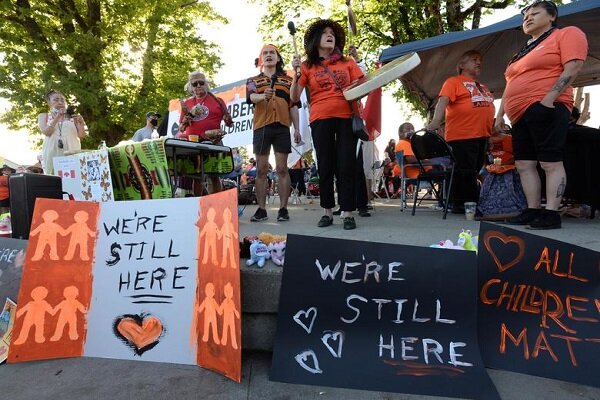
Dozens of people are pictured on the steps of the Manitoba legislative building on Saturday, many wearing either a red shirt to protest Bill 64 or an orange one in memory of children who died at residential schools. (Justin Fraser/CBC)

People who gathered in front of Manitoba's legislative building on Saturday say recent comments from the premier and the minister of Indigenous reconciliation about colonization and residential schools were "an attempt to revise history" — and one more example, they say, of why the province's proposed education overhaul should be struck down.

That proposed legislation, known as Bill 64, would see elected school boards dissolved and replaced with a provincial education authority with people appointed by the government — something that raises concerns for Chantal Shivanna Ramraj, who teaches grades 3 and 4.

"Based on the comments of this government, we can imagine who they will appoint," Ramraj said at the "no truth, no reconciliation" rally against residential school denial and Bill 64 put on by community group Protect Ed MB.

"And we can imagine what directives they will give teachers."

Manitoba Premier Brian Pallister drew ire last week when, in response to the toppling of two statues of British queens on Canada Day, he made comments that were widely criticized as suggesting colonization was done with good intentions.

Those comments, which he later stood by, led to the resignation of his Indigenous relations minister, Eileen Clarke, who was later replaced by backbench MLA Alan Lagimodiere as the new minister of Indigenous reconciliation.

Lagimodiere immediately sparked criticism when he said the people who ran residential schools believed "they were doing the right thing" — a statement for which he issued an apology late Friday afternoon.

Chantal Shivanna Ramraj teaches grades 3 and 4 and was among the protesters on the legislative grounds on Saturday. (Justin Fraser/CBC)

High school history teacher Michael Kirkness said many educators were deeply offended by those comments.

"We feel that it's our duty to not only teach … our history properly, but make sure that the powers that be aren't rewriting history to suit their own ends," said Kirkness, who is from Fox Lake Cree Nation and is the son and grandson of residential school survivors.

He called the officials' comments "completely tone deaf" and said he thinks Pallister should step down as premier.

"It's pretty clear that they don't really have any idea as to how to tackle these issues pertaining to the legacy of residential schools," Kirkness said.

Michael Kirkness, who teaches high school students history, said educators like him feel a duty to make sure students are learning what really happened. (Justin Fraser/CBC)

Leaders 'need to self-educate'

While many at the rally were those who teach, others were there to learn.

Wanda Guenette and her friend Leora Almstrom said they've been working recently to educate themselves on the history of residential schools in Canada.

Leora Almstrom and Wanda Guenette say they've been working to learn more about Canada's history of residential schools — and they want provincial leaders to do the same. (Justin Fraser/CBC)

"We have been told lies for most of our education. And it's a bit daunting to me, because I actually at one point represented Canada," said Guenette, a retired Team Canada volleyball player.

Almstrom agreed.

"I feel, as a Métis, that I don't know enough. I am ignorant of the truth and I seek the truth. And whatever I can do to learn more, to be educated, I'm on that mission," she said.

They said they wish Manitoba's government officials would put in the same work.

"They need to self-educate. I mean, there are people here self-educating, people out there are self-educating, and our leaders are just spewing things that they think are right and it's not," Guenette said.

Fifteen-year-old Dominic Eidse said his English teacher spent time last year teaching his class about genocides.

The soon-to-be Grade 10 student said it had a huge effect on him, and he hopes those kinds of lessons — including lessons about Canada's own history — will become more common in schools.

High school student Dominic Eidse was also among those at the rally on Saturday. (Justin Fraser/CBC)

"I think it's a very important thing to know to keep it from happening again," he said.

"There were so many things that I didn't know before this year."

Cliff Cullen, Manitoba's education minister, has previously suggested changes could be made to Bill 64 over the summer. 

The legislation is expected to get a second reading in the legislature this fall before being subject to committee hearings. By the end of June, nearly 500 people had registered to speak at those hearings — the largest number on record, according to Legislative Assembly of Manitoba staff.

With files from Erin Brohman and Riley Laychuk


Saturday, July 03, 2021

How unmarked graves haunt the Indigenous community


For decades, beginning in the 1800s, thousands of Indigenous peoples from Canada were taken from their homes and families by the Canadian government, shipped thousands of miles away in some cases and placed into so-called residential schools.


The stated purpose of the schools, some of which date to the 19th century and the last of which closed in the 1990s, was assimilation -- ridding the students of ties to their communities and instilling European culture, according to the Truth and Reconciliation Commission of Canada (TRC).

There were reports from the TRC -- a commission funded by the Canadian government as part of a legal settlement to address the wrongs of the system -- of thousands of instances of abuse and mistreatment against students and many of the students did not make it back to their homes in what advocates for the Indigenous population and officials alternately term "injustice," "systemic racism" or even "genocide."

© Geoff Robins/AFP via Getty Images A family walks through a field where flags and solar lights now mark the site where human remains were discovered in unmarked graves at the former Marieval Indian Residential School site on Cowessess First Nation, Saskatchewan, June 26, 2021.

There have recently been a number of reminders of that grim past -- one which advocates say continues to haunt Indigenous communities.

Another 182 sets of human remains were found on June 30 near the former St. Eugene's Mission School for Indigenous children in the community of Aqam,, bringing the total found in the country in recent days to nearly 1,000.

A week earlier, 751 unmarked graves were found at the cemetery of the former Marieval Indian Residential School. It is unclear how many of the students died or what the causes of death were.

“It’s opened fresh wounds for a number of people,” said David Pratt, the second vice-chief of the Federation of Sovereign Indigenous Nations. FSIN is an advocacy organization that represents 74 First Nations in the implementation of treaties that protect Indigenous people and land.

© Provincial Archives of Saskatchewan via Shutterstock A historical photo from 1900 provided by the Provincial Archives of Saskatchewan shows Catholic priests with students at the St. Michael's Indian Residential School in Duck Lake, Northwest Territories, now Saskatchewan, Canada.

MORE : As Deb Haaland creates unit to investigate missing and murdered Native Americans, a look at why it's necessary

The site at Marieval has the largest number of graves connected to a residential school discovered in Canada so far, according to the National Centre for Truth and Reconciliation (NCTR), which archives and compiles the complete history of Canada's residential school system.

In a June 24 statement, Canadian Prime Minister Justin Trudeau sent his condolences to Indigenous groups across the country following the Marieval discovery.

“They are a shameful reminder of the systemic racism, discrimination, and injustice that Indigenous peoples have faced – and continue to face – in this country,” the statement read. “Together, we must acknowledge this truth, learn from our past, and walk the shared path of reconciliation, so we can build a better future.”

However, Stephanie Scott, executive director of the NCTR, said that these problems continue to harm Indigenous communities to this day.

“The residential school system has impacted generations,” Scott said. “Take action, take responsibility to learn the true history, seek out survivors and indigenous people and start that dialogue.”


What are residential schools?

What are residential schools? In a 2015 report, the NCTR said there had been 150,000 First Nation, Métis and Inuit students in the residential school system. The first schools of this kind were formed in the 1860s and lasted all the way until the final school, Gordon Indian Residential School, closed in the late 1990s.

About 139 Indian residential schools were identified in the 2006 Indian Residential School Settlement Agreement.

For decades, Indigenous children in both Canada and the United States were taken from their families and sent to boarding schools, sometimes thousands of miles away, according to the Truth and Reconciliation Commission of Canada.

Scott, who was a student in one of these schools in the 1960s, said that many students were beaten and abused for speaking their language or practicing Indigenous traditions. She said there have been reports of physical and sexual abuse, neglect, and illness.

“We've even heard stories about young girls getting pregnant and the children being born and putting into incinerators,” Scott said. “We've heard stories of children being hidden in walls. We went to the community one time where there was a caretaker’s house where we found this strap that was covered in blood.”

The official report from TRC reiterates stories of children being strapped, beaten, and forced into crawl spaces.MORE: Why Native American children have higher rates of disability

Scott said her mother got pregnant while attending the residential schools, and child welfare authorities took her away and put her in a separate residential school.

“I was adopted out yeah into a community with that forced assimilation and those policies where I didn't have access to my culture and community,” Scott said. “I grew up without my language.”

Why are there so many unmarked graves?

Many students never returned home from the schools, according to the NCTR. The NCTR reports that the deaths of more than 4,000 children have been connected to residential schools, as graves of young children continue to be uncovered -- but Scott said that there are likely more left to be found.

Researchers have been used ground-penetrating radar (GPR) to discover unmarked burials, like the St. Eugene's Mission School and the Marieval Indian Residential School.

THE NUN
© Provincial Archives of Saskatchewan via Shutterstock A historical photo from 1900 provided by the Provincial Archives of Saskatchewan shows a Roman Catholic nun with students at the St. Michael's Indian Residential School in Duck Lake, Northwest Territories, now Saskatchewan, Canada.

In May, researchers also found the remains of 215 students at the Kamloops Indian Residential School in British Columbia. Some children buried onsite had been as young as 3 years old.

The NCTR has found that many of the children died from illness and malnourishment, among other causes. Scott said she’s heard stories from old school attendees who claimed illnesses and injuries went untreated.

It is unclear how all of the children have died, and who they were.

For many, the discovery of graves is a time of grief, as many can remember the days when residential schools were still around. Pratt said the discoveries of unmarked graves bring up a lot of emotion, trauma and heartbreak for those who’ve been lost and called on the Canadian government and the Roman Catholic Church to help.

“They need to apologize and they need to take responsibility and ownership on the trauma and the chaos they've caused amongst indigenous peoples of this land,” Pratt said.

Who has taken responsibility for these?


The residential schools were run by the Canadian government, the department of Indian Affairs and churches, including the Roman Catholic Church at various points in their histories, which has been connected with the recent unmarked grave discoveries.

The St. Eugene's Mission School, for instance, was operated by the Roman Catholic Church from 1912 to 1970. The Marieval Indian Residential School was also run by the Church from 1899 to 1997.

The Kamloops Indian Residential School was run by the Church until the late 60s when it was taken over by the federal government.MORE: 215 bodies discovered at former residential school for Indigenous children in Canada

Pope Francis plans to meet in December with Indigenous survivors of the residential school system from the First Nations, Metis and Inuit groups.

But the Roman Catholic Church has yet to issue a statement on the discoveries. The Canadian Conference of Catholic Bishops did not respond to ABC News’ requests for comments.

According to the National Native American Boarding School Healing Coalition, the United States also had more than 350 government-funded boarding schools across the US.

In 2000, U.S. Assistant Secretary of Indian Affairs Kevin Gover apologized for the trauma and violence against children at the American residential schools.

Trudeau, in his recent statement following the discovery of the Marieval graves, said he promised to help Indigenous people in Canada heal.

“The government will continue to provide Indigenous communities across the country with the funding and resources they need to bring these terrible wrongs to light,” the statement read. “While we cannot bring back those who were lost, we can – and we will – tell the truth of these injustices, and we will forever honour their memory.”

In the largest class-action settlement in Canadian history, reached in 2007, Canada promised funding, support, and the formation of federal commissions to help the community heal. The settlement of the Indian Residential Schools Settlement Agreement was a step, activists say, but many are demanding stronger action.

High incarceration rates, poverty, addiction, trauma, and climate change have plagued Indigenous communities, and Pratt links them to the lasting effects of residential schools.

Scott agreed, saying the unmarked graves have opened up an opportunity to discuss what Indigenous communities are owed and what they continue to experience as a community. Scott said education and dialogue about these atrocities are just the first steps.

“Canada must claim responsibility for the genocide and it has to show a commitment to sharing these truths with all people in Canada,” Scott said.

Saturday, June 05, 2021

CANADA
Catholic church’s ‘lack of commitment’ to share residential school records under scrutiny


By Amanda Connolly Global News
Posted June 3, 2021 


WATCH: Canadians have been mourning the discovery of an unmarked burial site at a residential school in Kamloops, B.C.

 But Indigenous leaders and experts say the uncovering of the remains of 215 children is not an isolated incident. Emanuela Campanella has more.

Warning: Some of the details in this story may be disturbing to some readers. Discretion is advised.


The Catholic church is showing a “lack of commitment” to face up to its role in the horrors of Canada’s residential school system, according to one former Canadian senator and a residential school survivor.

Senator Murray Sinclair’s testimony before a special parliamentary committee came as calls continue to grow for church officials to open their archives to survivors and formally apologize for the schools.

Scrutiny of the church’s inaction is mounting after the horrific discovery of the remains of 215 children in unmarked burial sites at the former Kamloops Indian Residential School in B.C.

“The fact that there are still church records that have not been revealed … is also a sad commentary of the lack of commitment by the Catholic church to allow us to investigate this further. We need to have that question looked at as well,” Sinclair told the committee.


READ MORE: Residential schools — What we know about their history and how many died

Shortly before his testimony, residential school survivor Evelyn Korkmaz told journalists that the time for “crocodile tears” from governments is over, and the time has come to support Indigenous communities that have for years been pushing to explore the former school locations for unmarked burial sites.

As part of that, the Catholic church, which ran roughly 60 per cent of residential schools, must also recognize its role.

“The Catholic Church also needs to acknowledge and take ownership to repent and pay for their sins,” said Korkmaz at a press conference ahead of a House of Commons debate on an NDP motion urging the government to act.

READ MORE: Canada’s Catholic bishops have responsibility to apologize for residential schools, minister says

Martin Reiher, an assistant deputy minister with the Department of Crown-Indigenous Relations, suggested there’s no easy way to get those records from churches until they offer them up.

He said federal officials have had conversations with the churches involved in running the schools.

“As part of these discussions, they have all indicated around the table they are prepared to share the information in their archives,” he said.

“In terms of legal capacity to impose sharing, we do not have that authority.”

Residential schools were boarding schools set up by the Canadian federal government and administered by the Roman Catholic, Anglican, United, Methodist and Presbyterian churches as part of a federal policy with the goal of stripping Indigenous children of their culture and identities.

READ MORE: ‘Disgrace’ — Indigenous leaders blast Catholic Church for silence on residential schools


Sir John A. Macdonald, the first prime minister of Canada, described the intent of the schools as follows:

“When the school is on the reserve, the child lives with its parents, who are savages; he is surrounded by savages, and though he may learn to read and write his habits, and training and mode of thought are Indian. He is simply a savage who can read and write. It has been strongly pressed on myself, as the head of the Department, that Indian children should be withdrawn as much as possible from the parental influence, and the only way to do that would be to put them in central training industrial schools where they will acquire the habits and modes of thought of white men.”

ALBERTA PREMIER JASON KENNEY IS A BIG FAN 
OF SIR JOHN 'EH THE DRUNK

A total of 139 residential schools across the country have been identified in the Indian Residential School Settlement Agreement. A map of the schools can be found online.

Victims forced to attend the schools suffered horrific physical, mental and sexual abuse.

But so far, the responses from Catholic church representatives have ranged from regional apologies to a complete lack of acknowledgement of the church’s role in the system.


Richard Gagnon, president of the Canadian Conference of Catholic Bishops, expressed “sorrow” in a statement that described the discovery of the remains as “shocking.” The statement made no apology and did not acknowledge the Catholic church’s central role in the residential school system.

Archbishop Brian Dunn of the Archdiocese of Halifax-Yarmouth in Nova Scotia issued a statement that acknowledged the participation of Catholics in the residential school system and called news of the discovery of the 215 remains “absolutely heartbreaking.”

“I am conscious that this tragedy has a significant impact on all Indigenous communities, especially those here in Nova Scotia,” he said in the statement.

“As Archbishop I want to offer my prayers for these children, their families, and their communities. Acknowledging and bringing to light this dark chapter of our Catholic and Canadian history is difficult but necessary in order to be able to do and be better,” Dunn continued.

“I continue to be committed to all who have been mistreated and hurt by the residential school experience, in which Church members participated knowingly or unknowingly.”

READ MORE: No apology for Canada’s residential schools, Pope Francis says

Rev. J. Michael Miller, the current shepherd of the Roman Catholic Archdiocese of Vancouver, apologized to all First Nations governments, Indigenous communities, families and citizens for the Church’s involvement in a letter released Wednesday.

“The Church was unquestionably wrong in implementing a government colonialist policy which resulted in devastation for children, families and communities,” he said.

The Indian Residential School Survivors Society (IRSSS) last week called on Pope Francis to apologize.

He has refused to do so, despite issuing formal apologies for the “crimes” of the Catholic church in Ireland and for its “grave sins” in Latin 
America

Indigenous Services Minister Marc Miller on Wednesday said he believes the time has come for a papal apology, while Crown-Indigenous Relations Minister Carolyn Bennett said that it’s clear Indigenous people want an apology and that it’s up to Catholics to urge their church to do better.


‘Shameful’ Catholic Church hasn’t apologized
over burial sites discovered at B.C. residential school, Indigenous Services minister says

Anyone experiencing pain or distress as a result of their residential school experience can access the 24-hour, toll-free and confidential National Indian Residential School Crisis Line at 1-866-925-4419.

© 2021 Global News, a division of Corus Entertainment Inc.