Bishops get educated on Gen Z, who are ‘religious but not spiritual’
(RNS) — “It’s probably premature to say that there is a Catholic revival taking place,” the U.S. Catholic bishops were told by a panel of experts from The Catholic University of America on Nov. 18 at their annual meeting in Baltimore.
“And while we rejoice in higher numbers of conversions, we cannot help but lament the high number of people who leave the Catholic Church,” continued Aaron Weldon, the panel moderator and director of the New Wineskins project at the Catholic University of America.
According to the Pew Research Center, for every adult convert entering the church, 8.4 adults leave.
The panel was kicked off by sociologist Brandon Vaidyanathan, who, using data from a 2026 Gallup survey, laid out for the bishops how young people (18- to 29-year-olds) are expressing their religious beliefs and identities.
An encouraging finding is that about two-thirds of young Catholics say that religion has grown in importance for them in the past five years compared to 41% of older Catholics. The young Catholics also think that the people around them are becoming more religious.
Vaidyanathan cautions that this is a subjective judgment and that the Pew Research Center in a longitudinal study did not find any increased religious activity (church attendance, prayer life) in this same cohort. Increased interest in religion is not yet reflected in increased religious practice.
Young Catholics are attending church weekly at about the same rate (24% to 25%) as other Catholics but praying significantly less than older Catholics. Of young Catholics, 28% are praying daily or more compared to 48% of older Catholics.
And while the previous generation tended to identify as “spiritual but not religious,” this new generation is more likely to identify as “religious but not spiritual.” This is even more true of young Catholics, 30% of whom consider themselves “religious but not spiritual” versus only 12% for older Catholics. Only 14% of young Catholics consider themselves “spiritual but not religious.”
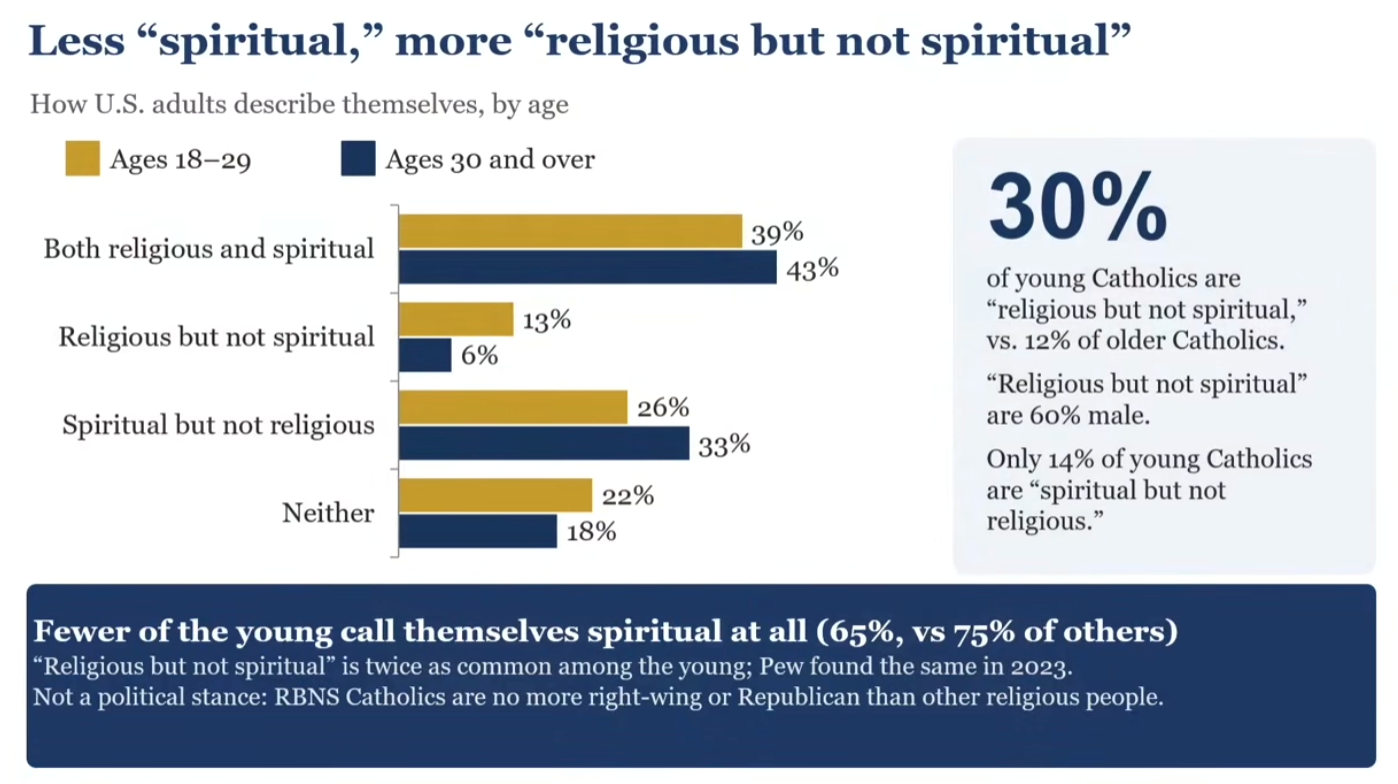
“Less ‘Spiritual,’ more ‘religious but not spiritual,'” screen grab from address of Brandon Vaidyanathan, USCCB, Nov. 18, 2026.
More than half (60%) of those who say that they are “religious but not spiritual” are men. Young men are also more likely to consider themselves neither religious nor spiritual compared to young women.
When Vaidyanathan asks his students about the term “spirituality,” they said, “That’s for my mom and her friends. They go on these yoga retreats. They’re kind of pagan, you know, they like to do these weird, woo rituals. That’s not for us.” This fits with the finding that the “spiritual but not religious” tend to be seeking a sense of inner peace and a connection with their true self rather than a connection with the divine.
Vaidyanathan notes that men and women seem to be equally religious, but that means something somewhat different for each of them. Among those who feel religion has become more important, men attend church weekly at a slightly higher rate than women. Women, on the other hand, are much more likely to pray daily (54% versus 35%).
“For men,” Vaidyanathan concludes, “religiosity has much more to do with identity, with affiliating… with attendance. And for women, it’s much more about the interior life.”
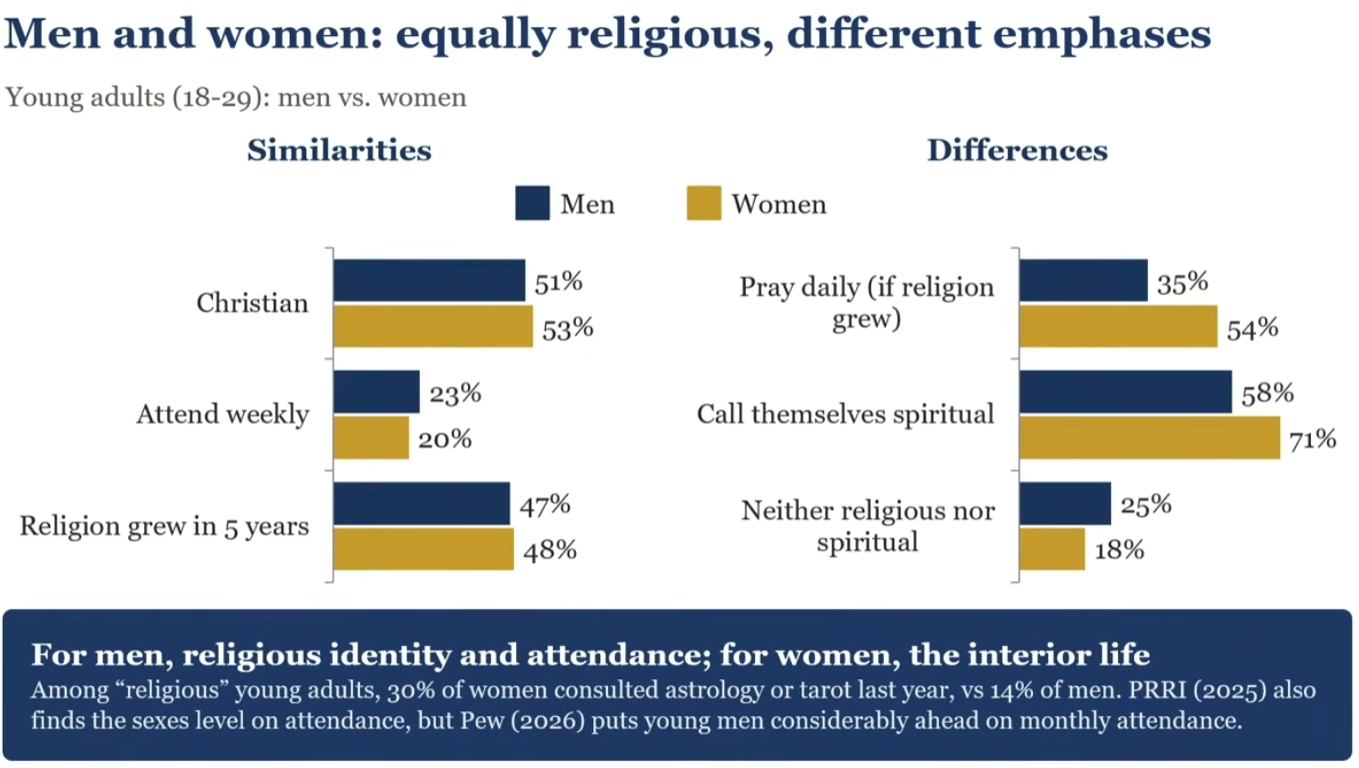
“Men and women: equally religious, different emphasis,” screen grab from address of Brandon Vaidyanathan, USCCB, Nov. 18, 2026.
His research also found that 18- to 29-year-olds are much more likely to say, compared to their older peers, that they are yearning for a connection to community and yearning for guidance to tell right from wrong. And young women are yearning more for moral guidance than young men.
And when asked what factors helped young people become more religious, the top five responses were “personal experiences or life events, religious beliefs or teachings, family or social relationships, worship, music, ritual and sacred spaces, and finding beauty in religious spaces or rituals.”
He notes that a Chicago archdiocesan study of OCIA entrants in 20 dioceses found that “it’s the sacred liturgy, prayer, ritual and sacraments that is drawing people towards the church.”
Finally, he noted that the next generation of Catholics is mostly Hispanic, but that they do not attend church as much as others.
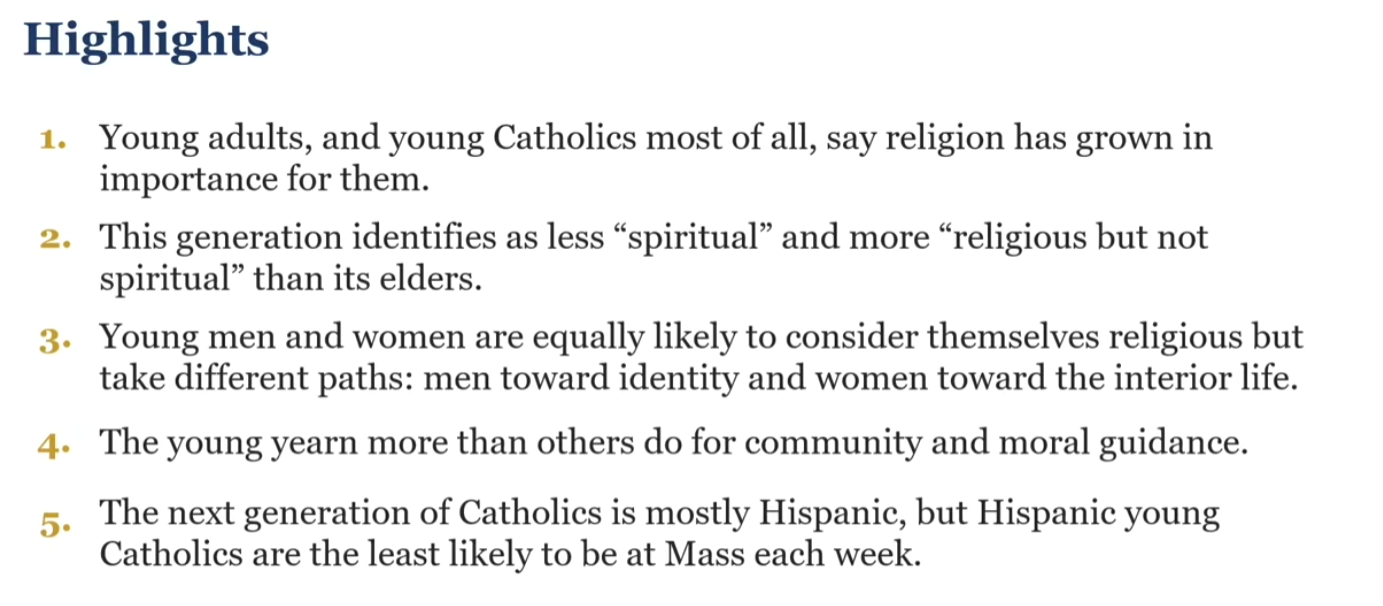
“Highlights,” screen grab from address of Brandon Vaidyanathan, USCCB, Nov. 18, 2026.
His presentation was followed by theologian Angela Franks, who put religious seeking in the context of identity and contemporary culture.
Using concepts first developed by sociologist Zygmunt Bauman, she notes that “in our contemporary moment we privilege things such as fluidity, flexibility and change. And this preference contrasts with premodern societies that valued stability, solidity.”
In premodern, solid societies, our identities are predetermined within solid social structures, whereas in liquid, modern societies, we tend to mistrust solid institutions and must make our own identities.
This can be exhausting and demoralizing, she notes, which can lead to identity politics that “provide very visible identities behind which there’s usually a group of noisy supporters for that identity. As Bauman says, it provides us with an identity suit off-the-rack as opposed to having to sew an identity for ourselves.”
But “because these tend to develop online, these identities tend to be easy to join but also easy to leave.”
“They are often very superficial,” she continues, “because, given that so much of this happens online, it relies on a very visual culture to backstop this identity.”
“Some people love this very liquid nature of identity formation because it’s wrapped up with freedom,” she notes. “Other people are deeply uncomfortable with it.”
Men are more likely than women to yearn for solidity, which “goes along with a growing sense of their being unappreciated in part because of so many traditionally male jobs being technologized and automated.”
“Against the background of our very liquid culture, Christianity looks exceptionally solid,” explains Franks. “Her dogmas are rooted in the divine person of Jesus Christ. She has traditions. She has an ecclesiastical hierarchy. She has an ordered liturgy.”
Franks concludes that this is very likely one driver in the rise of young adult conversions to Catholicism
But at its beginnings, she reminds the bishops, Christianity was a liquefying force that threatened the solid identities of the time, when what mattered was “whether you’re free or slave, you’re Roman or not Roman, you are wealthy or poor, what kind of family you belong into.” These might have been important, but “the ultimate place where we seek identity in Christianity is in God’s call to the person,” she said.
However, in modern times, when God is removed from the process of creating an identity, the church becomes the enemy of freedom, just another solid institution to rebel against.
“It is understandable,” she says, “that those who are dissatisfied with what the secular and liquid West provides would be attracted to the church.” But she warns that the church is more liquid than they think.
While Catholicism is solidly based on the person of Jesus Christ, who is the revelation of the Father, the magisterium is also guided by the Holy Spirit to work in new historical situations.
“Catholic doctrine is not a malleable language game,” she says. Nor is Catholicism “an antiquarianism which looks to just one age’s practices or language to norm us.”
“The church has a strength in flexibility or maybe a flexible strength that enables her to weather storms through history,” she concludes.
What is needed is a “delicate balance between liquidity and solidity that is, in truth, very hard for people to strike and maintain,” she says. “We tend to favor extremes.”
If in response to the contemporary identity crisis, “if people are looking simply for the most solid place to stand,” Franks warns, “they are going to be scandalized when the church proves herself to be less predictable than they were hoping.”
As a result, she says, it is important “to have more careful intellectual formation on the development of doctrine and what it means for practices to grow and change.”
But the problem is not primarily intellectual. It is an existential crisis, she believes. “People have yoked their identity to the church being a certain way.” There is a need to recognize “that my personal foundation is rooted in the triune God and therefore is rooted in his reliable personal love for me, but also that the church is divinely equipped to ride through the vicissitudes of history.”
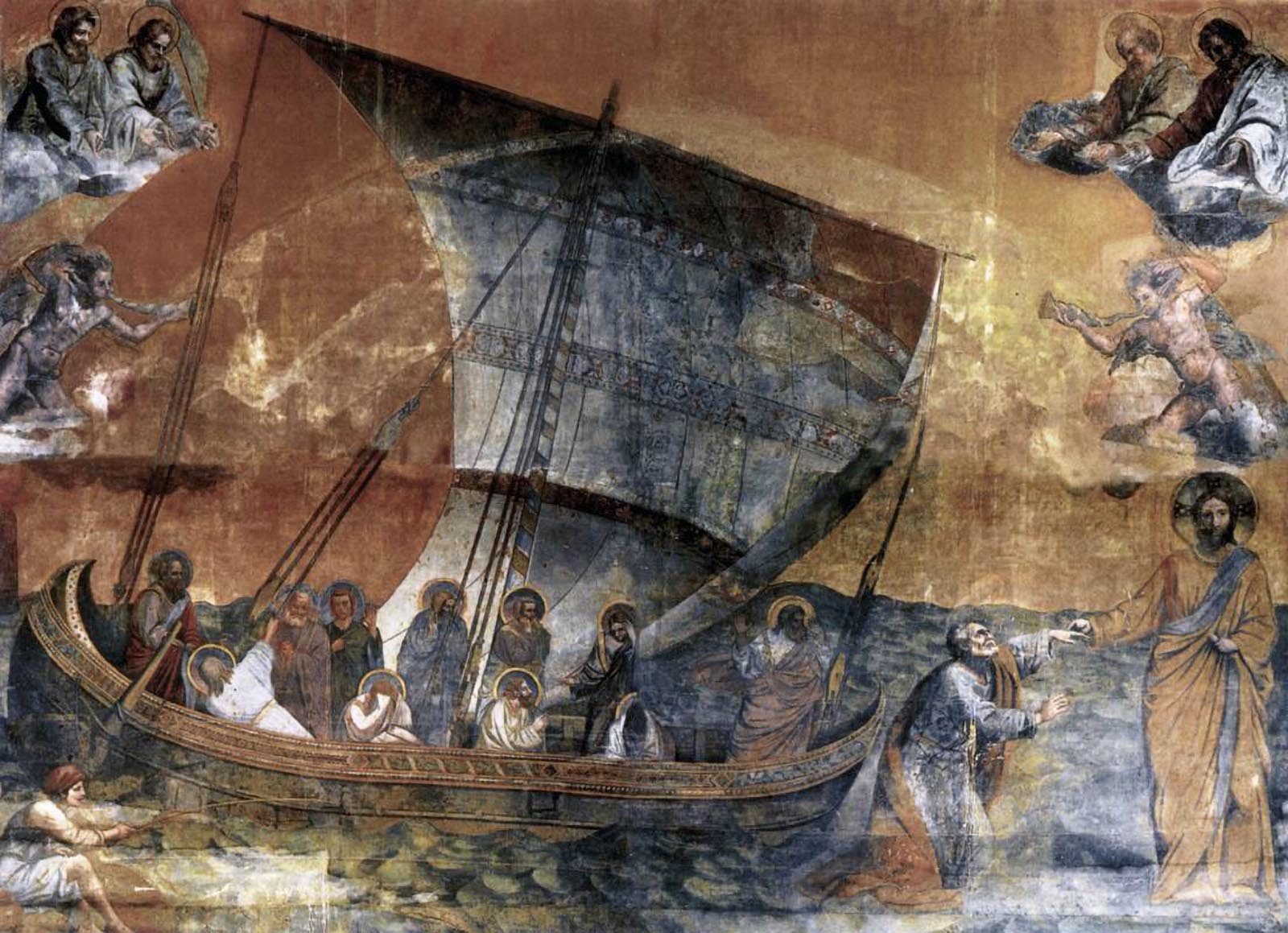
She concluded with a meditation on the “La Navicella,” a mosaic created by Giotto on the façade of old St. Peter’s in Rome in 1298 and has been reproduced by others. It shows Peter attempting to walk on water to Jesus. Here the solid boat represents the safety of the church, while Peter steps out of the boat to follow Christ into the liquid world.
Peter’s “foolish wish to follow Christ into the liquid is unfathomably granted, at least as long as he has faith in Christ,” says Franks. “This is an image of moving through the liquid world with confidence as our eyes are fixed on our Lord, who remains our solid foundation.
“There’s a temptation to want to either embrace or reject liquidity, which is a distraction,” says Franks, who believes “that we should be focused on embracing Christ and rejecting sin and in relying on him to give us the strength to move with confidence through difficult times.”
This, she believes, “is a great gift we can give to contemporary seekers, and hopefully help straighten out any possibly off-kilter priorities with the hope that they will be guided into the arms of the church.”
The panel presentations are available on YouTube beginning at 2:40.

No comments:
Post a Comment