Ukraine says hopes of 'progress toward peace' knocked by attack on aid distribution centre
Zelenskyy said the Zaporizhzhia attack showed Russia was "sending an entirely opposite signal" and that it was "counting on more killings."
Ukrainian President Volodymyr Zelenskyy said any hopes of "progress toward peace" following a localised truce last week had been dampened by deadly Russian strikes on an aid distribution centre in southeastern Ukraine.
The aerial bomb attack in the region of Zaporizhzhia killed at least 26 people, including two rescue workers and four police officers, on Monday, according to Ukraine's State Emergency Service (DSNS). Five others were also reportedly injured in the strikes.
Ivan Fedorov, the regional governor, said Russian forces had fired "at least nine KAB-3000 bombs" on the Komyshuvakha settlement throughout the day.
"All emergency services are working flat out at the scene, while municipal workers are clearing the rubble," he wrote in a post on Telegram.
Zelenskyy called it an "utterly horrific" attack, saying it had targeted "a school used for humanitarian purposes" where some people were receiving aid.
"After the first aerial bomb strike, there was a double-tap strike with nine more bombs, specifically targeting the shelter where people were taking cover," he wrote on X.
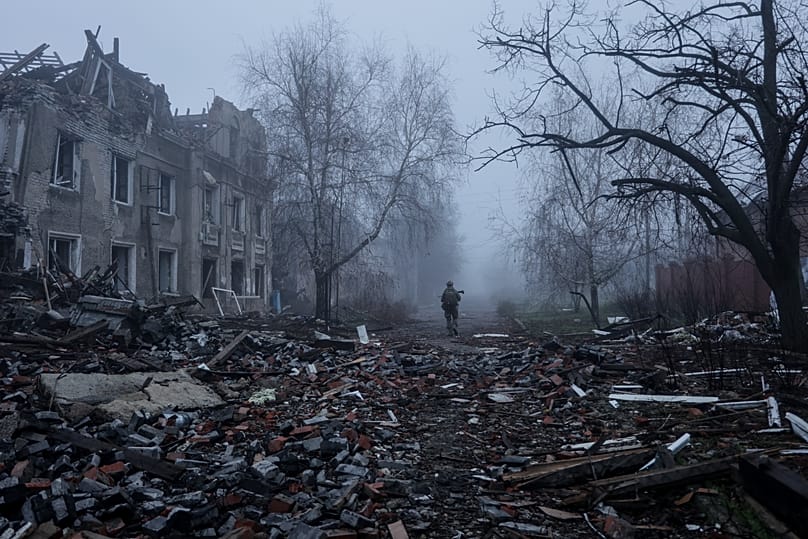
Images shared by the DSNS from the scene show a building reduced to a pile of rubble and what appears to be a burned-out bus.
Russia 'counting on more killings'
In his post, Zelenskyy said the attacks had also knocked hopes of moving closer to a peace deal.
"After the humanitarian operation in Oleshky, there was a moment when the next steps could have shown that progress toward peace was possible," he wrote. Evacuees from the Russian-occupied city of Oleshky in Ukraine's southern Kherson region arrived in Ukraine on Saturday after travelling through Belarus amid a rare humanitarian truce between Kyiv and Moscow.
But Zelenskyy said the Zaporizhzhia attack showed Russia was "sending an entirely opposite signal" and that it was "counting on more killings."
"There must be a response to this – a response from the world. A strong and tough response," he added.
Authorities in Kherson said Russia had resumed attacks on the region on Monday following a drone strike on the Korabelny district.
A 62-year-old woman and a 73-year-old man reportedly sustained blast injuries in the attack.
Thousands of troops from Europe to rehearse post-war Ukraine deployment in Poland
The force, which was set up in 2025 and already has an operational headquarters in Paris, is not a NATO operation and has little US involvement.
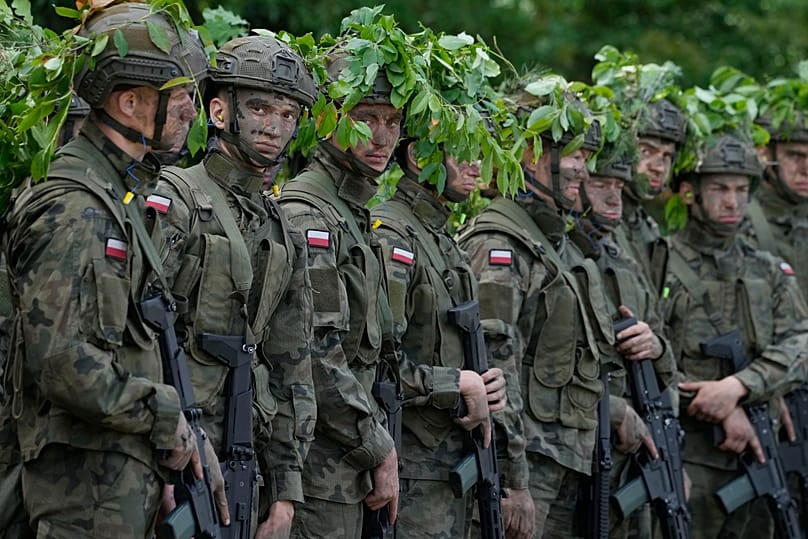
Around 2,800 troops from 10 European countries will stage the first exercise of a new multinational force in support of Ukraine in Poland later this month, London and Paris said on Tuesday.
Led by France and the UK, the Multinational Force - Ukraine (MNF-U) has no offensive mission and is only to be deployed once a ceasefire is agreed to end the war sparked by Russia's 2022 full-scale invasion.
The force, which was set up in 2025 and already has an operational headquarters in Paris, is not a NATO operation and has little US involvement.
It aims to support the Ukrainian armed forces, ensure security in Ukrainian airspace and allow economic activity to resume in the Black Sea.
But the extent and duration of the exercise, dubbed Koalicja ("Coalition" in Polish), risks antagonising Russia, with Moscow still showing little appetite to settle for peace.
"The exercise will allow the testing of the speed and efficiency at which several nations can deploy forces on land, sea and air to support Ukraine once hostilities have finished," the joint statement released by the French defence ministry said.
"This isn't a hypothetical plan, it's a real force, ready to help Ukraine once the fighting stops," UK Defence Minister Wes Streeting was quoted as saying in the UK statement.
The exercise is scheduled to last from 9-22 November in southeast Poland not far from the Ukrainian border, involving 2,800 troops.
The largest contingent of 1,100 troops will come from France, with the UK deploying 300 soldiers.
Light equipment deployed
The first exercise for the coalition force is "a key milestone, as it will serve as a concrete demonstration of the MNF-U's ability to be deployed as soon as hostilities have ended," said French General Armel Dirou, who will co-lead the exercise alongside Britain's Lieutenant General Tom Bateman.
It will involve troops from Belgium, Estonia, Germany, France, Lithuania, the Netherlands, Poland, Spain, Sweden and the UK in air and land operations around the town of Nowa Deba, some 100 kilometres west of the Ukrainian border, the joint statement said.
Meanwhile, a maritime simulation will be led by Turkey from Istanbul to test preparedness for eventual mine-clearing operations in the Black Sea. Turkish troops will not be involved in the land exercise in Poland, it added.
Bateman emphasised that the force is not a "peacekeeping or ceasefire monitoring mission".
"It is not designed for offensive operations. Its purpose is to provide reassurance and support the regeneration of Ukraine's armed forces, strengthening their ability to deter and, if necessary, defend against future Russian aggression," he said.
Nevertheless, Moscow will be watching closely as the war grinds towards its five-year milestone with neither side apparently close to a decisive breakthrough.
Dirou said that the aim of the exercise was to prepare how the mission would be deployed, overcoming the various potential logistical and cultural issues between the different countries' militaries.
"This is not a show of force. We are not going to flex our muscles," he said.
It is expected that only light equipment, such as drones, will be deployed in Poland for anti-drone and self-defence exercises, rather than heavy weaponry, and that no tanks will be deployed.
Aspects tested in the exercise will include coordination arrangements, rehearsing the movement of personnel, equipment and supplies, and assessing whether the different components can integrate and operate effectively as one multinational force, said Bateman.

No comments:
Post a Comment